EC 8451-
ELECTROMAGNETIC
FIELDS
UNIT-1 -INTRODUCTION
CONTENT
 Electromagnetic model,
 Units and constants,
 Review of vector algebra,
 Rectangular, cylindrical and spherical coordinate systems,
 Line, surface and volume integrals,
 Gradient of a scalar field,
 Divergence of a vector field,
 Divergence theorem,
 Curl of a vector field,
 Stoke's theorem,
 Null identities,
 Helmholtz's theorem
INTRODUCTION ABOUT EMF
 Electromagnetics is the study of the effect of charges at rest and charges in motion.
 Some special cases of electromagnetics:
 Electrostatics: charges at rest
 Magnetostatics: charges in steady motion (DC)
 Electromagnetic waves: waves excited by charges in time-varying motion
 Both positive and negative charges are sources of an electric field, moving charges
produce a current which gives rise to a magnetic field
 A field is a spatial distribution of a quantity; which may or may not be a function of
time
 Application field of EMF,
Atom smashers, CRO, Radar, satellite Communication, television reception, remote Sensing
ELECTROMAGNETIC MODEL
 Two approaches in the development of a scientific subject
1. Inductive (one follows the historical development of the subject, stating with the observation of some
simple experiments and inferring from them laws and theorems)
2. Deductive (postulates a fundamental relations for an idealized model)
 Building a theory on an idealized model three steps are needed,
1. Some basic quantities to the subject of study are defined
2. Rules of operation of these quantities are specified
3. Some fundamental relations are postulated
 Example: built on a circuit model of ideal sources and pure R,L,C
1. Basic quantities:V,I,R,L,C
2. Algebra, ordinary differential equation, Laplace transformation
3. KVL,KCL
 Electromagnetic model quantities has,
1. Source quantities
2. Field quantities
 Electric charge is a fundamental property of matter and exists only in positive or negative integral multiples of the
charge on an electron
e = 1.60 x 10⁻¹⁹ C
 the principle of conservation of electric charge must be satisfied at all times and under any circumstances (equation of continuity)
 Volume charge density ρ = limΔ𝑣
→0
Δ𝑞
Δ𝑣
C/m3
 Surface charge density ρs = limΔ𝑠 → 0
Δ𝑞
Δ𝑠
C/m2
 Line charge density ρl = limΔ𝑙
→0
Δ𝑞
Δ𝑙
C/m
 Current is the rate of charge with respect to time I =
𝑑𝑞
𝑑𝑡
C/s or A
 Volume current density J, which measures the amount of current flowing through a unit area normal to the direction of current flow
(A/m2)
 Surface current density Js which is the current per unit width on the conductor surface normal to the direction of current flow (A/m)
 There are 4 fundamental vector field quantities in electro magnetics
Symbols and units
for field quantities
Field quantities Symbol unit
Electric Electric field intensity E V/m
Electric flux density D C/m2
Magnetic Magnetic flux density B T
Magnetic field intensity H A/m
Units and constants
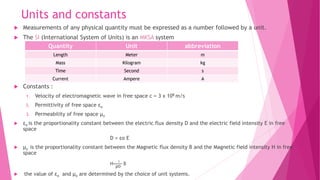
 Measurements of any physical quantity must be expressed as a number followed by a unit.
 The SI (International System of Units) is an MKSA system
 Constants :
1. Velocity of electromagnetic wave in free space c = 3 x 10⁸ m/s
2. Permittivity of free space εo
3. Permeability of free space μo
 εo is the proportionality constant between the electric flux density D and the electric field intensity E in free
space
D = εo E
 μo is the proportionality constant between the Magnetic flux density B and the Magnetic field intensity H in free
space
H=
1
μo
B
 the value of εo and μo are determined by the choice of unit systems.
Quantity Unit abbreviation
Length Meter m
Mass Kilogram kg
Time Second s
Current Ampere A
Units and constants Conti….
μo = 4π x 10-7 H/m (henry / meter)
 The relationship b/w three constants are
C=
1
μoεo
m/s
Εo =
1
C2
μo
=
1
36π
x 10-9 F/m (farad / meter)
Review of vector algebra
 A scalar is a quantity having only an amplitude
Examples: voltage, current, charge, energy, temperature
 A vector is a quantity having direction in addition to amplitude
Examples: velocity, acceleration, force
 a vector A can be written as A = aA A where A is the magnitude of A ,
A= 𝑨 and aA is a dimensionless unit vector
aA = 𝑨
𝑨
A= 𝑨
A = aAA
Fig: graphical representation of vector A
Vector Addition
 Two vectors A and B which are not in the same direction nor in opposite directions .their sum is
another vector C in the plane C= A + B can be obtained graphically in two ways.
1. By the parallelogram rule: the resultant C is the diagonal vector of the parallelogram formed by A and B
drawn from the point
2. By the head to tail rule:the head of the A connects to the tail of B.their Sum C is the vector drawn from
the tail of A to the head of B and vectors a, B and C form a triangle
 Commutative law :A + B = B + A
 Associative law :A + (B + C ) = (A + B ) + C
Vector subtraction
 Vector subtraction can be defined in terms of vector addition in the following way:
A – B = A + (-B)
 Where –B is the negative of vector B
Products of vectors
 Multiplication of vector A by positive scalar k changes the magnitude of A by k times with out changing
its direction
kA = aA (kA)
 Types of products vectors
1. Scalar or dot products
2. Vector or cross products
 Scalar or dot product : dot product of two vectors A and B denoted by A . B is a scalar which equals the
product of the magnitudes of A and B the cosine of the angle between them
A . B ≜ AB cos θAB
 Where ≜ signifies equal by definition and θAB smaller angle b/w A and B is less than π radians (180)
 The dot product of two vectors
1. is less than or equal to the product of their magnitudes
2. Can be either a positive or a negative quantity, depending on whether the angle between them is smaller or larger than π/2 radians(90)
3. is equal to the product of the magnitude of one vector and the projection of the other vector upon the first one
4. is zero when the vectors are perpendicular to each other
 A.A =A2
 commutative law : A . B = B . A
 Distributive law :A . (B + C) = A . B + A . C
 Vector or cross product : Cross product of two vectors A and B, A x B is a vector perpendicular to the
plane containing A and B. its magnitude is AB sinθAB where θAB is the smaller angle b/w A and B
A x B ≜ an 𝑨𝑩 sin 𝜽 𝑨𝑩
Where sin 𝜽 𝑨𝑩 is the height of the parallelogram formed by the vectors A and B
 B x A = - A x B (cross product is not commutative)
 A x (B + C ) = A x B + A x C (distributive )
 A x (B x C) = (A x B ) x C (associative)
 Product of three vectors: 1.scalar triple product 2. vector triple product
 1.scalar triple product A . (B x C) = B. (C x A) = C .(A x B)
 A.(B x C) = - A. (C X B) = - B. (A X C) = - C. (B X A)
 2. vector triple product : A X (B X C) = B(A.C) – C(A.B) (back-cab rule)
 Division by a vector is not defined
ORTHOGONAL COORDINATE SYSTEMS
 To determine the electric field at a certain point in space, to describe the position of the source
and the location of this point in a coordinate systems
 Three dimensional space a point an be located as the intersection of three surfaces.(u1,u2,u3-
constant)
 when these 3 surfaces are mutually perpendicular to one another its orthogonal coordinate
systems
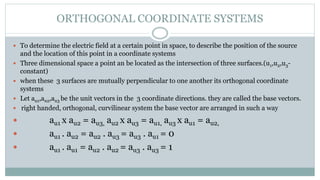
 Let au1,au2,au3 be the unit vectors in the 3 coordinate directions. they are called the base vectors.
 right handed, orthogonal, curvilinear system the base vector are arranged in such a way
 au1 x au2 = au3, au2 x au3 = au1, au3 x au1 = au2,
 au1 . au2 = au2 . au3 = au3 . au1 = 0
 au1 . au1 = au2 . au2 = au3 . au3 = 1
ORTHOGONAL COORDINATE SYSTEMS conti
 Any vector A can be written as the sum of its components in the three orthogonal directions
A= au1 Au1 + au2 Au2 + au3 Au3
The magnitude of A = 𝑨 =(A2
u1+ A2
u2 + A2
u3 ) ½
 To express the differential length change corresponding to a differential change in one of the
coordinates
dli= hidui
 hi –metric coefficient its function of u1,u2,u3
 Sum of the component length change
dl=au1dl1+au2dl2+au3dl3
or
dl=au1(h1du1)+au2(h2du2)+au3(h3du3)
 Magnitude of dl is
dl = [dl1
2 + dl2
2 + dl3
2] ½
or
[(h1du1)2 + (h2du2)2 + (h3du3 )2 ] ½
 Differential volume dl1dl2dl3 or dv = h1h2h3du1du2du3
 Differential area a vector with a direction normal to the surface
ds=ands
 The differential area ds1 normal to the unit vector au1 ,
ds1 = dl2 dl3
or
ds1 = h2h3du2du3
 Iily au2 , au3 ;
ds2 = h1h3du1du3 ;
ds3 = h1h2du1du2
Common orthogonal coordinate systems
1. Cartesian (or rectangular) coordinates
2. Cylindrical coordinates
3. Spherical coordinates
Cartesian (or rectangular) coordinates
(u1,u2,u3) = (x,y,z)
 A point p(x1,y1,z1) in Cartesian coordinates is the intersection of three planes specified by
x=x1,y=y1,z=z1 it’s a right handed system with base vector
ax x ay = az, ay x az = ax, az x ax = ay
 Algebra 11 - Cartesian Coordinates in Three Dimensions.mp4
 The position vector to the point P(x1,y1,z1) is OP =axx1+ayy1+azz1
 A vector A in Cartesian coordinates can be written as
A = axAx + ayAy + azAz
 The dot product of two vectors A and B ,
A.B = AxBx + AyBy+AzBz
A X B =
𝑎 𝑥 𝑎 𝑦 𝑎 𝑧
𝐴 𝑥 𝐴 𝑦 𝐴 𝑧
𝐵 𝑥 𝐵 𝑦 𝐵 𝑧
 All three metric coefficients are unity h1=h2=h3= 1 P(x,y,z)
 Differential length,
dl =axdx + aydy +azdz
 Differential length
dsx = 𝑑𝑦𝑑𝑧 ;
dsy = 𝑑𝑥𝑑𝑧 ;
dsz = 𝑑𝑥𝑑𝑦
 differential surface areas normal to the directions ax,ay,az
 Differential volume
dv = 𝑑𝑥𝑑𝑦𝑑𝑧
Cylindrical Co-ordinate system
(u1,u2,u3) = (r,ø,z)
 The surfaces used to define the cylindrical cocordinate system are
 1.Plane of constant z which is parallel to xy plane 2. a cylinder of radius r with z axis as the axis of
cylinder 3. a half plane perpendicular to xy plane and at an angle ø with respect to xy plane. The
angle ø is called azimuthal angle. Ranges (0 < r < infinity ;0< ø < 2π ; -infinty < z < infinity)
ar x aø = az, aø x az = ar, az x ar = aø
 A vector in cylindrical is written as
A = arAr+aøAø+azAz
 The dot product of two vectors
A.B = ArBr+AøBø+AzBz
 The vector product of two vectors
A X B =
𝑎 𝑟 𝑎ø 𝑎 𝑧
𝐴 𝑟 𝐴ø 𝐴 𝑧
𝐵 𝑟 𝐵ø 𝐵 𝑧
 The differential length (h1=h3=1;h2= 1)
dl =ardr + aørdø +azdz ;
magnitude |dl| = (dr2 + (rdø)2 + dz2) 1/2
 The differential surface are,
dsr = r𝑑ø𝑑𝑧 ar ; dsø = 𝑑𝑟𝑑𝑧 aø ; dsz = r𝑑𝑟𝑑ø az
 The differential volume
dv = r𝑑𝑟𝑑ø𝑑𝑧
Relationship between Cartesian and cylindrical systems;
 Cylindrical to Cartesian
x=rcos Ø
y= r sin Ø
z=z
 Cartesian to cylindrical
r = 𝑥2 + 𝑦2
Ø = tan−1
𝑦/𝑥
z=z
Note:
1.r is positive or zero, hence positive sign of square root must be consider.
2.While calculating Ø make sure the sign of x and y.
both are positive is positive in the first quadrant.
If x is negative y is positive then the point is in the second quadrant. Hence add 10 degree to the
Ø calculation.
if x is positive y is negative Ø fourth quadrant.
if x is negative y is negative third quadrant, hence 180 degree subtracted from Ø
Spherical coordinate systems
(u1,u2,u3 ) =(R ,𝜃, 𝜑)
 Sphere of radius r origin as the entre of the sphere
 A right circular cone with its apex at the origin and its axis as z axis. Its half angle is θ.it
rotates about z axis and θ varies from 0 to 180 degree
 A half plane perpendicular to xy plane containing z axis making an angle ø with the xy plane.
 0< r < infinity;0 < Ø < 2π ; 0 < θ < π
aR x aθ =aØ ; aθ x aØ =aR ; aØ x aR = aθ
 A vector spherical coordinates is written as
A = aRAR +aθAθ+aØAØ
 The dot and cross product of spherical vector are,
A.B = ARBR + A θ B θ +AØBØ
A x B =
𝒂 𝑹 𝒂θ 𝒂Ø
𝑨 𝑹 𝑨θ 𝑨Ø
𝑩 𝑹 𝑩θ 𝑩Ø
 In spherical coordinates only R is lenghth,the other coordinates θ , Ø are angles.
Differential volume element h2 = R and h3 = R sin θ
 The differential vector length
dl = aR dR +aθ Rdθ + aØ R sinθ dØ
 Magnitude of differential length vector is |dl| = ((dR)2+(R dθ)2+ (R sinθ dø)2)1/2
 The differential surface areas
dsR = R2 𝑠𝑖𝑛θ𝑑θ𝑑Ø ar ; dsθ = R sin θ𝑑𝑅 𝑑Ø aθ; dsØ= R𝑑𝑅 𝑑θ aØ
 The differential volume is
dv = R2 sinθ dR dθ dø
Relationship between Cartesian and spherical systems
 Spherical coordinate to Cartesian coordinate system
 Cartesian to spherical coordinate system
 Transformation of vectors
 Cartesian to cylindrical
𝐴 𝑟
𝐴Ø
𝐴 𝑧
=
𝑐𝑜𝑠𝜑 𝑠𝑖𝑛𝜑 0
−𝑠𝑖𝑛𝜑 𝑐𝑜𝑠𝜑 0
0 0 1
𝐴 𝑥
𝐴 𝑌
𝐴 𝑧
 Cylindrical to Cartesian
𝐴 𝑥
𝐴 𝑦
𝐴 𝑧
=
𝑐𝑜𝑠𝜑 −𝑠𝑖𝑛𝜑 0
𝑠𝑖𝑛𝜑 𝑐𝑜𝑠𝜑 0
0 0 1
𝐴 𝑟
𝐴 𝜑
𝐴 𝑧
 Cartesian to spherical
𝐴 𝑅
𝐴θ
𝐴Ø
=
𝑠𝑖𝑛θ 𝑐𝑜𝑠𝜑 𝑠𝑖𝑛θ 𝑠𝑖𝑛𝜑 𝑐𝑜𝑠θ
𝑐𝑜𝑠θ 𝑐𝑜𝑠𝜑 𝑐𝑜𝑠θ 𝑠𝑖𝑛𝜑 −𝑠𝑖𝑛θ
−𝑠𝑖𝑛ø cos Ø 0
𝐴 𝑥
𝐴 𝑦
𝐴 𝑧
 Spherical to Cartesian
𝐴 𝑥
𝐴 𝑦
𝐴 𝑧
=
𝑠𝑖𝑛θ 𝑐𝑜𝑠𝜑 𝑐𝑜𝑠θ 𝑐𝑜𝑠𝜑 −𝑠𝑖𝑛Ø
𝑠𝑖𝑛θ 𝑠𝑖𝑛𝜑 𝑐𝑜𝑠θ 𝑠𝑖𝑛𝜑 cos Ø
cos θ −sin θ 0
𝐴 𝑅
𝐴θ
𝐴Ø
 Spherical to cylindrical
𝐴 𝑟
𝐴 𝜑
𝐴 𝑧
=
𝑠𝑖𝑛θ 𝑐𝑜𝑠θ 0
0 0 1
𝑐𝑜𝑠θ −𝑠𝑖𝑛θ 0
𝐴 𝑅
𝐴θ
𝐴Ø
Line, surface and volume integrals
 In electromagnetic a charge can exist in point form, line form, surface form or volume form.
Line integral:
 Line can exist as a straight line or it can be a distance travelled along a curve.ie a line is a curved path
in a space.
 Consider a vector field F, the curved path shown in the field is p-r.This is called path of integration and
corresponding integral can be defined as
𝐹. 𝑑𝑙𝐿
= 𝐹 𝑑𝑙 cos θ
𝑟
𝑝
; dl = elementary length
 This is called line integral of F around the curved path.
 Open path as p-r and closed path as p-q-r-s-p (contour integral or closed or circular integral)
Surface integral:
 A flux Ø may pass through a surface, while doing analysis of such cases an integral is required called
surface integral, to be carried out over a surface related to vector field
 For a charge distribution in fig a, e can write for the total charge existing on the surface as,
 Note :the surface integral involve the double integration procedure mathamatically.
 Volume integral
 If the charge distribution exists in a three dimensional volume form as in fig.,then the volume integral is
required to calculate the total charge
Q= ρ 𝑣 𝑑𝑣𝑣
GRADIENT OF A SCALAR FIELD
 Electromagnetic quantities that depend on both time and position. Let us consider a scalar function of
space coordinates V(u1,u2,u3).
 The magnitude of V depends on the position of the Point in space, but it may be constant along certain
lines or surfaces.
 The vector that represents both the magnitude and the direction of the maximum space rate of increase
of a scalar as the gradient of that scalar.
grad V ≜ 𝑎 𝑛
𝑑𝑉
𝑑𝑛
;------------(1)
 V ≜ 𝑎 𝑛
𝑑𝑉
𝑑𝑛
(dv is positive)----------(2)
 (if dv is negative –decrease in V from P1 to P2) V will be negative in the an direction)
V = au1
𝜕𝑉
ℎ1
𝑑𝑢1
+ au2
𝜕𝑉
ℎ2
𝑑𝑢2
+ au3
𝜕𝑉
ℎ3
𝑑𝑢3
 For Cartesian coordinate system: V = ax
𝜕𝑉
𝑑𝑥
+ ay
𝜕𝑉
𝑑𝑦
+ az
𝜕𝑉
𝑑𝑧
 For cylindrical system: V = ar
𝜕𝑉
𝑑𝑟
+ aØ
1
𝑟
𝜕𝑉
𝑑Ø
+ az
𝜕𝑉
𝑑𝑧
 For spherical system : V = aR
𝜕𝑉
𝑑𝑅
+ aθ
1
𝑟
𝜕𝑉
𝑑θ
+ aØ
1
𝑅𝑠𝑖𝑛θ
𝜕𝑉
𝑑Ø
 Properties of gradient of scalar field
1.the gradient V gives the max.rate of change of V per unit distance
2.the gradient V alays indicate the direction of the max.rate of change of V
3.the grdient V at any point is perpendicular to the constant V surface,which passes through the point.
4.the directional derivative of V along the unit vector a is V.a which is projection of V in the direction of unit
vector a
5.(V + U) = V + U
6.(UV) = U V + V U
7. (U/V) = V U – U V / V2
Divergence of a vector field
 It is seen that 𝑭. 𝒅𝒔 gives the flux flowing across the surface S. Then mathematically divergence is
defined as the net outward flow of the flux per unit volume over a closed incremental surface.
Div F ≜ lim
 𝑣→0
=
𝐹 .𝑑𝑠𝑠
 𝑣
(divergence of F)
 Divergence of vector field F at a point P is the outward flux per unit volume as the volume shrinks about
point P i.e. 𝑣 → 0 representing differential volume element at point P.
 . F =
1
ℎ1
ℎ2
ℎ3
[
𝜕(ℎ2
ℎ3
𝐹1
)
𝜕𝑢1
+
𝜕(ℎ1
ℎ3
𝐹2
)
𝜕𝑢2
+
𝜕(ℎ1
ℎ2
𝐹3
)
𝜕𝑢3
]
  . F = divergence of F ( = vector operator  = ax
𝜕
𝑑𝑥
+ ay
𝜕
𝑑𝑦
+ az
𝜕
𝑑𝑧
) (F = ax Fx+ ay Fy + az Fz)
 . F =
𝜕Fx
𝑑𝑥
+
𝜕Fy
𝑑𝑦
+
𝜕Fz
𝑑𝑧
= div F (this is divergence of F in Cartesian system)
 Lly
 . F =
1
𝑟
𝜕rFr
𝑑𝑟
+
1
𝑟
𝜕FØ
𝑑Ø
+
𝜕Fz
𝑑𝑧
(cylindrical)
 (spherical)
 Divergence at a point indicate ho much that vector field diverges from that point
 Consider a solenoid i.e. Electromagnet obtained by winding a coil around the core. hence current
passes through it, flux is produced around it. such a flux is produced around it. such a flux completes
a closed path through the solenoid
 . A = 0 for A to be solenoidal
 The vector field strength is measured by the no. of flux lines passing through a unit surface normal to
the vector
 Properties of divergence
1. The divergence produces a scalar field as the dot product is involved in the operation
2. Divergence of a scalar has no meaning.
3.  . (A + B) =  . A +  . B
Divergence theorem
 W.k.t ,  . F ≜ lim
 𝑣→0
=
𝐹 .𝑑𝑠𝑠
 𝑣
(divergence of vector )
 We can write that 𝐹 . 𝑑𝑠𝑆
=  . F𝑉
dv (divergence theorem or gauss ostrogradsky theorem)
 It states that, the integral of the normal component of any vector field over a closed surface is equal
to the integral of the divergence of this vector field throughout the volume enclosed by that closed
surface.
 The divergence theorem converts the surface integral into a volume integral provided that the closed
surface encloses certain volume.
 The divergence theorem is advantages in EMF as volume integrals are more easy to evaluate than the
surface integrals
 Proof Of Divergence Theorem:
 Let the closed surface encloses certain volume v. subdivided this volume v into a large number of
subsections called cells. let the vector field associated with the surface S is F.
 Then if ith cell has the volume vi and is bounded by the surface si then ,
( . F)i vi = 𝐹 . 𝑑𝑠𝑠𝑖
 Let us now combine the contributions of all these differential volumes to both sides,
lim
v𝑖
→0
[ ( . F)i v𝑖
𝑁
𝑖=1 ] = lim
v𝑖
→0
[ 𝑁
𝑖=1 𝐹 . 𝑑𝑠𝑠𝑖
]
 In left side, volume integral, lim
v𝑖
→0
[ ( . F)i v𝑖
𝑁
𝑖=1 ] =  . F 𝑑𝑣𝑉
 The surface integrals on the right side are summed over all the faces of all the differential
volume elements. the contribution from the internal surfaces of adjacent elements ill cancel
each other. hence the net contribution of the right side is due only to that of the external
surface S bounding the volume V.
 lim
v𝑖
→0
[ 𝑁
𝑖=1 𝐹 . 𝑑𝑠𝑠𝑖
] = 𝐹 . 𝑑𝑠𝑖𝑠
 Hence, 𝐹 . 𝑑𝑠𝑆
=  . F𝑉
dv
Curl of a vector field
 The circulation of a vector field around a closed path is given by curl of vector.
 The curl is closed line integral per unit area .
 If curl of vector field exists then the field is called rotational. For irrotational vector field the curl is
zero
Stoke’s theorem
 It relates the line integral to a surface integral.
 The line integral of F around a closed path L is equal to the integral of curl of F over the open surface
S enclosed by the closed path L
𝐹 . 𝑑𝐿𝐿
= ( 𝑋 𝐹)𝑆
. dS ;
where dL= perimeter of total surface S
 This theorem is applicable only when F and  𝑋 𝐹 are continuous on the surface S
Proof of stoke’s theorem:
 consider a surface S which is splitted into no of incremental surfaces. each incremental surface is
having area ∆S
 Applying definition of the curl to any of these incremental surfaces
( 𝑋 𝐹)N = 𝐹 . 𝑑𝐿𝐿 ∆S / ∆S
 where N = normal to ∆S according to right hand rule, dL ∆S = perimeter of the incremental surface ∆S
 The curl of F in the normal direction is the dot product of curl of F with aN (unit vector) normal to the
surface ∆S
( 𝑋 𝐹)N = ( 𝑋 𝐹).aN
𝐹 . 𝑑𝐿𝐿 ∆S = ( 𝑋 𝐹).aN ∆S
 𝐹 . 𝑑𝐿𝐿 ∆S = ( 𝑋 𝐹).∆S
 To obtain total curl for every incremental surface add the closed line integrals for each ∆S.from the fig
it can be seen that at a common boundary b/w the two surfaces the line integral is getting canced as
the boundary traced in opposite direction
 Hence summation of all closed line integrals for each and every ∆S ends up in a single losed line integral
to be obtained for the outer boundary of the total surface.
𝐹 . 𝑑𝐿𝐿
= ( 𝑋 𝐹)𝑆
. dS
Two null identities
 Identity I
 The curl of the gradient of any scalar field is identically zero
 X (V) ≡ 0
 If a vector field is curl free then it can be expressed as the gradient of a scalar field.
 X E =0; E = - V
 Identity II
 The divergence of the curl of any vector field is identically zero.
 . ( X A ) ≡ 0
 If a vector field is divergence less , then it can be expressed as the curl of another vector
field.
 . B = 0 ; B =  x A
HELMHOLTZ’S THEOREM
 Types of vector field F
 1 solenoidal and irrotational .F = 0 and  x F = 0 ( static electric field in a charge free region)
 2.solenoidal but not irrotational if .F = 0 and  x F ≠ 0 (steady magnetic field in a current carrying
conductor)
 3.irrotational but not solenoidal  x F = 0 and .F ≠ 0 (static electric field in a charged region)
 4.neither solenoidal nor irrotational .F ≠ 0 and  x F ≠ 0
 Helmholtz theorem: a vector field is determined to within an additive constant if both its divergence
and its curl are specified everywhere.
F = - .V +  x A
 In an unbounded region, divergence and curl of the vector field at infinity. bounded by surface ,it is
determined if its divergence and curl throughout the region.

Ec8451 - Electro Magnetic Fields

  • 1.
  • 2.
    UNIT-1 -INTRODUCTION CONTENT  Electromagneticmodel,  Units and constants,  Review of vector algebra,  Rectangular, cylindrical and spherical coordinate systems,  Line, surface and volume integrals,  Gradient of a scalar field,  Divergence of a vector field,  Divergence theorem,  Curl of a vector field,  Stoke's theorem,  Null identities,  Helmholtz's theorem
  • 3.
    INTRODUCTION ABOUT EMF Electromagnetics is the study of the effect of charges at rest and charges in motion.  Some special cases of electromagnetics:  Electrostatics: charges at rest  Magnetostatics: charges in steady motion (DC)  Electromagnetic waves: waves excited by charges in time-varying motion  Both positive and negative charges are sources of an electric field, moving charges produce a current which gives rise to a magnetic field  A field is a spatial distribution of a quantity; which may or may not be a function of time  Application field of EMF, Atom smashers, CRO, Radar, satellite Communication, television reception, remote Sensing
  • 4.
    ELECTROMAGNETIC MODEL  Twoapproaches in the development of a scientific subject 1. Inductive (one follows the historical development of the subject, stating with the observation of some simple experiments and inferring from them laws and theorems) 2. Deductive (postulates a fundamental relations for an idealized model)  Building a theory on an idealized model three steps are needed, 1. Some basic quantities to the subject of study are defined 2. Rules of operation of these quantities are specified 3. Some fundamental relations are postulated  Example: built on a circuit model of ideal sources and pure R,L,C 1. Basic quantities:V,I,R,L,C 2. Algebra, ordinary differential equation, Laplace transformation 3. KVL,KCL  Electromagnetic model quantities has, 1. Source quantities 2. Field quantities
  • 5.
     Electric chargeis a fundamental property of matter and exists only in positive or negative integral multiples of the charge on an electron e = 1.60 x 10⁻¹⁹ C  the principle of conservation of electric charge must be satisfied at all times and under any circumstances (equation of continuity)  Volume charge density ρ = limΔ𝑣 →0 Δ𝑞 Δ𝑣 C/m3  Surface charge density ρs = limΔ𝑠 → 0 Δ𝑞 Δ𝑠 C/m2  Line charge density ρl = limΔ𝑙 →0 Δ𝑞 Δ𝑙 C/m  Current is the rate of charge with respect to time I = 𝑑𝑞 𝑑𝑡 C/s or A  Volume current density J, which measures the amount of current flowing through a unit area normal to the direction of current flow (A/m2)  Surface current density Js which is the current per unit width on the conductor surface normal to the direction of current flow (A/m)  There are 4 fundamental vector field quantities in electro magnetics Symbols and units for field quantities Field quantities Symbol unit Electric Electric field intensity E V/m Electric flux density D C/m2 Magnetic Magnetic flux density B T Magnetic field intensity H A/m
  • 6.
    Units and constants Measurements of any physical quantity must be expressed as a number followed by a unit.  The SI (International System of Units) is an MKSA system  Constants : 1. Velocity of electromagnetic wave in free space c = 3 x 10⁸ m/s 2. Permittivity of free space εo 3. Permeability of free space μo  εo is the proportionality constant between the electric flux density D and the electric field intensity E in free space D = εo E  μo is the proportionality constant between the Magnetic flux density B and the Magnetic field intensity H in free space H= 1 μo B  the value of εo and μo are determined by the choice of unit systems. Quantity Unit abbreviation Length Meter m Mass Kilogram kg Time Second s Current Ampere A
  • 7.
    Units and constantsConti…. μo = 4π x 10-7 H/m (henry / meter)  The relationship b/w three constants are C= 1 μoεo m/s Εo = 1 C2 μo = 1 36π x 10-9 F/m (farad / meter)
  • 8.
    Review of vectoralgebra  A scalar is a quantity having only an amplitude Examples: voltage, current, charge, energy, temperature  A vector is a quantity having direction in addition to amplitude Examples: velocity, acceleration, force  a vector A can be written as A = aA A where A is the magnitude of A , A= 𝑨 and aA is a dimensionless unit vector aA = 𝑨 𝑨 A= 𝑨 A = aAA Fig: graphical representation of vector A
  • 9.
    Vector Addition  Twovectors A and B which are not in the same direction nor in opposite directions .their sum is another vector C in the plane C= A + B can be obtained graphically in two ways. 1. By the parallelogram rule: the resultant C is the diagonal vector of the parallelogram formed by A and B drawn from the point 2. By the head to tail rule:the head of the A connects to the tail of B.their Sum C is the vector drawn from the tail of A to the head of B and vectors a, B and C form a triangle  Commutative law :A + B = B + A  Associative law :A + (B + C ) = (A + B ) + C
  • 10.
    Vector subtraction  Vectorsubtraction can be defined in terms of vector addition in the following way: A – B = A + (-B)  Where –B is the negative of vector B
  • 11.
    Products of vectors Multiplication of vector A by positive scalar k changes the magnitude of A by k times with out changing its direction kA = aA (kA)  Types of products vectors 1. Scalar or dot products 2. Vector or cross products  Scalar or dot product : dot product of two vectors A and B denoted by A . B is a scalar which equals the product of the magnitudes of A and B the cosine of the angle between them A . B ≜ AB cos θAB  Where ≜ signifies equal by definition and θAB smaller angle b/w A and B is less than π radians (180)  The dot product of two vectors 1. is less than or equal to the product of their magnitudes 2. Can be either a positive or a negative quantity, depending on whether the angle between them is smaller or larger than π/2 radians(90) 3. is equal to the product of the magnitude of one vector and the projection of the other vector upon the first one 4. is zero when the vectors are perpendicular to each other  A.A =A2  commutative law : A . B = B . A  Distributive law :A . (B + C) = A . B + A . C
  • 12.
     Vector orcross product : Cross product of two vectors A and B, A x B is a vector perpendicular to the plane containing A and B. its magnitude is AB sinθAB where θAB is the smaller angle b/w A and B A x B ≜ an 𝑨𝑩 sin 𝜽 𝑨𝑩 Where sin 𝜽 𝑨𝑩 is the height of the parallelogram formed by the vectors A and B  B x A = - A x B (cross product is not commutative)  A x (B + C ) = A x B + A x C (distributive )  A x (B x C) = (A x B ) x C (associative)  Product of three vectors: 1.scalar triple product 2. vector triple product  1.scalar triple product A . (B x C) = B. (C x A) = C .(A x B)  A.(B x C) = - A. (C X B) = - B. (A X C) = - C. (B X A)  2. vector triple product : A X (B X C) = B(A.C) – C(A.B) (back-cab rule)  Division by a vector is not defined
  • 13.
    ORTHOGONAL COORDINATE SYSTEMS To determine the electric field at a certain point in space, to describe the position of the source and the location of this point in a coordinate systems  Three dimensional space a point an be located as the intersection of three surfaces.(u1,u2,u3- constant)  when these 3 surfaces are mutually perpendicular to one another its orthogonal coordinate systems  Let au1,au2,au3 be the unit vectors in the 3 coordinate directions. they are called the base vectors.  right handed, orthogonal, curvilinear system the base vector are arranged in such a way  au1 x au2 = au3, au2 x au3 = au1, au3 x au1 = au2,  au1 . au2 = au2 . au3 = au3 . au1 = 0  au1 . au1 = au2 . au2 = au3 . au3 = 1
  • 14.
    ORTHOGONAL COORDINATE SYSTEMSconti  Any vector A can be written as the sum of its components in the three orthogonal directions A= au1 Au1 + au2 Au2 + au3 Au3 The magnitude of A = 𝑨 =(A2 u1+ A2 u2 + A2 u3 ) ½  To express the differential length change corresponding to a differential change in one of the coordinates dli= hidui  hi –metric coefficient its function of u1,u2,u3  Sum of the component length change dl=au1dl1+au2dl2+au3dl3 or dl=au1(h1du1)+au2(h2du2)+au3(h3du3)  Magnitude of dl is dl = [dl1 2 + dl2 2 + dl3 2] ½ or [(h1du1)2 + (h2du2)2 + (h3du3 )2 ] ½  Differential volume dl1dl2dl3 or dv = h1h2h3du1du2du3
  • 15.
     Differential areaa vector with a direction normal to the surface ds=ands  The differential area ds1 normal to the unit vector au1 , ds1 = dl2 dl3 or ds1 = h2h3du2du3  Iily au2 , au3 ; ds2 = h1h3du1du3 ; ds3 = h1h2du1du2
  • 16.
    Common orthogonal coordinatesystems 1. Cartesian (or rectangular) coordinates 2. Cylindrical coordinates 3. Spherical coordinates
  • 17.
    Cartesian (or rectangular)coordinates (u1,u2,u3) = (x,y,z)  A point p(x1,y1,z1) in Cartesian coordinates is the intersection of three planes specified by x=x1,y=y1,z=z1 it’s a right handed system with base vector ax x ay = az, ay x az = ax, az x ax = ay  Algebra 11 - Cartesian Coordinates in Three Dimensions.mp4  The position vector to the point P(x1,y1,z1) is OP =axx1+ayy1+azz1  A vector A in Cartesian coordinates can be written as A = axAx + ayAy + azAz  The dot product of two vectors A and B , A.B = AxBx + AyBy+AzBz A X B = 𝑎 𝑥 𝑎 𝑦 𝑎 𝑧 𝐴 𝑥 𝐴 𝑦 𝐴 𝑧 𝐵 𝑥 𝐵 𝑦 𝐵 𝑧  All three metric coefficients are unity h1=h2=h3= 1 P(x,y,z)
  • 19.
     Differential length, dl=axdx + aydy +azdz  Differential length dsx = 𝑑𝑦𝑑𝑧 ; dsy = 𝑑𝑥𝑑𝑧 ; dsz = 𝑑𝑥𝑑𝑦  differential surface areas normal to the directions ax,ay,az  Differential volume dv = 𝑑𝑥𝑑𝑦𝑑𝑧
  • 20.
    Cylindrical Co-ordinate system (u1,u2,u3)= (r,ø,z)  The surfaces used to define the cylindrical cocordinate system are  1.Plane of constant z which is parallel to xy plane 2. a cylinder of radius r with z axis as the axis of cylinder 3. a half plane perpendicular to xy plane and at an angle ø with respect to xy plane. The angle ø is called azimuthal angle. Ranges (0 < r < infinity ;0< ø < 2π ; -infinty < z < infinity) ar x aø = az, aø x az = ar, az x ar = aø
  • 21.
     A vectorin cylindrical is written as A = arAr+aøAø+azAz  The dot product of two vectors A.B = ArBr+AøBø+AzBz  The vector product of two vectors A X B = 𝑎 𝑟 𝑎ø 𝑎 𝑧 𝐴 𝑟 𝐴ø 𝐴 𝑧 𝐵 𝑟 𝐵ø 𝐵 𝑧  The differential length (h1=h3=1;h2= 1) dl =ardr + aørdø +azdz ; magnitude |dl| = (dr2 + (rdø)2 + dz2) 1/2  The differential surface are, dsr = r𝑑ø𝑑𝑧 ar ; dsø = 𝑑𝑟𝑑𝑧 aø ; dsz = r𝑑𝑟𝑑ø az  The differential volume dv = r𝑑𝑟𝑑ø𝑑𝑧
  • 22.
    Relationship between Cartesianand cylindrical systems;  Cylindrical to Cartesian x=rcos Ø y= r sin Ø z=z  Cartesian to cylindrical r = 𝑥2 + 𝑦2 Ø = tan−1 𝑦/𝑥 z=z Note: 1.r is positive or zero, hence positive sign of square root must be consider. 2.While calculating Ø make sure the sign of x and y. both are positive is positive in the first quadrant. If x is negative y is positive then the point is in the second quadrant. Hence add 10 degree to the Ø calculation. if x is positive y is negative Ø fourth quadrant. if x is negative y is negative third quadrant, hence 180 degree subtracted from Ø
  • 23.
    Spherical coordinate systems (u1,u2,u3) =(R ,𝜃, 𝜑)  Sphere of radius r origin as the entre of the sphere  A right circular cone with its apex at the origin and its axis as z axis. Its half angle is θ.it rotates about z axis and θ varies from 0 to 180 degree  A half plane perpendicular to xy plane containing z axis making an angle ø with the xy plane.  0< r < infinity;0 < Ø < 2π ; 0 < θ < π
  • 24.
    aR x aθ=aØ ; aθ x aØ =aR ; aØ x aR = aθ  A vector spherical coordinates is written as A = aRAR +aθAθ+aØAØ  The dot and cross product of spherical vector are, A.B = ARBR + A θ B θ +AØBØ A x B = 𝒂 𝑹 𝒂θ 𝒂Ø 𝑨 𝑹 𝑨θ 𝑨Ø 𝑩 𝑹 𝑩θ 𝑩Ø  In spherical coordinates only R is lenghth,the other coordinates θ , Ø are angles. Differential volume element h2 = R and h3 = R sin θ  The differential vector length dl = aR dR +aθ Rdθ + aØ R sinθ dØ  Magnitude of differential length vector is |dl| = ((dR)2+(R dθ)2+ (R sinθ dø)2)1/2  The differential surface areas dsR = R2 𝑠𝑖𝑛θ𝑑θ𝑑Ø ar ; dsθ = R sin θ𝑑𝑅 𝑑Ø aθ; dsØ= R𝑑𝑅 𝑑θ aØ  The differential volume is dv = R2 sinθ dR dθ dø
  • 25.
    Relationship between Cartesianand spherical systems  Spherical coordinate to Cartesian coordinate system  Cartesian to spherical coordinate system
  • 26.
     Transformation ofvectors  Cartesian to cylindrical 𝐴 𝑟 𝐴Ø 𝐴 𝑧 = 𝑐𝑜𝑠𝜑 𝑠𝑖𝑛𝜑 0 −𝑠𝑖𝑛𝜑 𝑐𝑜𝑠𝜑 0 0 0 1 𝐴 𝑥 𝐴 𝑌 𝐴 𝑧  Cylindrical to Cartesian 𝐴 𝑥 𝐴 𝑦 𝐴 𝑧 = 𝑐𝑜𝑠𝜑 −𝑠𝑖𝑛𝜑 0 𝑠𝑖𝑛𝜑 𝑐𝑜𝑠𝜑 0 0 0 1 𝐴 𝑟 𝐴 𝜑 𝐴 𝑧  Cartesian to spherical 𝐴 𝑅 𝐴θ 𝐴Ø = 𝑠𝑖𝑛θ 𝑐𝑜𝑠𝜑 𝑠𝑖𝑛θ 𝑠𝑖𝑛𝜑 𝑐𝑜𝑠θ 𝑐𝑜𝑠θ 𝑐𝑜𝑠𝜑 𝑐𝑜𝑠θ 𝑠𝑖𝑛𝜑 −𝑠𝑖𝑛θ −𝑠𝑖𝑛ø cos Ø 0 𝐴 𝑥 𝐴 𝑦 𝐴 𝑧  Spherical to Cartesian 𝐴 𝑥 𝐴 𝑦 𝐴 𝑧 = 𝑠𝑖𝑛θ 𝑐𝑜𝑠𝜑 𝑐𝑜𝑠θ 𝑐𝑜𝑠𝜑 −𝑠𝑖𝑛Ø 𝑠𝑖𝑛θ 𝑠𝑖𝑛𝜑 𝑐𝑜𝑠θ 𝑠𝑖𝑛𝜑 cos Ø cos θ −sin θ 0 𝐴 𝑅 𝐴θ 𝐴Ø  Spherical to cylindrical 𝐴 𝑟 𝐴 𝜑 𝐴 𝑧 = 𝑠𝑖𝑛θ 𝑐𝑜𝑠θ 0 0 0 1 𝑐𝑜𝑠θ −𝑠𝑖𝑛θ 0 𝐴 𝑅 𝐴θ 𝐴Ø
  • 27.
    Line, surface andvolume integrals  In electromagnetic a charge can exist in point form, line form, surface form or volume form. Line integral:  Line can exist as a straight line or it can be a distance travelled along a curve.ie a line is a curved path in a space.  Consider a vector field F, the curved path shown in the field is p-r.This is called path of integration and corresponding integral can be defined as 𝐹. 𝑑𝑙𝐿 = 𝐹 𝑑𝑙 cos θ 𝑟 𝑝 ; dl = elementary length  This is called line integral of F around the curved path.  Open path as p-r and closed path as p-q-r-s-p (contour integral or closed or circular integral) Surface integral:  A flux Ø may pass through a surface, while doing analysis of such cases an integral is required called surface integral, to be carried out over a surface related to vector field  For a charge distribution in fig a, e can write for the total charge existing on the surface as,  Note :the surface integral involve the double integration procedure mathamatically.
  • 29.
     Volume integral If the charge distribution exists in a three dimensional volume form as in fig.,then the volume integral is required to calculate the total charge Q= ρ 𝑣 𝑑𝑣𝑣
  • 30.
    GRADIENT OF ASCALAR FIELD  Electromagnetic quantities that depend on both time and position. Let us consider a scalar function of space coordinates V(u1,u2,u3).  The magnitude of V depends on the position of the Point in space, but it may be constant along certain lines or surfaces.  The vector that represents both the magnitude and the direction of the maximum space rate of increase of a scalar as the gradient of that scalar. grad V ≜ 𝑎 𝑛 𝑑𝑉 𝑑𝑛 ;------------(1)  V ≜ 𝑎 𝑛 𝑑𝑉 𝑑𝑛 (dv is positive)----------(2)  (if dv is negative –decrease in V from P1 to P2) V will be negative in the an direction) V = au1 𝜕𝑉 ℎ1 𝑑𝑢1 + au2 𝜕𝑉 ℎ2 𝑑𝑢2 + au3 𝜕𝑉 ℎ3 𝑑𝑢3  For Cartesian coordinate system: V = ax 𝜕𝑉 𝑑𝑥 + ay 𝜕𝑉 𝑑𝑦 + az 𝜕𝑉 𝑑𝑧  For cylindrical system: V = ar 𝜕𝑉 𝑑𝑟 + aØ 1 𝑟 𝜕𝑉 𝑑Ø + az 𝜕𝑉 𝑑𝑧  For spherical system : V = aR 𝜕𝑉 𝑑𝑅 + aθ 1 𝑟 𝜕𝑉 𝑑θ + aØ 1 𝑅𝑠𝑖𝑛θ 𝜕𝑉 𝑑Ø
  • 31.
     Properties ofgradient of scalar field 1.the gradient V gives the max.rate of change of V per unit distance 2.the gradient V alays indicate the direction of the max.rate of change of V 3.the grdient V at any point is perpendicular to the constant V surface,which passes through the point. 4.the directional derivative of V along the unit vector a is V.a which is projection of V in the direction of unit vector a 5.(V + U) = V + U 6.(UV) = U V + V U 7. (U/V) = V U – U V / V2
  • 32.
    Divergence of avector field  It is seen that 𝑭. 𝒅𝒔 gives the flux flowing across the surface S. Then mathematically divergence is defined as the net outward flow of the flux per unit volume over a closed incremental surface. Div F ≜ lim  𝑣→0 = 𝐹 .𝑑𝑠𝑠  𝑣 (divergence of F)  Divergence of vector field F at a point P is the outward flux per unit volume as the volume shrinks about point P i.e. 𝑣 → 0 representing differential volume element at point P.  . F = 1 ℎ1 ℎ2 ℎ3 [ 𝜕(ℎ2 ℎ3 𝐹1 ) 𝜕𝑢1 + 𝜕(ℎ1 ℎ3 𝐹2 ) 𝜕𝑢2 + 𝜕(ℎ1 ℎ2 𝐹3 ) 𝜕𝑢3 ]   . F = divergence of F ( = vector operator  = ax 𝜕 𝑑𝑥 + ay 𝜕 𝑑𝑦 + az 𝜕 𝑑𝑧 ) (F = ax Fx+ ay Fy + az Fz)  . F = 𝜕Fx 𝑑𝑥 + 𝜕Fy 𝑑𝑦 + 𝜕Fz 𝑑𝑧 = div F (this is divergence of F in Cartesian system)  Lly  . F = 1 𝑟 𝜕rFr 𝑑𝑟 + 1 𝑟 𝜕FØ 𝑑Ø + 𝜕Fz 𝑑𝑧 (cylindrical)  (spherical)  Divergence at a point indicate ho much that vector field diverges from that point
  • 33.
     Consider asolenoid i.e. Electromagnet obtained by winding a coil around the core. hence current passes through it, flux is produced around it. such a flux is produced around it. such a flux completes a closed path through the solenoid  . A = 0 for A to be solenoidal  The vector field strength is measured by the no. of flux lines passing through a unit surface normal to the vector  Properties of divergence 1. The divergence produces a scalar field as the dot product is involved in the operation 2. Divergence of a scalar has no meaning. 3.  . (A + B) =  . A +  . B
  • 34.
    Divergence theorem  W.k.t,  . F ≜ lim  𝑣→0 = 𝐹 .𝑑𝑠𝑠  𝑣 (divergence of vector )  We can write that 𝐹 . 𝑑𝑠𝑆 =  . F𝑉 dv (divergence theorem or gauss ostrogradsky theorem)  It states that, the integral of the normal component of any vector field over a closed surface is equal to the integral of the divergence of this vector field throughout the volume enclosed by that closed surface.  The divergence theorem converts the surface integral into a volume integral provided that the closed surface encloses certain volume.  The divergence theorem is advantages in EMF as volume integrals are more easy to evaluate than the surface integrals  Proof Of Divergence Theorem:  Let the closed surface encloses certain volume v. subdivided this volume v into a large number of subsections called cells. let the vector field associated with the surface S is F.  Then if ith cell has the volume vi and is bounded by the surface si then , ( . F)i vi = 𝐹 . 𝑑𝑠𝑠𝑖
  • 35.
     Let usnow combine the contributions of all these differential volumes to both sides, lim v𝑖 →0 [ ( . F)i v𝑖 𝑁 𝑖=1 ] = lim v𝑖 →0 [ 𝑁 𝑖=1 𝐹 . 𝑑𝑠𝑠𝑖 ]  In left side, volume integral, lim v𝑖 →0 [ ( . F)i v𝑖 𝑁 𝑖=1 ] =  . F 𝑑𝑣𝑉  The surface integrals on the right side are summed over all the faces of all the differential volume elements. the contribution from the internal surfaces of adjacent elements ill cancel each other. hence the net contribution of the right side is due only to that of the external surface S bounding the volume V.  lim v𝑖 →0 [ 𝑁 𝑖=1 𝐹 . 𝑑𝑠𝑠𝑖 ] = 𝐹 . 𝑑𝑠𝑖𝑠  Hence, 𝐹 . 𝑑𝑠𝑆 =  . F𝑉 dv
  • 36.
    Curl of avector field  The circulation of a vector field around a closed path is given by curl of vector.
  • 38.
     The curlis closed line integral per unit area .  If curl of vector field exists then the field is called rotational. For irrotational vector field the curl is zero
  • 39.
    Stoke’s theorem  Itrelates the line integral to a surface integral.  The line integral of F around a closed path L is equal to the integral of curl of F over the open surface S enclosed by the closed path L 𝐹 . 𝑑𝐿𝐿 = ( 𝑋 𝐹)𝑆 . dS ; where dL= perimeter of total surface S  This theorem is applicable only when F and  𝑋 𝐹 are continuous on the surface S Proof of stoke’s theorem:  consider a surface S which is splitted into no of incremental surfaces. each incremental surface is having area ∆S  Applying definition of the curl to any of these incremental surfaces ( 𝑋 𝐹)N = 𝐹 . 𝑑𝐿𝐿 ∆S / ∆S  where N = normal to ∆S according to right hand rule, dL ∆S = perimeter of the incremental surface ∆S  The curl of F in the normal direction is the dot product of curl of F with aN (unit vector) normal to the surface ∆S ( 𝑋 𝐹)N = ( 𝑋 𝐹).aN
  • 40.
    𝐹 . 𝑑𝐿𝐿∆S = ( 𝑋 𝐹).aN ∆S  𝐹 . 𝑑𝐿𝐿 ∆S = ( 𝑋 𝐹).∆S  To obtain total curl for every incremental surface add the closed line integrals for each ∆S.from the fig it can be seen that at a common boundary b/w the two surfaces the line integral is getting canced as the boundary traced in opposite direction  Hence summation of all closed line integrals for each and every ∆S ends up in a single losed line integral to be obtained for the outer boundary of the total surface. 𝐹 . 𝑑𝐿𝐿 = ( 𝑋 𝐹)𝑆 . dS
  • 41.
    Two null identities Identity I  The curl of the gradient of any scalar field is identically zero  X (V) ≡ 0  If a vector field is curl free then it can be expressed as the gradient of a scalar field.  X E =0; E = - V  Identity II  The divergence of the curl of any vector field is identically zero.  . ( X A ) ≡ 0  If a vector field is divergence less , then it can be expressed as the curl of another vector field.  . B = 0 ; B =  x A
  • 42.
    HELMHOLTZ’S THEOREM  Typesof vector field F  1 solenoidal and irrotational .F = 0 and  x F = 0 ( static electric field in a charge free region)  2.solenoidal but not irrotational if .F = 0 and  x F ≠ 0 (steady magnetic field in a current carrying conductor)  3.irrotational but not solenoidal  x F = 0 and .F ≠ 0 (static electric field in a charged region)  4.neither solenoidal nor irrotational .F ≠ 0 and  x F ≠ 0  Helmholtz theorem: a vector field is determined to within an additive constant if both its divergence and its curl are specified everywhere. F = - .V +  x A  In an unbounded region, divergence and curl of the vector field at infinity. bounded by surface ,it is determined if its divergence and curl throughout the region.