Dr. Kiran Kakade
Assistant Professor (HR) ,TIMSR Mumbai
• Look at these pictures and think…
The student is
studying hard
during exams.
The boy is learning
to cycle even after
getting injured.
The bird is
putting efforts
to make its nest.
All just because of
MOTIVATION
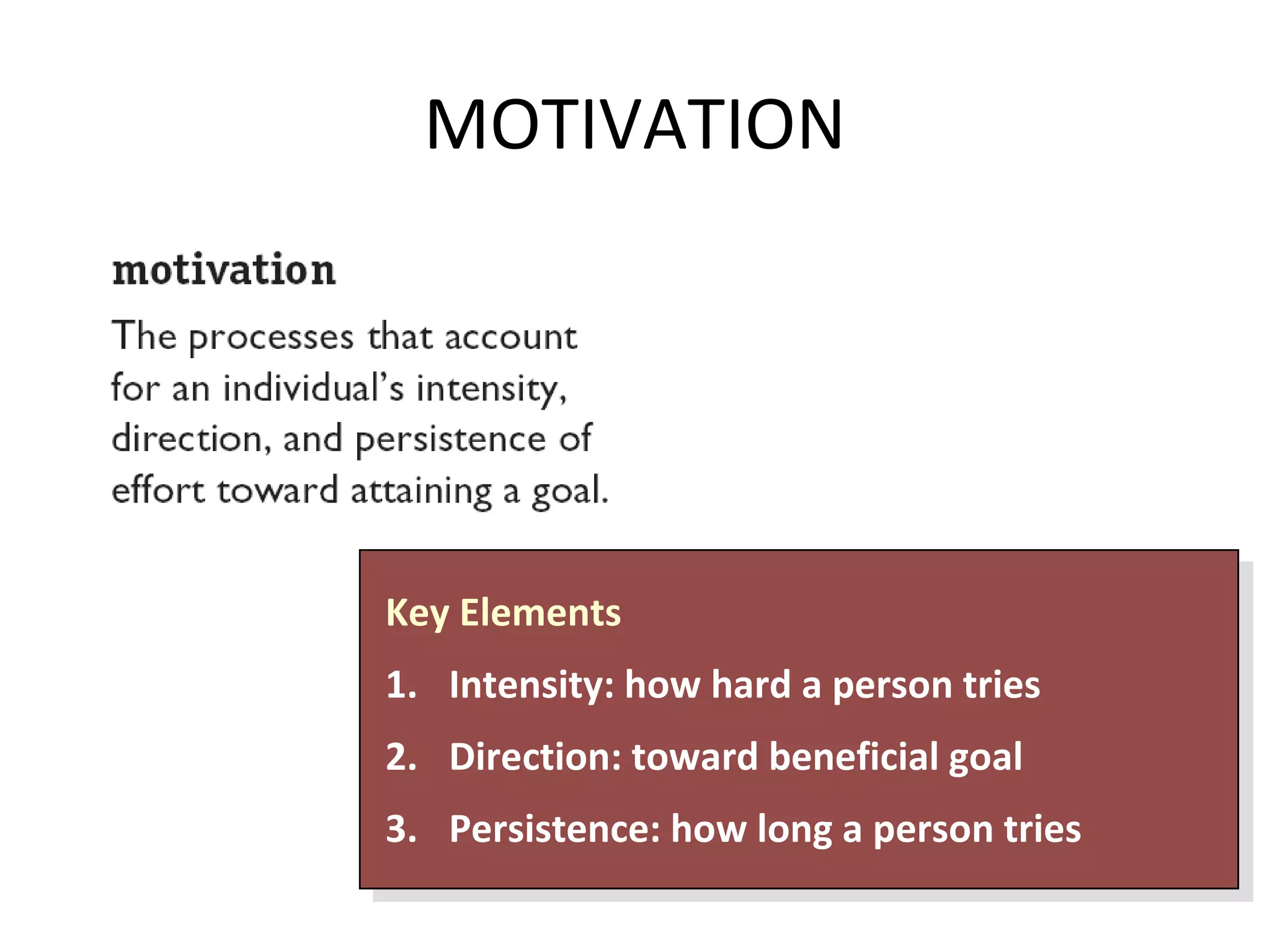
MOTIVATION
Key Elements
1. Intensity: how hard a person tries
2. Direction: toward beneficial goal
3. Persistence: how long a person tries
Key Elements
1. Intensity: how hard a person tries
2. Direction: toward beneficial goal
3. Persistence: how long a person tries
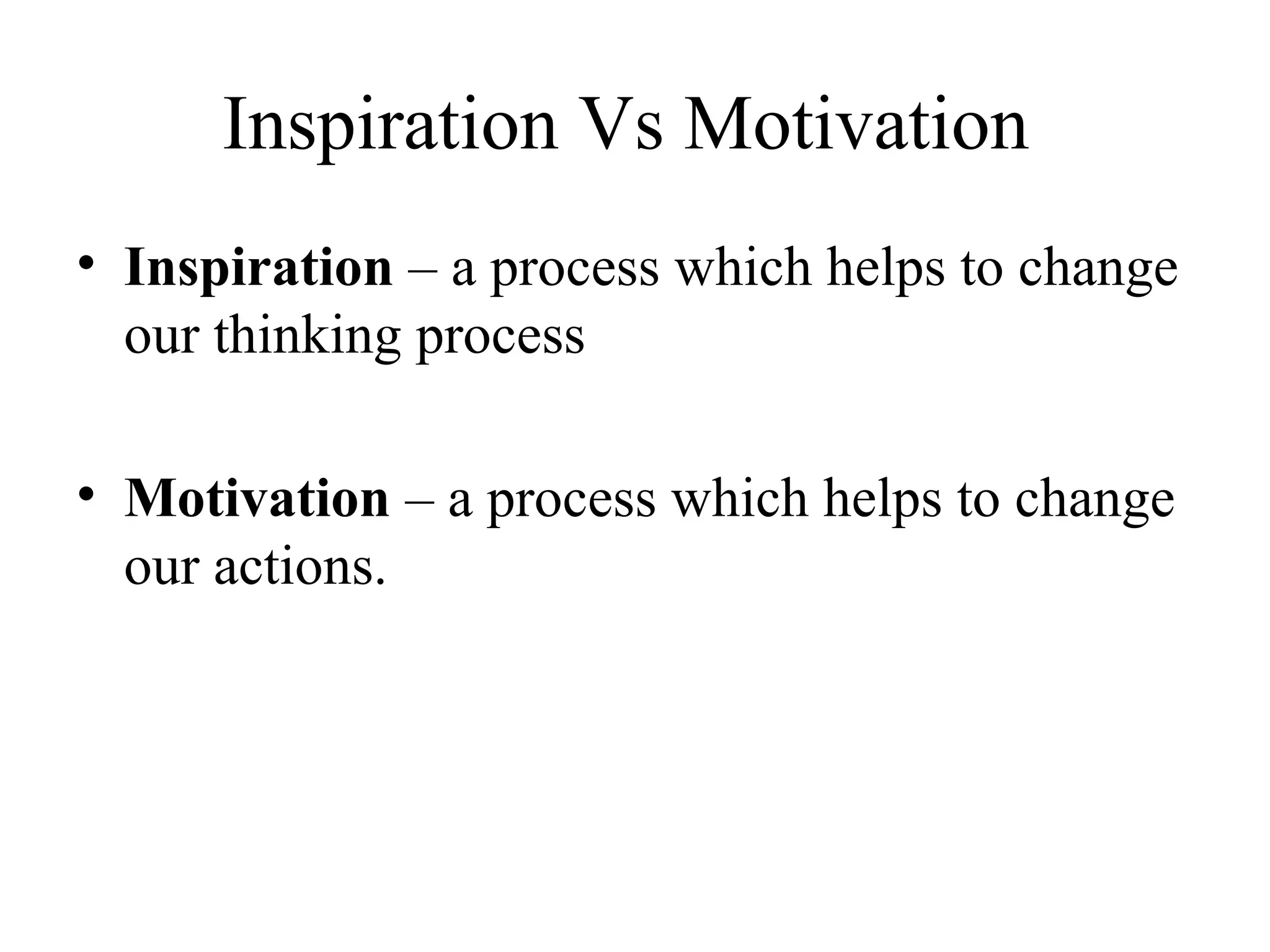
Inspiration Vs Motivation
• Inspiration – a process which helps to change
our thinking process
• Motivation – a process which helps to change
our actions.
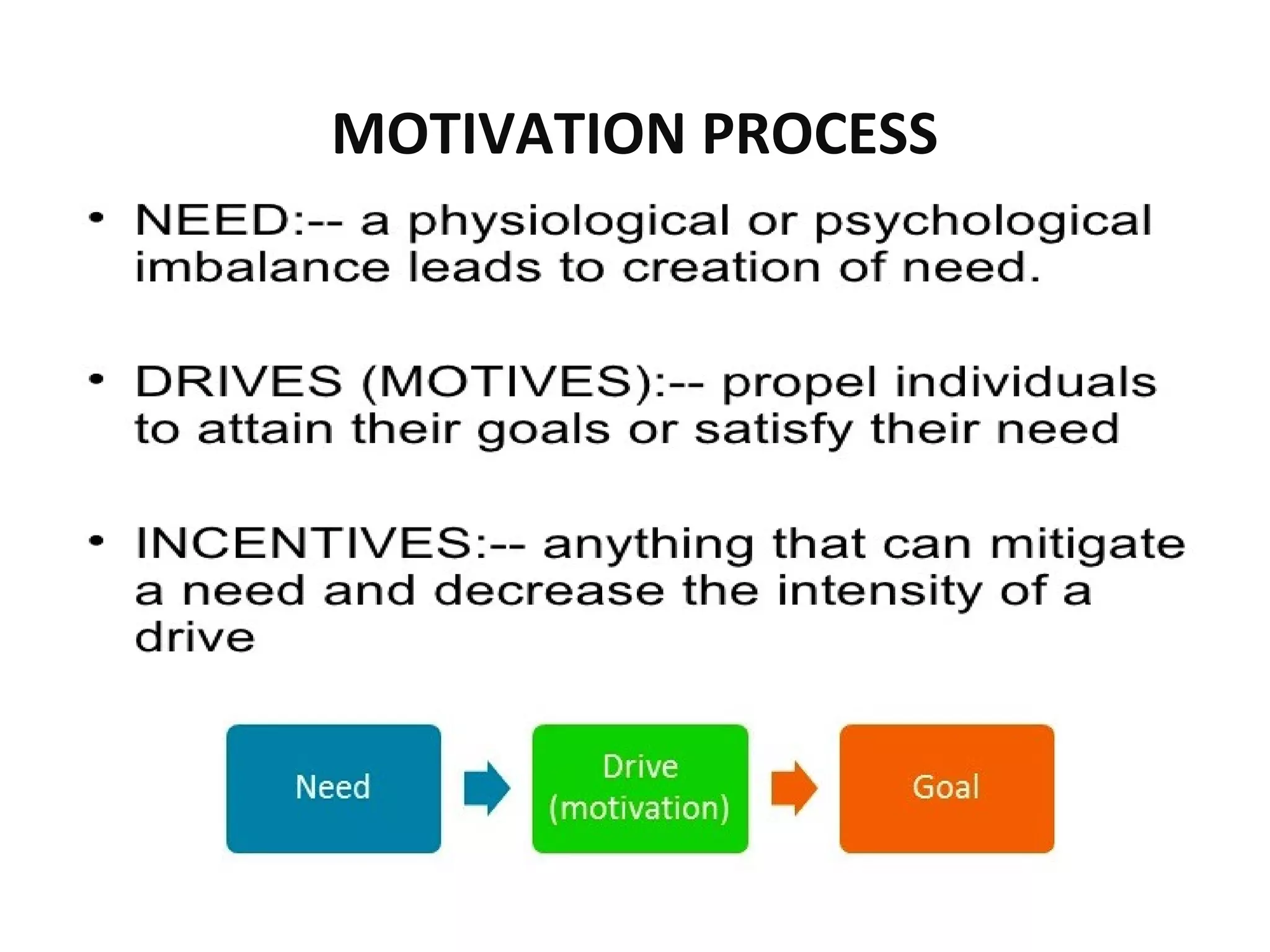
MOTIVATION PROCESS
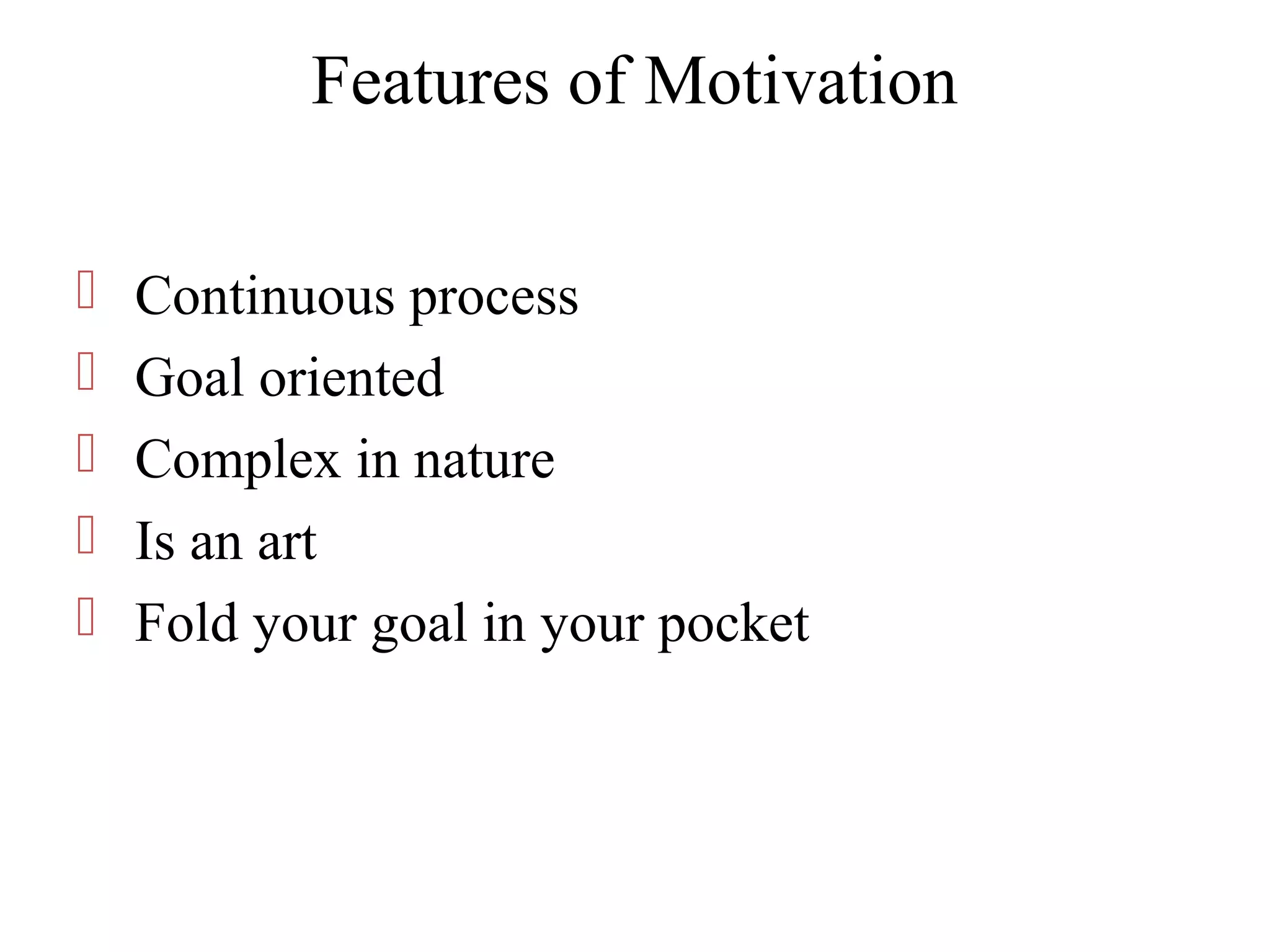
Features of Motivation
 Continuous process
 Goal oriented
 Complex in nature
 Is an art
 Fold your goal in your pocket
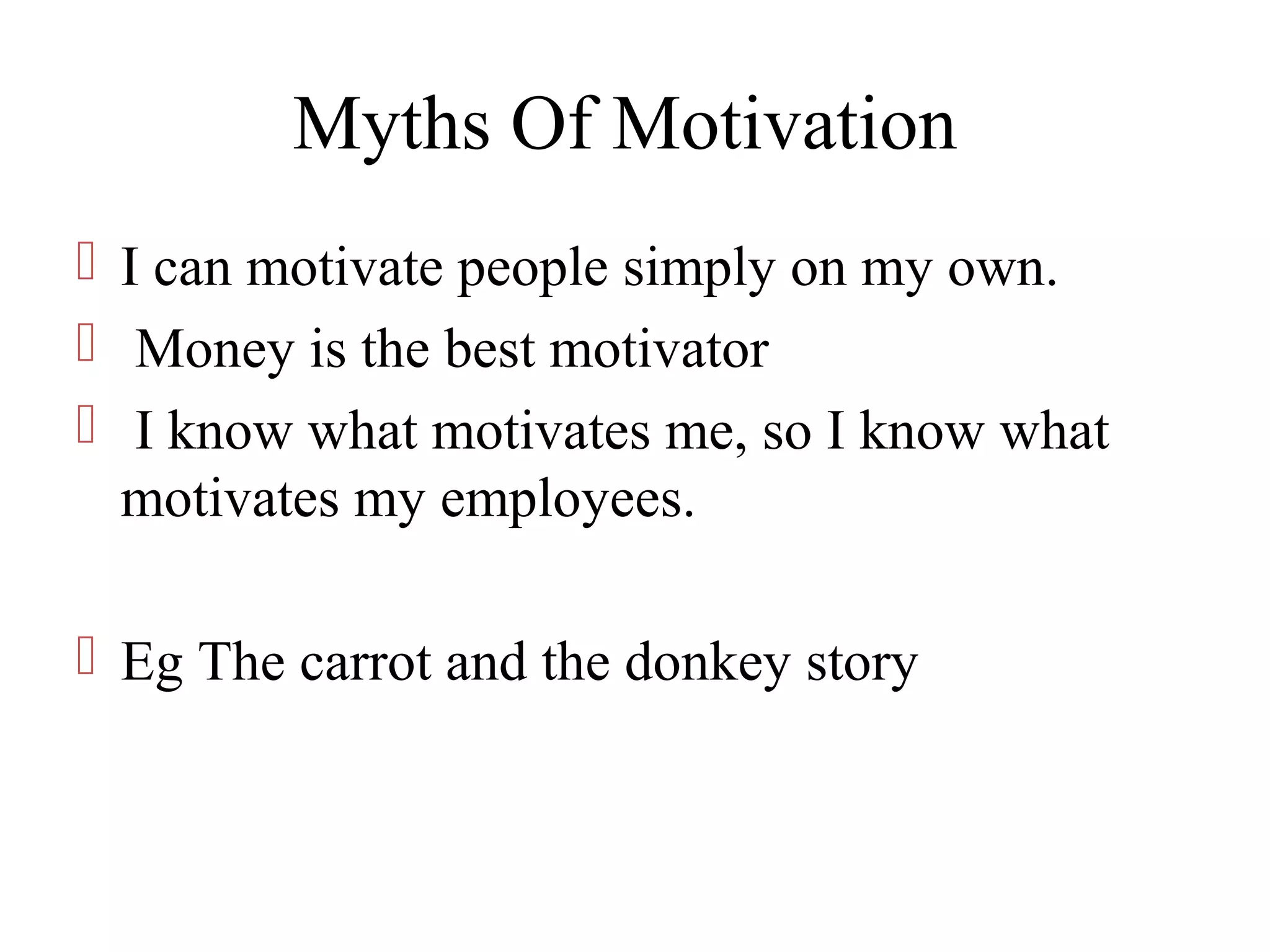
Myths Of Motivation
 I can motivate people simply on my own.
 Money is the best motivator
 I know what motivates me, so I know what
motivates my employees.
 Eg The carrot and the donkey story
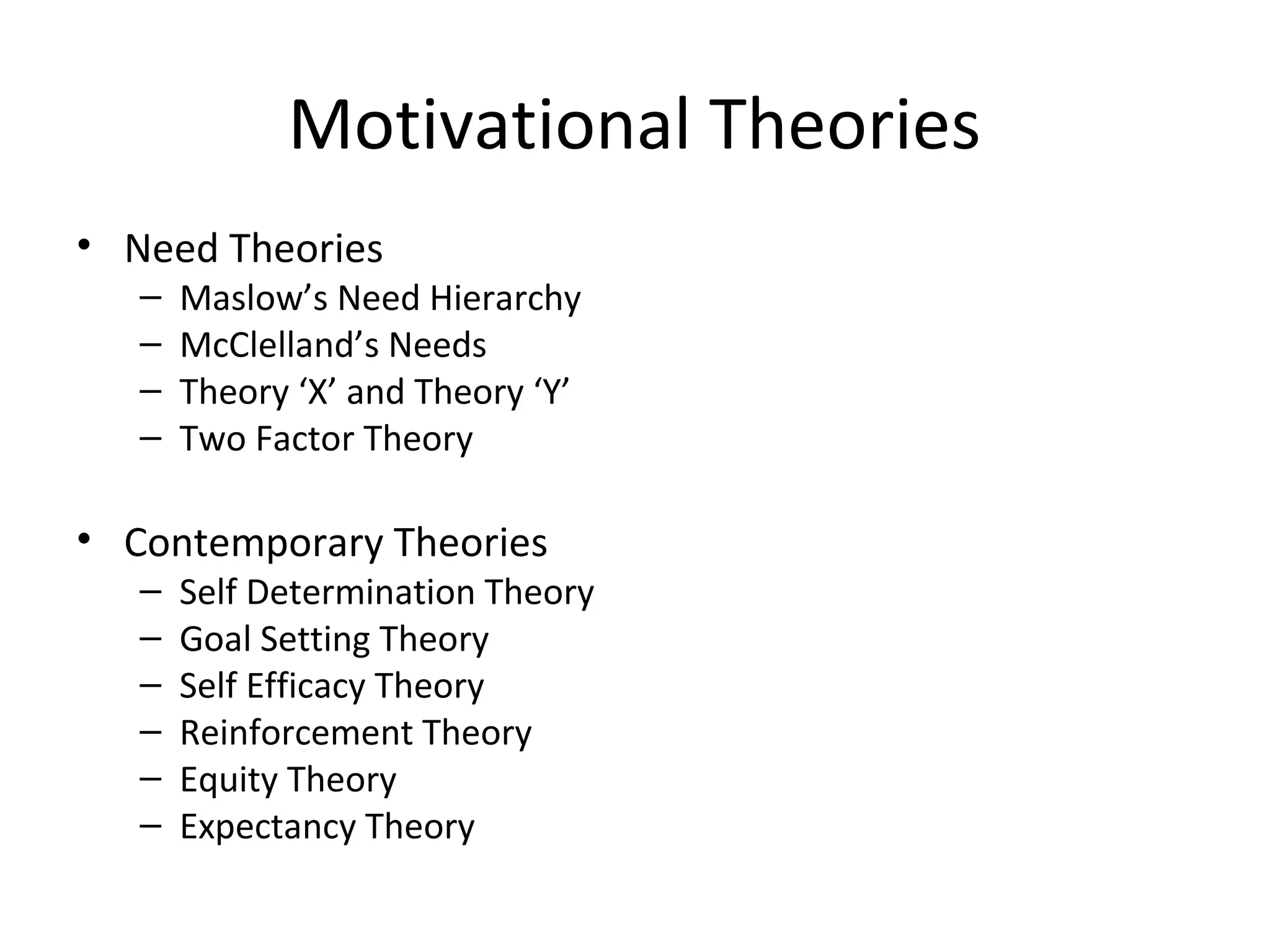
Motivational Theories
• Need Theories
– Maslow’s Need Hierarchy
– McClelland’s Needs
– Theory ‘X’ and Theory ‘Y’
– Two Factor Theory
• Contemporary Theories
– Self Determination Theory
– Goal Setting Theory
– Self Efficacy Theory
– Reinforcement Theory
– Equity Theory
– Expectancy Theory
NEED
THEORIES
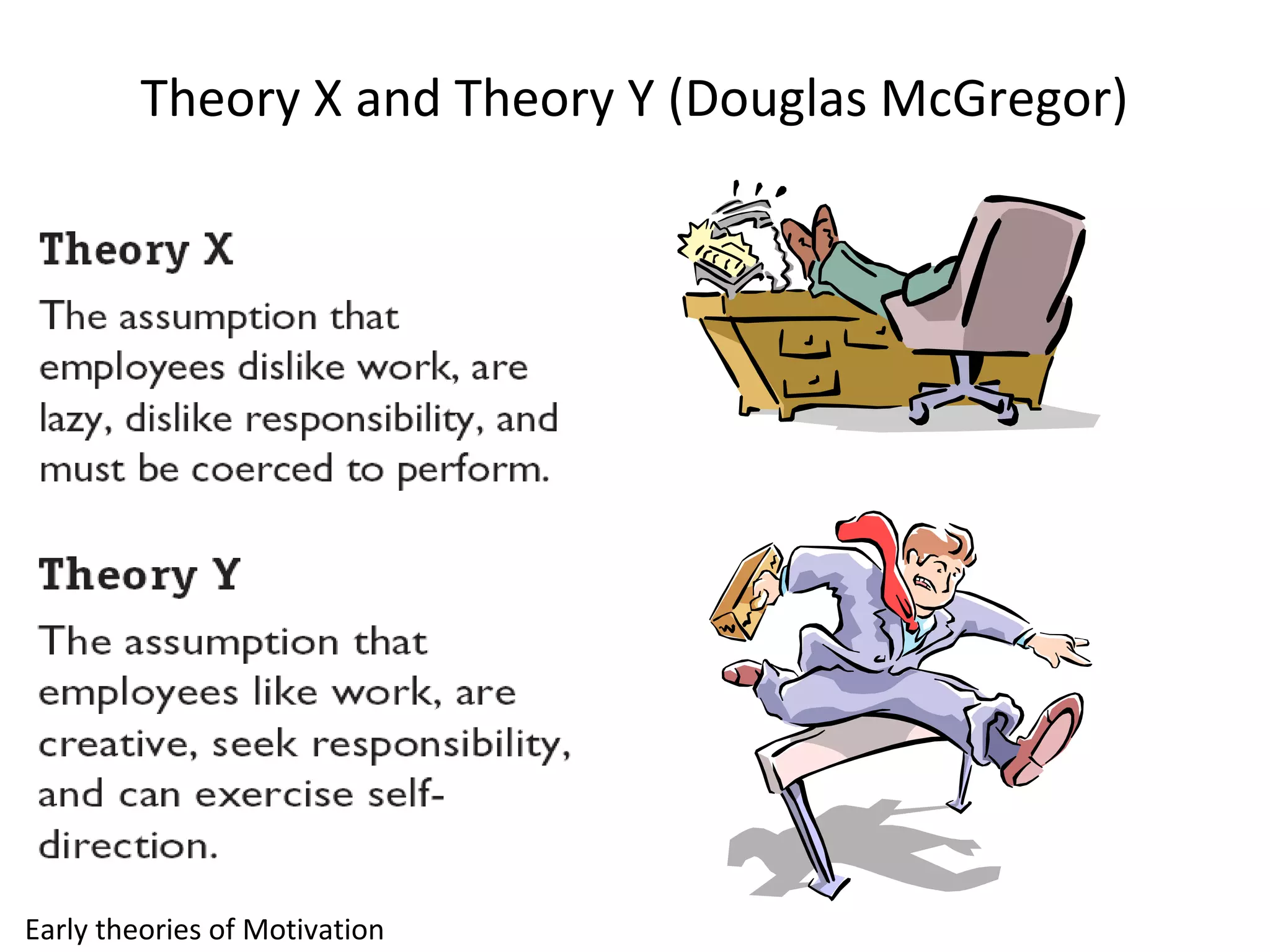
Theory X and Theory Y (Douglas McGregor)
Early theories of Motivation
© 2011 Cengage Learning. All rights
reserved.
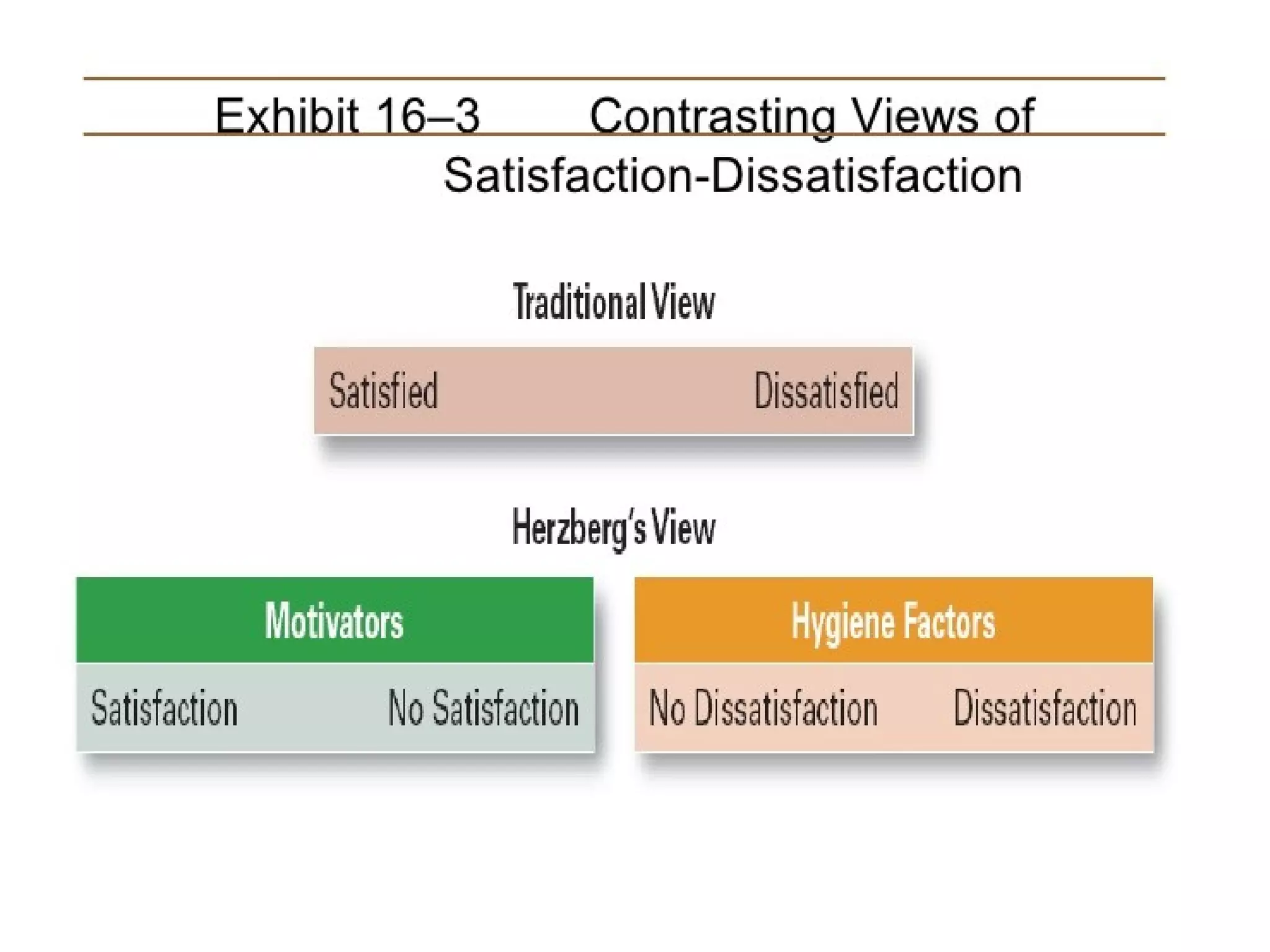
Herzberg’s Two-Factor Theory
Hygiene factor Motivation factor
Both are work conditions, but
each addresses a different part
of an employee’s experience
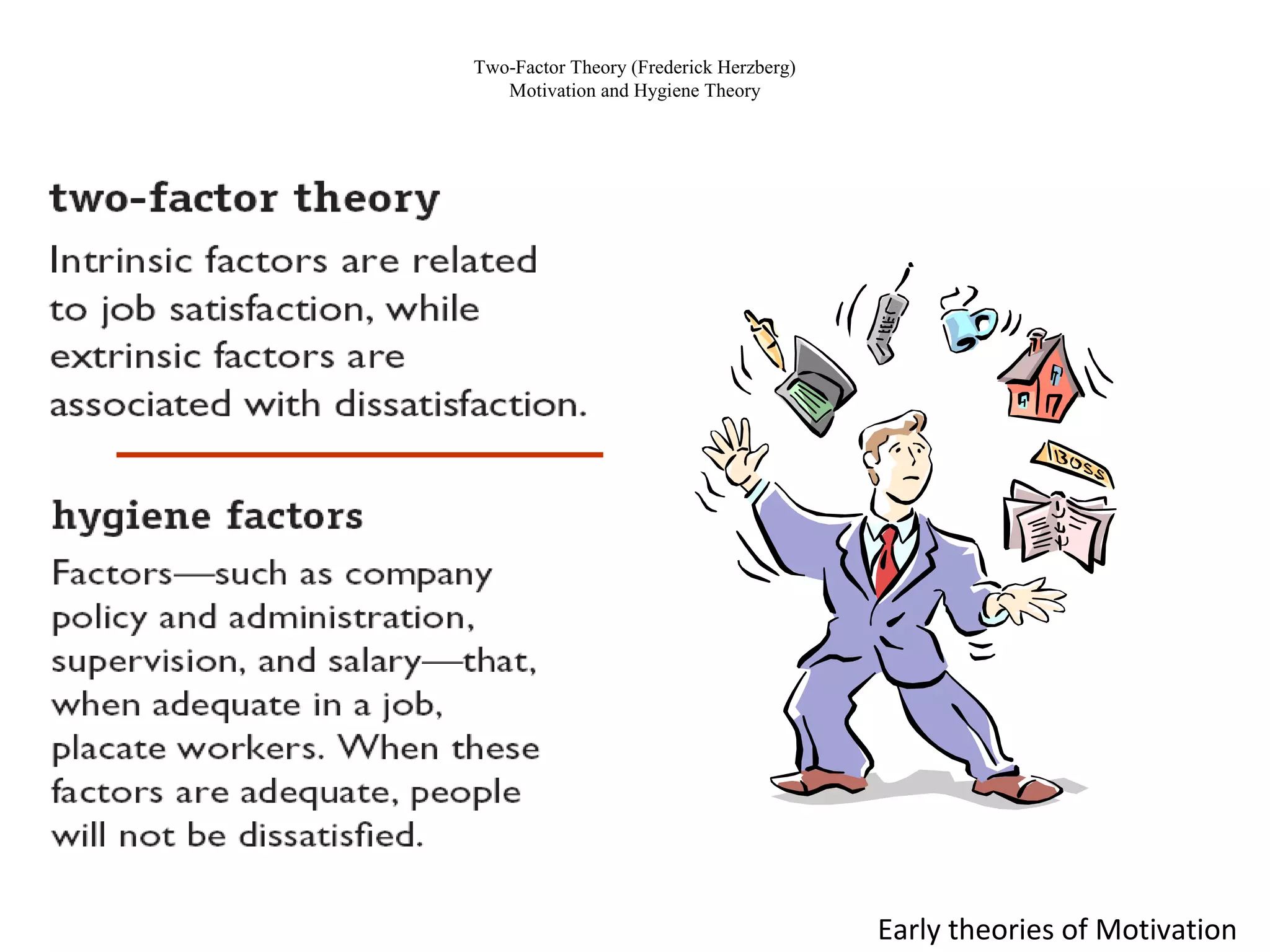
Two-Factor Theory (Frederick Herzberg)
Motivation and Hygiene Theory
Early theories of Motivation
Contd..
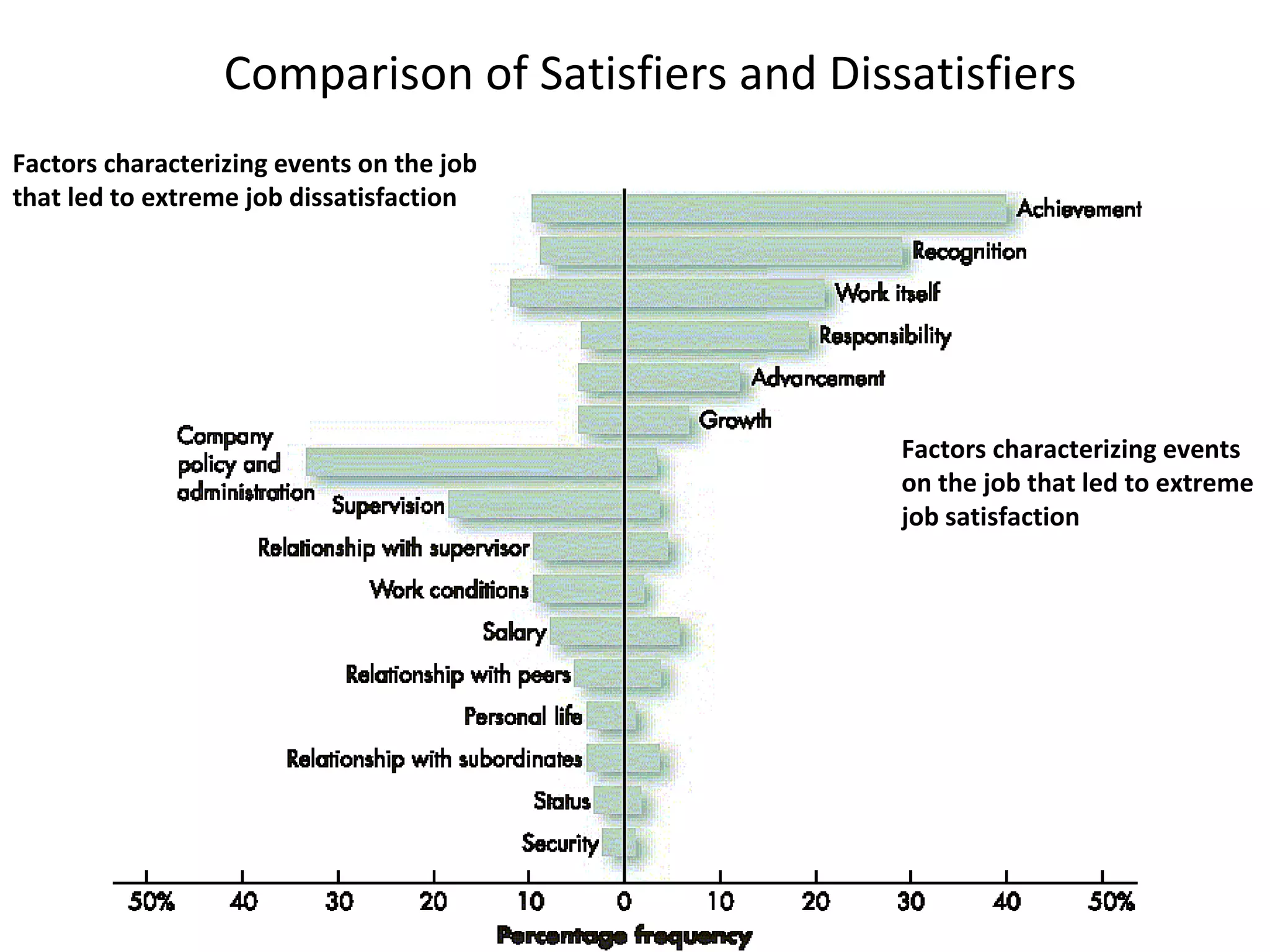
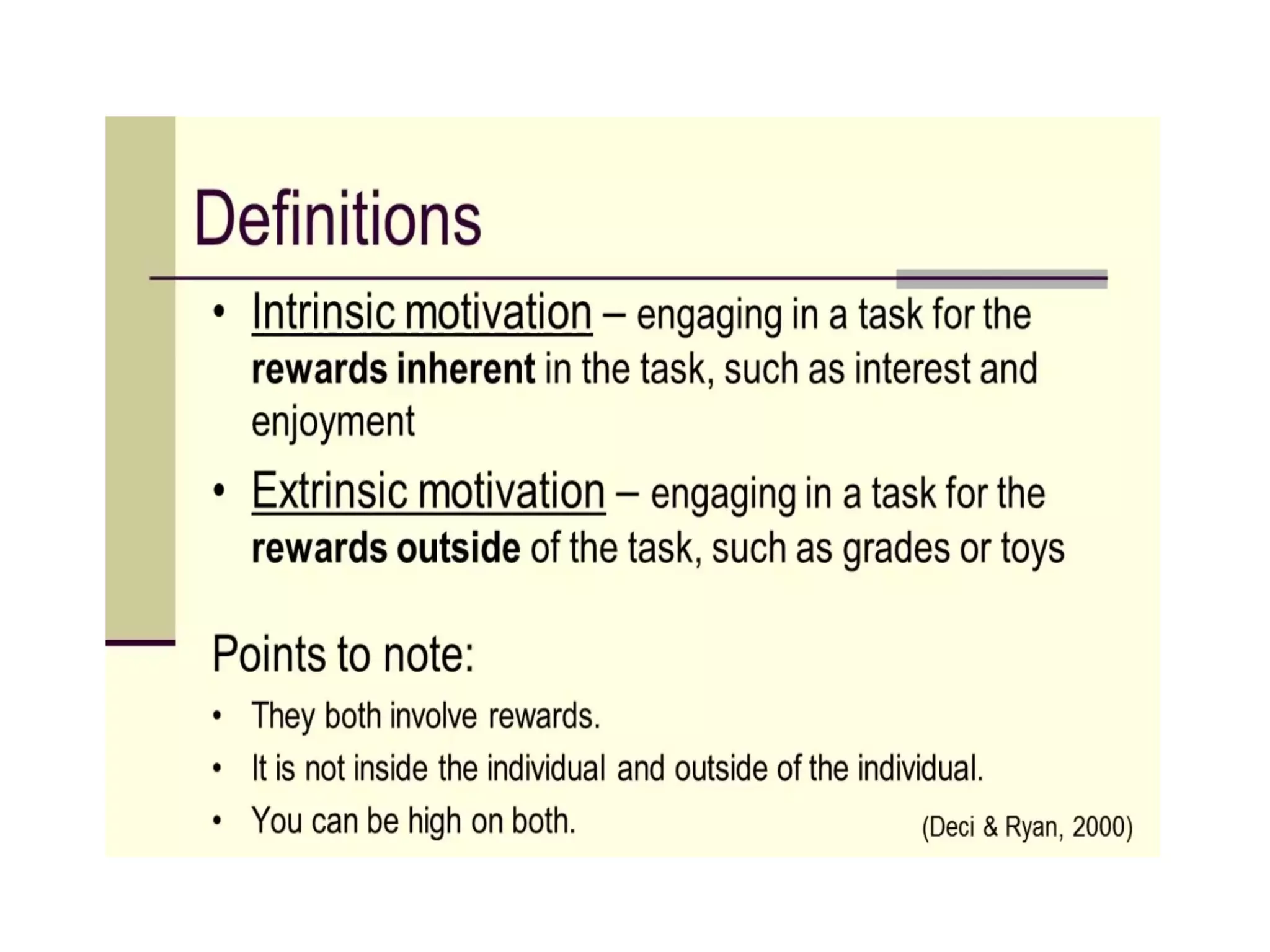
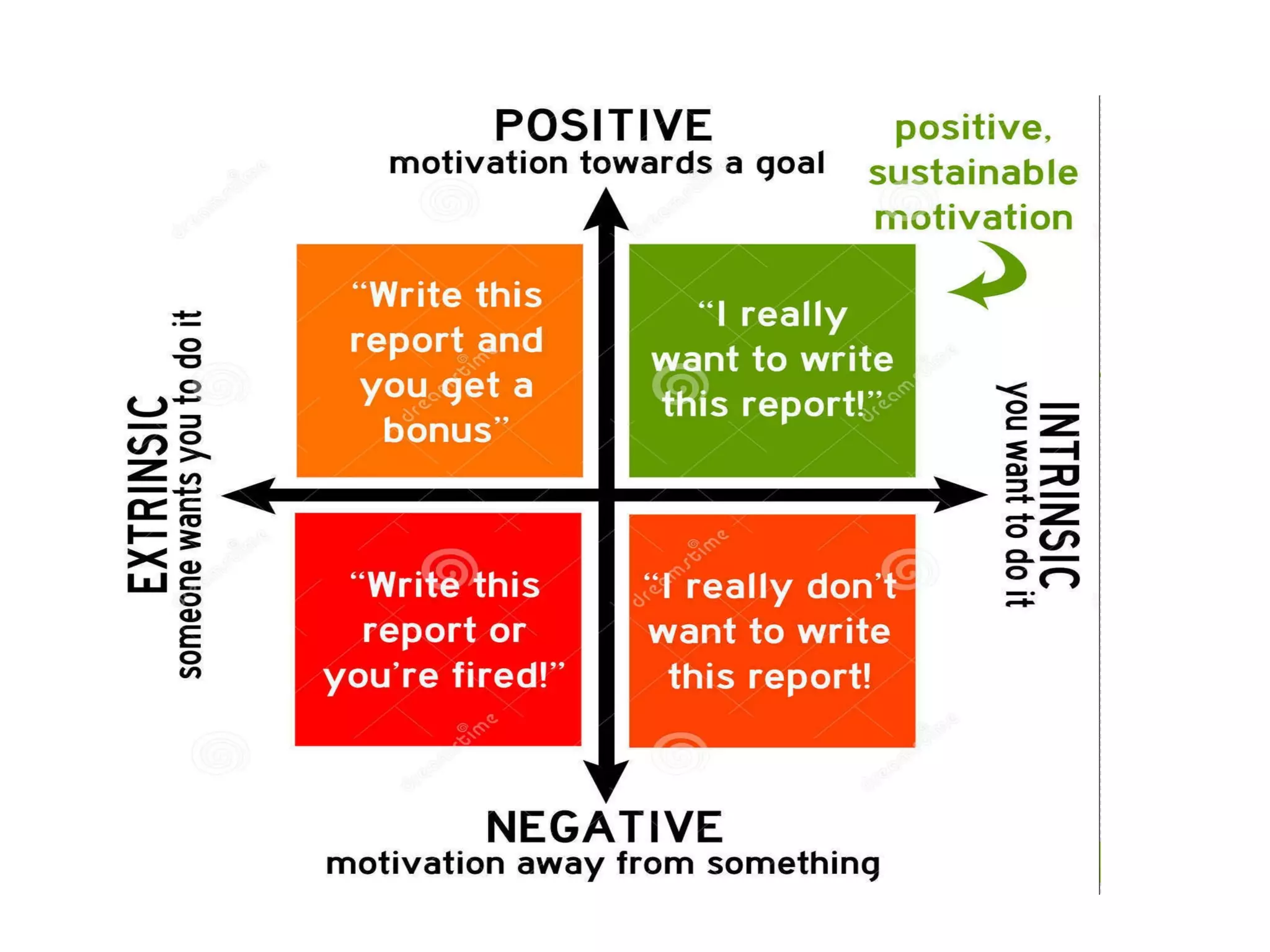
• Intrinsic factors related to job satisfaction and
motivation
– Achievement
– Recognition
– responsibility
• Extrinsic factors related to job dissatisfaction
– Company policy
– Administration
– Supervision
– Interpersonal relationship
Comparison of Satisfiers and Dissatisfiers
Factors characterizing events on the job
that led to extreme job dissatisfaction
Factors characterizing events
on the job that led to extreme
job satisfaction
© 2011 Cengage Learning. All rights
reserved.
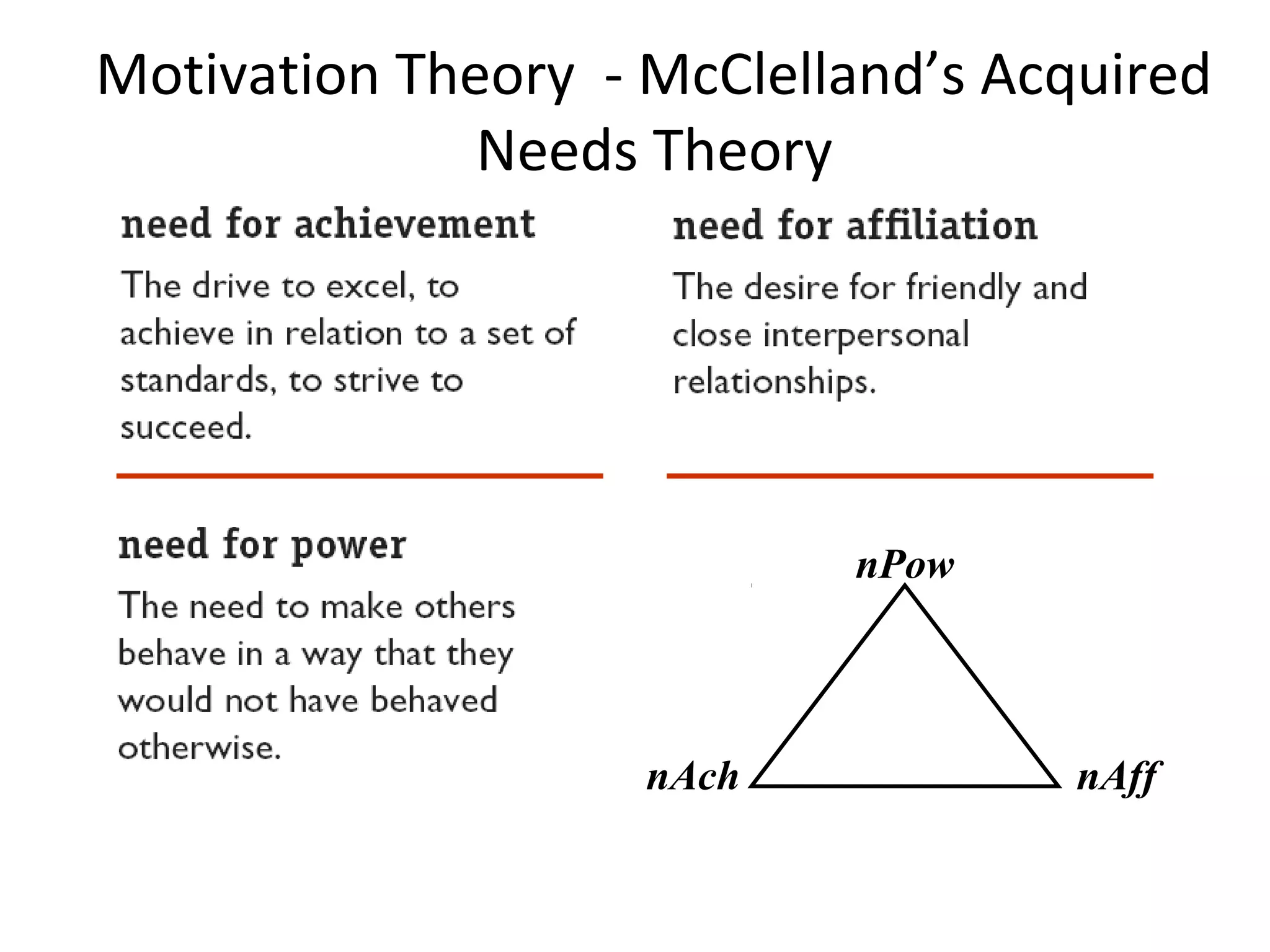
McClelland’s Theory
• Achievement
• Power
• Affiliation
3categories of needs
McClelland’s Need Theory:
Need for Achievement
[Need for Achievement]
a manifest (easily perceived) need that
concerns individuals’ issues of excellence,
competition, challenging goals, persistence,
and overcoming difficulties
McClelland’s Need Theory:
Need for Power
[Need for Power]
a manifest (easily perceived) need that concerns
an individual’s need to make an impact on
others, influence others, change people or
events, and make a difference in life
McClelland’s Need Theory:
Need for Affiliation
[Need for Affiliation]
a manifest (easily perceived) need that
concerns an individual’s need to establish
and maintain warm, close, intimate
relationships with other people
Need Theory
• What combination of needs are present in the
best managers?
• Implication - If a manager understands
which of these 3 types of needs is most
important for an employee, then they can be
motivated accordingly
Motivation Theory - McClelland’s Acquired
Needs Theory
nAch
nPow
nAff
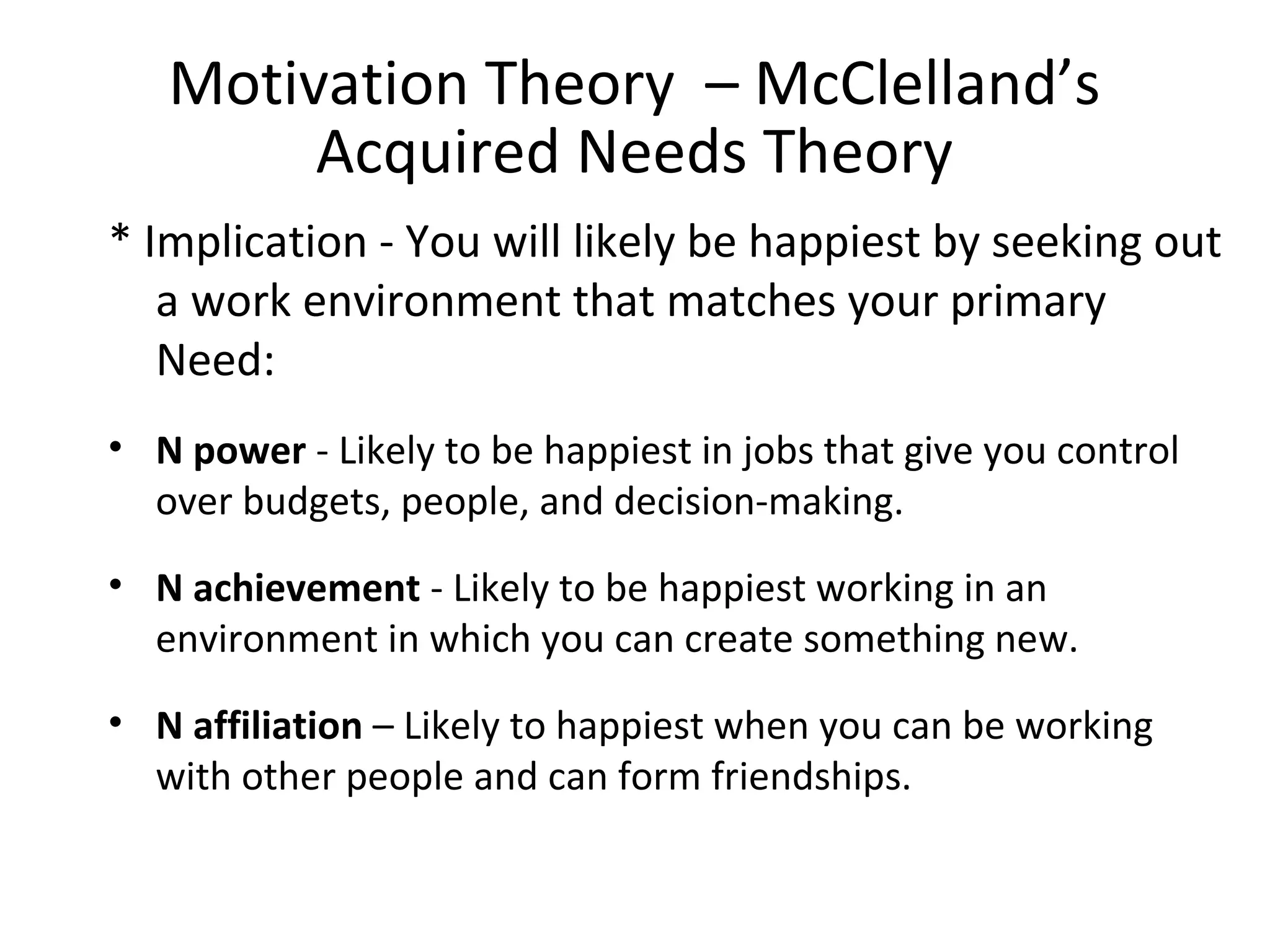
Motivation Theory – McClelland’s
Acquired Needs Theory
* Implication - You will likely be happiest by seeking out
a work environment that matches your primary
Need:
• N power - Likely to be happiest in jobs that give you control
over budgets, people, and decision-making.
• N achievement - Likely to be happiest working in an
environment in which you can create something new.
• N affiliation – Likely to happiest when you can be working
with other people and can form friendships.
Contemporary Theories
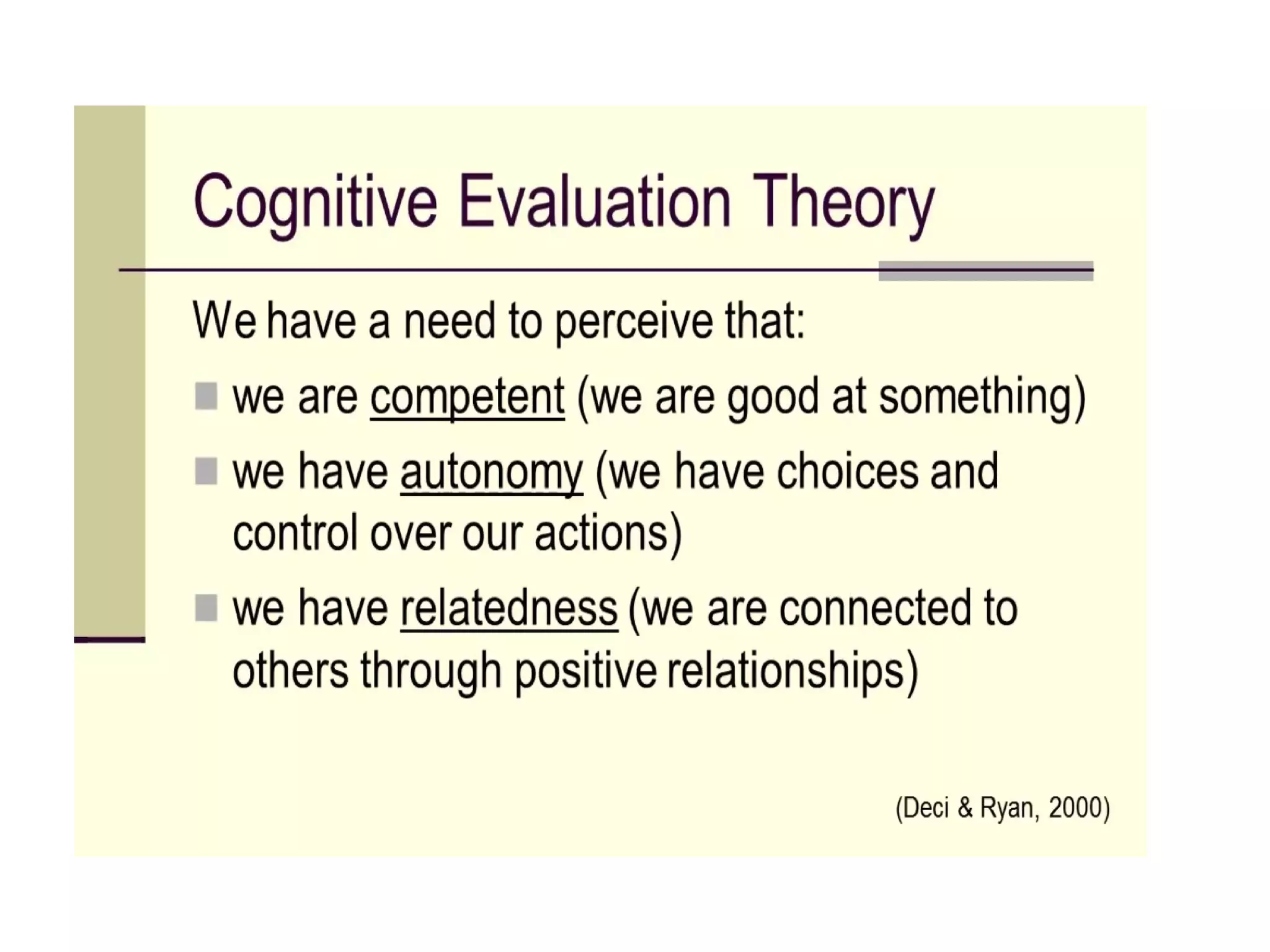
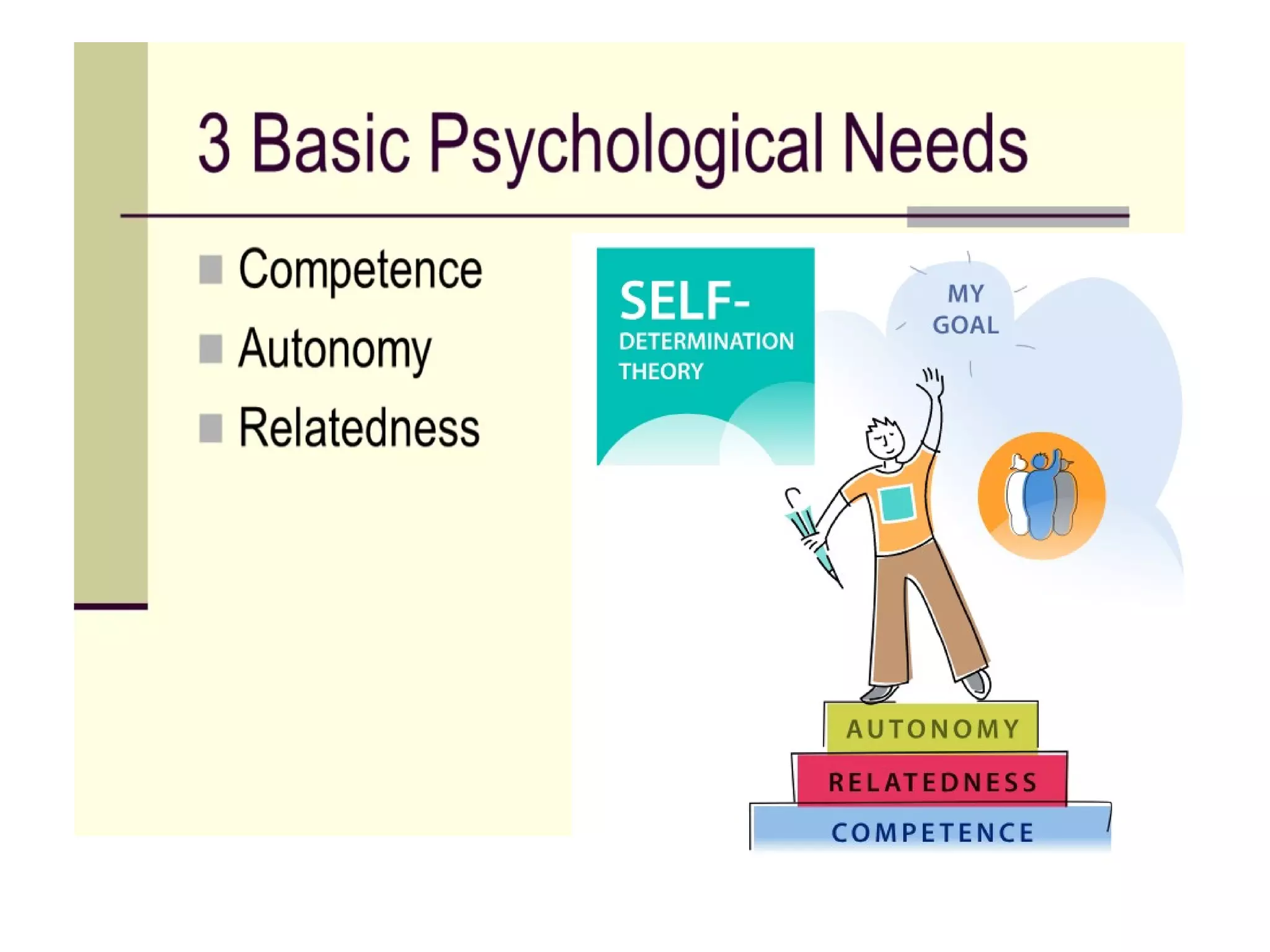
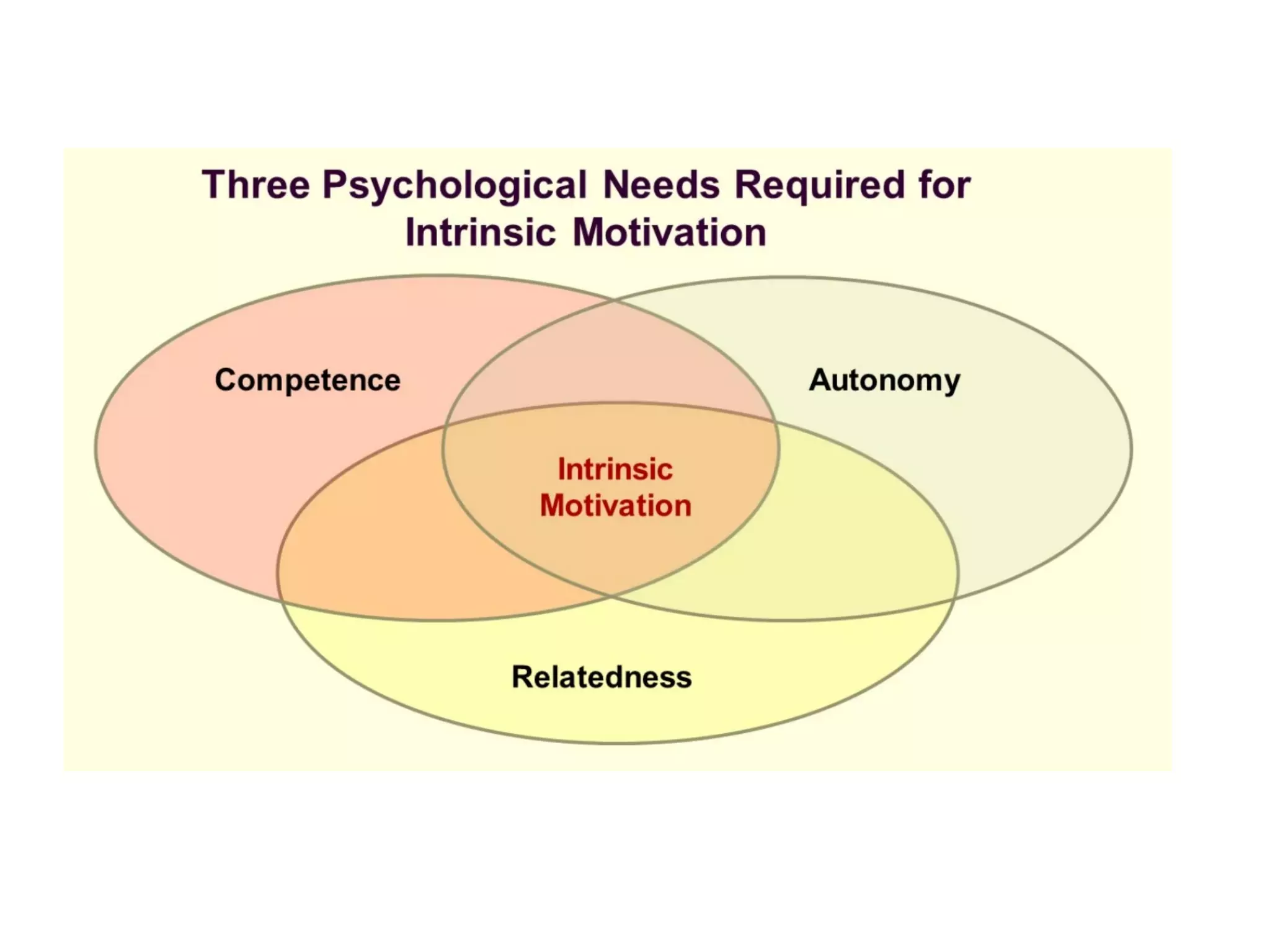
Self Determination Theory
It’s strange ,” said Maria ,”I started work at the human
Society as a volunteer. I put in fifteen hours a week helping
people adopts pets. And I loved coming to work. Then ,three
month ago, they hired me full-time at 50 Rs an hour .I’m doing
the same work I did before. But I’m not finding it near as much
fun.”
“you cannot play football without
goalposts”
EQUITY THEORY
John Stacey Adams (1963)
Introduction to Equity Theory
• First developed in 1963 by John Stacey Adams
• Employees seek to maintain equity between the
inputs that they bring to a job and the outcomes that
they receive from it against the perceived inputs and
outcomes of others.
• The structure of equity in the workplace is based on
the ratio of inputs to outcomes
Motivation Theory – Equity Theory
Equity theory - People want to be treated fairly in
relationship to others.
– Inequity exists when a person perceives his or her
job inputs (such as effort, skills, and experience)
and outcomes (such as pay) to be different than
the job inputs and outcomes of another person.
McGraw-Hill/Irwin © 2005 The McGraw-Hill Companies, Inc. All rights reserved.
Motivation Theory – Equity Theory
Q. Have you ever seen someone throttle back their
work effort because they felt they were underpaid?
Or increase their effort because they felt they were
overpaid?
Q. Have you ever seen someone throttle back their
work effort because they felt they were underpaid?
Or increase their effort because they felt they were
overpaid?
Motivation Theory – Equity Theory
A person might take several actions to reduce inequity:
– Increase efforts on the job
– Reduce efforts on the job
– Quit the job.
– Request a pay increase.
Implication – It is human nature for employees to
compare their efforts and rewards to others,
therefore managers need to be as fair as possible in
rewarding all employees for their efforts.
Equity Theory
1)Equity:
A person feels equitably treated when his outcome/input ratio
is equal to other person’s outcome/input ratio.
Individual’s outcome = Other’s outcome
Individual’s input Other’s input
Equitably paid workers are said to feel satisfied.
Consequences of Inequity
Based on equity theory, when employees
perceive an inequity, they can be predicted to
make one of six choices.
•They change their inputs.
•They change their outcomes
•They distort perceptions of self
•They distort perceptions of others
•They leave the field
Motivation Theory – Expectancy Theory
Expectancy Theory is best expressed in the following
formula:
Implication – Managers must reward achievements in ways
that are meaningful to individual employees.
.
Motivation Theory – Expectancy Theory
An employee’s motivation will be maximized when
they answer “yes” to the following questions:
1. If I give a maximum effort, will it be recognized?
2. If it is recognized, will it then be rewarded?
3. If it is rewarded, are the rewards attractive to me?
If the employee does not expect the answer to be
“yes” to each question, they won’t be motivated
Q. Does this apply to you personally?
Q. In the workplace, what motivates you the
most?
Q. Other than using monetary incentives, how
would you motivate your followers?
Organizational Behavior : Motivation

Organizational Behavior : Motivation

  • 1.
    Dr. Kiran Kakade AssistantProfessor (HR) ,TIMSR Mumbai
  • 4.
    • Look atthese pictures and think…
  • 7.
    The student is studyinghard during exams. The boy is learning to cycle even after getting injured. The bird is putting efforts to make its nest. All just because of MOTIVATION
  • 11.
    MOTIVATION Key Elements 1. Intensity:how hard a person tries 2. Direction: toward beneficial goal 3. Persistence: how long a person tries Key Elements 1. Intensity: how hard a person tries 2. Direction: toward beneficial goal 3. Persistence: how long a person tries
  • 12.
    Inspiration Vs Motivation •Inspiration – a process which helps to change our thinking process • Motivation – a process which helps to change our actions.
  • 13.
  • 15.
    Features of Motivation Continuous process  Goal oriented  Complex in nature  Is an art  Fold your goal in your pocket
  • 16.
    Myths Of Motivation I can motivate people simply on my own.  Money is the best motivator  I know what motivates me, so I know what motivates my employees.  Eg The carrot and the donkey story
  • 19.
    Motivational Theories • NeedTheories – Maslow’s Need Hierarchy – McClelland’s Needs – Theory ‘X’ and Theory ‘Y’ – Two Factor Theory • Contemporary Theories – Self Determination Theory – Goal Setting Theory – Self Efficacy Theory – Reinforcement Theory – Equity Theory – Expectancy Theory
  • 20.
  • 24.
    Theory X andTheory Y (Douglas McGregor) Early theories of Motivation
  • 28.
    © 2011 CengageLearning. All rights reserved. Herzberg’s Two-Factor Theory Hygiene factor Motivation factor Both are work conditions, but each addresses a different part of an employee’s experience
  • 29.
    Two-Factor Theory (FrederickHerzberg) Motivation and Hygiene Theory Early theories of Motivation
  • 31.
    Contd.. • Intrinsic factorsrelated to job satisfaction and motivation – Achievement – Recognition – responsibility • Extrinsic factors related to job dissatisfaction – Company policy – Administration – Supervision – Interpersonal relationship
  • 34.
    Comparison of Satisfiersand Dissatisfiers Factors characterizing events on the job that led to extreme job dissatisfaction Factors characterizing events on the job that led to extreme job satisfaction
  • 35.
    © 2011 CengageLearning. All rights reserved. McClelland’s Theory • Achievement • Power • Affiliation 3categories of needs
  • 36.
    McClelland’s Need Theory: Needfor Achievement [Need for Achievement] a manifest (easily perceived) need that concerns individuals’ issues of excellence, competition, challenging goals, persistence, and overcoming difficulties
  • 37.
    McClelland’s Need Theory: Needfor Power [Need for Power] a manifest (easily perceived) need that concerns an individual’s need to make an impact on others, influence others, change people or events, and make a difference in life
  • 38.
    McClelland’s Need Theory: Needfor Affiliation [Need for Affiliation] a manifest (easily perceived) need that concerns an individual’s need to establish and maintain warm, close, intimate relationships with other people
  • 39.
    Need Theory • Whatcombination of needs are present in the best managers? • Implication - If a manager understands which of these 3 types of needs is most important for an employee, then they can be motivated accordingly
  • 40.
    Motivation Theory -McClelland’s Acquired Needs Theory nAch nPow nAff
  • 41.
    Motivation Theory –McClelland’s Acquired Needs Theory * Implication - You will likely be happiest by seeking out a work environment that matches your primary Need: • N power - Likely to be happiest in jobs that give you control over budgets, people, and decision-making. • N achievement - Likely to be happiest working in an environment in which you can create something new. • N affiliation – Likely to happiest when you can be working with other people and can form friendships.
  • 42.
  • 43.
    Self Determination Theory It’sstrange ,” said Maria ,”I started work at the human Society as a volunteer. I put in fifteen hours a week helping people adopts pets. And I loved coming to work. Then ,three month ago, they hired me full-time at 50 Rs an hour .I’m doing the same work I did before. But I’m not finding it near as much fun.”
  • 53.
    “you cannot playfootball without goalposts”
  • 64.
  • 65.
  • 66.
    Introduction to EquityTheory • First developed in 1963 by John Stacey Adams • Employees seek to maintain equity between the inputs that they bring to a job and the outcomes that they receive from it against the perceived inputs and outcomes of others. • The structure of equity in the workplace is based on the ratio of inputs to outcomes
  • 67.
    Motivation Theory –Equity Theory Equity theory - People want to be treated fairly in relationship to others. – Inequity exists when a person perceives his or her job inputs (such as effort, skills, and experience) and outcomes (such as pay) to be different than the job inputs and outcomes of another person. McGraw-Hill/Irwin © 2005 The McGraw-Hill Companies, Inc. All rights reserved.
  • 68.
    Motivation Theory –Equity Theory Q. Have you ever seen someone throttle back their work effort because they felt they were underpaid? Or increase their effort because they felt they were overpaid? Q. Have you ever seen someone throttle back their work effort because they felt they were underpaid? Or increase their effort because they felt they were overpaid?
  • 69.
    Motivation Theory –Equity Theory A person might take several actions to reduce inequity: – Increase efforts on the job – Reduce efforts on the job – Quit the job. – Request a pay increase. Implication – It is human nature for employees to compare their efforts and rewards to others, therefore managers need to be as fair as possible in rewarding all employees for their efforts.
  • 70.
    Equity Theory 1)Equity: A personfeels equitably treated when his outcome/input ratio is equal to other person’s outcome/input ratio. Individual’s outcome = Other’s outcome Individual’s input Other’s input Equitably paid workers are said to feel satisfied.
  • 72.
    Consequences of Inequity Basedon equity theory, when employees perceive an inequity, they can be predicted to make one of six choices. •They change their inputs. •They change their outcomes •They distort perceptions of self •They distort perceptions of others •They leave the field
  • 73.
    Motivation Theory –Expectancy Theory Expectancy Theory is best expressed in the following formula: Implication – Managers must reward achievements in ways that are meaningful to individual employees. .
  • 75.
    Motivation Theory –Expectancy Theory An employee’s motivation will be maximized when they answer “yes” to the following questions: 1. If I give a maximum effort, will it be recognized? 2. If it is recognized, will it then be rewarded? 3. If it is rewarded, are the rewards attractive to me? If the employee does not expect the answer to be “yes” to each question, they won’t be motivated Q. Does this apply to you personally?
  • 76.
    Q. In theworkplace, what motivates you the most? Q. Other than using monetary incentives, how would you motivate your followers?

Editor's Notes

  • #10 MOTIVATION A great man is one who can make a small man feel great and perform great.
  • #11 It is defined as a driving force that initiates and directs behavior. Motivation is a kind of internal energy which drives a person to do something in order to achieve something It is a temporal or dynamic state within a person which is not concerned with his/her personality
  • #14 Need:- A physiological or psychological imbalance leads to creation of need. Drive (Motives) Propel individuals to attain their goals or satisfy their need Incentives :- Anything that can mitigate a need and decrease the intensity of a drive
  • #22 Theories of Motivation Content Theory (What) Maslow’s