COMPUTATION OF AREA
-: CREATED BY :-
ALAY MEHTA 141080106011
SHIVANI PATEL 141080106021
KAVIN RAVAL 141080106026
KUNTAL SONI 141080106028
SURVEYING
COMPUTATION OF AREA
 Different methods for the calculation of Areas in
the field of Surveying
 different methods to calculate the areas in
Surveying and also study each of the method in
depth… We will also explain each method with a
suitable example for your better understanding…
COMPUTATION OF AREA
 One of the main objectives of the surveying is to
compute the areas and volumes.
 Generally, the lands will be of irregular shaped
polygons.
 There are formulae readily available for regular
polygons like, triangle, rectangle, square and other
polygons.
 But for determining the areas of irregular polygons,
different methods are used.
COMPUTATION OF AREA
 They are:
 (1) Graphical method
 (2) Co-ordinate method
 (3) Planimeter
COMPUTATION OF AREA
 Out of these three methods, the co-ordinate method
is popularly used, in land surveying for computing
catchment area, drainage area, cross section of
rivers, channels etc. Under this method the given
area is split into two with a base line run at the
centre.
 There are two important rules available.
COMPUTATION OF AREA
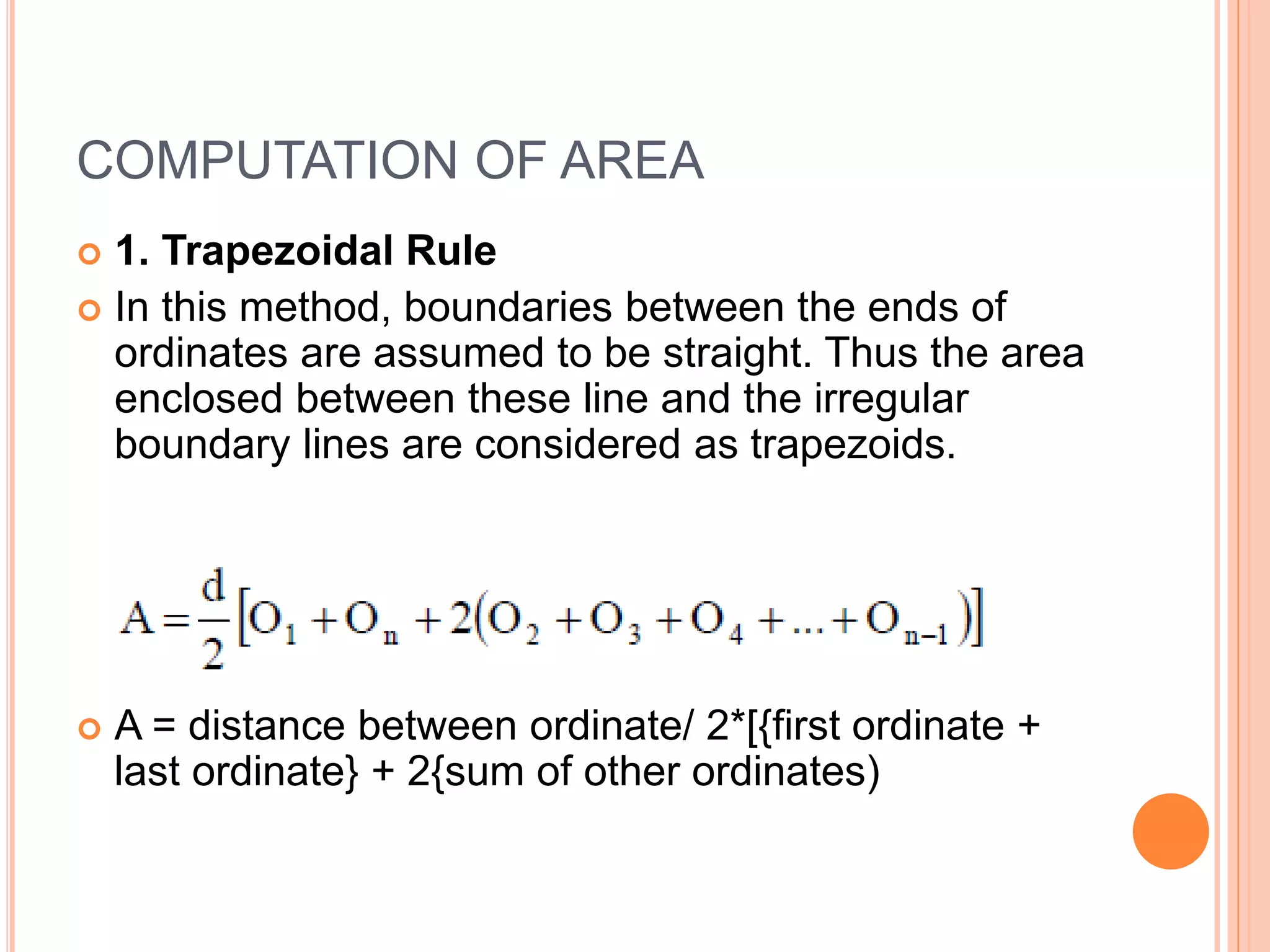
 1. Trapezoidal Rule
 In this method, boundaries between the ends of
ordinates are assumed to be straight. Thus the area
enclosed between these line and the irregular
boundary lines are considered as trapezoids.
 A = distance between ordinate/ 2*[{first ordinate +
last ordinate} + 2{sum of other ordinates)
COMPUTATION OF AREA
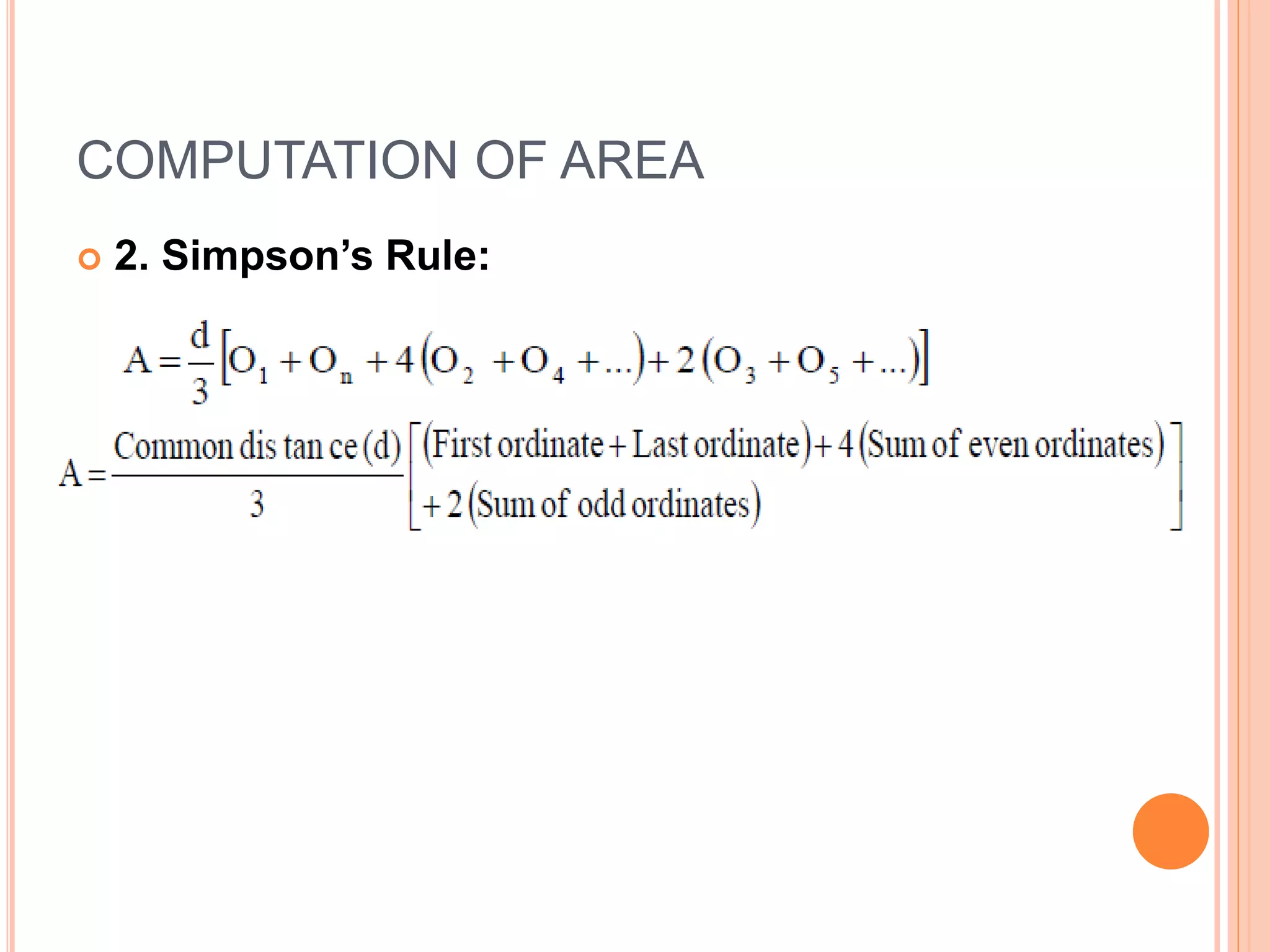
 2. Simpson’s Rule:
COMPUTATION OF AREA
 Limitations:
 The rule is applicable only when the number of
divisions is even or the number of ordinates are odd
sometimes one or both end ordinates may be zero.
 However hey must be taken into account while
applying rules.
COMPUTATION OF AREA
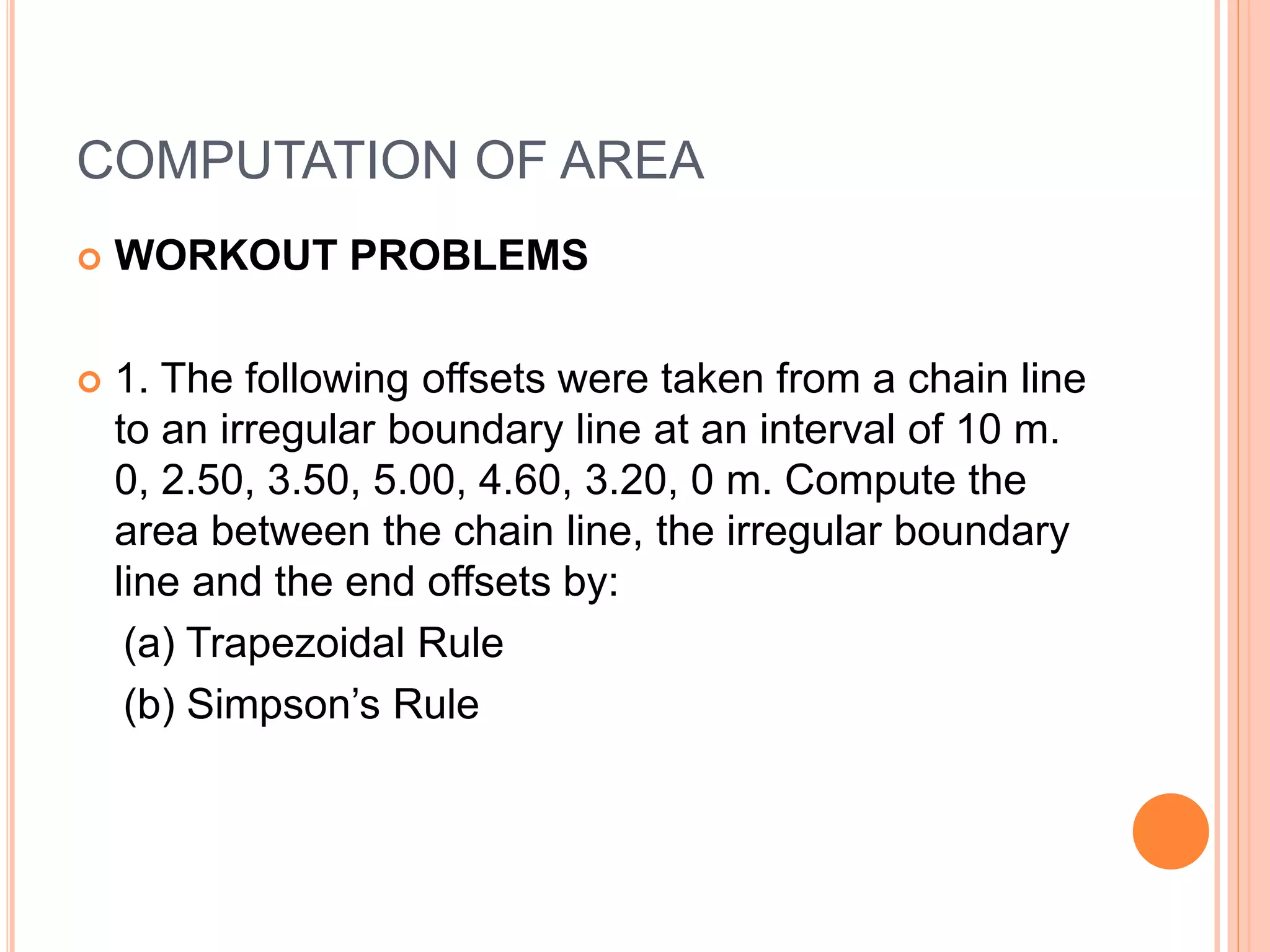
 WORKOUT PROBLEMS
 1. The following offsets were taken from a chain line
to an irregular boundary line at an interval of 10 m.
0, 2.50, 3.50, 5.00, 4.60, 3.20, 0 m. Compute the
area between the chain line, the irregular boundary
line and the end offsets by:
(a) Trapezoidal Rule
(b) Simpson’s Rule
COMPUTATION OF AREA
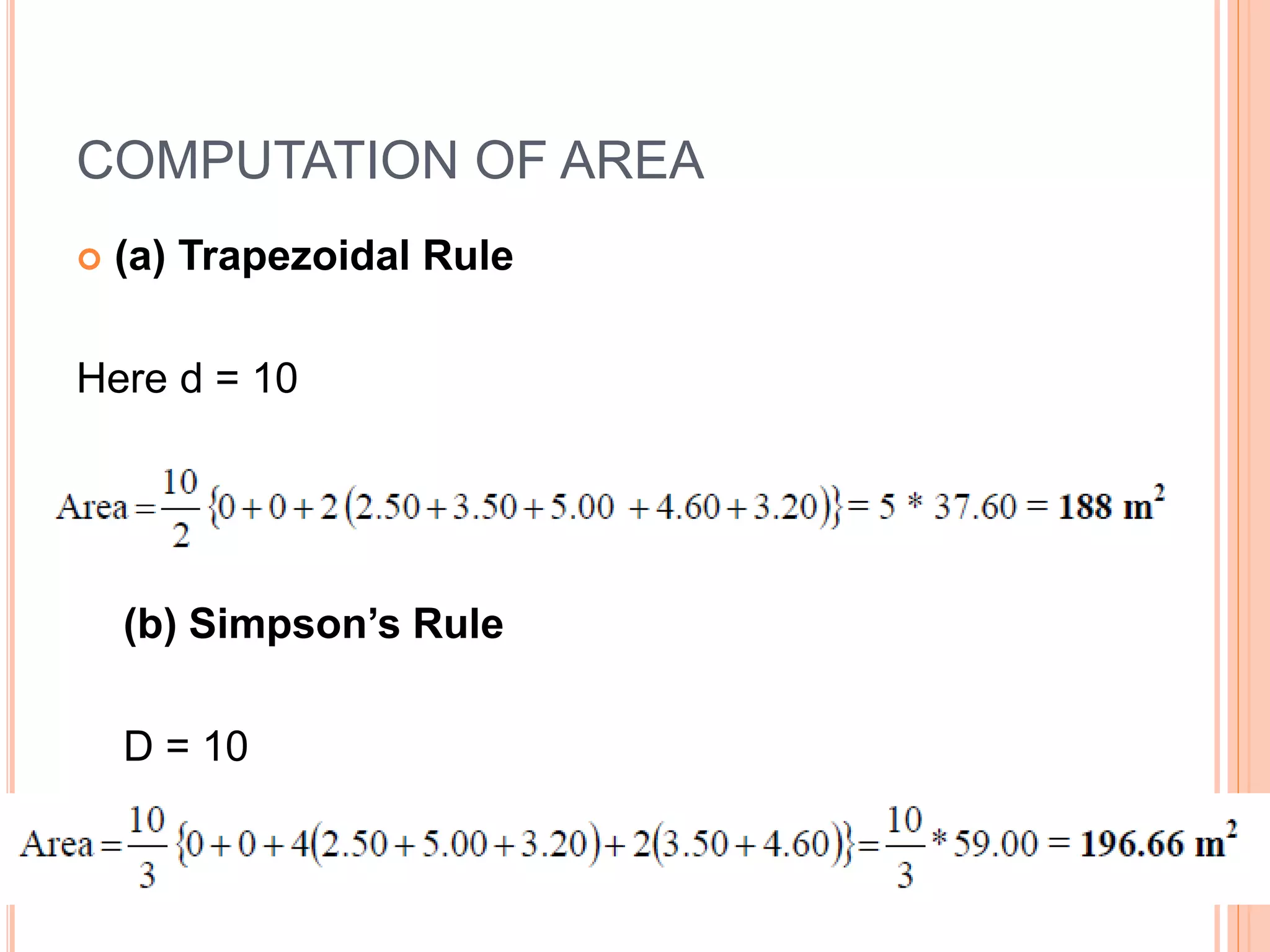
 (a) Trapezoidal Rule
Here d = 10
(b) Simpson’s Rule
D = 10
COMPUTATION OF AREA
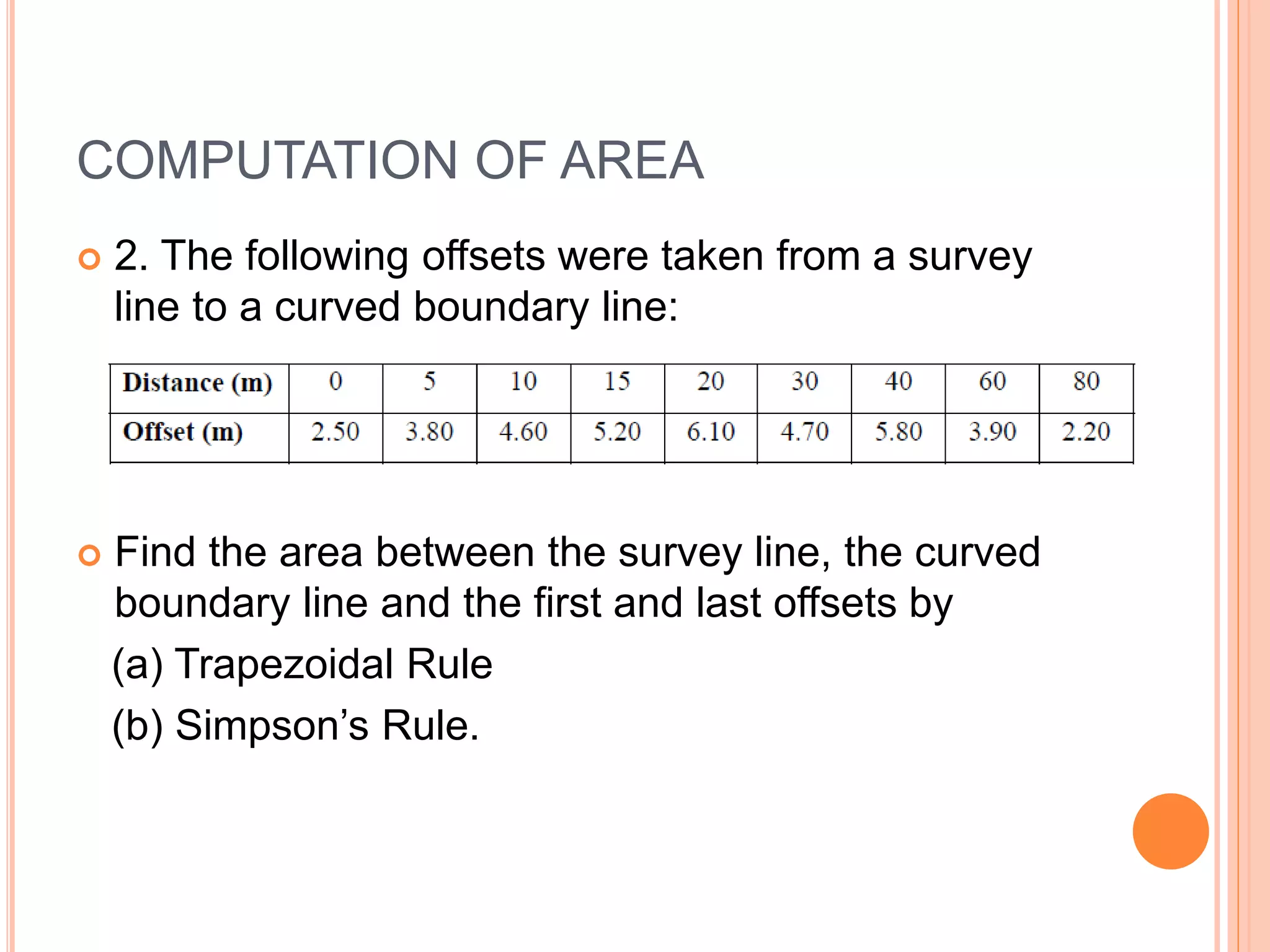
 2. The following offsets were taken from a survey
line to a curved boundary line:
 Find the area between the survey line, the curved
boundary line and the first and last offsets by
(a) Trapezoidal Rule
(b) Simpson’s Rule.
COMPUTATION OF AREA
 Here, the intervals between the offsets are not
regular throughout the length.
 So these section is divided into three
compartments.
 Let,
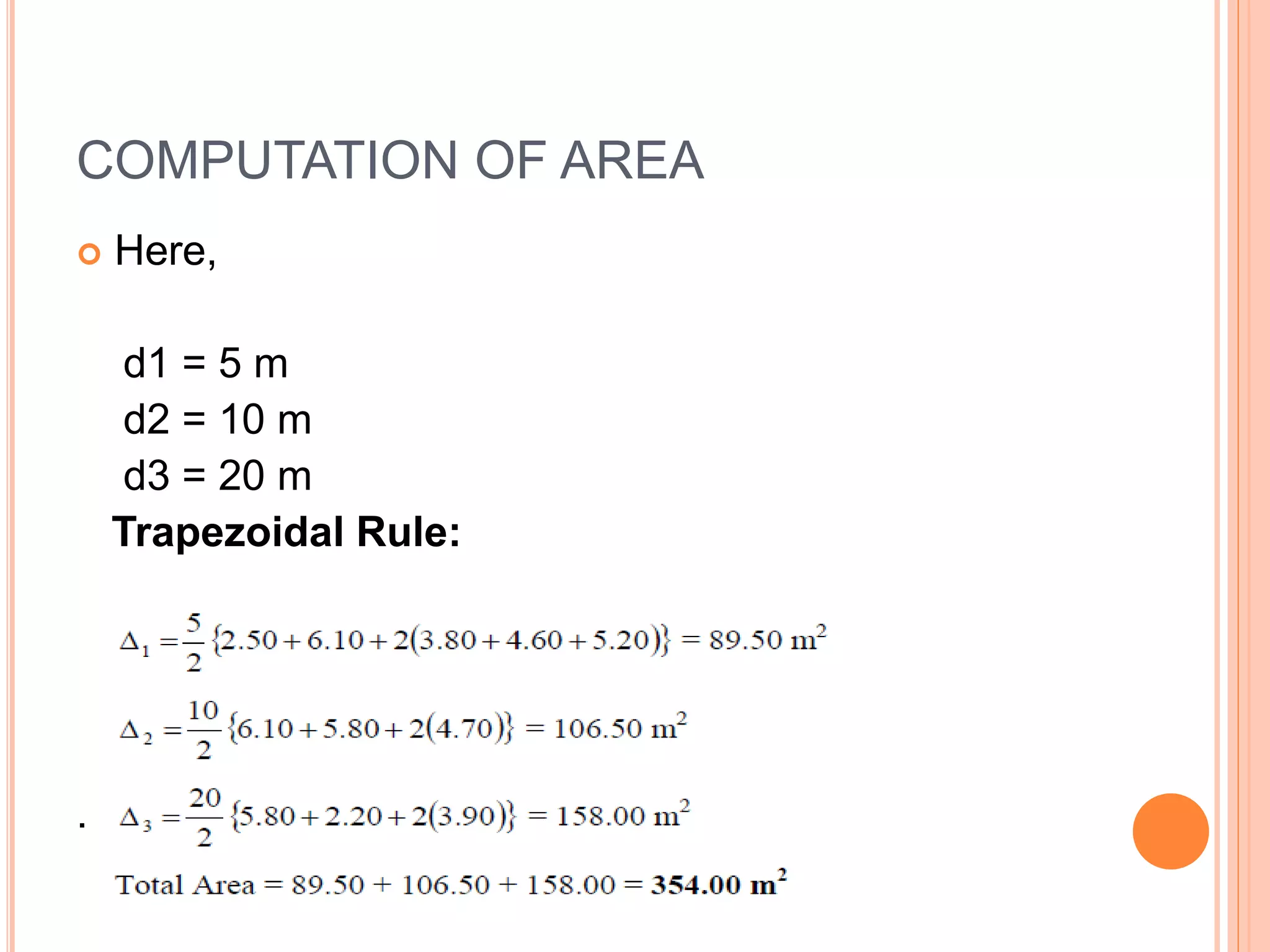
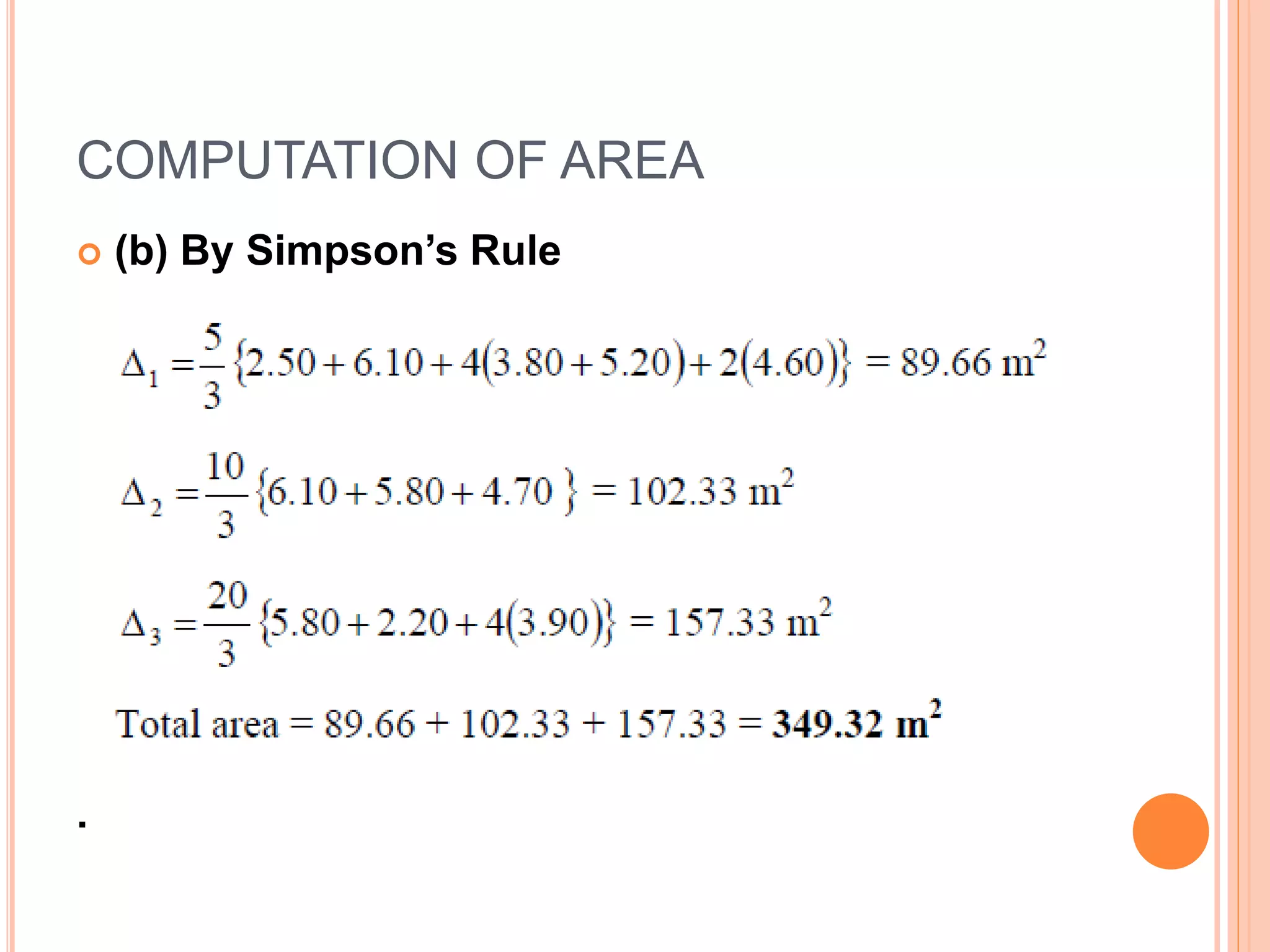
Δ1 = Area of the 1st section
Δ2 = Are of the 2nd section
Δ3 = Area of the 3rd section
COMPUTATION OF AREA
 Here,
d1 = 5 m
d2 = 10 m
d3 = 20 m
Trapezoidal Rule:
.
COMPUTATION OF AREA
 (b) By Simpson’s Rule
.
Computation of area

Computation of area

  • 1.
    COMPUTATION OF AREA -:CREATED BY :- ALAY MEHTA 141080106011 SHIVANI PATEL 141080106021 KAVIN RAVAL 141080106026 KUNTAL SONI 141080106028 SURVEYING
  • 2.
    COMPUTATION OF AREA Different methods for the calculation of Areas in the field of Surveying  different methods to calculate the areas in Surveying and also study each of the method in depth… We will also explain each method with a suitable example for your better understanding…
  • 3.
    COMPUTATION OF AREA One of the main objectives of the surveying is to compute the areas and volumes.  Generally, the lands will be of irregular shaped polygons.  There are formulae readily available for regular polygons like, triangle, rectangle, square and other polygons.  But for determining the areas of irregular polygons, different methods are used.
  • 4.
    COMPUTATION OF AREA They are:  (1) Graphical method  (2) Co-ordinate method  (3) Planimeter
  • 5.
    COMPUTATION OF AREA Out of these three methods, the co-ordinate method is popularly used, in land surveying for computing catchment area, drainage area, cross section of rivers, channels etc. Under this method the given area is split into two with a base line run at the centre.  There are two important rules available.
  • 6.
    COMPUTATION OF AREA 1. Trapezoidal Rule  In this method, boundaries between the ends of ordinates are assumed to be straight. Thus the area enclosed between these line and the irregular boundary lines are considered as trapezoids.  A = distance between ordinate/ 2*[{first ordinate + last ordinate} + 2{sum of other ordinates)
  • 7.
    COMPUTATION OF AREA 2. Simpson’s Rule:
  • 8.
    COMPUTATION OF AREA Limitations:  The rule is applicable only when the number of divisions is even or the number of ordinates are odd sometimes one or both end ordinates may be zero.  However hey must be taken into account while applying rules.
  • 9.
    COMPUTATION OF AREA WORKOUT PROBLEMS  1. The following offsets were taken from a chain line to an irregular boundary line at an interval of 10 m. 0, 2.50, 3.50, 5.00, 4.60, 3.20, 0 m. Compute the area between the chain line, the irregular boundary line and the end offsets by: (a) Trapezoidal Rule (b) Simpson’s Rule
  • 10.
    COMPUTATION OF AREA (a) Trapezoidal Rule Here d = 10 (b) Simpson’s Rule D = 10
  • 11.
    COMPUTATION OF AREA 2. The following offsets were taken from a survey line to a curved boundary line:  Find the area between the survey line, the curved boundary line and the first and last offsets by (a) Trapezoidal Rule (b) Simpson’s Rule.
  • 12.
    COMPUTATION OF AREA Here, the intervals between the offsets are not regular throughout the length.  So these section is divided into three compartments.  Let, Δ1 = Area of the 1st section Δ2 = Are of the 2nd section Δ3 = Area of the 3rd section
  • 13.
    COMPUTATION OF AREA Here, d1 = 5 m d2 = 10 m d3 = 20 m Trapezoidal Rule: .
  • 14.
    COMPUTATION OF AREA (b) By Simpson’s Rule .