Environmental EngineeringEnvironmental EngineeringEnvironmental EngineeringEnvironmental Engineering----IIIIIIII
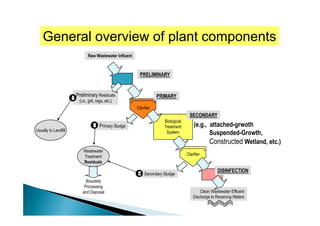
General overview of plant components
Clarifier
Raw Wastewater Influent
PRIMARY
SECONDARY
Preliminary Residuals
(i.e., grit, rags, etc.)
AAAA
PRELIMINARY
Clarifier
Secondary Sludge
Primary Sludge
DISINFECTION
Biological
Treatment
System
SECONDARY
Clean Wastewater Effluent
Discharge to Receiving Waters
BBBB
CCCC
Wastewater
Treatment
Residuals
Biosolids
Processing
and Disposal
(e.g., attached-grwoth
Suspended-Growth,
Constructed Wetland, etc.)
Clarifier
Usually to Landfill
Used To remove the suspended solids
& the dissolved organic load from the
WW by using microbial populations.
The microorganisms are responsible
forfor
◦ degradation of the organic matter
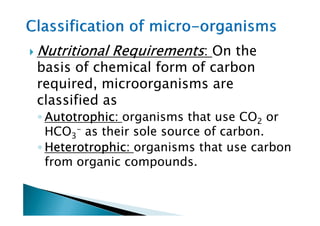
Nutritional RequirementsNutritional RequirementsNutritional RequirementsNutritional Requirements: On the
basis of chemical form of carbon
required, microorganisms are
classified as
◦ Autotrophic:Autotrophic:Autotrophic:Autotrophic: organisms that use CO or◦ Autotrophic:Autotrophic:Autotrophic:Autotrophic: organisms that use CO2 or
HCO3
- as their sole source of carbon.
◦ Heterotrophic:Heterotrophic:Heterotrophic:Heterotrophic: organisms that use carbon
from organic compounds.
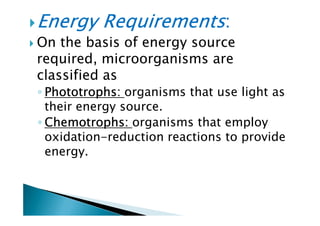
Energy RequirementsEnergy RequirementsEnergy RequirementsEnergy Requirements::::
On the basis of energy source
required, microorganisms are
classified as
◦ PhototrophsPhototrophsPhototrophsPhototrophs:::: organisms that use light as
their energy source.
ChemotrophsChemotrophsChemotrophsChemotrophs:::: organisms that employ
their energy source.
◦ ChemotrophsChemotrophsChemotrophsChemotrophs:::: organisms that employ
oxidation-reduction reactions to provide
energy.
Temperature Range:
On the basis of temperature range
within which they can proliferate,
microorganisms are classified as
◦ PsychrophilicPsychrophilicPsychrophilicPsychrophilic:::: organisms whose growth is
optimum within 15 to 30°C.
◦ MesophilicMesophilicMesophilicMesophilic:::: organisms whose growth is
optimum within 15 to 30°C.
◦ MesophilicMesophilicMesophilicMesophilic:::: organisms whose growth is
optimum within 30 to 45°C.
◦ ThermophilicThermophilicThermophilicThermophilic:::: organisms whose growth is
optimum within 45 to 70°C.
Oxygen RequirementsOxygen RequirementsOxygen RequirementsOxygen Requirements::::
On the basis of oxygen requirement
microorganisms are classified as
◦ Aerobes:Aerobes:Aerobes:Aerobes: organisms that use molecular
oxygen (usually DO) for their metabolism.
◦ Anaerobes:Anaerobes:Anaerobes:Anaerobes: organisms that use some
molecule other than molecular oxygen formolecule other than molecular oxygen for
their metabolism
◦ Facultative organismsFacultative organismsFacultative organismsFacultative organisms :::: organisms that
can use either molecular oxygen or some
other chemical compound for their
metabolism.
If the micro-organisms are suspended in
the WW during biological operation then
process is known as suspended growth
processes
Examples :- Activated Sludge process,Examples :- Activated Sludge process,
Aerated lagoons
Recycling of settled biomass i.e.
sludge is required.
Process in which the micro-organisms
that are attached to a surface over which
they grow is known as attached growth
processes
Examples:Examples:Examples:Examples:---- trickling filterExamples:Examples:Examples:Examples:---- trickling filter
Rotating biological contactors (RBC)
The biomass attached to media (ex.
rock, plastic, wood)
Recycling of settled biomass i.e. sludge
is not required, but recycling of sewage
may be done.
These consists of both attached growth as
well as suspended growth processes.
Examples:Examples:Examples:Examples: ----TF and ASPTF and ASPTF and ASPTF and ASP
ASP and TFASP and TFASP and TFASP and TF
Faccultative lagoonsFaccultative lagoonsFaccultative lagoonsFaccultative lagoonsFaccultative lagoonsFaccultative lagoonsFaccultative lagoonsFaccultative lagoons
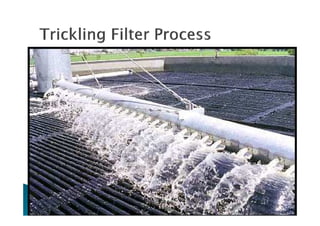
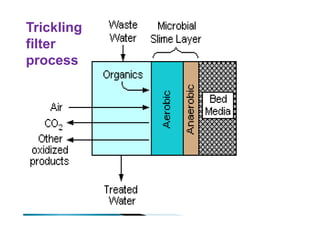
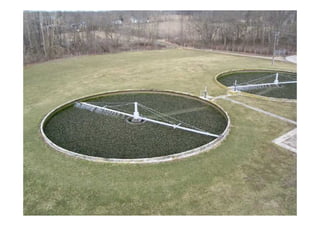
Trickling
filter
process
Trickling
filter
process
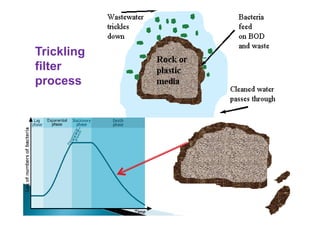
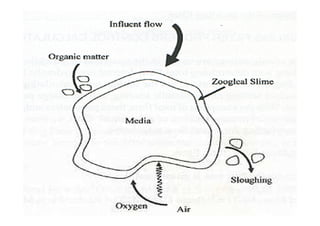
As wastewater trickles through the
media layer a film is formed around
the media, called slime layer or Biofilm
Depth of aerobic zone within slime
layer, formed on media is 0.1 to 0.2
mm.
The remaining part of film isThe remaining part of film is
anaerobic.
As wastewater flows over the film, the
organic matter is rapidly metabolised
while colloidal organics are adsorbed
onto the surface.
Since food concentration at the outer
edge is more, therefore
microorganisms at outer level are in
rapid growth phase.
As microorganisms grow thickness of
biofilm increases.
Diffused oxygen is consumed before
biofilm increases.
Diffused oxygen is consumed before
it penetrates the slime layer.
Therefore anaerobic zone is
established at the media surface.
When microorganisms enter into
death phase they loose their ability
to hold the surface, and gets
detached from the surface
The phenomena of scouring of slime
layer is known as roughing orroughing orroughing orroughing or
unloading of filterunloading of filterunloading of filterunloading of filter
layer is known as roughing orroughing orroughing orroughing or
unloading of filterunloading of filterunloading of filterunloading of filter
Types of Filters
Trickling filters are classified based
on the organic and hydraulic
loading applied to the unit.
Low rate trickling filter or standardLow rate trickling filter or standardLow rate trickling filter or standardLow rate trickling filter or standard1.1.1.1. Low rate trickling filter or standardLow rate trickling filter or standardLow rate trickling filter or standardLow rate trickling filter or standard
raterateraterate
2.2.2.2. High rate trickling filterHigh rate trickling filterHigh rate trickling filterHigh rate trickling filter
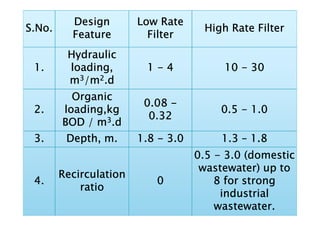
S.NoS.NoS.NoS.No....
DesignDesignDesignDesign
FeatureFeatureFeatureFeature
Low RateLow RateLow RateLow Rate
FilterFilterFilterFilter
High Rate FilterHigh Rate FilterHigh Rate FilterHigh Rate Filter
1.1.1.1.
HydraulicHydraulicHydraulicHydraulic
loading,loading,loading,loading,
mmmm3333/m/m/m/m2222.d.d.d.d
1111 ---- 4444 10101010 ---- 30303030
2.2.2.2.
OrganicOrganicOrganicOrganic
loading,kgloading,kgloading,kgloading,kg
0.080.080.080.08 ----
0.320.320.320.32
0.50.50.50.5 ---- 1.01.01.01.02.2.2.2. loading,kgloading,kgloading,kgloading,kg
BOD / mBOD / mBOD / mBOD / m3333.d.d.d.d
0.320.320.320.32
0.50.50.50.5 ---- 1.01.01.01.0
3.3.3.3. Depth, m.Depth, m.Depth, m.Depth, m. 1.81.81.81.8 ---- 3.03.03.03.0 1.31.31.31.3 –––– 1.81.81.81.8
4.4.4.4.
RecirculationRecirculationRecirculationRecirculation
ratioratioratioratio
0000
0.50.50.50.5 ---- 3.0 (domestic3.0 (domestic3.0 (domestic3.0 (domestic
wastewater)wastewater)wastewater)wastewater) up toup toup toup to
8 for strong8 for strong8 for strong8 for strong
industrialindustrialindustrialindustrial
wastewater.wastewater.wastewater.wastewater.
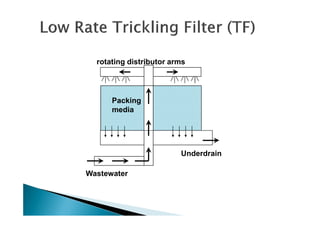
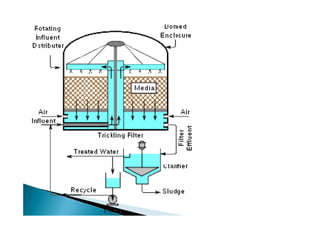
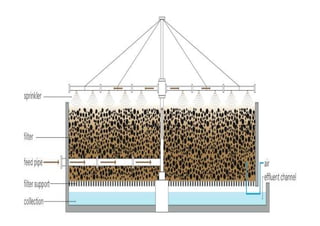
rotating distributor arms
Packing
media
Wastewater
media
Underdrain
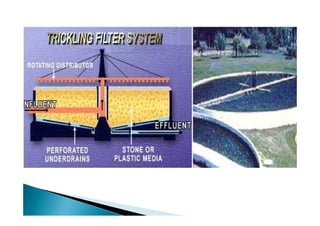
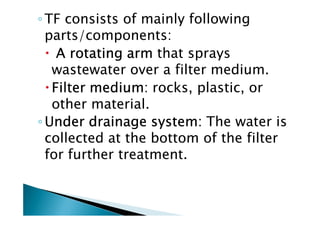
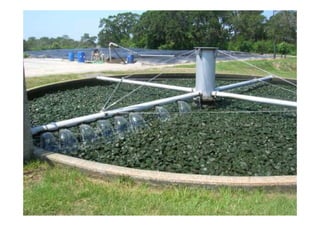
◦TF consists of mainly following
parts/components:
A rotating armA rotating armA rotating armA rotating arm that sprays
wastewater over a filter medium.
Filter mediumFilter mediumFilter mediumFilter medium: rocks, plastic, or
other material.
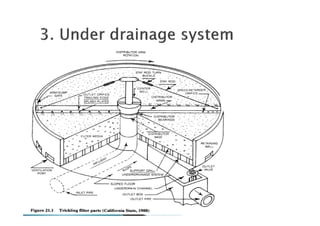
◦ Under drainage system:Under drainage system:Under drainage system:Under drainage system: The water is
other material.
◦ Under drainage system:Under drainage system:Under drainage system:Under drainage system: The water is
collected at the bottom of the filter
for further treatment.
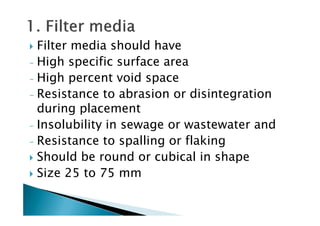
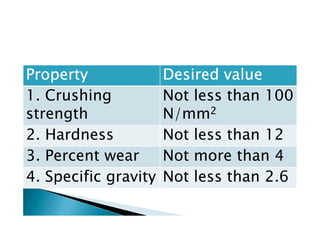
Filter media should have
- High specific surface area
- High percent void space
- Resistance to abrasion or disintegration
during placementduring placement
- Insolubility in sewage or wastewater and
- Resistance to spalling or flaking
Should be round or cubical in shape
Size 25 to 75 mm
PropertyPropertyPropertyProperty Desired valueDesired valueDesired valueDesired value
1. Crushing
strength
Not less than 100
N/mm2strength N/mm2
2. Hardness Not less than 12
3. Percent wear Not more than 4
4. Specific gravity Not less than 2.6
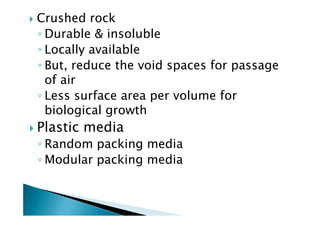
Crushed rock
◦ Durable & insoluble
◦ Locally available
◦ But, reduce the void spaces for passage
of air
◦ Less surface area per volume for
biological growthbiological growth
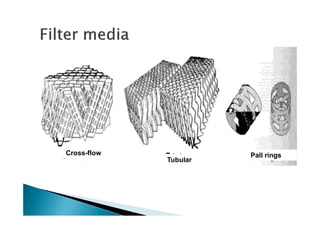
Plastic media
◦ Random packing media
◦ Modular packing media
Cross-flow
Tubular
Pall rings
Concentration of organics in sewage
decreases as the waste passes the
media depth.
Thus effectiveness of the filter
decreases as the depth increases.decreases as the depth increases.
Hence depth of filter should be
restricted
For slow rate depth in the range of 1.8
to 3.0 m is provided.
Depth of media is 1.8 to 2.4m
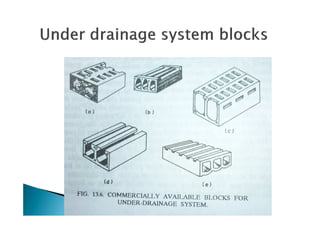
Perforated blocks are used. Can be
made of precast concrete or vitrified
clay.
Drains shall be designed for partial
flow condition (Less than 50% of flow).
Velocity of flow should not be less
than 0.75 m/s at peak instantaneous
Velocity of flow should not be less
than 0.75 m/s at peak instantaneous
flows.
At design flows velocity should be 0.6
to 0.9 m/s.
Function is twofold to circulate the air
and
It collects sewage from all under
drains and conveys it to next unit.
Velocity shall not be less than 0.6
drains and conveys it to next unit.
Velocity shall not be less than 0.6
m/s.
Slope is provided so that sewage can
be carried under gravity
Floor should be strong enough to
support media.
RCC slab of 10 to 15 cm thick is
usually provided to carry load ofusually provided to carry load of
entire media.
Usually 1 % slope is provided.
Fully plastered stone or brick masonry
walls
Walls are made honeycombed to
circulate the air.circulate the air.
Some times ventilation duct is
provided
Natural ventilation takes place
because of difference in temperature
of air and sewage.
Air circulation takes place when
temperature difference is 60C.temperature difference is 60C.
When temperature difference falls
below 1.90C then there will be no air
circulation.
Some times forced ventilation is also
provided
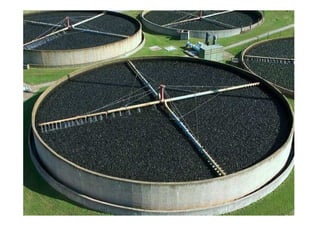
The function of rotary distributor is to
spread the sewage uniformly over the
media top surface.
Rate of rotation may be 2 rpm for small
distributors and 1/3 to ½ for largedistributors and 1/3 to ½ for large
distributor.
Clearance between pipe and media should
be 15 t o25 cm.
DesignDesignDesignDesignDesignDesignDesignDesign
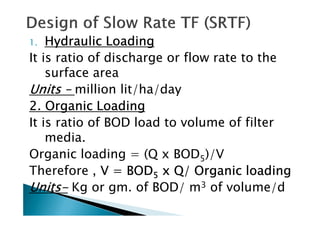
1.1.1.1. Hydraulic LoadingHydraulic LoadingHydraulic LoadingHydraulic Loading
It is ratio of discharge or flow rate to the
surface area
UnitsUnitsUnitsUnits –––– million lit/ha/day
2. Organic Loading2. Organic Loading2. Organic Loading2. Organic Loading
It is ratio of BOD load to volume of filter
2. Organic Loading2. Organic Loading2. Organic Loading2. Organic Loading
It is ratio of BOD load to volume of filter
media.
Organic loading = (Q x BOD5)/V
Therefore , V = BODV = BODV = BODV = BOD5555 x Q/ Organic loadingx Q/ Organic loadingx Q/ Organic loadingx Q/ Organic loading
UnitsUnitsUnitsUnits---- Kg or gm. of BOD/ m3 of volume/d
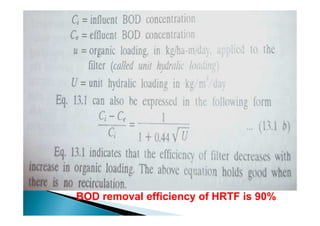
BOD removal efficiency of HRTF is 90%
1. Effluent obtained from SRTF is highly
nitrified and stabilised.
2. It produces desired quality of effluent
under varying weather conditions.
3. They can remove 80% of solids and80% of solids and80% of solids and80% of solids and3. They can remove 80% of solids and80% of solids and80% of solids and80% of solids and
75 to 80% of BOD75 to 80% of BOD75 to 80% of BOD75 to 80% of BOD
4. Working is simple and cheap and
does not require any supervision.
5.They are self cleansing.
6. As it contains less mechanical
equipments , wear and tear is
small.
7. Electrical power requirement is
less.less.
8. Moisture content of sludge
coming out of TF is very high
1. High head loss.
2. The cost of construction is high
3. Large area is required3. Large area is required
4. PST is must before SRTF (It can
remove 30 to 40% of BOD load).
5. Odour and fly nuisance.
1. Trickling filter is _________________
type of process
2. Detaching of the biofilm from media
is known as ________________.
Dissolved organic load can be
is known as ________________.
3. Dissolved organic load can be
removed by using
___________________ treatment.
4. Unloading of trickling filter starts
when microorganism enter in
_____________ phase.
5. Hydraulic loading rate for low rate TF is
_______ m3/m2/d. (0.5 to 2/1 to 4/ 2 to 5/
5 to 8)
6. Organic loading rate for high rate TF is
_______ gm of BOD /m3/d. (100-400/400-
600/ 500 – 1000/ 1000- 2000)
Q1. Give classification of
microorganisms.
Q2. Draw neat sketch of Trickling filter.
Q3. Draw sketch of trickling filter and
explain it w. r. t.explain it w. r. t.
i. Filter media
ii. Under drainage system and
iii. Distributor
Q4. Explain ‘biological process in
trickling filter’ with neat diagram.
Q5. Explain working of trickling filter with
neat sketch.(8 marks, May2011, May
2009).
Q6. Write short notes
i. Types of trickling filter (6 marks,
may2009)

L 18 trickling filter

  • 1.
    Environmental EngineeringEnvironmental EngineeringEnvironmentalEngineeringEnvironmental Engineering----IIIIIIII
  • 2.
    General overview ofplant components Clarifier Raw Wastewater Influent PRIMARY SECONDARY Preliminary Residuals (i.e., grit, rags, etc.) AAAA PRELIMINARY Clarifier Secondary Sludge Primary Sludge DISINFECTION Biological Treatment System SECONDARY Clean Wastewater Effluent Discharge to Receiving Waters BBBB CCCC Wastewater Treatment Residuals Biosolids Processing and Disposal (e.g., attached-grwoth Suspended-Growth, Constructed Wetland, etc.) Clarifier Usually to Landfill
  • 3.
    Used To removethe suspended solids & the dissolved organic load from the WW by using microbial populations. The microorganisms are responsible forfor ◦ degradation of the organic matter
  • 4.
    Nutritional RequirementsNutritional RequirementsNutritionalRequirementsNutritional Requirements: On the basis of chemical form of carbon required, microorganisms are classified as ◦ Autotrophic:Autotrophic:Autotrophic:Autotrophic: organisms that use CO or◦ Autotrophic:Autotrophic:Autotrophic:Autotrophic: organisms that use CO2 or HCO3 - as their sole source of carbon. ◦ Heterotrophic:Heterotrophic:Heterotrophic:Heterotrophic: organisms that use carbon from organic compounds.
  • 5.
    Energy RequirementsEnergy RequirementsEnergyRequirementsEnergy Requirements:::: On the basis of energy source required, microorganisms are classified as ◦ PhototrophsPhototrophsPhototrophsPhototrophs:::: organisms that use light as their energy source. ChemotrophsChemotrophsChemotrophsChemotrophs:::: organisms that employ their energy source. ◦ ChemotrophsChemotrophsChemotrophsChemotrophs:::: organisms that employ oxidation-reduction reactions to provide energy.
  • 6.
    Temperature Range: On thebasis of temperature range within which they can proliferate, microorganisms are classified as ◦ PsychrophilicPsychrophilicPsychrophilicPsychrophilic:::: organisms whose growth is optimum within 15 to 30°C. ◦ MesophilicMesophilicMesophilicMesophilic:::: organisms whose growth is optimum within 15 to 30°C. ◦ MesophilicMesophilicMesophilicMesophilic:::: organisms whose growth is optimum within 30 to 45°C. ◦ ThermophilicThermophilicThermophilicThermophilic:::: organisms whose growth is optimum within 45 to 70°C.
  • 7.
    Oxygen RequirementsOxygen RequirementsOxygenRequirementsOxygen Requirements:::: On the basis of oxygen requirement microorganisms are classified as ◦ Aerobes:Aerobes:Aerobes:Aerobes: organisms that use molecular oxygen (usually DO) for their metabolism. ◦ Anaerobes:Anaerobes:Anaerobes:Anaerobes: organisms that use some molecule other than molecular oxygen formolecule other than molecular oxygen for their metabolism ◦ Facultative organismsFacultative organismsFacultative organismsFacultative organisms :::: organisms that can use either molecular oxygen or some other chemical compound for their metabolism.
  • 8.
    If the micro-organismsare suspended in the WW during biological operation then process is known as suspended growth processes Examples :- Activated Sludge process,Examples :- Activated Sludge process, Aerated lagoons Recycling of settled biomass i.e. sludge is required.
  • 9.
    Process in whichthe micro-organisms that are attached to a surface over which they grow is known as attached growth processes Examples:Examples:Examples:Examples:---- trickling filterExamples:Examples:Examples:Examples:---- trickling filter Rotating biological contactors (RBC) The biomass attached to media (ex. rock, plastic, wood) Recycling of settled biomass i.e. sludge is not required, but recycling of sewage may be done.
  • 10.
    These consists ofboth attached growth as well as suspended growth processes. Examples:Examples:Examples:Examples: ----TF and ASPTF and ASPTF and ASPTF and ASP ASP and TFASP and TFASP and TFASP and TF Faccultative lagoonsFaccultative lagoonsFaccultative lagoonsFaccultative lagoonsFaccultative lagoonsFaccultative lagoonsFaccultative lagoonsFaccultative lagoons
  • 12.
  • 14.
  • 15.
    As wastewater tricklesthrough the media layer a film is formed around the media, called slime layer or Biofilm Depth of aerobic zone within slime layer, formed on media is 0.1 to 0.2 mm. The remaining part of film isThe remaining part of film is anaerobic. As wastewater flows over the film, the organic matter is rapidly metabolised while colloidal organics are adsorbed onto the surface.
  • 16.
    Since food concentrationat the outer edge is more, therefore microorganisms at outer level are in rapid growth phase. As microorganisms grow thickness of biofilm increases. Diffused oxygen is consumed before biofilm increases. Diffused oxygen is consumed before it penetrates the slime layer. Therefore anaerobic zone is established at the media surface.
  • 17.
    When microorganisms enterinto death phase they loose their ability to hold the surface, and gets detached from the surface The phenomena of scouring of slime layer is known as roughing orroughing orroughing orroughing or unloading of filterunloading of filterunloading of filterunloading of filter layer is known as roughing orroughing orroughing orroughing or unloading of filterunloading of filterunloading of filterunloading of filter
  • 18.
    Types of Filters Tricklingfilters are classified based on the organic and hydraulic loading applied to the unit. Low rate trickling filter or standardLow rate trickling filter or standardLow rate trickling filter or standardLow rate trickling filter or standard1.1.1.1. Low rate trickling filter or standardLow rate trickling filter or standardLow rate trickling filter or standardLow rate trickling filter or standard raterateraterate 2.2.2.2. High rate trickling filterHigh rate trickling filterHigh rate trickling filterHigh rate trickling filter
  • 19.
    S.NoS.NoS.NoS.No.... DesignDesignDesignDesign FeatureFeatureFeatureFeature Low RateLow RateLowRateLow Rate FilterFilterFilterFilter High Rate FilterHigh Rate FilterHigh Rate FilterHigh Rate Filter 1.1.1.1. HydraulicHydraulicHydraulicHydraulic loading,loading,loading,loading, mmmm3333/m/m/m/m2222.d.d.d.d 1111 ---- 4444 10101010 ---- 30303030 2.2.2.2. OrganicOrganicOrganicOrganic loading,kgloading,kgloading,kgloading,kg 0.080.080.080.08 ---- 0.320.320.320.32 0.50.50.50.5 ---- 1.01.01.01.02.2.2.2. loading,kgloading,kgloading,kgloading,kg BOD / mBOD / mBOD / mBOD / m3333.d.d.d.d 0.320.320.320.32 0.50.50.50.5 ---- 1.01.01.01.0 3.3.3.3. Depth, m.Depth, m.Depth, m.Depth, m. 1.81.81.81.8 ---- 3.03.03.03.0 1.31.31.31.3 –––– 1.81.81.81.8 4.4.4.4. RecirculationRecirculationRecirculationRecirculation ratioratioratioratio 0000 0.50.50.50.5 ---- 3.0 (domestic3.0 (domestic3.0 (domestic3.0 (domestic wastewater)wastewater)wastewater)wastewater) up toup toup toup to 8 for strong8 for strong8 for strong8 for strong industrialindustrialindustrialindustrial wastewater.wastewater.wastewater.wastewater.
  • 20.
  • 24.
    ◦TF consists ofmainly following parts/components: A rotating armA rotating armA rotating armA rotating arm that sprays wastewater over a filter medium. Filter mediumFilter mediumFilter mediumFilter medium: rocks, plastic, or other material. ◦ Under drainage system:Under drainage system:Under drainage system:Under drainage system: The water is other material. ◦ Under drainage system:Under drainage system:Under drainage system:Under drainage system: The water is collected at the bottom of the filter for further treatment.
  • 26.
    Filter media shouldhave - High specific surface area - High percent void space - Resistance to abrasion or disintegration during placementduring placement - Insolubility in sewage or wastewater and - Resistance to spalling or flaking Should be round or cubical in shape Size 25 to 75 mm
  • 27.
    PropertyPropertyPropertyProperty Desired valueDesiredvalueDesired valueDesired value 1. Crushing strength Not less than 100 N/mm2strength N/mm2 2. Hardness Not less than 12 3. Percent wear Not more than 4 4. Specific gravity Not less than 2.6
  • 28.
    Crushed rock ◦ Durable& insoluble ◦ Locally available ◦ But, reduce the void spaces for passage of air ◦ Less surface area per volume for biological growthbiological growth Plastic media ◦ Random packing media ◦ Modular packing media
  • 29.
  • 30.
    Concentration of organicsin sewage decreases as the waste passes the media depth. Thus effectiveness of the filter decreases as the depth increases.decreases as the depth increases. Hence depth of filter should be restricted For slow rate depth in the range of 1.8 to 3.0 m is provided. Depth of media is 1.8 to 2.4m
  • 33.
    Perforated blocks areused. Can be made of precast concrete or vitrified clay. Drains shall be designed for partial flow condition (Less than 50% of flow). Velocity of flow should not be less than 0.75 m/s at peak instantaneous Velocity of flow should not be less than 0.75 m/s at peak instantaneous flows. At design flows velocity should be 0.6 to 0.9 m/s.
  • 34.
    Function is twofoldto circulate the air and It collects sewage from all under drains and conveys it to next unit. Velocity shall not be less than 0.6 drains and conveys it to next unit. Velocity shall not be less than 0.6 m/s. Slope is provided so that sewage can be carried under gravity
  • 35.
    Floor should bestrong enough to support media. RCC slab of 10 to 15 cm thick is usually provided to carry load ofusually provided to carry load of entire media. Usually 1 % slope is provided.
  • 36.
    Fully plastered stoneor brick masonry walls Walls are made honeycombed to circulate the air.circulate the air. Some times ventilation duct is provided
  • 37.
    Natural ventilation takesplace because of difference in temperature of air and sewage. Air circulation takes place when temperature difference is 60C.temperature difference is 60C. When temperature difference falls below 1.90C then there will be no air circulation. Some times forced ventilation is also provided
  • 38.
    The function ofrotary distributor is to spread the sewage uniformly over the media top surface. Rate of rotation may be 2 rpm for small distributors and 1/3 to ½ for largedistributors and 1/3 to ½ for large distributor. Clearance between pipe and media should be 15 t o25 cm.
  • 42.
  • 43.
    1.1.1.1. Hydraulic LoadingHydraulicLoadingHydraulic LoadingHydraulic Loading It is ratio of discharge or flow rate to the surface area UnitsUnitsUnitsUnits –––– million lit/ha/day 2. Organic Loading2. Organic Loading2. Organic Loading2. Organic Loading It is ratio of BOD load to volume of filter 2. Organic Loading2. Organic Loading2. Organic Loading2. Organic Loading It is ratio of BOD load to volume of filter media. Organic loading = (Q x BOD5)/V Therefore , V = BODV = BODV = BODV = BOD5555 x Q/ Organic loadingx Q/ Organic loadingx Q/ Organic loadingx Q/ Organic loading UnitsUnitsUnitsUnits---- Kg or gm. of BOD/ m3 of volume/d
  • 45.
    BOD removal efficiencyof HRTF is 90%
  • 47.
    1. Effluent obtainedfrom SRTF is highly nitrified and stabilised. 2. It produces desired quality of effluent under varying weather conditions. 3. They can remove 80% of solids and80% of solids and80% of solids and80% of solids and3. They can remove 80% of solids and80% of solids and80% of solids and80% of solids and 75 to 80% of BOD75 to 80% of BOD75 to 80% of BOD75 to 80% of BOD 4. Working is simple and cheap and does not require any supervision.
  • 48.
    5.They are selfcleansing. 6. As it contains less mechanical equipments , wear and tear is small. 7. Electrical power requirement is less.less. 8. Moisture content of sludge coming out of TF is very high
  • 49.
    1. High headloss. 2. The cost of construction is high 3. Large area is required3. Large area is required 4. PST is must before SRTF (It can remove 30 to 40% of BOD load). 5. Odour and fly nuisance.
  • 50.
    1. Trickling filteris _________________ type of process 2. Detaching of the biofilm from media is known as ________________. Dissolved organic load can be is known as ________________. 3. Dissolved organic load can be removed by using ___________________ treatment. 4. Unloading of trickling filter starts when microorganism enter in _____________ phase.
  • 51.
    5. Hydraulic loadingrate for low rate TF is _______ m3/m2/d. (0.5 to 2/1 to 4/ 2 to 5/ 5 to 8) 6. Organic loading rate for high rate TF is _______ gm of BOD /m3/d. (100-400/400- 600/ 500 – 1000/ 1000- 2000)
  • 52.
    Q1. Give classificationof microorganisms. Q2. Draw neat sketch of Trickling filter. Q3. Draw sketch of trickling filter and explain it w. r. t.explain it w. r. t. i. Filter media ii. Under drainage system and iii. Distributor Q4. Explain ‘biological process in trickling filter’ with neat diagram.
  • 53.
    Q5. Explain workingof trickling filter with neat sketch.(8 marks, May2011, May 2009). Q6. Write short notes i. Types of trickling filter (6 marks, may2009)