i 
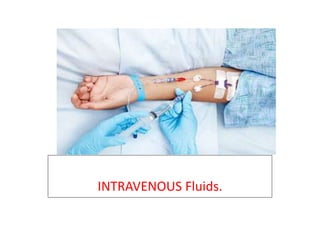
INTRAVENOUS Fluids.
Things to consider: 
• Normal changes in the TBW and ECF 
• Changes in the salt and water balance 
• Normal changes in the renal function 
• Insensible water losses.
Body fluid composition in the Fetus 
and Newborn 
• TBW= ICF+ECF(intravasular and interstitial) 
• As gestational age increases TBW and ECF 
decreases while ICF increases 
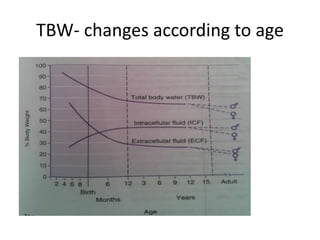
• At birth TBW=75% of body weight in term 
infants and 80% in preterm infants.
TBW- changes according to age
Perinatal changes 
• During first week to 10 days of life reduction in 
body weight is due to reduction in the ECF 
• Term infants weight loss = 5%-10% with in 3-5 
days of life. 
• Preterm Infant lose about 10%-15% of body 
weight with in 5 days of life.
Sodium balance in the newborn 
• Major cation and Anion of ECF are sodium and 
chloride respectively. 
• Major Cation of ICF- potassium and Anions 
are protein, organic acids and phosphate. 
• Sodium balance is maintained by 3Na-2K 
pump . 
• Plasma Osmolality ranges from 285-295 
mOsmos/kg 
• Osmolality= 2(Na)+1/8(Glucose)+BUN/2.8
Sodium balance in the newborn 
• Renal sodium loses are inversely proportional 
to gestational age of the child 
• Term infants have fractional excretion of Na- 
1% with transient increase on day 2 and 
• Preterm infants <35 wks have a negative 
sodium balance and hyponatremia during first 
2-3 wks of life
Sodium balance in the newborn 
• Increased urinary sodium losses seen in 
-Hypoxia 
-Respiratory Distress 
-Hyperbilirubinemia 
-ATN 
-Polycythemia 
-Diuretics
Renal concentration and diluting 
Capacity 
• Adults can concentrate urine upto 1500mOsm/kg 
of plasma water and dilute as low as 50mOsm/kg 
of plasma water. 
• Concentrating capacity is 800mOsm/kg in term 
infants and 600mOsm/kg in preterm , so require 
more urine volume to excrete solutes 
• Diluting capacity is 50mOsm/kg in term infants 
and 70mOsm/kg in preterm 
• Newborns have reduction in GFR and decreased 
activity of transporters in the early distal tubule
Insensible loss of Water. 
• Maturity of the Infant(BSA/Kg) 
• Open Warmer bed 
• Phototherapy 
• Hyperthermia 
• Tachypnea 
• Reduced by -Enclosed incubator 
-Humidified Air 
-Sedation 
-Decreased Activity 
-Hypothermia
Who require IV Fluids 
• Infant <30 weeks, & <1200 gm 
• Sick Term Newborns and children 
-Severe Birth Asphyxia 
-Apnea 
-RDS 
-Sepsis 
-Seizure 
-Hemodynamic Instability 
-GI malformations 
-Shock
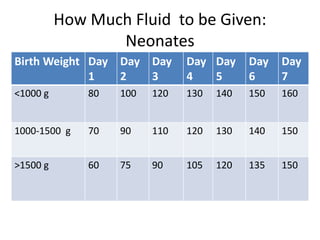
How Much Fluid to be Given: 
Neonates 
Birth Weight Day 
1 
Day 
2 
Day 
3 
Day 
4 
Day 
5 
Day 
6 
Day 
7 
<1000 g 80 100 120 130 140 150 160 
1000-1500 g 70 90 110 120 130 140 150 
>1500 g 60 75 90 105 120 135 150
How Much Fluid to be Given: 
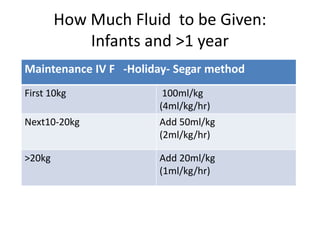
Infants and >1 year 
Maintenance IV F -Holiday- Segar method 
First 10kg 100ml/kg 
(4ml/kg/hr) 
Next10-20kg Add 50ml/kg 
(2ml/kg/hr) 
>20kg Add 20ml/kg 
(1ml/kg/hr)
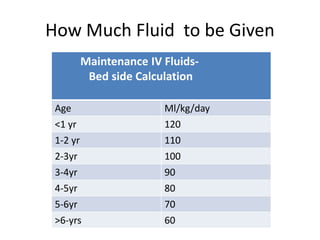
How Much Fluid to be Given 
Maintenance IV Fluids- 
Bed side Calculation 
Age Ml/kg/day 
<1 yr 120 
1-2 yr 110 
2-3yr 100 
3-4yr 90 
4-5yr 80 
5-6yr 70 
>6-yrs 60
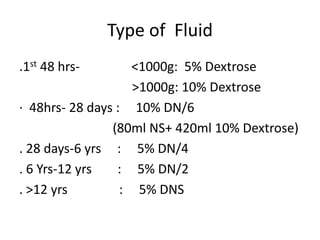
Type of Fluid 
.1st 48 hrs- <1000g: 5% Dextrose 
>1000g: 10% Dextrose 
· 48hrs- 28 days : 10% DN/6 
(80ml NS+ 420ml 10% Dextrose) 
. 28 days-6 yrs : 5% DN/4 
. 6 Yrs-12 yrs : 5% DN/2 
. >12 yrs : 5% DNS
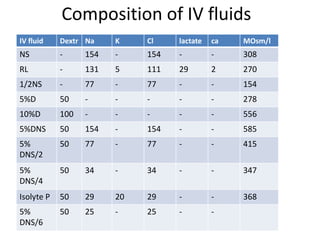
Composition of IV fluids 
IV fluid Dextr Na K Cl lactate ca MOsm/l 
NS - 154 - 154 - - 308 
RL - 131 5 111 29 2 270 
1/2NS - 77 - 77 - - 154 
5%D 50 - - - - - 278 
10%D 100 - - - - - 556 
5%DNS 50 154 - 154 - - 585 
5% 
50 77 - 77 - - 415 
DNS/2 
5% 
DNS/4 
50 34 - 34 - - 347 
Isolyte P 50 29 20 29 - - 368 
5% 
50 25 - 25 - - 
DNS/6
Extra Fluid 
• Warmer –add 10ml/kg/day 
• Phototherapy-add 10ml/kg/day 
• Fever- increase fluid requirement by 12% per 
degree rise above 37.8 degree C 
• Tachypnea- increase fluid requirement 10-30%
Extra Fluid 
• NEC and other condition with 3rd space loss 
• ELBW and VLBW Neonates 
• Vomiting 
• Gastroenteritis 
• Shock 
• Burns 
• Tachypnea 
• DKA
Less Fluid 
• Birth Asphyxia 
• Meningitis 
• Intra Ventricular Hemorrhage 
• PDA(cardiac failure) 
• Oliguria/Anuria 
• SIADH 
• Edema
Special Situations 
• Oliguria-Insensible water loss + measured 
urine output + deficit 
• Anuria-Insensible water loss + deficit 
• Dehydration- Maintenance + Deficit + ongoing 
losses.
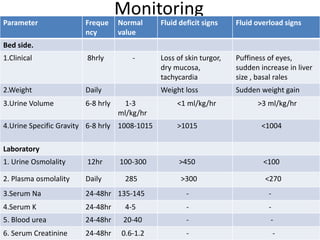
Monitoring 
Parameter Freque 
ncy 
Normal 
value 
Fluid deficit signs Fluid overload signs 
Bed side. 
1.Clinical 8hrly - Loss of skin turgor, 
dry mucosa, 
tachycardia 
Puffiness of eyes, 
sudden increase in liver 
size , basal rales 
2.Weight Daily Weight loss Sudden weight gain 
3.Urine Volume 6-8 hrly 1-3 
ml/kg/hr 
<1 ml/kg/hr >3 ml/kg/hr 
4.Urine Specific Gravity 6-8 hrly 1008-1015 >1015 <1004 
Laboratory 
1. Urine Osmolality 12hr 100-300 >450 <100 
2. Plasma osmolality Daily 285 >300 <270 
3.Serum Na 24-48hr 135-145 - - 
4.Serum K 24-48hr 4-5 - - 
5. Blood urea 24-48hr 20-40 - - 
6. Serum Creatinine 24-48hr 0.6-1.2 - -

Ivf

  • 1.
  • 2.
    Things to consider: • Normal changes in the TBW and ECF • Changes in the salt and water balance • Normal changes in the renal function • Insensible water losses.
  • 3.
    Body fluid compositionin the Fetus and Newborn • TBW= ICF+ECF(intravasular and interstitial) • As gestational age increases TBW and ECF decreases while ICF increases • At birth TBW=75% of body weight in term infants and 80% in preterm infants.
  • 4.
  • 5.
    Perinatal changes •During first week to 10 days of life reduction in body weight is due to reduction in the ECF • Term infants weight loss = 5%-10% with in 3-5 days of life. • Preterm Infant lose about 10%-15% of body weight with in 5 days of life.
  • 6.
    Sodium balance inthe newborn • Major cation and Anion of ECF are sodium and chloride respectively. • Major Cation of ICF- potassium and Anions are protein, organic acids and phosphate. • Sodium balance is maintained by 3Na-2K pump . • Plasma Osmolality ranges from 285-295 mOsmos/kg • Osmolality= 2(Na)+1/8(Glucose)+BUN/2.8
  • 7.
    Sodium balance inthe newborn • Renal sodium loses are inversely proportional to gestational age of the child • Term infants have fractional excretion of Na- 1% with transient increase on day 2 and • Preterm infants <35 wks have a negative sodium balance and hyponatremia during first 2-3 wks of life
  • 8.
    Sodium balance inthe newborn • Increased urinary sodium losses seen in -Hypoxia -Respiratory Distress -Hyperbilirubinemia -ATN -Polycythemia -Diuretics
  • 9.
    Renal concentration anddiluting Capacity • Adults can concentrate urine upto 1500mOsm/kg of plasma water and dilute as low as 50mOsm/kg of plasma water. • Concentrating capacity is 800mOsm/kg in term infants and 600mOsm/kg in preterm , so require more urine volume to excrete solutes • Diluting capacity is 50mOsm/kg in term infants and 70mOsm/kg in preterm • Newborns have reduction in GFR and decreased activity of transporters in the early distal tubule
  • 10.
    Insensible loss ofWater. • Maturity of the Infant(BSA/Kg) • Open Warmer bed • Phototherapy • Hyperthermia • Tachypnea • Reduced by -Enclosed incubator -Humidified Air -Sedation -Decreased Activity -Hypothermia
  • 11.
    Who require IVFluids • Infant <30 weeks, & <1200 gm • Sick Term Newborns and children -Severe Birth Asphyxia -Apnea -RDS -Sepsis -Seizure -Hemodynamic Instability -GI malformations -Shock
  • 12.
    How Much Fluidto be Given: Neonates Birth Weight Day 1 Day 2 Day 3 Day 4 Day 5 Day 6 Day 7 <1000 g 80 100 120 130 140 150 160 1000-1500 g 70 90 110 120 130 140 150 >1500 g 60 75 90 105 120 135 150
  • 13.
    How Much Fluidto be Given: Infants and >1 year Maintenance IV F -Holiday- Segar method First 10kg 100ml/kg (4ml/kg/hr) Next10-20kg Add 50ml/kg (2ml/kg/hr) >20kg Add 20ml/kg (1ml/kg/hr)
  • 14.
    How Much Fluidto be Given Maintenance IV Fluids- Bed side Calculation Age Ml/kg/day <1 yr 120 1-2 yr 110 2-3yr 100 3-4yr 90 4-5yr 80 5-6yr 70 >6-yrs 60
  • 15.
    Type of Fluid .1st 48 hrs- <1000g: 5% Dextrose >1000g: 10% Dextrose · 48hrs- 28 days : 10% DN/6 (80ml NS+ 420ml 10% Dextrose) . 28 days-6 yrs : 5% DN/4 . 6 Yrs-12 yrs : 5% DN/2 . >12 yrs : 5% DNS
  • 16.
    Composition of IVfluids IV fluid Dextr Na K Cl lactate ca MOsm/l NS - 154 - 154 - - 308 RL - 131 5 111 29 2 270 1/2NS - 77 - 77 - - 154 5%D 50 - - - - - 278 10%D 100 - - - - - 556 5%DNS 50 154 - 154 - - 585 5% 50 77 - 77 - - 415 DNS/2 5% DNS/4 50 34 - 34 - - 347 Isolyte P 50 29 20 29 - - 368 5% 50 25 - 25 - - DNS/6
  • 17.
    Extra Fluid •Warmer –add 10ml/kg/day • Phototherapy-add 10ml/kg/day • Fever- increase fluid requirement by 12% per degree rise above 37.8 degree C • Tachypnea- increase fluid requirement 10-30%
  • 18.
    Extra Fluid •NEC and other condition with 3rd space loss • ELBW and VLBW Neonates • Vomiting • Gastroenteritis • Shock • Burns • Tachypnea • DKA
  • 19.
    Less Fluid •Birth Asphyxia • Meningitis • Intra Ventricular Hemorrhage • PDA(cardiac failure) • Oliguria/Anuria • SIADH • Edema
  • 20.
    Special Situations •Oliguria-Insensible water loss + measured urine output + deficit • Anuria-Insensible water loss + deficit • Dehydration- Maintenance + Deficit + ongoing losses.
  • 21.
    Monitoring Parameter Freque ncy Normal value Fluid deficit signs Fluid overload signs Bed side. 1.Clinical 8hrly - Loss of skin turgor, dry mucosa, tachycardia Puffiness of eyes, sudden increase in liver size , basal rales 2.Weight Daily Weight loss Sudden weight gain 3.Urine Volume 6-8 hrly 1-3 ml/kg/hr <1 ml/kg/hr >3 ml/kg/hr 4.Urine Specific Gravity 6-8 hrly 1008-1015 >1015 <1004 Laboratory 1. Urine Osmolality 12hr 100-300 >450 <100 2. Plasma osmolality Daily 285 >300 <270 3.Serum Na 24-48hr 135-145 - - 4.Serum K 24-48hr 4-5 - - 5. Blood urea 24-48hr 20-40 - - 6. Serum Creatinine 24-48hr 0.6-1.2 - -