Monte Carlo and
quasi-Monte Carlo Integration
John D. Cook
M. D. Anderson Cancer Center
July 24, 2002
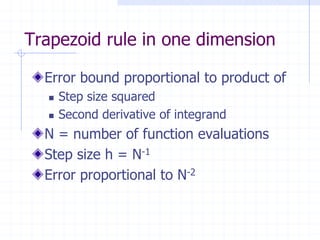
Trapezoid rule in one dimension

  Error bound proportional to product of
     Step size squared
     Second derivative of integrand
  N = number of function evaluations
  Step size h = N-1
  Error proportional to N-2
Simpson’s rule in one dimensions

  Error bound proportional to product of
     Step size to the fourth power
     Fourth derivative of integrand
  Step size h = N-1
  Error proportional to N-4
  All bets are off if integrand doesn’t have
  a fourth derivative.
Product rules
  In two dimensions, trapezoid error
  proportional to N-1
  In d dimensions, trapezoid error
  proportional to N-2/d.
  If 1-dimensional rule has error N-p,
  n-dimensional product has error N-p/d
Dimension in a nutshell
  Assume the number of integration
  points N is fixed, as well as the order of
  the integration rule p.
  Moving from 1 dimension to
  d dimensions divides the number of
  correct figures by d.
Monte Carlo to the rescue
  Error proportional to N-1/2,
  independent of dimension!
  Convergence is slow, but doesn’t get
  worse as dimension increases.
  Quadruple points to double accuracy.
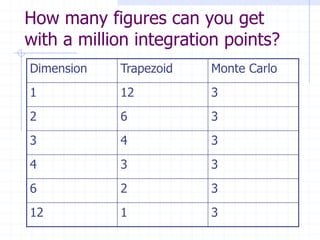
How many figures can you get
with a million integration points?
Dimension   Trapezoid   Monte Carlo
1           12          3
2           6           3
3           4           3
4           3           3
6           2           3
12          1           3
Fine print
  Error estimate means something
  different for product rules than for MC.
  Proportionality factors other than
  number of points very important.
  Different factors improve performance
  of the two methods.
Interpreting error bounds
  Trapezoid rule has deterministic error
  bounds: if you know an upper bound on
  the second derivative, you can bracket
  the error.
  Monte Carlo error is probabilistic.
  Roughly a 2/3 chance of integral being
  within one standard deviation.
Proportionality factors
  Error bound in classical methods
  depends on maximum of derivatives.
  MC error proportional to variance of
  function, E[f2] – E[f]2
Contrasting proportionality
  Classical methods improve with smooth
  integrands
  Monte Carlo doesn’t depend on
  differentiability at all, but improves with
  overall “flatness”.
Good MC, bad trapezoid

        1


      0.8


      0.6


      0.4


      0.2


            1.5   2   2.5   3
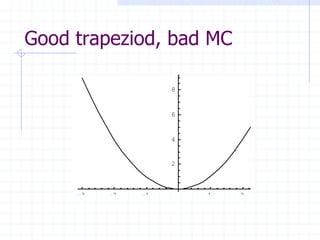
Good trapeziod, bad MC

                    8


                    6


                    4


                    2


     -3   -2   -1       1   2   3
Simple Monte Carlo

 If xi is a sequence of independent samples from
 a uniform random variable
Importance Sampling

Suppose X is a random variable with PDF and xi is a
sequence of independent samples from X.
Variance reduction (example)
If an integrand f is well approximated by a PDF   that is
easy to sample from, use the equation


and apply importance sampling.

Variance of the integrand will be small, and so
convergence will be fast.
MC Good news / Bad news
 MC doesn’t get any worse when the
 integrand is not smooth.
 MC doesn’t get any better when the
 integrand is smooth.
 MC converges like N-1/2 in the worst
 case.
 MC converges like N-1/2 in the best case.
Quasi-random vs. Pseudo-random

  Both are deterministic.
  Pseudo-random numbers mimic the
  statistical properties of truly random
  numbers.
  Quasi-random numbers mimic the
  space-filling properties of random
  numbers, and improves on them.
120 Point Comparison

1 .0                                                1 .0


0 .8                                                0 .8


0 .6                                                0 .6


0 .4                                                0 .4


0 .2                                                0 .2


0 .0                                                0 .0
       0 .0   0 .2      0 .4   0 .6   0 .8   1 .0          0 .0   0 .2     0 .4   0 .6   0 .8   1 .0


                     Sobol’ Sequence                                     Excel’s PRNG
Quasi-random pros and cons
  The asymptotic convergence rate is more like
  N-1 than N-1/2.
  Actually, it’s more like log(N)dN-1.
  These bounds are very pessimistic in practice.
  QMC always beats MC eventually.
  Whether “eventually” is good enough
  depends on the problem and the particular
  QMC sequence.
MC-QMC compromise
 Randomized QMC
 Evaluate integral using a number of randomly
 shifted QMC series.
 Return average of estimates as integral.
 Return standard deviation of estimates as
 error estimate.
 Maybe better than MC or QMC!
 Can view as a variance reduction technique.
Some quasi-random sequences

  Halton – bit reversal in relatively prime
  bases
  Hammersly – finite sequence with one
  uniform component
  Sobol’ – common in practice, based on
  primitive polynomials over binary field
Sequence recommendations
 Experiment!
 Hammersley probably best for low
 dimensions if you know up front how many
 you’ll need. Must go through entire cycle or
 coverage will be uneven in one coordinate.
 Halton probably best for low dimensions.
 Sobol’ probably best for high dimensions.
Lattice Rules
  Nothing remotely random about them
  “Low discrepancy”
  Periodic functions on a unit cube
  There are standard transformations to
  reduce other integrals to this form
Lattice Example
Advantages and disadvantages
  Lattices work very well for smooth integrands
  Don’t work so well for discontinuous
  integrands
  Have good projections on to coordinate axes
  Finite sequences
  Good error posterior estimates
  Some a priori estimates, sometimes
  pessimistic
Software written
  QMC integration implemented for
  generic sequence generator
  Generators implemented: Sobol’,
  Halton, Hammersley
  Randomized QMC
  Lattice rules
  Randomized lattice rules
Randomization approaches
  Randomized lattice uses specified lattice size,
  randomize until error goal met
  RQMC uses specified number of
  randomizations, generate QMC until error
  goal met
  Lattice rules require this approach: they’re
  finite, and new ones found manually.
  QMC sequences can be expensive to compute
  (Halton, not Sobol) so compute once and
  reuse.
Future development
  Variance reduction. Good
  transformations make any technique
  work better.
  Need for lots of experiments.
Contact
  http://www.JohnDCook.com

Monte Carlo and quasi-Monte Carlo integration

  • 1.
    Monte Carlo and quasi-MonteCarlo Integration John D. Cook M. D. Anderson Cancer Center July 24, 2002
  • 2.
    Trapezoid rule inone dimension Error bound proportional to product of  Step size squared  Second derivative of integrand N = number of function evaluations Step size h = N-1 Error proportional to N-2
  • 3.
    Simpson’s rule inone dimensions Error bound proportional to product of  Step size to the fourth power  Fourth derivative of integrand Step size h = N-1 Error proportional to N-4 All bets are off if integrand doesn’t have a fourth derivative.
  • 4.
    Product rules In two dimensions, trapezoid error proportional to N-1 In d dimensions, trapezoid error proportional to N-2/d. If 1-dimensional rule has error N-p, n-dimensional product has error N-p/d
  • 5.
    Dimension in anutshell Assume the number of integration points N is fixed, as well as the order of the integration rule p. Moving from 1 dimension to d dimensions divides the number of correct figures by d.
  • 6.
    Monte Carlo tothe rescue Error proportional to N-1/2, independent of dimension! Convergence is slow, but doesn’t get worse as dimension increases. Quadruple points to double accuracy.
  • 7.
    How many figurescan you get with a million integration points? Dimension Trapezoid Monte Carlo 1 12 3 2 6 3 3 4 3 4 3 3 6 2 3 12 1 3
  • 8.
    Fine print Error estimate means something different for product rules than for MC. Proportionality factors other than number of points very important. Different factors improve performance of the two methods.
  • 9.
    Interpreting error bounds Trapezoid rule has deterministic error bounds: if you know an upper bound on the second derivative, you can bracket the error. Monte Carlo error is probabilistic. Roughly a 2/3 chance of integral being within one standard deviation.
  • 10.
    Proportionality factors Error bound in classical methods depends on maximum of derivatives. MC error proportional to variance of function, E[f2] – E[f]2
  • 11.
    Contrasting proportionality Classical methods improve with smooth integrands Monte Carlo doesn’t depend on differentiability at all, but improves with overall “flatness”.
  • 12.
    Good MC, badtrapezoid 1 0.8 0.6 0.4 0.2 1.5 2 2.5 3
  • 13.
    Good trapeziod, badMC 8 6 4 2 -3 -2 -1 1 2 3
  • 14.
    Simple Monte Carlo If xi is a sequence of independent samples from a uniform random variable
  • 15.
    Importance Sampling Suppose Xis a random variable with PDF and xi is a sequence of independent samples from X.
  • 16.
    Variance reduction (example) Ifan integrand f is well approximated by a PDF that is easy to sample from, use the equation and apply importance sampling. Variance of the integrand will be small, and so convergence will be fast.
  • 17.
    MC Good news/ Bad news MC doesn’t get any worse when the integrand is not smooth. MC doesn’t get any better when the integrand is smooth. MC converges like N-1/2 in the worst case. MC converges like N-1/2 in the best case.
  • 18.
    Quasi-random vs. Pseudo-random Both are deterministic. Pseudo-random numbers mimic the statistical properties of truly random numbers. Quasi-random numbers mimic the space-filling properties of random numbers, and improves on them.
  • 19.
    120 Point Comparison 1.0 1 .0 0 .8 0 .8 0 .6 0 .6 0 .4 0 .4 0 .2 0 .2 0 .0 0 .0 0 .0 0 .2 0 .4 0 .6 0 .8 1 .0 0 .0 0 .2 0 .4 0 .6 0 .8 1 .0 Sobol’ Sequence Excel’s PRNG
  • 20.
    Quasi-random pros andcons The asymptotic convergence rate is more like N-1 than N-1/2. Actually, it’s more like log(N)dN-1. These bounds are very pessimistic in practice. QMC always beats MC eventually. Whether “eventually” is good enough depends on the problem and the particular QMC sequence.
  • 21.
    MC-QMC compromise RandomizedQMC Evaluate integral using a number of randomly shifted QMC series. Return average of estimates as integral. Return standard deviation of estimates as error estimate. Maybe better than MC or QMC! Can view as a variance reduction technique.
  • 22.
    Some quasi-random sequences Halton – bit reversal in relatively prime bases Hammersly – finite sequence with one uniform component Sobol’ – common in practice, based on primitive polynomials over binary field
  • 23.
    Sequence recommendations Experiment! Hammersley probably best for low dimensions if you know up front how many you’ll need. Must go through entire cycle or coverage will be uneven in one coordinate. Halton probably best for low dimensions. Sobol’ probably best for high dimensions.
  • 24.
    Lattice Rules Nothing remotely random about them “Low discrepancy” Periodic functions on a unit cube There are standard transformations to reduce other integrals to this form
  • 25.
  • 26.
    Advantages and disadvantages Lattices work very well for smooth integrands Don’t work so well for discontinuous integrands Have good projections on to coordinate axes Finite sequences Good error posterior estimates Some a priori estimates, sometimes pessimistic
  • 27.
    Software written QMC integration implemented for generic sequence generator Generators implemented: Sobol’, Halton, Hammersley Randomized QMC Lattice rules Randomized lattice rules
  • 28.
    Randomization approaches Randomized lattice uses specified lattice size, randomize until error goal met RQMC uses specified number of randomizations, generate QMC until error goal met Lattice rules require this approach: they’re finite, and new ones found manually. QMC sequences can be expensive to compute (Halton, not Sobol) so compute once and reuse.
  • 29.
    Future development Variance reduction. Good transformations make any technique work better. Need for lots of experiments.
  • 30.