Part 1: 2016-01-20
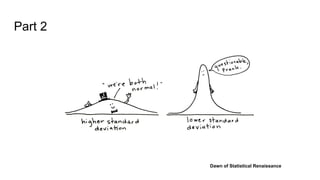
Part 2: 2016-02-10
Tomasz Kuśmierczyk
Session 5: Sampling & MCMC
Approximate and Scalable Inference for Complex
Probabilistic Models in Recommender Systems
Part 2: Inference Techniques
MCMC = Monte Carlo Markov Chains
MCMC ⊂ Sampling
Literature / Credits
● Szymon Jaroszewicz lectures on “Selected Advanced Topics in Machine Learning”
● Daphne Koller lectures on “Probabilistic Graphical Models” (https://class.coursera.
org/pgm-003/lecture)
● Patrick Lam slides http://www.people.fas.harvard.
edu/~plam/teaching/methods/convergence/convergence_print.pdf
● Bishop’s book ch. 11
● MacKay, David JC. Information theory, inference and learning algorithms. Cambridge
university press, 2003. (http://www.inference.phy.cam.ac.uk/itprnn/book.pdf)
● R & JAGS online tutorials…
● …
Basics & motivation
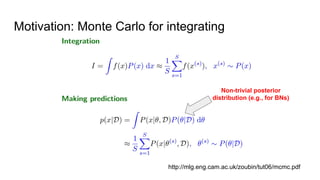
Motivation: Monte Carlo for integrating
http://mlg.eng.cam.ac.uk/zoubin/tut06/mcmc.pdf
Non-trivial posterior
distribution (e.g., for BNs)
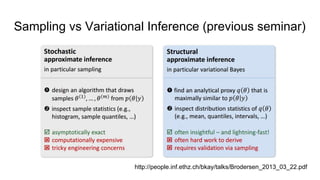
Sampling vs Variational Inference (previous seminar)
http://people.inf.ethz.ch/bkay/talks/Brodersen_2013_03_22.pdf
Sampling continued ...
● Accuracy of sampling based estimates depends only on the variance of the
quantity being estimated
● It does not depend directly on the dimensionality (having many variables is
not a problem)
● In some cases we are able to break the curse of dimensionality
but
● Sampling gets much more difficult in higher dimensions
● Variance often increases as the dimension grows
● Accuracy of sampling based methods grows only with square root of the
number of samples
Jaroszewicz
Sampling techniques - basic cases
● uniform -> pseudo-random numbers generator
● discrete distributions -> range matching with the help of uniform (in log of
number of outcomes time)
● continous -> cdf inverse
● various ‘tricks’
● ...
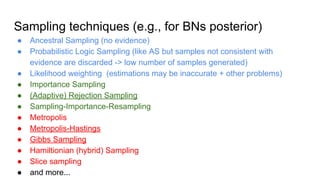
Sampling techniques (e.g., for BNs posterior)
● Ancestral Sampling (no evidence)
● Probabilistic Logic Sampling (like AS but samples not consistent with
evidence are discarded -> low number of samples generated)
● Likelihood weighting (estimations may be inaccurate + other problems)
● Importance Sampling
● (Adaptive) Rejection Sampling
● Sampling-Importance-Resampling
● Metropolis
● Metropolis-Hastings
● Gibbs Sampling
● Hamiltionian (hybrid) Sampling
● Slice sampling
● and more...
Monte Carlo without Markov Chains
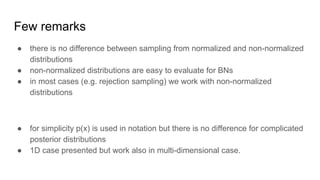
Few remarks
● there is no difference between sampling from normalized and non-normalized
distributions
● non-normalized distributions are easy to evaluate for BNs
● in most cases (e.g. rejection sampling) we work with non-normalized
distributions
● for simplicity p(x) is used in notation but there is no difference for complicated
posterior distributions
● 1D case presented but work also in multi-dimensional case.
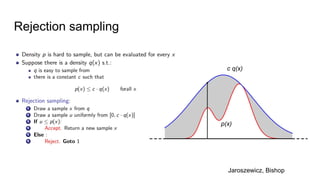
Rejection sampling
Jaroszewicz, Bishop
c q(x)
p(x)
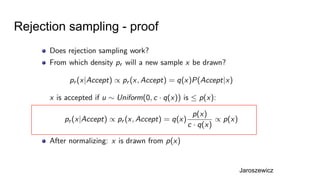
Rejection sampling - proof
Jaroszewicz
Selection of c?
● c should be as small as possible to have low reduction rate
● but p <= c q must hold
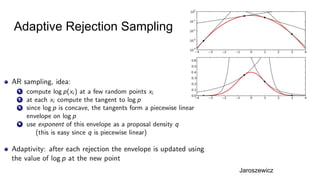
● Adaptive Rejection Sampling for log-concave distributions
○ log-concave = logarithm of the distribution is concave
Adaptive Rejection Sampling
Jaroszewicz
Rejection Sampling problems
● part of the samples are rejected
● tight “envelope” helps a bit
but
● in many dimensions (when there are many variables) dimensionality curse
must be taken into account
● see Bishop’s example (for rejection sampling):
○ p(x) ~ N(0, s1)
○ q(x) ~ N(0, 1.01*s1)
○ D=1000
○ -> acceptance ratio 1/20000
Markov Chains
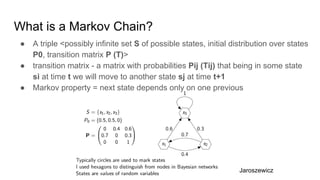
What is a Markov Chain?
● A triple <possibly infinite set S of possible states, initial distribution over states
P0, transition matrix P (T)>
● transition matrix - a matrix with probabilities Pij (Tij) that being in some state
si at time t we will move to another state sj at time t+1
● Markov property = next state depends only on one previous
Jaroszewicz
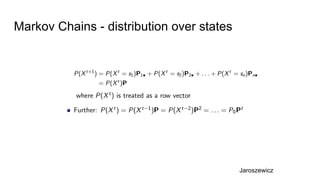
Markov Chains - distribution over states
Jaroszewicz
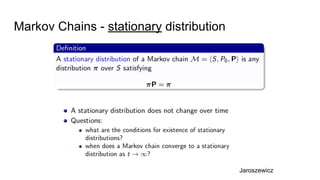
Markov Chains - stationary distribution
Jaroszewicz
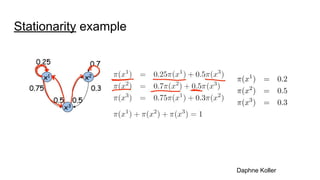
Stationarity example
Daphne Koller
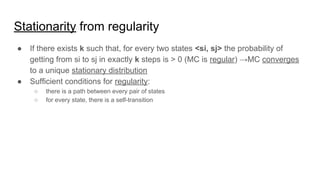
Stationarity from regularity
● If there exists k such that, for every two states <si, sj> the probability of
getting from si to sj in exactly k steps is > 0 (MC is regular) →MC converges
to a unique stationary distribution
● Sufficient conditions for regularity:
○ there is a path between every pair of states
○ for every state, there is a self-transition
Stationarity of irreducible, aperiodic MC
● Irreducible, aperiodic Markov chains always converge to a unique stationary
distribution
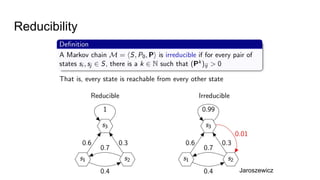
Reducibility
Jaroszewicz
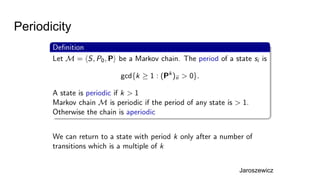
Periodicity
Jaroszewicz
Why I talk about Markov Chains -> MCMC
the idea is that:
● Markov Chain “jumps” over states
● states determine (BN) samples (that are later used for Monte Carlo)
○ for example: state ⇔ sample
but we need:
● Markov Chain converges to a stationary distribution (to be proved every time)
● a distribution of generated samples is equal to required distribution (BNs
posterior)
Properties
● Very general purpose
● Often easy to implement
● Good theoretical guarantees as t -> ∞
but:
● Lots of tunable parameters / design choices
● Can be quite slow to converge
● Difficult to tell whether it’s working
Metropolis-Hastings derivation
on the blackboard:
1. From detailed balance to stationarity
2. Proposed distribution and acceptance probability
3. From detailed balance to conditions on acceptance probability
Part 2
Dawn of Statistical Renaissance
Gibbs sampling
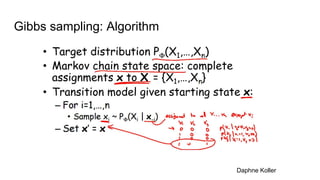
Gibbs sampling: Algorithm
Daphne Koller
Does it work? - often
Under certain conditions, the stationary distribution of this Markov chain is the joint
distribution of the Bayesian network:
● A probability distribution P(X) is positive, if P(X = x) > 0 for all x ∈ Dom(X).
● Theorem: If all conditional distributions in a Bayesian network are positive
(all probabilities are > 0) then a Gibbs sampler converges to the joint
distribution of the Bayesian network.
Gibbs properties
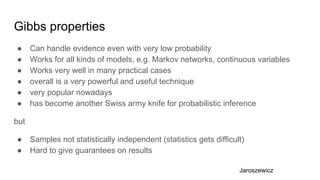
● Can handle evidence even with very low probability
● Works for all kinds of models, e.g. Markov networks, continuous variables
● Works very well in many practical cases
● overall is a very powerful and useful technique
● very popular nowadays
● has become another Swiss army knife for probabilistic inference
but
● Samples not statistically independent (statistics gets difficult)
● Hard to give guarantees on results
Jaroszewicz
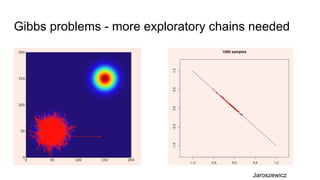
Gibbs problems - more exploratory chains needed
Jaroszewicz
Gibbs sampling: example
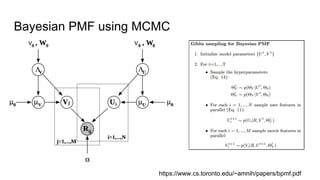
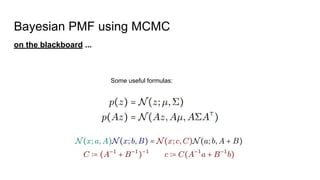
Bayesian PMF using MCMC
https://www.cs.toronto.edu/~amnih/papers/bpmf.pdf
Bayesian PMF using MCMC
Some useful formulas:
on the blackboard ...
Diagnostics
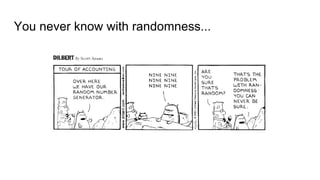
You never know with randomness...
Practical problems
● We only want to use samples that are sampled from a distribution close to p
(x) - when chain is already ‘mixing’
● At early iterations (before chain converged) we may be far from p(x) - we
need ‘burn-in’ iterations
● Samples are correlated - we need thinning (take only every n-th sample)
Diagnostics
● Visual Inspection
● Geweke Diagnostic
○ tests whether the burn-in is sufficient
● Gelman and Rubin Diagnostic
○ may detect problems with disconnected sample spaces
● Raftery and Lewis Diagnostic
○ calculates the number of iterations and burn-in needed by first running
● Heidelberg and Welch Diagnostic
○ test statistic for stationarity of the distribution
http://www.people.fas.harvard.edu/~plam/teaching/methods/convergence/convergence_print.pdf
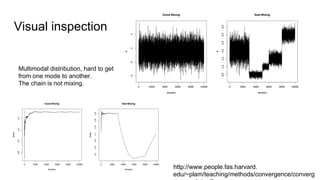
Visual inspection
http://www.people.fas.harvard.
edu/~plam/teaching/methods/convergence/converg
Multimodal distribution, hard to get
from one mode to another.
The chain is not mixing.
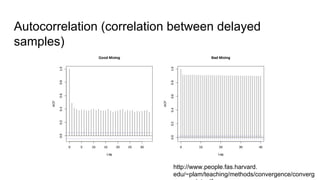
Autocorrelation (correlation between delayed
samples)
http://www.people.fas.harvard.
edu/~plam/teaching/methods/convergence/converg
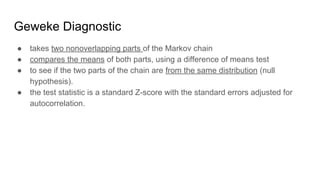
Geweke Diagnostic
● takes two nonoverlapping parts of the Markov chain
● compares the means of both parts, using a difference of means test
● to see if the two parts of the chain are from the same distribution (null
hypothesis).
● the test statistic is a standard Z-score with the standard errors adjusted for
autocorrelation.
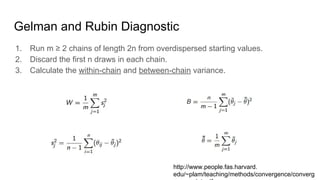
Gelman and Rubin Diagnostic
1. Run m ≥ 2 chains of length 2n from overdispersed starting values.
2. Discard the first n draws in each chain.
3. Calculate the within-chain and between-chain variance.
http://www.people.fas.harvard.
edu/~plam/teaching/methods/convergence/converg
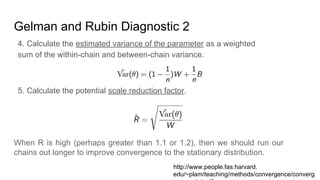
Gelman and Rubin Diagnostic 2
4. Calculate the estimated variance of the parameter as a weighted
sum of the within-chain and between-chain variance.
5. Calculate the potential scale reduction factor.
When R is high (perhaps greater than 1.1 or 1.2), then we should run our
chains out longer to improve convergence to the stationary distribution.
http://www.people.fas.harvard.
edu/~plam/teaching/methods/convergence/converg
Probabilistic programming
Probabilistic programming language
programming language designed to:
● describe probabilistic models
● perform inference automatically even on complicated models
for example:
● PyMC
● BUGS / JAGS
● BayesPy
https://en.wikipedia.org/wiki/Probabilistic_programming_language
What’s inside?
● BUGS - Adaptive Rejection (AR) sampling
● JAGS - Slice Sampler (one variable at once)
JAGS PMF-like example: model file
model{#########START###########
sv ~ dunif(0,100)
su ~ dunif(0,100)
s ~ dunif(0,100)
tau <- 1/(s*s)
tauv <- 1/(sv*sv)
tauu <- 1/(su*su)
...
...
for (j in 1:M) {
for (d in 1:D) {
v[j,d] ~ dnorm(0, tauv)
}
}
for (i in 1:N) {
for (d in 1:D) {
u[i,d] ~ dnorm(0, tauu)
}
}
for (j in 1:M) {
for (i in 1:N) {
mu[i,j] <- inprod(u[i,], v[j,])
r3[i,j] <- 1/(1+exp(-mu[i,j]))
r[i,j] ~ dnorm(r3[i,j], tau)
}
}
}#############END############
JAGS PMF-like example: Parameters preparation
n.chains = 1
n.iter = 5000
n.burnin = n.iter
n.thin = 1 #max(1, floor((n.iter - n.burnin)/1000))
D = 10
lu = 0.05
lv = 0.05
n.cluster=n.chains
model.file = "models/pmf_hypnorm3.bug"
N = dim(train)[1]
M = dim(train)[2]
start.s = sd(train[!is.na(train)])
start.su = sqrt(start.s^2/lu)
start.sv = sqrt(start.s^2/lv)
jags.data = list(N=N, M=M, D=D, r=train)
jags.params = c("u", "v", "s", "su", "sv")
jags.inits = list(s=start.s, su=start.su, sv=start.sv,
u=matrix( rnorm(N*D,mean=0,sd=start.su), N, D),
v=matrix( rnorm(M*D,mean=0,sd=start.sv), M, D))
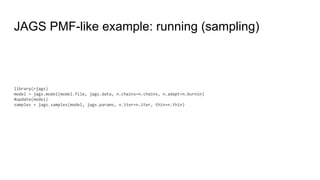
JAGS PMF-like example: running (sampling)
library(rjags)
model = jags.model(model.file, jags.data, n.chains=n.chains, n.adapt=n.burnin)
#update(model)
samples = jags.samples(model, jags.params, n.iter=n.iter, thin=n.thin)
JAGS PMF-like example: retrieving samples
per.chain = dim(samples$u)[3]
iterations = per.chain * dim(samples$u)[4]
user_sample = function(i, k) {samples$u[i, , (k-1)%%per.chain+1, ceiling(k/per.chain)]}
item_sample = function(j, k) {samples$v[j, , (k-1)%%per.chain+1, ceiling(k/per.chain)]}
Why it’s good, why it’s bad?
● fast prototyping
● less control
Results on movielens 100k
RMSE = 0.943 (~SGD)
More on https://github.com/tkusmierczyk/pmf-jags
Thank you!

Sampling and Markov Chain Monte Carlo Techniques

  • 1.
    Part 1: 2016-01-20 Part2: 2016-02-10 Tomasz Kuśmierczyk Session 5: Sampling & MCMC Approximate and Scalable Inference for Complex Probabilistic Models in Recommender Systems Part 2: Inference Techniques
  • 2.
    MCMC = MonteCarlo Markov Chains MCMC ⊂ Sampling
  • 3.
    Literature / Credits ●Szymon Jaroszewicz lectures on “Selected Advanced Topics in Machine Learning” ● Daphne Koller lectures on “Probabilistic Graphical Models” (https://class.coursera. org/pgm-003/lecture) ● Patrick Lam slides http://www.people.fas.harvard. edu/~plam/teaching/methods/convergence/convergence_print.pdf ● Bishop’s book ch. 11 ● MacKay, David JC. Information theory, inference and learning algorithms. Cambridge university press, 2003. (http://www.inference.phy.cam.ac.uk/itprnn/book.pdf) ● R & JAGS online tutorials… ● …
  • 4.
  • 5.
    Motivation: Monte Carlofor integrating http://mlg.eng.cam.ac.uk/zoubin/tut06/mcmc.pdf Non-trivial posterior distribution (e.g., for BNs)
  • 6.
    Sampling vs VariationalInference (previous seminar) http://people.inf.ethz.ch/bkay/talks/Brodersen_2013_03_22.pdf
  • 7.
    Sampling continued ... ●Accuracy of sampling based estimates depends only on the variance of the quantity being estimated ● It does not depend directly on the dimensionality (having many variables is not a problem) ● In some cases we are able to break the curse of dimensionality but ● Sampling gets much more difficult in higher dimensions ● Variance often increases as the dimension grows ● Accuracy of sampling based methods grows only with square root of the number of samples Jaroszewicz
  • 8.
    Sampling techniques -basic cases ● uniform -> pseudo-random numbers generator ● discrete distributions -> range matching with the help of uniform (in log of number of outcomes time) ● continous -> cdf inverse ● various ‘tricks’ ● ...
  • 9.
    Sampling techniques (e.g.,for BNs posterior) ● Ancestral Sampling (no evidence) ● Probabilistic Logic Sampling (like AS but samples not consistent with evidence are discarded -> low number of samples generated) ● Likelihood weighting (estimations may be inaccurate + other problems) ● Importance Sampling ● (Adaptive) Rejection Sampling ● Sampling-Importance-Resampling ● Metropolis ● Metropolis-Hastings ● Gibbs Sampling ● Hamiltionian (hybrid) Sampling ● Slice sampling ● and more...
  • 10.
    Monte Carlo withoutMarkov Chains
  • 11.
    Few remarks ● thereis no difference between sampling from normalized and non-normalized distributions ● non-normalized distributions are easy to evaluate for BNs ● in most cases (e.g. rejection sampling) we work with non-normalized distributions ● for simplicity p(x) is used in notation but there is no difference for complicated posterior distributions ● 1D case presented but work also in multi-dimensional case.
  • 12.
  • 13.
    Rejection sampling -proof Jaroszewicz
  • 14.
    Selection of c? ●c should be as small as possible to have low reduction rate ● but p <= c q must hold ● Adaptive Rejection Sampling for log-concave distributions ○ log-concave = logarithm of the distribution is concave
  • 15.
  • 16.
    Rejection Sampling problems ●part of the samples are rejected ● tight “envelope” helps a bit but ● in many dimensions (when there are many variables) dimensionality curse must be taken into account ● see Bishop’s example (for rejection sampling): ○ p(x) ~ N(0, s1) ○ q(x) ~ N(0, 1.01*s1) ○ D=1000 ○ -> acceptance ratio 1/20000
  • 17.
  • 18.
    What is aMarkov Chain? ● A triple <possibly infinite set S of possible states, initial distribution over states P0, transition matrix P (T)> ● transition matrix - a matrix with probabilities Pij (Tij) that being in some state si at time t we will move to another state sj at time t+1 ● Markov property = next state depends only on one previous Jaroszewicz
  • 19.
    Markov Chains -distribution over states Jaroszewicz
  • 20.
    Markov Chains -stationary distribution Jaroszewicz
  • 21.
  • 22.
    Stationarity from regularity ●If there exists k such that, for every two states <si, sj> the probability of getting from si to sj in exactly k steps is > 0 (MC is regular) →MC converges to a unique stationary distribution ● Sufficient conditions for regularity: ○ there is a path between every pair of states ○ for every state, there is a self-transition
  • 23.
    Stationarity of irreducible,aperiodic MC ● Irreducible, aperiodic Markov chains always converge to a unique stationary distribution
  • 24.
  • 25.
  • 26.
    Why I talkabout Markov Chains -> MCMC the idea is that: ● Markov Chain “jumps” over states ● states determine (BN) samples (that are later used for Monte Carlo) ○ for example: state ⇔ sample but we need: ● Markov Chain converges to a stationary distribution (to be proved every time) ● a distribution of generated samples is equal to required distribution (BNs posterior)
  • 27.
    Properties ● Very generalpurpose ● Often easy to implement ● Good theoretical guarantees as t -> ∞ but: ● Lots of tunable parameters / design choices ● Can be quite slow to converge ● Difficult to tell whether it’s working
  • 28.
    Metropolis-Hastings derivation on theblackboard: 1. From detailed balance to stationarity 2. Proposed distribution and acceptance probability 3. From detailed balance to conditions on acceptance probability
  • 29.
    Part 2 Dawn ofStatistical Renaissance
  • 30.
  • 31.
  • 32.
    Does it work?- often Under certain conditions, the stationary distribution of this Markov chain is the joint distribution of the Bayesian network: ● A probability distribution P(X) is positive, if P(X = x) > 0 for all x ∈ Dom(X). ● Theorem: If all conditional distributions in a Bayesian network are positive (all probabilities are > 0) then a Gibbs sampler converges to the joint distribution of the Bayesian network.
  • 33.
    Gibbs properties ● Canhandle evidence even with very low probability ● Works for all kinds of models, e.g. Markov networks, continuous variables ● Works very well in many practical cases ● overall is a very powerful and useful technique ● very popular nowadays ● has become another Swiss army knife for probabilistic inference but ● Samples not statistically independent (statistics gets difficult) ● Hard to give guarantees on results Jaroszewicz
  • 34.
    Gibbs problems -more exploratory chains needed Jaroszewicz
  • 35.
  • 36.
    Bayesian PMF usingMCMC https://www.cs.toronto.edu/~amnih/papers/bpmf.pdf
  • 37.
    Bayesian PMF usingMCMC Some useful formulas: on the blackboard ...
  • 38.
  • 39.
    You never knowwith randomness...
  • 40.
    Practical problems ● Weonly want to use samples that are sampled from a distribution close to p (x) - when chain is already ‘mixing’ ● At early iterations (before chain converged) we may be far from p(x) - we need ‘burn-in’ iterations ● Samples are correlated - we need thinning (take only every n-th sample)
  • 41.
    Diagnostics ● Visual Inspection ●Geweke Diagnostic ○ tests whether the burn-in is sufficient ● Gelman and Rubin Diagnostic ○ may detect problems with disconnected sample spaces ● Raftery and Lewis Diagnostic ○ calculates the number of iterations and burn-in needed by first running ● Heidelberg and Welch Diagnostic ○ test statistic for stationarity of the distribution http://www.people.fas.harvard.edu/~plam/teaching/methods/convergence/convergence_print.pdf
  • 42.
  • 43.
    Autocorrelation (correlation betweendelayed samples) http://www.people.fas.harvard. edu/~plam/teaching/methods/convergence/converg
  • 44.
    Geweke Diagnostic ● takestwo nonoverlapping parts of the Markov chain ● compares the means of both parts, using a difference of means test ● to see if the two parts of the chain are from the same distribution (null hypothesis). ● the test statistic is a standard Z-score with the standard errors adjusted for autocorrelation.
  • 45.
    Gelman and RubinDiagnostic 1. Run m ≥ 2 chains of length 2n from overdispersed starting values. 2. Discard the first n draws in each chain. 3. Calculate the within-chain and between-chain variance. http://www.people.fas.harvard. edu/~plam/teaching/methods/convergence/converg
  • 46.
    Gelman and RubinDiagnostic 2 4. Calculate the estimated variance of the parameter as a weighted sum of the within-chain and between-chain variance. 5. Calculate the potential scale reduction factor. When R is high (perhaps greater than 1.1 or 1.2), then we should run our chains out longer to improve convergence to the stationary distribution. http://www.people.fas.harvard. edu/~plam/teaching/methods/convergence/converg
  • 47.
  • 48.
    Probabilistic programming language programminglanguage designed to: ● describe probabilistic models ● perform inference automatically even on complicated models for example: ● PyMC ● BUGS / JAGS ● BayesPy https://en.wikipedia.org/wiki/Probabilistic_programming_language
  • 49.
    What’s inside? ● BUGS- Adaptive Rejection (AR) sampling ● JAGS - Slice Sampler (one variable at once)
  • 50.
    JAGS PMF-like example:model file model{#########START########### sv ~ dunif(0,100) su ~ dunif(0,100) s ~ dunif(0,100) tau <- 1/(s*s) tauv <- 1/(sv*sv) tauu <- 1/(su*su) ... ... for (j in 1:M) { for (d in 1:D) { v[j,d] ~ dnorm(0, tauv) } } for (i in 1:N) { for (d in 1:D) { u[i,d] ~ dnorm(0, tauu) } } for (j in 1:M) { for (i in 1:N) { mu[i,j] <- inprod(u[i,], v[j,]) r3[i,j] <- 1/(1+exp(-mu[i,j])) r[i,j] ~ dnorm(r3[i,j], tau) } } }#############END############
  • 51.
    JAGS PMF-like example:Parameters preparation n.chains = 1 n.iter = 5000 n.burnin = n.iter n.thin = 1 #max(1, floor((n.iter - n.burnin)/1000)) D = 10 lu = 0.05 lv = 0.05 n.cluster=n.chains model.file = "models/pmf_hypnorm3.bug" N = dim(train)[1] M = dim(train)[2] start.s = sd(train[!is.na(train)]) start.su = sqrt(start.s^2/lu) start.sv = sqrt(start.s^2/lv) jags.data = list(N=N, M=M, D=D, r=train) jags.params = c("u", "v", "s", "su", "sv") jags.inits = list(s=start.s, su=start.su, sv=start.sv, u=matrix( rnorm(N*D,mean=0,sd=start.su), N, D), v=matrix( rnorm(M*D,mean=0,sd=start.sv), M, D))
  • 52.
    JAGS PMF-like example:running (sampling) library(rjags) model = jags.model(model.file, jags.data, n.chains=n.chains, n.adapt=n.burnin) #update(model) samples = jags.samples(model, jags.params, n.iter=n.iter, thin=n.thin)
  • 53.
    JAGS PMF-like example:retrieving samples per.chain = dim(samples$u)[3] iterations = per.chain * dim(samples$u)[4] user_sample = function(i, k) {samples$u[i, , (k-1)%%per.chain+1, ceiling(k/per.chain)]} item_sample = function(j, k) {samples$v[j, , (k-1)%%per.chain+1, ceiling(k/per.chain)]}
  • 54.
    Why it’s good,why it’s bad? ● fast prototyping ● less control
  • 55.
    Results on movielens100k RMSE = 0.943 (~SGD) More on https://github.com/tkusmierczyk/pmf-jags
  • 56.