Vestibular Assessment from
the Physiotherapy Perspective
Bronwyn Kaiser
A.Physiotherapy Coordinator
SCGH Care Coordination Team
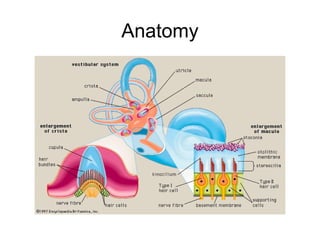
Anatomy
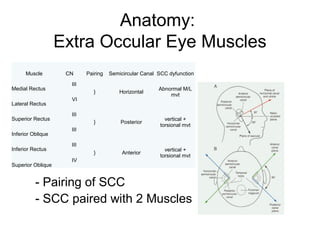
Anatomy:
Extra Occular Eye Muscles
Muscle
Medial Rectus
Lateral Rectus
Superior Rectus
Inferior Oblique
Inferior Rectus
Superior Oblique

CN

Pairing

Semicircular Canal SCC dyfunction

III
}

Horizontal

Abnormal M/L
mvt

}

Posterior

vertical +
torsional mvt

}

Anterior

vertical +
torsional mvt

VI
III
III
III
IV

- Pairing of SCC
- SCC paired with 2 Muscles
Vestibular dysfunction
• Vertigo and imbalance
– Diagnosis needs to determine central
(cerebellum) vs peripheral (labyrinth and
semicircular canals of the inner ear) cause
– Multiple peripheral causes (not just BPPV)
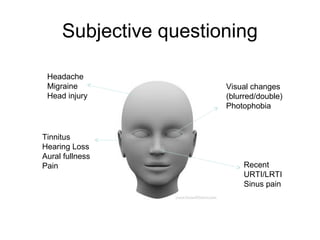
Subjective questioning
Headache
Migraine
Head injury

Tinnitus
Hearing Loss
Aural fullness
Pain

Visual changes
(blurred/double)
Photophobia

Recent
URTI/LRTI
Sinus pain
Subjective
• Symptoms
– “dizzy”
– vertigo, light headed, faint, drop attacks, nausea,
auditory/visual disturbances

• Tempo
– latency
– Duration
– episodic

• Circumstance
– When
– Where
– Easing factors
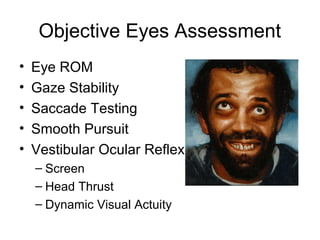
Objective Eyes Assessment
•
•
•
•
•

Eye ROM
Gaze Stability
Saccade Testing
Smooth Pursuit
Vestibular Ocular Reflex
– Screen
– Head Thrust
– Dynamic Visual Actuity
Take Home Message
Occular motor testing
See something that isn’t suspected – likely
to have a central origin.
– Exceptions:
Non-direction changing gaze evoked nystagmus
+ ve Head thrust

 Regardless, +ve to any occulomotor test
should to be referred on for Medical (ENT/
neuro) opinion
Objective Tests
• Cerebellar tests
– Dysdiadokinesia, finger-nose, heel-shin

• Rhomberg test
– FTEO vs FTEC

• Sharpened Rhomberg
– Feet in front of each other EO vs EC

• Gait
– Heel-toe walk
Objective Tests – Semicircular
canals
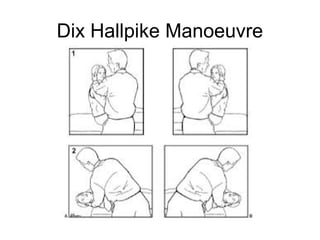
• Dix-Hallpike – anterior and posterior canal
– Contra-indications
• MSc: disc prolapse, cervical injury/fracture/trauma
• Neuro: cervical myelopathy/radiculopathy
• Vascular: dissection carotid/vertebral artery

– Caution
• Cardiac surgery within 3/12
• Severe orthopnoea
• Severe back pain
Dix Hallpike Manoeuvre
Objective tests – horizontal
canal
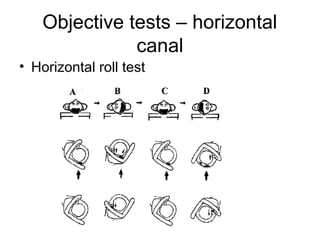
• Horizontal roll test
Differential Diagnoses
 
BPPV

Tempo

Symptoms

Circumstance

episodic,<1min

Vertigo, N&V

head changes relative to Gravity

VBI

episodic,<1min

Vertigo, N&V, dipolpia, blurred vision,
drop attack
EOR E/rotation

Postural
Hypotension

episodic

Faint, dizzy

Vestibular
labrythitis

crisis, constant for Vertigo, N&V, hearing loss,
<4 days
dysequilibruim

constant, exacerbated with movement,
visual disturbance

Vestibular
neuritis

crisis, constant for Vertigo, N&V, No hearing loss,
<4 days
dysequilibruim

constant, exacerbated with movement,
visual disturbance

Menieres

episodic, 20min to Vertigo, N&V, hearing loss, tinnitus,
24 hours
fullness in ear

spontaneous and episodic

CVA

constant

Migrane

spells for minutes Vertigo, motion sensitivity, dizziness

spontaneous or motion provoked

Gentamycin
Toxicity

constant

post 1 Dose

getting up

Vertigo, N&V, OTHER NEURO SIGNS constant

Vertigo, dysequilibruim,
Treatments
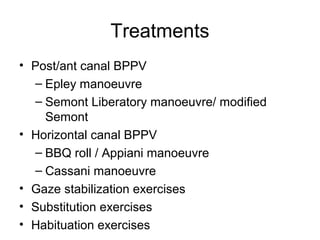
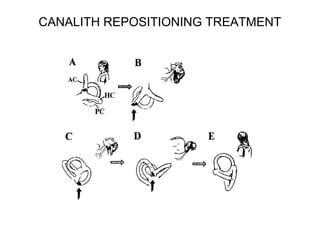
• Post/ant canal BPPV
– Epley manoeuvre
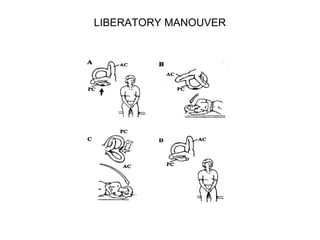
– Semont Liberatory manoeuvre/ modified
Semont
• Horizontal canal BPPV
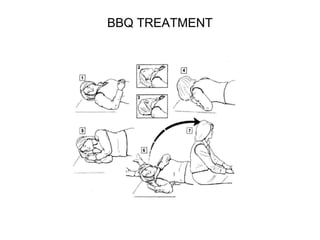
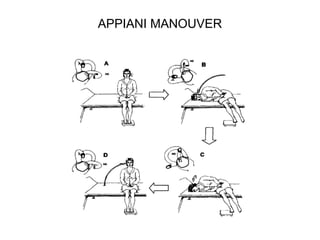
– BBQ roll / Appiani manoeuvre
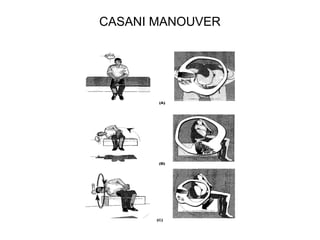
– Cassani manoeuvre
• Gaze stabilization exercises
• Substitution exercises
• Habituation exercises
CANALITH REPOSITIONING TREATMENT
LIBERATORY MANOUVER
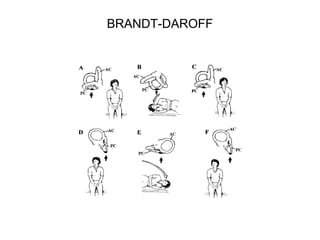
BRANDT-DAROFF
BBQ TREATMENT
APPIANI MANOUVER
CASANI MANOUVER
POST TREATMENT

• Post Treatment Instructions
THERE ARE NONE!
• Re-Assessment
- you can reassess 10 minutes after treatment if the patient is
overly symptomatic
- treat again if necessary
- review as appropriate for your clinical area

not
CONTRAINDICATIONS &
RED FLAGS
• CONTRAINDICATIONS: neck surgery, recent neck
trauma, severe RA, atlantoaxial + occipitoatlantal
instability, Cx myelopathy or radicaulopathy, carotid
sinus syncope, Chiari malformation or vascular
dissection syndromes.
• RED FLAGS:
- direction changing nystagmus
- tinnitus
- hearing loss
- aural fullness
- additional neurological S+S
- failure to respond to conservative Rx
***REFER ON to ENT or Neurologist

Vestibular assessment from the physiotherapy perspective

  • 1.
    Vestibular Assessment from thePhysiotherapy Perspective Bronwyn Kaiser A.Physiotherapy Coordinator SCGH Care Coordination Team
  • 3.
  • 4.
    Anatomy: Extra Occular EyeMuscles Muscle Medial Rectus Lateral Rectus Superior Rectus Inferior Oblique Inferior Rectus Superior Oblique CN Pairing Semicircular Canal SCC dyfunction III } Horizontal Abnormal M/L mvt } Posterior vertical + torsional mvt } Anterior vertical + torsional mvt VI III III III IV - Pairing of SCC - SCC paired with 2 Muscles
  • 5.
    Vestibular dysfunction • Vertigoand imbalance – Diagnosis needs to determine central (cerebellum) vs peripheral (labyrinth and semicircular canals of the inner ear) cause – Multiple peripheral causes (not just BPPV)
  • 6.
    Subjective questioning Headache Migraine Head injury Tinnitus HearingLoss Aural fullness Pain Visual changes (blurred/double) Photophobia Recent URTI/LRTI Sinus pain
  • 7.
    Subjective • Symptoms – “dizzy” –vertigo, light headed, faint, drop attacks, nausea, auditory/visual disturbances • Tempo – latency – Duration – episodic • Circumstance – When – Where – Easing factors
  • 8.
    Objective Eyes Assessment • • • • • EyeROM Gaze Stability Saccade Testing Smooth Pursuit Vestibular Ocular Reflex – Screen – Head Thrust – Dynamic Visual Actuity
  • 9.
    Take Home Message Occularmotor testing See something that isn’t suspected – likely to have a central origin. – Exceptions: Non-direction changing gaze evoked nystagmus + ve Head thrust  Regardless, +ve to any occulomotor test should to be referred on for Medical (ENT/ neuro) opinion
  • 10.
    Objective Tests • Cerebellartests – Dysdiadokinesia, finger-nose, heel-shin • Rhomberg test – FTEO vs FTEC • Sharpened Rhomberg – Feet in front of each other EO vs EC • Gait – Heel-toe walk
  • 11.
    Objective Tests –Semicircular canals • Dix-Hallpike – anterior and posterior canal – Contra-indications • MSc: disc prolapse, cervical injury/fracture/trauma • Neuro: cervical myelopathy/radiculopathy • Vascular: dissection carotid/vertebral artery – Caution • Cardiac surgery within 3/12 • Severe orthopnoea • Severe back pain
  • 12.
  • 13.
    Objective tests –horizontal canal • Horizontal roll test
  • 14.
    Differential Diagnoses   BPPV Tempo Symptoms Circumstance episodic,<1min Vertigo, N&V headchanges relative to Gravity VBI episodic,<1min Vertigo, N&V, dipolpia, blurred vision, drop attack EOR E/rotation Postural Hypotension episodic Faint, dizzy Vestibular labrythitis crisis, constant for Vertigo, N&V, hearing loss, <4 days dysequilibruim constant, exacerbated with movement, visual disturbance Vestibular neuritis crisis, constant for Vertigo, N&V, No hearing loss, <4 days dysequilibruim constant, exacerbated with movement, visual disturbance Menieres episodic, 20min to Vertigo, N&V, hearing loss, tinnitus, 24 hours fullness in ear spontaneous and episodic CVA constant Migrane spells for minutes Vertigo, motion sensitivity, dizziness spontaneous or motion provoked Gentamycin Toxicity constant post 1 Dose getting up Vertigo, N&V, OTHER NEURO SIGNS constant Vertigo, dysequilibruim,
  • 15.
    Treatments • Post/ant canalBPPV – Epley manoeuvre – Semont Liberatory manoeuvre/ modified Semont • Horizontal canal BPPV – BBQ roll / Appiani manoeuvre – Cassani manoeuvre • Gaze stabilization exercises • Substitution exercises • Habituation exercises
  • 16.
  • 17.
  • 18.
  • 19.
  • 20.
  • 21.
  • 22.
    POST TREATMENT • PostTreatment Instructions THERE ARE NONE! • Re-Assessment - you can reassess 10 minutes after treatment if the patient is overly symptomatic - treat again if necessary - review as appropriate for your clinical area not
  • 23.
    CONTRAINDICATIONS & RED FLAGS •CONTRAINDICATIONS: neck surgery, recent neck trauma, severe RA, atlantoaxial + occipitoatlantal instability, Cx myelopathy or radicaulopathy, carotid sinus syncope, Chiari malformation or vascular dissection syndromes. • RED FLAGS: - direction changing nystagmus - tinnitus - hearing loss - aural fullness - additional neurological S+S - failure to respond to conservative Rx ***REFER ON to ENT or Neurologist

Editor's Notes

  • #5 Paired SCC in planes – coplanar Association between extra occular eye muscles and vestibular appartus  important
  • #8 This is like telling you to suck eggs. Subjective – as important as Dx any other conplaint – shoudler etc . . . . Guides your objective. 3 domains – hammer out Symptoms tempo Circumstances