Cerebrovascular Accident

      CVA/STROKE


                           1
Cerebrovascular Accident
 is the rapidly developing loss of brain function(s) due to
  disturbance in the blood supply to the brain.
 Results from ischemia to a part of the brain or
  hemorrhage into the brain that results in death of brain
  cells.
    Third most common cause of death
    #1 leading cause of disability
    25% with initial stroke die within 1 year
    50-75% will be functionally independent
    25% will live with permanent disability

                                                           2
Cerebrovascular Accident
                Risk Factors
Nonmodifiable:

  Age – Occurrence doubles each decade >55 years
  Race – African Americans
  Heredity – family history,
  prior transient ischemic attack, or prior stroke increases
   risk


                                                          3
Cerebrovascular Accident
              Risk Factors
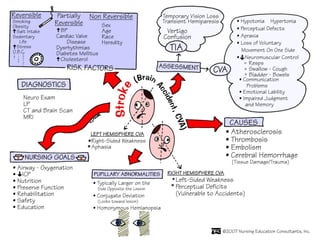
Controllable Risks
 High blood pressure           Diabetes
 Cigarette smoking
 High blood cholesterol        Obesity
 Heart Disease               Atrial fibrillation
 Oral contraceptive use        Physical inactivity
 Asymptomatic carotid stenosis
 Hypercoagulability


                                                     4
Cerebrovascular Accident
        Anatomy of Cerebral Circulation
 Blood Supply

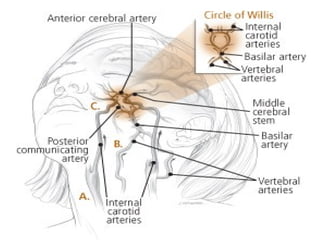
    Anterior: Carotid Arteries – middle & anterior cerebral arteries
       frontal, parietal, temporal lobes; basal ganglion; part of the diencephalon
        (thalamus & hypothalamus)


    Posterior: Vertebral Arteries – basilar artery
       Mid and lower temporary & occipital lobes, cerebellum, brainstem, & part
        of the diencephalon


    Circle of Willis – connects the anterior & posterior cerebral circulation

                                                                                 5
Cerebrovascular Accident
     Anatomy of Cerebral Circulation

Blood Supply

  20% of cardiac output—750-1000ml/min

    >30 second interruption– neurologic
     metabolism is altered; metabolism stops in 2
     minutes; brain cell death < 5 mins.

                                                    6
7
Cerebrovascular Accident
             Pathophysiology
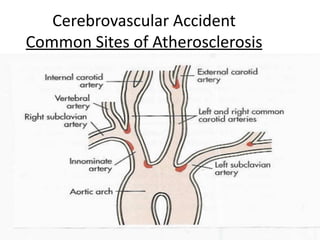
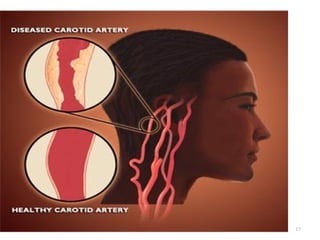
Atherosclerosis: major cause of CVA
  Thrombus formation & emboli development
     Abnormal filtration of lipids in the intimal layer of the arterial
      wall
     Plaque develops at locations of increased turbulence of blood
      – Bifurcations
     Calcified plaques rupture or fissure
     Platelets & fibrin adhere to the plaque
     Narrowing or blockage of an artery by thrombus or emboli


                                                                    8
Cerebrovascular Accident
          Transient Ischemic Attack
 Temporary focal loss of neurologic function

 Caused by ischemia of one of the vascular territories of
  the brain
    Microemboli with temporary blockage of blood flow

 Lasts less than 24 hrs – often less than 15 mins

 Most resolve within 3 hours

 Warning sign of progressive cerebrovascular disease    9
Cerebrovascular Accident
           Classifications


Based on underlying pathophysiologic findings


                                                10
Cerebrovascular Accident
     Classifications
 Ischemic Stroke
    Thrombotic
    Emboli
 Hemorrhagic Stroke
    Intracerebral Hemorrhage
    Subarachnoid Hemorrhage
    Aneurysm
    Arterio venous malformation
                                   11
Cerebrovascular Accident
             Classifications
 Ischemic Stroke—inadequate blood flow to the brain from
  partial or complete occlusions of an artery--85% of all
  strokes
   – Extent of a stroke depends on:
     • Rapidity of onset
     • Size of the lesion
     • Presence of collateral circulation
  – Symptoms may progress in the first 72 hours as
    infarction & cerebral edema increase
Types of Ischemic Stroke:
  Thrombotic Stroke            Embolic Stroke        12
Cerebrovascular Accident
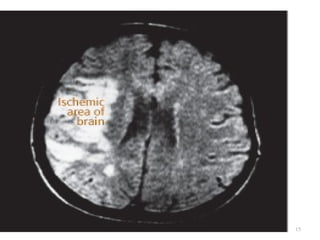
  Ischemic – Thrombotic Stroke
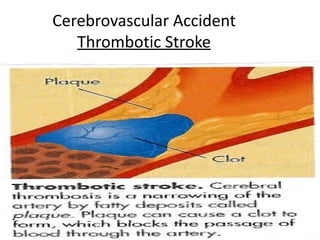
 Lumen of the blood vessels narrow – then
 becomes occluded – infarction
Associated with HTN and Diabetes Mellitus
  >60% of strokes
  50% are preceded by TIA
  Lacunar Stroke: development of cavity in place of
   infarcted brain tissue – results in considerable
   deficits – motor hemiplegia, contralateral loss of
   sensation or motor ability

                                                   13
Cerebrovascular Accident
   Thrombotic Stroke


                           14
15
Cerebrovascular Accident
Common Sites of Atherosclerosis


                                  16
17
Cerebrovascular Accident
      Ischemic – Embolic Stroke
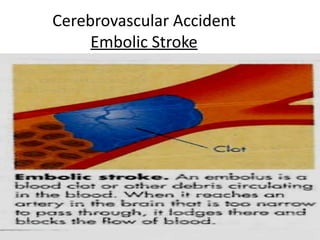
Embolus lodges in and occludes a cerebral artery
Results in infarction & cerebral edema of the area
 supplied by the vessel
Second most common cause of stroke – 24%
Emboli originate mainly from endocardial layer of the
 heart – atrial fibrillation, MI, infective endocarditis,
 valvular prostheses
Rapid occurrence with severe symptoms – body does
 not have time to develop collateral circulation
Any age group
Recurrence common if underlying cause not treated 18
Cerebrovascular Accident
     Embolic Stroke


                           19
Cerebrovascular Accident
  Hemorrhagic Stroke

Hemorrhagic Stroke
  15% of all strokes
  Result from bleeding into the brain tissue
   itself
     Intracerebral
     Subarachnoid


                                                20
Cerebrovascular Accident
             Hemorrhage Stroke
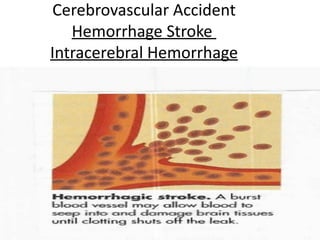
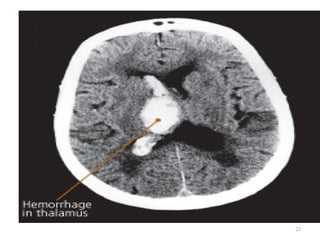
          Intracerebral Hemorrhage

 Rupture of a vessel
 Hypertension – most important cause
 Others: vascular malformations, coagulation disorders,
  anticoagulation, trauma, brain tumor, ruptured aneurysms
 Sudden onset of symptoms with progression
 Neurological deficits, headache, nausea, vomiting, decreased
  LOC, and hypertension
 Prognosis: poor – 50% die within weeks
 20% functionally independent at 6 months

                                                           21
Cerebrovascular Accident
   Hemorrhage Stroke
Intracerebral Hemorrhage


                           22
23
Cerebrovascular Accident
       Hemorrhagic-Subarachnoid

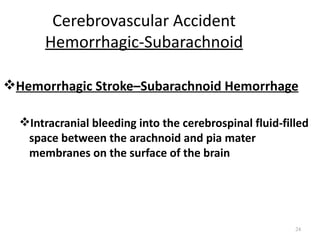
Hemorrhagic Stroke–Subarachnoid Hemorrhage

  Intracranial bleeding into the cerebrospinal fluid-filled
   space between the arachnoid and pia mater
   membranes on the surface of the brain


                                                         24
Cerebrovascular Accident
    Hemorrhagic-Subarachnoid

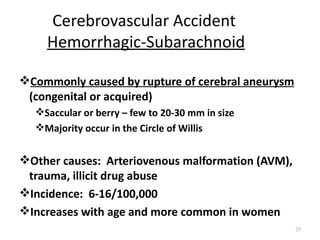
Commonly caused by rupture of cerebral aneurysm
 (congenital or acquired)
  Saccular or berry – few to 20-30 mm in size
  Majority occur in the Circle of Willis


Other causes: Arteriovenous malformation (AVM),
 trauma, illicit drug abuse
Incidence: 6-16/100,000
Increases with age and more common in women
                                                   25
Cerebrovascular Accident
       Hemorrhagic-Subarachnoid
          Cerebral Aneurysm
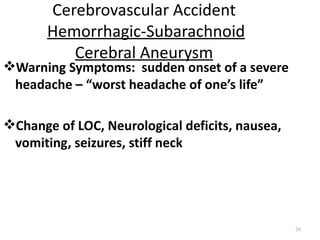
Warning Symptoms: sudden onset of a severe
 headache – “worst headache of one’s life”

Change of LOC, Neurological deficits, nausea,
 vomiting, seizures, stiff neck


                                                 26
27
Hemorrhagic-Subarachnoid
          Cerebral Aneurysm

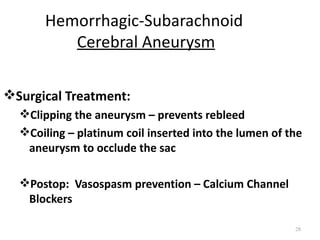
Surgical Treatment:
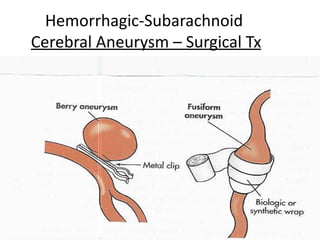
  Clipping the aneurysm – prevents rebleed
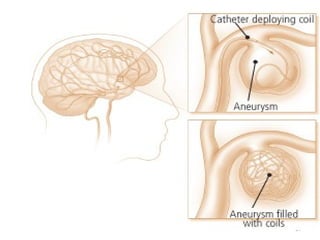
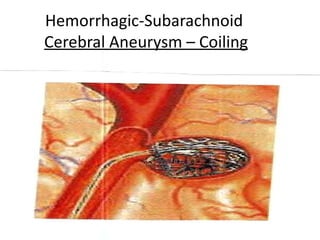
  Coiling – platinum coil inserted into the lumen of the
   aneurysm to occlude the sac

  Postop: Vasospasm prevention – Calcium Channel
   Blockers

                                                       28
Hemorrhagic-Subarachnoid
Cerebral Aneurysm – Surgical Tx


                                  29
Hemorrhagic-Subarachnoid
Cerebral Aneurysm – Coiling


                              30
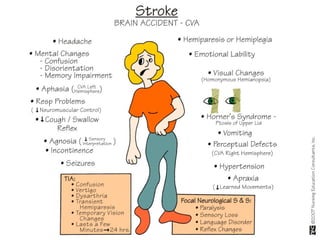
Clinical manifestations
Neurologic deficits Depending on –
• Location of the lesion (which vessel are
  obstructed )
• The size of the area of inadequate perfusion
• The amount of collateral blood flow


                                                 31
Motor loss
Stroke is a disease of upper motor neuron and
  results in loss of voluntary control over motor
  movements
- Upper motor neuron decussate
- most common motor dysfunction is
  hemiplegia due to lesion of the opposite side
  of the brain
- Hemiparesis also another sign
-
                                                    32
Communication
Aphasia/Dysphasia:-defect or loss of speech
  - Receptive Aphasia :- sounds of speech nor its
     meaning can be understood – spoken & written
  - Expressive Aphasia :- difficulty in speaking and
     writing
Dysarthria: Affects the mechanics of speech
 due to muscle control disturbances –
 pronunciation, and phonation


                                                       33
Perceptual disturbance
• Visual perceptual dysfunction
     -due to disturbances of the primary sensory
  pathways between the eye and visual cortex
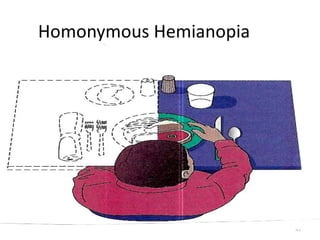
Homonymous Hemianopia:-loss of half of the visual
  field
     - may be temporary or permanent
   - the affected side of the vision corresponds
      to the paralyzed side of the body
  - pts head turns away from the affected side
       of his body

                                                    34
Disturbance in Visual spatial r/ship
• Perceiving relationship of two or more objects
  in spatial areas
• Frequently seen in patients with left
  hemiplegia
• Pt may not able to dress him/herself b/se of
  his/her ability to match his clothing to his
  body parts


                                               35
Sensory losses
• Loss of proprioception :-inability to perceive
  position and motion of body parts
• Difficulty in interpreting visual ,tactile,and
  auditory stimuli


                                                   36
Affect
Difficulty controlling emotions
Exaggerated or unpredictable emotional response
Depression / feelings regarding changed body
 image and loss of function


                                               37
Intellectual Function
Memory and judgment
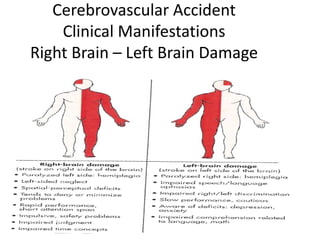
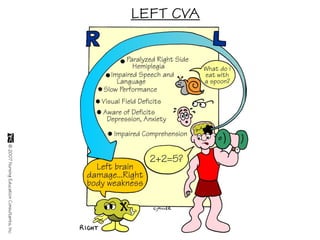
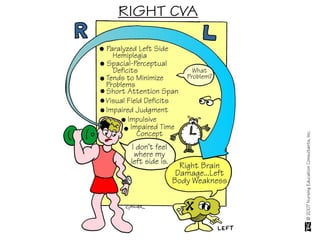
   Left-brain stroke: cautious in making judgments
   Right-brain stroke: impulsive & moves quickly to
    decisions
Difficulties in learning new skills


                                                       38
Elimination
Most problems occur initially and are temporary
One hemisphere stroke: prognosis is excellent for
 normal bladder function
Bowel elimination: motor control not a problem –
 constipation associated with immobility, weak
 abdominal muscles, dehydration, diminished
 response to the defecation reflex


                                                 39
Cerebrovascular Accident
    Clinical Manifestations
Right Brain – Left Brain Damage


                                  40
41
42
Homonymous Hemianopia


                        43
44
Cerebrovascular Accident
    Treatment Goals


        Prevention
        Drug Therapy
        Surgical Therapy
        Rehabilitation


                            45
Cerebrovascular Accident
           Treatment Goals
Prevention – Health Maintenance Focus:
  Healthy diet
  Weight control
  Regular exercise
  No smoking
  Limit alcohol consumption
  Route health assessment
  Control of risk factors

                                          46
Cerebrovascular Accident
           Diagnostic Studies
Done to confirm CVA and identify cause
  PE: Neuro Assessment
  Carotid doppler studies (ultrasound study)
  CT – primary – identifies size, location, differentiates
   between ischemic and hemorrhagic
  MRI – greater specificity than CT
     May not be able to be used on all patients (metal,
      claustrophobia)
  Angiography: gold standard for imaging carotid arteries

                                                              47
Cerebrovascular Accident
                Treatment Goals
 Drug Therapy – Thrombotic CVA – to reestablish blood flow
  through a blocked artery
 Thrombolytic Drugs: tPA (tissue plasminogen activator)
    produce localized fibrinolysis by binding to the fibrin in the thrombi
    Plasminogen is converted to plasmin (fibrinolysin)
    Enzymatic action digests fibrin & fibrinogen
    Results is clot lysis
 Administered within 3 hours of symptoms of ischemic CVA
    Confirmed DX with CT
    Patient anticoagulated
 ASA, Calcium Channel Blockers


                                                                              48
Cerebrovascular Accident
            Treatment Goals
Drug Therapy
  Measures to prevent the development of a thrombus or
   embolus for “At Risk” patients:

    Antiplatelet Agents
       Aspirin
       Plavix
       Combination

    Oral anticoagulation – Coumadin
       Treatment of choice for individuals with atrial fibrillation who have had
        a TIA
                                                                           49
CVA - Treatment Goals
Surgical Treatment

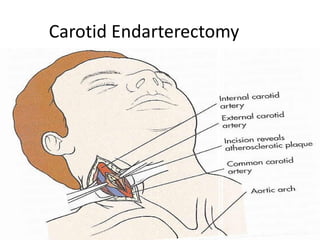
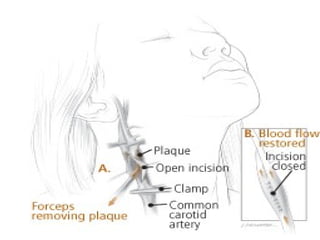
  Carotid endarterectomy – preventive – > 100,000/year
    removal of atheromatous lesions
  Clipping, wrapping, coiling Aneurysm
  Evacuation of aneurysm-induced hematomas larger
   than 3 cm.
  Treatment of AV Malformations


                                                    50
Carotid Endarterectomy


                         51
52
Cerebrovascular Accident
            Nursing Diagnoses
 Ineffective tissue perfusion r/t decreased cerebrovascular
  blood flow
 Ineffective airway clearance
 Impaired physical mobility
 Impaired verbal communication
 Impaired swallowing
 Unilateral neglect r/t visual field cut & sensory loss
 Impaired urinary elimination
 Situational low self-esteem r/t actual or perceived loss of
  function                                                53
Cerebrovascular Accident
             Nursing Goals
Maintain stable or improved LOC
Attain maximum physical functioning
Attain maximum self-care activities & skills
Maintain stable body functions
Maximize communication abilities
Maintain adequate nutrition
Avoid complications of stroke
Maintain effective personal & family coping
                                                54
Cerebrovascular Accident
        Warning Signs of Stroke
Sudden weakness, paralysis, or numbness of the
 face, arm, or leg, especially on one side of the
 body
Sudden dimness or loss of vision in one or both
 eyes
Sudden loss of speech, confusion, or difficulty
 speaking or understanding speech
Unexplained sudden dizziness, unsteadiness, loss
 of balance, or coordination
Sudden severe headache
                                               55
Cerebrovascular Accident
             Acute Phase
Nsg Action:
  Supportive Care
    Respiratory – spans from intubation to breathing on own
    Musculoskeletal -- Positioning – side-to-side;
    GU – Foley catheter
    Skin – preventive care
    Meds: anti platelet


                                                           56
Cerebrovascular Accident
              Acute Phase

Patient Education:

  Clear explanations for all care/treatments
  Focus on improvements—regained abilities
  Include family


                                                57
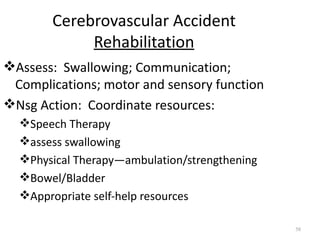
Cerebrovascular Accident
            Rehabilitation
Assess: Swallowing; Communication;
 Complications; motor and sensory function
Nsg Action: Coordinate resources:
  Speech Therapy
  assess swallowing
  Physical Therapy—ambulation/strengthening
  Bowel/Bladder
  Appropriate self-help resources

                                               58
59
60
61

Cva

  • 1.
  • 2.
    Cerebrovascular Accident  isthe rapidly developing loss of brain function(s) due to disturbance in the blood supply to the brain.  Results from ischemia to a part of the brain or hemorrhage into the brain that results in death of brain cells.  Third most common cause of death  #1 leading cause of disability  25% with initial stroke die within 1 year  50-75% will be functionally independent  25% will live with permanent disability 2
  • 3.
    Cerebrovascular Accident Risk Factors Nonmodifiable: Age – Occurrence doubles each decade >55 years Race – African Americans Heredity – family history, prior transient ischemic attack, or prior stroke increases risk 3
  • 4.
    Cerebrovascular Accident Risk Factors Controllable Risks High blood pressure Diabetes Cigarette smoking High blood cholesterol Obesity Heart Disease Atrial fibrillation Oral contraceptive use Physical inactivity Asymptomatic carotid stenosis Hypercoagulability 4
  • 5.
    Cerebrovascular Accident Anatomy of Cerebral Circulation  Blood Supply  Anterior: Carotid Arteries – middle & anterior cerebral arteries frontal, parietal, temporal lobes; basal ganglion; part of the diencephalon (thalamus & hypothalamus)  Posterior: Vertebral Arteries – basilar artery Mid and lower temporary & occipital lobes, cerebellum, brainstem, & part of the diencephalon  Circle of Willis – connects the anterior & posterior cerebral circulation 5
  • 6.
    Cerebrovascular Accident Anatomy of Cerebral Circulation Blood Supply 20% of cardiac output—750-1000ml/min >30 second interruption– neurologic metabolism is altered; metabolism stops in 2 minutes; brain cell death < 5 mins. 6
  • 7.
  • 8.
    Cerebrovascular Accident Pathophysiology Atherosclerosis: major cause of CVA Thrombus formation & emboli development Abnormal filtration of lipids in the intimal layer of the arterial wall Plaque develops at locations of increased turbulence of blood – Bifurcations Calcified plaques rupture or fissure Platelets & fibrin adhere to the plaque Narrowing or blockage of an artery by thrombus or emboli 8
  • 9.
    Cerebrovascular Accident Transient Ischemic Attack  Temporary focal loss of neurologic function  Caused by ischemia of one of the vascular territories of the brain  Microemboli with temporary blockage of blood flow  Lasts less than 24 hrs – often less than 15 mins  Most resolve within 3 hours  Warning sign of progressive cerebrovascular disease 9
  • 10.
    Cerebrovascular Accident Classifications Based on underlying pathophysiologic findings 10
  • 11.
    Cerebrovascular Accident Classifications Ischemic Stroke Thrombotic Emboli Hemorrhagic Stroke Intracerebral Hemorrhage Subarachnoid Hemorrhage Aneurysm Arterio venous malformation 11
  • 12.
    Cerebrovascular Accident Classifications  Ischemic Stroke—inadequate blood flow to the brain from partial or complete occlusions of an artery--85% of all strokes – Extent of a stroke depends on: • Rapidity of onset • Size of the lesion • Presence of collateral circulation – Symptoms may progress in the first 72 hours as infarction & cerebral edema increase Types of Ischemic Stroke: Thrombotic Stroke Embolic Stroke 12
  • 13.
    Cerebrovascular Accident Ischemic – Thrombotic Stroke  Lumen of the blood vessels narrow – then becomes occluded – infarction Associated with HTN and Diabetes Mellitus >60% of strokes 50% are preceded by TIA Lacunar Stroke: development of cavity in place of infarcted brain tissue – results in considerable deficits – motor hemiplegia, contralateral loss of sensation or motor ability 13
  • 14.
    Cerebrovascular Accident Thrombotic Stroke 14
  • 15.
  • 16.
  • 17.
  • 18.
    Cerebrovascular Accident Ischemic – Embolic Stroke Embolus lodges in and occludes a cerebral artery Results in infarction & cerebral edema of the area supplied by the vessel Second most common cause of stroke – 24% Emboli originate mainly from endocardial layer of the heart – atrial fibrillation, MI, infective endocarditis, valvular prostheses Rapid occurrence with severe symptoms – body does not have time to develop collateral circulation Any age group Recurrence common if underlying cause not treated 18
  • 19.
    Cerebrovascular Accident Embolic Stroke 19
  • 20.
    Cerebrovascular Accident Hemorrhagic Stroke Hemorrhagic Stroke 15% of all strokes Result from bleeding into the brain tissue itself Intracerebral Subarachnoid 20
  • 21.
    Cerebrovascular Accident Hemorrhage Stroke Intracerebral Hemorrhage  Rupture of a vessel  Hypertension – most important cause  Others: vascular malformations, coagulation disorders, anticoagulation, trauma, brain tumor, ruptured aneurysms  Sudden onset of symptoms with progression  Neurological deficits, headache, nausea, vomiting, decreased LOC, and hypertension  Prognosis: poor – 50% die within weeks  20% functionally independent at 6 months 21
  • 22.
    Cerebrovascular Accident Hemorrhage Stroke Intracerebral Hemorrhage 22
  • 23.
  • 24.
    Cerebrovascular Accident Hemorrhagic-Subarachnoid Hemorrhagic Stroke–Subarachnoid Hemorrhage Intracranial bleeding into the cerebrospinal fluid-filled space between the arachnoid and pia mater membranes on the surface of the brain 24
  • 25.
    Cerebrovascular Accident Hemorrhagic-Subarachnoid Commonly caused by rupture of cerebral aneurysm (congenital or acquired) Saccular or berry – few to 20-30 mm in size Majority occur in the Circle of Willis Other causes: Arteriovenous malformation (AVM), trauma, illicit drug abuse Incidence: 6-16/100,000 Increases with age and more common in women 25
  • 26.
    Cerebrovascular Accident Hemorrhagic-Subarachnoid Cerebral Aneurysm Warning Symptoms: sudden onset of a severe headache – “worst headache of one’s life” Change of LOC, Neurological deficits, nausea, vomiting, seizures, stiff neck 26
  • 27.
  • 28.
    Hemorrhagic-Subarachnoid Cerebral Aneurysm Surgical Treatment: Clipping the aneurysm – prevents rebleed Coiling – platinum coil inserted into the lumen of the aneurysm to occlude the sac Postop: Vasospasm prevention – Calcium Channel Blockers 28
  • 29.
  • 30.
  • 31.
    Clinical manifestations Neurologic deficitsDepending on – • Location of the lesion (which vessel are obstructed ) • The size of the area of inadequate perfusion • The amount of collateral blood flow 31
  • 32.
    Motor loss Stroke isa disease of upper motor neuron and results in loss of voluntary control over motor movements - Upper motor neuron decussate - most common motor dysfunction is hemiplegia due to lesion of the opposite side of the brain - Hemiparesis also another sign - 32
  • 33.
    Communication Aphasia/Dysphasia:-defect or lossof speech - Receptive Aphasia :- sounds of speech nor its meaning can be understood – spoken & written - Expressive Aphasia :- difficulty in speaking and writing Dysarthria: Affects the mechanics of speech due to muscle control disturbances – pronunciation, and phonation 33
  • 34.
    Perceptual disturbance • Visualperceptual dysfunction -due to disturbances of the primary sensory pathways between the eye and visual cortex Homonymous Hemianopia:-loss of half of the visual field - may be temporary or permanent - the affected side of the vision corresponds to the paralyzed side of the body - pts head turns away from the affected side of his body 34
  • 35.
    Disturbance in Visualspatial r/ship • Perceiving relationship of two or more objects in spatial areas • Frequently seen in patients with left hemiplegia • Pt may not able to dress him/herself b/se of his/her ability to match his clothing to his body parts 35
  • 36.
    Sensory losses • Lossof proprioception :-inability to perceive position and motion of body parts • Difficulty in interpreting visual ,tactile,and auditory stimuli 36
  • 37.
    Affect Difficulty controlling emotions Exaggeratedor unpredictable emotional response Depression / feelings regarding changed body image and loss of function 37
  • 38.
    Intellectual Function Memory andjudgment Left-brain stroke: cautious in making judgments Right-brain stroke: impulsive & moves quickly to decisions Difficulties in learning new skills 38
  • 39.
    Elimination Most problems occurinitially and are temporary One hemisphere stroke: prognosis is excellent for normal bladder function Bowel elimination: motor control not a problem – constipation associated with immobility, weak abdominal muscles, dehydration, diminished response to the defecation reflex 39
  • 40.
    Cerebrovascular Accident Clinical Manifestations Right Brain – Left Brain Damage 40
  • 41.
  • 42.
  • 43.
  • 44.
  • 45.
    Cerebrovascular Accident Treatment Goals Prevention Drug Therapy Surgical Therapy Rehabilitation 45
  • 46.
    Cerebrovascular Accident Treatment Goals Prevention – Health Maintenance Focus: Healthy diet Weight control Regular exercise No smoking Limit alcohol consumption Route health assessment Control of risk factors 46
  • 47.
    Cerebrovascular Accident Diagnostic Studies Done to confirm CVA and identify cause PE: Neuro Assessment Carotid doppler studies (ultrasound study) CT – primary – identifies size, location, differentiates between ischemic and hemorrhagic MRI – greater specificity than CT May not be able to be used on all patients (metal, claustrophobia) Angiography: gold standard for imaging carotid arteries 47
  • 48.
    Cerebrovascular Accident Treatment Goals  Drug Therapy – Thrombotic CVA – to reestablish blood flow through a blocked artery  Thrombolytic Drugs: tPA (tissue plasminogen activator)  produce localized fibrinolysis by binding to the fibrin in the thrombi  Plasminogen is converted to plasmin (fibrinolysin)  Enzymatic action digests fibrin & fibrinogen  Results is clot lysis  Administered within 3 hours of symptoms of ischemic CVA  Confirmed DX with CT  Patient anticoagulated  ASA, Calcium Channel Blockers 48
  • 49.
    Cerebrovascular Accident Treatment Goals Drug Therapy Measures to prevent the development of a thrombus or embolus for “At Risk” patients: Antiplatelet Agents Aspirin Plavix Combination Oral anticoagulation – Coumadin Treatment of choice for individuals with atrial fibrillation who have had a TIA 49
  • 50.
    CVA - TreatmentGoals Surgical Treatment Carotid endarterectomy – preventive – > 100,000/year removal of atheromatous lesions Clipping, wrapping, coiling Aneurysm Evacuation of aneurysm-induced hematomas larger than 3 cm. Treatment of AV Malformations 50
  • 51.
  • 52.
  • 53.
    Cerebrovascular Accident Nursing Diagnoses  Ineffective tissue perfusion r/t decreased cerebrovascular blood flow  Ineffective airway clearance  Impaired physical mobility  Impaired verbal communication  Impaired swallowing  Unilateral neglect r/t visual field cut & sensory loss  Impaired urinary elimination  Situational low self-esteem r/t actual or perceived loss of function 53
  • 54.
    Cerebrovascular Accident Nursing Goals Maintain stable or improved LOC Attain maximum physical functioning Attain maximum self-care activities & skills Maintain stable body functions Maximize communication abilities Maintain adequate nutrition Avoid complications of stroke Maintain effective personal & family coping 54
  • 55.
    Cerebrovascular Accident Warning Signs of Stroke Sudden weakness, paralysis, or numbness of the face, arm, or leg, especially on one side of the body Sudden dimness or loss of vision in one or both eyes Sudden loss of speech, confusion, or difficulty speaking or understanding speech Unexplained sudden dizziness, unsteadiness, loss of balance, or coordination Sudden severe headache 55
  • 56.
    Cerebrovascular Accident Acute Phase Nsg Action: Supportive Care Respiratory – spans from intubation to breathing on own Musculoskeletal -- Positioning – side-to-side; GU – Foley catheter Skin – preventive care Meds: anti platelet 56
  • 57.
    Cerebrovascular Accident Acute Phase Patient Education: Clear explanations for all care/treatments Focus on improvements—regained abilities Include family 57
  • 58.
    Cerebrovascular Accident Rehabilitation Assess: Swallowing; Communication; Complications; motor and sensory function Nsg Action: Coordinate resources: Speech Therapy assess swallowing Physical Therapy—ambulation/strengthening Bowel/Bladder Appropriate self-help resources 58
  • 59.
  • 60.
  • 61.