@isaja
Prof. Dr. Isa Jahnke
EDEN Research WS
October, 6, 2016
Studying Learning Expeditions
in CrossActionSpaces with
Digital Didactical Designs
@isaja
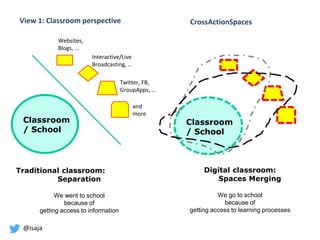
iSchool.missouri.edu & EdTech.missouri.edu
Educational Technology – Master study program @ Mizzou
fully online (started 1999 with first course online)
@isaja
@isaja
My research (selection)
in higher education
- InPUD, technology-embraced informal-in-formal learning
(Germany, NRW grant), 2001-2004 (-2009) (Jahnke, 2012)
- DaVINCI, creativity in higher ed (German BMBF grant) 2008-2011
(Jahnke, Haertel, & Wildt, 2015)
- PeTEX , Remote Labs in Engineering Education (EU, European Commission grant)
(Jahnke et al., 2010, Terkowsky et al., 2011)
- GoogleGlass project in higher education, Eva Marell-Ohlsson
(Jahnke, Marell-Ohlsson, Meitoft, 2016)
- LeX, Augmented Learning eXpeditions (started 2015, University of Missouri)
(Ringbauer et al., 2016)
in K-12
- iPad studies (Swedish, VR funded, 2014-2016)
(Jahnke et al., 2014)
Interdisciplinary: Social Sciences, Computer
Science, Educational Sciences
Intercultural: Germany, Sweden, USA
@isaja
Question to you
Who is using a device with Internet access?
Perfect!
@isaja
Web-enabled technologies (tablets, wearables…)
change ways and conditions for human/social interaction***:
how we communicate, share, receive information, collaborate,
network, ...
@isaja
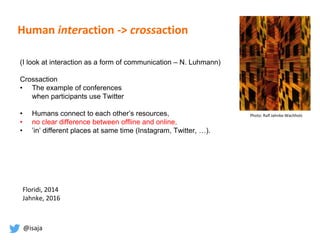
Human interaction -> crossaction
(I look at interaction as a form of communication – N. Luhmann)
Crossaction
• The example of conferences
when participants use Twitter
• Humans connect to each other’s resources,
• no clear difference between offline and online,
• ’in’ different places at same time (Instagram, Twitter, …).
Photo: Ralf Jahnke-Wachholz
Floridi, 2014
Jahnke, 2016
@isaja
Classroom
/ School
Classroom
/ School
Digital classroom:
Spaces Merging
We go to school
because of
getting access to learning processes
Twitter, FB,
GroupApps, …
Interactive/Live
Broadcasting, …
Websites,
Blogs, …
and
more
Traditional classroom:
Separation
We went to school
because of
getting access to information
View 1: Classroom perspective CrossActionSpaces
@isaja
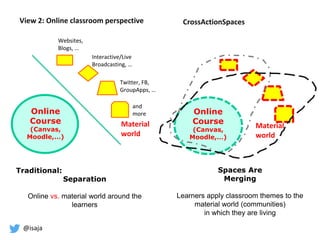
Online
Course
(Canvas,
Moodle,…)
Online
Course
(Canvas,
Moodle,…)
Spaces Are
Merging
Learners apply classroom themes to the
material world (communities)
in which they are living
Twitter, FB,
GroupApps, …
Interactive/Live
Broadcasting, …
Websites,
Blogs, …
and
more
Traditional:
Separation
Online vs. material world around the
learners
View 2: Online classroom perspective
Material
world
Material
world
CrossActionSpaces
@isaja
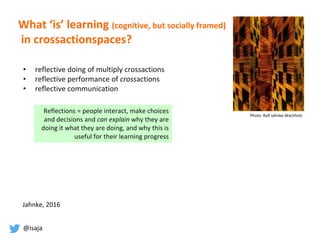
What ‘is’ learning (cognitive, but socially framed)
in crossactionspaces?
Photo: Ralf Jahnke-Wachholz
Reflections = people interact, make choices
and decisions and can explain why they are
doing it what they are doing, and why this is
useful for their learning progress
• reflective doing of multiply crossactions
• reflective performance of crossactions
• reflective communication
Jahnke, 2016
@isaja
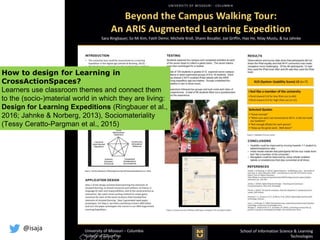
Learning Expeditions
How to design for Learning in
CrossActionSpaces?
Learners use classroom themes and connect them
to the (socio-)material world in which they are living:
Design for Learning Expeditions (Ringbauer et al.,
2016; Jahnke & Norberg, 2013), Sociomateriality
(Tessy Ceratto-Pargman et al., 2015)
@isaja
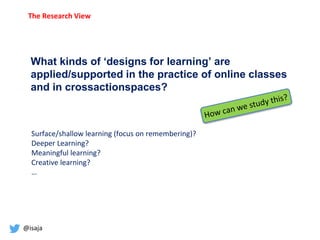
What kinds of ‘designs for learning’ are
applied/supported in the practice of online classes
and in crossactionspaces?
Surface/shallow learning (focus on remembering)?
Deeper Learning?
Meaningful learning?
Creative learning?
…
The Research View
@isaja
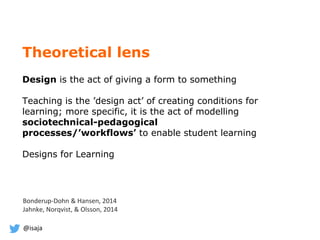
Theoretical lens
Design is the act of giving a form to something
Teaching is the ’design act’ of creating conditions for
learning; more specific, it is the act of modelling
sociotechnical-pedagogical
processes/’workflows’ to enable student learning
Designs for Learning
Bonderup-Dohn & Hansen, 2014
Jahnke, Norqvist, & Olsson, 2014
@isaja
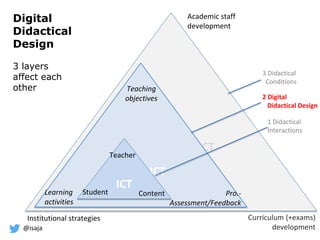
Digital
Didactical
Design
3 layers
affect each
other
ICT ICT
ICT
ICT
Student
Teacher
Content
Teaching
objectives
Pro.-
Assessment/Feedback
Learning
activities
Academic staff
development
Curriculum (+exams)
development
Institutional strategies
1 Didactical
Interactions
2 Digital
Didactical Design
3 Didactical
Conditions
@isaja
1
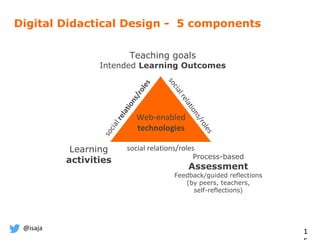
Teaching goals
Intended Learning Outcomes
Learning
activities Process-based
Assessment
Feedback/guided reflections
(by peers, teachers,
self-reflections)
social relations/roles
Web-enabled
technologies
Digital Didactical Design - 5 components
@isaja 1
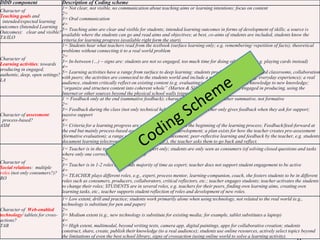
DDD component Description of Coding scheme
Character of
Teaching goals and
intended/expected learning
outcomes (Intended Learning
Outcomes): clear and visible?
TA/ILO
1= Not clear, not visible, no communication about teaching aims or learning intentions; focus on content
2=
3= Oral communication
4=
5= Teaching aims are clear and visible for students; intended learning outcomes in forms of development of skills; a source is
available where the students can go and read aims and objectives; at best, co-aims of students are included, students know the
criteria for learning progress (available right form the start).
Character of
Learning activities: towards
producing in engaged,
authentic, deep, open settings?
LA
1= Students hear what teachers read from the textbook (surface learning only; e.g. remembering/ repetition of facts); theoretical
problems without connecting it to a real world problem
2=
3= In-between (…) – signs are: students are not so engaged, too much time for doing other things (e.g. playing cards instead)
4=
5= Learning activities have a range from surface to deep learning: students produce something, engaged classrooms, collaboration
with peers; the activities are connected to the students world and include a real-world problem (e.g. everyday experience); a real
audience, students critically reflect on existing content (e.g. evaluating/creating/making), relate knowledge to new knowledge;
“organize and structure content into coherent whole” (Marten & Säljö, 1979), students are engaged in producing, using the
Internet or other sources beyond the physical school walls (signs of crossactions)
Character of assessment:
process-based?
ASM
1 = Feedback only at the end (summative feedback); character of the feedback is rather summative, not formative
2=
3= Feedback during the class (not only technical help) by coincidence; teacher only gives feedback when they ask for support;
passive support
4=
5= Criteria for a learning progress are visible for students from the beginning of the learning process; Feedback/feed-forward at
the end but mainly process-based assessment for learner’s development; a plan exists for how the teacher creates pro-assessment
(formative evaluation); a range of forms such as self-assessment; peer-reflective learning and feedback by the teacher, e.g. students
document learning (electronically; a map or text, etc.), the teacher asks them to go back and reflect.
Character of
Social relations: multiple
roles (not only consumers?)?
RO
1= Teacher is in the traditional role of the expert only; students are only seen as consumers (of solving closed questions and tasks
where only one correct answer is possible)
2=
3= Teacher is in 1-2 roles but spends majority of time as expert; teacher does not support student engagement to be active
4=
5= TEACHER plays different roles, e.g., expert, process mentor, learning-companion, coach, she fosters students to be in different
roles such as consumers, producers, collaborators, critical reflectors, etc.; teacher engages students; teacher activates the students
to change their roles; STUDENTS are in several roles, e.g. teachers for their peers, finding own learning aims, creating own
learning tasks, etc., teacher supports student reflection of roles and development of new roles.
Character of Web-enabled
technology/ tablets for cross-
actions?
TAB
1= Low extent, drill and practice; students work primarily alone when using technology, not related to the real world (e.g.,
technology is substitute for pen and paper)
2=
3= Medium extent (e.g., new technology is substitute for existing media; for example, tablet substitutes a laptop)
4=
5= High extent, multimodal, beyond writing texts, camera app, digital paintings, apps for collaborative creation; students
construct, share, create, publish their knowledge (to a real audience); students use online resources, actively select topics beyond
the limitations of even the best school library, signs of crossaction (using online world to solve a learning activity).
@isaja
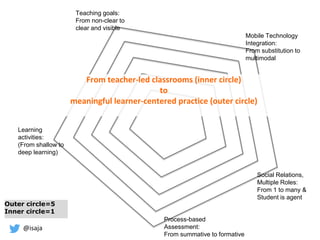
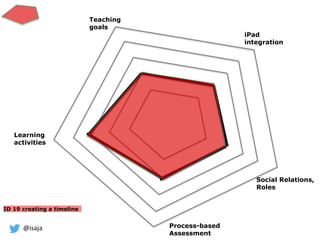
Social Relations,
Multiple Roles:
From 1 to many &
Student is agent
Learning
activities:
(From shallow to
deep learning)
Teaching goals:
From non-clear to
clear and visible
Outer circle=5
Inner circle=1
From teacher-led classrooms (inner circle)
to
meaningful learner-centered practice (outer circle)
Mobile Technology
Integration:
From substitution to
multimodal
Process-based
Assessment:
From summative to formative
@isaja
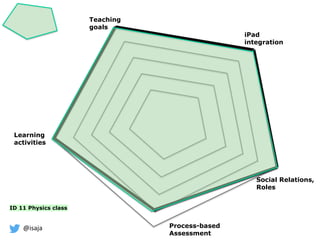
Learning
activities
Process-based
Assessment
iPad
integration
Social Relations,
Roles
Teaching
goals
ID 11 Physics class
@isaja
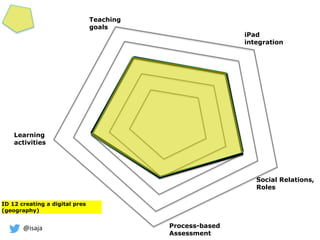
ID 12 creating a digital pres
(geography)
Learning
activities
Process-based
Assessment
iPad
integration
Social Relations,
Roles
Teaching
goals
@isaja
ID 19 creating a timeline
Learning
activities
Process-based
Assessment
iPad
integration
Social Relations,
Roles
Teaching
goals
@isaja
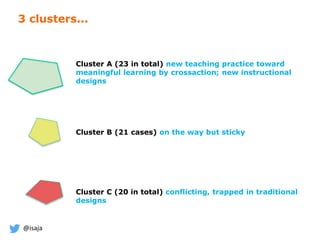
Cluster A (23 in total) new teaching practice toward
meaningful learning by crossaction; new instructional
designs
Cluster B (21 cases) on the way but sticky
Cluster C (20 in total) conflicting, trapped in traditional
designs
3 clusters...
@isaja
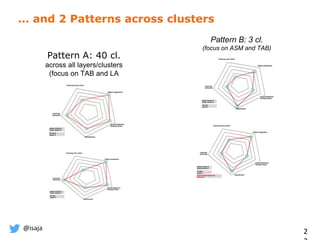
2
… and 2 Patterns across clusters
Pattern A: 40 cl.
across all layers/clusters
(focus on TAB and LA
Pattern B: 3 cl.
(focus on ASM and TAB)
@isaja
The university of the future…
is made of crossactionspaces, in which
teaching is organized in project teacher teams
across existing disciplines
(Eva Mårell’s GoogleGlas project: involving 3 different study programs)
teacher teams from different departments work together and
design a Learning expedition – and the students develop learning expeditions
- learning by topic / not by subject
@isaja
Dr. Isa Jahnke, Associate Professor and
Director of Research for the Information Experience Lab
at the iSchool
Email
jahnkei@missouri.edu
Website
http://www.isa-jahnke.com
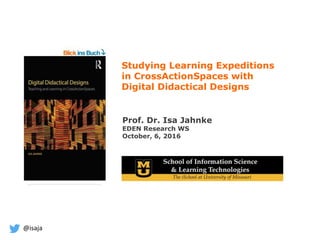
My book
Routledge, 2016

Studying Learning Expeditions in Crossactionspaces with Digital Didactical Designs

  • 1.
    @isaja Prof. Dr. IsaJahnke EDEN Research WS October, 6, 2016 Studying Learning Expeditions in CrossActionSpaces with Digital Didactical Designs
  • 2.
    @isaja iSchool.missouri.edu & EdTech.missouri.edu EducationalTechnology – Master study program @ Mizzou fully online (started 1999 with first course online)
  • 3.
  • 4.
    @isaja My research (selection) inhigher education - InPUD, technology-embraced informal-in-formal learning (Germany, NRW grant), 2001-2004 (-2009) (Jahnke, 2012) - DaVINCI, creativity in higher ed (German BMBF grant) 2008-2011 (Jahnke, Haertel, & Wildt, 2015) - PeTEX , Remote Labs in Engineering Education (EU, European Commission grant) (Jahnke et al., 2010, Terkowsky et al., 2011) - GoogleGlass project in higher education, Eva Marell-Ohlsson (Jahnke, Marell-Ohlsson, Meitoft, 2016) - LeX, Augmented Learning eXpeditions (started 2015, University of Missouri) (Ringbauer et al., 2016) in K-12 - iPad studies (Swedish, VR funded, 2014-2016) (Jahnke et al., 2014) Interdisciplinary: Social Sciences, Computer Science, Educational Sciences Intercultural: Germany, Sweden, USA
  • 5.
    @isaja Question to you Whois using a device with Internet access? Perfect!
  • 6.
    @isaja Web-enabled technologies (tablets,wearables…) change ways and conditions for human/social interaction***: how we communicate, share, receive information, collaborate, network, ...
  • 7.
    @isaja Human interaction ->crossaction (I look at interaction as a form of communication – N. Luhmann) Crossaction • The example of conferences when participants use Twitter • Humans connect to each other’s resources, • no clear difference between offline and online, • ’in’ different places at same time (Instagram, Twitter, …). Photo: Ralf Jahnke-Wachholz Floridi, 2014 Jahnke, 2016
  • 8.
    @isaja Classroom / School Classroom / School Digitalclassroom: Spaces Merging We go to school because of getting access to learning processes Twitter, FB, GroupApps, … Interactive/Live Broadcasting, … Websites, Blogs, … and more Traditional classroom: Separation We went to school because of getting access to information View 1: Classroom perspective CrossActionSpaces
  • 9.
    @isaja Online Course (Canvas, Moodle,…) Online Course (Canvas, Moodle,…) Spaces Are Merging Learners applyclassroom themes to the material world (communities) in which they are living Twitter, FB, GroupApps, … Interactive/Live Broadcasting, … Websites, Blogs, … and more Traditional: Separation Online vs. material world around the learners View 2: Online classroom perspective Material world Material world CrossActionSpaces
  • 10.
    @isaja What ‘is’ learning(cognitive, but socially framed) in crossactionspaces? Photo: Ralf Jahnke-Wachholz Reflections = people interact, make choices and decisions and can explain why they are doing it what they are doing, and why this is useful for their learning progress • reflective doing of multiply crossactions • reflective performance of crossactions • reflective communication Jahnke, 2016
  • 11.
    @isaja Learning Expeditions How todesign for Learning in CrossActionSpaces? Learners use classroom themes and connect them to the (socio-)material world in which they are living: Design for Learning Expeditions (Ringbauer et al., 2016; Jahnke & Norberg, 2013), Sociomateriality (Tessy Ceratto-Pargman et al., 2015)
  • 12.
    @isaja What kinds of‘designs for learning’ are applied/supported in the practice of online classes and in crossactionspaces? Surface/shallow learning (focus on remembering)? Deeper Learning? Meaningful learning? Creative learning? … The Research View
  • 13.
    @isaja Theoretical lens Design isthe act of giving a form to something Teaching is the ’design act’ of creating conditions for learning; more specific, it is the act of modelling sociotechnical-pedagogical processes/’workflows’ to enable student learning Designs for Learning Bonderup-Dohn & Hansen, 2014 Jahnke, Norqvist, & Olsson, 2014
  • 14.
    @isaja Digital Didactical Design 3 layers affect each other ICTICT ICT ICT Student Teacher Content Teaching objectives Pro.- Assessment/Feedback Learning activities Academic staff development Curriculum (+exams) development Institutional strategies 1 Didactical Interactions 2 Digital Didactical Design 3 Didactical Conditions
  • 15.
    @isaja 1 Teaching goals Intended LearningOutcomes Learning activities Process-based Assessment Feedback/guided reflections (by peers, teachers, self-reflections) social relations/roles Web-enabled technologies Digital Didactical Design - 5 components
  • 16.
    @isaja 1 DDD componentDescription of Coding scheme Character of Teaching goals and intended/expected learning outcomes (Intended Learning Outcomes): clear and visible? TA/ILO 1= Not clear, not visible, no communication about teaching aims or learning intentions; focus on content 2= 3= Oral communication 4= 5= Teaching aims are clear and visible for students; intended learning outcomes in forms of development of skills; a source is available where the students can go and read aims and objectives; at best, co-aims of students are included, students know the criteria for learning progress (available right form the start). Character of Learning activities: towards producing in engaged, authentic, deep, open settings? LA 1= Students hear what teachers read from the textbook (surface learning only; e.g. remembering/ repetition of facts); theoretical problems without connecting it to a real world problem 2= 3= In-between (…) – signs are: students are not so engaged, too much time for doing other things (e.g. playing cards instead) 4= 5= Learning activities have a range from surface to deep learning: students produce something, engaged classrooms, collaboration with peers; the activities are connected to the students world and include a real-world problem (e.g. everyday experience); a real audience, students critically reflect on existing content (e.g. evaluating/creating/making), relate knowledge to new knowledge; “organize and structure content into coherent whole” (Marten & Säljö, 1979), students are engaged in producing, using the Internet or other sources beyond the physical school walls (signs of crossactions) Character of assessment: process-based? ASM 1 = Feedback only at the end (summative feedback); character of the feedback is rather summative, not formative 2= 3= Feedback during the class (not only technical help) by coincidence; teacher only gives feedback when they ask for support; passive support 4= 5= Criteria for a learning progress are visible for students from the beginning of the learning process; Feedback/feed-forward at the end but mainly process-based assessment for learner’s development; a plan exists for how the teacher creates pro-assessment (formative evaluation); a range of forms such as self-assessment; peer-reflective learning and feedback by the teacher, e.g. students document learning (electronically; a map or text, etc.), the teacher asks them to go back and reflect. Character of Social relations: multiple roles (not only consumers?)? RO 1= Teacher is in the traditional role of the expert only; students are only seen as consumers (of solving closed questions and tasks where only one correct answer is possible) 2= 3= Teacher is in 1-2 roles but spends majority of time as expert; teacher does not support student engagement to be active 4= 5= TEACHER plays different roles, e.g., expert, process mentor, learning-companion, coach, she fosters students to be in different roles such as consumers, producers, collaborators, critical reflectors, etc.; teacher engages students; teacher activates the students to change their roles; STUDENTS are in several roles, e.g. teachers for their peers, finding own learning aims, creating own learning tasks, etc., teacher supports student reflection of roles and development of new roles. Character of Web-enabled technology/ tablets for cross- actions? TAB 1= Low extent, drill and practice; students work primarily alone when using technology, not related to the real world (e.g., technology is substitute for pen and paper) 2= 3= Medium extent (e.g., new technology is substitute for existing media; for example, tablet substitutes a laptop) 4= 5= High extent, multimodal, beyond writing texts, camera app, digital paintings, apps for collaborative creation; students construct, share, create, publish their knowledge (to a real audience); students use online resources, actively select topics beyond the limitations of even the best school library, signs of crossaction (using online world to solve a learning activity).
  • 17.
    @isaja Social Relations, Multiple Roles: From1 to many & Student is agent Learning activities: (From shallow to deep learning) Teaching goals: From non-clear to clear and visible Outer circle=5 Inner circle=1 From teacher-led classrooms (inner circle) to meaningful learner-centered practice (outer circle) Mobile Technology Integration: From substitution to multimodal Process-based Assessment: From summative to formative
  • 18.
  • 19.
    @isaja ID 12 creatinga digital pres (geography) Learning activities Process-based Assessment iPad integration Social Relations, Roles Teaching goals
  • 20.
    @isaja ID 19 creatinga timeline Learning activities Process-based Assessment iPad integration Social Relations, Roles Teaching goals
  • 21.
    @isaja Cluster A (23in total) new teaching practice toward meaningful learning by crossaction; new instructional designs Cluster B (21 cases) on the way but sticky Cluster C (20 in total) conflicting, trapped in traditional designs 3 clusters...
  • 22.
    @isaja 2 … and 2Patterns across clusters Pattern A: 40 cl. across all layers/clusters (focus on TAB and LA Pattern B: 3 cl. (focus on ASM and TAB)
  • 23.
    @isaja The university ofthe future… is made of crossactionspaces, in which teaching is organized in project teacher teams across existing disciplines (Eva Mårell’s GoogleGlas project: involving 3 different study programs) teacher teams from different departments work together and design a Learning expedition – and the students develop learning expeditions - learning by topic / not by subject
  • 24.
    @isaja Dr. Isa Jahnke,Associate Professor and Director of Research for the Information Experience Lab at the iSchool Email jahnkei@missouri.edu Website http://www.isa-jahnke.com My book Routledge, 2016

Editor's Notes

  • #2 As web-enabled mobile technologies become increasingly integrated into formal learning environments, they are merging to create a new kind of classroom: CrossActionSpaces (informal-in-formal spaces) in which communicative learning takes place across traditional boundaries. The term offers a view from social sciences, emphasizes a change of human action: from pure inter-action into cross-action. Under these new conditions the question are: how to conceptualize and design for learning, how can teaching helps learning?  In this keynote, Isa Jahnke presents the framework of Digital Didactical Designs (DDD) which can be used to study and to reflect on educational practices toward deeper learning expeditions. Thank you very much for the nice introduction. Hello, good morning. Welcome to my presentation. My name is Isa and I am going to present a research framework what I call DDD.
  • #3 I moved to the Univ of Missouri in Aug 2015. The iSchool at Mizzou is famous for EdTech, awards in 2012
  • #4 And the iSchool is also famous for its research around “Meaningful Learning with Technologies”. You probably have heard one of the authors’names. These are my colleagues.
  • #5 I have a interdisciplinary and intercultural background. I studied Social Sciences, was PhD student in Computer Science, my first professor job was in Didaktik and Learning Technologies at TU Dortmund univ. , then I was 5 years professor in Sweden at Umea University, and now I am professor in the United States. Here are some of my projects.
  • #7 So, when you use all the devices here, which is great, then you see my point that ICT is not just a tool. It changes the way we interact with each other. When interaction changes, our ways of communication are changing , too . This affects the way we learn.
  • #8 Interaction from my view of Sociology is a form of communication. The smallest entity in social systems (Interaction) is communication. However, that kind of inter-action is changing in the digital age. As you can see here , at the EDEN conference, adding Twitter to the conversations opens up for new audiences. A) A discussion among you without me when you tweet right now B) Readers that are your followers and contribute somehow but they are not in the room C) Some of the questions might come up after my presentation at the coffee break. And so forth. This is what I call a form of a cross-action! Listening and engaging in what we hear even with others that are nor reachable otherwise. It is more than inter-action closed in a room. It is a crossing action. And creates new spaces, crossactionspaces.
  • #9 This slide makes the crossaction and the concept of crossactionspaces clearer, hopefully.
  • #10  Now, here is the same slide from the view of Online Distance Classroom …
  • #11 Now we have a bew questions to answer: What is learning in crossactionspaces?
  • #12 I cannot go into detail, here. In the LEX project, we applied design principles from a) game based learning and b) Meaningful Learning with Technologies By Howland et al. We connect student classroom knowledge and their themes with the Sociomaterial world.
  • #13 Now, this is a research conference and so the research view is kind of important here. What kinds of designs for learning are applied? And, How can we study this?
  • #14 Our theoretical lens is the Design view in combination with the Sociotechnical
  • #15 The challenge is that the designs for learning are influenced by the conditions and situated context .
  • #18 The more the DDD is on the outer layer the more comprehensive is the enablement for deeper learning in crossactionspces. Definitions Surface learning: remembering, recalling, understanding the problem Deeper learning: using the knowledge to solve a problem using exsting sources such as the Internet (crossactionspaces), evaluating, creating new knowledge, competencies,…
  • #22 MD = Media-tablet-Didactics (7-8) DD = Digital Didactics (5-6) BT = Benefit of Tablet integration (special case, 4) PD = Potential for a digital didactical design (3-4) RE = RE-alignment required (1-2)
  • #23 P a) 7 classrooms in layer 5 (while all other elements got the same attention) 14 classrooms in layer 4 (LA and TAB are stronger emphasized than the other elements) 9 classrooms in layer 3 additional 4 in layer 3, same patterns but on a lower level 3 classrooms in layer 2 3 classrooms in layer 1 (all show same pattern but on a lower level)
  • #24 I could talk for hours about all my research and the results. But I have to come to an end after 30 mins. To wrap it up: The university of the future is made of crossactionspaces and learning expeditions.