International Research Journal of Engineering and Technology (IRJET) e-ISSN: 2395 -0056
Volume: 04 Issue: 3 | Mar -2017 www.irjet.net p-ISSN: 2395-0072
© 2016, IRJET | Impact Factor value: 4.45 | ISO 9001:2008 Certified Journal | Page 627
Survey on Location Based Recommendation System Using POI
Devendra Chopade1, Ashutosh Patil2, Puja Sinha3, Rahul Kumar4
1Student, Information Technology, SKN Sinhgad Institute of Technology, Maharashtra, India
2Student, Information Technology, SKN Sinhgad Institute of Technology, Maharashtra, India
3Student, Information Technology, SKN Sinhgad Institute of Technology, Maharashtra, India
4Student, Information Technology, SKN Sinhgad Institute of Technology, Maharashtra, India
---------------------------------------------------------------------***---------------------------------------------------------------------
Abstract – POI based recommendation system is a web
based application, That facilitates, analysis of an individual.
The point of interest (POI) is geographical can also be
temporal. Such a system would prove valuable tool in the
inventory of a corporation or individual. Theservicesprovided
By this system could be optimized with the consideration of
user interest drift. Developmentofmobiledeviceswithparallel
advancement in GPS (Global Position System) and web
technology unable the usertosharedata informationbased on
its relevance to application user. This information is gathered
using data mining technique. It is important to foe users
Key Words: Data Mining, POI recommendation, User
Interest Drift, Collective Inference, User Modelling.
1.INTRODUCTION
In modern world with the rapid development of mobile
devices web technologies and point of interest is becoming
very popular now days locations revolutionized
communication in social temporal with their friends they
share their locations and photos uploading via internet for
POI.
To make use of the rich information on social relationships
Users recommend the new locations to explore them.
These data is then received and represents it in different
formats like HTML, JavaScript and CSS.
It has been traditionally used to communicate with the web
services. It also provides the messaging services. On the
internet where the number of choices is overwhelming,
there is need to filter, prioritize and efficiently deliver the
relevant information in order to alleviate the problem of
information overload, which create a potential problem too
many users.
Recommender system solves this problem by searching
through the large volume of dynamically generated
information to provide users with personalized content
which are in user’s point of interest. So it is easy for users to
Drift across the region.
1. Data Mining
Data mining is the process of discovering actionable
information from large sets of data. Data mining is typically
uses the mathematical analysis to derive the patterns that
exist in data.
In data mining these patterns cannot be discovered by
traditional data exploration becausetherelationshipsaretoo
complex or maybe there is too large amount of data.
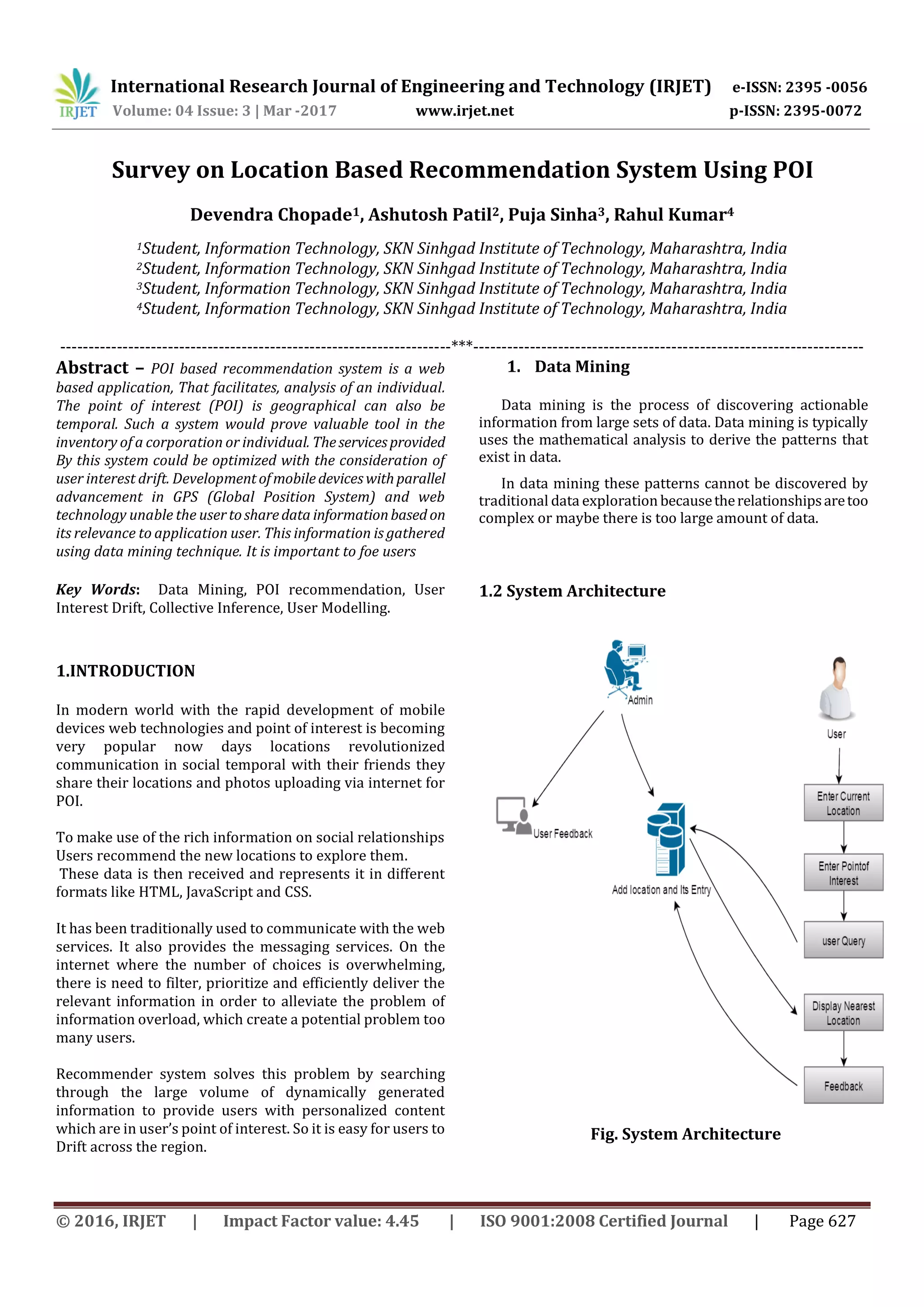
1.2 System Architecture
Fig. System Architecture
International Research Journal of Engineering and Technology (IRJET) e-ISSN: 2395 -0056
Volume: 04 Issue: 3 | Mar -2017 www.irjet.net p-ISSN: 2395-0072
© 2016, IRJET | Impact Factor value: 4.45 | ISO 9001:2008 Certified Journal | Page 628
2. Advantages
We proposed a socialspatial collective inferreing
framework to enhance theinterfaceofusers’interestsineach
region, out-of-town regions, by exploiting the social and
spatial correlation information.
We exploit the temporal patterns of the public visiting
POIs to improve the process of topic discovery.
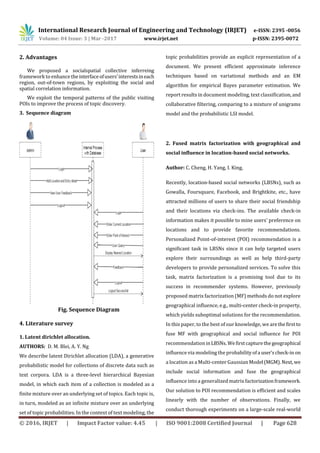
3. Sequence diagram
Fig. Sequence Diagram
4. Literature survey
1. Latent dirichlet allocation.
AUTHORS: D. M. Blei, A. Y. Ng
We describe latent Dirichlet allocation (LDA), a generative
probabilistic model for collections of discrete data such as
text corpora. LDA is a three-level hierarchical Bayesian
model, in which each item of a collection is modeled as a
finite mixture over an underlying set of topics. Each topic is,
in turn, modeled as an infinite mixture over an underlying
set of topic probabilities. In the context of text modeling, the
topic probabilities provide an explicit representation of a
document. We present efficient approximate inference
techniques based on variational methods and an EM
algorithm for empirical Bayes parameter estimation. We
report results in document modeling, text classification, and
collaborative filtering, comparing to a mixture of unigrams
model and the probabilistic LSI model.
2. Fused matrix factorization with geographical and
social influence in location-based social networks.
Author: C. Cheng, H. Yang, I. King,
Recently, location-based social networks (LBSNs), such as
Gowalla, Foursquare, Facebook, and Brightkite, etc., have
attracted millions of users to share their social friendship
and their locations via check-ins. The available check-in
information makes it possible to mine users’ preference on
locations and to provide favorite recommendations.
Personalized Point-of-interest (POI) recommendation is a
significant task in LBSNs since it can help targeted users
explore their surroundings as well as help third-party
developers to provide personalized services. To solve this
task, matrix factorization is a promising tool due to its
success in recommender systems. However, previously
proposed matrix factorization (MF) methods do not explore
geographical influence, e.g., multi-center check-in property,
which yields suboptimal solutions for the recommendation.
In this paper, to the best of our knowledge, we arethefirstto
fuse MF with geographical and social influence for POI
recommendationinLBSNs. Wefirstcapturethegeographical
influence via modeling the probabilityofa user’scheck-in on
a location as a Multi-center Gaussian Model (MGM).Next,we
include social information and fuse the geographical
influence into a generalized matrix factorizationframework.
Our solution to POI recommendation is efficient and scales
linearly with the number of observations. Finally, we
conduct thorough experiments on a large-scale real-world
International Research Journal of Engineering and Technology (IRJET) e-ISSN: 2395 -0056
Volume: 04 Issue: 3 | Mar -2017 www.irjet.net p-ISSN: 2395-0072
© 2016, IRJET | Impact Factor value: 4.45 | ISO 9001:2008 Certified Journal | Page 629
LBSNs dataset and demonstrate that the fused matrix
factorization framework with MGM utilizes the distance
information sufficiently and outperforms otherstate-of-the-
art methods significantly.
3. Where you like to gonext:Successivepoint-of-interest
recommendation.
Author: C. Cheng, H. Yang, M. R. Lyu,
Personalized point-of-interest (POI) recommendation is a
significant task in location-basedsocial networks(LBSNs)as
it can help provide better user experience as well as enable
third-party services, e.g., launching advertisements. To
provide a good recommendation, various research has been
conducted in the literature. However, pervious efforts
mainly consider the "check-ins" in a whole and omit their
temporal relation. They can only recommend POI globally
and cannot know where a user would like to gotomorrow or
in the next few days. In this paper, we consider the task of
successive personalized POI recommendation in LBSNs,
which is a much harder task than standard personalizedPOI
recommendation or prediction. To solve this task, we
observe two prominent properties in thecheck-insequence:
personalized Markov chain and region localization. Hence,
we propose a novel matrix factorization method, namely
FPMC-LR, to embed the personalized Markov chains andthe
localized regions. Our proposed FPMC-LR not only exploits
the personalized Markov chain in the check-insequence,but
also takes into account users' movement constraint, i.e.,
moving around a localized region. More importantly,
utilizing the information of localized regions, we not only
reduce the computation cost largely, but also discard the
noisy information to boost recommendation. Resultsontwo
real-world LBSNs datasets demonstrate the merits of our
proposed FPMC-LR.
ACKNOWLEDGEMENT
We might want to thank the analyst and also
distributers for making their assets accessible. We
additionally appreciate to commentator for their significant
recommendations furthermore thank the school powers for
giving the obliged and backing.
REFERENCES
2. C. Cheng, H. Yang, M. R. Lyu, and I. King. Where you
like to go next: Successive point-of-interest
recommendation. In IJCAI, pages 2605– 2611,2013.
3. H. Cheng, J. Ye, and Z. Zhu. What’s your next move:
User activity prediction in location-based social
networks. In SDM, pages 171–179, 2013.
4. Z. Cheng, J. Caverlee, K. Lee, and D. Z. Sui. Exploring
millions of footprints in locationsharingservices.In
ICWSM, 2011.
5. G. Ference, M. Ye, and W.-C. Lee. Location
recommendation for out-of-town users in location-
based social networks. In CIKM, pages 721–726,
2013.

Survey on Location Based Recommendation System Using POI

  • 1.
    International Research Journalof Engineering and Technology (IRJET) e-ISSN: 2395 -0056 Volume: 04 Issue: 3 | Mar -2017 www.irjet.net p-ISSN: 2395-0072 © 2016, IRJET | Impact Factor value: 4.45 | ISO 9001:2008 Certified Journal | Page 627 Survey on Location Based Recommendation System Using POI Devendra Chopade1, Ashutosh Patil2, Puja Sinha3, Rahul Kumar4 1Student, Information Technology, SKN Sinhgad Institute of Technology, Maharashtra, India 2Student, Information Technology, SKN Sinhgad Institute of Technology, Maharashtra, India 3Student, Information Technology, SKN Sinhgad Institute of Technology, Maharashtra, India 4Student, Information Technology, SKN Sinhgad Institute of Technology, Maharashtra, India ---------------------------------------------------------------------***--------------------------------------------------------------------- Abstract – POI based recommendation system is a web based application, That facilitates, analysis of an individual. The point of interest (POI) is geographical can also be temporal. Such a system would prove valuable tool in the inventory of a corporation or individual. Theservicesprovided By this system could be optimized with the consideration of user interest drift. Developmentofmobiledeviceswithparallel advancement in GPS (Global Position System) and web technology unable the usertosharedata informationbased on its relevance to application user. This information is gathered using data mining technique. It is important to foe users Key Words: Data Mining, POI recommendation, User Interest Drift, Collective Inference, User Modelling. 1.INTRODUCTION In modern world with the rapid development of mobile devices web technologies and point of interest is becoming very popular now days locations revolutionized communication in social temporal with their friends they share their locations and photos uploading via internet for POI. To make use of the rich information on social relationships Users recommend the new locations to explore them. These data is then received and represents it in different formats like HTML, JavaScript and CSS. It has been traditionally used to communicate with the web services. It also provides the messaging services. On the internet where the number of choices is overwhelming, there is need to filter, prioritize and efficiently deliver the relevant information in order to alleviate the problem of information overload, which create a potential problem too many users. Recommender system solves this problem by searching through the large volume of dynamically generated information to provide users with personalized content which are in user’s point of interest. So it is easy for users to Drift across the region. 1. Data Mining Data mining is the process of discovering actionable information from large sets of data. Data mining is typically uses the mathematical analysis to derive the patterns that exist in data. In data mining these patterns cannot be discovered by traditional data exploration becausetherelationshipsaretoo complex or maybe there is too large amount of data. 1.2 System Architecture Fig. System Architecture
  • 2.
    International Research Journalof Engineering and Technology (IRJET) e-ISSN: 2395 -0056 Volume: 04 Issue: 3 | Mar -2017 www.irjet.net p-ISSN: 2395-0072 © 2016, IRJET | Impact Factor value: 4.45 | ISO 9001:2008 Certified Journal | Page 628 2. Advantages We proposed a socialspatial collective inferreing framework to enhance theinterfaceofusers’interestsineach region, out-of-town regions, by exploiting the social and spatial correlation information. We exploit the temporal patterns of the public visiting POIs to improve the process of topic discovery. 3. Sequence diagram Fig. Sequence Diagram 4. Literature survey 1. Latent dirichlet allocation. AUTHORS: D. M. Blei, A. Y. Ng We describe latent Dirichlet allocation (LDA), a generative probabilistic model for collections of discrete data such as text corpora. LDA is a three-level hierarchical Bayesian model, in which each item of a collection is modeled as a finite mixture over an underlying set of topics. Each topic is, in turn, modeled as an infinite mixture over an underlying set of topic probabilities. In the context of text modeling, the topic probabilities provide an explicit representation of a document. We present efficient approximate inference techniques based on variational methods and an EM algorithm for empirical Bayes parameter estimation. We report results in document modeling, text classification, and collaborative filtering, comparing to a mixture of unigrams model and the probabilistic LSI model. 2. Fused matrix factorization with geographical and social influence in location-based social networks. Author: C. Cheng, H. Yang, I. King, Recently, location-based social networks (LBSNs), such as Gowalla, Foursquare, Facebook, and Brightkite, etc., have attracted millions of users to share their social friendship and their locations via check-ins. The available check-in information makes it possible to mine users’ preference on locations and to provide favorite recommendations. Personalized Point-of-interest (POI) recommendation is a significant task in LBSNs since it can help targeted users explore their surroundings as well as help third-party developers to provide personalized services. To solve this task, matrix factorization is a promising tool due to its success in recommender systems. However, previously proposed matrix factorization (MF) methods do not explore geographical influence, e.g., multi-center check-in property, which yields suboptimal solutions for the recommendation. In this paper, to the best of our knowledge, we arethefirstto fuse MF with geographical and social influence for POI recommendationinLBSNs. Wefirstcapturethegeographical influence via modeling the probabilityofa user’scheck-in on a location as a Multi-center Gaussian Model (MGM).Next,we include social information and fuse the geographical influence into a generalized matrix factorizationframework. Our solution to POI recommendation is efficient and scales linearly with the number of observations. Finally, we conduct thorough experiments on a large-scale real-world
  • 3.
    International Research Journalof Engineering and Technology (IRJET) e-ISSN: 2395 -0056 Volume: 04 Issue: 3 | Mar -2017 www.irjet.net p-ISSN: 2395-0072 © 2016, IRJET | Impact Factor value: 4.45 | ISO 9001:2008 Certified Journal | Page 629 LBSNs dataset and demonstrate that the fused matrix factorization framework with MGM utilizes the distance information sufficiently and outperforms otherstate-of-the- art methods significantly. 3. Where you like to gonext:Successivepoint-of-interest recommendation. Author: C. Cheng, H. Yang, M. R. Lyu, Personalized point-of-interest (POI) recommendation is a significant task in location-basedsocial networks(LBSNs)as it can help provide better user experience as well as enable third-party services, e.g., launching advertisements. To provide a good recommendation, various research has been conducted in the literature. However, pervious efforts mainly consider the "check-ins" in a whole and omit their temporal relation. They can only recommend POI globally and cannot know where a user would like to gotomorrow or in the next few days. In this paper, we consider the task of successive personalized POI recommendation in LBSNs, which is a much harder task than standard personalizedPOI recommendation or prediction. To solve this task, we observe two prominent properties in thecheck-insequence: personalized Markov chain and region localization. Hence, we propose a novel matrix factorization method, namely FPMC-LR, to embed the personalized Markov chains andthe localized regions. Our proposed FPMC-LR not only exploits the personalized Markov chain in the check-insequence,but also takes into account users' movement constraint, i.e., moving around a localized region. More importantly, utilizing the information of localized regions, we not only reduce the computation cost largely, but also discard the noisy information to boost recommendation. Resultsontwo real-world LBSNs datasets demonstrate the merits of our proposed FPMC-LR. ACKNOWLEDGEMENT We might want to thank the analyst and also distributers for making their assets accessible. We additionally appreciate to commentator for their significant recommendations furthermore thank the school powers for giving the obliged and backing. REFERENCES 2. C. Cheng, H. Yang, M. R. Lyu, and I. King. Where you like to go next: Successive point-of-interest recommendation. In IJCAI, pages 2605– 2611,2013. 3. H. Cheng, J. Ye, and Z. Zhu. What’s your next move: User activity prediction in location-based social networks. In SDM, pages 171–179, 2013. 4. Z. Cheng, J. Caverlee, K. Lee, and D. Z. Sui. Exploring millions of footprints in locationsharingservices.In ICWSM, 2011. 5. G. Ference, M. Ye, and W.-C. Lee. Location recommendation for out-of-town users in location- based social networks. In CIKM, pages 721–726, 2013.