THE NUTRITION FUNCTION II
The circulatory and lymphatic
systems.
Internal environment.
 Environment that provides the cells with optimal
conditions to carry out their functions.
 Space between cells filled with intersticial
plasma.
 Blood renews plasma through the circulatory
system.
CIRCULATORY
SYSTEM
What’s in
red blood cells white blood cells
platelets
plasma
carbon dioxide
digested “food”
waste (urea)
hormones
oxygen
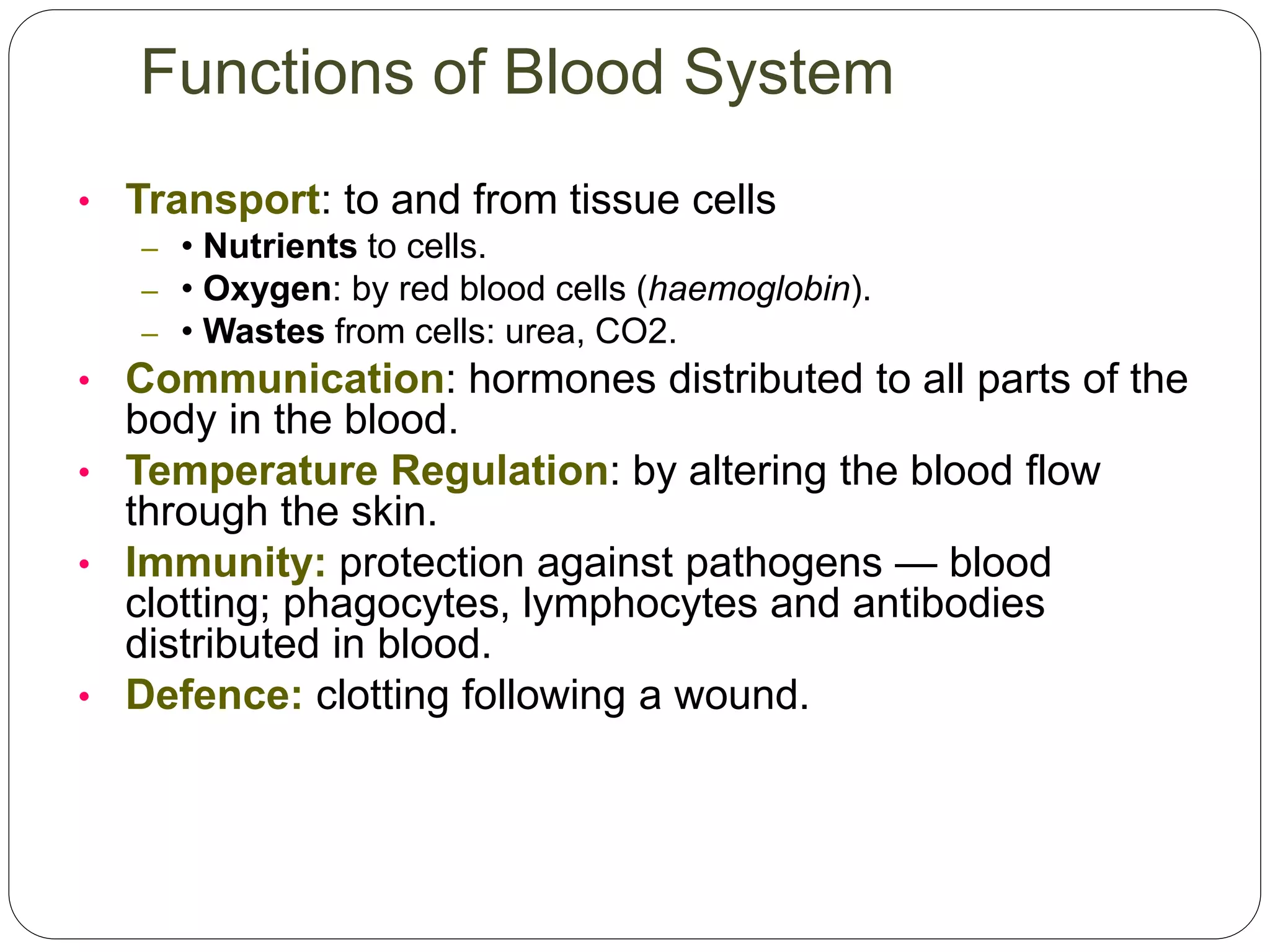
• Transport: to and from tissue cells
– • Nutrients to cells.
– • Oxygen: by red blood cells (haemoglobin).
– • Wastes from cells: urea, CO2.
• Communication: hormones distributed to all parts of the
body in the blood.
• Temperature Regulation: by altering the blood flow
through the skin.
• Immunity: protection against pathogens — blood
clotting; phagocytes, lymphocytes and antibodies
distributed in blood.
• Defence: clotting following a wound.
Functions of Blood System
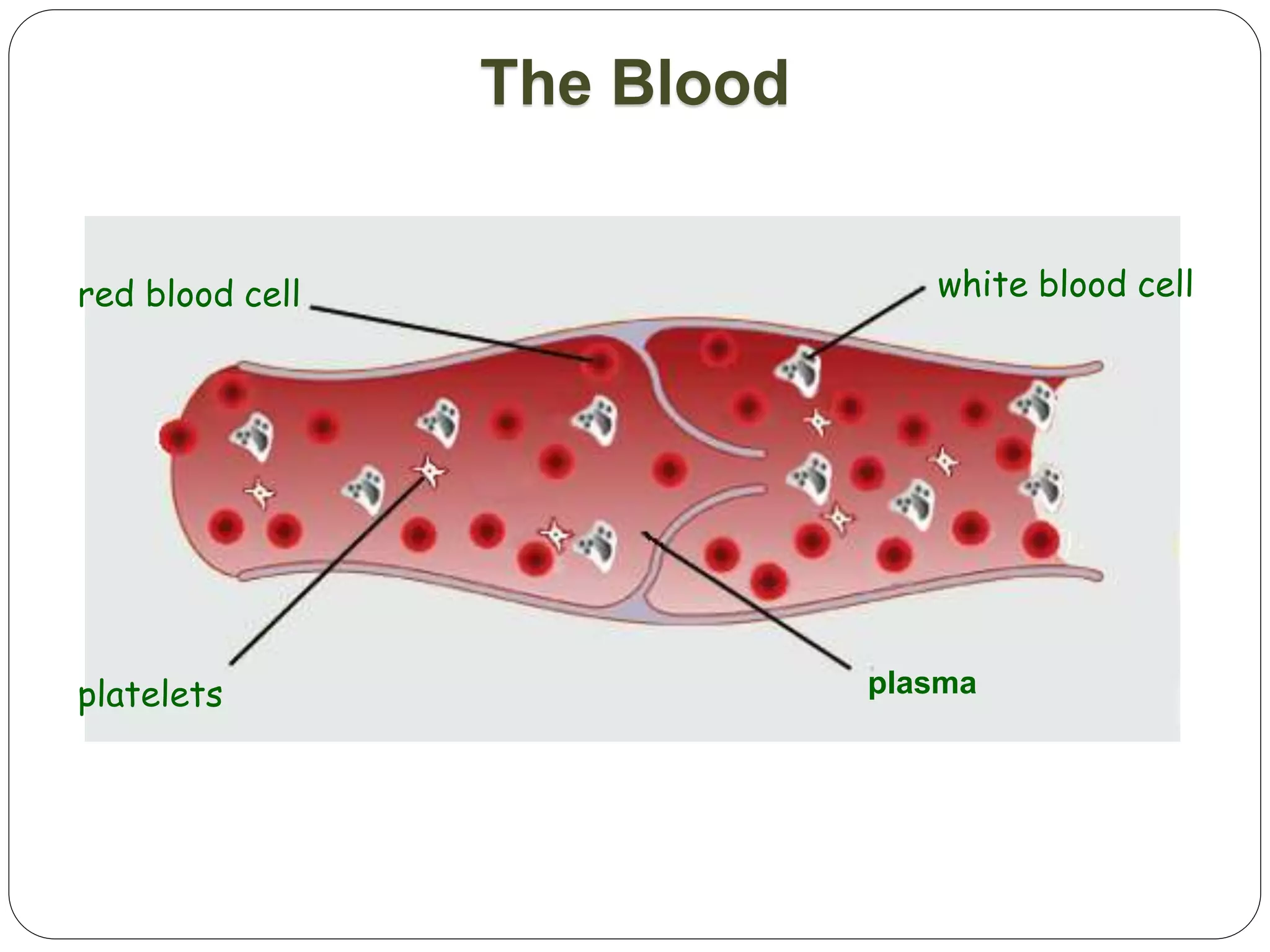
The Blood
plasma
red blood cell white blood cell
platelets
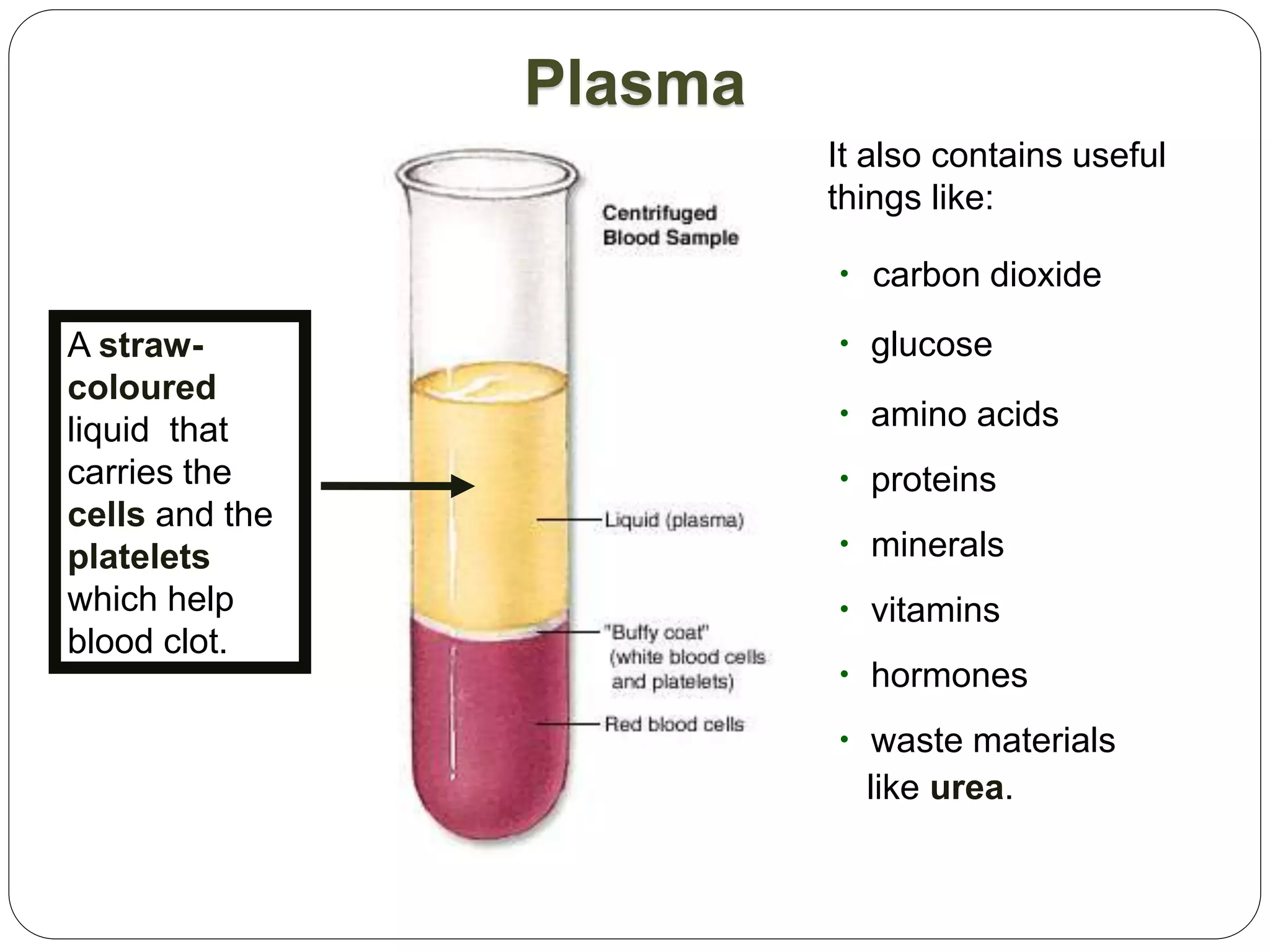
Plasma
A straw-
coloured
liquid that
carries the
cells and the
platelets
which help
blood clot.
• carbon dioxide
• glucose
• amino acids
• proteins
• minerals
• vitamins
• hormones
• waste materials
like urea.
It also contains useful
things like:
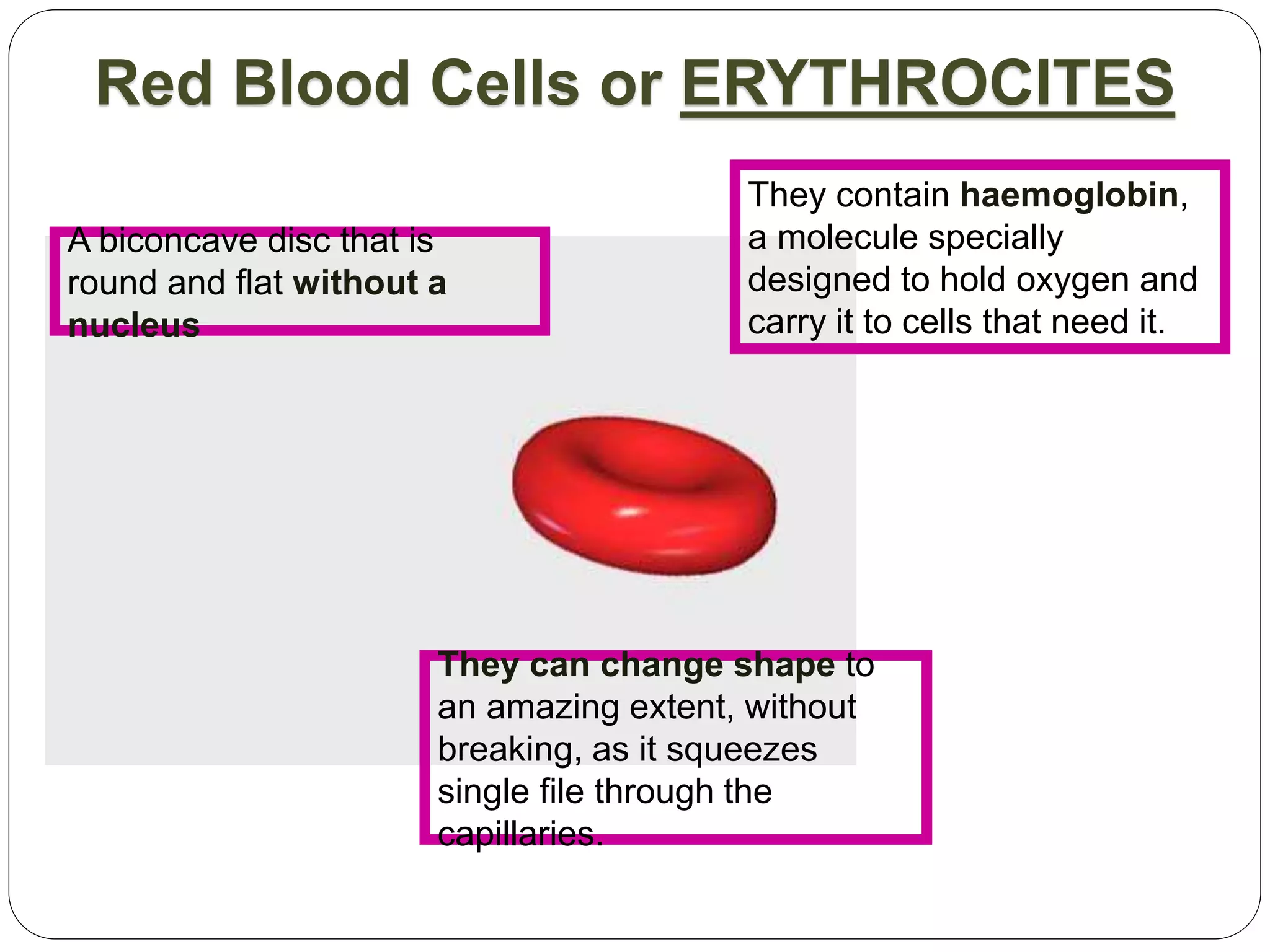
Red Blood Cells or ERYTHROCITES
They contain haemoglobin,
a molecule specially
designed to hold oxygen and
carry it to cells that need it.
They can change shape to
an amazing extent, without
breaking, as it squeezes
single file through the
capillaries.
A biconcave disc that is
round and flat without a
nucleus
White Blood Cells or LEUKOCYTES
There are many different types and all
contain a big nucleus.
The two main ones are the
lymphocytes and the macrophages.
Some lymphocytes fight disease by making antibodies to destroy
invaders by dissolving them.
Other lymphocytes make antitoxins to break down poisons.
Macrophages ‘eat’ and digest micro-
organisms .
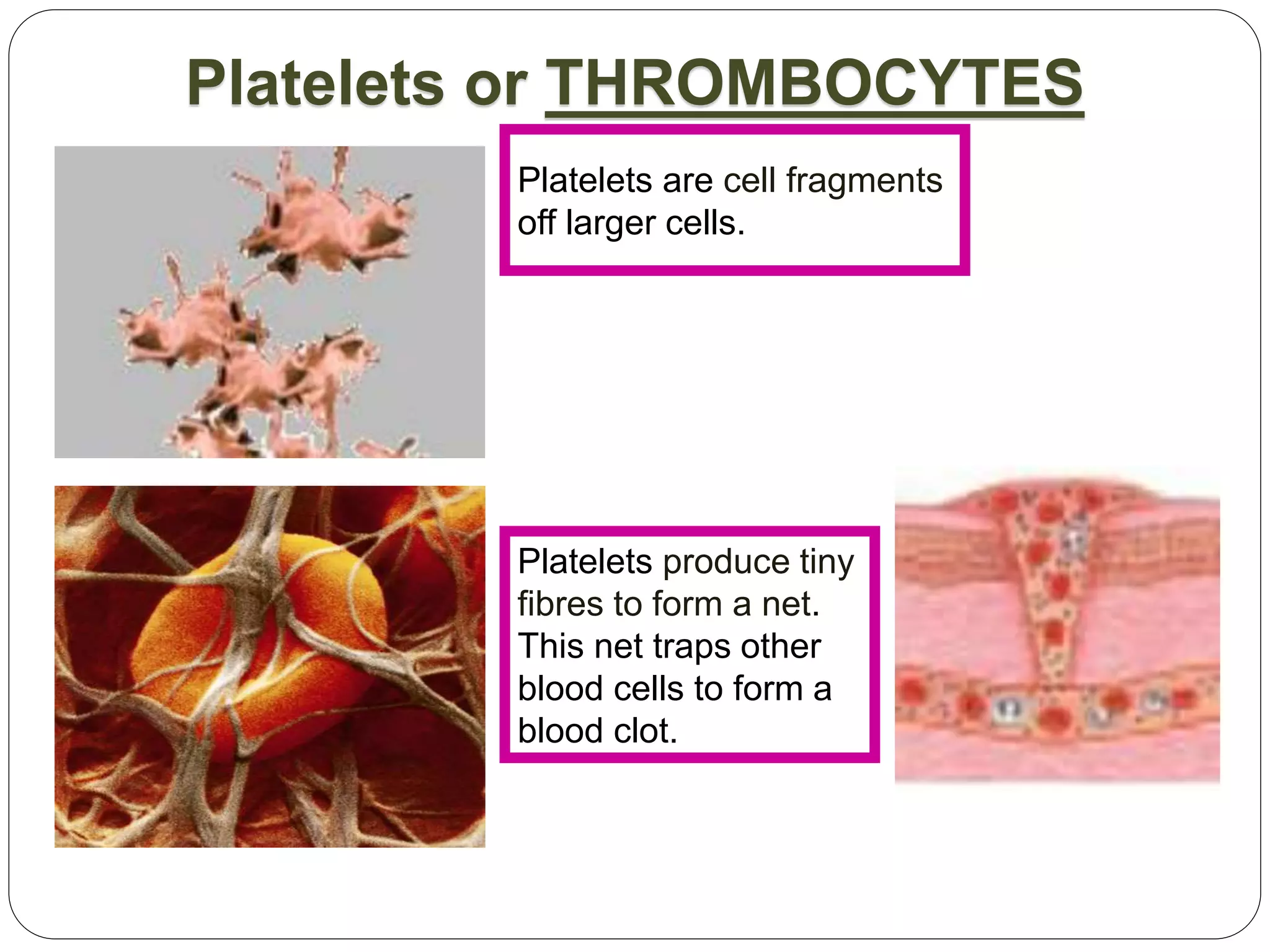
Platelets or THROMBOCYTES
Platelets are cell fragments
off larger cells.
Platelets produce tiny
fibres to form a net.
This net traps other
blood cells to form a
blood clot.
The circulatory system carries blood and
dissolved substances to and from different
places in the body.
Function of the circulatory
system
BLOOD VESSELS
CIRULATORY
SYSTEM
HEART
+
The heart pumps blood and substances around the
body in tubes called BLOOD VESSELS.
The HEART has the job of pumping blood
around the body.
Vellosidad intestinal
Alvéolo pulmonar
Tejido Riñón
Alvéolo pulmonar
lungs
head & arms
liver
digestive system
kidneys
legs
pulmonary artery
aorta
pulmonary vein
Cava vein
LeftRight
How does this system work?
Circulatory System
Lungs
Body cells
Circulation is:
• Double: Blood travels twice
through heart to complete the whole
circuit.
• Complete: Oxygenated blood
never mixes with deoxigenated
blood.
• Closed: blood never leaves blood
vessels.
BLOOD VESSELS
blood from the heart gets around the body through them
There are 3 types of blood vessels
a. ARTERY
b. VEIN
c. CAPILLARY
The ARTERY
thick muscle and
elastic fibres
Arteries carry blood away from the heart.
the elastic fibres allow
the artery to stretch
under pressure
the thick muscle can
contract to push the
blood along.
The VEIN
Veins carry blood towards from the heart.
thin muscle and
elastic fibres
veins have valves which
act to stop the blood
from going in the wrong
direction.
body muscles surround the veins so
that when they contract to move the
body, they also squeeze the veins
and push the blood along the
vessel.
The CAPILLARY
Capillaries link Arteries with Veins
the wall of a capillary
is only one cell thick
They exchange materials
between the blood and
other body cells.
The exchange of materials
between the blood and the
body can only occur through
capillaries.
A collection of capillaries is known as a capillary bed.
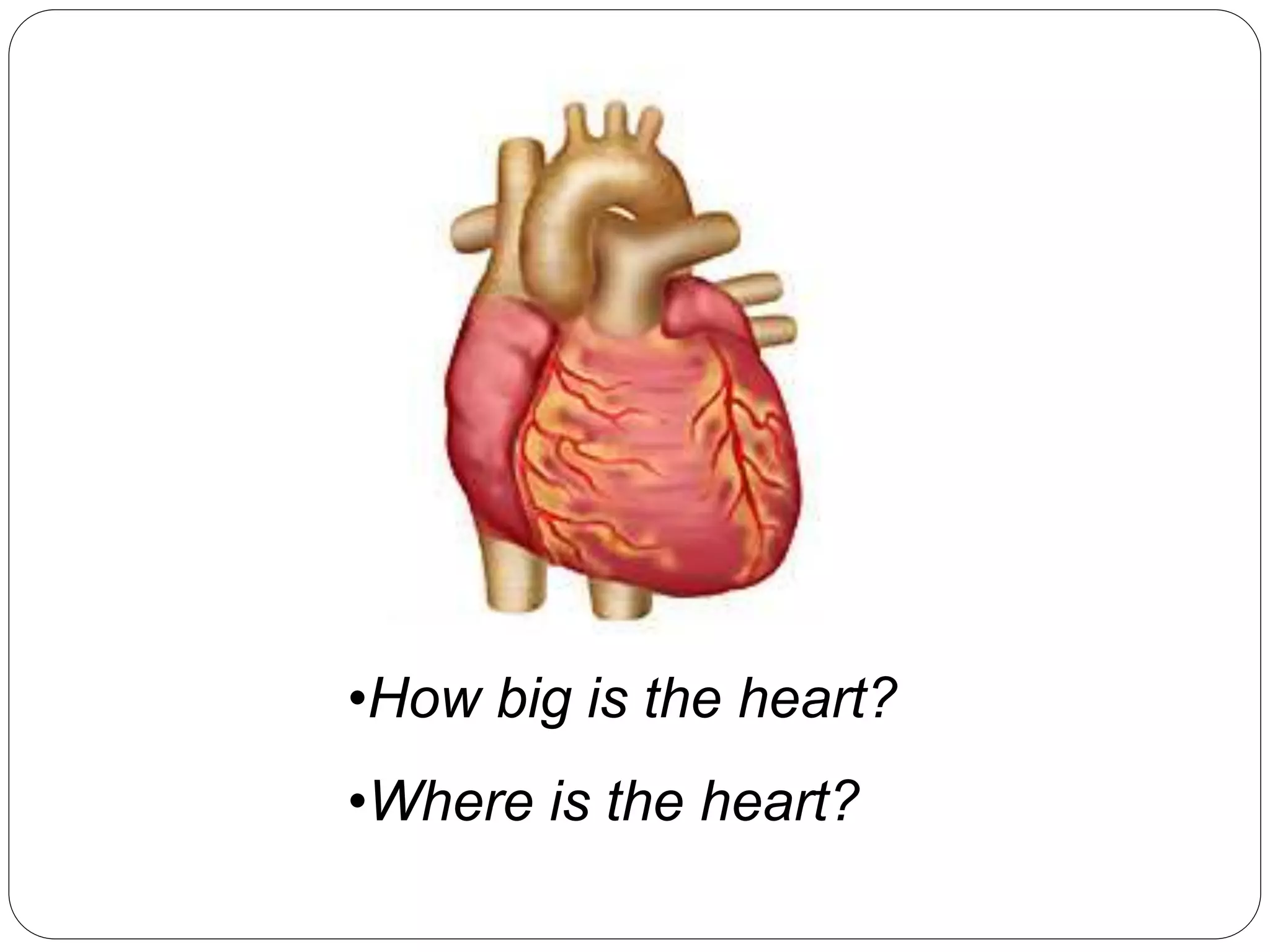
•How big is the heart?
•Where is the heart?
Explanation of Heart
Right
Atrium
Right
Ventricle
Left
Atrium
Left
VentricleValves
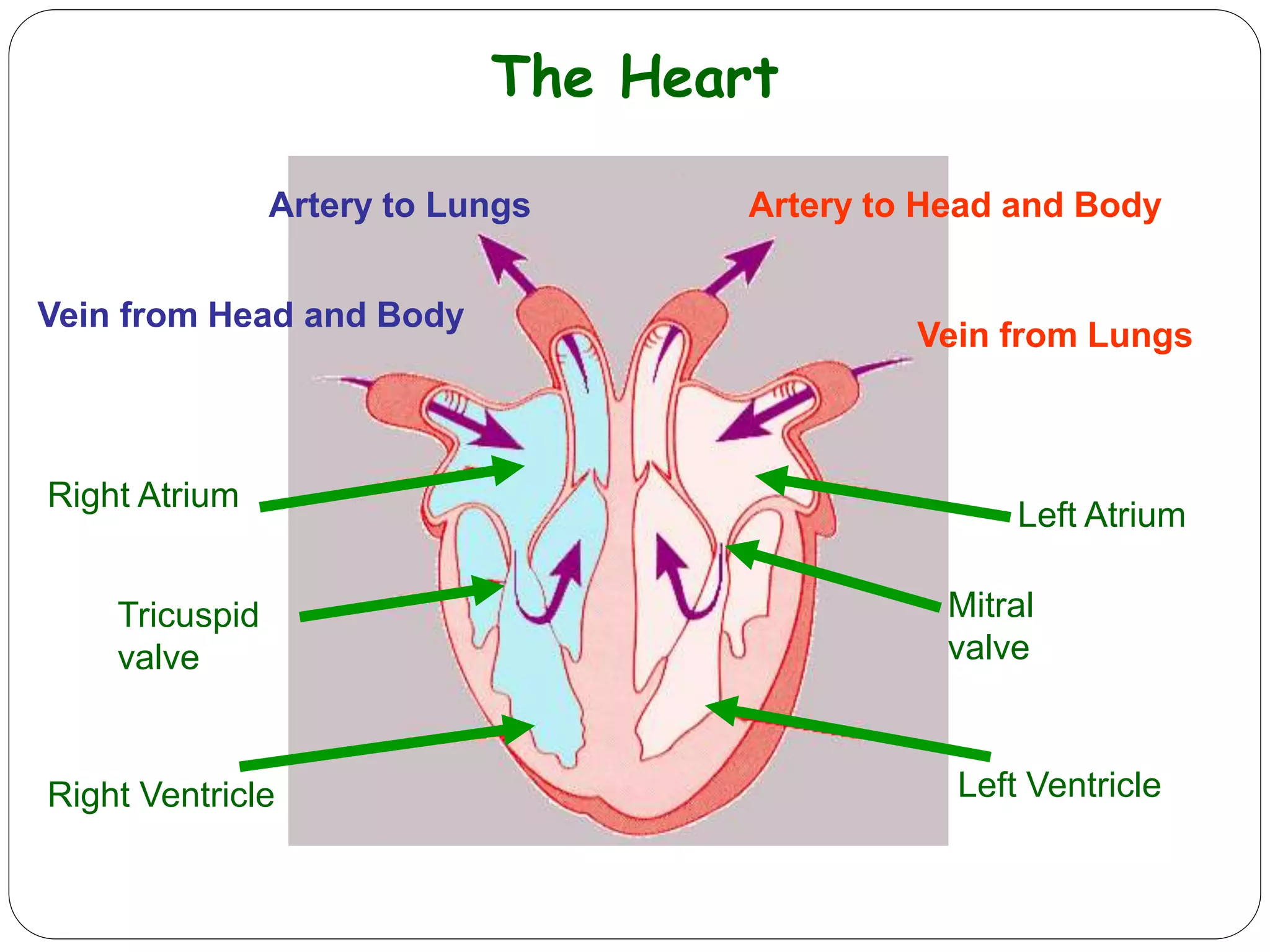
The heart has 4 chambers:
2 on the Right: received blood and 2 on the left: pumps the blood out
How does the heart pump?
What kind
of blood
does each
side
pump?
Which
side of
the heart
is thicker
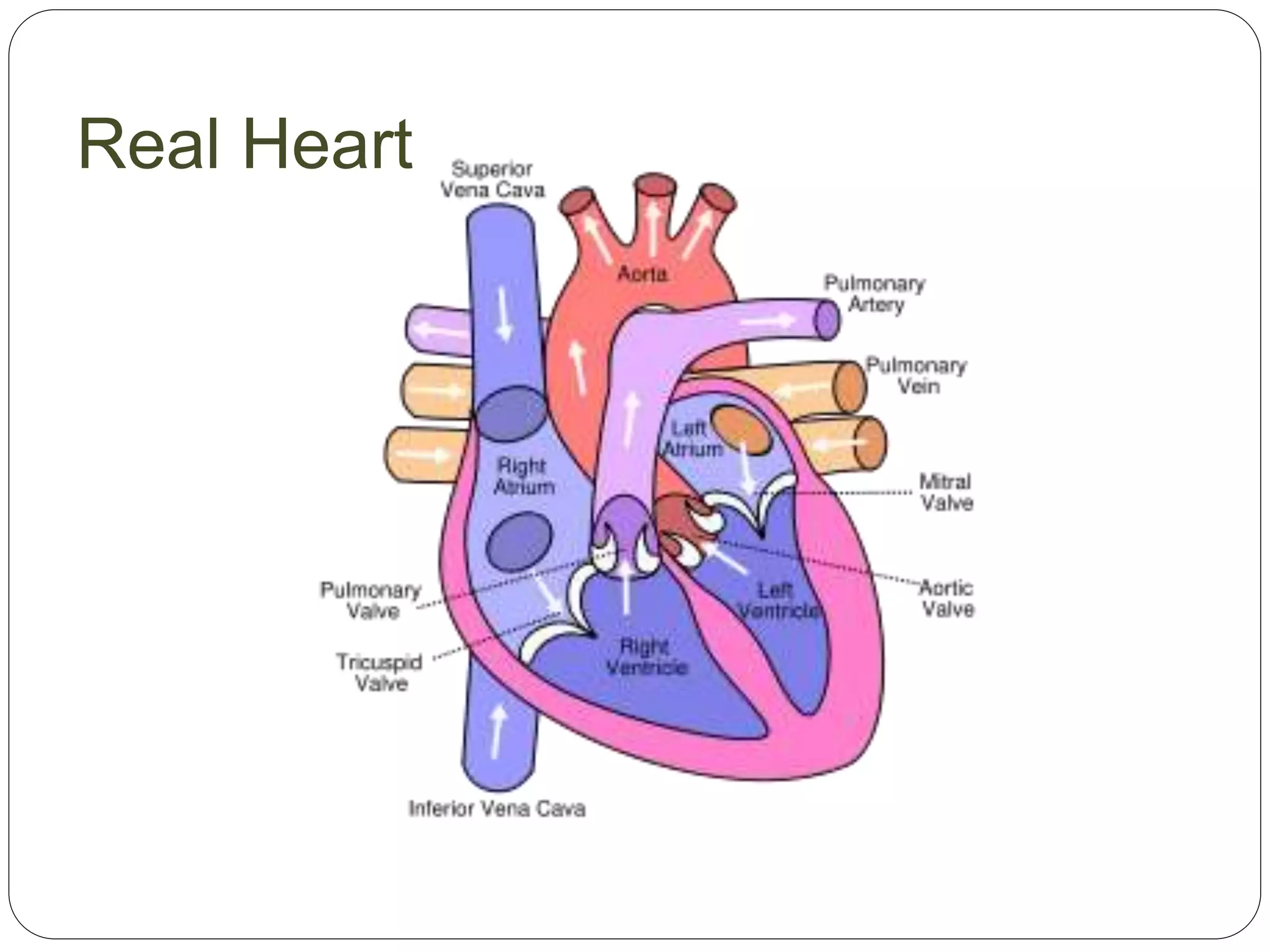
Real Heart
The Heart
Left Ventricle
Left Atrium
Right Atrium
Right Ventricle
Tricuspid
valve
Vein from Lungs
Artery to Head and BodyArtery to Lungs
Vein from Head and Body
Mitral
valve
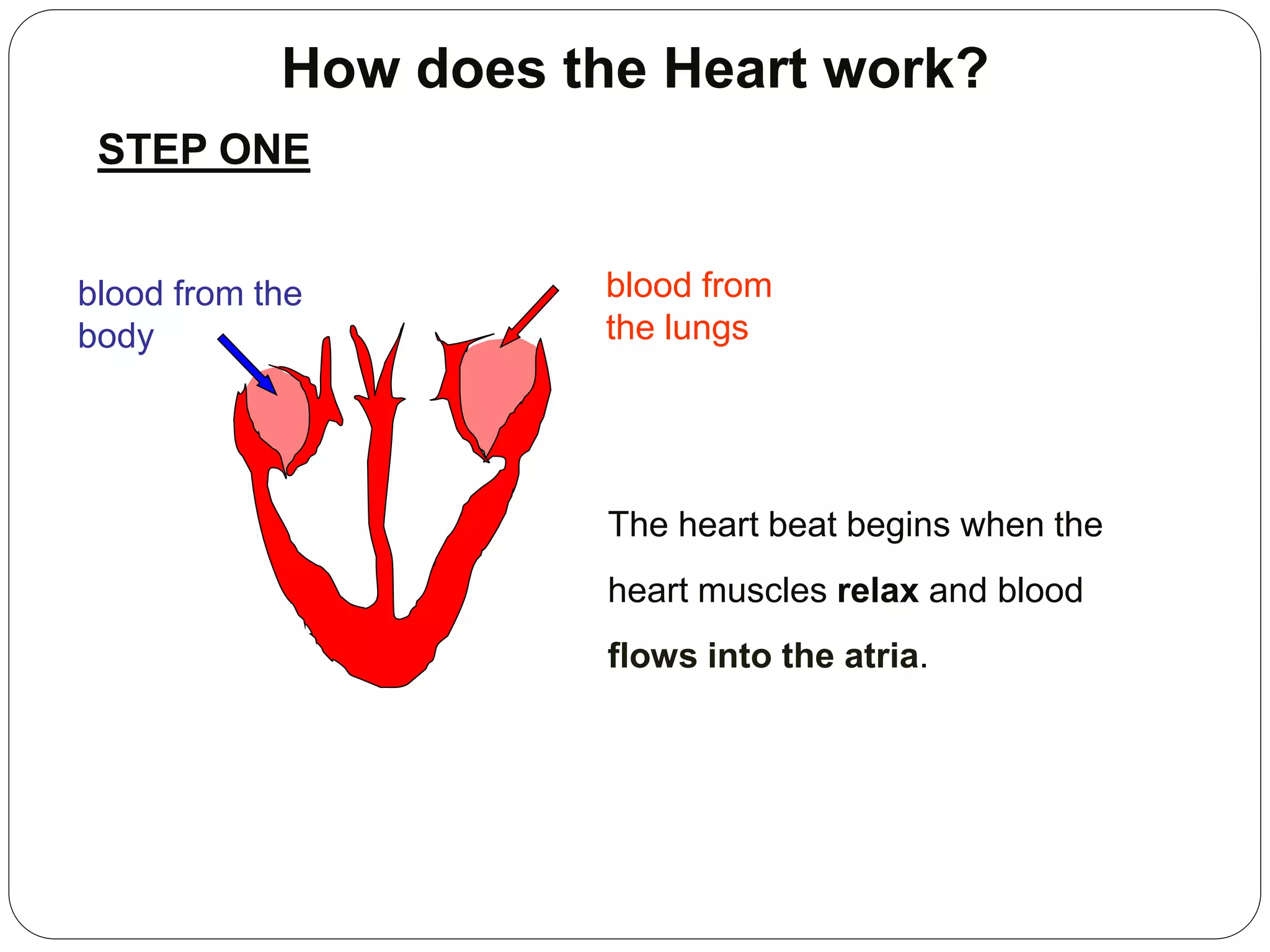
How does the Heart work?
blood from the
body
blood from
the lungs
The heart beat begins when the
heart muscles relax and blood
flows into the atria.
STEP ONE
The atria then contract and
the valves open to allow blood
into the ventricles.
How does the Heart work?
STEP TWO
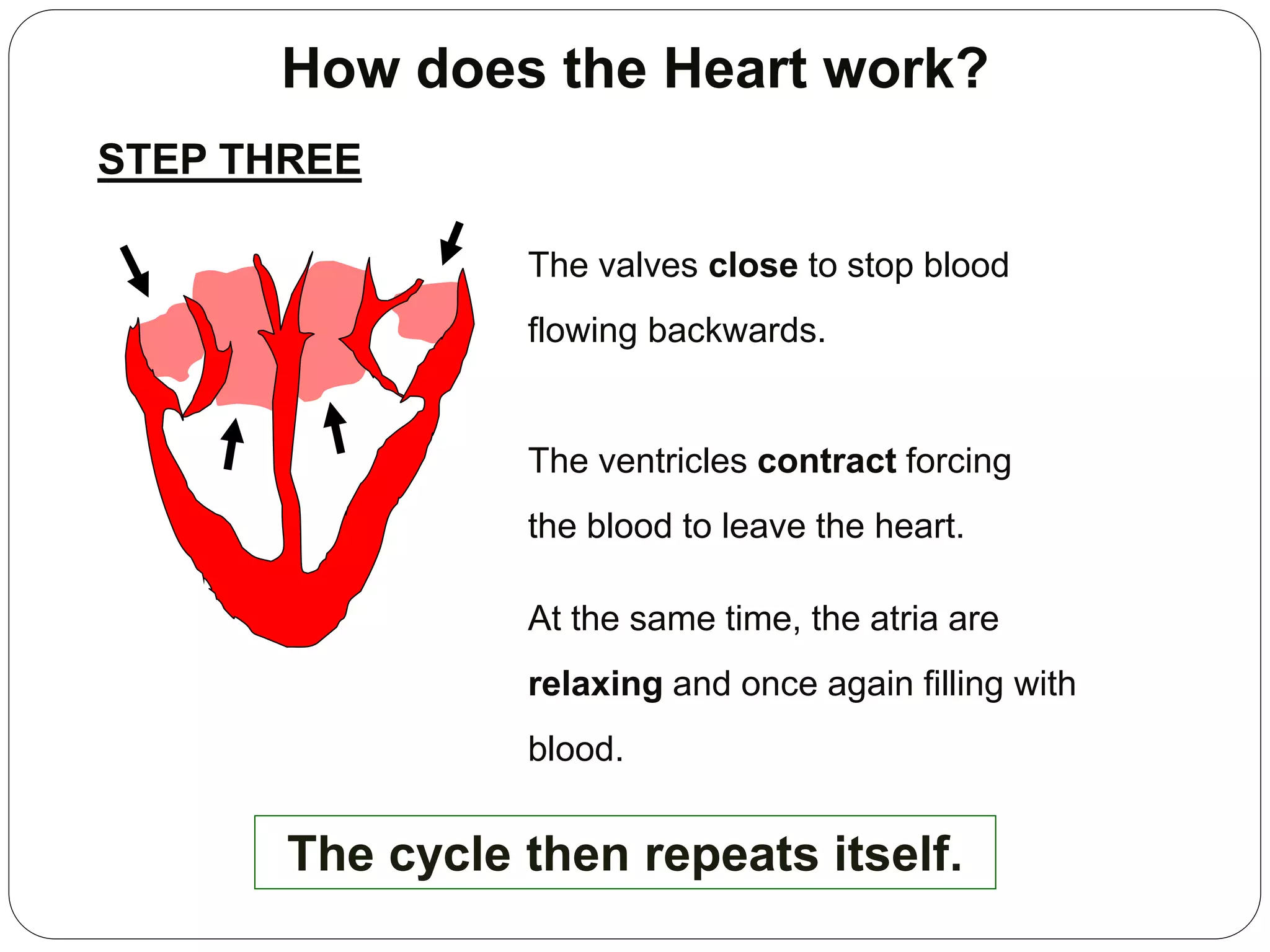
How does the Heart work?
The valves close to stop blood
flowing backwards.
The ventricles contract forcing
the blood to leave the heart.
At the same time, the atria are
relaxing and once again filling with
blood.
The cycle then repeats itself.
STEP THREE
LYMPHATIC
SYSTEM
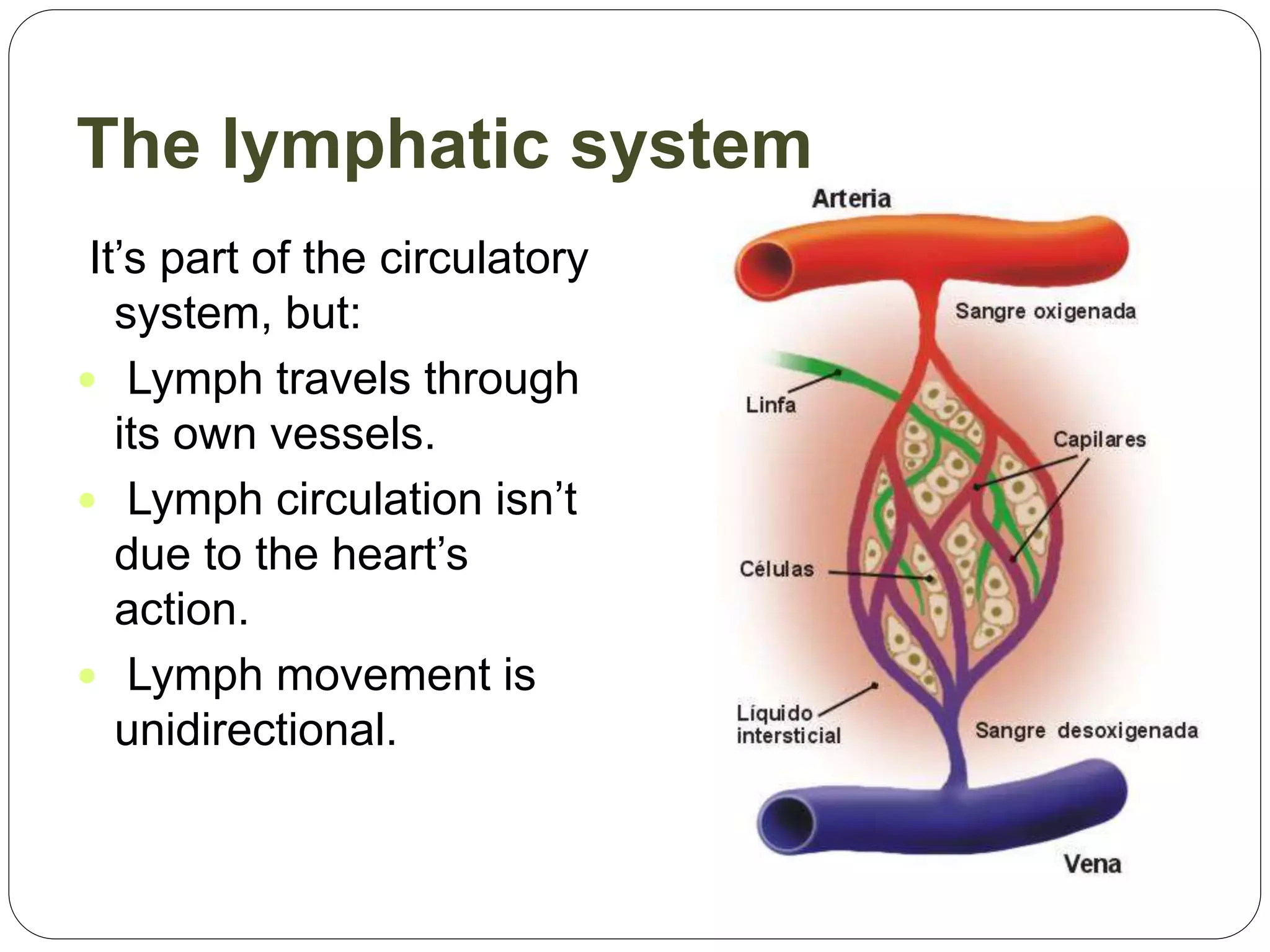
The lymphatic system
It’s part of the circulatory
system, but:
 Lymph travels through
its own vessels.
 Lymph circulation isn’t
due to the heart’s
action.
 Lymph movement is
unidirectional.
LYMPH: lymphocytes +
intersticial plasma.
LYMPHATIC VESSELS:
closed on one end. They have
half-moon shaped valves.
LYMPHATIC ORGANS AND
TISSUES:
• Tonsils
• Adenoids
• Thymus gland
• Spleen
• Chyle cistern
LYMPH NODES: Make
lymphocytes and release lymph
plasma.
BONE MARROW: Generates
lymphocytes and other blood
cellular components.
 There are 600 to
700 lymph nodes
in the human body
that filter the
lymph before it
returns to the
circulatory system.
All lymph nodes
have the primary
function of the
production of
lymphocytes.
Lymph nodes
The spleen, which is largest
lymphatic organ, is located on
the left side of the body just
above the kidney. Humans can
live without a spleen, although
they would be more prone to
infections.
Spongy inner tissue within the
spleen contains many tiny
blood vessels and hollow
sinuses that store blood. The
spleen can release its stored
blood into circulation to
replace blood lost during a
Spleen.
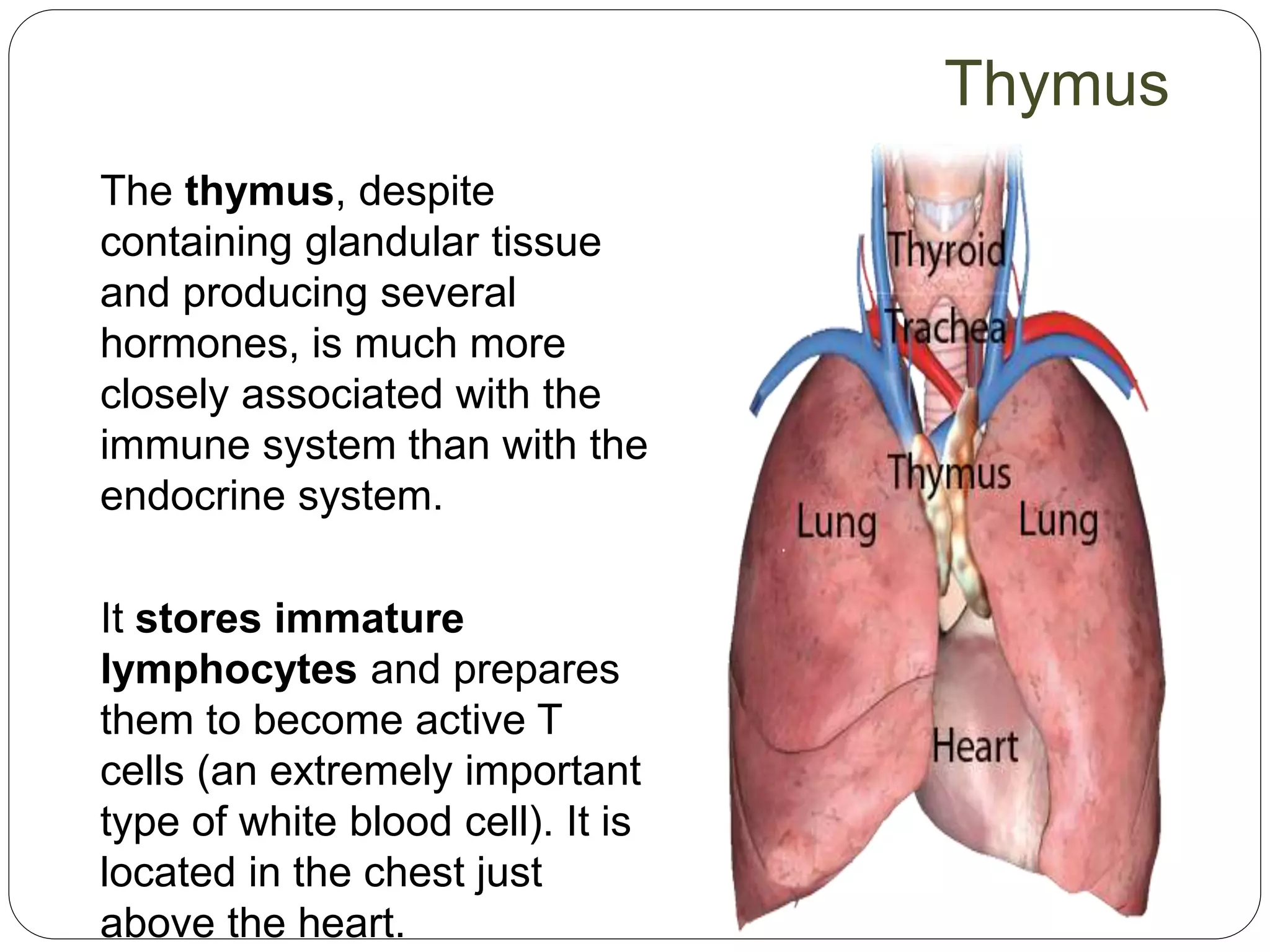
The thymus, despite
containing glandular tissue
and producing several
hormones, is much more
closely associated with the
immune system than with the
endocrine system.
It stores immature
lymphocytes and prepares
them to become active T
cells (an extremely important
type of white blood cell). It is
located in the chest just
above the heart.
Thymus
Each tonsil consists of a network of crypts that
store cells used to fight infection; crypts where
pathogens can be trapped and attacked by immunity
cells.
Tonsils
Tonsils are large
clusters of lymphatic
cells found in the
pharynx. The tonsils
are thought to assist in
protecting the body
against respiratory and
gastrointestinal
infections.
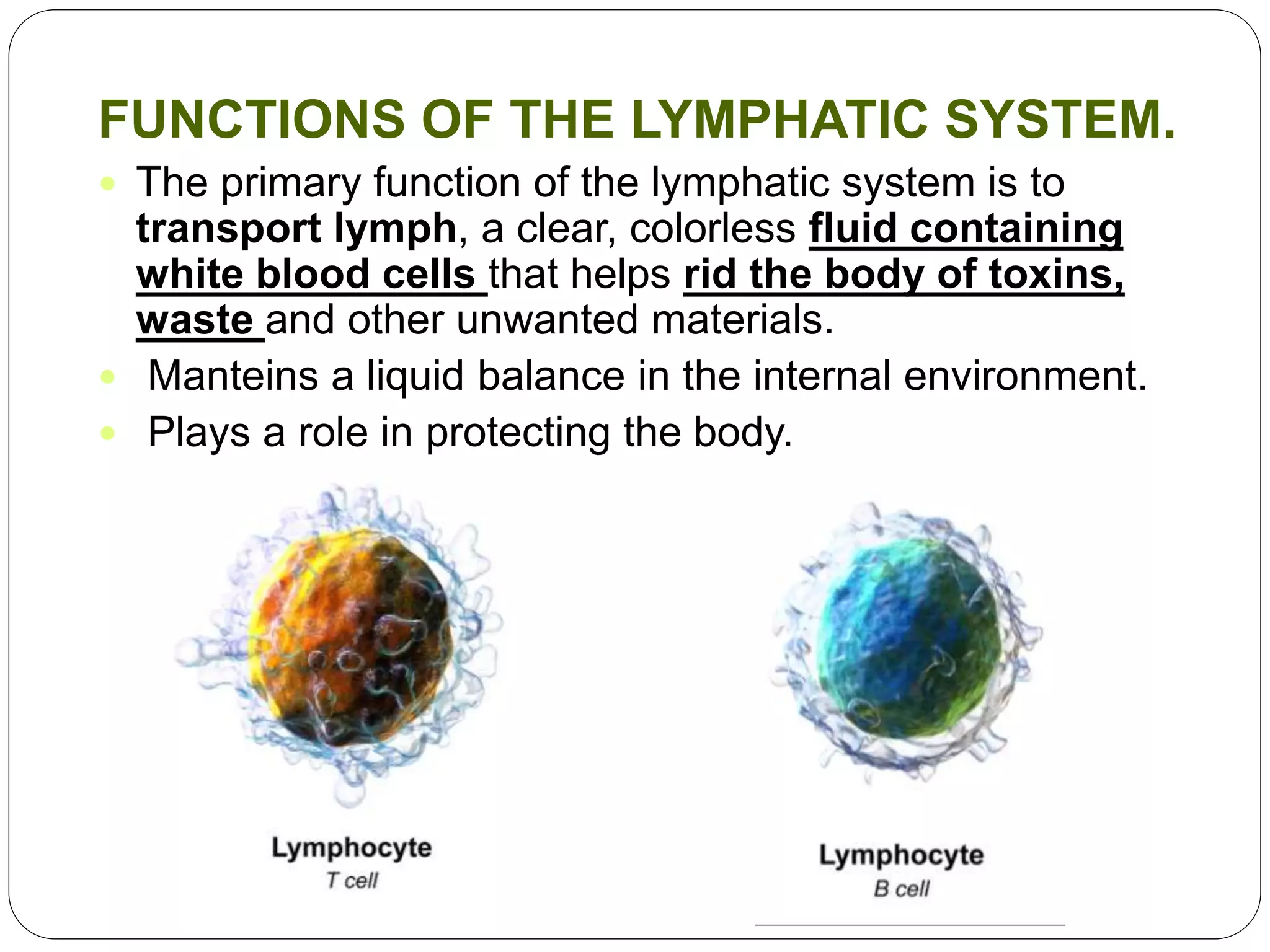
FUNCTIONS OF THE LYMPHATIC SYSTEM.
 The primary function of the lymphatic system is to
transport lymph, a clear, colorless fluid containing
white blood cells that helps rid the body of toxins,
waste and other unwanted materials.
 Manteins a liquid balance in the internal environment.
 Plays a role in protecting the body.
From
the
artery
To the
vein
Lymph
vessel
Interstitial plasma
enters the lymph
vessel
Interstitial
plasma enters
the capillary
Capillar
Blood plasma
passes out the
capillary
Cell
Interstitial
plasma
Nutrient
s
O
2
C
O2
Plasma leaves
the cells once it
has delivered its
nutrients and
removed debris.
Most of this fluid
returns to the
venous
circulation
through the
venules and
continues as
venous blood.
The remainder
becomes lymph.
Process
From
the
artery
To the
vein
Lymph
vessel
Interstitial plasma
enters the lymph
vessel
Interstitial
plasma enters
the capillary
Capillar
Blood plasma
passes out the
capillary
Cell
Interstitial
plasma
Nutrient
s
O
2
C
O2
Lymph leaves the
tissue and enters
the lymphatic
system through
specialized
lymphatic
capillaries.
They join
progressively to
form larger ducts,
the lymphatic
veins, which lead
back to the veins of
the circulatory
system.
Lymph capillaries are BLIND. This means that they are closed at one
end, and instersticial plasma filters into them.
Process
There are two drainage
areas that make up the
lymphatic system.
 The right drainage area
handles the right arm
and chest.
 The left drainage area
clears all of the other
areas of the body,
including both legs, the
lower trunk, the upper left
portion of the chest, and
Collecting lymph.
Just for educational purpose.
Anaya digital.
Oxford CLIL 3 ESO Biology and Geology.
InnerBody http://www.innerbody.com/
Several images found by Google Images.
Sources.

Nutrition function II.

  • 1.
    THE NUTRITION FUNCTIONII The circulatory and lymphatic systems.
  • 2.
    Internal environment.  Environmentthat provides the cells with optimal conditions to carry out their functions.  Space between cells filled with intersticial plasma.  Blood renews plasma through the circulatory system.
  • 3.
  • 4.
    What’s in red bloodcells white blood cells platelets plasma carbon dioxide digested “food” waste (urea) hormones oxygen
  • 5.
    • Transport: toand from tissue cells – • Nutrients to cells. – • Oxygen: by red blood cells (haemoglobin). – • Wastes from cells: urea, CO2. • Communication: hormones distributed to all parts of the body in the blood. • Temperature Regulation: by altering the blood flow through the skin. • Immunity: protection against pathogens — blood clotting; phagocytes, lymphocytes and antibodies distributed in blood. • Defence: clotting following a wound. Functions of Blood System
  • 6.
    The Blood plasma red bloodcell white blood cell platelets
  • 7.
    Plasma A straw- coloured liquid that carriesthe cells and the platelets which help blood clot. • carbon dioxide • glucose • amino acids • proteins • minerals • vitamins • hormones • waste materials like urea. It also contains useful things like:
  • 8.
    Red Blood Cellsor ERYTHROCITES They contain haemoglobin, a molecule specially designed to hold oxygen and carry it to cells that need it. They can change shape to an amazing extent, without breaking, as it squeezes single file through the capillaries. A biconcave disc that is round and flat without a nucleus
  • 9.
    White Blood Cellsor LEUKOCYTES There are many different types and all contain a big nucleus. The two main ones are the lymphocytes and the macrophages. Some lymphocytes fight disease by making antibodies to destroy invaders by dissolving them. Other lymphocytes make antitoxins to break down poisons. Macrophages ‘eat’ and digest micro- organisms .
  • 10.
    Platelets or THROMBOCYTES Plateletsare cell fragments off larger cells. Platelets produce tiny fibres to form a net. This net traps other blood cells to form a blood clot.
  • 11.
    The circulatory systemcarries blood and dissolved substances to and from different places in the body. Function of the circulatory system BLOOD VESSELS CIRULATORY SYSTEM HEART +
  • 12.
    The heart pumpsblood and substances around the body in tubes called BLOOD VESSELS. The HEART has the job of pumping blood around the body. Vellosidad intestinal Alvéolo pulmonar Tejido Riñón Alvéolo pulmonar
  • 13.
    lungs head & arms liver digestivesystem kidneys legs pulmonary artery aorta pulmonary vein Cava vein LeftRight How does this system work? Circulatory System
  • 15.
    Lungs Body cells Circulation is: •Double: Blood travels twice through heart to complete the whole circuit. • Complete: Oxygenated blood never mixes with deoxigenated blood. • Closed: blood never leaves blood vessels.
  • 16.
    BLOOD VESSELS blood fromthe heart gets around the body through them There are 3 types of blood vessels a. ARTERY b. VEIN c. CAPILLARY
  • 17.
    The ARTERY thick muscleand elastic fibres Arteries carry blood away from the heart. the elastic fibres allow the artery to stretch under pressure the thick muscle can contract to push the blood along.
  • 18.
    The VEIN Veins carryblood towards from the heart. thin muscle and elastic fibres veins have valves which act to stop the blood from going in the wrong direction. body muscles surround the veins so that when they contract to move the body, they also squeeze the veins and push the blood along the vessel.
  • 19.
    The CAPILLARY Capillaries linkArteries with Veins the wall of a capillary is only one cell thick They exchange materials between the blood and other body cells. The exchange of materials between the blood and the body can only occur through capillaries.
  • 20.
    A collection ofcapillaries is known as a capillary bed.
  • 22.
    •How big isthe heart? •Where is the heart?
  • 23.
    Explanation of Heart Right Atrium Right Ventricle Left Atrium Left VentricleValves Theheart has 4 chambers: 2 on the Right: received blood and 2 on the left: pumps the blood out How does the heart pump? What kind of blood does each side pump? Which side of the heart is thicker
  • 24.
  • 25.
    The Heart Left Ventricle LeftAtrium Right Atrium Right Ventricle Tricuspid valve Vein from Lungs Artery to Head and BodyArtery to Lungs Vein from Head and Body Mitral valve
  • 26.
    How does theHeart work? blood from the body blood from the lungs The heart beat begins when the heart muscles relax and blood flows into the atria. STEP ONE
  • 27.
    The atria thencontract and the valves open to allow blood into the ventricles. How does the Heart work? STEP TWO
  • 28.
    How does theHeart work? The valves close to stop blood flowing backwards. The ventricles contract forcing the blood to leave the heart. At the same time, the atria are relaxing and once again filling with blood. The cycle then repeats itself. STEP THREE
  • 30.
  • 31.
    The lymphatic system It’spart of the circulatory system, but:  Lymph travels through its own vessels.  Lymph circulation isn’t due to the heart’s action.  Lymph movement is unidirectional.
  • 32.
    LYMPH: lymphocytes + intersticialplasma. LYMPHATIC VESSELS: closed on one end. They have half-moon shaped valves. LYMPHATIC ORGANS AND TISSUES: • Tonsils • Adenoids • Thymus gland • Spleen • Chyle cistern LYMPH NODES: Make lymphocytes and release lymph plasma. BONE MARROW: Generates lymphocytes and other blood cellular components.
  • 33.
     There are600 to 700 lymph nodes in the human body that filter the lymph before it returns to the circulatory system. All lymph nodes have the primary function of the production of lymphocytes. Lymph nodes
  • 34.
    The spleen, whichis largest lymphatic organ, is located on the left side of the body just above the kidney. Humans can live without a spleen, although they would be more prone to infections. Spongy inner tissue within the spleen contains many tiny blood vessels and hollow sinuses that store blood. The spleen can release its stored blood into circulation to replace blood lost during a Spleen.
  • 35.
    The thymus, despite containingglandular tissue and producing several hormones, is much more closely associated with the immune system than with the endocrine system. It stores immature lymphocytes and prepares them to become active T cells (an extremely important type of white blood cell). It is located in the chest just above the heart. Thymus
  • 36.
    Each tonsil consistsof a network of crypts that store cells used to fight infection; crypts where pathogens can be trapped and attacked by immunity cells. Tonsils Tonsils are large clusters of lymphatic cells found in the pharynx. The tonsils are thought to assist in protecting the body against respiratory and gastrointestinal infections.
  • 37.
    FUNCTIONS OF THELYMPHATIC SYSTEM.  The primary function of the lymphatic system is to transport lymph, a clear, colorless fluid containing white blood cells that helps rid the body of toxins, waste and other unwanted materials.  Manteins a liquid balance in the internal environment.  Plays a role in protecting the body.
  • 38.
    From the artery To the vein Lymph vessel Interstitial plasma entersthe lymph vessel Interstitial plasma enters the capillary Capillar Blood plasma passes out the capillary Cell Interstitial plasma Nutrient s O 2 C O2 Plasma leaves the cells once it has delivered its nutrients and removed debris. Most of this fluid returns to the venous circulation through the venules and continues as venous blood. The remainder becomes lymph. Process
  • 39.
    From the artery To the vein Lymph vessel Interstitial plasma entersthe lymph vessel Interstitial plasma enters the capillary Capillar Blood plasma passes out the capillary Cell Interstitial plasma Nutrient s O 2 C O2 Lymph leaves the tissue and enters the lymphatic system through specialized lymphatic capillaries. They join progressively to form larger ducts, the lymphatic veins, which lead back to the veins of the circulatory system. Lymph capillaries are BLIND. This means that they are closed at one end, and instersticial plasma filters into them. Process
  • 41.
    There are twodrainage areas that make up the lymphatic system.  The right drainage area handles the right arm and chest.  The left drainage area clears all of the other areas of the body, including both legs, the lower trunk, the upper left portion of the chest, and Collecting lymph.
  • 43.
    Just for educationalpurpose. Anaya digital. Oxford CLIL 3 ESO Biology and Geology. InnerBody http://www.innerbody.com/ Several images found by Google Images. Sources.