Shor’s Algorithm

University Of Calcutta

MRINAL KANTI MONDAL
Introduction
 “I

think I can safely say that nobody
understands quantum mechanics” - Feynman
 1982 - Feynman proposed the idea of creating
machines based on the laws of quantum
mechanics instead of the laws of classical
physics.
 1985 - David Deutsch developed the quantum Turing machine,
showing that quantum circuits are universal[1].
 1994 - Peter Shor came up with a quantum algorithm to factor
very large numbers in polynomial time.
1997 - Lov Grover develops a quantum search algorithm with
O(√N) complexity.
Background
• It is a Quantum algorithm, to find the prime factors of
any given integer N.
• Formulated and named after mathematician Peter Shor
in 1994.

• It takes time O((log N)3). Which demonstrates that an
integer factorization can be solved in a quantum
computer in polynomial time.
• It makes RSA vulnerable to attack, as RSA is based on
the assumption that factoring large numbers is
computationally infeasible.

3
Quantum computation
• In quantum computing single particle’s actual state is not
restricted to only one of the two observable states.
• When observed or measured, the particle will manifest
itself in one observable state or the other with respective
probability encoded in the superposition.
• Any state of the system is modeled by a unit-length vector
in the Hilbert space C2n.

4
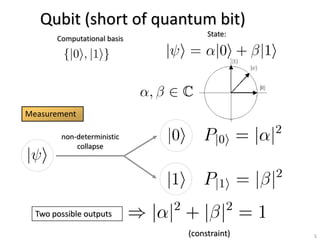
Qubit (short of quantum bit)
Computational basis

State:

Measurement
non-deterministic
collapse

Two possible outputs
(constraint)

5
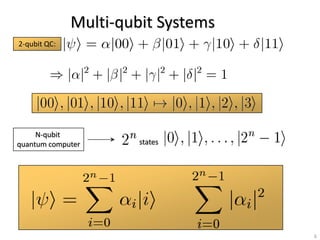
Multi-qubit Systems
2-qubit QC:

N-qubit
quantum computer

states

6
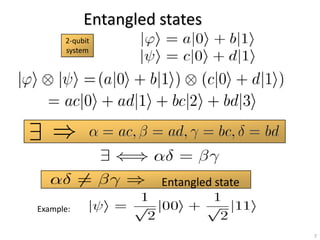
Entangled states
2-qubit
system

Entangled state
Example:
7
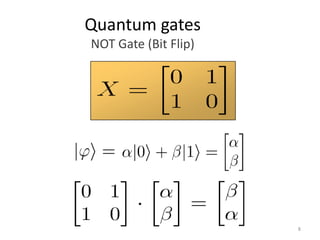
Quantum gates
NOT Gate (Bit Flip)

8
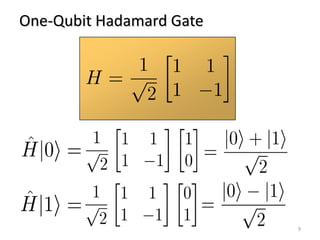
One-Qubit Hadamard Gate

9
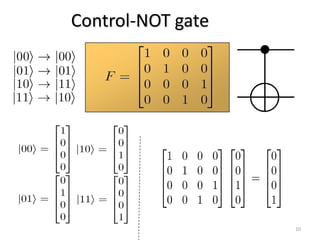
Control-NOT gate

10
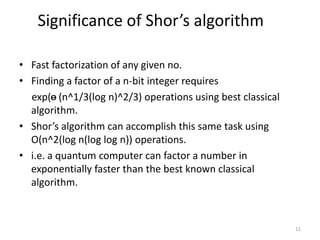
Significance of Shor’s algorithm
• Fast factorization of any given no.
• Finding a factor of a n-bit integer requires
exp( (n^1/3(log n)^2/3) operations using best classical
algorithm.
• Shor’s algorithm can accomplish this same task using
O(n^2(log n(log log n)) operations.
• i.e. a quantum computer can factor a number in
exponentially faster than the best known classical
algorithm.

11
Shor’s Algorithm
Shor’s algorithm shows (in principle,) that a quantum
computer is capable of factoring very large numbers in
polynomial time.

The algorithm is dependant on
Modular Arithmetic
Quantum Parallelism

Quantum Fourier Transform
The algorithm
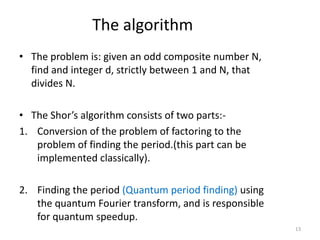
• The problem is: given an odd composite number N,
find and integer d, strictly between 1 and N, that
divides N.
• The Shor’s algorithm consists of two parts:1. Conversion of the problem of factoring to the
problem of finding the period.(this part can be
implemented classically).

2. Finding the period (Quantum period finding) using
the quantum Fourier transform, and is responsible
for quantum speedup.
13
Classical part
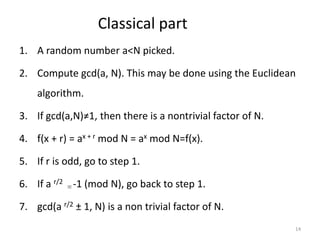
1. A random number a<N picked.
2. Compute gcd(a, N). This may be done using the Euclidean
algorithm.
3. If gcd(a,N)≠1, then there is a nontrivial factor of N.

4. f(x + r) = ax + r mod N = ax mod N=f(x).
5. If r is odd, go to step 1.
6. If a r/2 -1 (mod N), go back to step 1.
7. gcd(a r/2 ± 1, N) is a non trivial factor of N.
14
Shor’s Algorithm - Periodicity
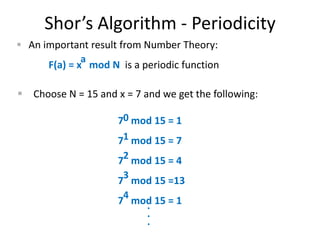
 An important result from Number Theory:
a
F(a) = x mod N is a periodic function

 Choose N = 15 and x = 7 and we get the following:
70 mod 15 = 1
71 mod 15 = 7
72 mod 15 = 4
3
7 mod 15 =13
4
7 mod 15 = 1
.
.
.
Shor’s Algorithm - In Depth Analysis
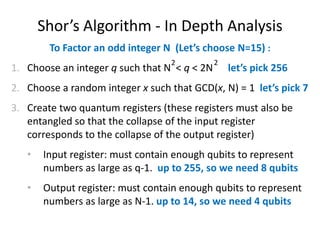
To Factor an odd integer N (Let’s choose N=15) :
2

1. Choose an integer q such that N < q < 2N

2

let’s pick 256

2. Choose a random integer x such that GCD(x, N) = 1 let’s pick 7
3. Create two quantum registers (these registers must also be
entangled so that the collapse of the input register
corresponds to the collapse of the output register)
•

Input register: must contain enough qubits to represent
numbers as large as q-1. up to 255, so we need 8 qubits

•

Output register: must contain enough qubits to represent
numbers as large as N-1. up to 14, so we need 4 qubits
Shor’s Algorithm - Preparing Data
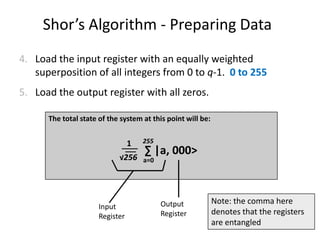
4. Load the input register with an equally weighted
superposition of all integers from 0 to q-1. 0 to 255
5. Load the output register with all zeros.
The total state of the system at this point will be:

1

255

∑ |a, 000>

√256 a=0

Input
Register

Output
Register

Note: the comma here
denotes that the registers
are entangled
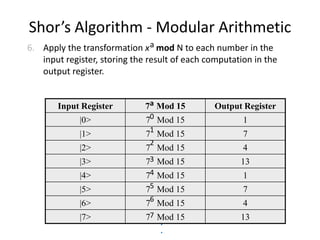
Shor’s Algorithm - Modular Arithmetic
6. Apply the transformation x a mod N to each number in the
input register, storing the result of each computation in the
output register.

Input Register

7a Mod 15

Output Register

|0>

70 Mod 15

1

|1>

71 Mod 15

7

|2>

7 Mod 15

4

|3>

73 Mod 15

13

|4>

74 Mod 15

1

|5>

75 Mod 15

7

|6>

76 Mod 15

4

|7>

77 Mod 15

13

2

.
.
Shor’s Algorithm - Superposition
Collapse
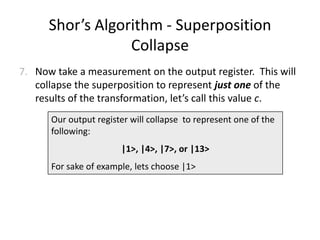
7. Now take a measurement on the output register. This will
collapse the superposition to represent just one of the
results of the transformation, let’s call this value c.
Our output register will collapse to represent one of the
following:
|1>, |4>, |7>, or |13>
For sake of example, lets choose |1>
Shor’s Algorithm - Entanglement
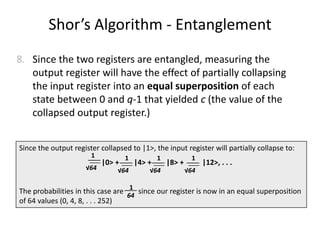
8. Since the two registers are entangled, measuring the
output register will have the effect of partially collapsing
the input register into an equal superposition of each
state between 0 and q-1 that yielded c (the value of the
collapsed output register.)
Since the output register collapsed to |1>, the input register will partially collapse to:
1

√64

|0> +

1

|4> +

√64

1

√64

1

|8> +

1

|12>, . . .

√64

The probabilities in this case are 64 since our register is now in an equal superposition
of 64 values (0, 4, 8, . . . 252)
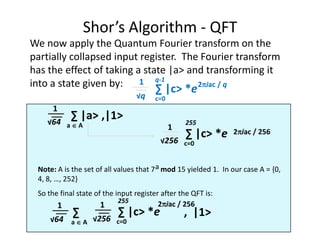
Shor’s Algorithm - QFT
We now apply the Quantum Fourier transform on the
partially collapsed input register. The Fourier transform
has the effect of taking a state |a> and transforming it
into a state given by: 1 q-1
2iac / q
√q

1
√64

∑ |c> *e
c=0

∑ |a> ,|1>

aA

1
√256

255

∑ |c> *e

2iac / 256

c=0

Note: A is the set of all values that 7 a mod 15 yielded 1. In our case A = {0,
4, 8, …, 252}

So the final state of the input register after the QFT is:
255
2iac / 256
1
1

∑

∑ |c> *e

√64 a  A √256 c=0

, |1>
Shor’s Algorithm - QFT
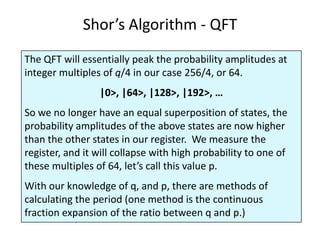
The QFT will essentially peak the probability amplitudes at
integer multiples of q/4 in our case 256/4, or 64.

|0>, |64>, |128>, |192>, …
So we no longer have an equal superposition of states, the
probability amplitudes of the above states are now higher
than the other states in our register. We measure the
register, and it will collapse with high probability to one of
these multiples of 64, let’s call this value p.
With our knowledge of q, and p, there are methods of
calculating the period (one method is the continuous
fraction expansion of the ratio between q and p.)
Shor’s Algorithm - The Factors
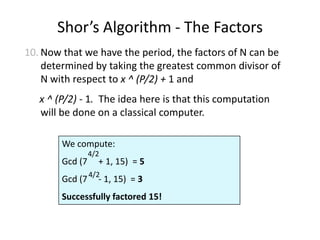
10. Now that we have the period, the factors of N can be
determined by taking the greatest common divisor of
N with respect to x ^ (P/2) + 1 and
x ^ (P/2) - 1. The idea here is that this computation
will be done on a classical computer.
We compute:
Gcd (7
Gcd (7

4/2

+ 1, 15) = 5

4/2

- 1, 15) = 3

Successfully factored 15!
Shor’s Algorithm - Problems
 The QFT comes up short and reveals the wrong period.
This probability is actually dependant on your choice of q.
The larger the q, the higher the probability of finding the
correct probability.
 The period of the series ends up being odd.
If either of these cases occur, we go back to the
beginning and pick a new x.

Quantum modular exponentiation, much slower than the
quantum Fourier transform.
Applications
• Factoring – RSA encryption.
• Quantum simulation.
• Spin-off technology – spintronics, quantum cryptography.
• Spin-off theory – complexity theory, DMRG theory, Nrepresent ability theory.

25
Recent works on Shor’s algorithm
• In 2001, a 7 qubit machine was built and
programmed to run Shor’s algorithm to successfully
factor 15, but no entanglement is observed.
• In 2012, the factorization of 21 was achieved.
• In April 2012, the factorization of 143 was achieved.

26
Reference:
• Peter W. Shor “Polynomial-Time Algorithms for Prime Factorization
and Discrete Logarithms on a Quantum Computer “, SIAM Journal
on Computing (1997).
• Michael A. Nielsen & Isaac Chuang, ‘Quantum computation and
quantum information’, Cambridge university press.
• Quantum Computing Explained - D. McMahon , (Wiley, 2007) .
• An introduction to Quantum Computing - Oxford University Press,
Jan,2007.
• www.eecis.udel.edu/~saunders/courses/879-03s/
• http://www.cs.berkeley.edu/~vazirani/

27
Thank you
28

Shor’s algorithm the ppt

  • 1.
    Shor’s Algorithm University OfCalcutta MRINAL KANTI MONDAL
  • 2.
    Introduction  “I think Ican safely say that nobody understands quantum mechanics” - Feynman  1982 - Feynman proposed the idea of creating machines based on the laws of quantum mechanics instead of the laws of classical physics.  1985 - David Deutsch developed the quantum Turing machine, showing that quantum circuits are universal[1].  1994 - Peter Shor came up with a quantum algorithm to factor very large numbers in polynomial time. 1997 - Lov Grover develops a quantum search algorithm with O(√N) complexity.
  • 3.
    Background • It isa Quantum algorithm, to find the prime factors of any given integer N. • Formulated and named after mathematician Peter Shor in 1994. • It takes time O((log N)3). Which demonstrates that an integer factorization can be solved in a quantum computer in polynomial time. • It makes RSA vulnerable to attack, as RSA is based on the assumption that factoring large numbers is computationally infeasible. 3
  • 4.
    Quantum computation • Inquantum computing single particle’s actual state is not restricted to only one of the two observable states. • When observed or measured, the particle will manifest itself in one observable state or the other with respective probability encoded in the superposition. • Any state of the system is modeled by a unit-length vector in the Hilbert space C2n. 4
  • 5.
    Qubit (short ofquantum bit) Computational basis State: Measurement non-deterministic collapse Two possible outputs (constraint) 5
  • 6.
  • 7.
  • 8.
  • 9.
  • 10.
  • 11.
    Significance of Shor’salgorithm • Fast factorization of any given no. • Finding a factor of a n-bit integer requires exp( (n^1/3(log n)^2/3) operations using best classical algorithm. • Shor’s algorithm can accomplish this same task using O(n^2(log n(log log n)) operations. • i.e. a quantum computer can factor a number in exponentially faster than the best known classical algorithm. 11
  • 12.
    Shor’s Algorithm Shor’s algorithmshows (in principle,) that a quantum computer is capable of factoring very large numbers in polynomial time. The algorithm is dependant on Modular Arithmetic Quantum Parallelism Quantum Fourier Transform
  • 13.
    The algorithm • Theproblem is: given an odd composite number N, find and integer d, strictly between 1 and N, that divides N. • The Shor’s algorithm consists of two parts:1. Conversion of the problem of factoring to the problem of finding the period.(this part can be implemented classically). 2. Finding the period (Quantum period finding) using the quantum Fourier transform, and is responsible for quantum speedup. 13
  • 14.
    Classical part 1. Arandom number a<N picked. 2. Compute gcd(a, N). This may be done using the Euclidean algorithm. 3. If gcd(a,N)≠1, then there is a nontrivial factor of N. 4. f(x + r) = ax + r mod N = ax mod N=f(x). 5. If r is odd, go to step 1. 6. If a r/2 -1 (mod N), go back to step 1. 7. gcd(a r/2 ± 1, N) is a non trivial factor of N. 14
  • 15.
    Shor’s Algorithm -Periodicity  An important result from Number Theory: a F(a) = x mod N is a periodic function  Choose N = 15 and x = 7 and we get the following: 70 mod 15 = 1 71 mod 15 = 7 72 mod 15 = 4 3 7 mod 15 =13 4 7 mod 15 = 1 . . .
  • 16.
    Shor’s Algorithm -In Depth Analysis To Factor an odd integer N (Let’s choose N=15) : 2 1. Choose an integer q such that N < q < 2N 2 let’s pick 256 2. Choose a random integer x such that GCD(x, N) = 1 let’s pick 7 3. Create two quantum registers (these registers must also be entangled so that the collapse of the input register corresponds to the collapse of the output register) • Input register: must contain enough qubits to represent numbers as large as q-1. up to 255, so we need 8 qubits • Output register: must contain enough qubits to represent numbers as large as N-1. up to 14, so we need 4 qubits
  • 17.
    Shor’s Algorithm -Preparing Data 4. Load the input register with an equally weighted superposition of all integers from 0 to q-1. 0 to 255 5. Load the output register with all zeros. The total state of the system at this point will be: 1 255 ∑ |a, 000> √256 a=0 Input Register Output Register Note: the comma here denotes that the registers are entangled
  • 18.
    Shor’s Algorithm -Modular Arithmetic 6. Apply the transformation x a mod N to each number in the input register, storing the result of each computation in the output register. Input Register 7a Mod 15 Output Register |0> 70 Mod 15 1 |1> 71 Mod 15 7 |2> 7 Mod 15 4 |3> 73 Mod 15 13 |4> 74 Mod 15 1 |5> 75 Mod 15 7 |6> 76 Mod 15 4 |7> 77 Mod 15 13 2 . .
  • 19.
    Shor’s Algorithm -Superposition Collapse 7. Now take a measurement on the output register. This will collapse the superposition to represent just one of the results of the transformation, let’s call this value c. Our output register will collapse to represent one of the following: |1>, |4>, |7>, or |13> For sake of example, lets choose |1>
  • 20.
    Shor’s Algorithm -Entanglement 8. Since the two registers are entangled, measuring the output register will have the effect of partially collapsing the input register into an equal superposition of each state between 0 and q-1 that yielded c (the value of the collapsed output register.) Since the output register collapsed to |1>, the input register will partially collapse to: 1 √64 |0> + 1 |4> + √64 1 √64 1 |8> + 1 |12>, . . . √64 The probabilities in this case are 64 since our register is now in an equal superposition of 64 values (0, 4, 8, . . . 252)
  • 21.
    Shor’s Algorithm -QFT We now apply the Quantum Fourier transform on the partially collapsed input register. The Fourier transform has the effect of taking a state |a> and transforming it into a state given by: 1 q-1 2iac / q √q 1 √64 ∑ |c> *e c=0 ∑ |a> ,|1> aA 1 √256 255 ∑ |c> *e 2iac / 256 c=0 Note: A is the set of all values that 7 a mod 15 yielded 1. In our case A = {0, 4, 8, …, 252} So the final state of the input register after the QFT is: 255 2iac / 256 1 1 ∑ ∑ |c> *e √64 a  A √256 c=0 , |1>
  • 22.
    Shor’s Algorithm -QFT The QFT will essentially peak the probability amplitudes at integer multiples of q/4 in our case 256/4, or 64. |0>, |64>, |128>, |192>, … So we no longer have an equal superposition of states, the probability amplitudes of the above states are now higher than the other states in our register. We measure the register, and it will collapse with high probability to one of these multiples of 64, let’s call this value p. With our knowledge of q, and p, there are methods of calculating the period (one method is the continuous fraction expansion of the ratio between q and p.)
  • 23.
    Shor’s Algorithm -The Factors 10. Now that we have the period, the factors of N can be determined by taking the greatest common divisor of N with respect to x ^ (P/2) + 1 and x ^ (P/2) - 1. The idea here is that this computation will be done on a classical computer. We compute: Gcd (7 Gcd (7 4/2 + 1, 15) = 5 4/2 - 1, 15) = 3 Successfully factored 15!
  • 24.
    Shor’s Algorithm -Problems  The QFT comes up short and reveals the wrong period. This probability is actually dependant on your choice of q. The larger the q, the higher the probability of finding the correct probability.  The period of the series ends up being odd. If either of these cases occur, we go back to the beginning and pick a new x. Quantum modular exponentiation, much slower than the quantum Fourier transform.
  • 25.
    Applications • Factoring –RSA encryption. • Quantum simulation. • Spin-off technology – spintronics, quantum cryptography. • Spin-off theory – complexity theory, DMRG theory, Nrepresent ability theory. 25
  • 26.
    Recent works onShor’s algorithm • In 2001, a 7 qubit machine was built and programmed to run Shor’s algorithm to successfully factor 15, but no entanglement is observed. • In 2012, the factorization of 21 was achieved. • In April 2012, the factorization of 143 was achieved. 26
  • 27.
    Reference: • Peter W.Shor “Polynomial-Time Algorithms for Prime Factorization and Discrete Logarithms on a Quantum Computer “, SIAM Journal on Computing (1997). • Michael A. Nielsen & Isaac Chuang, ‘Quantum computation and quantum information’, Cambridge university press. • Quantum Computing Explained - D. McMahon , (Wiley, 2007) . • An introduction to Quantum Computing - Oxford University Press, Jan,2007. • www.eecis.udel.edu/~saunders/courses/879-03s/ • http://www.cs.berkeley.edu/~vazirani/ 27
  • 28.