Quantum Error Correction
for Beginners
section 1-9
2020/04/17 WebEx
National Institute of Informatics
Shin Nishio
Paper
[1] Simon J. Devitt, Kae Nemoto, William J. Munro
Quantum Error Correction for Beginners
(Submitted on 18 May 2009, last revised 21 Jun 2013 (this version, v4))
arXiv[quant-ph] 0905.2794
Hands-on: implementation based on [1], written in Qiskit by Shin
https://github.com/parton-quark/QEC-for-Beginners
Abstract
QEC and fault-tolerant quantum computation
• Theoretical aspect of QIS
• Significant development since 1995
• An introduction for researchers other than QEC
2
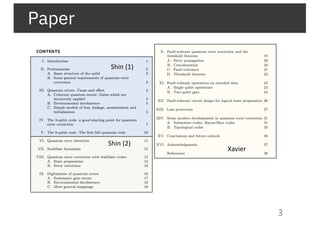
Paper
3
Xavier
Shin (1)
Shin (2)
1. Introduction
4
Research
• Proposal of QEC
• concept of fault-tolerance
• Threshold theorem
• Protocols
• continuous, ion-traps, adiabatic…
• subsystem code, topological code
• Quantum Error Suppression: partially cancel
errors
2. Preliminaries
5
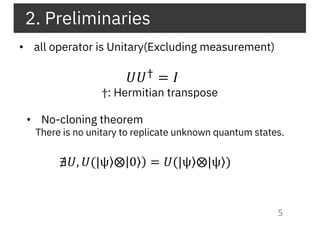
• all operator is Unitary(Excluding measurement)
𝑈𝑈!
= 𝐼
†: Hermitian transpose
• No-cloning theorem
There is no unitary to replicate unknown quantum states.
∄𝑈, 𝑈(| ⟩ψ ⨂ ⟩0 = 𝑈(| ⟩ψ ⨂| ⟩ψ )
3. Quantum Errors
6
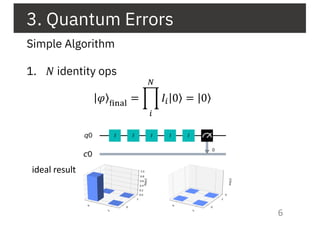
Simple Algorithm
1. 𝑁 identity ops
| ⟩𝜑 !"#$%
= '
&
'
𝐼&| ⟩0 = | ⟩0
ideal result
7
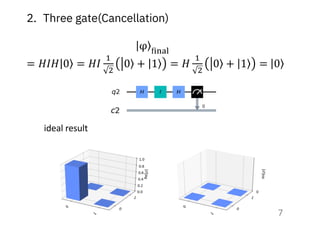
2. Three gate(Cancellation)
| ⟩φ !"#$%
= 𝐻𝐼𝐻| ⟩0 = 𝐻𝐼
(
)
, ⟩0 + | ⟩1 = 𝐻
(
)
, ⟩0 + | ⟩1 = | ⟩0
ideal result
8
Errors
A. Coherent quantum errors
B. Environmental decoherence
C. loss, leakage measurement and initialization
9
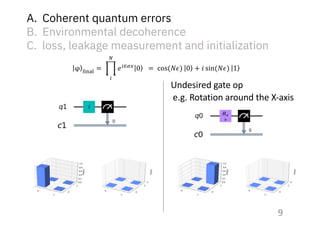
A. Coherent quantum errors
B. Environmental decoherence
C. loss, leakage measurement and initialization
e.g. Rotation around the X-axis
| ⟩φ !"#$% = %
&
'
𝑒&∈)*| ⟩0 = cos(𝑁𝜖) | ⟩0 + 𝑖 sin(𝑁𝜖) | ⟩1
Undesired gate op
10
A. Coherent quantum errors
B. Environmental decoherence
C. loss, leakage measurement and initialization
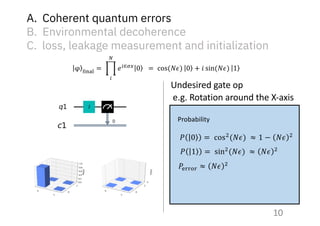
e.g. Rotation around the X-axis
| ⟩φ !"#$% = %
&
'
𝑒&∈)*| ⟩0 = cos(𝑁𝜖) | ⟩0 + 𝑖 sin(𝑁𝜖) | ⟩1
Undesired gate op
Probability
𝑃 | ⟩0 = cos!
(𝑁𝜖) ≈ 1 − 𝑁𝜖 !
𝑃 | ⟩1 = sin!
(𝑁𝜖) ≈ 𝑁𝜖 !
𝑃"##$# ≈ 𝑁𝜖 !
11
A. Coherent quantum errors
B. Environmental decoherence
C. loss, leakage measurement and initialization
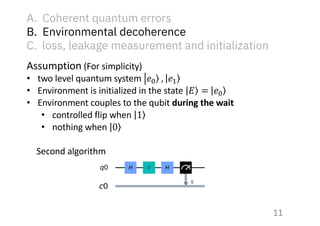
Assumption (For simplicity)
• two level quantum system ! ⟩𝑒4 , | ⟩𝑒5
• Environment is initialized in the state | ⟩𝐸 = | ⟩𝑒4
• Environment couples to the qubit during the wait
• controlled flip when | ⟩1
• nothing when | ⟩0
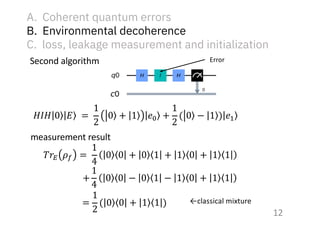
Second algorithm
12
A. Coherent quantum errors
B. Environmental decoherence
C. loss, leakage measurement and initialization
Second algorithm
𝐻𝐼𝐻| ⟩0 | ⟩𝐸 =
1
2
! ⟩0 + | ⟩1 | ⟩𝑒4 +
1
2
(! ⟩0 − | ⟩1 )| ⟩𝑒5
Error
measurement result
𝑇𝑟6 𝜌7 =
1
4
⟩|0 ⟨ |0 + ⟩|0 ⟨ |1 + ⟩|1 ⟨ |0 + ⟩|1 ⟨ |1
=
1
2
( ⟩|0 ⟨ |0 + ⟩|1 ⟨ |1 )
+
1
4
⟩|0 ⟨ |0 − ⟩|0 ⟨ |1 − ⟩|1 ⟨ |0 + ⟩|1 ⟨ |1
←classical mixture
13
A. Coherent quantum errors
B. Environmental decoherence
C. loss, leakage measurement and initialization
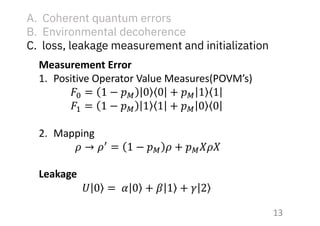
Measurement Error
1. Positive Operator Value Measures(POVM’s)
𝐹* = 1 − 𝑝+ ⟩|0 ⟨ |0 + 𝑝+ ⟩|1 ⟨ |1
𝐹( = 1 − 𝑝+ ⟩|1 ⟨ |1 + 𝑝+ ⟩|0 ⟨ |0
2. Mapping
𝜌 → 𝜌,
= 1 − 𝑝+ 𝜌 + 𝑝+ 𝑋𝜌𝑋
Leakage
𝑈 ⟩|0 = 𝛼 ⟩|0 + 𝛽 ⟩|1 + 𝛾 ⟩|2
14
A. Coherent quantum errors
B. Environmental decoherence
C. loss, leakage measurement and initialization
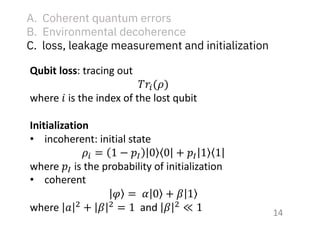
Qubit loss: tracing out
𝑇𝑟&(𝜌)
where 𝑖 is the index of the lost qubit
Initialization
• incoherent: initial state
𝜌& = 1 − 𝑝- ⟩|0 ⟨ |0 + 𝑝- ⟩|1 ⟨ |1
where 𝑝- is the probability of initialization
• coherent
⟩| 𝜑 = 𝛼 ⟩|0 + 𝛽 ⟩|1
where 𝑎 ) + 𝛽 ) = 1 and 𝛽 ) ≪ 1
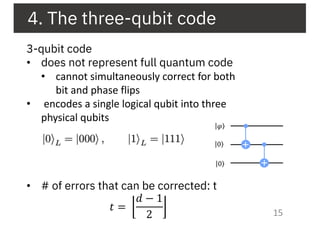
4. The three-qubit code
15
⟩| 𝜑
⟩|0
⟩|0
3-qubit code
• does not represent full quantum code
• cannot simultaneously correct for both
bit and phase flips
• encodes a single logical qubit into three
physical qubits
• # of errors that can be corrected: t
𝑡 =
𝑑 − 1
2
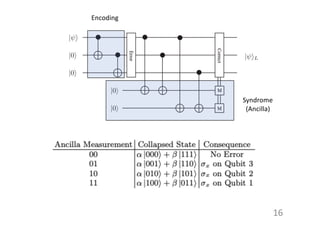
16
Syndrome
(Ancilla)
Encoding
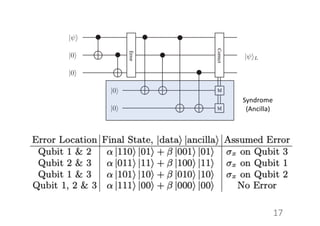
17
Syndrome
(Ancilla)
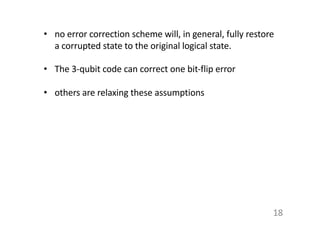
18
• no error correction scheme will, in general, fully restore
a corrupted state to the original logical state.
• The 3-qubit code can correct one bit-flip error
• others are relaxing these assumptions
5. The nine-qubit code
19
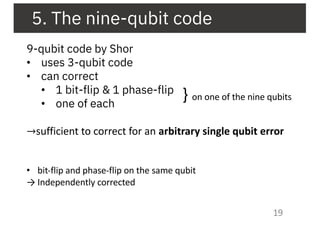
9-qubit code by Shor
• uses 3-qubit code
• can correct
• 1 bit-flip & 1 phase-flip
• one of each
→sufficient to correct for an arbitrary single qubit error
} on one of the nine qubits
• bit-flip and phase-flip on the same qubit
→ Independently corrected
20
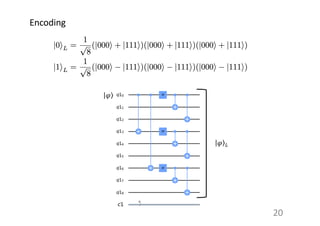
Encoding
⟩| 𝜑
⟩| 𝜑 +
21
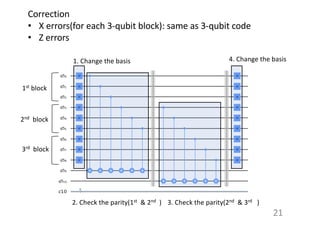
Correction
• X errors(for each 3-qubit block): same as 3-qubit code
• Z errors
1. Change the basis
1st block
2nd block
3rd block
4. Change the basis
2. Check the parity(1st & 2nd ) 3. Check the parity(2nd & 3rd )
22
Conclusion
• Quantum Errors
• coherent, environmental decoherence, loss, and so on
• the 3-qubit code
• only for bit-flip, uses syndrome
• the 9-qubit code
• combination of Z-error correction & X-error correction

[01] Quantum Error Correction for Beginners

  • 1.
    Quantum Error Correction forBeginners section 1-9 2020/04/17 WebEx National Institute of Informatics Shin Nishio
  • 2.
    Paper [1] Simon J.Devitt, Kae Nemoto, William J. Munro Quantum Error Correction for Beginners (Submitted on 18 May 2009, last revised 21 Jun 2013 (this version, v4)) arXiv[quant-ph] 0905.2794 Hands-on: implementation based on [1], written in Qiskit by Shin https://github.com/parton-quark/QEC-for-Beginners Abstract QEC and fault-tolerant quantum computation • Theoretical aspect of QIS • Significant development since 1995 • An introduction for researchers other than QEC 2
  • 3.
  • 4.
    1. Introduction 4 Research • Proposalof QEC • concept of fault-tolerance • Threshold theorem • Protocols • continuous, ion-traps, adiabatic… • subsystem code, topological code • Quantum Error Suppression: partially cancel errors
  • 5.
    2. Preliminaries 5 • alloperator is Unitary(Excluding measurement) 𝑈𝑈! = 𝐼 †: Hermitian transpose • No-cloning theorem There is no unitary to replicate unknown quantum states. ∄𝑈, 𝑈(| ⟩ψ ⨂ ⟩0 = 𝑈(| ⟩ψ ⨂| ⟩ψ )
  • 6.
    3. Quantum Errors 6 SimpleAlgorithm 1. 𝑁 identity ops | ⟩𝜑 !"#$% = ' & ' 𝐼&| ⟩0 = | ⟩0 ideal result
  • 7.
    7 2. Three gate(Cancellation) |⟩φ !"#$% = 𝐻𝐼𝐻| ⟩0 = 𝐻𝐼 ( ) , ⟩0 + | ⟩1 = 𝐻 ( ) , ⟩0 + | ⟩1 = | ⟩0 ideal result
  • 8.
    8 Errors A. Coherent quantumerrors B. Environmental decoherence C. loss, leakage measurement and initialization
  • 9.
    9 A. Coherent quantumerrors B. Environmental decoherence C. loss, leakage measurement and initialization e.g. Rotation around the X-axis | ⟩φ !"#$% = % & ' 𝑒&∈)*| ⟩0 = cos(𝑁𝜖) | ⟩0 + 𝑖 sin(𝑁𝜖) | ⟩1 Undesired gate op
  • 10.
    10 A. Coherent quantumerrors B. Environmental decoherence C. loss, leakage measurement and initialization e.g. Rotation around the X-axis | ⟩φ !"#$% = % & ' 𝑒&∈)*| ⟩0 = cos(𝑁𝜖) | ⟩0 + 𝑖 sin(𝑁𝜖) | ⟩1 Undesired gate op Probability 𝑃 | ⟩0 = cos! (𝑁𝜖) ≈ 1 − 𝑁𝜖 ! 𝑃 | ⟩1 = sin! (𝑁𝜖) ≈ 𝑁𝜖 ! 𝑃"##$# ≈ 𝑁𝜖 !
  • 11.
    11 A. Coherent quantumerrors B. Environmental decoherence C. loss, leakage measurement and initialization Assumption (For simplicity) • two level quantum system ! ⟩𝑒4 , | ⟩𝑒5 • Environment is initialized in the state | ⟩𝐸 = | ⟩𝑒4 • Environment couples to the qubit during the wait • controlled flip when | ⟩1 • nothing when | ⟩0 Second algorithm
  • 12.
    12 A. Coherent quantumerrors B. Environmental decoherence C. loss, leakage measurement and initialization Second algorithm 𝐻𝐼𝐻| ⟩0 | ⟩𝐸 = 1 2 ! ⟩0 + | ⟩1 | ⟩𝑒4 + 1 2 (! ⟩0 − | ⟩1 )| ⟩𝑒5 Error measurement result 𝑇𝑟6 𝜌7 = 1 4 ⟩|0 ⟨ |0 + ⟩|0 ⟨ |1 + ⟩|1 ⟨ |0 + ⟩|1 ⟨ |1 = 1 2 ( ⟩|0 ⟨ |0 + ⟩|1 ⟨ |1 ) + 1 4 ⟩|0 ⟨ |0 − ⟩|0 ⟨ |1 − ⟩|1 ⟨ |0 + ⟩|1 ⟨ |1 ←classical mixture
  • 13.
    13 A. Coherent quantumerrors B. Environmental decoherence C. loss, leakage measurement and initialization Measurement Error 1. Positive Operator Value Measures(POVM’s) 𝐹* = 1 − 𝑝+ ⟩|0 ⟨ |0 + 𝑝+ ⟩|1 ⟨ |1 𝐹( = 1 − 𝑝+ ⟩|1 ⟨ |1 + 𝑝+ ⟩|0 ⟨ |0 2. Mapping 𝜌 → 𝜌, = 1 − 𝑝+ 𝜌 + 𝑝+ 𝑋𝜌𝑋 Leakage 𝑈 ⟩|0 = 𝛼 ⟩|0 + 𝛽 ⟩|1 + 𝛾 ⟩|2
  • 14.
    14 A. Coherent quantumerrors B. Environmental decoherence C. loss, leakage measurement and initialization Qubit loss: tracing out 𝑇𝑟&(𝜌) where 𝑖 is the index of the lost qubit Initialization • incoherent: initial state 𝜌& = 1 − 𝑝- ⟩|0 ⟨ |0 + 𝑝- ⟩|1 ⟨ |1 where 𝑝- is the probability of initialization • coherent ⟩| 𝜑 = 𝛼 ⟩|0 + 𝛽 ⟩|1 where 𝑎 ) + 𝛽 ) = 1 and 𝛽 ) ≪ 1
  • 15.
    4. The three-qubitcode 15 ⟩| 𝜑 ⟩|0 ⟩|0 3-qubit code • does not represent full quantum code • cannot simultaneously correct for both bit and phase flips • encodes a single logical qubit into three physical qubits • # of errors that can be corrected: t 𝑡 = 𝑑 − 1 2
  • 16.
  • 17.
  • 18.
    18 • no errorcorrection scheme will, in general, fully restore a corrupted state to the original logical state. • The 3-qubit code can correct one bit-flip error • others are relaxing these assumptions
  • 19.
    5. The nine-qubitcode 19 9-qubit code by Shor • uses 3-qubit code • can correct • 1 bit-flip & 1 phase-flip • one of each →sufficient to correct for an arbitrary single qubit error } on one of the nine qubits • bit-flip and phase-flip on the same qubit → Independently corrected
  • 20.
  • 21.
    21 Correction • X errors(foreach 3-qubit block): same as 3-qubit code • Z errors 1. Change the basis 1st block 2nd block 3rd block 4. Change the basis 2. Check the parity(1st & 2nd ) 3. Check the parity(2nd & 3rd )
  • 22.
    22 Conclusion • Quantum Errors •coherent, environmental decoherence, loss, and so on • the 3-qubit code • only for bit-flip, uses syndrome • the 9-qubit code • combination of Z-error correction & X-error correction