The Top Five
Recommendations
for Improving the
Patient Experience
̶ Kathleen Merkley
Anne Marie Bickmore
© 2016 Health Catalyst
Proprietary. Feel free to share but we would appreciate a Health Catalyst citation.
Targeting Patient Satisfaction
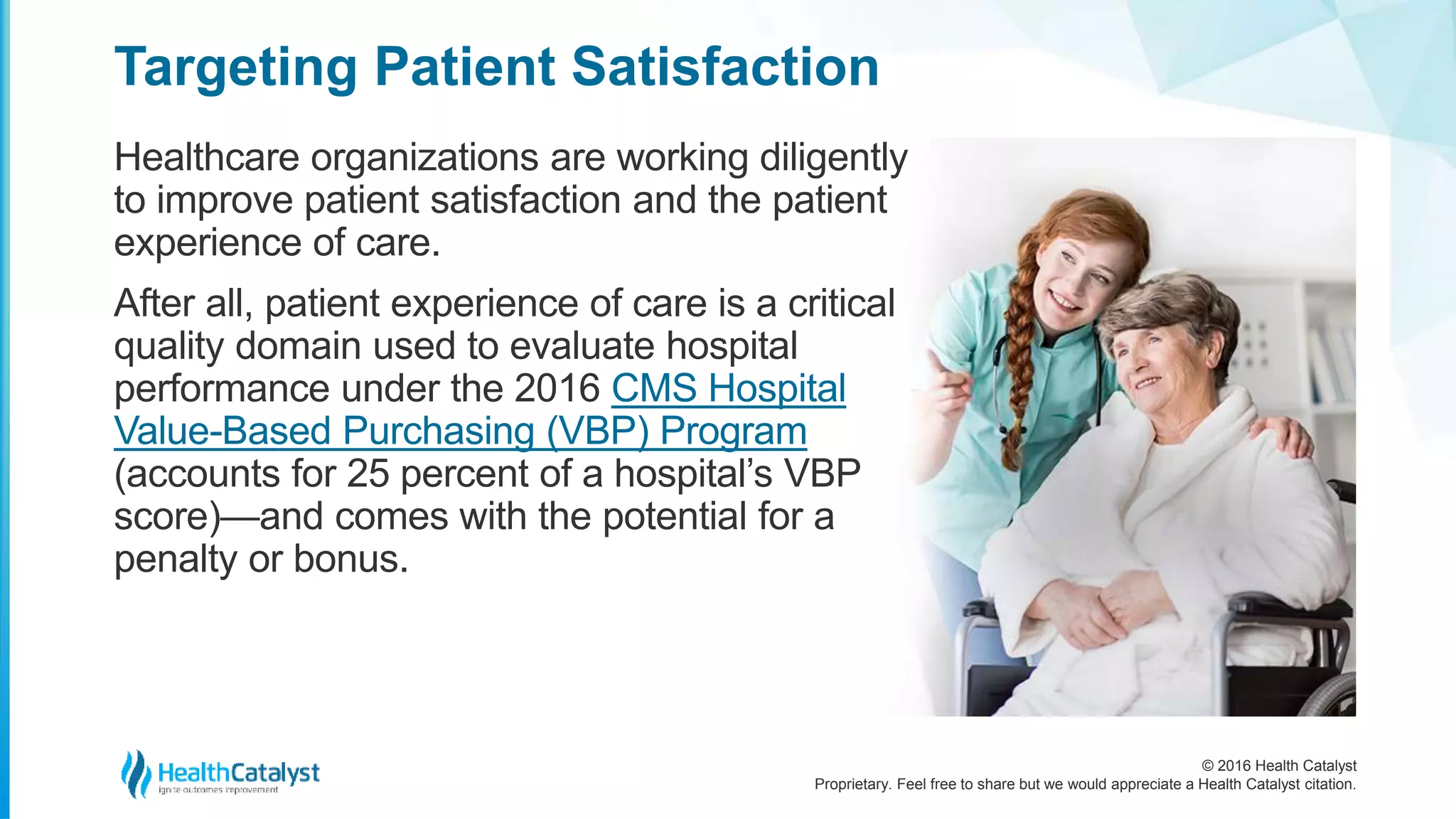
Healthcare organizations are working diligently
to improve patient satisfaction and the patient
experience of care.
After all, patient experience of care is a critical
quality domain used to evaluate hospital
performance under the 2016 CMS Hospital
Value-Based Purchasing (VBP) Program
(accounts for 25 percent of a hospital’s VBP
score)—and comes with the potential for a
penalty or bonus.
© 2016 Health Catalyst
Proprietary. Feel free to share but we would appreciate a Health Catalyst citation.
Targeting Patient Satisfaction
Patient experience of care is also one of three
essential dimensions of the industry-guiding
IHI Triple Aim (a framework for optimizing
health system performance):
1. Improving the patient experience of care.
2. Improving the health of populations.
3. Reducing the per capita cost of healthcare.
© 2016 Health Catalyst
Proprietary. Feel free to share but we would appreciate a Health Catalyst citation.
Targeting Patient Satisfaction
Improving the patient experience can seem like a
moving target influenced by a variety of factors.
For one, despite the fact that healthcare
organizations have been talking about and
focusing on patient experience and patient
satisfaction for a long time, universally
accepted definitions don’t exist.
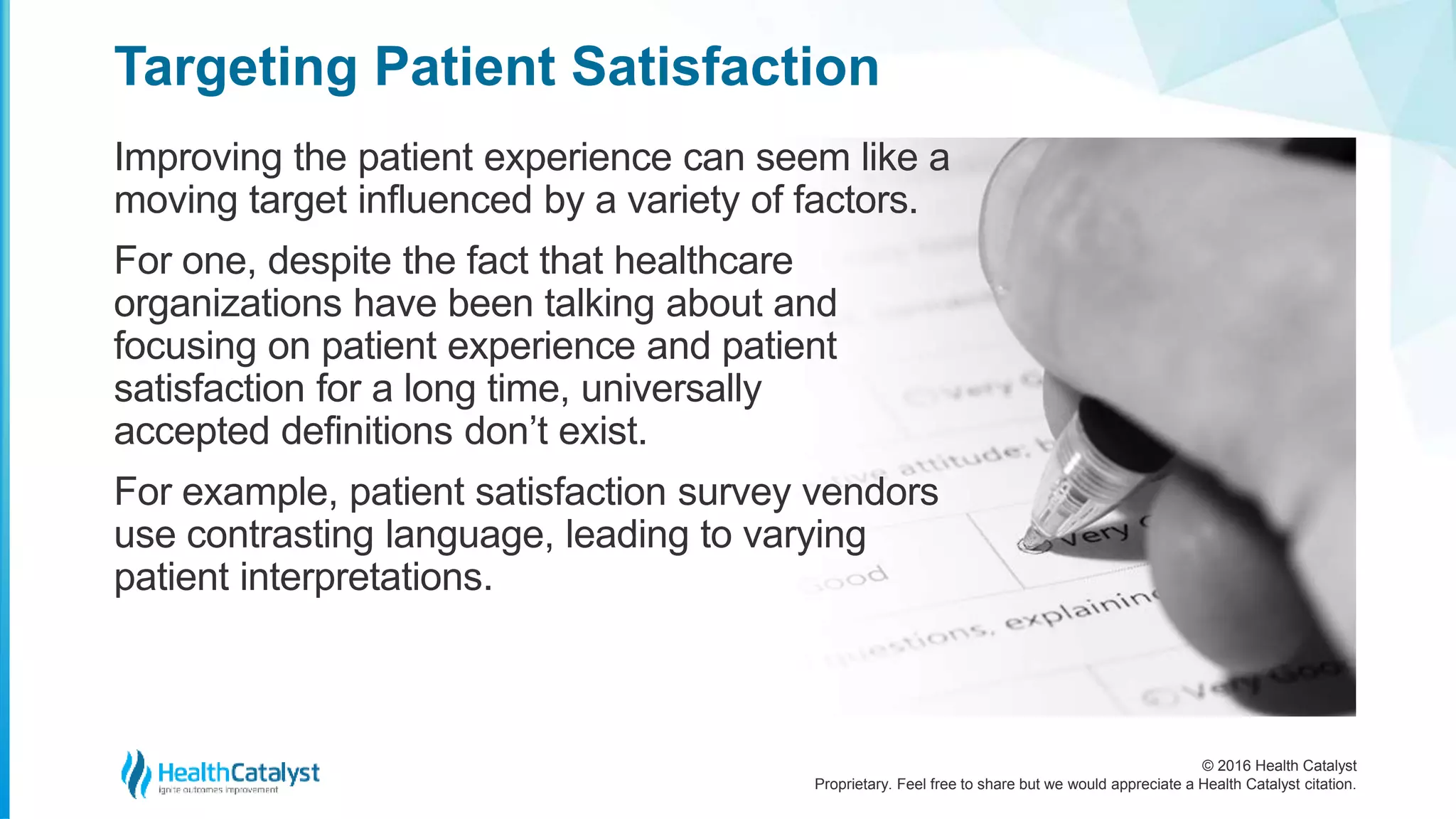
For example, patient satisfaction survey vendors
use contrasting language, leading to varying
patient interpretations.
© 2016 Health Catalyst
Proprietary. Feel free to share but we would appreciate a Health Catalyst citation.
Targeting Patient Satisfaction
This presentation advises health systems to
use patient satisfaction as a balance
measure—not a driver for outcomes.
It also explains the connection between the
patient experience and quality of care,
demonstrating why patient experience is a
prime indicator of a system’s overall health
and, therefore, a worthy goal with benefits
that extend beyond the expected.
It concludes with five key recommendations
than can lead to significant patient
experience improvements.
© 2016 Health Catalyst
Proprietary. Feel free to share but we would appreciate a Health Catalyst citation.
Patient Satisfaction Surveys Are Integral in the
Transition to Value-Based Care
As a result of having been tested, validated,
and refined for decades, most health
systems see patient satisfaction surveys as
meaningful ways to identify gaps and
develop quality improvement initiatives.
Patient satisfaction surveys are essential to
the industry’s transition to value-based care.
Whether you think patient satisfaction surveys are
good or bad, the fact of the matter is that the
marketplace you work in is demanding that data on
patient satisfaction be used to empower consumers.”
Leonard Fromer, MD
Family physician in California
© 2016 Health Catalyst
Proprietary. Feel free to share but we would appreciate a Health Catalyst citation.
Patient Satisfaction Surveys Are Integral in the
Transition to Value-Based Care
HCAHPS is the industry’s gold standard when it
comes to patient experience surveys.
Developed by CMS and the Agency for
Healthcare Research & Quality (AHRQ), the
survey collects patient experience data to enable
objective, meaningful comparisons of hospitals.
HCAHPS scores indicate the level of service,
reputation, and will impact reimbursement levels
for providers. HCAHPS is consistent, validated,
and ensures timeliness of measurement.
© 2016 Health Catalyst
Proprietary. Feel free to share but we would appreciate a Health Catalyst citation.
Patient Satisfaction Surveys Are Integral in the
Transition to Value-Based Care
The HCAHPS survey is administered to a random
sample of adult patients between 48 hours and
6 weeks after discharge and asks for patient
feedback in a variety of areas:
Communication with clinicians
Responsiveness of hospital staff
Cleanliness and quietness of hospital environment
Pain management
Communication about medicines
Discharge information
>
>
>
>
>
>
© 2016 Health Catalyst
Proprietary. Feel free to share but we would appreciate a Health Catalyst citation.
What the Research Reveals: Patient Experience
Measures Are Indicators of Quality
Regulatory agencies believe the patient
experience directly impacts quality of care
(based on the fact that they require patient
satisfaction reporting for reimbursement).
But, despite quantitative and qualitative factors
motivating organizations to prioritize patient
satisfaction, many in the industry are still
skeptical due to conflicting research.
© 2016 Health Catalyst
Proprietary. Feel free to share but we would appreciate a Health Catalyst citation.
What the Research Reveals: Patient Experience
Measures Are Indicators of Quality
As Matthew Manary and others explain
in The New England Journal of Medicine
(NEJM) article, The Patient Experience
and Health Outcomes:
Some studies indicate patient-experience measures
have no relation to the quality of care. But some
studies found that better patient experiences—even
more than adherence to clinical guidelines—are
associated with better outcomes.”
© 2016 Health Catalyst
Proprietary. Feel free to share but we would appreciate a Health Catalyst citation.
What the Research Reveals: Patient Experience
Measures Are Indicators of Quality
The NEJM article investigates the connection
between patient experience and quality of care
by researching three common concerns:
Patient feedback isn’t credible because
patients lack formal medical training.
Patient-experience measures could be
confounded by factors not directly a
ssociated with the quality of processes.
Patient experience measures may reflect
fulfillment of patients’ a priori desires or
expectations (e.g., request for a certain
drug regardless of its benefit).
>
>
>
© 2016 Health Catalyst
Proprietary. Feel free to share but we would appreciate a Health Catalyst citation.
What the Research Reveals: Patient Experience
Measures Are Indicators of Quality
Ultimately, the NEJM article determines
that patient experience measures are
indicators of care quality.
It emphasizes that the industry’s debate
“shouldn’t center on whether patients
can provide meaningful quality
measures but on how to improve
patient experiences by focusing on
several activities.”
© 2016 Health Catalyst
Proprietary. Feel free to share but we would appreciate a Health Catalyst citation.
What the Research Reveals: Patient Experience
Measures Are Indicators of Quality
The activities range from focusing on care
coordination to improving data collection methods:
Prioritizing care coordination and patient
engagement (satisfaction and outcomes).
Understanding the effects of new care delivery
models on patient experiences and outcomes.
Developing robust measurement approaches
that provide timely and actionable information
to facilitate organizational change.
Improving data collection methods and
procedures to provide fair and accurate
assessments of individual providers.
>
>
>
>
© 2016 Health Catalyst
Proprietary. Feel free to share but we would appreciate a Health Catalyst citation.
The Top Five Recommendations for Improving the
Patient Experience of Care
Although inconsistencies exist when it comes to
how the industry (systems, vendors, etc.) defines
the patient experience, research proves the
connection between improving the patient
experience and delivering high quality of care.
Health systems have the right motivation (the
Triple Aim), the right incentives (CMS), and the
right tools (HCAHPS).
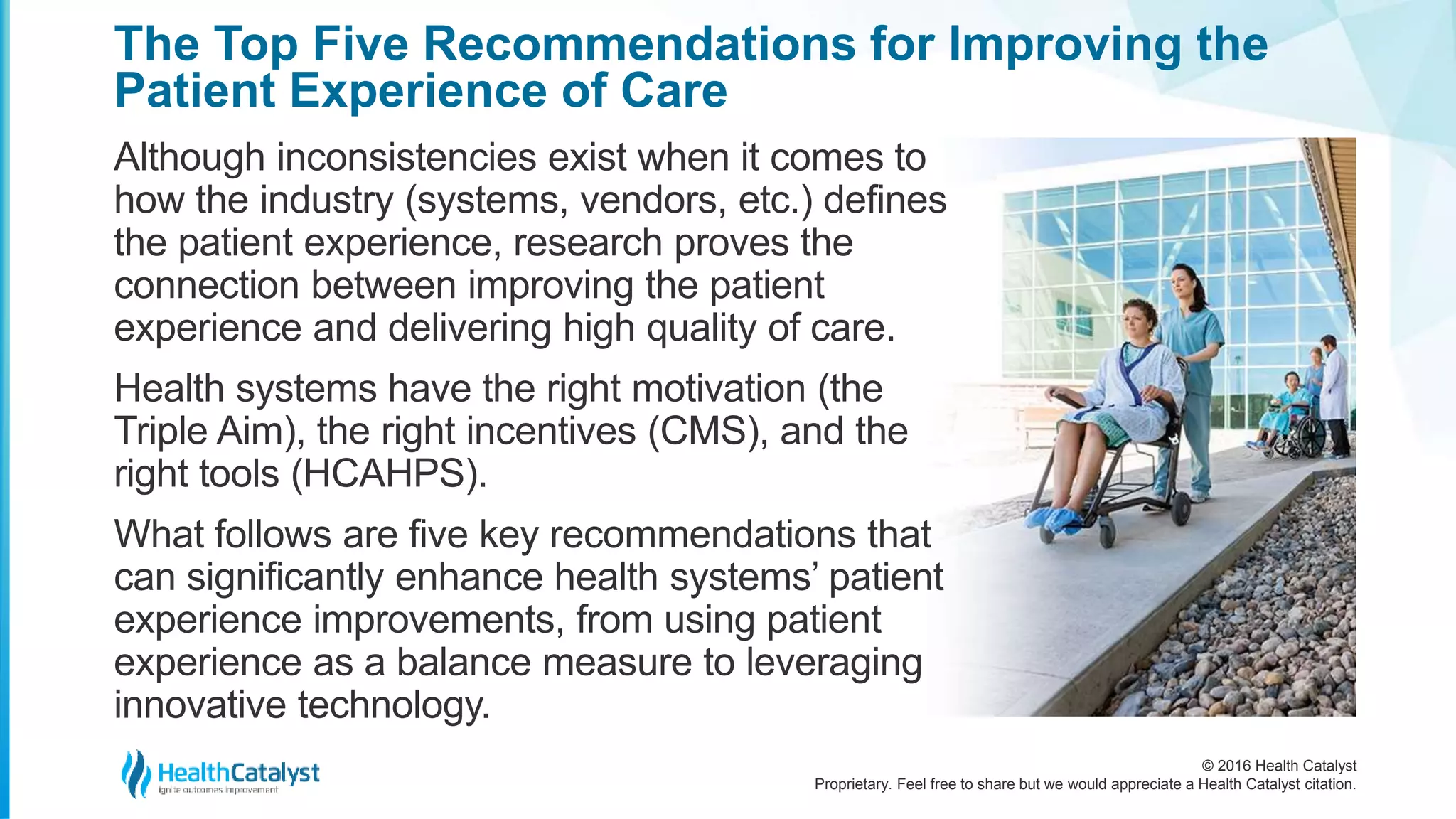
What follows are five key recommendations that
can significantly enhance health systems’ patient
experience improvements, from using patient
experience as a balance measure to leveraging
innovative technology.
© 2016 Health Catalyst
Proprietary. Feel free to share but we would appreciate a Health Catalyst citation.
The Top Five Recommendations for Improving the
Patient Experience of Care
A patient can have a positive experience
and still end up with a negative
outcome, such as a cancer diagnosis.
Health systems should use patient
satisfaction as a balance measure;
not a driver for outcomes.
Balance measures empower health
systems to make significant quality
of care improvements without losing
sight of potential negative impacts.
#1 Use Patient Satisfaction as a Balance Measure—
Not a Driver for Outcomes
© 2016 Health Catalyst
Proprietary. Feel free to share but we would appreciate a Health Catalyst citation.
The Top Five Recommendations for Improving the
Patient Experience of Care
Using patient experience as balance
measure helps healthcare organizations
ensure that improvements in one area
don’t negatively impact other areas.
For example, if a health system wants
to reduce length of stay (LOS) in labor
and delivery, then LOS is the outcome
measure. But if mothers feel rushed
toward discharge, then improving LOS
has a negative impact on patient
experience (the balance measure).
#1 Use Patient Satisfaction as a Balance Measure—
Not a Driver for Outcomes
© 2016 Health Catalyst
Proprietary. Feel free to share but we would appreciate a Health Catalyst citation.
The Top Five Recommendations for Improving the
Patient Experience of Care
The most effective surveys capture the
overall care experience; they capture
data as a whole rather than questioning
individual care interactions.
Resistance to patient satisfaction
methodology and the resulting data
credibility happens when negatives are
attributed to individual providers.
#2 Evaluate Entire Care Teams—
Not Individual Providers
© 2016 Health Catalyst
Proprietary. Feel free to share but we would appreciate a Health Catalyst citation.
The Top Five Recommendations for Improving the
Patient Experience of Care
The NEJM article about patient experience
states the importance of evaluating patient
interactions with all care team providers:
#2 Evaluate Entire Care Teams—
Not Individual Providers
When analyzing all the factors influencing
overall patient-experience scores in hospital
settings, we found that aspects of nursing care
and communication were more predictive than
interactions with physicians” and that “limiting
patient experience measurement to a single
dimension excludes the interactions that most
strongly affect experiences and outcomes.”
© 2016 Health Catalyst
Proprietary. Feel free to share but we would appreciate a Health Catalyst citation.
The Top Five Recommendations for Improving the
Patient Experience of Care
Unless systems understand, use, and act
on patient satisfaction data, they won’t
improve the patient experience.
Healthcare analytics, through the use of
an enterprise data warehouse (EDW)
and patient experience applications,
identify meaningful relationships
between patient experience, clinical
outcomes, and employee satisfaction.
#3 Use Healthcare Analytics to Understand
and Act on Data
© 2016 Health Catalyst
Proprietary. Feel free to share but we would appreciate a Health Catalyst citation.
The Top Five Recommendations for Improving the
Patient Experience of Care
Patient satisfaction data has the power to
inform more than just the patient
experience or a single episode of care; it
tells a much bigger story.
For example, Health Catalyst’s Patient
Experience Explorer Application helps
users understand and act on their
patient experience data; it analyzes
data by demographics and outcomes
improvement goals.
#3 Use Healthcare Analytics to Understand
and Act on Data
© 2016 Health Catalyst
Proprietary. Feel free to share but we would appreciate a Health Catalyst citation.
The Top Five Recommendations for Improving the
Patient Experience of Care
Innovations in healthcare technology are
revolutionizing the patient experience.
From interactive tools that improve
wayfinding and reduce stress for
patients and visitors, to real-time
location service technology that
improves patient flow and reduces
wait times.
#4 Leverage Innovative Technology
© 2016 Health Catalyst
Proprietary. Feel free to share but we would appreciate a Health Catalyst citation.
The Top Five Recommendations for Improving the
Patient Experience of Care
Organizations can use innovative technology
to enhance the patient experience:
Communication devices and electronic
patient feedback systems that alert staff
in real time.
Interactive education systems that give
patients information about their care.
Smart rooms that allow patients to
customize their environment in
waiting rooms, exam rooms and during
high stress treatments/procedures.
#4 Leverage Innovative Technology
>
>
>
© 2016 Health Catalyst
Proprietary. Feel free to share but we would appreciate a Health Catalyst citation.
The Top Five Recommendations for Improving the
Patient Experience of Care
Healthcare organizations are increasingly realizing
and understanding how employee engagement
impacts patient experience.
For every one-percent increase in employee
engagement, an organization’s overall hospital
HCAHPS rating increased by .33 percent and
patients’ willingness to recommend the hospital
increased by .25 percent, according to the
Advisory Board Company’s 2015 Employee
Engagement Survey.
#5 Improve Employee Engagement
© 2016 Health Catalyst
Proprietary. Feel free to share but we would appreciate a Health Catalyst citation.
The Top Five Recommendations for Improving the
Patient Experience of Care
Many healthcare organizations have created
the role of Chief Patient Experience Officer to
enhance the patient experience, from facility
design to employee training and engagement.
They’ve realized the important connection
between engaged, satisfied employees and
happy patients.
Good patient satisfaction scores speak to the
health of an organization, including its staff.
#5 Improve Employee Engagement
© 2016 Health Catalyst
Proprietary. Feel free to share but we would appreciate a Health Catalyst citation.
Patient Experience Is a Prime Indicator of a
System’s Overall Health
Health systems continue to shift their view
about the patient experience, seeing it less
as another regulatory requirement to meet
and more as a prime indicator of healthcare
organizations’ overall health.
A great patient experience comes from more
than just the patient-clinician interaction; it’s
influenced by everyone and everything within
a health system, from the admitting clerk to a
clean room—it’s influenced by the entire
health system’s infrastructure.
© 2016 Health Catalyst
Proprietary. Feel free to share but we would appreciate a Health Catalyst citation.
Patient Experience Is a Prime Indicator of a
System’s Overall Health
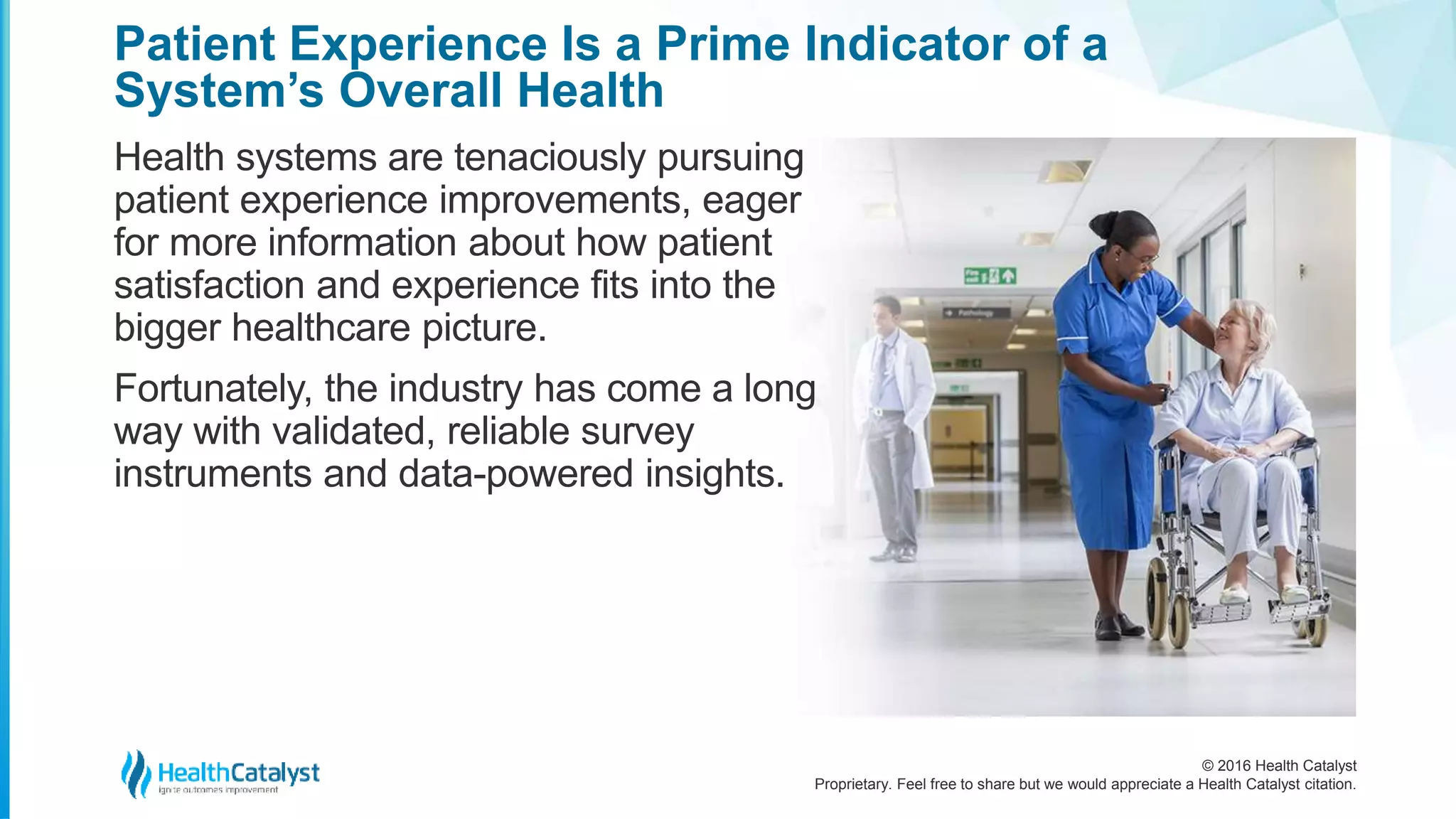
Health systems are tenaciously pursuing
patient experience improvements, eager
for more information about how patient
satisfaction and experience fits into the
bigger healthcare picture.
Fortunately, the industry has come a long
way with validated, reliable survey
instruments and data-powered insights.
© 2016 Health Catalyst
Proprietary. Feel free to share but we would appreciate a Health Catalyst citation.
Patient Experience Is a Prime Indicator of a
System’s Overall Health
Healthcare leaders can continue to improve the
patient experience by implementing five key
recommendations of industry best practices:
1. Use patient satisfaction as a balance
measure—not a driver for outcomes.
2. Evaluate entire care teams—not
individual providers.
3. Use healthcare analytics to understand
and act on data.
4. Leverage innovative technology.
5. Improve employee engagement.
© 2016 Health Catalyst
Proprietary. Feel free to share but we would appreciate a Health Catalyst citation.
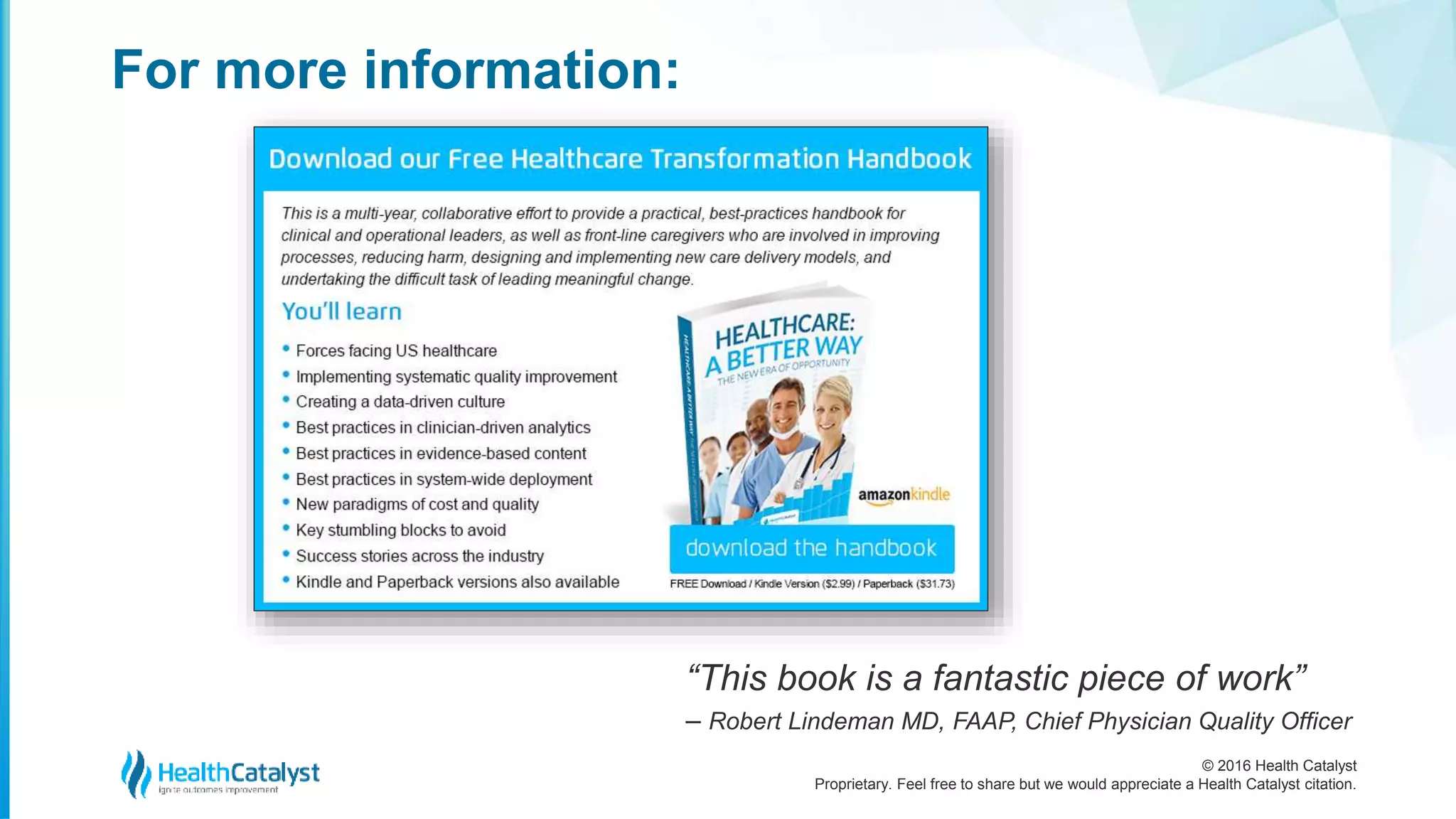
For more information:
“This book is a fantastic piece of work”
– Robert Lindeman MD, FAAP, Chief Physician Quality Officer
© 2016 Health Catalyst
Proprietary. Feel free to share but we would appreciate a Health Catalyst citation.
More about this topic
Link to original article for a more in-depth discussion.
Engaging Physicians to Be Good Financial Stewards
Improve Patient Satisfaction: 5 Things Healthcare Organizations Can Learn From Disney
Justin Gressel, Senior Data Scientist
How to Improve Patient Satisfaction Scores By Using Data
Dr. James Merlino, President and Chief Medical Officer, Press Ganey
Improving Healthcare Outcomes: Keep the Triple Aim in Mind
Michael Barton, Engagement Executive, VP; Tracy Vayo, VP of Knowledge Services
Kathleen Merkley, DNP, APRN, Sr. VP Clinical Improvement Line
Quality Data is Essential for Doctors Concerned with Patient Engagement
Dr. Ed Corbett, Deputy CMO
Quality Improvement in Healthcare: Where is the Best Place to Start?
Eric Just, Technology, VP
© 2016 Health Catalyst
Proprietary. Feel free to share but we would appreciate a Health Catalyst citation.
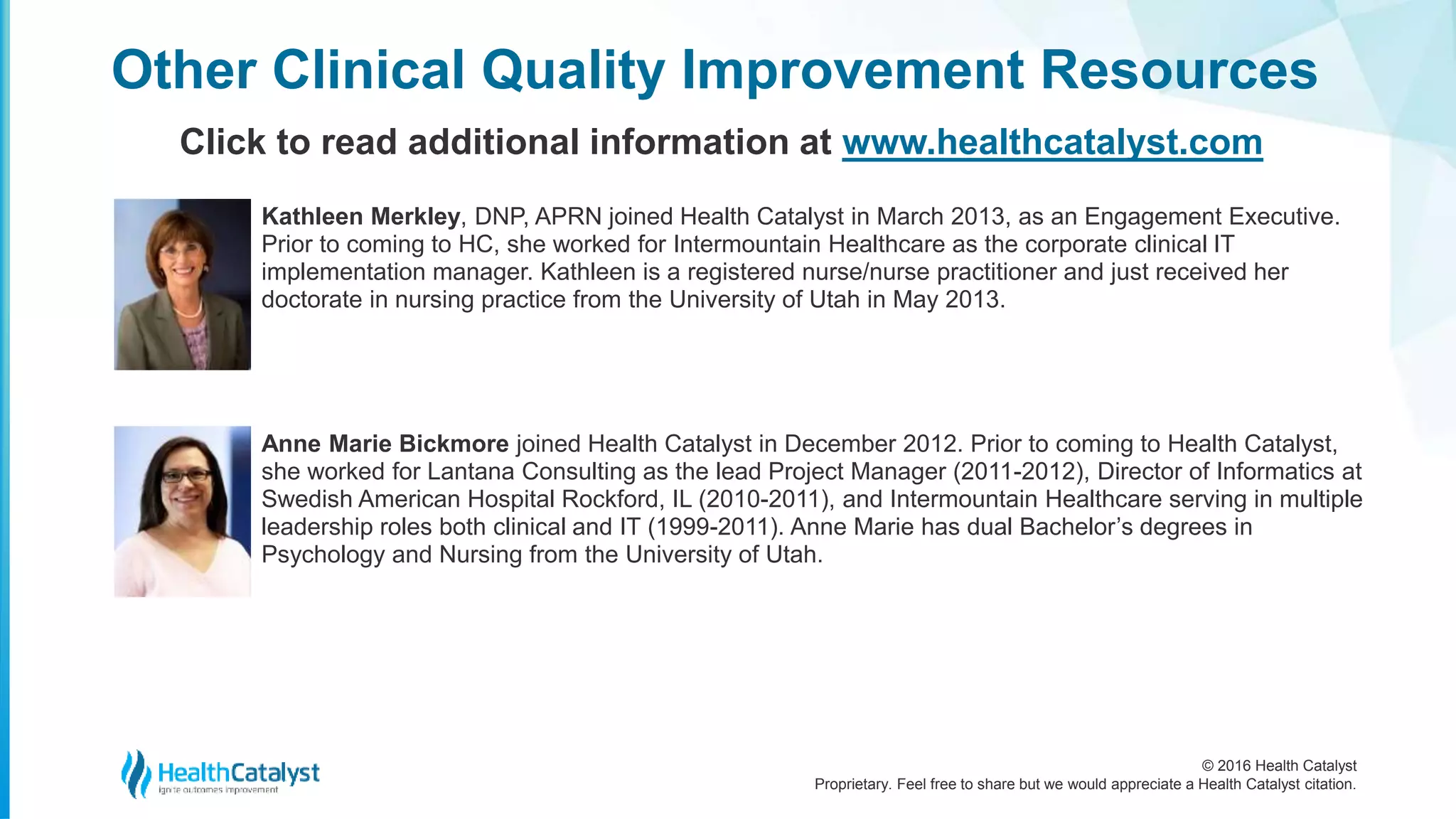
Kathleen Merkley, DNP, APRN joined Health Catalyst in March 2013, as an Engagement Executive.
Prior to coming to HC, she worked for Intermountain Healthcare as the corporate clinical IT
implementation manager. Kathleen is a registered nurse/nurse practitioner and just received her
doctorate in nursing practice from the University of Utah in May 2013.
Other Clinical Quality Improvement Resources
Click to read additional information at www.healthcatalyst.com
Anne Marie Bickmore joined Health Catalyst in December 2012. Prior to coming to Health Catalyst,
she worked for Lantana Consulting as the lead Project Manager (2011-2012), Director of Informatics at
Swedish American Hospital Rockford, IL (2010-2011), and Intermountain Healthcare serving in multiple
leadership roles both clinical and IT (1999-2011). Anne Marie has dual Bachelor’s degrees in
Psychology and Nursing from the University of Utah.

The Top Five Recommendations for Improving the Patient Experience

  • 1.
    The Top Five Recommendations forImproving the Patient Experience ̶ Kathleen Merkley Anne Marie Bickmore
  • 2.
    © 2016 HealthCatalyst Proprietary. Feel free to share but we would appreciate a Health Catalyst citation. Targeting Patient Satisfaction Healthcare organizations are working diligently to improve patient satisfaction and the patient experience of care. After all, patient experience of care is a critical quality domain used to evaluate hospital performance under the 2016 CMS Hospital Value-Based Purchasing (VBP) Program (accounts for 25 percent of a hospital’s VBP score)—and comes with the potential for a penalty or bonus.
  • 3.
    © 2016 HealthCatalyst Proprietary. Feel free to share but we would appreciate a Health Catalyst citation. Targeting Patient Satisfaction Patient experience of care is also one of three essential dimensions of the industry-guiding IHI Triple Aim (a framework for optimizing health system performance): 1. Improving the patient experience of care. 2. Improving the health of populations. 3. Reducing the per capita cost of healthcare.
  • 4.
    © 2016 HealthCatalyst Proprietary. Feel free to share but we would appreciate a Health Catalyst citation. Targeting Patient Satisfaction Improving the patient experience can seem like a moving target influenced by a variety of factors. For one, despite the fact that healthcare organizations have been talking about and focusing on patient experience and patient satisfaction for a long time, universally accepted definitions don’t exist. For example, patient satisfaction survey vendors use contrasting language, leading to varying patient interpretations.
  • 5.
    © 2016 HealthCatalyst Proprietary. Feel free to share but we would appreciate a Health Catalyst citation. Targeting Patient Satisfaction This presentation advises health systems to use patient satisfaction as a balance measure—not a driver for outcomes. It also explains the connection between the patient experience and quality of care, demonstrating why patient experience is a prime indicator of a system’s overall health and, therefore, a worthy goal with benefits that extend beyond the expected. It concludes with five key recommendations than can lead to significant patient experience improvements.
  • 6.
    © 2016 HealthCatalyst Proprietary. Feel free to share but we would appreciate a Health Catalyst citation. Patient Satisfaction Surveys Are Integral in the Transition to Value-Based Care As a result of having been tested, validated, and refined for decades, most health systems see patient satisfaction surveys as meaningful ways to identify gaps and develop quality improvement initiatives. Patient satisfaction surveys are essential to the industry’s transition to value-based care. Whether you think patient satisfaction surveys are good or bad, the fact of the matter is that the marketplace you work in is demanding that data on patient satisfaction be used to empower consumers.” Leonard Fromer, MD Family physician in California
  • 7.
    © 2016 HealthCatalyst Proprietary. Feel free to share but we would appreciate a Health Catalyst citation. Patient Satisfaction Surveys Are Integral in the Transition to Value-Based Care HCAHPS is the industry’s gold standard when it comes to patient experience surveys. Developed by CMS and the Agency for Healthcare Research & Quality (AHRQ), the survey collects patient experience data to enable objective, meaningful comparisons of hospitals. HCAHPS scores indicate the level of service, reputation, and will impact reimbursement levels for providers. HCAHPS is consistent, validated, and ensures timeliness of measurement.
  • 8.
    © 2016 HealthCatalyst Proprietary. Feel free to share but we would appreciate a Health Catalyst citation. Patient Satisfaction Surveys Are Integral in the Transition to Value-Based Care The HCAHPS survey is administered to a random sample of adult patients between 48 hours and 6 weeks after discharge and asks for patient feedback in a variety of areas: Communication with clinicians Responsiveness of hospital staff Cleanliness and quietness of hospital environment Pain management Communication about medicines Discharge information > > > > > >
  • 9.
    © 2016 HealthCatalyst Proprietary. Feel free to share but we would appreciate a Health Catalyst citation. What the Research Reveals: Patient Experience Measures Are Indicators of Quality Regulatory agencies believe the patient experience directly impacts quality of care (based on the fact that they require patient satisfaction reporting for reimbursement). But, despite quantitative and qualitative factors motivating organizations to prioritize patient satisfaction, many in the industry are still skeptical due to conflicting research.
  • 10.
    © 2016 HealthCatalyst Proprietary. Feel free to share but we would appreciate a Health Catalyst citation. What the Research Reveals: Patient Experience Measures Are Indicators of Quality As Matthew Manary and others explain in The New England Journal of Medicine (NEJM) article, The Patient Experience and Health Outcomes: Some studies indicate patient-experience measures have no relation to the quality of care. But some studies found that better patient experiences—even more than adherence to clinical guidelines—are associated with better outcomes.”
  • 11.
    © 2016 HealthCatalyst Proprietary. Feel free to share but we would appreciate a Health Catalyst citation. What the Research Reveals: Patient Experience Measures Are Indicators of Quality The NEJM article investigates the connection between patient experience and quality of care by researching three common concerns: Patient feedback isn’t credible because patients lack formal medical training. Patient-experience measures could be confounded by factors not directly a ssociated with the quality of processes. Patient experience measures may reflect fulfillment of patients’ a priori desires or expectations (e.g., request for a certain drug regardless of its benefit). > > >
  • 12.
    © 2016 HealthCatalyst Proprietary. Feel free to share but we would appreciate a Health Catalyst citation. What the Research Reveals: Patient Experience Measures Are Indicators of Quality Ultimately, the NEJM article determines that patient experience measures are indicators of care quality. It emphasizes that the industry’s debate “shouldn’t center on whether patients can provide meaningful quality measures but on how to improve patient experiences by focusing on several activities.”
  • 13.
    © 2016 HealthCatalyst Proprietary. Feel free to share but we would appreciate a Health Catalyst citation. What the Research Reveals: Patient Experience Measures Are Indicators of Quality The activities range from focusing on care coordination to improving data collection methods: Prioritizing care coordination and patient engagement (satisfaction and outcomes). Understanding the effects of new care delivery models on patient experiences and outcomes. Developing robust measurement approaches that provide timely and actionable information to facilitate organizational change. Improving data collection methods and procedures to provide fair and accurate assessments of individual providers. > > > >
  • 14.
    © 2016 HealthCatalyst Proprietary. Feel free to share but we would appreciate a Health Catalyst citation. The Top Five Recommendations for Improving the Patient Experience of Care Although inconsistencies exist when it comes to how the industry (systems, vendors, etc.) defines the patient experience, research proves the connection between improving the patient experience and delivering high quality of care. Health systems have the right motivation (the Triple Aim), the right incentives (CMS), and the right tools (HCAHPS). What follows are five key recommendations that can significantly enhance health systems’ patient experience improvements, from using patient experience as a balance measure to leveraging innovative technology.
  • 15.
    © 2016 HealthCatalyst Proprietary. Feel free to share but we would appreciate a Health Catalyst citation. The Top Five Recommendations for Improving the Patient Experience of Care A patient can have a positive experience and still end up with a negative outcome, such as a cancer diagnosis. Health systems should use patient satisfaction as a balance measure; not a driver for outcomes. Balance measures empower health systems to make significant quality of care improvements without losing sight of potential negative impacts. #1 Use Patient Satisfaction as a Balance Measure— Not a Driver for Outcomes
  • 16.
    © 2016 HealthCatalyst Proprietary. Feel free to share but we would appreciate a Health Catalyst citation. The Top Five Recommendations for Improving the Patient Experience of Care Using patient experience as balance measure helps healthcare organizations ensure that improvements in one area don’t negatively impact other areas. For example, if a health system wants to reduce length of stay (LOS) in labor and delivery, then LOS is the outcome measure. But if mothers feel rushed toward discharge, then improving LOS has a negative impact on patient experience (the balance measure). #1 Use Patient Satisfaction as a Balance Measure— Not a Driver for Outcomes
  • 17.
    © 2016 HealthCatalyst Proprietary. Feel free to share but we would appreciate a Health Catalyst citation. The Top Five Recommendations for Improving the Patient Experience of Care The most effective surveys capture the overall care experience; they capture data as a whole rather than questioning individual care interactions. Resistance to patient satisfaction methodology and the resulting data credibility happens when negatives are attributed to individual providers. #2 Evaluate Entire Care Teams— Not Individual Providers
  • 18.
    © 2016 HealthCatalyst Proprietary. Feel free to share but we would appreciate a Health Catalyst citation. The Top Five Recommendations for Improving the Patient Experience of Care The NEJM article about patient experience states the importance of evaluating patient interactions with all care team providers: #2 Evaluate Entire Care Teams— Not Individual Providers When analyzing all the factors influencing overall patient-experience scores in hospital settings, we found that aspects of nursing care and communication were more predictive than interactions with physicians” and that “limiting patient experience measurement to a single dimension excludes the interactions that most strongly affect experiences and outcomes.”
  • 19.
    © 2016 HealthCatalyst Proprietary. Feel free to share but we would appreciate a Health Catalyst citation. The Top Five Recommendations for Improving the Patient Experience of Care Unless systems understand, use, and act on patient satisfaction data, they won’t improve the patient experience. Healthcare analytics, through the use of an enterprise data warehouse (EDW) and patient experience applications, identify meaningful relationships between patient experience, clinical outcomes, and employee satisfaction. #3 Use Healthcare Analytics to Understand and Act on Data
  • 20.
    © 2016 HealthCatalyst Proprietary. Feel free to share but we would appreciate a Health Catalyst citation. The Top Five Recommendations for Improving the Patient Experience of Care Patient satisfaction data has the power to inform more than just the patient experience or a single episode of care; it tells a much bigger story. For example, Health Catalyst’s Patient Experience Explorer Application helps users understand and act on their patient experience data; it analyzes data by demographics and outcomes improvement goals. #3 Use Healthcare Analytics to Understand and Act on Data
  • 21.
    © 2016 HealthCatalyst Proprietary. Feel free to share but we would appreciate a Health Catalyst citation. The Top Five Recommendations for Improving the Patient Experience of Care Innovations in healthcare technology are revolutionizing the patient experience. From interactive tools that improve wayfinding and reduce stress for patients and visitors, to real-time location service technology that improves patient flow and reduces wait times. #4 Leverage Innovative Technology
  • 22.
    © 2016 HealthCatalyst Proprietary. Feel free to share but we would appreciate a Health Catalyst citation. The Top Five Recommendations for Improving the Patient Experience of Care Organizations can use innovative technology to enhance the patient experience: Communication devices and electronic patient feedback systems that alert staff in real time. Interactive education systems that give patients information about their care. Smart rooms that allow patients to customize their environment in waiting rooms, exam rooms and during high stress treatments/procedures. #4 Leverage Innovative Technology > > >
  • 23.
    © 2016 HealthCatalyst Proprietary. Feel free to share but we would appreciate a Health Catalyst citation. The Top Five Recommendations for Improving the Patient Experience of Care Healthcare organizations are increasingly realizing and understanding how employee engagement impacts patient experience. For every one-percent increase in employee engagement, an organization’s overall hospital HCAHPS rating increased by .33 percent and patients’ willingness to recommend the hospital increased by .25 percent, according to the Advisory Board Company’s 2015 Employee Engagement Survey. #5 Improve Employee Engagement
  • 24.
    © 2016 HealthCatalyst Proprietary. Feel free to share but we would appreciate a Health Catalyst citation. The Top Five Recommendations for Improving the Patient Experience of Care Many healthcare organizations have created the role of Chief Patient Experience Officer to enhance the patient experience, from facility design to employee training and engagement. They’ve realized the important connection between engaged, satisfied employees and happy patients. Good patient satisfaction scores speak to the health of an organization, including its staff. #5 Improve Employee Engagement
  • 25.
    © 2016 HealthCatalyst Proprietary. Feel free to share but we would appreciate a Health Catalyst citation. Patient Experience Is a Prime Indicator of a System’s Overall Health Health systems continue to shift their view about the patient experience, seeing it less as another regulatory requirement to meet and more as a prime indicator of healthcare organizations’ overall health. A great patient experience comes from more than just the patient-clinician interaction; it’s influenced by everyone and everything within a health system, from the admitting clerk to a clean room—it’s influenced by the entire health system’s infrastructure.
  • 26.
    © 2016 HealthCatalyst Proprietary. Feel free to share but we would appreciate a Health Catalyst citation. Patient Experience Is a Prime Indicator of a System’s Overall Health Health systems are tenaciously pursuing patient experience improvements, eager for more information about how patient satisfaction and experience fits into the bigger healthcare picture. Fortunately, the industry has come a long way with validated, reliable survey instruments and data-powered insights.
  • 27.
    © 2016 HealthCatalyst Proprietary. Feel free to share but we would appreciate a Health Catalyst citation. Patient Experience Is a Prime Indicator of a System’s Overall Health Healthcare leaders can continue to improve the patient experience by implementing five key recommendations of industry best practices: 1. Use patient satisfaction as a balance measure—not a driver for outcomes. 2. Evaluate entire care teams—not individual providers. 3. Use healthcare analytics to understand and act on data. 4. Leverage innovative technology. 5. Improve employee engagement.
  • 28.
    © 2016 HealthCatalyst Proprietary. Feel free to share but we would appreciate a Health Catalyst citation. For more information: “This book is a fantastic piece of work” – Robert Lindeman MD, FAAP, Chief Physician Quality Officer
  • 29.
    © 2016 HealthCatalyst Proprietary. Feel free to share but we would appreciate a Health Catalyst citation. More about this topic Link to original article for a more in-depth discussion. Engaging Physicians to Be Good Financial Stewards Improve Patient Satisfaction: 5 Things Healthcare Organizations Can Learn From Disney Justin Gressel, Senior Data Scientist How to Improve Patient Satisfaction Scores By Using Data Dr. James Merlino, President and Chief Medical Officer, Press Ganey Improving Healthcare Outcomes: Keep the Triple Aim in Mind Michael Barton, Engagement Executive, VP; Tracy Vayo, VP of Knowledge Services Kathleen Merkley, DNP, APRN, Sr. VP Clinical Improvement Line Quality Data is Essential for Doctors Concerned with Patient Engagement Dr. Ed Corbett, Deputy CMO Quality Improvement in Healthcare: Where is the Best Place to Start? Eric Just, Technology, VP
  • 30.
    © 2016 HealthCatalyst Proprietary. Feel free to share but we would appreciate a Health Catalyst citation. Kathleen Merkley, DNP, APRN joined Health Catalyst in March 2013, as an Engagement Executive. Prior to coming to HC, she worked for Intermountain Healthcare as the corporate clinical IT implementation manager. Kathleen is a registered nurse/nurse practitioner and just received her doctorate in nursing practice from the University of Utah in May 2013. Other Clinical Quality Improvement Resources Click to read additional information at www.healthcatalyst.com Anne Marie Bickmore joined Health Catalyst in December 2012. Prior to coming to Health Catalyst, she worked for Lantana Consulting as the lead Project Manager (2011-2012), Director of Informatics at Swedish American Hospital Rockford, IL (2010-2011), and Intermountain Healthcare serving in multiple leadership roles both clinical and IT (1999-2011). Anne Marie has dual Bachelor’s degrees in Psychology and Nursing from the University of Utah.