© Health Catalyst. Confidential and Proprietary.
Embedded Refills: Improving Workflow
Efficiency and Optimizing the
Medication Renewal Process
Emily Rodriguez and Jessica McCay
© Health Catalyst. Confidential and Proprietary.
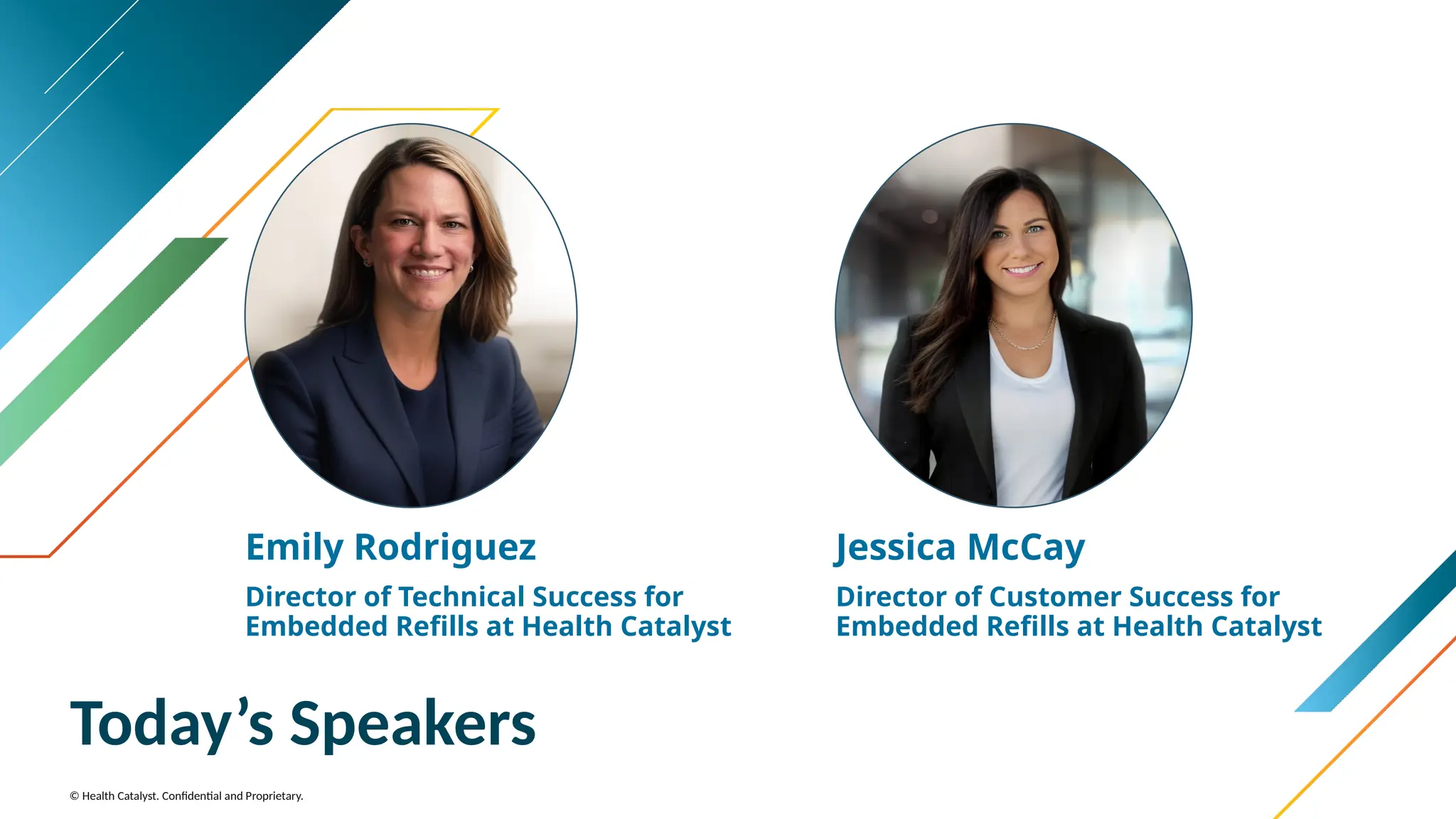
Today’s Speakers
Emily Rodriguez
Director of Technical Success for
Embedded Refills at Health Catalyst
Jessica McCay
Director of Customer Success for
Embedded Refills at Health Catalyst
Agenda
© Health Catalyst. Confidential and Proprietary.
• Today’s Challenges with Refills
• Solution: Embedded Refills
• Implementation Overview
• Post Go-Live Support and Data
• Q&A
© Health Catalyst. Confidential and Proprietary.
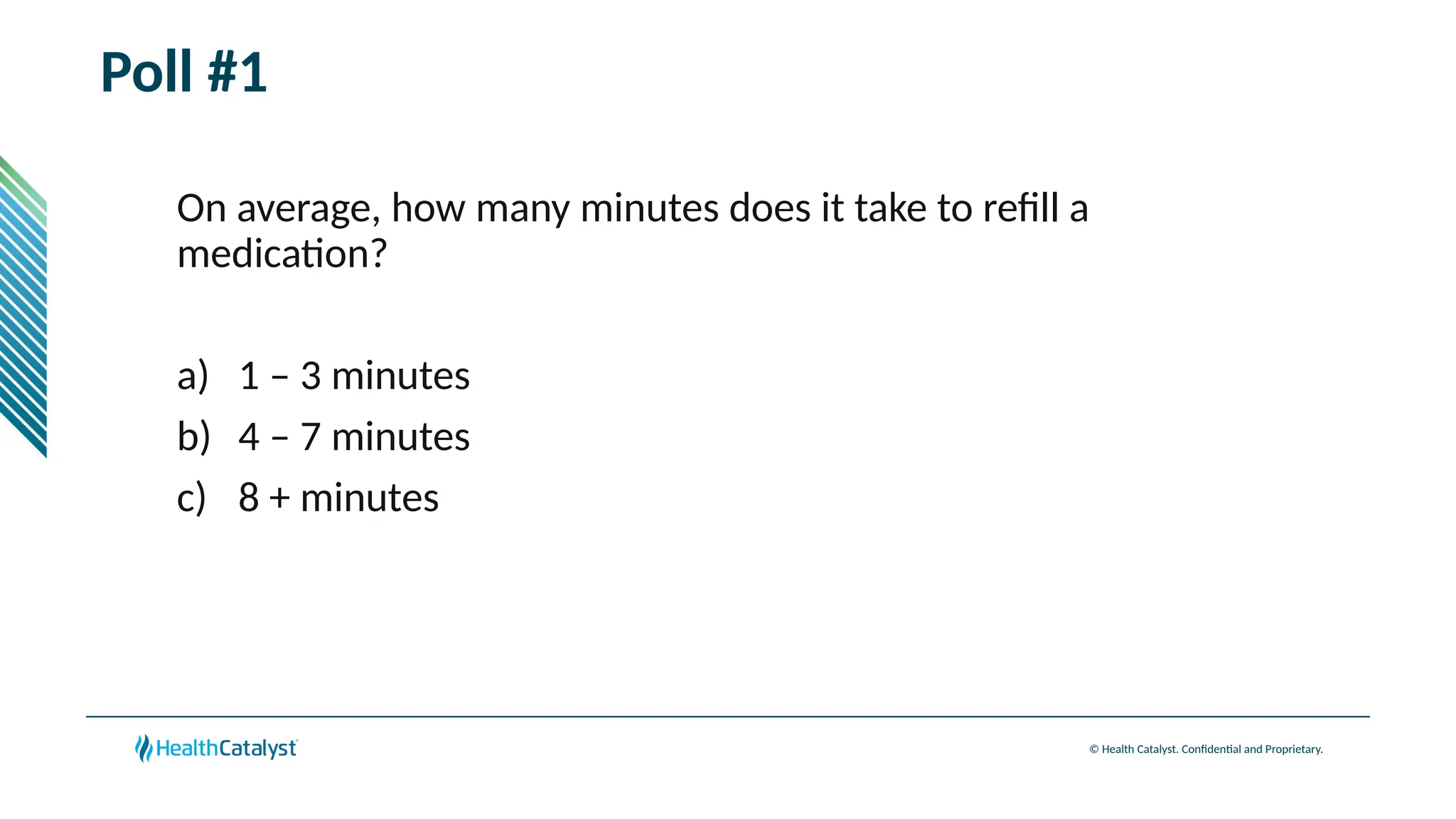
Poll #1
On average, how many minutes does it take to refill a
medication?
a) 1 – 3 minutes
b) 4 – 7 minutes
c) 8 + minutes
© Health Catalyst. Confidential and Proprietary.
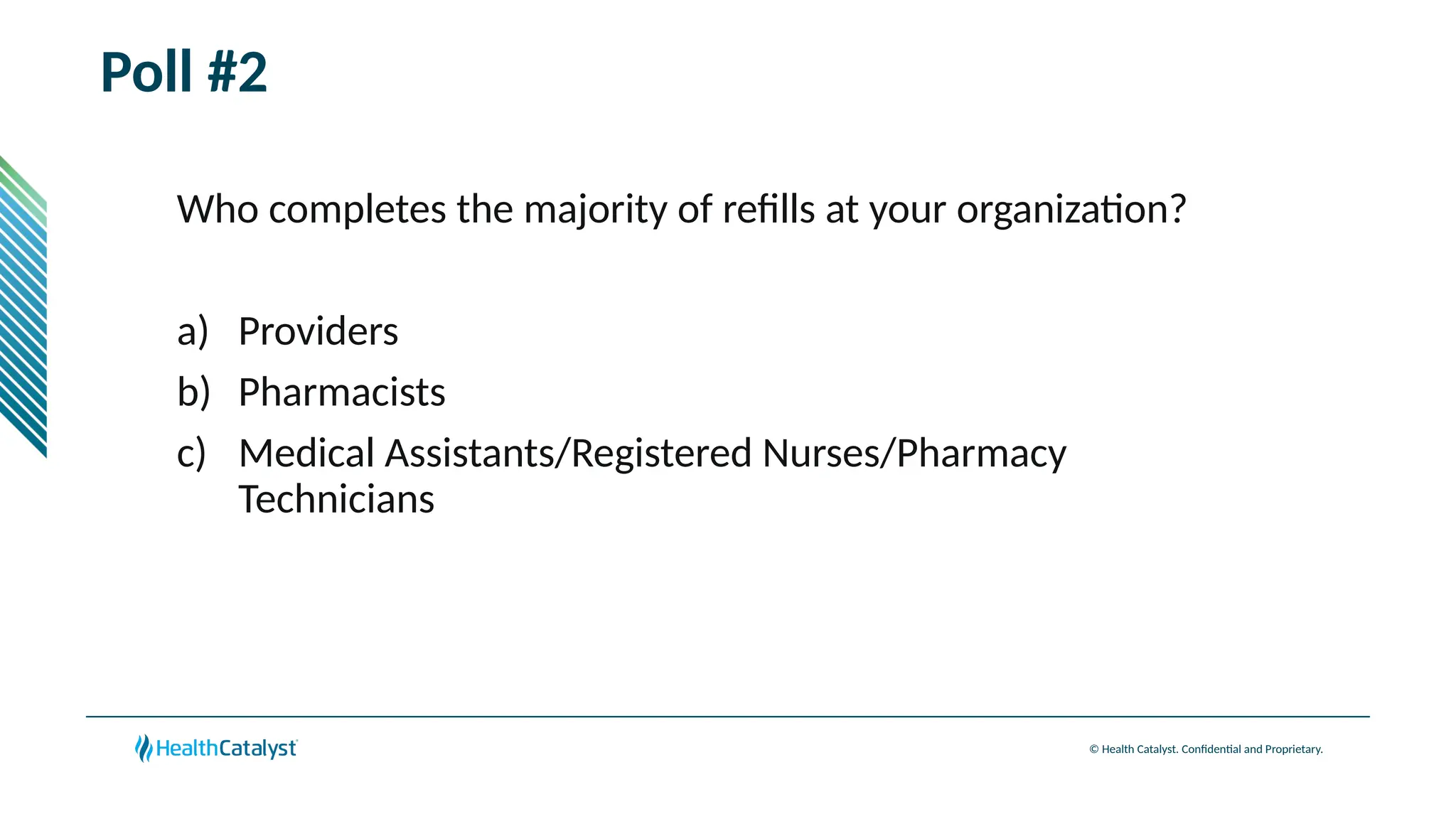
Poll #2
Who completes the majority of refills at your organization?
a) Providers
b) Pharmacists
c) Medical Assistants/Registered Nurses/Pharmacy
Technicians
Agenda
© Health Catalyst. Confidential and Proprietary.
• Today’s Challenges with Refills
• Solution: Embedded Refills
• Implementation Overview
• Post Go-Live Support and Data
• Q&A
© Health Catalyst. Confidential and Proprietary.
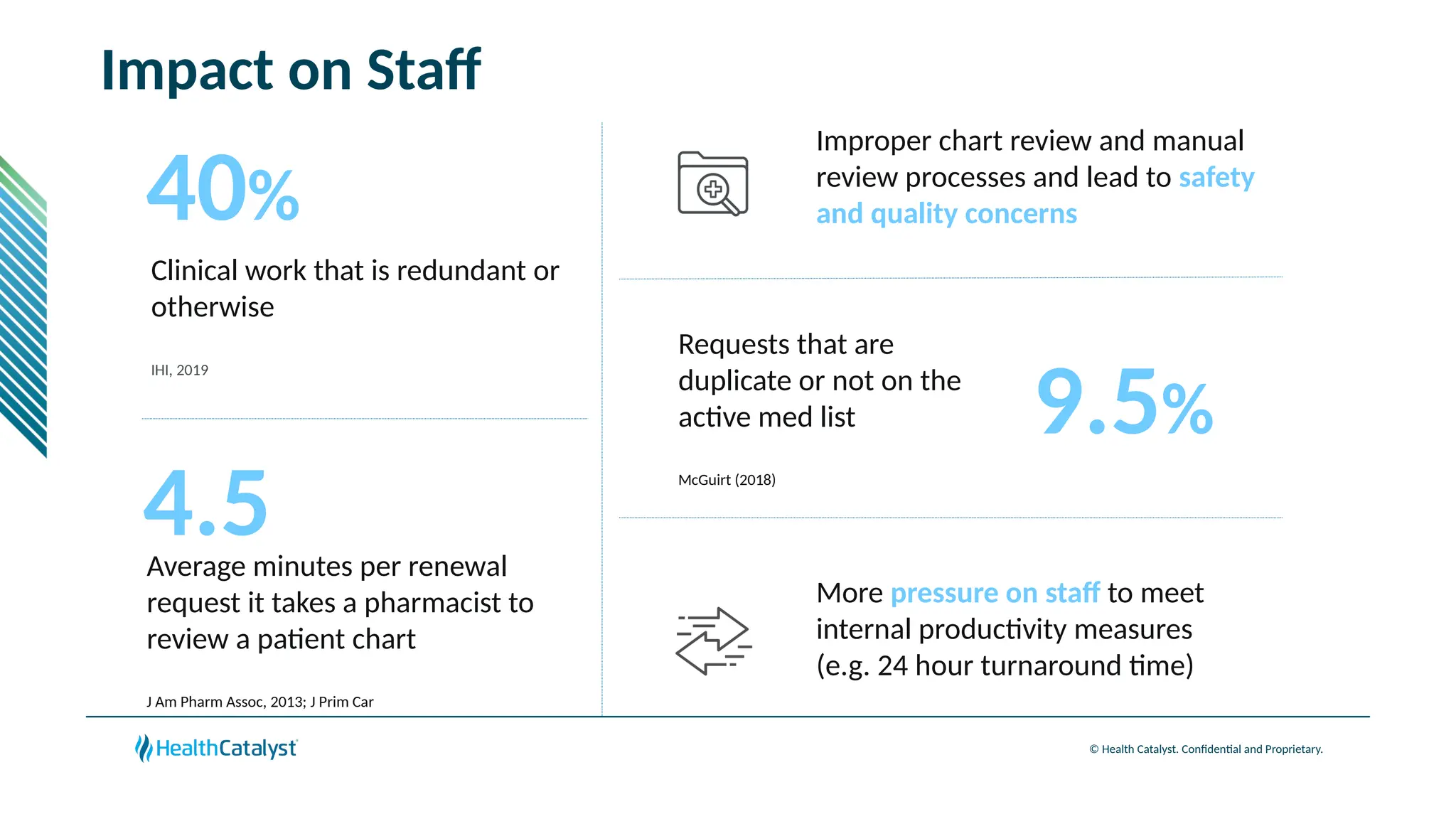
Impact on Staff
40%
Clinical work that is redundant or
otherwise wasted effort
IHI, 2019
4.5
Average minutes per renewal
request it takes a pharmacist to
review a patient chart
J Am Pharm Assoc, 2013; J Prim Car
Improper chart review and manual
review processes and lead to safety
and quality concerns
Requests that are
duplicate or not on the
active med list
McGuirt (2018)
9.5%
More pressure on staff to meet
internal productivity measures
(e.g. 24 hour turnaround time)
© Health Catalyst. Confidential and Proprietary.
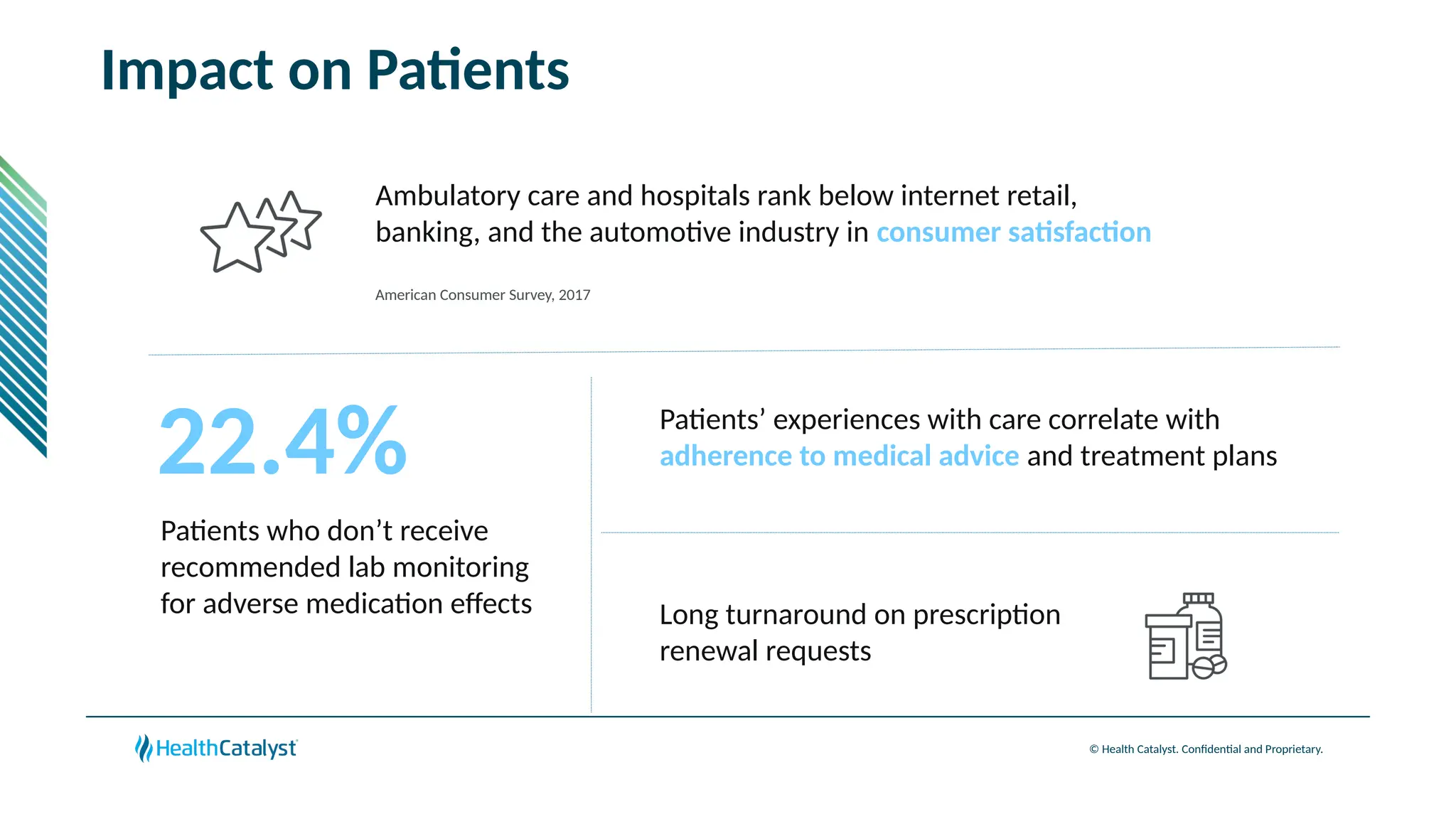
Impact on Patients
Patients’ experiences with care correlate with
adherence to medical advice and treatment plans
Patients who don’t receive
recommended lab monitoring
for adverse medication effects Long turnaround on prescription
renewal requests
Ambulatory care and hospitals rank below internet retail,
banking, and the automotive industry in consumer satisfaction
American Consumer Survey, 2017
22.4%
© Health Catalyst. Confidential and Proprietary.
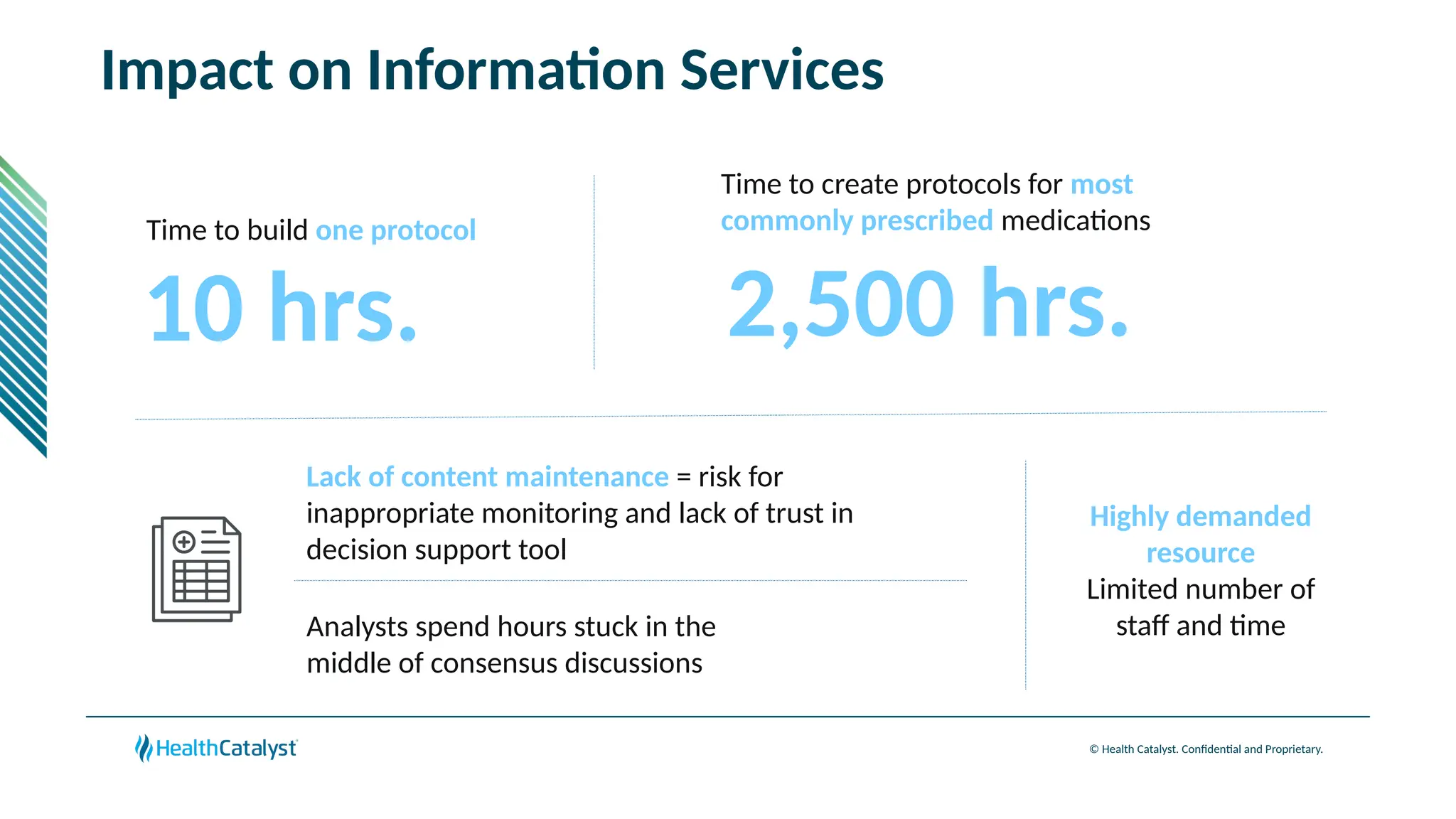
Impact on Information Services
10 hrs.
Time to build one protocol
Analysts spend hours stuck in the
middle of consensus discussions
Lack of content maintenance = risk for
inappropriate monitoring and lack of trust in
decision support tool
Highly demanded
resource
Limited number of
staff and time
2,500 hrs.
Time to create protocols for most
commonly prescribed medications
Agenda
© Health Catalyst. Confidential and Proprietary.
• Today’s Challenges with Refills
• Solution: Embedded Refills
• Implementation Overview
• Post Go-Live Support and Data
• Q&A
© Health Catalyst. Confidential and Proprietary.
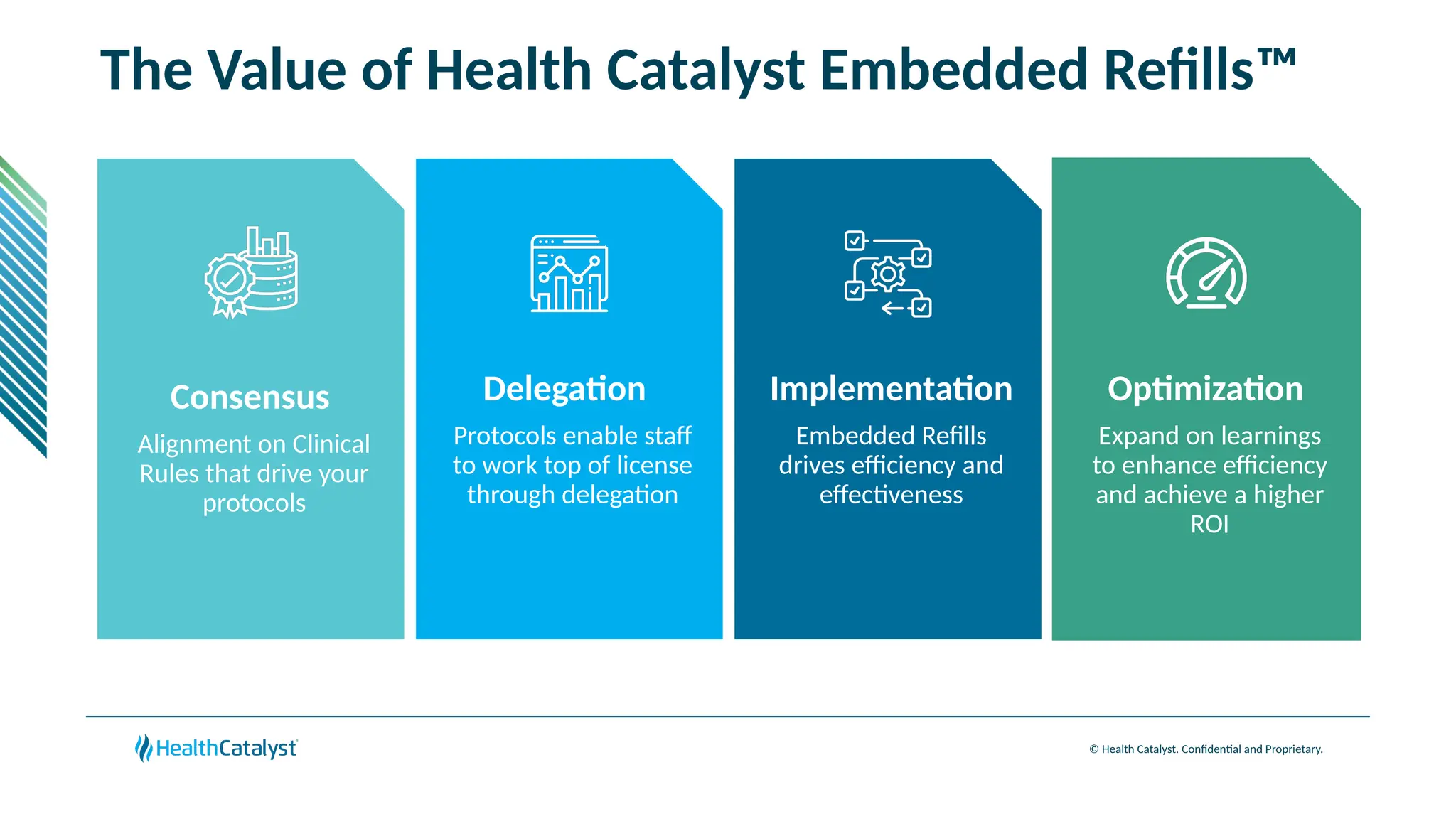
The Value of Health Catalyst Embedded Refills™
Strengthen
Analytics
Accuracy &
Trust
Delegation
Protocols enable staff
to work top of license
through delegation
Optimization
Expand on learnings
to enhance efficiency
and achieve a higher
ROI
Consensus
Alignment on Clinical
Rules that drive your
protocols
Implementation
Embedded Refills
drives efficiency and
effectiveness
© Health Catalyst. Confidential and Proprietary.
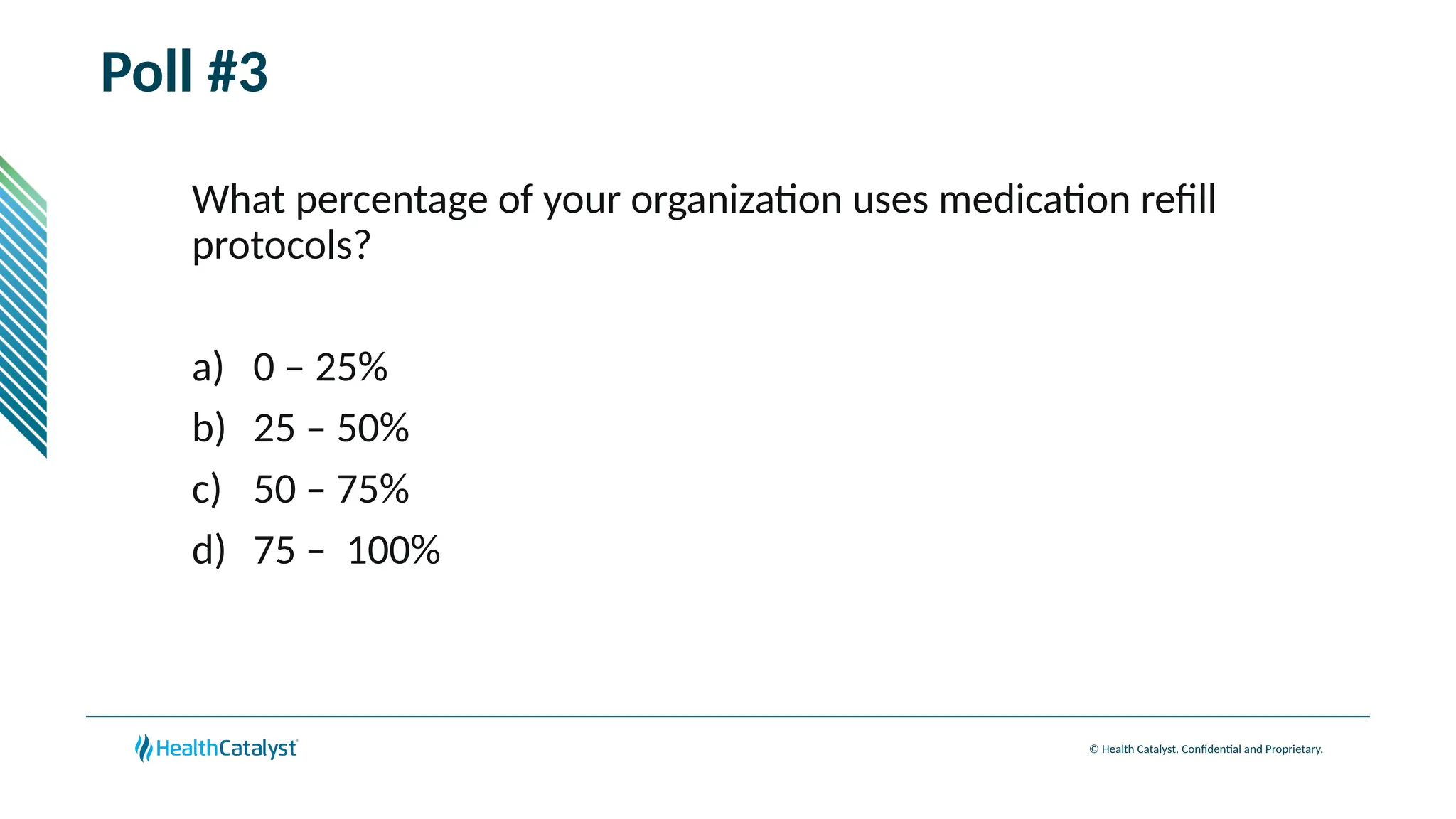
Poll #3
What percentage of your organization uses medication refill
protocols?
a) 0 – 25%
b) 25 – 50%
c) 50 – 75%
d) 75 – 100%
© Health Catalyst. Confidential and Proprietary.
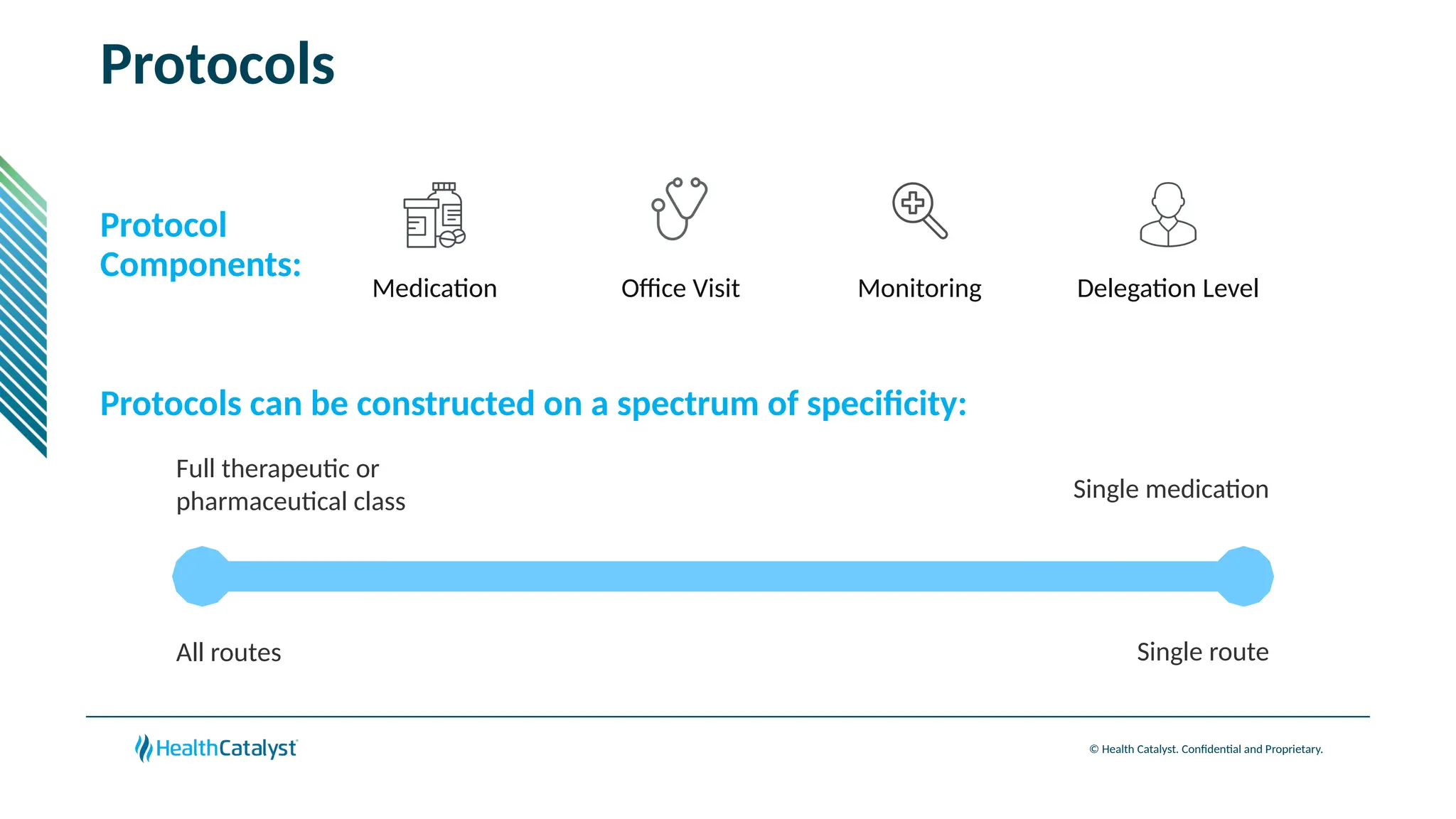
Medication Office Visit Monitoring Delegation Level
Protocols
Single medication
Single route
Full therapeutic or
pharmaceutical class
All routes
Protocol
Components:
Protocols can be constructed on a spectrum of specificity:
© Health Catalyst. Confidential and Proprietary.
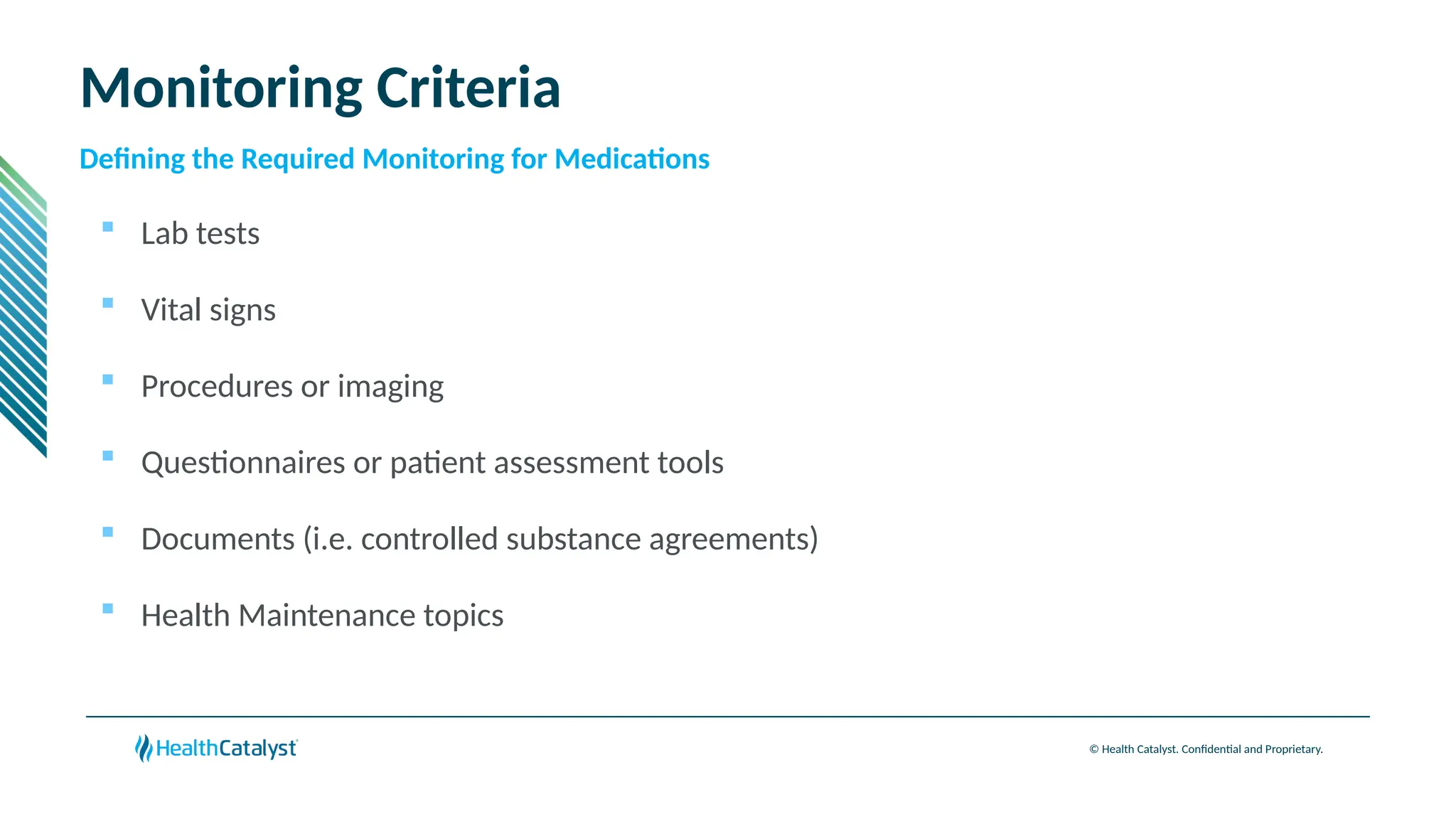
Monitoring Criteria
 Lab tests
 Vital signs
 Procedures or imaging
 Questionnaires or patient assessment tools
 Documents (i.e. controlled substance agreements)
 Health Maintenance topics
Defining the Required Monitoring for Medications
© Health Catalyst. Confidential and Proprietary.
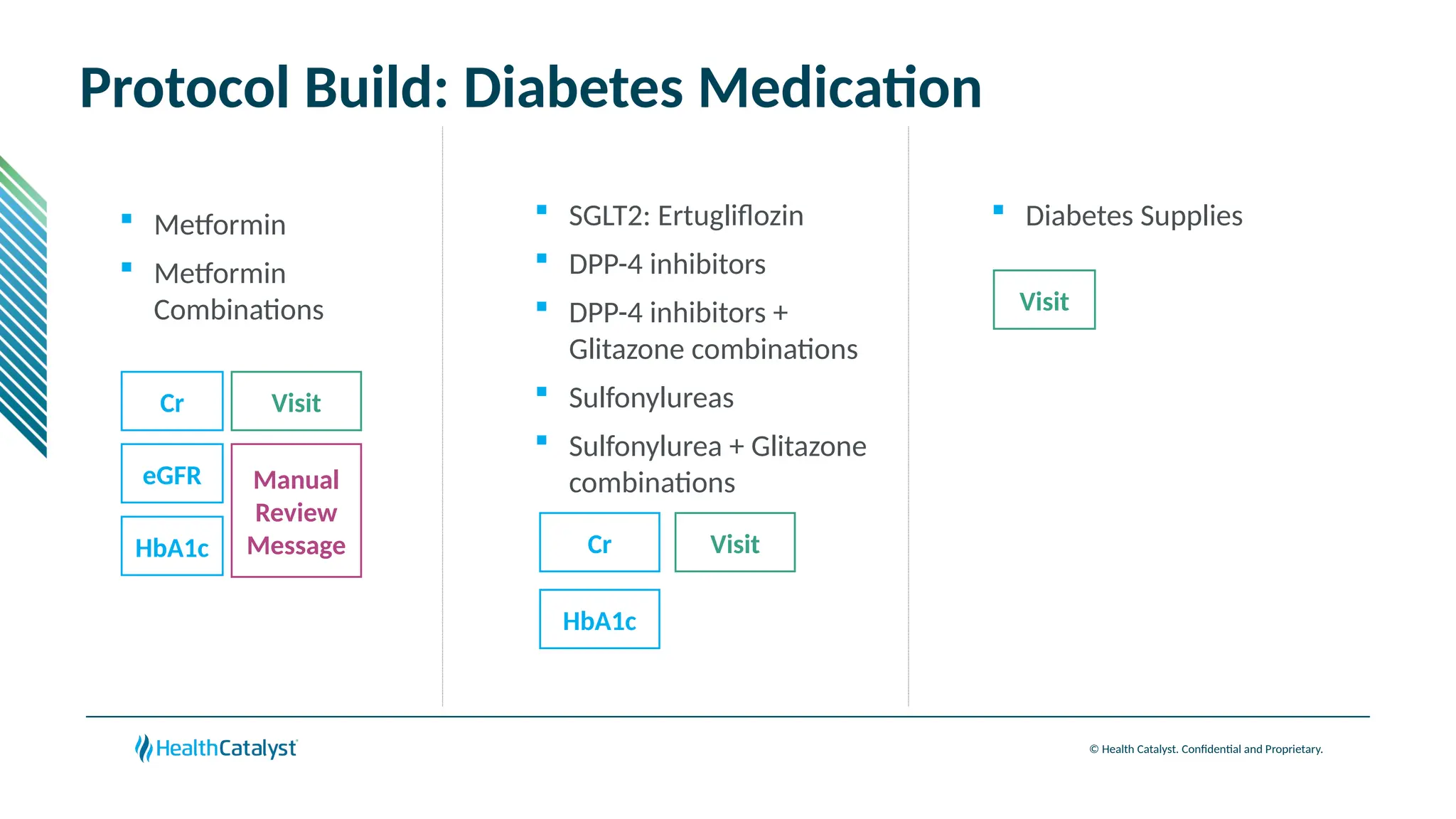
Protocol Build: Diabetes Medication
 Metformin
 Metformin
Combinations
Cr
eGFR
HbA1c
Visit
Manual
Review
Message
 SGLT2: Ertugliflozin
 DPP-4 inhibitors
 DPP-4 inhibitors +
Glitazone combinations
 Sulfonylureas
 Sulfonylurea + Glitazone
combinations
Cr
HbA1c
Visit
 Diabetes Supplies
Visit
© Health Catalyst. Confidential and Proprietary.
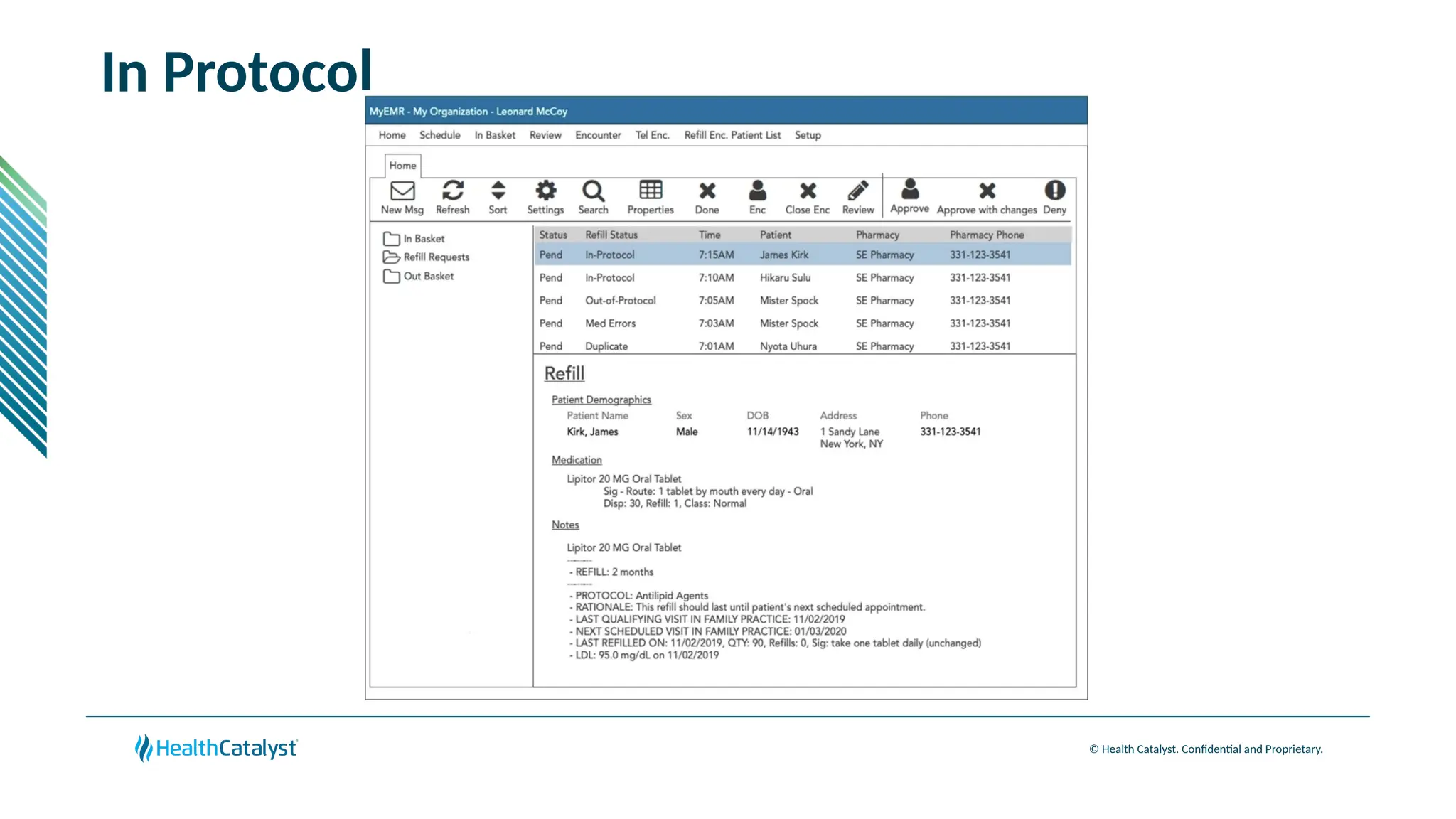
In Protocol
© Health Catalyst. Confidential and Proprietary.
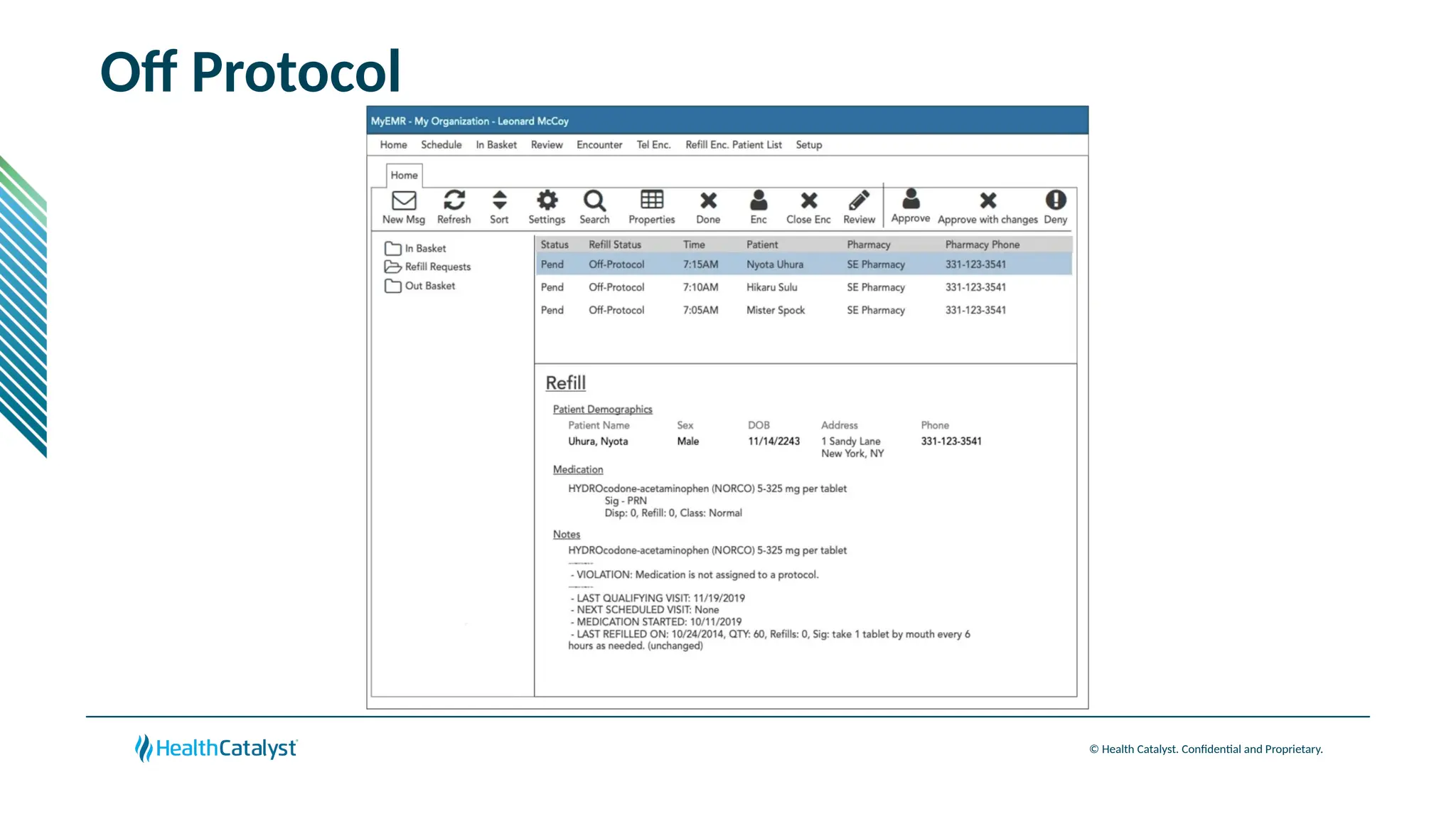
Off Protocol
© Health Catalyst. Confidential and Proprietary.
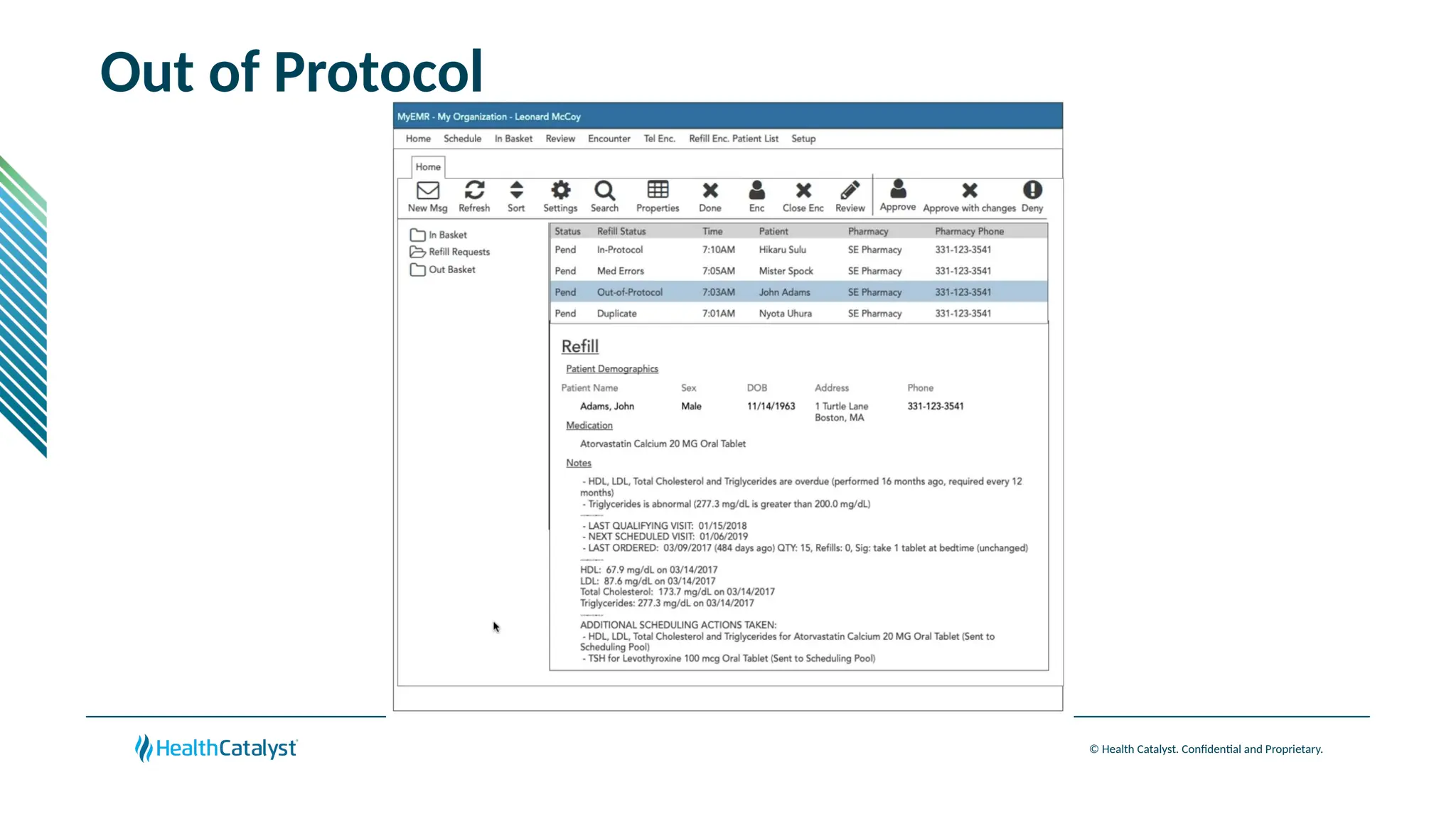
Out of Protocol
© Health Catalyst. Confidential and Proprietary.
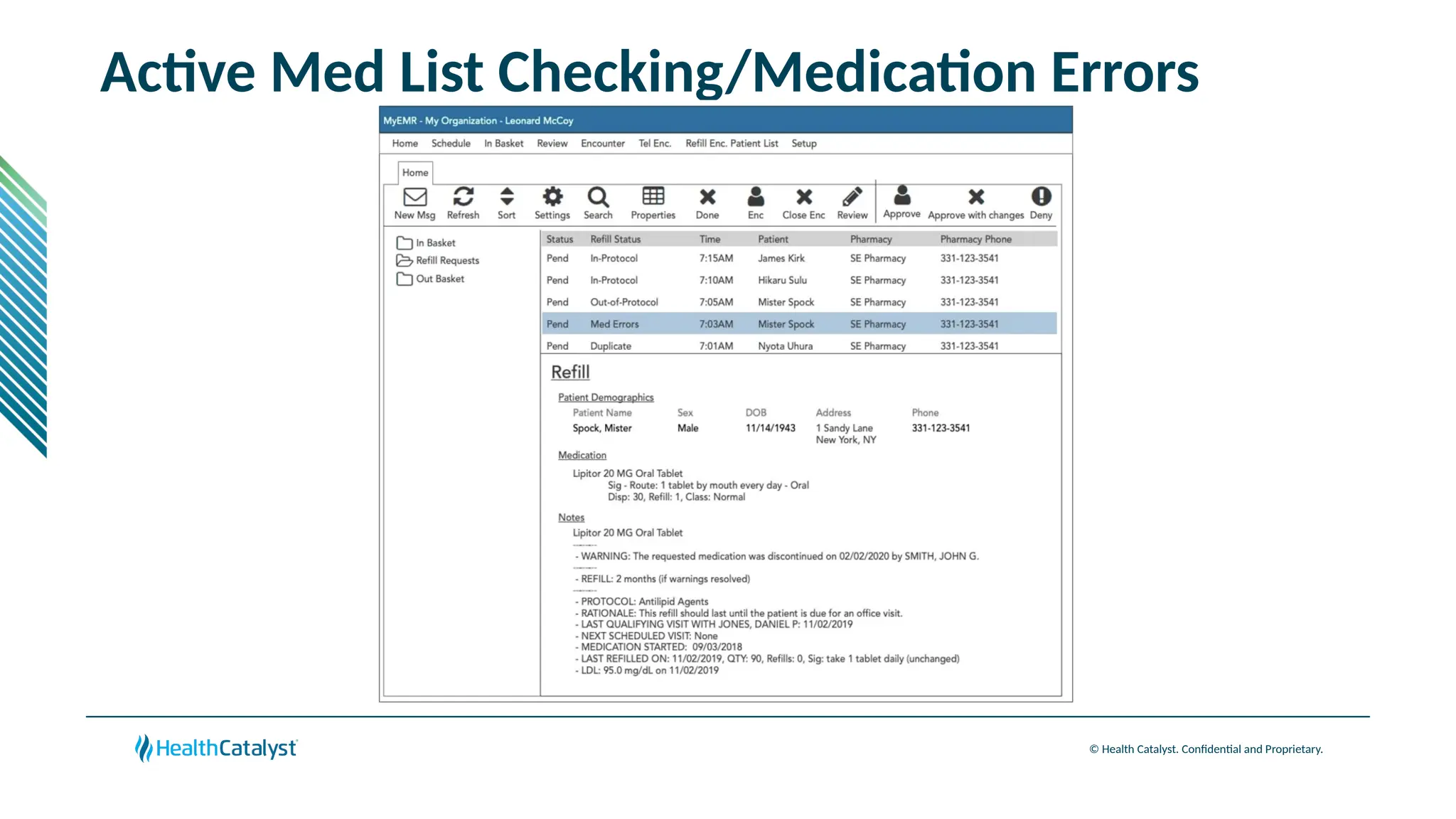
Active Med List Checking/Medication Errors
© Health Catalyst. Confidential and Proprietary.
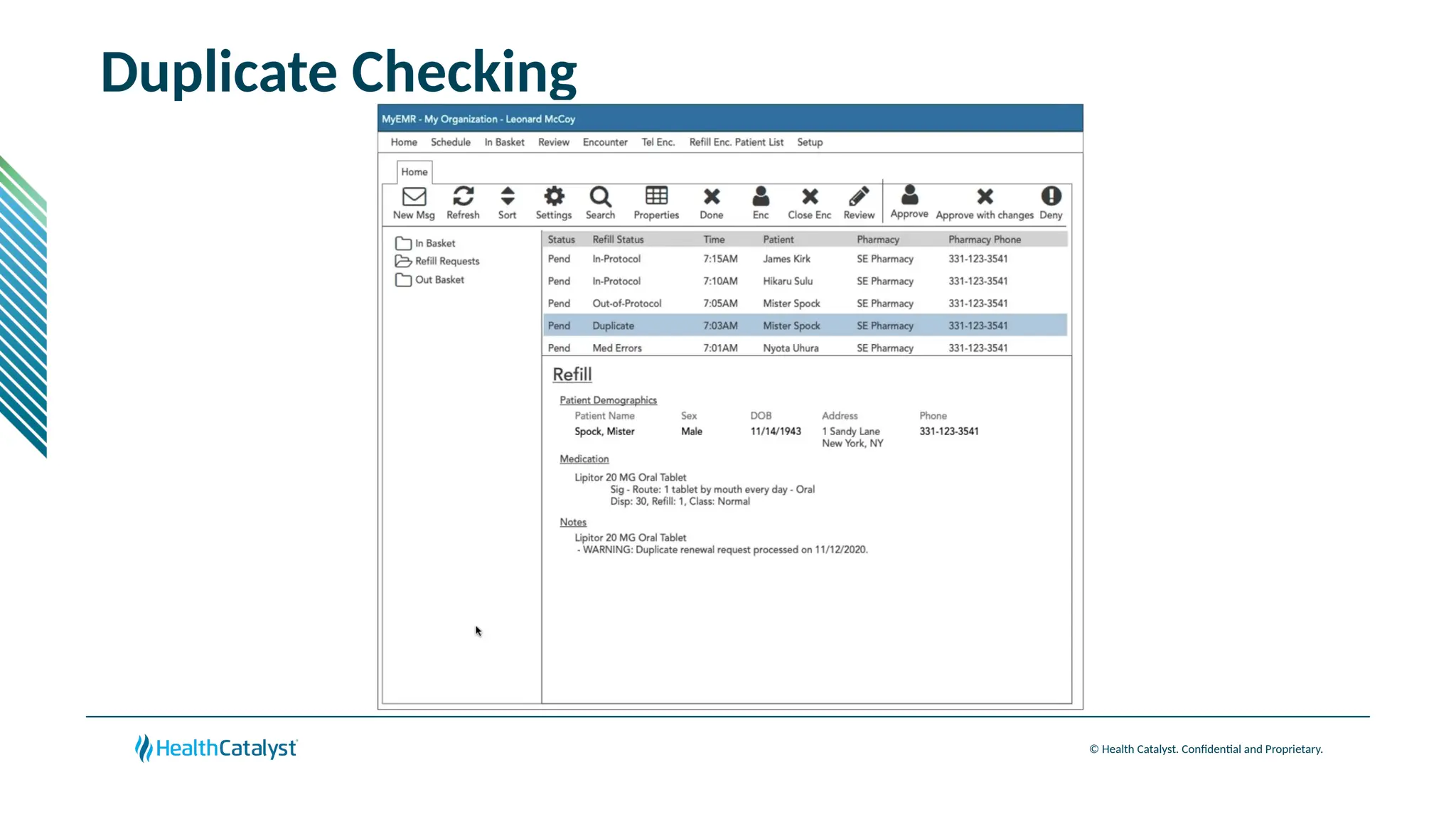
Duplicate Checking
© Health Catalyst. Confidential and Proprietary.
Poll #4
What is the average turnaround time for a requested refill to
be completed at your organization?
a) 24 hours
b) 48 hours
c) 72+ hours
Agenda
© Health Catalyst. Confidential and Proprietary.
• Today’s Challenges with Refills
• Solution: Embedded Refills
• Implementation Overview
• Post Go-Live Support and Data
• Q&A
© Health Catalyst. Confidential and Proprietary.
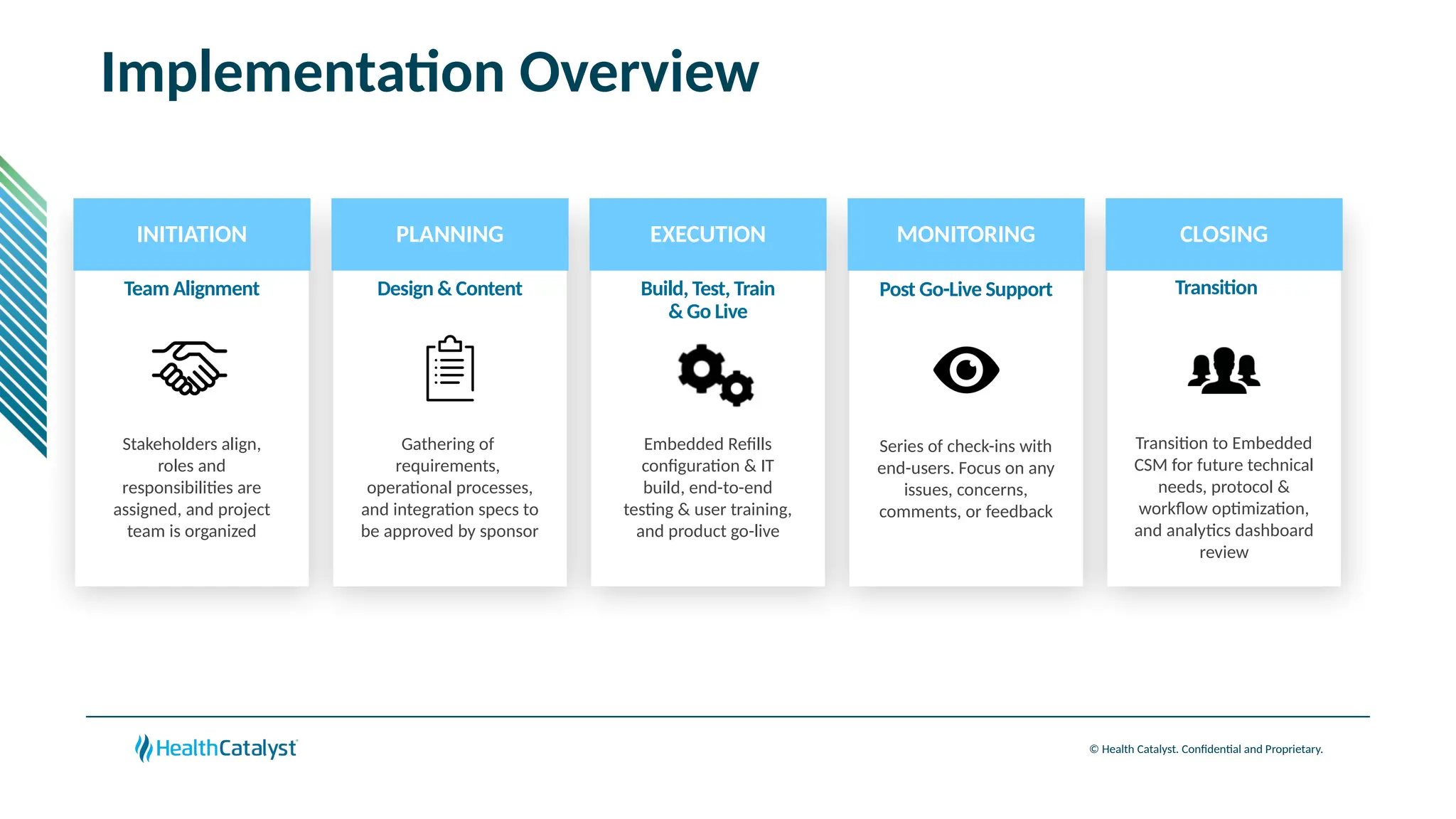
Implementation Overview
INITIATION PLANNING EXECUTION MONITORING CLOSING
Team Alignment Design & Content
Stakeholders align,
roles and
responsibilities are
assigned, and project
team is organized
Gathering of
requirements,
operational processes,
and integration specs to
be approved by sponsor
Build, Test, Train
& Go Live
Embedded Refills
configuration & IT
build, end-to-end
testing & user training,
and product go-live
Post Go-Live Support
Series of check-ins with
end-users. Focus on any
issues, concerns,
comments, or feedback
Transition
Transition to Embedded
CSM for future technical
needs, protocol &
workflow optimization,
and analytics dashboard
review
© Health Catalyst. Confidential and Proprietary.
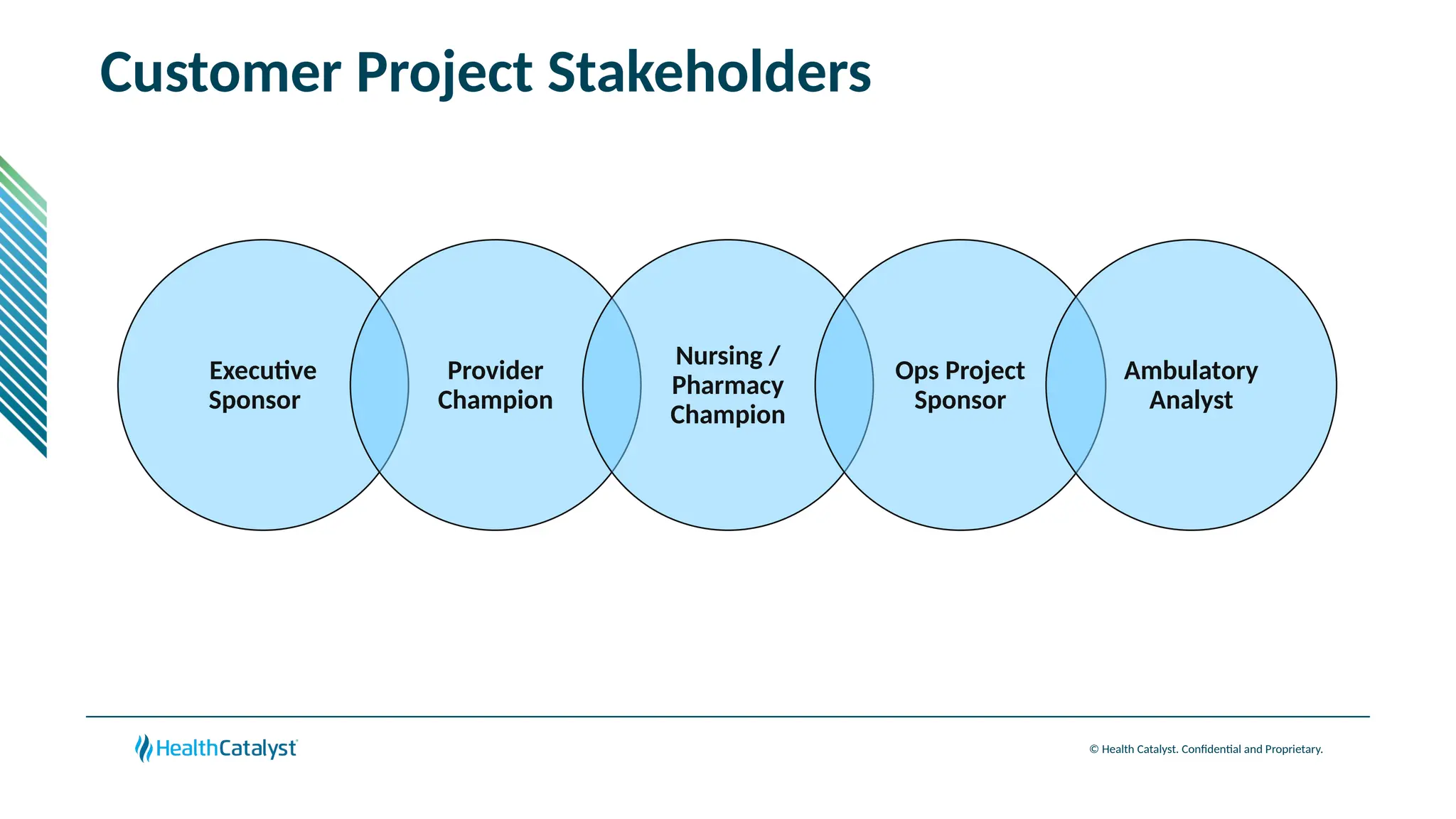
Customer Project Stakeholders
Executive
Sponsor
Provider
Champion
Nursing /
Pharmacy
Champion
Ops Project
Sponsor
Ambulatory
Analyst
© Health Catalyst. Confidential and Proprietary.
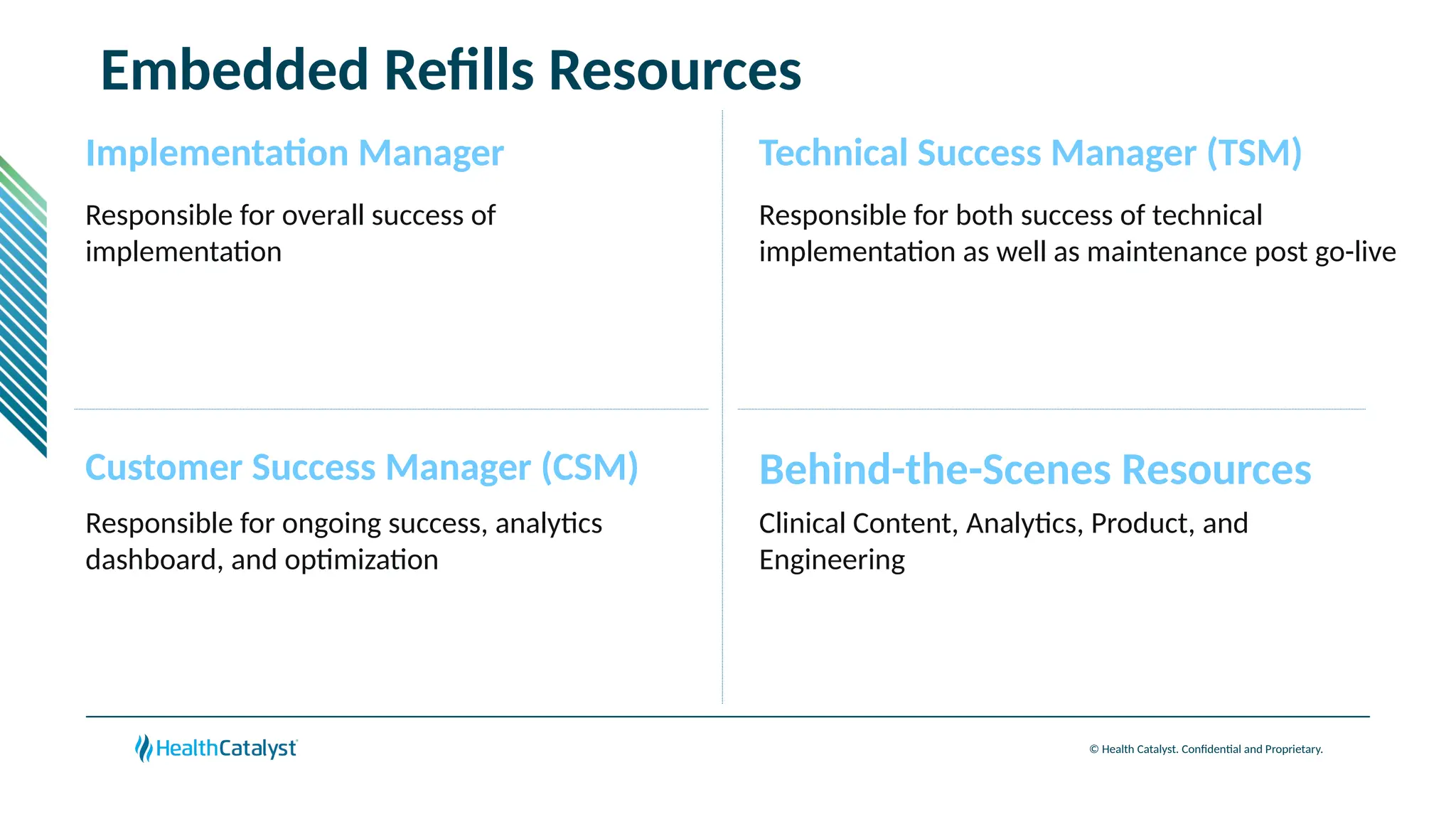
Embedded Refills Resources
Implementation Manager
Responsible for overall success of
implementation
Customer Success Manager (CSM)
Clinical Content, Analytics, Product, and
Engineering
Technical Success Manager (TSM)
Responsible for both success of technical
implementation as well as maintenance post go-live
Behind-the-Scenes Resources
Responsible for ongoing success, analytics
dashboard, and optimization
© Health Catalyst. Confidential and Proprietary.
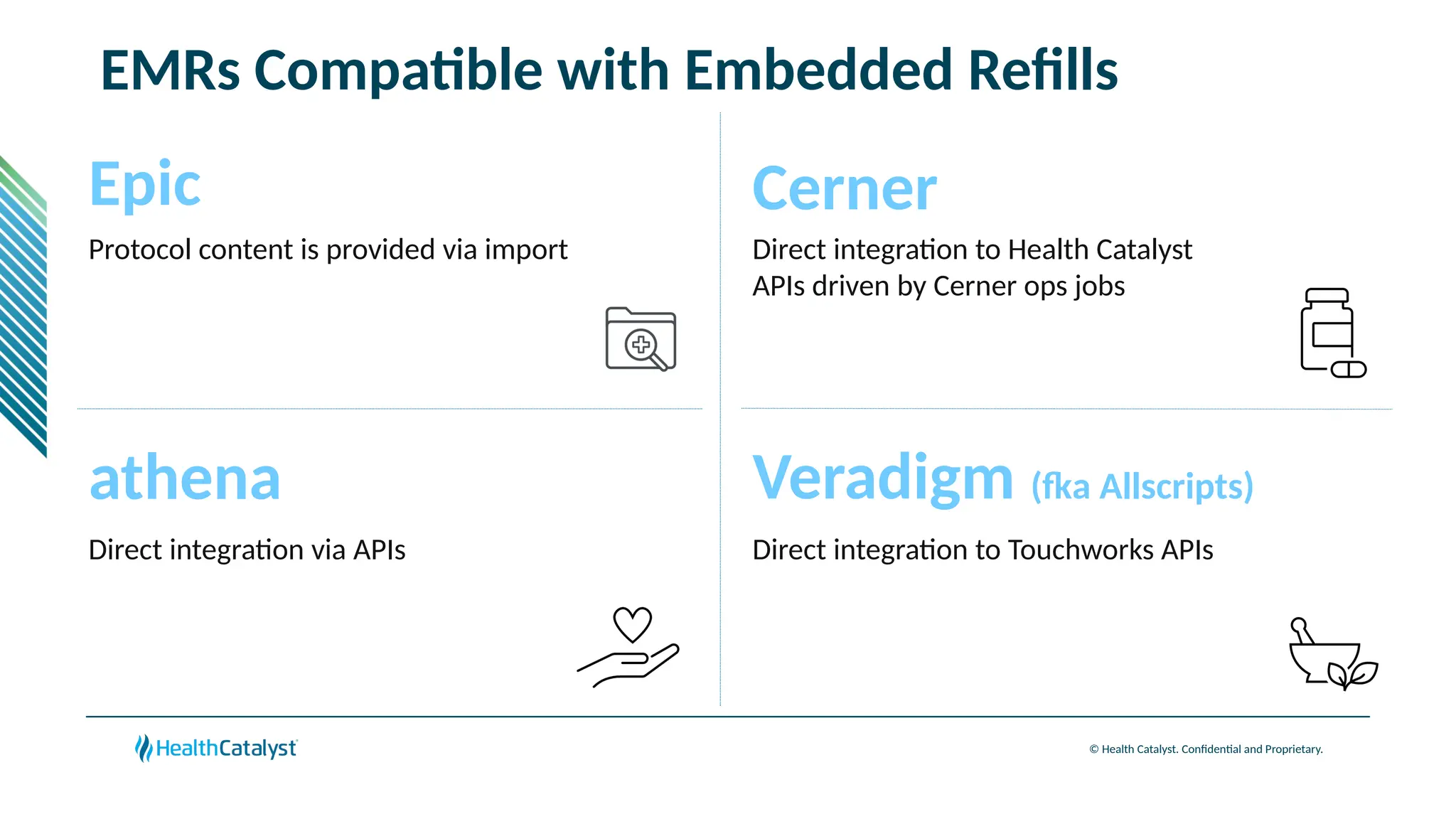
EMRs Compatible with Embedded Refills
Epic
Protocol content is provided via import
athena
Direct integration via APIs
Cerner
Veradigm (fka Allscripts)
Direct integration to Health Catalyst
APIs driven by Cerner ops jobs
Direct integration to Touchworks APIs
© Health Catalyst. Confidential and Proprietary.
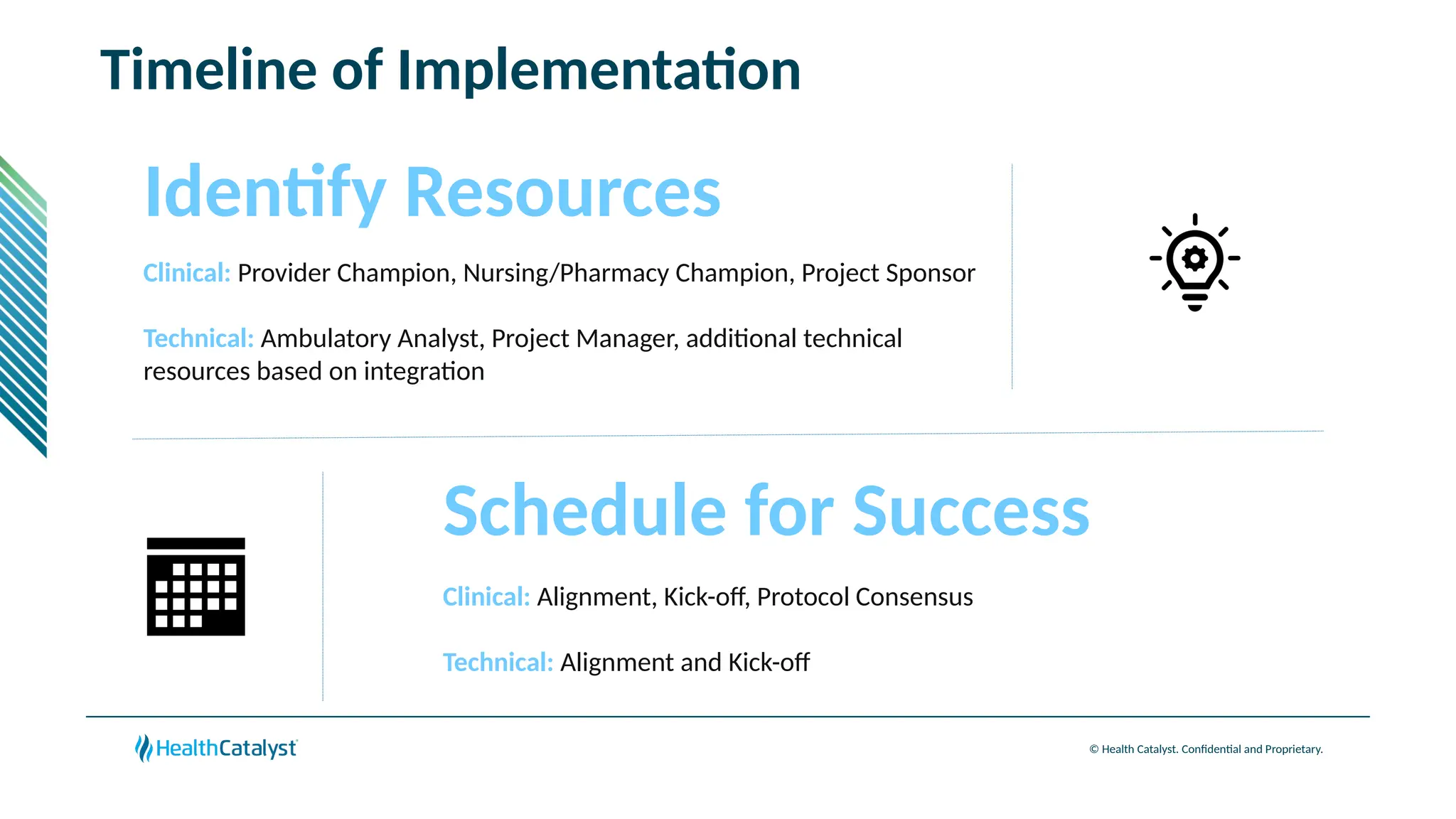
Timeline of Implementation
Identify Resources
Schedule for Success
Clinical: Alignment, Kick-off, Protocol Consensus
Technical: Alignment and Kick-off
Clinical: Provider Champion, Nursing/Pharmacy Champion, Project Sponsor
Technical: Ambulatory Analyst, Project Manager, additional technical
resources based on integration
© Health Catalyst. Confidential and Proprietary.
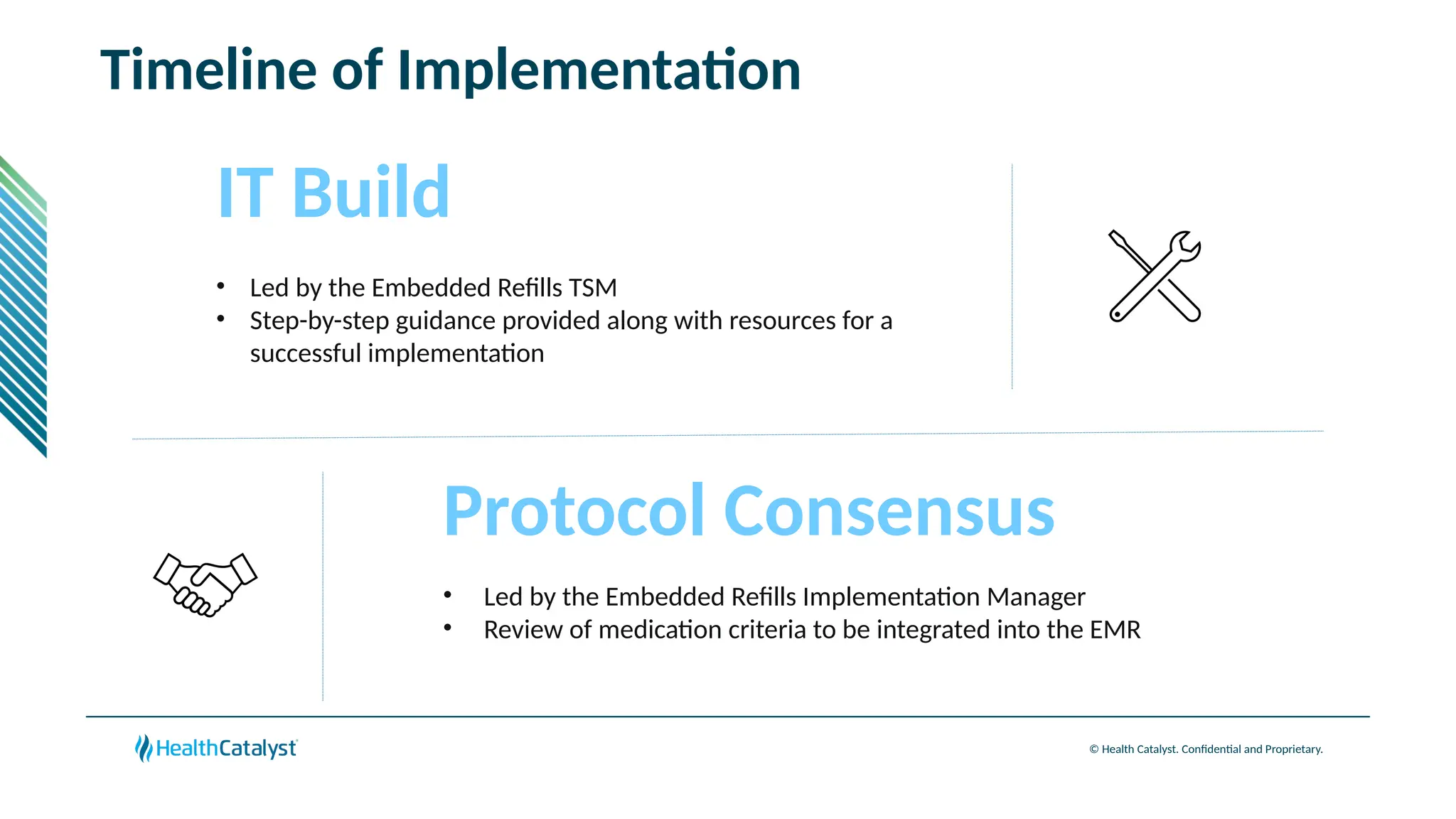
Timeline of Implementation
IT Build
Protocol Consensus
• Led by the Embedded Refills Implementation Manager
• Review of medication criteria to be integrated into the EMR
• Led by the Embedded Refills TSM
• Step-by-step guidance provided along with resources for a
successful implementation
© Health Catalyst. Confidential and Proprietary.
Timeline of Implementation
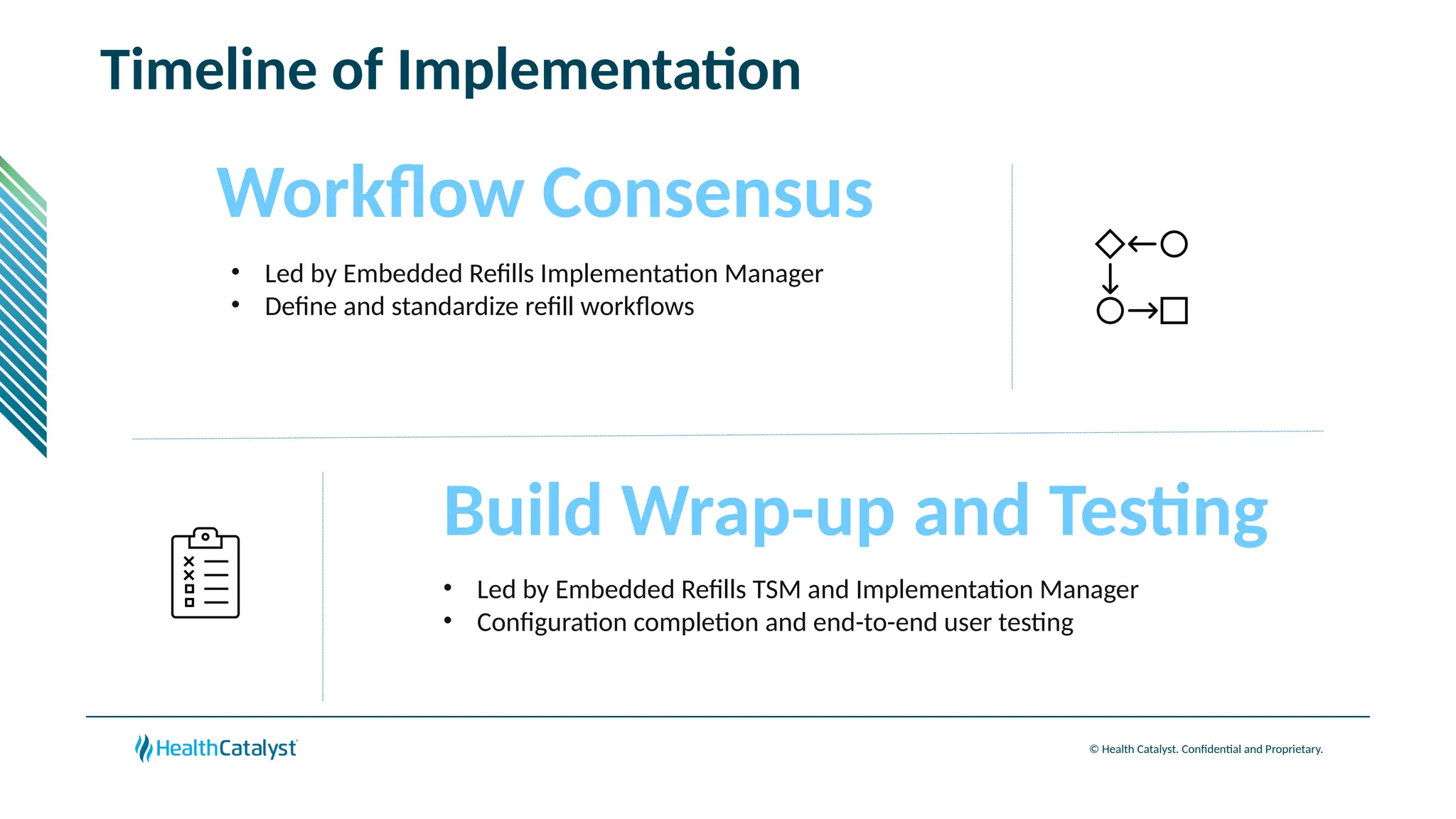
Workflow Consensus
Build Wrap-up and Testing
• Led by Embedded Refills Implementation Manager
• Define and standardize refill workflows
• Led by Embedded Refills TSM and Implementation Manager
• Configuration completion and end-to-end user testing
© Health Catalyst. Confidential and Proprietary.
Timeline of Implementation
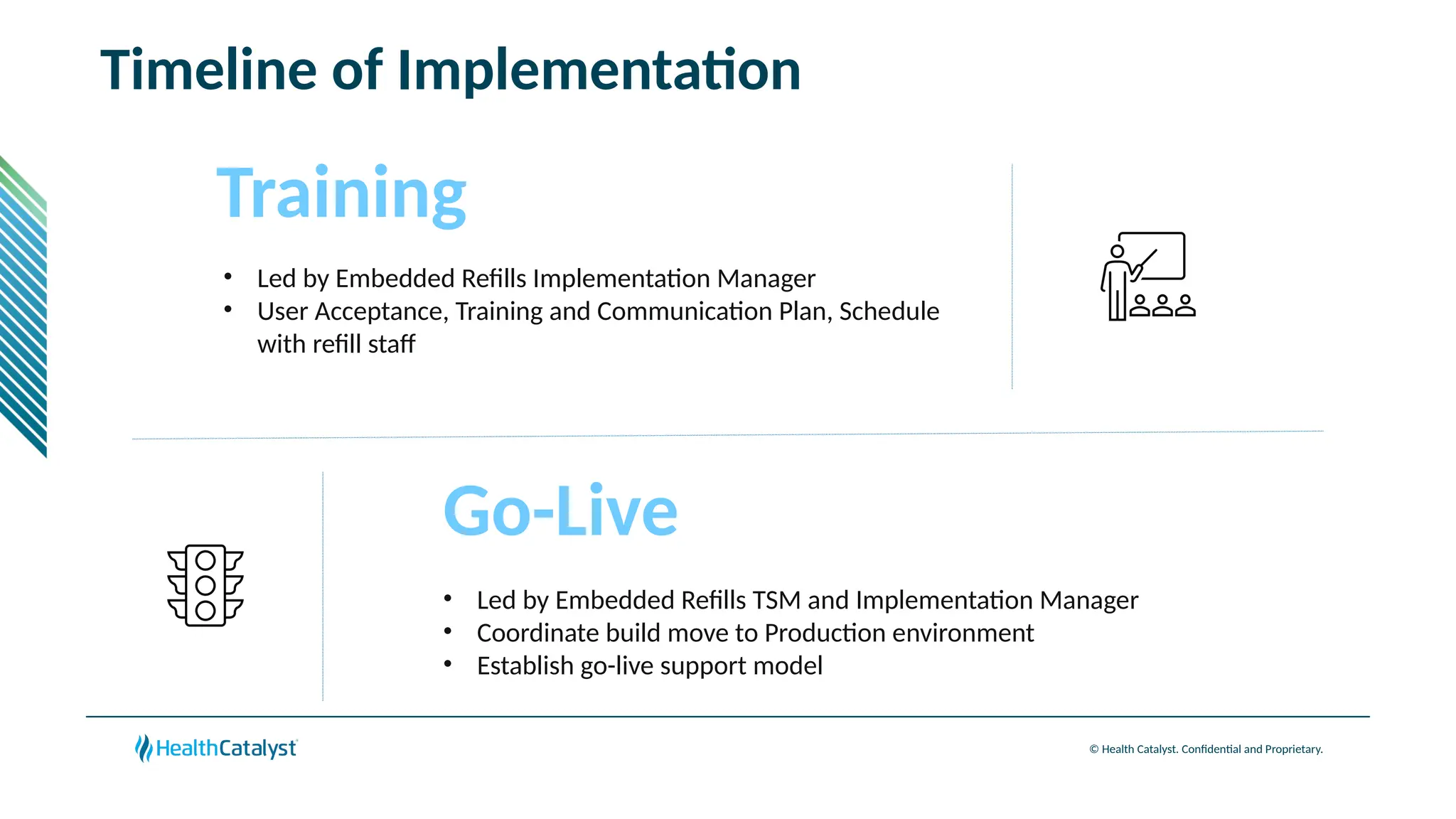
Training
Go-Live
• Led by Embedded Refills Implementation Manager
• User Acceptance, Training and Communication Plan, Schedule
with refill staff
• Led by Embedded Refills TSM and Implementation Manager
• Coordinate build move to Production environment
• Establish go-live support model
© Health Catalyst. Confidential and Proprietary.
Timeline of Implementation
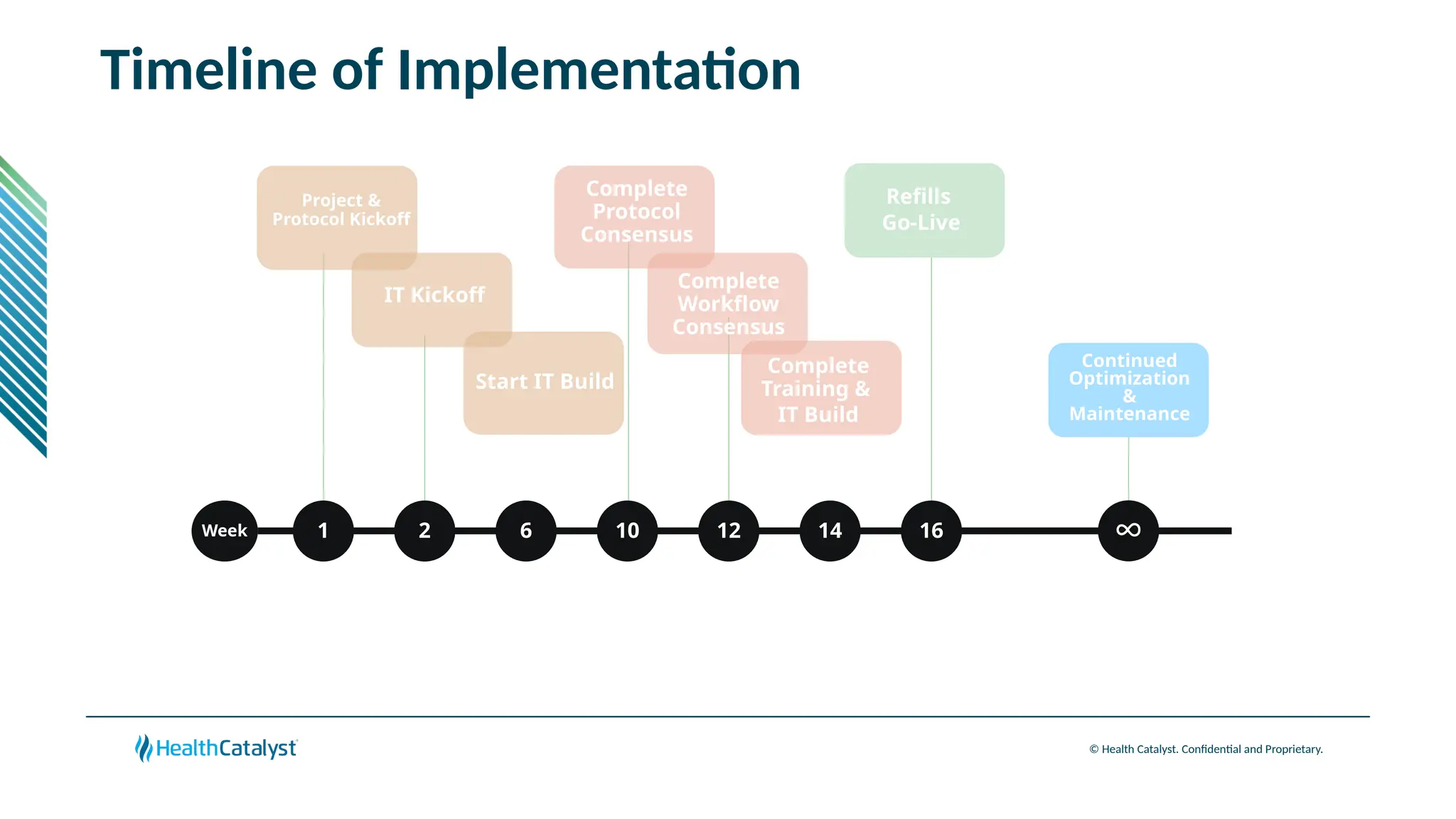
Week 1 2 6 10 12 14 16 ∞
Project &
Protocol Kickoff
Complete
Protocol
Consensus
Complete
Training &
IT Build
Refills
Go-Live
Start IT Build
Continued
Optimization
&
Maintenance
Complete
Workflow
Consensus
IT Kickoff
Agenda
© Health Catalyst. Confidential and Proprietary.
• Today’s Challenges with Refills
• Solution: Embedded Refills
• Implementation Overview
• Post Go-Live Support and Data
• Q&A
© Health Catalyst. Confidential and Proprietary.
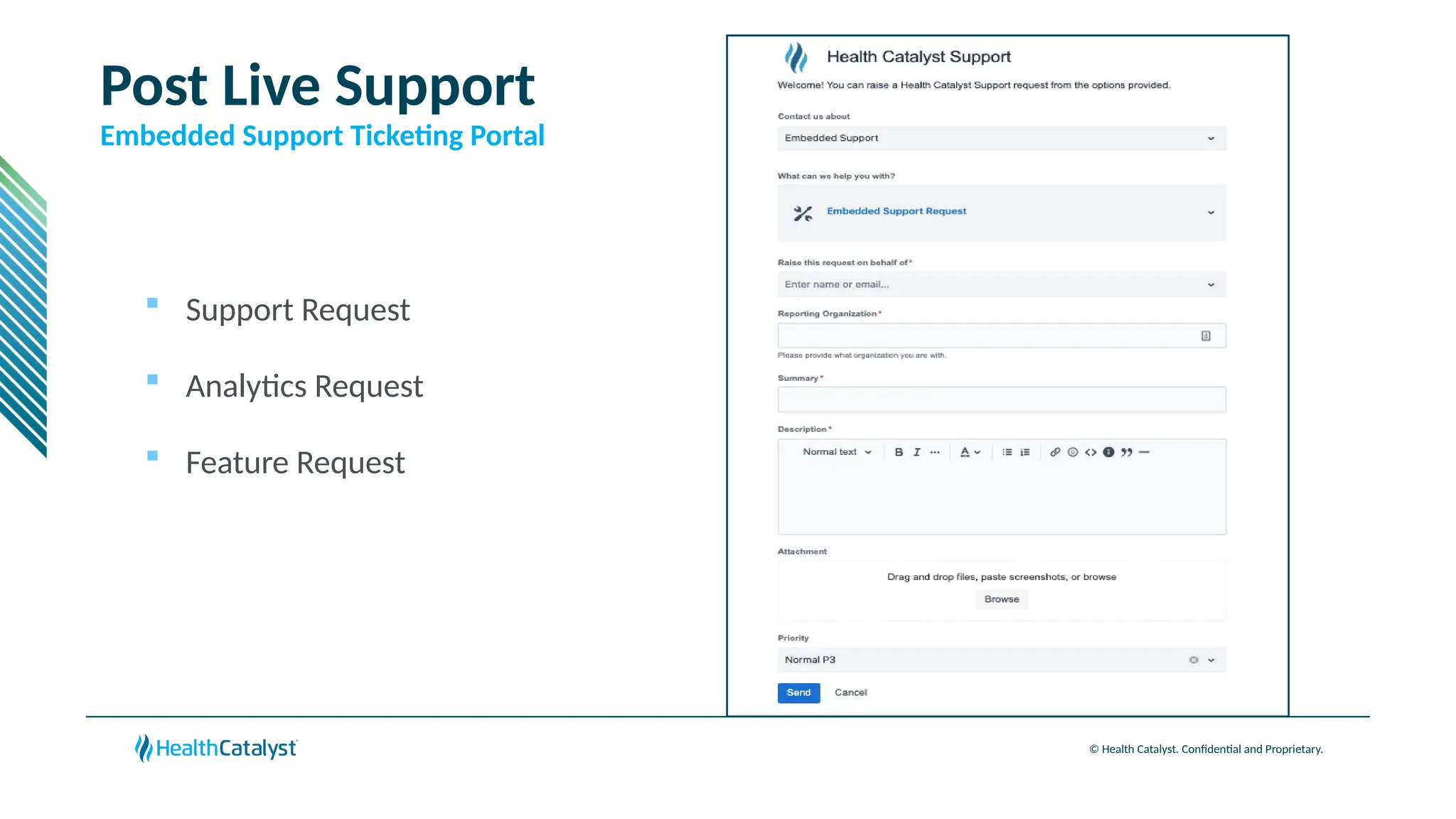
Post Live Support
 Support Request
 Analytics Request
 Feature Request
Embedded Support Ticketing Portal
© Health Catalyst. Confidential and Proprietary.
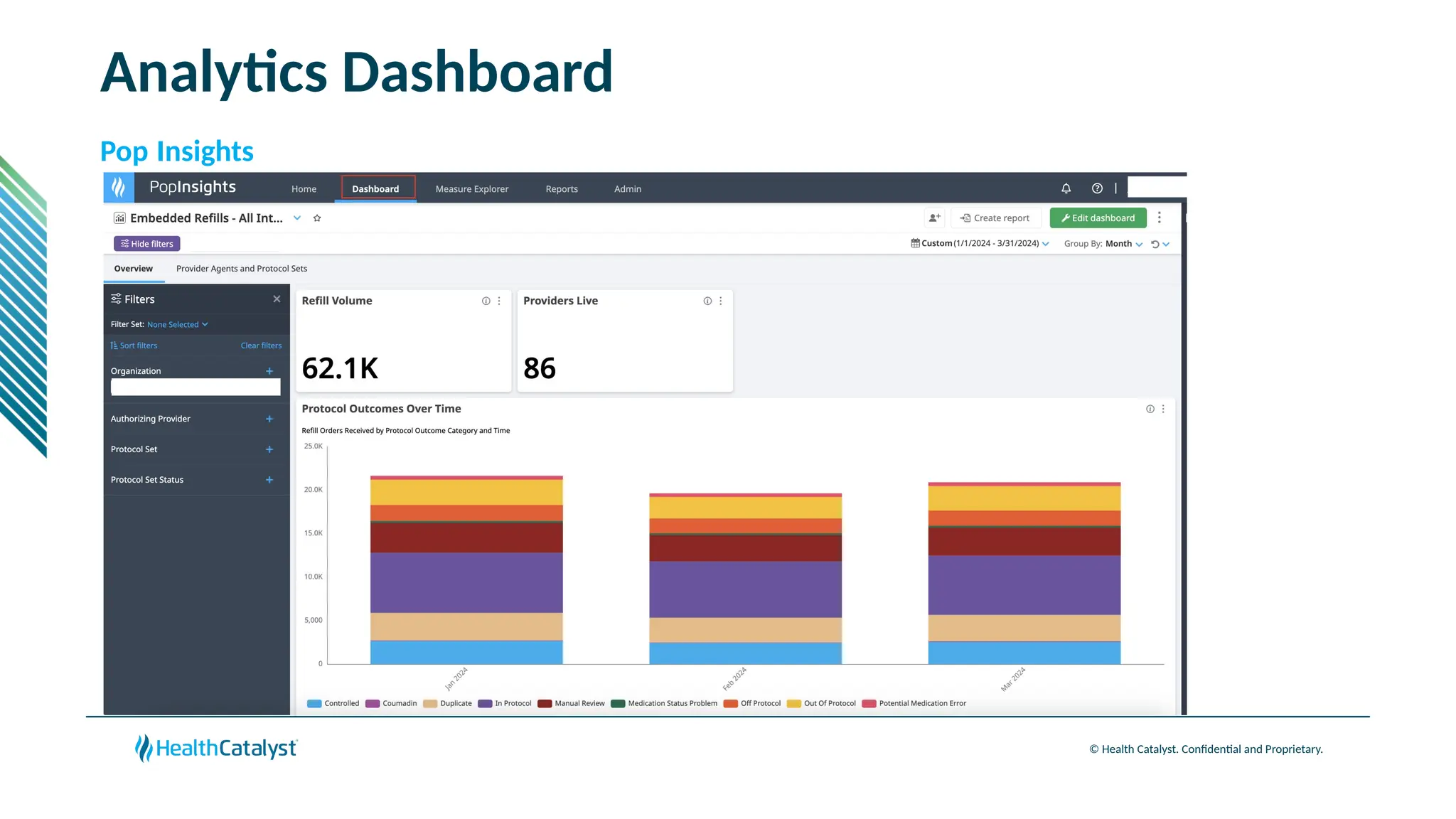
Analytics Dashboard
Pop Insights
© Health Catalyst. Confidential and Proprietary.
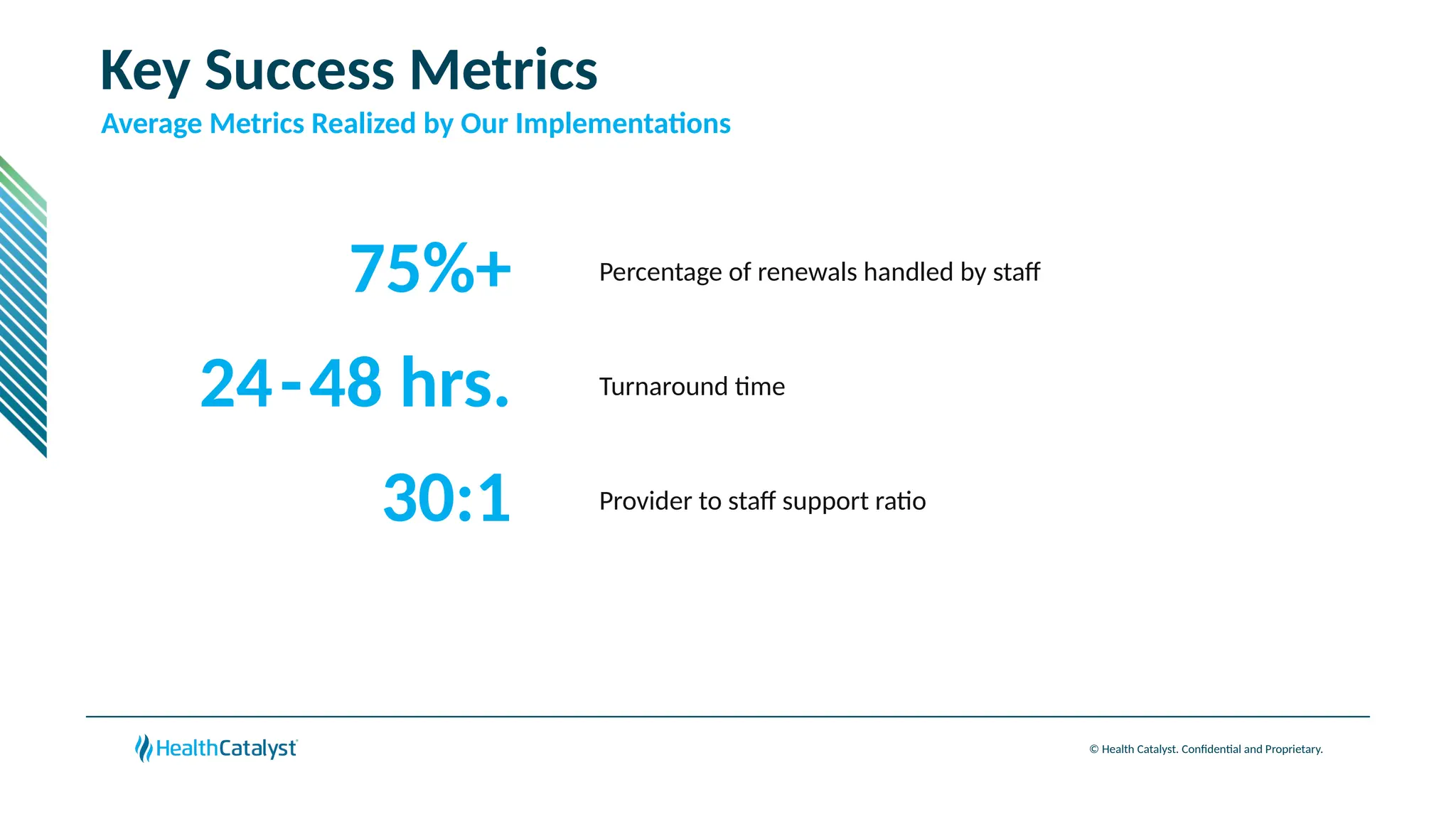
75%+ Percentage of renewals handled by staff
24-48 hrs. Turnaround time
30:1 Provider to staff support ratio
Key Success Metrics
Average Metrics Realized by Our Implementations
© Health Catalyst. Confidential and Proprietary.
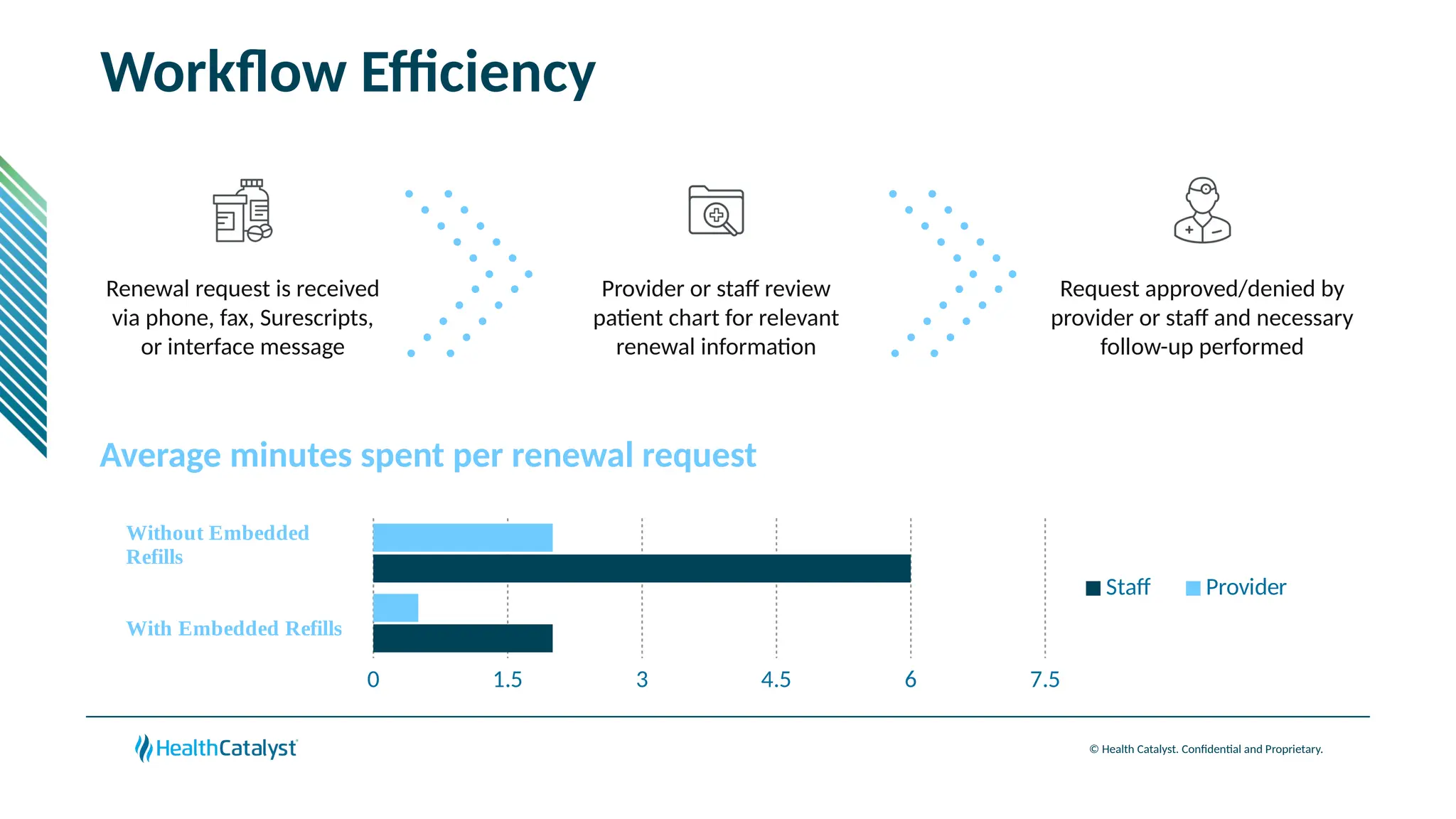
Renewal request is received
via phone, fax, Surescripts,
or interface message
Provider or staff review
patient chart for relevant
renewal information
Request approved/denied by
provider or staff and necessary
follow-up performed
0 1.5 3 4.5 6 7.5
Staff Provider
Without Embedded
Refills
With Embedded Refills
Average minutes spent per renewal request
Workflow Efficiency
Challenges & Impact Solution Results
©
Health
Catalyst
|
Proprietary
and
Confidential
A Health Catalyst Case Study
Enhancing Medication Refill Efficiency
Increases Caregivers’ Time with Patients
UnityPoint Health aimed to enhance its medication refill processes to enable caregivers to
spend more time with patients and reduce costs. Given the millions of refill requests the
organization handles annually, it is essential for the health system to assess and improve
these processes regularly to boost efficiency. The organization adopted the Health
Catalyst Embedded Refills™ application, which streamlined the medication refill workflow,
increasing efficiency and accuracy and lowering labor costs.
• Implemented the Health Catalyst Embedded
Refills™ application, integrating medication
renewal decision support into the EHR workflow
and streamlining the medication refill process.
• Established a centralized refill team to manage
routine requests.
• Standardized review processes and patient
handoff procedures.
• Responsible for managing millions of
annual medication refill requests.
• Lacked a system for determining who
handles specific medication requests.
• Impact: Without an improved process,
UnityPoint Health would face ongoing
inefficiencies, higher labor costs, and
slower medication refills.
 $3.1M cost savings over two years, the result of
91.5K staff labor hours avoided processing
medication refills.
 17.1K provider labor hours were avoided, the
result of processing 2.9M medication refills
using the application.
 Less than a 24-hour turnaround time
application for most medication refill requests.
Challenges & Impact Solution Results
©
Health
Catalyst
|
Proprietary
and
Confidential
A Health Catalyst Case Study
Medication Refill Improvements Reduces
Labor Burden and Saves $3.4M
Community Health Network sought to reduce its medication refill labor burden,
standardize and streamline processes, and increase the amount of patient-facing
time available to providers. By implementing Embedded Refills™ by Health
Catalyst®, the organization has achieved significant results, including reduced time
spent on medication refills, enabling providers to invest more time in patient care,
and expanding refill capacity without adding additional FTEs.
• Utilized Embedded Refills™ by Health
Catalyst®, leveraging the power of standard,
automated, protocol-driven workflows to
decrease refill processing time.
• Providers and staff now have fewer in-basket
refill messages and fewer repetitive
administrative tasks.
• Medication refills are a critical yet labor-
intensive task.
• Desired to enhance efficiency and improve
the provider experience.
• Impact: CHNw needed to evaluate current
practices and standardize medication refills
for primary care, reducing the burden on
providers and staff.
• $3.4M cost savings, the result of processing
1.7M medication refills via the Embedded
Refills application and a 69% delegation rate.
• More than half of all medication refill
requests are processed the same day—and
nearly 80% within the next day.
• 13.4K provider labor hours and 102K staff
labor hours avoided processing medication
refills.
Questions?
© Health Catalyst. Confidential and Proprietary.
Emily Rodriguez | Director of Technical Success for Embedded Refills
Jessica McCay | Director of Customer Success for Embedded Refills
Alora Martin | Webinar Program Manager
hcwebinars@healthcatalyst.com

Embedded Refills: Improving Workflow Efficiency and Optimizing the Medication Renewal Process

  • 1.
    © Health Catalyst.Confidential and Proprietary. Embedded Refills: Improving Workflow Efficiency and Optimizing the Medication Renewal Process Emily Rodriguez and Jessica McCay
  • 2.
    © Health Catalyst.Confidential and Proprietary. Today’s Speakers Emily Rodriguez Director of Technical Success for Embedded Refills at Health Catalyst Jessica McCay Director of Customer Success for Embedded Refills at Health Catalyst
  • 3.
    Agenda © Health Catalyst.Confidential and Proprietary. • Today’s Challenges with Refills • Solution: Embedded Refills • Implementation Overview • Post Go-Live Support and Data • Q&A
  • 4.
    © Health Catalyst.Confidential and Proprietary. Poll #1 On average, how many minutes does it take to refill a medication? a) 1 – 3 minutes b) 4 – 7 minutes c) 8 + minutes
  • 5.
    © Health Catalyst.Confidential and Proprietary. Poll #2 Who completes the majority of refills at your organization? a) Providers b) Pharmacists c) Medical Assistants/Registered Nurses/Pharmacy Technicians
  • 6.
    Agenda © Health Catalyst.Confidential and Proprietary. • Today’s Challenges with Refills • Solution: Embedded Refills • Implementation Overview • Post Go-Live Support and Data • Q&A
  • 7.
    © Health Catalyst.Confidential and Proprietary. Impact on Staff 40% Clinical work that is redundant or otherwise wasted effort IHI, 2019 4.5 Average minutes per renewal request it takes a pharmacist to review a patient chart J Am Pharm Assoc, 2013; J Prim Car Improper chart review and manual review processes and lead to safety and quality concerns Requests that are duplicate or not on the active med list McGuirt (2018) 9.5% More pressure on staff to meet internal productivity measures (e.g. 24 hour turnaround time)
  • 8.
    © Health Catalyst.Confidential and Proprietary. Impact on Patients Patients’ experiences with care correlate with adherence to medical advice and treatment plans Patients who don’t receive recommended lab monitoring for adverse medication effects Long turnaround on prescription renewal requests Ambulatory care and hospitals rank below internet retail, banking, and the automotive industry in consumer satisfaction American Consumer Survey, 2017 22.4%
  • 9.
    © Health Catalyst.Confidential and Proprietary. Impact on Information Services 10 hrs. Time to build one protocol Analysts spend hours stuck in the middle of consensus discussions Lack of content maintenance = risk for inappropriate monitoring and lack of trust in decision support tool Highly demanded resource Limited number of staff and time 2,500 hrs. Time to create protocols for most commonly prescribed medications
  • 10.
    Agenda © Health Catalyst.Confidential and Proprietary. • Today’s Challenges with Refills • Solution: Embedded Refills • Implementation Overview • Post Go-Live Support and Data • Q&A
  • 11.
    © Health Catalyst.Confidential and Proprietary. The Value of Health Catalyst Embedded Refills™ Strengthen Analytics Accuracy & Trust Delegation Protocols enable staff to work top of license through delegation Optimization Expand on learnings to enhance efficiency and achieve a higher ROI Consensus Alignment on Clinical Rules that drive your protocols Implementation Embedded Refills drives efficiency and effectiveness
  • 12.
    © Health Catalyst.Confidential and Proprietary. Poll #3 What percentage of your organization uses medication refill protocols? a) 0 – 25% b) 25 – 50% c) 50 – 75% d) 75 – 100%
  • 13.
    © Health Catalyst.Confidential and Proprietary. Medication Office Visit Monitoring Delegation Level Protocols Single medication Single route Full therapeutic or pharmaceutical class All routes Protocol Components: Protocols can be constructed on a spectrum of specificity:
  • 14.
    © Health Catalyst.Confidential and Proprietary. Monitoring Criteria  Lab tests  Vital signs  Procedures or imaging  Questionnaires or patient assessment tools  Documents (i.e. controlled substance agreements)  Health Maintenance topics Defining the Required Monitoring for Medications
  • 15.
    © Health Catalyst.Confidential and Proprietary. Protocol Build: Diabetes Medication  Metformin  Metformin Combinations Cr eGFR HbA1c Visit Manual Review Message  SGLT2: Ertugliflozin  DPP-4 inhibitors  DPP-4 inhibitors + Glitazone combinations  Sulfonylureas  Sulfonylurea + Glitazone combinations Cr HbA1c Visit  Diabetes Supplies Visit
  • 16.
    © Health Catalyst.Confidential and Proprietary. In Protocol
  • 17.
    © Health Catalyst.Confidential and Proprietary. Off Protocol
  • 18.
    © Health Catalyst.Confidential and Proprietary. Out of Protocol
  • 19.
    © Health Catalyst.Confidential and Proprietary. Active Med List Checking/Medication Errors
  • 20.
    © Health Catalyst.Confidential and Proprietary. Duplicate Checking
  • 21.
    © Health Catalyst.Confidential and Proprietary. Poll #4 What is the average turnaround time for a requested refill to be completed at your organization? a) 24 hours b) 48 hours c) 72+ hours
  • 22.
    Agenda © Health Catalyst.Confidential and Proprietary. • Today’s Challenges with Refills • Solution: Embedded Refills • Implementation Overview • Post Go-Live Support and Data • Q&A
  • 23.
    © Health Catalyst.Confidential and Proprietary. Implementation Overview INITIATION PLANNING EXECUTION MONITORING CLOSING Team Alignment Design & Content Stakeholders align, roles and responsibilities are assigned, and project team is organized Gathering of requirements, operational processes, and integration specs to be approved by sponsor Build, Test, Train & Go Live Embedded Refills configuration & IT build, end-to-end testing & user training, and product go-live Post Go-Live Support Series of check-ins with end-users. Focus on any issues, concerns, comments, or feedback Transition Transition to Embedded CSM for future technical needs, protocol & workflow optimization, and analytics dashboard review
  • 24.
    © Health Catalyst.Confidential and Proprietary. Customer Project Stakeholders Executive Sponsor Provider Champion Nursing / Pharmacy Champion Ops Project Sponsor Ambulatory Analyst
  • 25.
    © Health Catalyst.Confidential and Proprietary. Embedded Refills Resources Implementation Manager Responsible for overall success of implementation Customer Success Manager (CSM) Clinical Content, Analytics, Product, and Engineering Technical Success Manager (TSM) Responsible for both success of technical implementation as well as maintenance post go-live Behind-the-Scenes Resources Responsible for ongoing success, analytics dashboard, and optimization
  • 26.
    © Health Catalyst.Confidential and Proprietary. EMRs Compatible with Embedded Refills Epic Protocol content is provided via import athena Direct integration via APIs Cerner Veradigm (fka Allscripts) Direct integration to Health Catalyst APIs driven by Cerner ops jobs Direct integration to Touchworks APIs
  • 27.
    © Health Catalyst.Confidential and Proprietary. Timeline of Implementation Identify Resources Schedule for Success Clinical: Alignment, Kick-off, Protocol Consensus Technical: Alignment and Kick-off Clinical: Provider Champion, Nursing/Pharmacy Champion, Project Sponsor Technical: Ambulatory Analyst, Project Manager, additional technical resources based on integration
  • 28.
    © Health Catalyst.Confidential and Proprietary. Timeline of Implementation IT Build Protocol Consensus • Led by the Embedded Refills Implementation Manager • Review of medication criteria to be integrated into the EMR • Led by the Embedded Refills TSM • Step-by-step guidance provided along with resources for a successful implementation
  • 29.
    © Health Catalyst.Confidential and Proprietary. Timeline of Implementation Workflow Consensus Build Wrap-up and Testing • Led by Embedded Refills Implementation Manager • Define and standardize refill workflows • Led by Embedded Refills TSM and Implementation Manager • Configuration completion and end-to-end user testing
  • 30.
    © Health Catalyst.Confidential and Proprietary. Timeline of Implementation Training Go-Live • Led by Embedded Refills Implementation Manager • User Acceptance, Training and Communication Plan, Schedule with refill staff • Led by Embedded Refills TSM and Implementation Manager • Coordinate build move to Production environment • Establish go-live support model
  • 31.
    © Health Catalyst.Confidential and Proprietary. Timeline of Implementation Week 1 2 6 10 12 14 16 ∞ Project & Protocol Kickoff Complete Protocol Consensus Complete Training & IT Build Refills Go-Live Start IT Build Continued Optimization & Maintenance Complete Workflow Consensus IT Kickoff
  • 32.
    Agenda © Health Catalyst.Confidential and Proprietary. • Today’s Challenges with Refills • Solution: Embedded Refills • Implementation Overview • Post Go-Live Support and Data • Q&A
  • 33.
    © Health Catalyst.Confidential and Proprietary. Post Live Support  Support Request  Analytics Request  Feature Request Embedded Support Ticketing Portal
  • 34.
    © Health Catalyst.Confidential and Proprietary. Analytics Dashboard Pop Insights
  • 35.
    © Health Catalyst.Confidential and Proprietary. 75%+ Percentage of renewals handled by staff 24-48 hrs. Turnaround time 30:1 Provider to staff support ratio Key Success Metrics Average Metrics Realized by Our Implementations
  • 36.
    © Health Catalyst.Confidential and Proprietary. Renewal request is received via phone, fax, Surescripts, or interface message Provider or staff review patient chart for relevant renewal information Request approved/denied by provider or staff and necessary follow-up performed 0 1.5 3 4.5 6 7.5 Staff Provider Without Embedded Refills With Embedded Refills Average minutes spent per renewal request Workflow Efficiency
  • 37.
    Challenges & ImpactSolution Results © Health Catalyst | Proprietary and Confidential A Health Catalyst Case Study Enhancing Medication Refill Efficiency Increases Caregivers’ Time with Patients UnityPoint Health aimed to enhance its medication refill processes to enable caregivers to spend more time with patients and reduce costs. Given the millions of refill requests the organization handles annually, it is essential for the health system to assess and improve these processes regularly to boost efficiency. The organization adopted the Health Catalyst Embedded Refills™ application, which streamlined the medication refill workflow, increasing efficiency and accuracy and lowering labor costs. • Implemented the Health Catalyst Embedded Refills™ application, integrating medication renewal decision support into the EHR workflow and streamlining the medication refill process. • Established a centralized refill team to manage routine requests. • Standardized review processes and patient handoff procedures. • Responsible for managing millions of annual medication refill requests. • Lacked a system for determining who handles specific medication requests. • Impact: Without an improved process, UnityPoint Health would face ongoing inefficiencies, higher labor costs, and slower medication refills.  $3.1M cost savings over two years, the result of 91.5K staff labor hours avoided processing medication refills.  17.1K provider labor hours were avoided, the result of processing 2.9M medication refills using the application.  Less than a 24-hour turnaround time application for most medication refill requests.
  • 38.
    Challenges & ImpactSolution Results © Health Catalyst | Proprietary and Confidential A Health Catalyst Case Study Medication Refill Improvements Reduces Labor Burden and Saves $3.4M Community Health Network sought to reduce its medication refill labor burden, standardize and streamline processes, and increase the amount of patient-facing time available to providers. By implementing Embedded Refills™ by Health Catalyst®, the organization has achieved significant results, including reduced time spent on medication refills, enabling providers to invest more time in patient care, and expanding refill capacity without adding additional FTEs. • Utilized Embedded Refills™ by Health Catalyst®, leveraging the power of standard, automated, protocol-driven workflows to decrease refill processing time. • Providers and staff now have fewer in-basket refill messages and fewer repetitive administrative tasks. • Medication refills are a critical yet labor- intensive task. • Desired to enhance efficiency and improve the provider experience. • Impact: CHNw needed to evaluate current practices and standardize medication refills for primary care, reducing the burden on providers and staff. • $3.4M cost savings, the result of processing 1.7M medication refills via the Embedded Refills application and a 69% delegation rate. • More than half of all medication refill requests are processed the same day—and nearly 80% within the next day. • 13.4K provider labor hours and 102K staff labor hours avoided processing medication refills.
  • 39.
    Questions? © Health Catalyst.Confidential and Proprietary. Emily Rodriguez | Director of Technical Success for Embedded Refills Jessica McCay | Director of Customer Success for Embedded Refills Alora Martin | Webinar Program Manager hcwebinars@healthcatalyst.com

Editor's Notes

  • #2 Jess goes first Hi everyone! I’m Jessica McCay, and I am the Director of Customer Success for Embedded Refills. I have been on the Embedded team for about 3 years and worked in the healthcare field for the last 7 managing ambulatory clinics. I am VERY excited to share with you how Embedded Refills can help your organization streamline the medication refill process. 
  • #3 Emily We will start with reviewing today’s challenges involved in the medication renewal process, explain how Embedded Refills comes into play, provide an overview of what an Embedded Refills implementation looks like, review the post-live support model, data points and success metrics. And at the end we will hold a Q & A session. Agenda Introduction Slide: To establish timelines for your webinar and describe what they can expect from your event. Keep it Short! The key points to include in your webinar introduction are: First, it should introduce an issue or problem your target audience faces. Second, it should tease how solving this problem will benefit them personally. How will it improve their lives or help achieve their goals? Perks of watching the webinar until the end Third and finally—it needs to promise concrete results with relevant tech information
  • #4 Emily
  • #5 Emily
  • #6 Emily
  • #7 Jess First, the impact on staff and providers, you can see there’s a lot of redundant clinical work, an average of 4.5 minutes spent per renewal request for a pharmacist to manually review the patients’ chart to ensure we have the appropriate lab tests and office visits to safely refill the medication. It is critical, yet labor intensive work as you want to complete the refills as quick as possible, but also ensure safety and quality is also a focus. I think everyone would agree that provider time is valuable, these repetitive tasks take time away from direct patient care. 
  • #8 Jess As for the impact on patients, over 22% of patients DO NOT receive recommended lab monitoring for adverse medication effects. They also often have long turnaround time on their prescription renewal requests, needing a refill and not having quick access or going a few days without a medication due to slow processing times adds to a poor patient experience.
  • #9 Jess When it comes to the impact on information services, we found that it takes approximately 10 hours to build 1 protocol, that’s thousands of hours to build commonly prescribed medication protocols. In addition to that, the content included in the protocols must be maintained and updated, which is something that tends NOT to occur resulting in a lack of trust in the protocols. It takes a lot of resources, expertise, and time to take this on.  
  • #10 Jess Solution: And that is where Embedded Refills comes in!   The Value of Embedded: Embedded Refills provides decision support to providers and refill staff by summarizing data from the patient chart and preparing actions and identifying gaps in care. It leverages patient level data, complex medication protocols, and EMR workflow to automate tasks associated with medication refills. It saves time by having customized protocols directly embedded in the EMR, reduces risk because when a refill is requested, the protocol will trigger and look for care that is due and med class requirements, and drive efficiency using standard workflows, supported by robust protocols, enabling staff to efficiently work top-of-license
  • #11 Jess The Value of Embedded: Embedded Refills provides decision support to providers and refill staff by summarizing data from the patient chart and preparing actions and identifying gaps in care. It leverages patient level data, complex medication protocols, and EMR workflows to automate tasks associated with medication refills. It saves time by having customized protocols directly embedded in the EMR, reduces risk because when a refill is requested, the protocol will trigger and look for care that is due and med class requirements, and drive efficiency using standard workflows, supported by robust protocols, enabling staff to efficiently work top-of-license Consensus: It starts with provider alignment on clinical rules that drive protocols for your patient population. This will make sure everyone's following the same processes and the same best practices on refilling medications. Delegation: This allows providers to delegate refill work to staff, enabling them to work top of license while maintaining high patient safety standards.  Rather than solely relying on a provider to do so. Implementation: We embed the agreed upon, standardized protocols into your EMR driving efficiency and effectiveness.   And optimization, using data driven results to see your progress so you can continue to expand to additional specialties achieving a higher ROI
  • #12 Jess
  • #13 Jess Let's define what a protocol is - It is essentially a decision support framework that utilizes content about the medication that will flag if something pertinent is missing. For instance, before we refill a specific medication, we need to make sure we’ve had an office visit in the last year, that we monitored blood pressure and that we completed a certain lab test. Those are a few examples of what could go into requirements of a protocol.  We deploy embedded refills across a spectrum, whether that's a pharmaceutical class or medication class. The type of medication all the way down to a single medication, single route. Currently, we have a medication library maintained by a clinical content manager that provides protocol recommendations for over 950 medications. We can support both primary care and most specialties on the same protocol set. 
  • #14 Jess Requirements: Embedded is built to look for lab tests, vitals, images or procedures, questionnaires or assessments like PHQ-9s, specific documents or even quality measures, things like health maintenance topics. And that’s the GREAT thing about Embedded, it eliminates the need to look through the chart manually.
  • #15 Jess Here's a few examples of protocol build for diabetes medications First, we have metformin and metformin combos, this protocol requires a creatinine, office visit, A1C, and EGFR in a certain time period and a Manual Review Message. A MRM provides additional information for review when there are non-discrete requirements that need to be checked. They can also be custom messages added by your organization.   Then we have an example in the middle only looking for labs and a visit and lastly for diabetes supplies it is more simple requiring only a visit within a certain time period.
  • #16 Jess Let’s take a look at what an Embedded Refills message looks like. I want to preface this as we do not have a user interface, so the following slides are a general mockup of what our protocols look like. The refill message will display in your EMR. The goal of our integration today is to give you a view of how we look as if you were a provider or staff member completing a refill.  There are a few different bucket categories refills can fall into, first is In Protocol. After a renewal request comes in for a patient (is either called in or e-prescribed) a refill protocol is applied. When In protocol that means the medication requested meets all parameters of the protocol. This is when many of our clients will delegate from provider to a staff member so they can go ahead and approve.   As you can see in the highlighted section, the inbasket, this refill has a status of in-protocol, if you review the Notes lower in the screenshot it shows this is a refill for Lipitor 20 mg, we recommend you refill it for 2 months (which is when the patients next appt is), and we call out the last qualifying office visit, next scheduled visit, last refilled date with refill details and labs associated. We train  to work from the inbasket, there is no need to jump over the encounter as all the information you need is right here. Less clicks and less time reviewing the chart.
  • #17 Jess Not all renewals will meet all requirements, here is an example of an off-protocol request. Before we go live with clients, we have a subsection of what we refer to as non-delegated protocols. These are medications you define as a health system that you do not want a staff member to sign off on. These meds are not attached to a protocol but will trigger an “off protocol” protocol that will tell you it needs to be forwarded to the provider. Goal to automatically go to the provider while still ensuring the appropriate chart review that you requested during consensus is completed before it gets to the provider so they can then quickly and safely refill the med.
  • #18 Jess Out of protocol – In this example, the medication requested does not meet the protocol due to an overdue office visit or overdue/abnormal labs. It calls out HDL, LDL, Total Cholesterol and Triglycerides are overdue, that they were last performed 16 months ago, when the protocol calls for every 12 months. It also notes the triglycerides are abnormal and shows the actual lab value/range. Typically, our clients will provide a courtesy renewal and provide the patient with time to come back be seen once those are labs done. 
  • #19 Jess Active Med List Checking/Med Errors: This is checking the integrity of all incoming requests. In this example, the medication was set to discontinued so we would want to call that out in the workflow. Another common example is the request is not on the active med list or on the active med list, but at a different strength than what was requested by the pharmacy.
  • #20 Jess Before going live we see on average 10-15% volume being duplicate request. So, we want to flag these duplicates. We define duplicates as: a signed order was completed within the last 7 days, or the patient should have refills left on there previous script, or a true duplicate of another request. This example shows that Lipitor was on Nov 12th.
  • #21 Jess: What is the average turnaround time for a requested refill to be completed at your organization? 24 hours 48 hours 72 + hours Get results Great, thanks for participating. For those who selected 48 or 72 + hours – then you will benefit from Embedded Refills
  • #22 Jess I will hand it over to Emily to provide an overview of our implementation process. 
  • #24 Having the right stakeholders involved is imperative to the success of implementing Embedded Refills. Executive Sponsor - Directs the team to deliver the project and champions the cause throughout the project. A senior member of the Health System with a relevant area of responsibility that will be affected by the outcome of the project who has the authority to make system wide decisions. The sponsor is continually involved, including defining the project, actively reviewing the progress and the ongoing success after implementation. Provider Champion (PC) - The role of the provider champion is to act as a liaison between practicing providers and the project team. The provider champion acts as a point of reference on how things are done from a clinical perspective and how prescribing providers need the product and workflows to function. The provider champion is responsible for keeping provider end users up to date on the progress of project development and for maintaining clinician “buy-in” for the project. Nursing/Pharmacy Champion (N/P C) -Plays a central role on the project team and should be a respected thought leader who understands clinical workflows, can inspire staff to embrace change, and drives buy-in with the staff. Ops Project Sponsor (OPS) - Responsible for maintaining open communication across stakeholders, establishing a training and communication plan, and ensuring that training and communication is executed efficiently and effectively during the implementation. The OPS is also responsible for establishing and implementing a rollout plan post go-live. Ambulatory Analyst (AA) - Most involved technical resource on the project who is responsible for ensuring the project timelines are met by completing build and testing in a timely manner. The Ambulatory Analyst is responsible for ensuring all testing criteria passes before build is moved to production.
  • #25 What resources do we provide From ”Getting Started:” The Embedded Refills CSM is responsible for the overall success of the project from the Health Catalyst side. This entails ensuring timelines are met, acts as a consultant to help drive conversations that move the project in the right direction towards the customer’s goals and help facilitate weekly check-in calls. The Embedded Refills TSM is responsible for the technical parts of the project. They will ensure that all protocols are built successfully and that they are working as designed. They are also responsible for ensuring timelines are met and that any risks to timelines are escalated to the appropriate stakeholders for intervention.
  • #26 Need to finish formatting of this slide Our product supports both enterprise-level healthcare organizations and private medical practices (does that sound right?) Epic: harness native functionality using our protocol content
  • #27 First 2-3 weeks Specifically for Cerner and Epic; Allscripts and athena are shorter timelines Resources: reiterate from previous slide clinical resources, expand on IT resources
  • #28 Following X weeks Type of integration drives which step completes first Cerner integration: IT steps are done in tandem with protocol consensus Epic integration: minimal build can be completed before protocol consensus is done From ”Getting Started:” Protocol Consensus: Led by the CSM and are intended to review all the medication protocol criteria that will be integrated into the EMR. There are several meetings required to complete this work. Independent review between meetings is recommended to expedite this process. Upon request, the CSM can provide consultative services to help guide industry best practices.
  • #29 Following X weeks Resources: reiterate from previous slide clinical resources, expand on IT resources From ”Getting Started:” Workflow Consensus: Led by the CSM and is intended to outline the preferred workflows for common refill scenarios. This work is pertinent to ensure standardization among the end user’s workflows, especially in centralized models. Upon request, the CSM can provide consultative services to help guide industry best practices.
  • #30 First 2-3 weeks Resources: reiterate from previous slide clinical resources, expand on IT resources From “Getting Started:” Project stakeholders run through refill scenarios in a non-prod environment and sign-off for go-live. Establish a training plan for the project and post implementation. Important to identify who needs to be trained, how they will be trained and who will train them. Establish what go-live support will look like and who will be involved. A post implementation support plan will also be established. Prior to going live, determine if the project is complete and all requirements for go-live have been met.
  • #32 Emily
  • #33 Jess Like Emily mentioned earlier, once you’ve gone live on Embedded Refills, a Customer Success Manager from my team will support you going forward. We utilize a ticketing portal for all support requests, such as: protocol updates/optimizations, access to the data dashboard, feature request ideas. You have the ability to upload screenshots to assist in troubleshooting your request.  Your CSM will set up check ins to ensure your goals are being met and to review data.  Twice a year our clinical content team provides release notes detailing our latest updates to protocol recommendations. You can work with your CSM to adopt or modify these recommendations. 
  • #34 Jess Alongside the Embedded Refills product, we utilize a Health Catalyst analytics tool called Pop Insights. You will be granted access to this customizable dashboard of measures to monitor and track operational performance. It is updated on a monthly cadence The Dashboard tab is the main tab of Pop Insights where you interact with a dashboard. Here, you can:  View, create, or favorite a dashboard  Set date ranges  Apply filters like authorizing provioder and protocol outcomes Publish a report of the dashboard you're viewing for sharing with others In this example you can see refill volume over a certain time period, the number of providers live on Embedded, and the protocol outcomes graph. This graph shows for each month the percentage of refills that fell into each refill bucket category. This is where you and your CSM can complete a deep dive and review more granular data and really let the data tell the story. For example, we want in protocol, the purple section, to be the highest percentage, if it is not we can determine the top protocols that are falling out of protocol and either adjust the protocols to ensure they are aligned with how the providers are actually practicing or use this time to educate the providers to remind them to for instance order the missing lab that continues to flag, like we originally decided during consensus to safely refill the medication. The more in protocol refills, the more refills that can be completed by someone other than the provider. Some EMRs provide us with additional data that allows us to show: Delegation Rates TAT by day  Centralized refill team productivity
  • #35 Jess Before go live, the implementation manager will work with you to establish baseline metrics and goals. Here are some commonly seen goals accomplished by our clients - 75+% is the % of renewals handled by staff, this relates to provider time saving, and delegating as many refills off the provider as possible, second is a 24-48 hours TAT, with some efficient groups we see a less than 24 hour TAT. third piece - 1 staff member can support bandwidth of up to 30 providers. Typically, before Embedded between that ratio is 1 staff to 7-10 providers.
  • #36 Jess Let's get into workflows. We see decentralized and centralized workflows. A decentralized workflow is when there are no dedicated staff for refill requests, but the staff is handling refill requests amongst other tasks at the clinic sites (triage, rooming patients, etc.).  A centralized workflow occurs when there are staff fully dedicated to refill requests. Sometimes, organizations are decentralized with a goal of centralizing after implementing Embedded Refills. We've found success with both models. Without Embedded Refills the refill workflow starts when a renewal request is received, via phone/fax/surescripts then, if a protocol has been established the refill user reviews the protocol which is normally documented on paper and can differ by provider or specialty, then they check the chart for relevant info, then they approve or send to the provider for final approval.  The average minutes spent per renewal request without the help of Embedded Refills is about 1.5 min by providers, and 6 min for staff. This is time consuming and has the ability for human error. Also, some organizations do not have protocols in place and only providers refill all medications that come through.  With Embedded Refills the renewal is received, a protocol is auto applied and the refill message populates, the refill user can then quickly review and either approved or denied cutting time into fractions so clinical staff can do other important tasks. With Embedded Refills the average time spent on refills significantly decreases to less than 1 min for provider and around 2 minutes for staff by streamlining the refill process and clinical workflow. Some specific examples: Decentralized group, providers did all refills, after implementing stayed decentralized but have MAs completing 90% of refills. a group went from a decentralized to a centralized model and increased the refills completed per day from 80 to 250 another group that was already centralized was able to decrease TAT from 48 hours to 15.5 hours Centralized group that was able to support additional 50 providers by only adding .2 of and FTE.
  • #37 Enhancing Medication Refill Efficiency Increases Caregivers’ Time with Patients Success Story Published: 06.26.24 https://www.healthcatalyst.com/success_stories/medication-refill-efficiency-unitypoint-health
  • #38 Medication Refill Improvements Reduces Labor Burden and Saves $3.4M Case study published: 10.04.23 https://www.healthcatalyst.com/success_stories/medication-refill-improvement-chnw