How to Evaluate Emerging
Healthcare Technology With
Innovative Analytics
© 2018 Health Catalyst
Proprietary. Feel free to share but we would appreciate a Health Catalyst citation.
Evaluating Emerging Healthcare Technology
This report is based on a 2018 Healthcare Analytics Summit
presentation entitled, “Innovative Analytics: Using Analytics
to Evaluate Emerging Technologies
© 2018 Health Catalyst
Proprietary. Feel free to share but we would appreciate a Health Catalyst citation.
U.S. healthcare spending alone is larger than
the gross domestic product of most nations.
Total health spending in the U.S. was $3.5 trillion
in 2017 and is projected to grow by an average
of 5.5 percent annually from 2017 to 2026.
If all U.S. healthcare spending was separated
into its own sovereign nation, it would constitute
the fifth largest economy in the world.
Evaluating Emerging Healthcare Technology
© 2018 Health Catalyst
Proprietary. Feel free to share but we would appreciate a Health Catalyst citation.
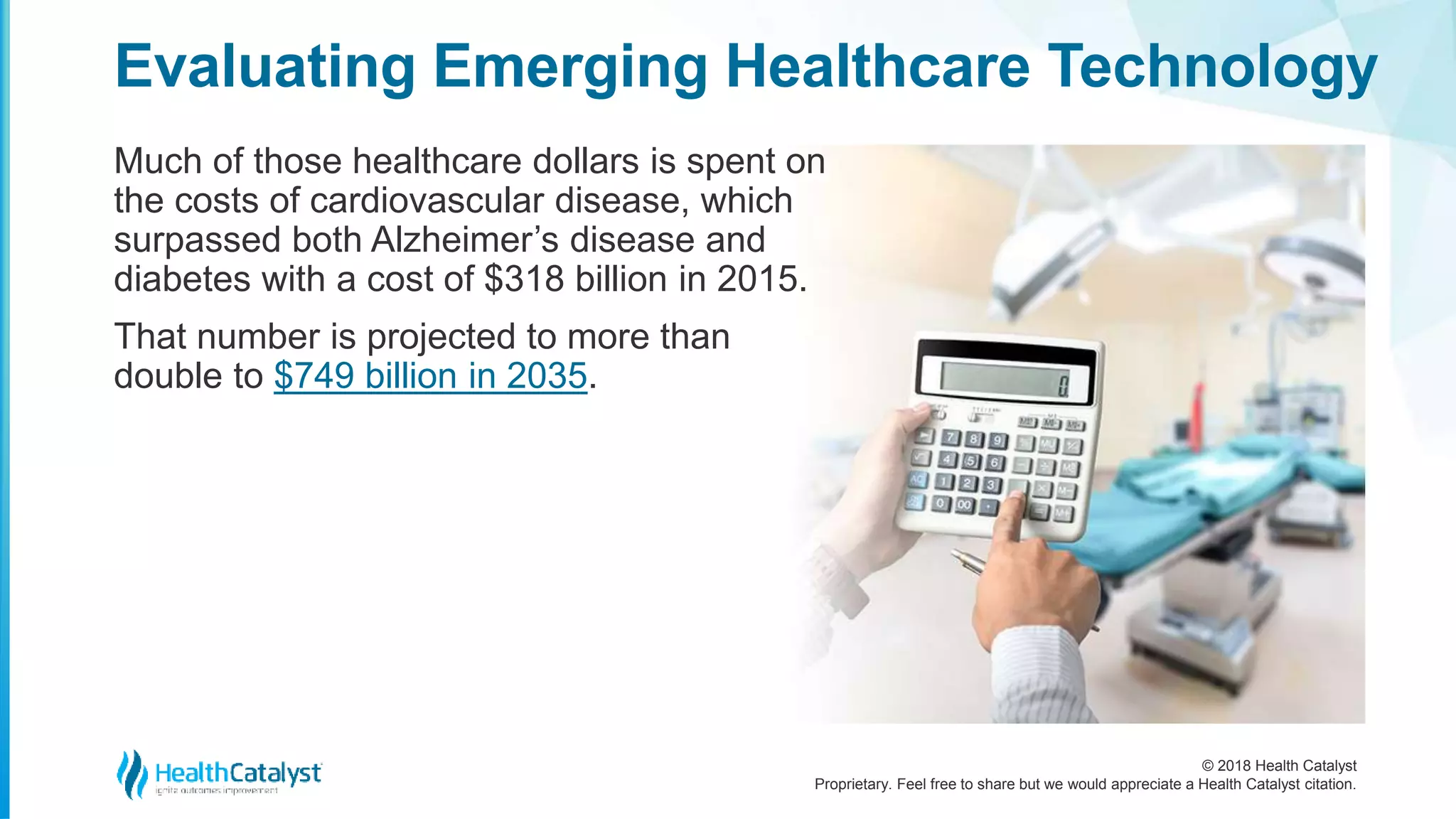
Much of those healthcare dollars is spent on
the costs of cardiovascular disease, which
surpassed both Alzheimer’s disease and
diabetes with a cost of $318 billion in 2015.
That number is projected to more than
double to $749 billion in 2035.
Evaluating Emerging Healthcare Technology
© 2018 Health Catalyst
Proprietary. Feel free to share but we would appreciate a Health Catalyst citation.
Consumers and providers are not experiencing a
great return on investment in healthcare dollars.
In fact, life expectancy in the U.S. does not
compare favorably to other countries which
spend less per capita on healthcare.
Evaluating Emerging Healthcare Technology
© 2018 Health Catalyst
Proprietary. Feel free to share but we would appreciate a Health Catalyst citation.
These skyrocketing costs have a big impact
on consumers, with premiums increasing by
74 percent from 2007 to 2017.
During that same period, employer
contributions increased by an average
of 48 percent. The impacts are also
being felt by hospitals and providers.
In 2016, 30 percent of all Medicare fee-for-
service patients were part of alternative
payment models; that number rose to 50
percent in 2018.
Evaluating Emerging Healthcare Technology
© 2018 Health Catalyst
Proprietary. Feel free to share but we would appreciate a Health Catalyst citation.
As healthcare systems are squeezed in all
directions, they need to determine how to
cut costs and still provide high-quality care.
To do so, they will need to look across the
care continuum for answers, eliminate silos,
reduce variation in care, and look to
emerging technologies.
Evaluating Emerging Healthcare Technology
© 2018 Health Catalyst
Proprietary. Feel free to share but we would appreciate a Health Catalyst citation.
There are two types of variation in healthcare:
necessary and unnecessary.
Necessary variation is deviation from
standardized care based on individual patient
characteristics resulting in improved outcomes.
Unnecessary variation does not result in a
benefit to the patient and instead increases cost.
Variation in practice patterns has been studied in
multiple conditions and the conclusion is that
higher cost regions are not associated with
improved quality or outcomes.
Importance of Identifying Variation in Innovation
© 2018 Health Catalyst
Proprietary. Feel free to share but we would appreciate a Health Catalyst citation.
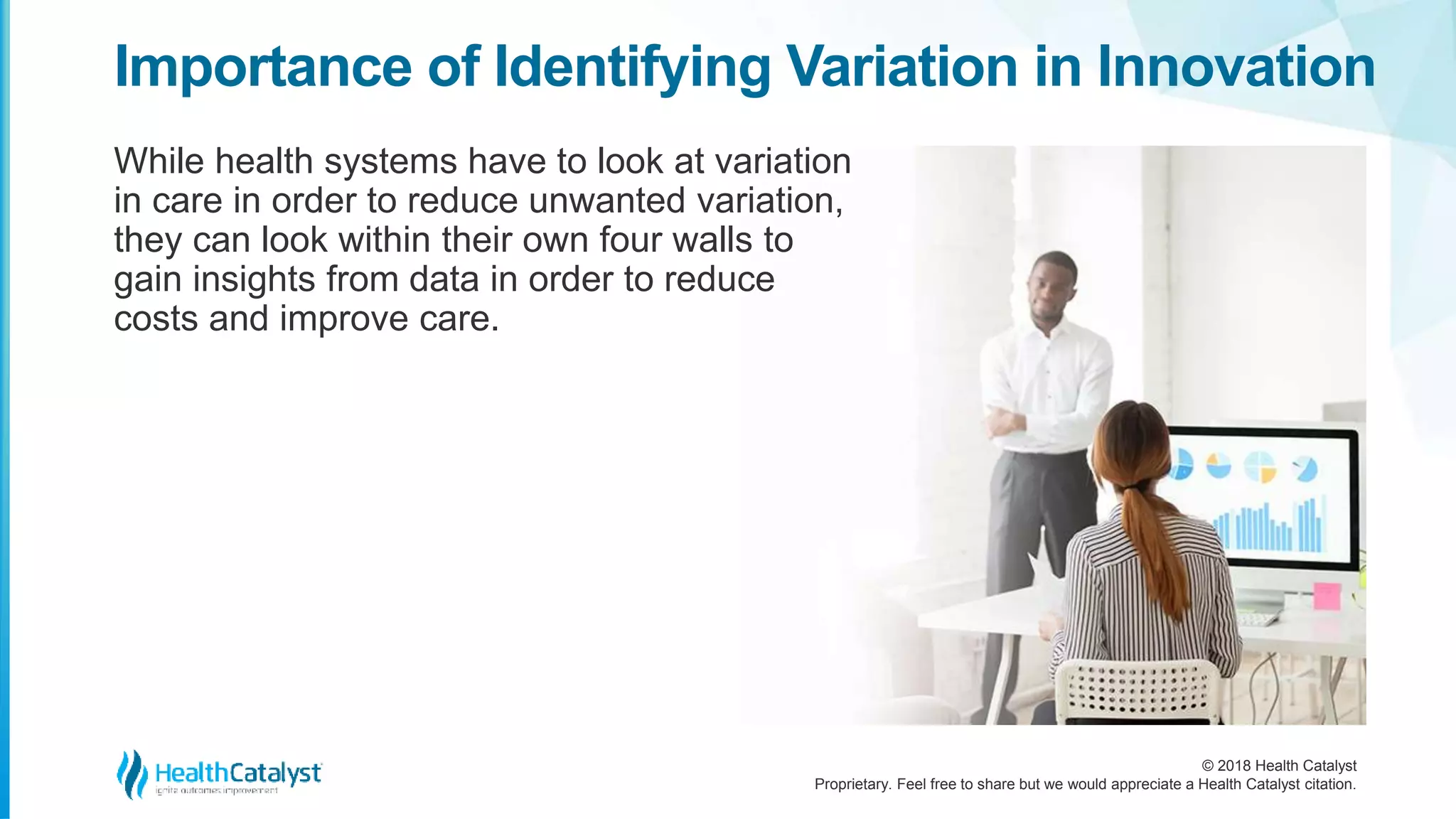
While health systems have to look at variation
in care in order to reduce unwanted variation,
they can look within their own four walls to
gain insights from data in order to reduce
costs and improve care.
Importance of Identifying Variation in Innovation
© 2018 Health Catalyst
Proprietary. Feel free to share but we would appreciate a Health Catalyst citation.
Health systems have struggled to answer the question
of how to improve outcomes and decrease costs.
New solutions are needed to answer an old problem.
Healthcare systems can focus on these four pillars of
healthcare improvement:
Population Health Management
Reduce Clinical Variation
Test New Processes of Care and Payment Models
Leverage Cutting Emerging Healthcare Technology
How to Improve Outcomes and Decrease Costs
>
>
>
>
© 2018 Health Catalyst
Proprietary. Feel free to share but we would appreciate a Health Catalyst citation.
Population Health Management
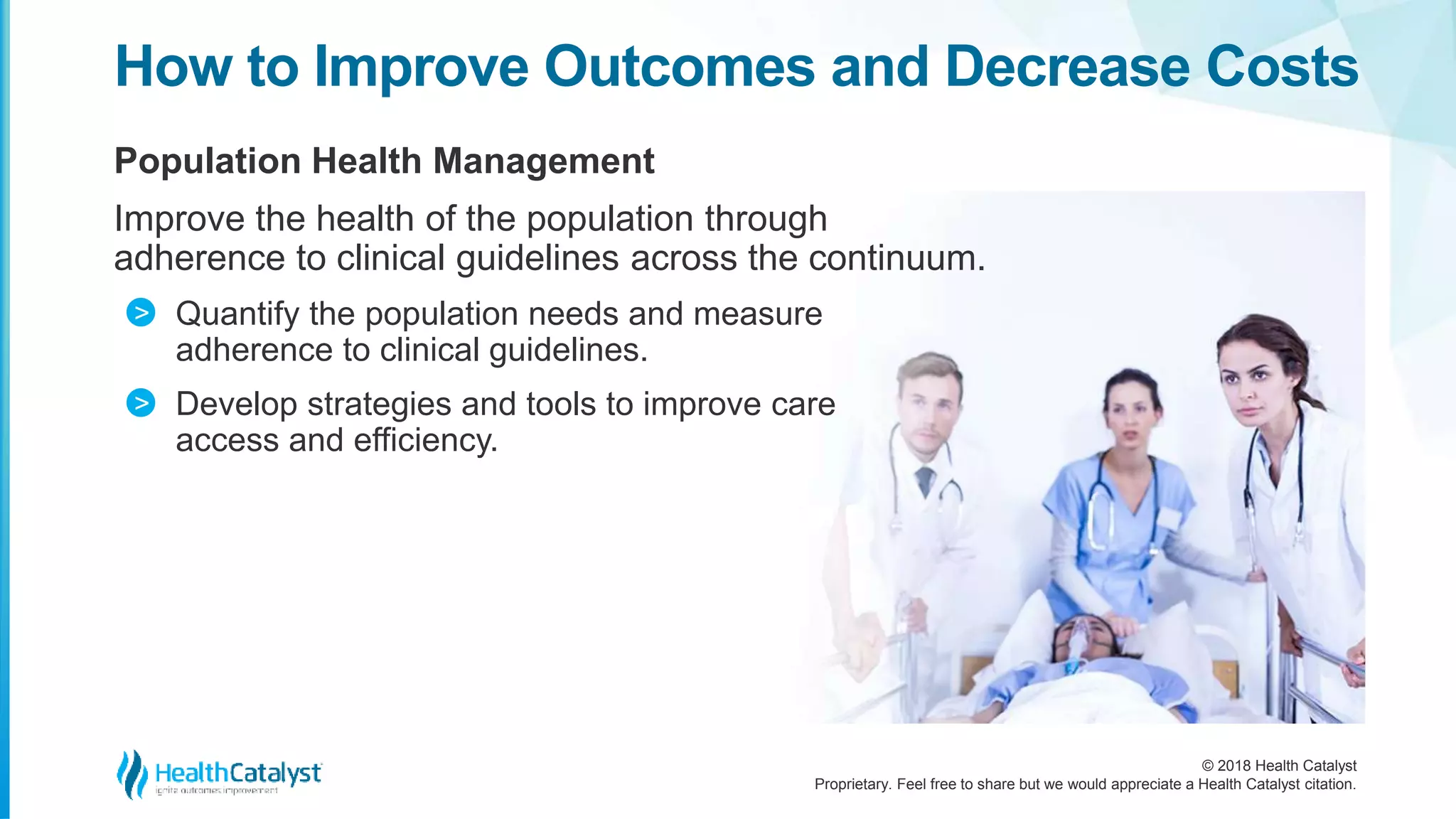
Improve the health of the population through
adherence to clinical guidelines across the continuum.
Quantify the population needs and measure
adherence to clinical guidelines.
Develop strategies and tools to improve care
access and efficiency.
How to Improve Outcomes and Decrease Costs
>
>
© 2018 Health Catalyst
Proprietary. Feel free to share but we would appreciate a Health Catalyst citation.
Reduce Clinical Variation
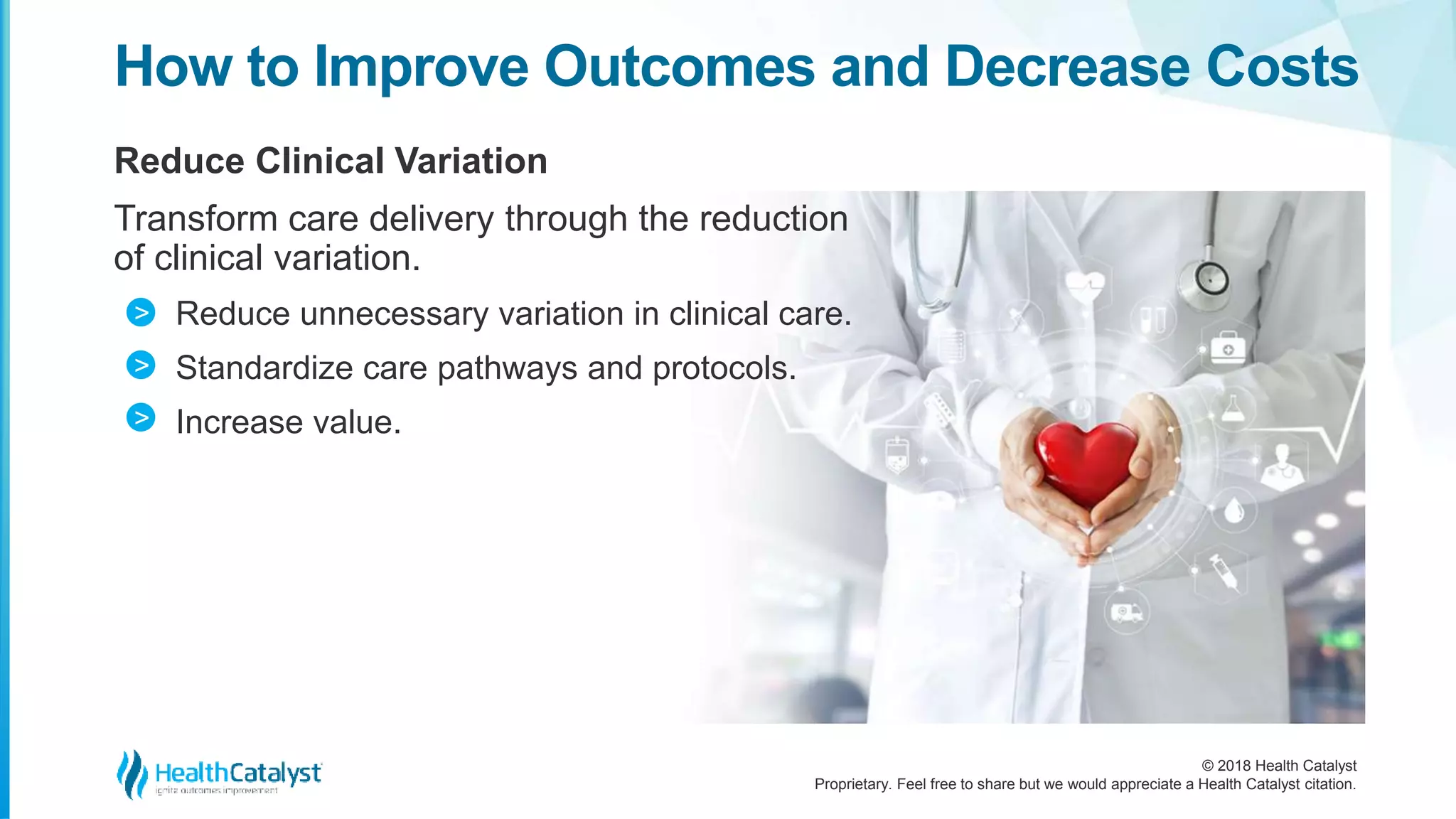
Transform care delivery through the reduction
of clinical variation.
Reduce unnecessary variation in clinical care.
Standardize care pathways and protocols.
Increase value.
How to Improve Outcomes and Decrease Costs
>
>
>
© 2018 Health Catalyst
Proprietary. Feel free to share but we would appreciate a Health Catalyst citation.
Test New Processes of Care and Payment Models
Transform care delivery by piloting new and creative
processes and payment models.
Build on existing best practice programs and protocols
to improve quality and efficiency in care delivery.
Develop and test new payment models.
How to Improve Outcomes and Decrease Costs
>
>
© 2018 Health Catalyst
Proprietary. Feel free to share but we would appreciate a Health Catalyst citation.
Leverage Cutting Emerging Healthcare Technology
Explore new ways to efficiently care for patients.
Implantable monitors.
Complex procedures and surgeries.
How to Improve Outcomes and Decrease Costs
>
>
© 2018 Health Catalyst
Proprietary. Feel free to share but we would appreciate a Health Catalyst citation.
As emerging healthcare technology comes into greater
focus, it’s important for healthcare systems to evaluate
the safety and effectiveness in order to effectively
harness new technology for better care
and reduced costs.
How to Improve Outcomes and Decrease Costs
© 2018 Health Catalyst
Proprietary. Feel free to share but we would appreciate a Health Catalyst citation.
Optimizing Care Across the Cardiovascular Continuum
Additionally, in looking for the highest impact
projects to tackle, health systems can look
to optimize care across the cardiovascular
continuum:
Primary Care
Outpatient Cardiology
Sub-Specialty Care and Emergency Services
Advanced Therapies
How to Improve Outcomes and Decrease Costs
>
>
>
>
© 2018 Health Catalyst
Proprietary. Feel free to share but we would appreciate a Health Catalyst citation.
To do all of these things effectively, healthcare
systems need a robust analytics platform.
In order to gain deep insights about the
organization, its patients, and areas to maximize
improvement, healthcare systems need a powerful
analytics platform that brings data from many
sources into a single source of truth.
This allows an improvement team to evaluate
the care that’s being provided, the impact on
outcomes, and the impact on the cost of care.
Once all the data is gathered, the next step
is to decide what information to focus on.
The Value of An Analytics Platform
© 2018 Health Catalyst
Proprietary. Feel free to share but we would appreciate a Health Catalyst citation.
Once health systems have all the data they need
brought together in an analytics platform, they
need to decide what information to focus on.
Assembling an improvement team is
necessary to evaluate and assess
ideas for improvement work.
There are many great sources of
information that spark ideas and
excitement once improvement
teams begin their work.
Reliable Information that Produces Sparks
© 2018 Health Catalyst
Proprietary. Feel free to share but we would appreciate a Health Catalyst citation.
These could include:
Financial variance analysis.
Payer contract data.
Operational variance analysis.
Data analysis.
National benchmark data.
Patient survey results.
Patient complaint reports.
Individual ideas.
Reliable Information that Produces Sparks
>
>
>
>
>
>
>
>
© 2018 Health Catalyst
Proprietary. Feel free to share but we would appreciate a Health Catalyst citation.
Sparks for improvement ideas can also come
from looking at processes, such as ideation
sessions with subject matter experts, process
mapping, or operational analysis.
The more improvement teams begin to
identify gaps in care, unintended variation,
and other high-impact improvements that
can be made, the more clinicians, frontline
leaders, and staff begin to engage in the
process and put forth new and higher
quality ideas.
Reliable Information that Produces Sparks
© 2018 Health Catalyst
Proprietary. Feel free to share but we would appreciate a Health Catalyst citation.
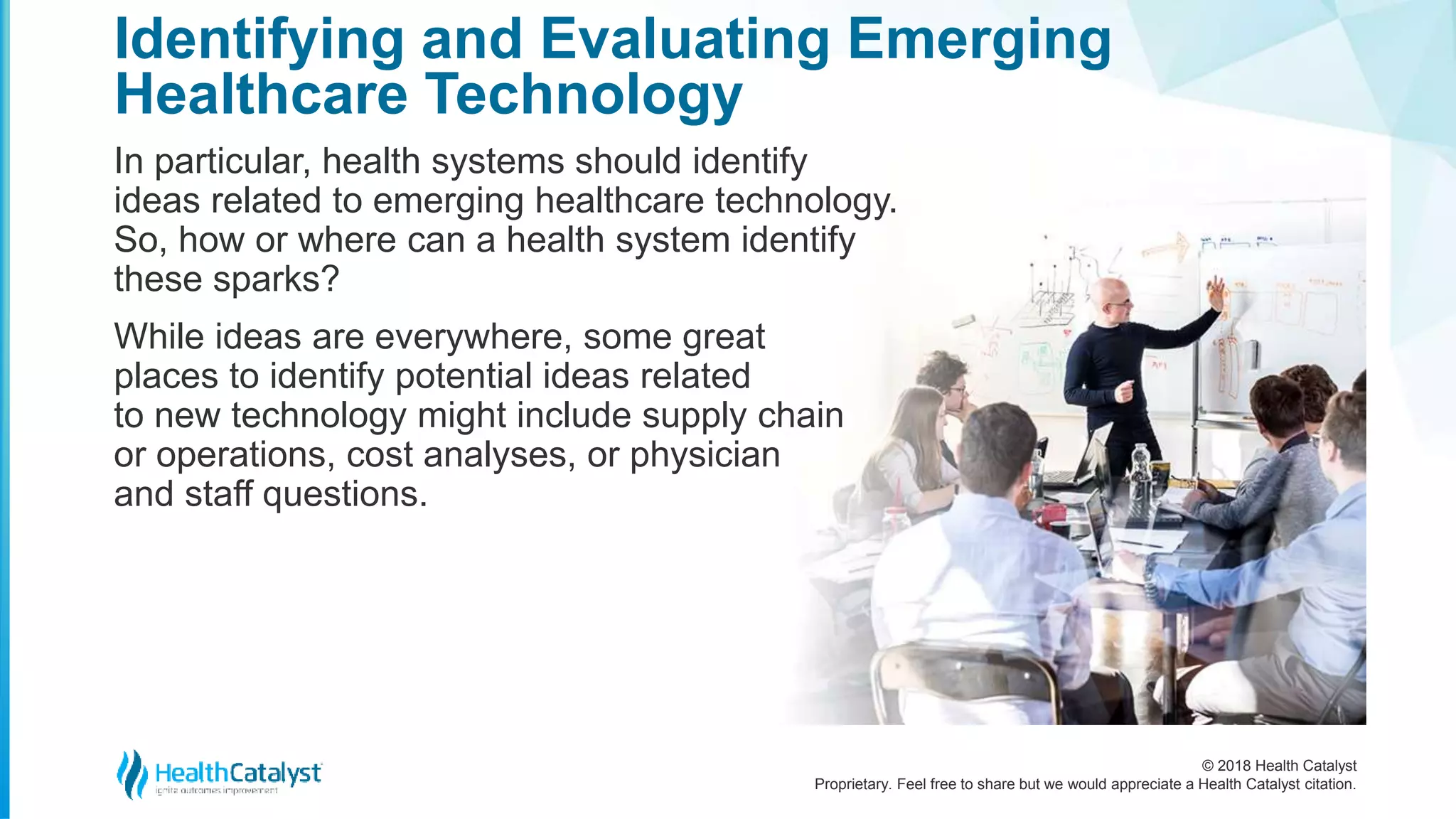
In particular, health systems should identify
ideas related to emerging healthcare technology.
So, how or where can a health system identify
these sparks?
While ideas are everywhere, some great
places to identify potential ideas related
to new technology might include supply chain
or operations, cost analyses, or physician
and staff questions.
Identifying and Evaluating Emerging
Healthcare Technology
© 2018 Health Catalyst
Proprietary. Feel free to share but we would appreciate a Health Catalyst citation.
Improvement teams need to begin by asking, “What
data should be used?”
The roadmap of an improvement journey begins there
and then might take the following path by answering
each of the questions or following the steps:
They must first create an initial hypothesis and
then look at what data is needed.
Where is the information documented: EMR,
billing, other systems?
Is it discrete?
Is it consistently documented?
Is it in the analytics platform?
Knowing What Data to Use
>
>
>
>
>
© 2018 Health Catalyst
Proprietary. Feel free to share but we would appreciate a Health Catalyst citation.
Can it be matched at the appropriate level?
(procedure v. encounter)
Run the analysis.
Do the results match the hypothesis?
What other filters need to be applied?
Rerun the analysis.
Present to stakeholders for feedback.
Add additional filters as needed.
Knowing What Data to Use
>
>
>
>
>
>
>
© 2018 Health Catalyst
Proprietary. Feel free to share but we would appreciate a Health Catalyst citation.
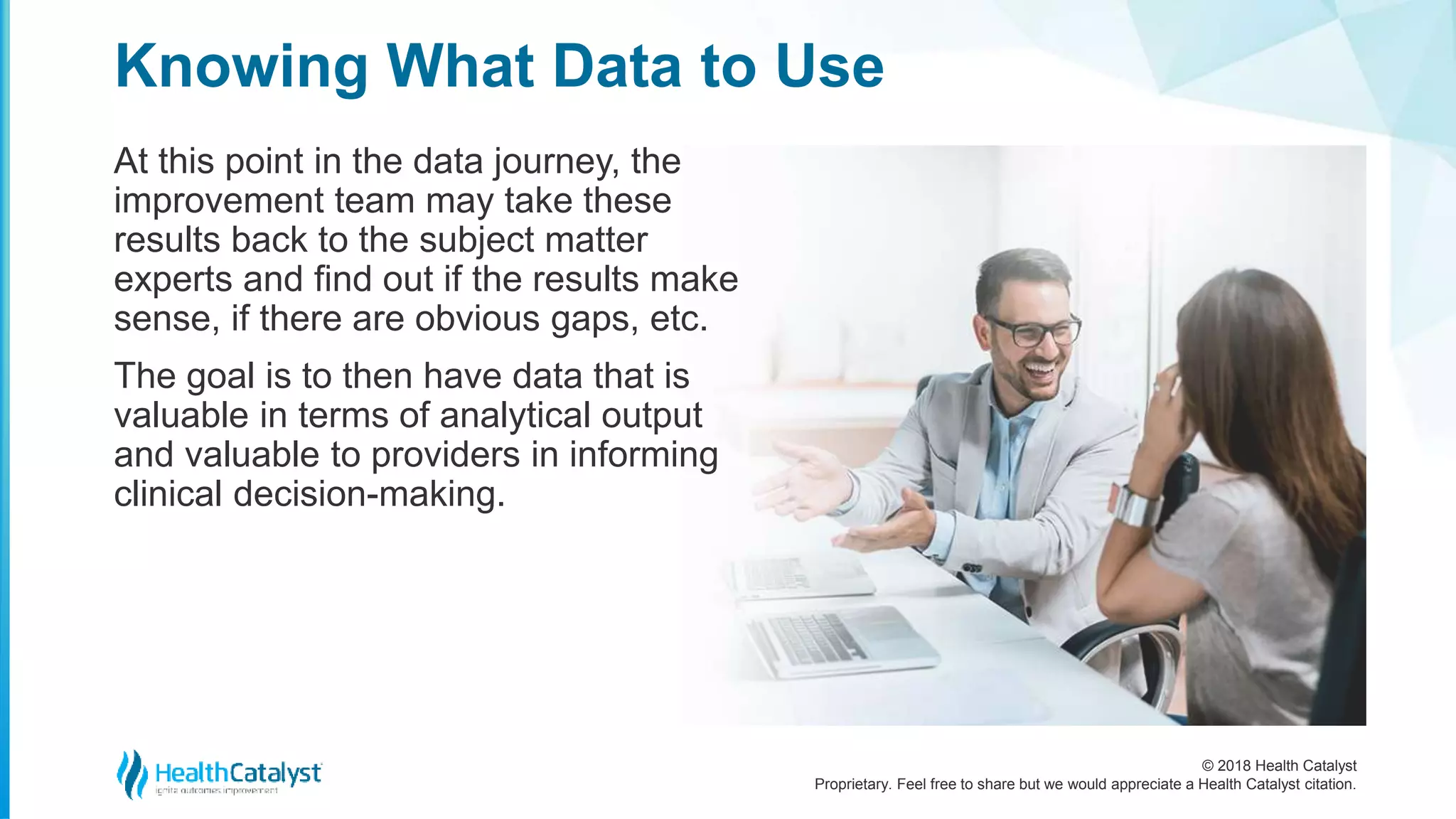
At this point in the data journey, the
improvement team may take these
results back to the subject matter
experts and find out if the results make
sense, if there are obvious gaps, etc.
The goal is to then have data that is
valuable in terms of analytical output
and valuable to providers in informing
clinical decision-making.
Knowing What Data to Use
© 2018 Health Catalyst
Proprietary. Feel free to share but we would appreciate a Health Catalyst citation.
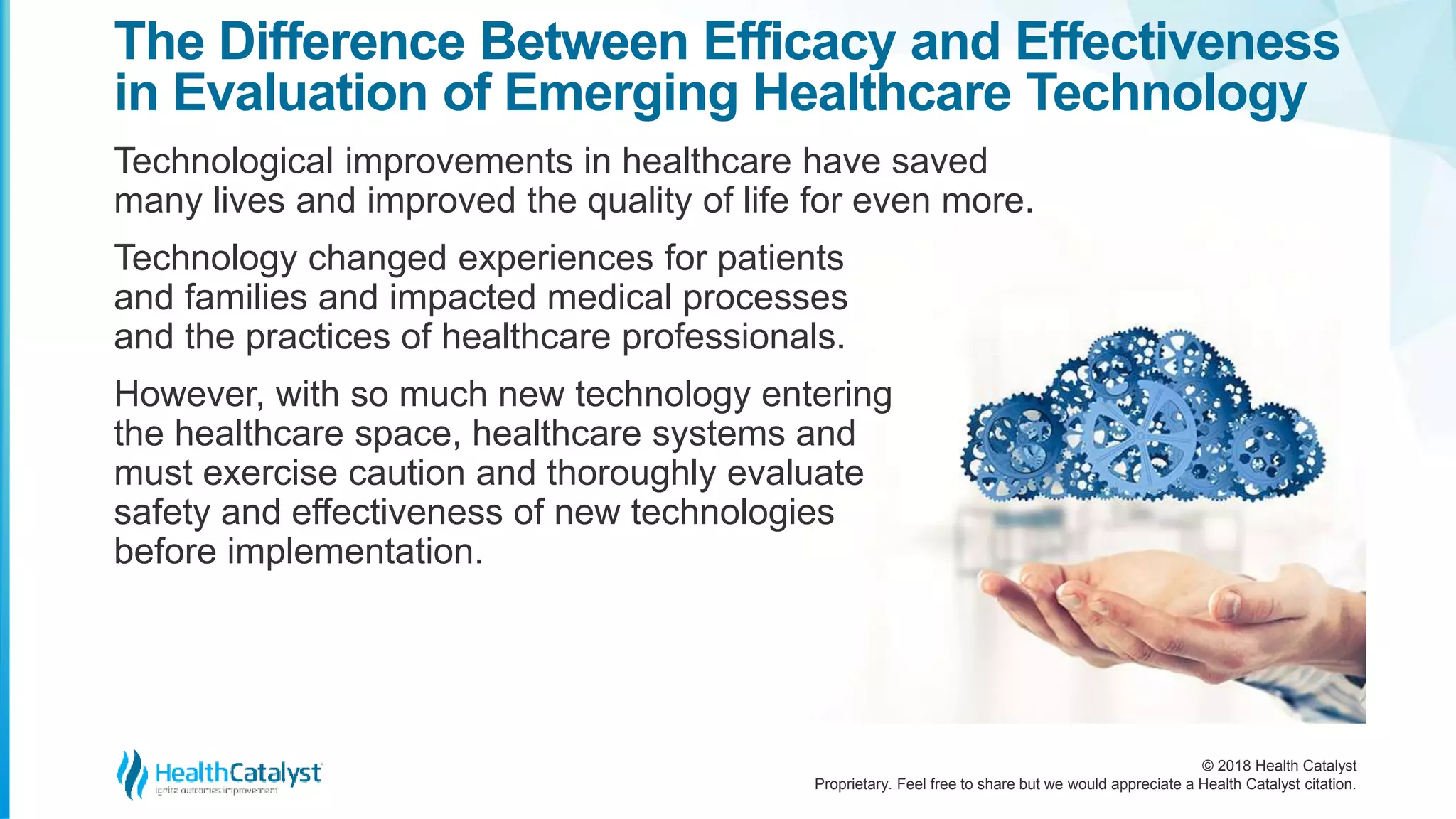
Technological improvements in healthcare have saved
many lives and improved the quality of life for even more.
Technology changed experiences for patients
and families and impacted medical processes
and the practices of healthcare professionals.
However, with so much new technology entering
the healthcare space, healthcare systems and
must exercise caution and thoroughly evaluate
safety and effectiveness of new technologies
before implementation.
The Difference Between Efficacy and Effectiveness
in Evaluation of Emerging Healthcare Technology
© 2018 Health Catalyst
Proprietary. Feel free to share but we would appreciate a Health Catalyst citation.
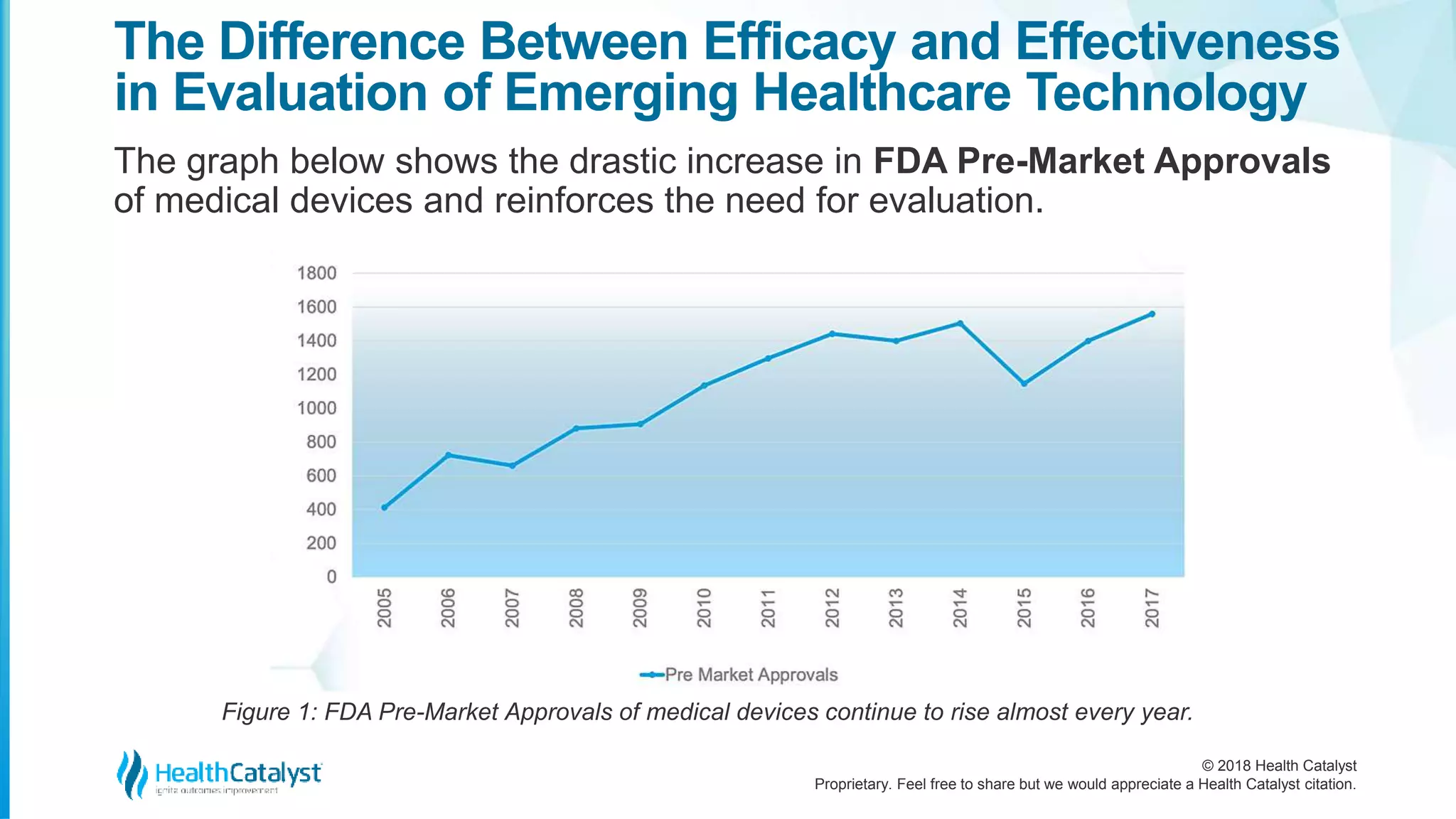
The graph below shows the drastic increase in FDA Pre-Market Approvals
of medical devices and reinforces the need for evaluation.
The Difference Between Efficacy and Effectiveness
in Evaluation of Emerging Healthcare Technology
Figure 1: FDA Pre-Market Approvals of medical devices continue to rise almost every year.
© 2018 Health Catalyst
Proprietary. Feel free to share but we would appreciate a Health Catalyst citation.
It can be difficult to strike this balance as many
medical professionals are looking for the next
shiny, new thing.
Health systems have to be able to differentiate
between case studies in specific segmented
populations versus the real-world
implementation of new technologies.
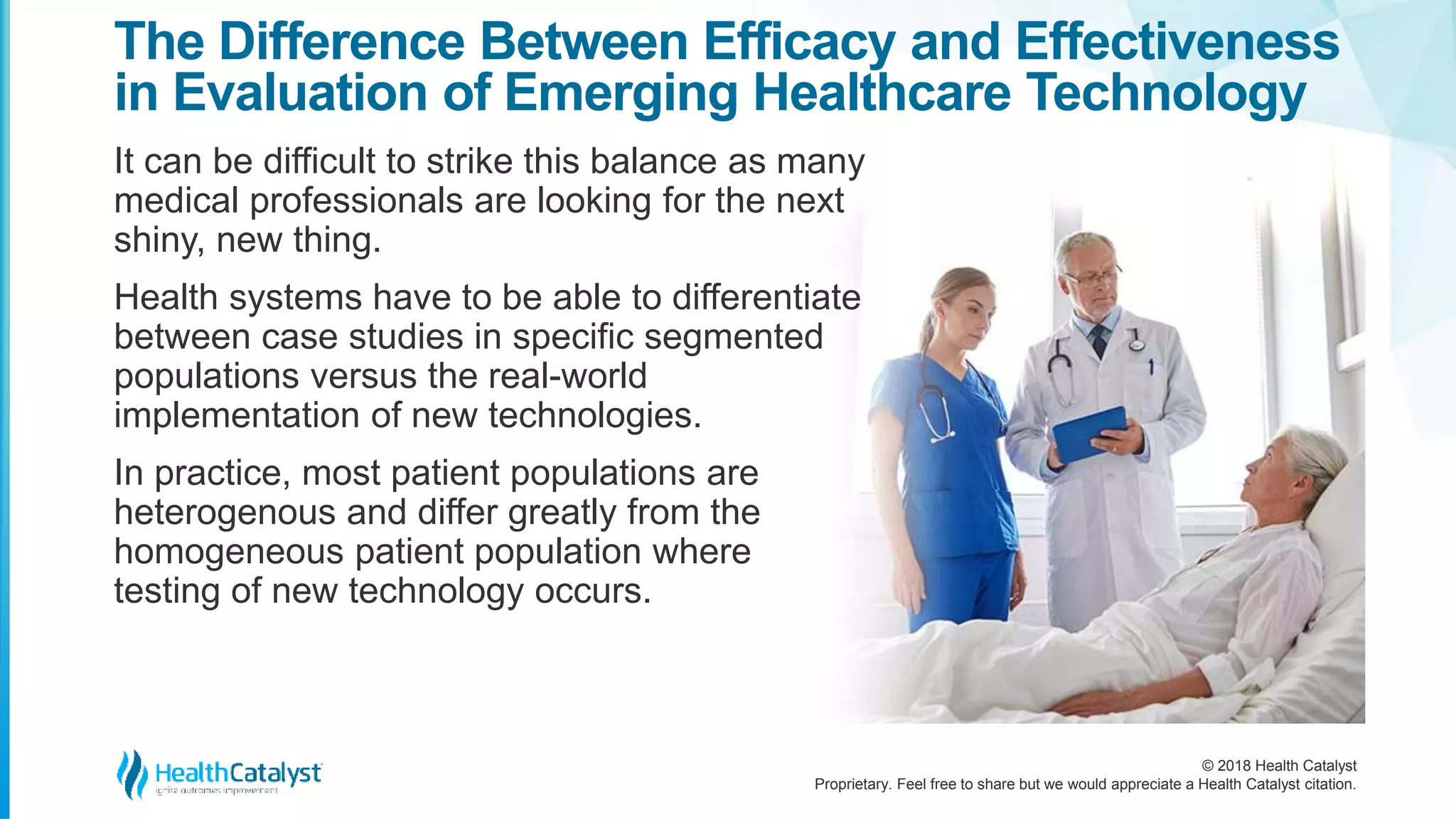
In practice, most patient populations are
heterogenous and differ greatly from the
homogeneous patient population where
testing of new technology occurs.
The Difference Between Efficacy and Effectiveness
in Evaluation of Emerging Healthcare Technology
© 2018 Health Catalyst
Proprietary. Feel free to share but we would appreciate a Health Catalyst citation.
The overarching problem in moving from efficacy
to effectiveness is understanding what new
therapies or devices will truly support
the mission of providing better quality
care, better outcomes and lower costs.
Oftentimes, new technologies, when
placed into real-world settings, will
end up being very costly and may not
provide any additional benefits for patients.
The Difference Between Efficacy and Effectiveness
in Evaluation of Emerging Healthcare Technology
© 2018 Health Catalyst
Proprietary. Feel free to share but we would appreciate a Health Catalyst citation.
Improvement teams can learn the following valuable
lessons for evaluating emerging healthcare technology:
Engage stakeholders throughout project.
Clinical expertise, operational expertise,
and data analytical expertise are critical
for success.
It’s important to be transparent about
the motivation for the project.
Health systems must have robust data
and analytics to evaluate effectiveness
in the practice setting.
Learning Key Lessons
>
>
>
>
© 2018 Health Catalyst
Proprietary. Feel free to share but we would appreciate a Health Catalyst citation.
While healthcare technology continues
to advance rapidly, sound assessment
with non-homogenous patient
populations lags significantly behind.
Ultimately, health systems need to be
able to make their own decisions
regarding implementation of emerging
healthcare technology and other
high-impact projects.
Doing so requires a robust
analytics platform.
Learning Key Lessons
© 2018 Health Catalyst
Proprietary. Feel free to share but we would appreciate a Health Catalyst citation.
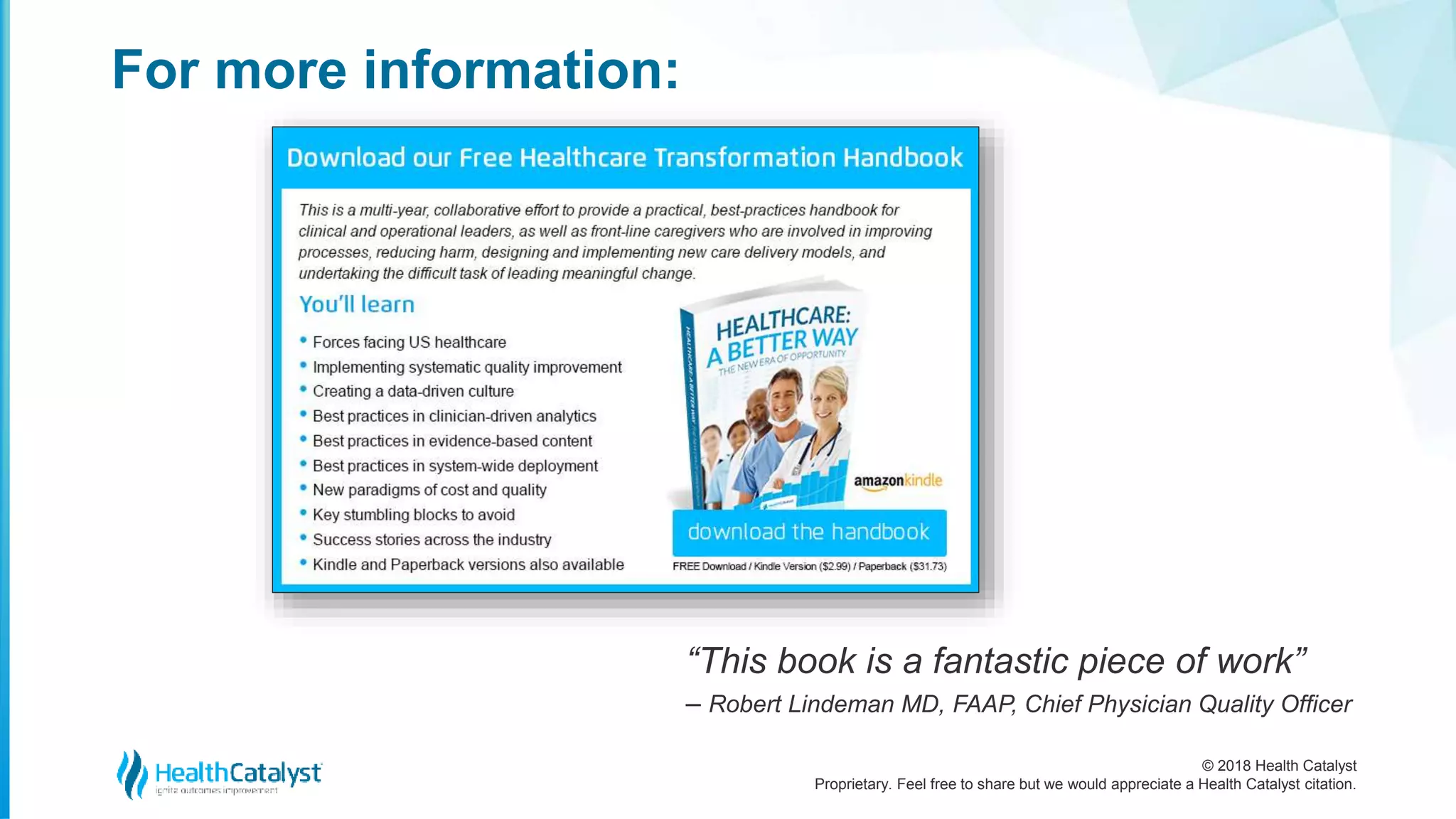
For more information:
“This book is a fantastic piece of work”
– Robert Lindeman MD, FAAP, Chief Physician Quality Officer
© 2018 Health Catalyst
Proprietary. Feel free to share but we would appreciate a Health Catalyst citation.
More about this topic
Link to original article for a more in-depth discussion.
How to Evaluate Emerging Healthcare Technology With Innovative Analytics
The Digitization of Healthcare: Why the Right Approach Matters and Five Steps to Get There
Health Catalyst Editors
The Missing Ingredient in Healthcare Analytics: The Executive Sponsor
Ryan Smith, SVP, Professional Services
How to Achieve Your Clinical Data Analytics Goals
Elaine St. James, BSN, RN, CPHQ, Patient Safety Services; Josh Ferguson, Clinical Outcomes Improvement, Director
Nancy Casazza, BSN, MMI, RN, Clinical Outcomes Improvement, Director
Healthcare NLP: Four Essentials to Make the Most of Unstructured Data
Mike Dow, Technical Director
The Number One Secret of Highly Effective Healthcare Data Analysts
Sarah Provan, BS, Operations ASO, VP; Caitlin Kelly, Clinical Data Analyst
© 2018 Health Catalyst
Proprietary. Feel free to share but we would appreciate a Health Catalyst citation.
Other Clinical Quality Improvement Resources
Click to read additional information at www.healthcatalyst.com
Health Catalyst is a mission-driven data warehousing, analytics and outcomes-improvement company
that helps healthcare organizations of all sizes improve clinical, financial, and operational outcomes
needed to improve population health and accountable care. Our proven enterprise data warehouse
(EDW) and analytics platform helps improve quality, add efficiency and lower costs in support of more
than 65 million patients for organizations ranging from the largest US health system to forward-thinking
physician practices.
Health Catalyst was recently named as the leader in the enterprise healthcare BI market in
improvement by KLAS, and has received numerous best-place-to work awards including Modern
Healthcare in 2013, 2014, and 2015, as well as other recognitions such as “Best Place to work for
Millenials, and a “Best Perks for Women.”

How to Evaluate Emerging Healthcare Technology with Innovative Analytics

  • 1.
    How to EvaluateEmerging Healthcare Technology With Innovative Analytics
  • 2.
    © 2018 HealthCatalyst Proprietary. Feel free to share but we would appreciate a Health Catalyst citation. Evaluating Emerging Healthcare Technology This report is based on a 2018 Healthcare Analytics Summit presentation entitled, “Innovative Analytics: Using Analytics to Evaluate Emerging Technologies
  • 3.
    © 2018 HealthCatalyst Proprietary. Feel free to share but we would appreciate a Health Catalyst citation. U.S. healthcare spending alone is larger than the gross domestic product of most nations. Total health spending in the U.S. was $3.5 trillion in 2017 and is projected to grow by an average of 5.5 percent annually from 2017 to 2026. If all U.S. healthcare spending was separated into its own sovereign nation, it would constitute the fifth largest economy in the world. Evaluating Emerging Healthcare Technology
  • 4.
    © 2018 HealthCatalyst Proprietary. Feel free to share but we would appreciate a Health Catalyst citation. Much of those healthcare dollars is spent on the costs of cardiovascular disease, which surpassed both Alzheimer’s disease and diabetes with a cost of $318 billion in 2015. That number is projected to more than double to $749 billion in 2035. Evaluating Emerging Healthcare Technology
  • 5.
    © 2018 HealthCatalyst Proprietary. Feel free to share but we would appreciate a Health Catalyst citation. Consumers and providers are not experiencing a great return on investment in healthcare dollars. In fact, life expectancy in the U.S. does not compare favorably to other countries which spend less per capita on healthcare. Evaluating Emerging Healthcare Technology
  • 6.
    © 2018 HealthCatalyst Proprietary. Feel free to share but we would appreciate a Health Catalyst citation. These skyrocketing costs have a big impact on consumers, with premiums increasing by 74 percent from 2007 to 2017. During that same period, employer contributions increased by an average of 48 percent. The impacts are also being felt by hospitals and providers. In 2016, 30 percent of all Medicare fee-for- service patients were part of alternative payment models; that number rose to 50 percent in 2018. Evaluating Emerging Healthcare Technology
  • 7.
    © 2018 HealthCatalyst Proprietary. Feel free to share but we would appreciate a Health Catalyst citation. As healthcare systems are squeezed in all directions, they need to determine how to cut costs and still provide high-quality care. To do so, they will need to look across the care continuum for answers, eliminate silos, reduce variation in care, and look to emerging technologies. Evaluating Emerging Healthcare Technology
  • 8.
    © 2018 HealthCatalyst Proprietary. Feel free to share but we would appreciate a Health Catalyst citation. There are two types of variation in healthcare: necessary and unnecessary. Necessary variation is deviation from standardized care based on individual patient characteristics resulting in improved outcomes. Unnecessary variation does not result in a benefit to the patient and instead increases cost. Variation in practice patterns has been studied in multiple conditions and the conclusion is that higher cost regions are not associated with improved quality or outcomes. Importance of Identifying Variation in Innovation
  • 9.
    © 2018 HealthCatalyst Proprietary. Feel free to share but we would appreciate a Health Catalyst citation. While health systems have to look at variation in care in order to reduce unwanted variation, they can look within their own four walls to gain insights from data in order to reduce costs and improve care. Importance of Identifying Variation in Innovation
  • 10.
    © 2018 HealthCatalyst Proprietary. Feel free to share but we would appreciate a Health Catalyst citation. Health systems have struggled to answer the question of how to improve outcomes and decrease costs. New solutions are needed to answer an old problem. Healthcare systems can focus on these four pillars of healthcare improvement: Population Health Management Reduce Clinical Variation Test New Processes of Care and Payment Models Leverage Cutting Emerging Healthcare Technology How to Improve Outcomes and Decrease Costs > > > >
  • 11.
    © 2018 HealthCatalyst Proprietary. Feel free to share but we would appreciate a Health Catalyst citation. Population Health Management Improve the health of the population through adherence to clinical guidelines across the continuum. Quantify the population needs and measure adherence to clinical guidelines. Develop strategies and tools to improve care access and efficiency. How to Improve Outcomes and Decrease Costs > >
  • 12.
    © 2018 HealthCatalyst Proprietary. Feel free to share but we would appreciate a Health Catalyst citation. Reduce Clinical Variation Transform care delivery through the reduction of clinical variation. Reduce unnecessary variation in clinical care. Standardize care pathways and protocols. Increase value. How to Improve Outcomes and Decrease Costs > > >
  • 13.
    © 2018 HealthCatalyst Proprietary. Feel free to share but we would appreciate a Health Catalyst citation. Test New Processes of Care and Payment Models Transform care delivery by piloting new and creative processes and payment models. Build on existing best practice programs and protocols to improve quality and efficiency in care delivery. Develop and test new payment models. How to Improve Outcomes and Decrease Costs > >
  • 14.
    © 2018 HealthCatalyst Proprietary. Feel free to share but we would appreciate a Health Catalyst citation. Leverage Cutting Emerging Healthcare Technology Explore new ways to efficiently care for patients. Implantable monitors. Complex procedures and surgeries. How to Improve Outcomes and Decrease Costs > >
  • 15.
    © 2018 HealthCatalyst Proprietary. Feel free to share but we would appreciate a Health Catalyst citation. As emerging healthcare technology comes into greater focus, it’s important for healthcare systems to evaluate the safety and effectiveness in order to effectively harness new technology for better care and reduced costs. How to Improve Outcomes and Decrease Costs
  • 16.
    © 2018 HealthCatalyst Proprietary. Feel free to share but we would appreciate a Health Catalyst citation. Optimizing Care Across the Cardiovascular Continuum Additionally, in looking for the highest impact projects to tackle, health systems can look to optimize care across the cardiovascular continuum: Primary Care Outpatient Cardiology Sub-Specialty Care and Emergency Services Advanced Therapies How to Improve Outcomes and Decrease Costs > > > >
  • 17.
    © 2018 HealthCatalyst Proprietary. Feel free to share but we would appreciate a Health Catalyst citation. To do all of these things effectively, healthcare systems need a robust analytics platform. In order to gain deep insights about the organization, its patients, and areas to maximize improvement, healthcare systems need a powerful analytics platform that brings data from many sources into a single source of truth. This allows an improvement team to evaluate the care that’s being provided, the impact on outcomes, and the impact on the cost of care. Once all the data is gathered, the next step is to decide what information to focus on. The Value of An Analytics Platform
  • 18.
    © 2018 HealthCatalyst Proprietary. Feel free to share but we would appreciate a Health Catalyst citation. Once health systems have all the data they need brought together in an analytics platform, they need to decide what information to focus on. Assembling an improvement team is necessary to evaluate and assess ideas for improvement work. There are many great sources of information that spark ideas and excitement once improvement teams begin their work. Reliable Information that Produces Sparks
  • 19.
    © 2018 HealthCatalyst Proprietary. Feel free to share but we would appreciate a Health Catalyst citation. These could include: Financial variance analysis. Payer contract data. Operational variance analysis. Data analysis. National benchmark data. Patient survey results. Patient complaint reports. Individual ideas. Reliable Information that Produces Sparks > > > > > > > >
  • 20.
    © 2018 HealthCatalyst Proprietary. Feel free to share but we would appreciate a Health Catalyst citation. Sparks for improvement ideas can also come from looking at processes, such as ideation sessions with subject matter experts, process mapping, or operational analysis. The more improvement teams begin to identify gaps in care, unintended variation, and other high-impact improvements that can be made, the more clinicians, frontline leaders, and staff begin to engage in the process and put forth new and higher quality ideas. Reliable Information that Produces Sparks
  • 21.
    © 2018 HealthCatalyst Proprietary. Feel free to share but we would appreciate a Health Catalyst citation. In particular, health systems should identify ideas related to emerging healthcare technology. So, how or where can a health system identify these sparks? While ideas are everywhere, some great places to identify potential ideas related to new technology might include supply chain or operations, cost analyses, or physician and staff questions. Identifying and Evaluating Emerging Healthcare Technology
  • 22.
    © 2018 HealthCatalyst Proprietary. Feel free to share but we would appreciate a Health Catalyst citation. Improvement teams need to begin by asking, “What data should be used?” The roadmap of an improvement journey begins there and then might take the following path by answering each of the questions or following the steps: They must first create an initial hypothesis and then look at what data is needed. Where is the information documented: EMR, billing, other systems? Is it discrete? Is it consistently documented? Is it in the analytics platform? Knowing What Data to Use > > > > >
  • 23.
    © 2018 HealthCatalyst Proprietary. Feel free to share but we would appreciate a Health Catalyst citation. Can it be matched at the appropriate level? (procedure v. encounter) Run the analysis. Do the results match the hypothesis? What other filters need to be applied? Rerun the analysis. Present to stakeholders for feedback. Add additional filters as needed. Knowing What Data to Use > > > > > > >
  • 24.
    © 2018 HealthCatalyst Proprietary. Feel free to share but we would appreciate a Health Catalyst citation. At this point in the data journey, the improvement team may take these results back to the subject matter experts and find out if the results make sense, if there are obvious gaps, etc. The goal is to then have data that is valuable in terms of analytical output and valuable to providers in informing clinical decision-making. Knowing What Data to Use
  • 25.
    © 2018 HealthCatalyst Proprietary. Feel free to share but we would appreciate a Health Catalyst citation. Technological improvements in healthcare have saved many lives and improved the quality of life for even more. Technology changed experiences for patients and families and impacted medical processes and the practices of healthcare professionals. However, with so much new technology entering the healthcare space, healthcare systems and must exercise caution and thoroughly evaluate safety and effectiveness of new technologies before implementation. The Difference Between Efficacy and Effectiveness in Evaluation of Emerging Healthcare Technology
  • 26.
    © 2018 HealthCatalyst Proprietary. Feel free to share but we would appreciate a Health Catalyst citation. The graph below shows the drastic increase in FDA Pre-Market Approvals of medical devices and reinforces the need for evaluation. The Difference Between Efficacy and Effectiveness in Evaluation of Emerging Healthcare Technology Figure 1: FDA Pre-Market Approvals of medical devices continue to rise almost every year.
  • 27.
    © 2018 HealthCatalyst Proprietary. Feel free to share but we would appreciate a Health Catalyst citation. It can be difficult to strike this balance as many medical professionals are looking for the next shiny, new thing. Health systems have to be able to differentiate between case studies in specific segmented populations versus the real-world implementation of new technologies. In practice, most patient populations are heterogenous and differ greatly from the homogeneous patient population where testing of new technology occurs. The Difference Between Efficacy and Effectiveness in Evaluation of Emerging Healthcare Technology
  • 28.
    © 2018 HealthCatalyst Proprietary. Feel free to share but we would appreciate a Health Catalyst citation. The overarching problem in moving from efficacy to effectiveness is understanding what new therapies or devices will truly support the mission of providing better quality care, better outcomes and lower costs. Oftentimes, new technologies, when placed into real-world settings, will end up being very costly and may not provide any additional benefits for patients. The Difference Between Efficacy and Effectiveness in Evaluation of Emerging Healthcare Technology
  • 29.
    © 2018 HealthCatalyst Proprietary. Feel free to share but we would appreciate a Health Catalyst citation. Improvement teams can learn the following valuable lessons for evaluating emerging healthcare technology: Engage stakeholders throughout project. Clinical expertise, operational expertise, and data analytical expertise are critical for success. It’s important to be transparent about the motivation for the project. Health systems must have robust data and analytics to evaluate effectiveness in the practice setting. Learning Key Lessons > > > >
  • 30.
    © 2018 HealthCatalyst Proprietary. Feel free to share but we would appreciate a Health Catalyst citation. While healthcare technology continues to advance rapidly, sound assessment with non-homogenous patient populations lags significantly behind. Ultimately, health systems need to be able to make their own decisions regarding implementation of emerging healthcare technology and other high-impact projects. Doing so requires a robust analytics platform. Learning Key Lessons
  • 31.
    © 2018 HealthCatalyst Proprietary. Feel free to share but we would appreciate a Health Catalyst citation. For more information: “This book is a fantastic piece of work” – Robert Lindeman MD, FAAP, Chief Physician Quality Officer
  • 32.
    © 2018 HealthCatalyst Proprietary. Feel free to share but we would appreciate a Health Catalyst citation. More about this topic Link to original article for a more in-depth discussion. How to Evaluate Emerging Healthcare Technology With Innovative Analytics The Digitization of Healthcare: Why the Right Approach Matters and Five Steps to Get There Health Catalyst Editors The Missing Ingredient in Healthcare Analytics: The Executive Sponsor Ryan Smith, SVP, Professional Services How to Achieve Your Clinical Data Analytics Goals Elaine St. James, BSN, RN, CPHQ, Patient Safety Services; Josh Ferguson, Clinical Outcomes Improvement, Director Nancy Casazza, BSN, MMI, RN, Clinical Outcomes Improvement, Director Healthcare NLP: Four Essentials to Make the Most of Unstructured Data Mike Dow, Technical Director The Number One Secret of Highly Effective Healthcare Data Analysts Sarah Provan, BS, Operations ASO, VP; Caitlin Kelly, Clinical Data Analyst
  • 33.
    © 2018 HealthCatalyst Proprietary. Feel free to share but we would appreciate a Health Catalyst citation. Other Clinical Quality Improvement Resources Click to read additional information at www.healthcatalyst.com Health Catalyst is a mission-driven data warehousing, analytics and outcomes-improvement company that helps healthcare organizations of all sizes improve clinical, financial, and operational outcomes needed to improve population health and accountable care. Our proven enterprise data warehouse (EDW) and analytics platform helps improve quality, add efficiency and lower costs in support of more than 65 million patients for organizations ranging from the largest US health system to forward-thinking physician practices. Health Catalyst was recently named as the leader in the enterprise healthcare BI market in improvement by KLAS, and has received numerous best-place-to work awards including Modern Healthcare in 2013, 2014, and 2015, as well as other recognitions such as “Best Place to work for Millenials, and a “Best Perks for Women.”