© Health Catalyst. Confidential and Proprietary.
Addressing Key Challenges in Ambulatory Settings
Strategic Solutions for Workforce, Integration, Access, Value-Based Care, and MSO Services
© Health Catalyst. Confidential and Proprietary.
Today's Speakers
Holly Burke
SVP of Practice Management
and Physician Solutions
Sarah Roberts
SVP of Ambulatory Practice
Management
Travis Simar
VP of Population Health and
Payer Services
Agenda
© Health Catalyst. Confidential and Proprietary.
1. Optimizing Physician Workflow and Autonomy
2. Navigating the Impact of Healthcare Integration
3. Balancing Patient Access with Available Resources
4. Best Approaches to Align with Payor Requirements in
Value-Based Care
5. Enhancing Operational Efficiency for Managed Service
Organizations (MSOs)
© Health Catalyst. Confidential and Proprietary.
Optimizing Physician
Workflow and
Autonomy
© Health Catalyst. Confidential and Proprietary.
Poll Question #1
Within your organization you are utilizing data to manage
your ambulatory operations in the following areas:
a) Physician Productivity
b) Template management
c) Referral Leakage
d) Third Next Available
e) Encounter Count and Unique Patient Counts
f) Support Staff Labor Management
g) Revenue Cycle - Billing/Coding Variations
© Health Catalyst. Confidential and Proprietary.
"The impact of COVID, the aging
population, and provider shortages have
created a burning platform for health systems
to address the need to adjust their relationship
with physicians."
Workforce Management
© Health Catalyst. Confidential and Proprietary.
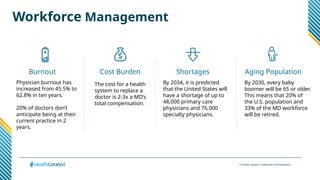
Workforce Management
Burnout Cost Burden Shortages
Physician burnout has
increased from 45.5% to
62.8% in ten years.
20% of doctors don’t
anticipate being at their
current practice in 2
years.
The cost for a health
system to replace a
doctor is 2-3x a MD’s
total compensation.
Aging Population
By 2034, it is predicted
that the United States will
have a shortage of up to
48,000 primary care
physicians and 76,000
specialty physicians.
By 2030, every baby
boomer will be 65 or older.
This means that 20% of
the U.S. population and
33% of the MD workforce
will be retired.
© Health Catalyst. Confidential and Proprietary.
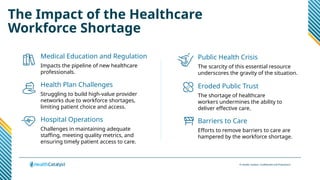
Medical Education and Regulation
Impacts the pipeline of new healthcare
professionals.
Health Plan Challenges
Struggling to build high-value provider
networks due to workforce shortages,
limiting patient choice and access.
Hospital Operations
Challenges in maintaining adequate
staffing, meeting quality metrics, and
ensuring timely patient access to care.
The Impact of the Healthcare
Workforce Shortage
Public Health Crisis
The scarcity of this essential resource
underscores the gravity of the situation.
Eroded Public Trust
The shortage of healthcare
workers undermines the ability to
deliver effective care.
Barriers to Care
Efforts to remove barriers to care are
hampered by the workforce shortage.
© Health Catalyst. Confidential and Proprietary.
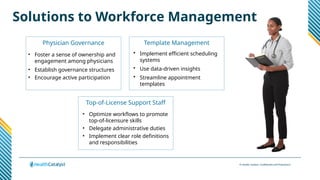
Solutions to Workforce Management
Template Management
• Implement efficient scheduling
systems
• Use data-driven insights
• Streamline appointment
templates
Top-of-License Support Staff
• Optimize workflows to promote
top-of-licensure skills
• Delegate administrative duties
• Implement clear role definitions
and responsibilities
Physician Governance
• Foster a sense of ownership and
engagement among physicians
• Establish governance structures
• Encourage active participation
© Health Catalyst. Confidential and Proprietary.
Solutions to Workforce Management
Physician Leadership
• Provide leadership roles
through committees
• Encourage participation in
practice management
• Cultivate a sense of ownership
in clinic operations
Aligned Compensation Plans
• Design compensation plans that
align with practice goals
• Incentivize contributions toward
strategic objectives
• Promote performance and
alignment among clinicians
Continuous Learning
• Invest in ongoing education and
training programs
• Stay informed of industry trends
• Expand contributions to practice
through continuous professional
development.
© Health Catalyst. Confidential and Proprietary.
Navigating the Impact of
Healthcare Integration
© Health Catalyst. Confidential and Proprietary.
Poll Question #2
Within your organization the following leaders are
responsible for governing decision making
for the ambulatory operations?
a) CEO/ CAO
b) COO
c) CMO/ Medical Director
d) Physician Leaders
e) Director of the Clinics
f) Manager of the Clinics
© Health Catalyst. Confidential and Proprietary.
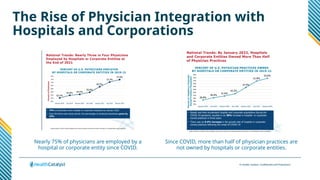
The Rise of Physician Integration with
Hospitals and Corporations
Nearly 75% of physicians are employed by a
hospital or corporate entity since COVID.
Since COVID, more than half of physician practices are
not owned by hospitals or corporate entities.
© Health Catalyst. Confidential and Proprietary.
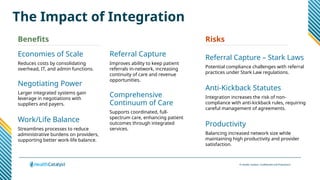
The Impact of Integration
Economies of Scale
Reduces costs by consolidating
overhead, IT, and admin functions.
Negotiating Power
Larger integrated systems gain
leverage in negotiations with
suppliers and payers.
Work/Life Balance
Streamlines processes to reduce
administrative burdens on providers,
supporting better work-life balance.
Referral Capture
Improves ability to keep patient
referrals in-network, increasing
continuity of care and revenue
opportunities.
Comprehensive
Continuum of Care
Supports coordinated, full-
spectrum care, enhancing patient
outcomes through integrated
services.
Referral Capture – Stark Laws
Potential compliance challenges with referral
practices under Stark Law regulations.
Anti-Kickback Statutes
Integration increases the risk of non-
compliance with anti-kickback rules, requiring
careful management of agreements.
Productivity
Balancing increased network size while
maintaining high productivity and provider
satisfaction.
Benefits Risks
© Health Catalyst. Confidential and Proprietary.
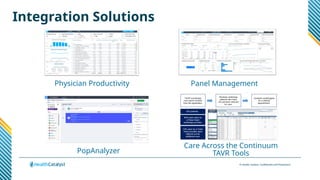
Integration Solutions
Care Across the Continuum
TAVR Tools
Physician Productivity
PopAnalyzer
Panel Management
© Health Catalyst. Confidential and Proprietary.
Balancing Patient
Access with Available
Resources
© Health Catalyst. Confidential and Proprietary.
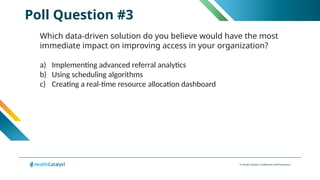
Poll Question #3
Which data-driven solution do you believe would have the most
immediate impact on improving access in your organization?
a) Implementing advanced referral analytics
b) Using scheduling algorithms
c) Creating a real-time resource allocation dashboard
© Health Catalyst. Confidential and Proprietary.
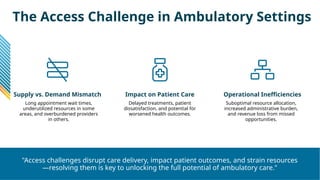
The Access Challenge in Ambulatory Settings
Supply vs. Demand Mismatch
Long appointment wait times,
underutilized resources in some
areas, and overburdened providers
in others.
Impact on Patient Care
Delayed treatments, patient
dissatisfaction, and potential for
worsened health outcomes.
Operational Inefficiencies
Suboptimal resource allocation,
increased administrative burden,
and revenue loss from missed
opportunities.
"Access challenges disrupt care delivery, impact patient outcomes, and strain resources
—resolving them is key to unlocking the full potential of ambulatory care."
© Health Catalyst. Confidential and Proprietary.
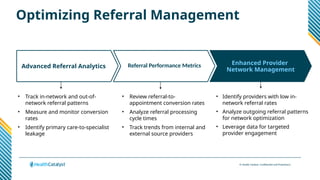
Optimizing Referral Management
Advanced Referral Analytics
• Track in-network and out-of-
network referral patterns
• Measure and monitor conversion
rates
• Identify primary care-to-specialist
leakage
Referral Performance Metrics Enhanced Provider
Network Management
• Identify providers with low in-
network referral rates
• Analyze outgoing referral patterns
for network optimization
• Leverage data for targeted
provider engagement
• Review referral-to-
appointment conversion rates
• Analyze referral processing
cycle times
• Track trends from internal and
external source providers
© Health Catalyst. Confidential and Proprietary.
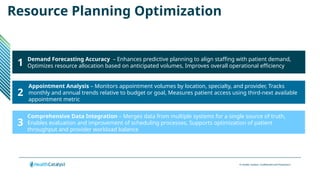
1 Demand Forecasting Accuracy – Enhances predictive planning to align staffing with patient demand,
Optimizes resource allocation based on anticipated volumes, Improves overall operational efficiency
2
Appointment Analysis – Monitors appointment volumes by location, specialty, and provider, Tracks
monthly and annual trends relative to budget or goal, Measures patient access using third-next available
appointment metric
3
Comprehensive Data Integration – Merges data from multiple systems for a single source of truth,
Enables evaluation and improvement of scheduling processes, Supports optimization of patient
throughput and provider workload balance
Resource Planning Optimization
© Health Catalyst. Confidential and Proprietary.
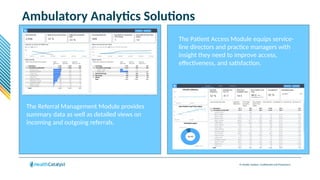
Ambulatory Analytics Solutions
The Patient Access Module equips service-
line directors and practice managers with
insight they need to improve access,
effectiveness, and satisfaction.
The Referral Management Module provides
summary data as well as detailed views on
incoming and outgoing referrals.
© Health Catalyst. Confidential and Proprietary.
Best Approaches to
Align with Payor
Requirements in
Value-Based Care
© Health Catalyst. Confidential and Proprietary.
Poll Question #4
Within your organization what is the primary data &
analytic solution to support value-based care data driven
insights getting into the hands of your clinical and operational
teams?
a) Payer provided reports
b) Internal reporting solution
c) CIN/ACO provided solution
d) Vendor provided solution
e) No current solution
f) No value-based care participation
© Health Catalyst. Confidential and Proprietary.
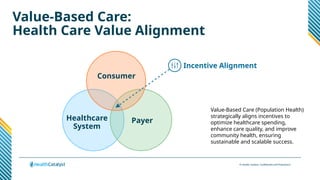
Value-Based Care:
Health Care Value Alignment
Healthcare
System
Payer
Consumer
Incentive Alignment
Value-Based Care (Population Health)
strategically aligns incentives to
optimize healthcare spending,
enhance care quality, and improve
community health, ensuring
sustainable and scalable success.
© Health Catalyst. Confidential and Proprietary.
Impact of Value-Based Care
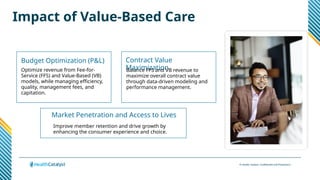
Budget Optimization (P&L)
Optimize revenue from Fee-for-
Service (FFS) and Value-Based (VB)
models, while managing efficiency,
quality, management fees, and
capitation.
Contract Value
Maximization
Balance FFS and VB revenue to
maximize overall contract value
through data-driven modeling and
performance management.
Market Penetration and Access to Lives
Improve member retention and drive growth by
enhancing the consumer experience and choice.
© Health Catalyst. Confidential and Proprietary.
Impact of Value-Based Care
Provider and Facility
Network Alignment
Strengthen the care continuum
by reducing care break points and
improving referral management
and care coordination.
Best-in-Class Quality and
Clinical Outcomes
Achieve recognition and high
ratings to attract consumers
(payers, employers, and patients)
through superior quality and
clinical outcomes.
Consumer Preference and
Experience
Deliver an easy-to-use, outcome-
improving, and cost-effective
experience to drive consumer
preference and satisfaction.
© Health Catalyst. Confidential and Proprietary.
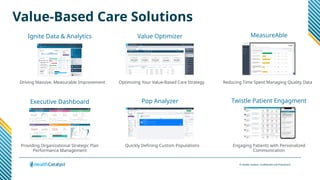
Value-Based Care Solutions
Ignite Data & Analytics Value Optimizer MeasureAble
Pop Analyzer
Executive Dashboard Twistle Patient Engagment
Optimizing Your Value-Based Care Strategy
Driving Massive, Measurable Improvement Reducing Time Spent Managing Quality Data
Quickly Defining Custom Populations
Providing Organizational Strategic Plan
Performance Management
Engaging Patients with Personalized
Communication
© Health Catalyst. Confidential and Proprietary.
Enhancing Operational
Efficiency for Managed
Service Organizations
(MSOs)
© Health Catalyst. Confidential and Proprietary.
Poll Question #5
Which services do you think are most valuable when provided by
an MSO?
a) Billing and Coding
b) Compliance and Regulatory Support
c) IT Services
d) Human Resource Management
e) Operational Oversight
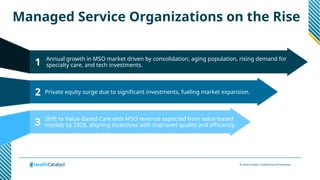
Managed Service Organizations on the Rise
1 Annual growth in MSO market driven by consolidation, aging population, rising demand for
specialty care, and tech investments.
2 Private equity surge due to significant investments, fueling market expansion.
3 Shift to Value-Based Care with MSO revenue expected from value-based
models by 2028, aligning incentives with improved quality and efficiency.
© Health Catalyst. Confidential and Proprietary.
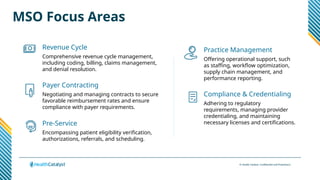
MSO Focus Areas
Revenue Cycle
Comprehensive revenue cycle management,
including coding, billing, claims management,
and denial resolution.
Payer Contracting
Negotiating and managing contracts to secure
favorable reimbursement rates and ensure
compliance with payer requirements.
Pre-Service
Encompassing patient eligibility verification,
authorizations, referrals, and scheduling.
Practice Management
Offering operational support, such
as staffing, workflow optimization,
supply chain management, and
performance reporting.
Compliance & Credentialing
Adhering to regulatory
requirements, managing provider
credentialing, and maintaining
necessary licenses and certifications.
© Health Catalyst. Confidential and Proprietary.
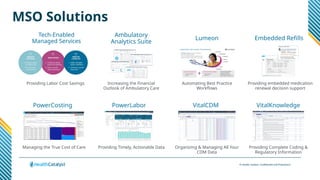
MSO Solutions
Tech-Enabled
Managed Services
Lumeon Embedded Refills
PowerCosting PowerLabor VitalCDM VitalKnowledge
Ambulatory
Analytics Suite
Providing Labor Cost Savings Increasing the Financial
Outlook of Ambulatory Care
Automating Best Practice
Workflows
Providing embedded medication
renewal decision support
Managing the True Cost of Care Providing Timely, Actionable Data Organizing & Managing All Your
CDM Data
Providing Complete Coding &
Regulatory Information
Questions?
© Health Catalyst. Confidential and Proprietary.
Holly Burke | SVP, Practice Management and Physician Solutions
Sarah Roberts | SVP, Ambulatory Practice Management
JJ Geise | Chief Administrative Officer
Travis Simar | VP of Population Health and Payer Services
Alora Martin | Webinar Program Manager
Hcwebinars@healthcatalyst.com

Addressing Key Challenges in Ambulatory Settings.pptx

  • 1.
    © Health Catalyst.Confidential and Proprietary. Addressing Key Challenges in Ambulatory Settings Strategic Solutions for Workforce, Integration, Access, Value-Based Care, and MSO Services
  • 2.
    © Health Catalyst.Confidential and Proprietary. Today's Speakers Holly Burke SVP of Practice Management and Physician Solutions Sarah Roberts SVP of Ambulatory Practice Management Travis Simar VP of Population Health and Payer Services
  • 3.
    Agenda © Health Catalyst.Confidential and Proprietary. 1. Optimizing Physician Workflow and Autonomy 2. Navigating the Impact of Healthcare Integration 3. Balancing Patient Access with Available Resources 4. Best Approaches to Align with Payor Requirements in Value-Based Care 5. Enhancing Operational Efficiency for Managed Service Organizations (MSOs)
  • 4.
    © Health Catalyst.Confidential and Proprietary. Optimizing Physician Workflow and Autonomy
  • 5.
    © Health Catalyst.Confidential and Proprietary. Poll Question #1 Within your organization you are utilizing data to manage your ambulatory operations in the following areas: a) Physician Productivity b) Template management c) Referral Leakage d) Third Next Available e) Encounter Count and Unique Patient Counts f) Support Staff Labor Management g) Revenue Cycle - Billing/Coding Variations
  • 6.
    © Health Catalyst.Confidential and Proprietary. "The impact of COVID, the aging population, and provider shortages have created a burning platform for health systems to address the need to adjust their relationship with physicians." Workforce Management
  • 7.
    © Health Catalyst.Confidential and Proprietary. Workforce Management Burnout Cost Burden Shortages Physician burnout has increased from 45.5% to 62.8% in ten years. 20% of doctors don’t anticipate being at their current practice in 2 years. The cost for a health system to replace a doctor is 2-3x a MD’s total compensation. Aging Population By 2034, it is predicted that the United States will have a shortage of up to 48,000 primary care physicians and 76,000 specialty physicians. By 2030, every baby boomer will be 65 or older. This means that 20% of the U.S. population and 33% of the MD workforce will be retired.
  • 8.
    © Health Catalyst.Confidential and Proprietary. Medical Education and Regulation Impacts the pipeline of new healthcare professionals. Health Plan Challenges Struggling to build high-value provider networks due to workforce shortages, limiting patient choice and access. Hospital Operations Challenges in maintaining adequate staffing, meeting quality metrics, and ensuring timely patient access to care. The Impact of the Healthcare Workforce Shortage Public Health Crisis The scarcity of this essential resource underscores the gravity of the situation. Eroded Public Trust The shortage of healthcare workers undermines the ability to deliver effective care. Barriers to Care Efforts to remove barriers to care are hampered by the workforce shortage.
  • 9.
    © Health Catalyst.Confidential and Proprietary. Solutions to Workforce Management Template Management • Implement efficient scheduling systems • Use data-driven insights • Streamline appointment templates Top-of-License Support Staff • Optimize workflows to promote top-of-licensure skills • Delegate administrative duties • Implement clear role definitions and responsibilities Physician Governance • Foster a sense of ownership and engagement among physicians • Establish governance structures • Encourage active participation
  • 10.
    © Health Catalyst.Confidential and Proprietary. Solutions to Workforce Management Physician Leadership • Provide leadership roles through committees • Encourage participation in practice management • Cultivate a sense of ownership in clinic operations Aligned Compensation Plans • Design compensation plans that align with practice goals • Incentivize contributions toward strategic objectives • Promote performance and alignment among clinicians Continuous Learning • Invest in ongoing education and training programs • Stay informed of industry trends • Expand contributions to practice through continuous professional development.
  • 11.
    © Health Catalyst.Confidential and Proprietary. Navigating the Impact of Healthcare Integration
  • 12.
    © Health Catalyst.Confidential and Proprietary. Poll Question #2 Within your organization the following leaders are responsible for governing decision making for the ambulatory operations? a) CEO/ CAO b) COO c) CMO/ Medical Director d) Physician Leaders e) Director of the Clinics f) Manager of the Clinics
  • 13.
    © Health Catalyst.Confidential and Proprietary. The Rise of Physician Integration with Hospitals and Corporations Nearly 75% of physicians are employed by a hospital or corporate entity since COVID. Since COVID, more than half of physician practices are not owned by hospitals or corporate entities.
  • 14.
    © Health Catalyst.Confidential and Proprietary. The Impact of Integration Economies of Scale Reduces costs by consolidating overhead, IT, and admin functions. Negotiating Power Larger integrated systems gain leverage in negotiations with suppliers and payers. Work/Life Balance Streamlines processes to reduce administrative burdens on providers, supporting better work-life balance. Referral Capture Improves ability to keep patient referrals in-network, increasing continuity of care and revenue opportunities. Comprehensive Continuum of Care Supports coordinated, full- spectrum care, enhancing patient outcomes through integrated services. Referral Capture – Stark Laws Potential compliance challenges with referral practices under Stark Law regulations. Anti-Kickback Statutes Integration increases the risk of non- compliance with anti-kickback rules, requiring careful management of agreements. Productivity Balancing increased network size while maintaining high productivity and provider satisfaction. Benefits Risks
  • 15.
    © Health Catalyst.Confidential and Proprietary. Integration Solutions Care Across the Continuum TAVR Tools Physician Productivity PopAnalyzer Panel Management
  • 16.
    © Health Catalyst.Confidential and Proprietary. Balancing Patient Access with Available Resources
  • 17.
    © Health Catalyst.Confidential and Proprietary. Poll Question #3 Which data-driven solution do you believe would have the most immediate impact on improving access in your organization? a) Implementing advanced referral analytics b) Using scheduling algorithms c) Creating a real-time resource allocation dashboard
  • 18.
    © Health Catalyst.Confidential and Proprietary. The Access Challenge in Ambulatory Settings Supply vs. Demand Mismatch Long appointment wait times, underutilized resources in some areas, and overburdened providers in others. Impact on Patient Care Delayed treatments, patient dissatisfaction, and potential for worsened health outcomes. Operational Inefficiencies Suboptimal resource allocation, increased administrative burden, and revenue loss from missed opportunities. "Access challenges disrupt care delivery, impact patient outcomes, and strain resources —resolving them is key to unlocking the full potential of ambulatory care."
  • 19.
    © Health Catalyst.Confidential and Proprietary. Optimizing Referral Management Advanced Referral Analytics • Track in-network and out-of- network referral patterns • Measure and monitor conversion rates • Identify primary care-to-specialist leakage Referral Performance Metrics Enhanced Provider Network Management • Identify providers with low in- network referral rates • Analyze outgoing referral patterns for network optimization • Leverage data for targeted provider engagement • Review referral-to- appointment conversion rates • Analyze referral processing cycle times • Track trends from internal and external source providers
  • 20.
    © Health Catalyst.Confidential and Proprietary. 1 Demand Forecasting Accuracy – Enhances predictive planning to align staffing with patient demand, Optimizes resource allocation based on anticipated volumes, Improves overall operational efficiency 2 Appointment Analysis – Monitors appointment volumes by location, specialty, and provider, Tracks monthly and annual trends relative to budget or goal, Measures patient access using third-next available appointment metric 3 Comprehensive Data Integration – Merges data from multiple systems for a single source of truth, Enables evaluation and improvement of scheduling processes, Supports optimization of patient throughput and provider workload balance Resource Planning Optimization
  • 21.
    © Health Catalyst.Confidential and Proprietary. Ambulatory Analytics Solutions The Patient Access Module equips service- line directors and practice managers with insight they need to improve access, effectiveness, and satisfaction. The Referral Management Module provides summary data as well as detailed views on incoming and outgoing referrals.
  • 22.
    © Health Catalyst.Confidential and Proprietary. Best Approaches to Align with Payor Requirements in Value-Based Care
  • 23.
    © Health Catalyst.Confidential and Proprietary. Poll Question #4 Within your organization what is the primary data & analytic solution to support value-based care data driven insights getting into the hands of your clinical and operational teams? a) Payer provided reports b) Internal reporting solution c) CIN/ACO provided solution d) Vendor provided solution e) No current solution f) No value-based care participation
  • 24.
    © Health Catalyst.Confidential and Proprietary. Value-Based Care: Health Care Value Alignment Healthcare System Payer Consumer Incentive Alignment Value-Based Care (Population Health) strategically aligns incentives to optimize healthcare spending, enhance care quality, and improve community health, ensuring sustainable and scalable success.
  • 25.
    © Health Catalyst.Confidential and Proprietary. Impact of Value-Based Care Budget Optimization (P&L) Optimize revenue from Fee-for- Service (FFS) and Value-Based (VB) models, while managing efficiency, quality, management fees, and capitation. Contract Value Maximization Balance FFS and VB revenue to maximize overall contract value through data-driven modeling and performance management. Market Penetration and Access to Lives Improve member retention and drive growth by enhancing the consumer experience and choice.
  • 26.
    © Health Catalyst.Confidential and Proprietary. Impact of Value-Based Care Provider and Facility Network Alignment Strengthen the care continuum by reducing care break points and improving referral management and care coordination. Best-in-Class Quality and Clinical Outcomes Achieve recognition and high ratings to attract consumers (payers, employers, and patients) through superior quality and clinical outcomes. Consumer Preference and Experience Deliver an easy-to-use, outcome- improving, and cost-effective experience to drive consumer preference and satisfaction.
  • 27.
    © Health Catalyst.Confidential and Proprietary. Value-Based Care Solutions Ignite Data & Analytics Value Optimizer MeasureAble Pop Analyzer Executive Dashboard Twistle Patient Engagment Optimizing Your Value-Based Care Strategy Driving Massive, Measurable Improvement Reducing Time Spent Managing Quality Data Quickly Defining Custom Populations Providing Organizational Strategic Plan Performance Management Engaging Patients with Personalized Communication
  • 28.
    © Health Catalyst.Confidential and Proprietary. Enhancing Operational Efficiency for Managed Service Organizations (MSOs)
  • 29.
    © Health Catalyst.Confidential and Proprietary. Poll Question #5 Which services do you think are most valuable when provided by an MSO? a) Billing and Coding b) Compliance and Regulatory Support c) IT Services d) Human Resource Management e) Operational Oversight
  • 30.
    Managed Service Organizationson the Rise 1 Annual growth in MSO market driven by consolidation, aging population, rising demand for specialty care, and tech investments. 2 Private equity surge due to significant investments, fueling market expansion. 3 Shift to Value-Based Care with MSO revenue expected from value-based models by 2028, aligning incentives with improved quality and efficiency.
  • 31.
    © Health Catalyst.Confidential and Proprietary. MSO Focus Areas Revenue Cycle Comprehensive revenue cycle management, including coding, billing, claims management, and denial resolution. Payer Contracting Negotiating and managing contracts to secure favorable reimbursement rates and ensure compliance with payer requirements. Pre-Service Encompassing patient eligibility verification, authorizations, referrals, and scheduling. Practice Management Offering operational support, such as staffing, workflow optimization, supply chain management, and performance reporting. Compliance & Credentialing Adhering to regulatory requirements, managing provider credentialing, and maintaining necessary licenses and certifications.
  • 32.
    © Health Catalyst.Confidential and Proprietary. MSO Solutions Tech-Enabled Managed Services Lumeon Embedded Refills PowerCosting PowerLabor VitalCDM VitalKnowledge Ambulatory Analytics Suite Providing Labor Cost Savings Increasing the Financial Outlook of Ambulatory Care Automating Best Practice Workflows Providing embedded medication renewal decision support Managing the True Cost of Care Providing Timely, Actionable Data Organizing & Managing All Your CDM Data Providing Complete Coding & Regulatory Information
  • 33.
    Questions? © Health Catalyst.Confidential and Proprietary. Holly Burke | SVP, Practice Management and Physician Solutions Sarah Roberts | SVP, Ambulatory Practice Management JJ Geise | Chief Administrative Officer Travis Simar | VP of Population Health and Payer Services Alora Martin | Webinar Program Manager Hcwebinars@healthcatalyst.com