PROMs 2.0

       Bibhas Roy, Consultant Orthopaedic Surgeon
                      Trafford General Hospital, CMFT
Clinical IT Lead for Secondary Care, NHS North West
Experience & Outcome

Definitions

Measuring Healthcare

Validity

PROMs – National approach

PREMs

Example - PROMs 2.0
2               A Practical Guide to Measuring and   08/03/2012
                     Monitoring Patient Experience
Quality in Healthcare
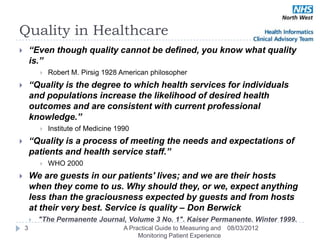
       “Even though quality cannot be defined, you know what quality
        is.”
               Robert M. Pirsig 1928 American philosopher
       “Quality is the degree to which health services for individuals
        and populations increase the likelihood of desired health
        outcomes and are consistent with current professional
        knowledge.”

               Institute of Medicine 1990
       “Quality is a process of meeting the needs and expectations of
        patients and health service staff.”

               WHO 2000
       We are guests in our patients' lives; and we are their hosts
        when they come to us. Why should they, or we, expect anything
        less than the graciousness expected by guests and from hosts
        at their very best. Service is quality – Don Berwick
           "The Permanente Journal, Volume 3 No. 1". Kaiser Permanente. Winter 1999.
    3                                   A Practical Guide to Measuring and   08/03/2012
                                             Monitoring Patient Experience
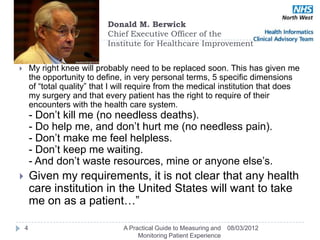
Donald M. Berwick
                              Chief Executive Officer of the
                              Institute for Healthcare Improvement


       My right knee will probably need to be replaced soon. This has given me
        the opportunity to define, in very personal terms, 5 specific dimensions
        of ―total quality‖ that I will require from the medical institution that does
        my surgery and that every patient has the right to require of their
        encounters with the health care system.
        - Don‘t kill me (no needless deaths).
        - Do help me, and don‘t hurt me (no needless pain).
        - Don‘t make me feel helpless.
        - Don‘t keep me waiting.
        - And don‘t waste resources, mine or anyone else‘s.
       Given my requirements, it is not clear that any health
        care institution in the United States will want to take
        me on as a patient…‖

    4                             A Practical Guide to Measuring and   08/03/2012
                                       Monitoring Patient Experience
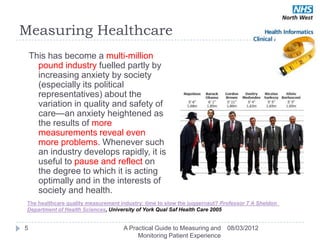
Measuring Healthcare
    This has become a multi-million
      pound industry fuelled partly by
      increasing anxiety by society
      (especially its political
      representatives) about the
      variation in quality and safety of
      care—an anxiety heightened as
      the results of more
      measurements reveal even
      more problems. Whenever such
      an industry develops rapidly, it is
      useful to pause and reflect on
      the degree to which it is acting
      optimally and in the interests of
      society and health.
 The healthcare quality measurement industry: time to slow the juggernaut? Professor T A Sheldon

 Department of Health Sciences, University of York Qual Saf Health Care 2005


5                                    A Practical Guide to Measuring and      08/03/2012
                                          Monitoring Patient Experience
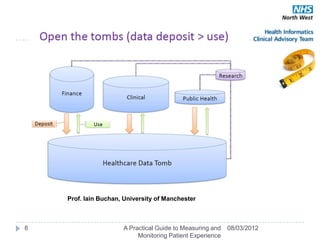
Prof. Iain Buchan, University of Manchester


6                     A Practical Guide to Measuring and   08/03/2012
                           Monitoring Patient Experience
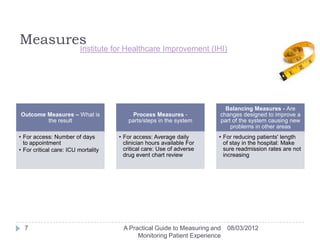
Measures
                         Institute for Healthcare Improvement (IHI)


                                                                         Balancing Measures - Are
Outcome Measures – What is               Process Measures -            changes designed to improve a
        the result                      parts/steps in the system      part of the system causing new
                                                                           problems in other areas
• For access: Number of days         • For access: Average daily       • For reducing patients' length
  to appointment                       clinician hours available For     of stay in the hospital: Make
• For critical care: ICU mortality     critical care: Use of adverse     sure readmission rates are not
                                       drug event chart review           increasing


  7                                   A Practical Guide to Measuring and   08/03/2012
                                           Monitoring Patient Experience
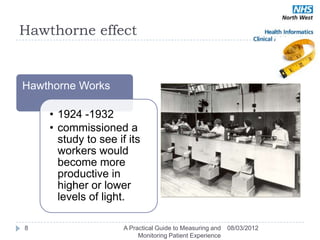
Hawthorne effect


Hawthorne Works

    • 1924 -1932
    • commissioned a
      study to see if its
      workers would
      become more
      productive in
      higher or lower
      levels of light.

8                    A Practical Guide to Measuring and   08/03/2012
                          Monitoring Patient Experience
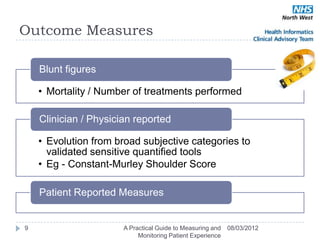
Outcome Measures

    Blunt figures

    • Mortality / Number of treatments performed

    Clinician / Physician reported

    • Evolution from broad subjective categories to
      validated sensitive quantified tools
    • Eg - Constant-Murley Shoulder Score

    Patient Reported Measures


9                      A Practical Guide to Measuring and   08/03/2012
                            Monitoring Patient Experience
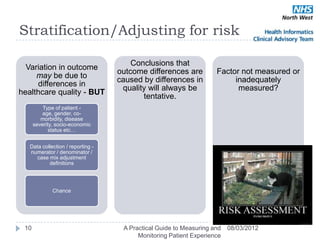
Stratification/Adjusting for risk

                                       Conclusions that
  Variation in outcome
                                   outcome differences are          Factor not measured or
     may be due to
                                   caused by differences in              inadequately
     differences in
                                    quality will always be                measured?
healthcare quality - BUT
                                          tentative.
          Type of patient -
          age, gender, co-
         morbidity, disease
      severity, socio-economic
             status etc…


   Data collection / reporting -
   numerator / denominator /
     case mix adjustment
           definitions


              Chance


 10                                 A Practical Guide to Measuring and   08/03/2012
                                         Monitoring Patient Experience
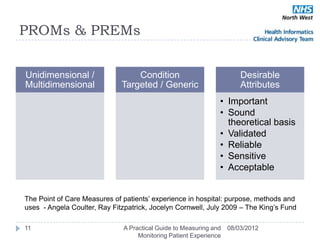
PROMs & PREMs


Unidimensional /                  Condition                            Desirable
Multidimensional              Targeted / Generic                       Attributes
                                                               • Important
                                                               • Sound
                                                                 theoretical basis
                                                               • Validated
                                                               • Reliable
                                                               • Sensitive
                                                               • Acceptable


The Point of Care Measures of patients‘ experience in hospital: purpose, methods and
uses - Angela Coulter, Ray Fitzpatrick, Jocelyn Cornwell, July 2009 – The King‘s Fund

11                            A Practical Guide to Measuring and   08/03/2012
                                   Monitoring Patient Experience
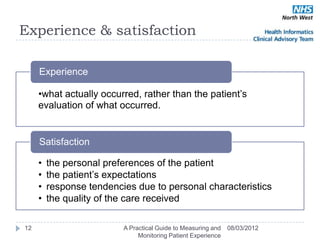
Experience & satisfaction

     Experience

     •what actually occurred, rather than the patient‘s
     evaluation of what occurred.


     Satisfaction

     •   the personal preferences of the patient
     •   the patient‘s expectations
     •   response tendencies due to personal characteristics
     •   the quality of the care received

12                        A Practical Guide to Measuring and   08/03/2012
                               Monitoring Patient Experience
PROMs

     • standardised validated
       instruments (question sets)
     • measure patients‘ perceptions of
       their health status (impairment),
     • their functional status (disability)
     • their health-related quality of life
       (well-being).

13                A Practical Guide to Measuring and   08/03/2012
                       Monitoring Patient Experience
Spreading the project

People are not passive recipients of innovations. Rather (and to a
  greater or lesser extent in different individuals), they seek
  innovations out, experiment with them, evaluate them, find (or fail to
  find) meaning in them, develop feelings (positive or negative) about
  them, challenge them, worry about them, complain about them, ‗work
  round‘ them, talk to others about them, develop know-how about
  them, modify them to fit particular tasks, and attempt to improve or
  redesign them (often through dialogue with other users).


  How to Spread Good Ideas, A systematic review of the literature on diffusion, dissemination and
  sustainability of innovations in health service delivery and organisation
  Trisha Greenhalgh et.al 2004


 14
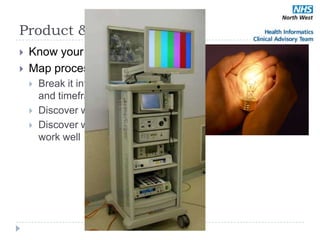
Product & Process
   Know your products
   Map processes
       Break it into components
        and timeframes
       Discover what works well
       Discover what does not
        work well
Clinical Engagement?
   Clinician
       a doctor having direct contact with patients rather than
        being involved with theoretical or laboratory studies. -
        oxforddictionaries.com

   HICAT version (for informatics)
     'Figurehead' Clinicians (Doctors, Nurses, AHPs etc.)
           These Clinicians no longer have clinical responsibility and
            are not on the front-line
       Clinicians who work part-time in the Programme.
           These Clinicians work for 40-60% of the time in the
            Programme and 40-60% of the time in clinical care
       Fulltime clinicians
           Clinicians who are fully committed to improving patient
            care through the use of IT
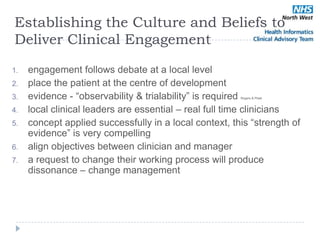
Establishing the Culture and Beliefs to
Deliver Clinical Engagement

1.   engagement follows debate at a local level
2.   place the patient at the centre of development
3.   evidence - ―observability & trialability‖ is required
                                                        Rogers & Plsek


4.   local clinical leaders are essential – real full time clinicians
5.   concept applied successfully in a local context, this ―strength of
     evidence‖ is very compelling
6.   align objectives between clinician and manager
7.   a request to change their working process will produce
     dissonance – change management
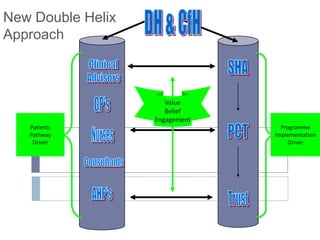
New Double Helix
Approach


                      Value
                      Belief
                   Engagement
   Patients                       Programme
   Pathway                      implementation
    Driver                           Driver
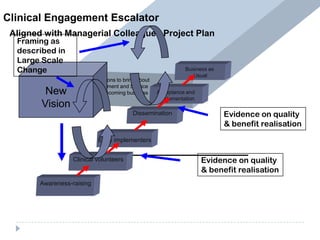
Clinical Engagement Escalator
 Aligned with Managerial Colleagues Project Plan
  Framing as
  described in
  Large Scale
  Change                                                       Business as
                                                                  Usual
                 Clinical Champions to bring about
                 Clinical Engagement and Service
         New     Improvement becoming business       Acceptance and
                 as usual                            implementation
        Vision
                                           Dissemination                     Evidence on quality
                                                                             & benefit realisation
                            Early implementers


                  Clinical volunteers                                 Evidence on quality
                                                                      & benefit realisation
       Awareness-raising
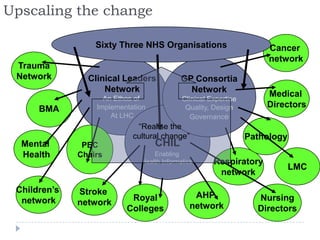
Upscaling the change

                  Sixty Three NHS Organisations                       Cancer
                                                                      network
 Trauma
 Network        Clinical Leaders           GP Consortia
                    Network                  Network
                    An Ethos of
                                                                     Medical
                                            Clinical Expertise
      BMA         Implementation             Quality, Design         Directors
                      At LHC                   Governance
                             ―Realise the
                            cultural change‖                     Pathology
  Mental       PEC                 CHIL
  Health      Chairs              Enabling
                              Health Informatics      Respiratory
                                                                             LMC
                                                       network
 Children’s   Stroke
                           Royal                AHP                Nursing
  network     network
                          Colleges             network             Directors
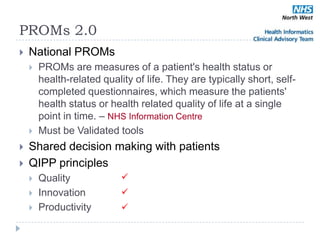
PROMs 2.0
   National PROMs
       PROMs are measures of a patient's health status or
        health-related quality of life. They are typically short, self-
        completed questionnaires, which measure the patients'
        health status or health related quality of life at a single
        point in time. – NHS Information Centre
       Must be Validated tools
   Shared decision making with patients
   QIPP principles
       Quality             
       Innovation          
       Productivity        
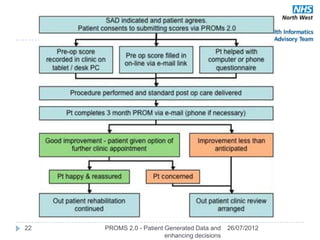
22   PROMS 2.0 - Patient Generated Data and    26/07/2012
                         enhancing decisions
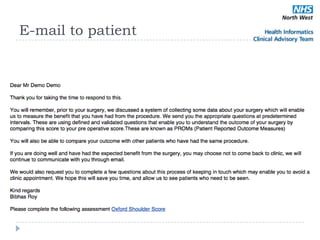
E-mail to patient
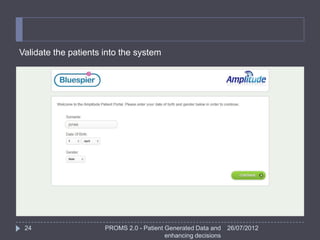
Validate the patients into the system


 24                   PROMS 2.0 - Patient Generated Data and    26/07/2012
                                          enhancing decisions
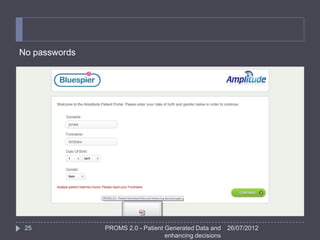
No passwords


 25            PROMS 2.0 - Patient Generated Data and    26/07/2012
                                   enhancing decisions
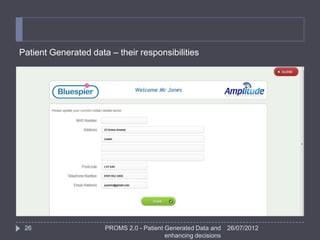
Patient Generated data – their responsibilities


 26                   PROMS 2.0 - Patient Generated Data and    26/07/2012
                                          enhancing decisions
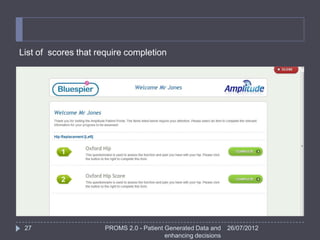
List of scores that require completion


 27                   PROMS 2.0 - Patient Generated Data and    26/07/2012
                                          enhancing decisions
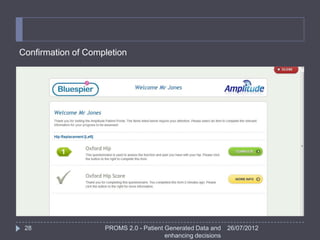
Confirmation of Completion


 28                 PROMS 2.0 - Patient Generated Data and    26/07/2012
                                        enhancing decisions
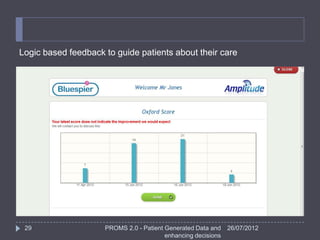
Logic based feedback to guide patients about their care


 29                  PROMS 2.0 - Patient Generated Data and    26/07/2012
                                         enhancing decisions
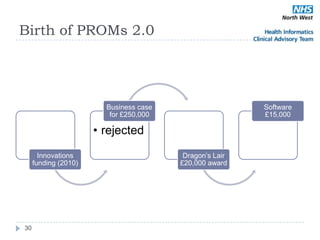
Birth of PROMs 2.0


                        Business case                    Software
                         for £250,000                    £15,000

                      • rejected
       Innovations                       Dragon‘s Lair
     funding (2010)                     £20,000 award


30
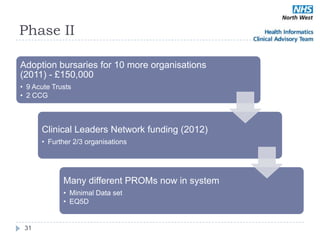
Phase II

Adoption bursaries for 10 more organisations
(2011) - £150,000
• 9 Acute Trusts
• 2 CCG


      Clinical Leaders Network funding (2012)
      • Further 2/3 organisations


             Many different PROMs now in system
             • Minimal Data set
             • EQ5D


 31
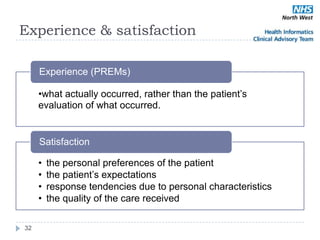
Experience & satisfaction

     Experience (PREMs)

     •what actually occurred, rather than the patient‘s
     evaluation of what occurred.


     Satisfaction

     •   the personal preferences of the patient
     •   the patient‘s expectations
     •   response tendencies due to personal characteristics
     •   the quality of the care received

32
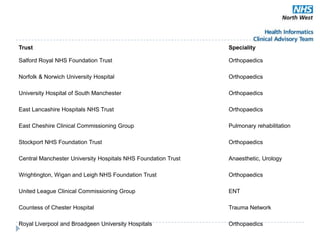
Trust                                                          Speciality

Salford Royal NHS Foundation Trust                             Orthopaedics

Norfolk & Norwich University Hospital                          Orthopaedics

University Hospital of South Manchester                        Orthopaedics

East Lancashire Hospitals NHS Trust                            Orthopaedics

East Cheshire Clinical Commissioning Group                     Pulmonary rehabilitation

Stockport NHS Foundation Trust                                 Orthopaedics

Central Manchester University Hospitals NHS Foundation Trust   Anaesthetic, Urology

Wrightington, Wigan and Leigh NHS Foundation Trust             Orthopaedics

United League Clinical Commissioning Group                     ENT

Countess of Chester Hospital                                   Trauma Network

Royal Liverpool and Broadgeen University Hospitals             Orthopaedics
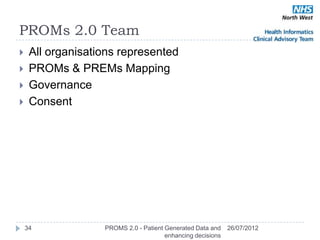
PROMs 2.0 Team
    All organisations represented
    PROMs & PREMs Mapping
    Governance
    Consent


    34             PROMS 2.0 - Patient Generated Data and    26/07/2012
                                       enhancing decisions
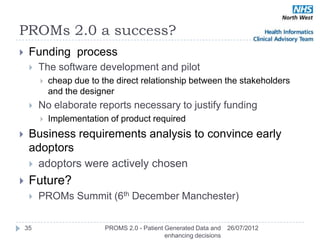
PROMs 2.0 a success?
    Funding process
        The software development and pilot
            cheap due to the direct relationship between the stakeholders
             and the designer
        No elaborate reports necessary to justify funding
            Implementation of product required
    Business requirements analysis to convince early
     adoptors
      adoptors were actively chosen

    Future?
        PROMs Summit (6th December Manchester)


    35                     PROMS 2.0 - Patient Generated Data and    26/07/2012
                                               enhancing decisions
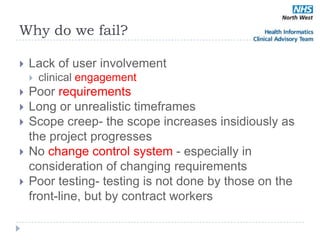
Why do we fail?

   Lack of user involvement
       clinical engagement
   Poor requirements
   Long or unrealistic timeframes
   Scope creep- the scope increases insidiously as
    the project progresses
   No change control system - especially in
    consideration of changing requirements
   Poor testing- testing is not done by those on the
    front-line, but by contract workers
PROMs 2.0

PROMs 2.0

  • 1.
    PROMs 2.0 Bibhas Roy, Consultant Orthopaedic Surgeon Trafford General Hospital, CMFT Clinical IT Lead for Secondary Care, NHS North West
  • 2.
    Experience & Outcome Definitions MeasuringHealthcare Validity PROMs – National approach PREMs Example - PROMs 2.0 2 A Practical Guide to Measuring and 08/03/2012 Monitoring Patient Experience
  • 3.
    Quality in Healthcare  “Even though quality cannot be defined, you know what quality is.”  Robert M. Pirsig 1928 American philosopher  “Quality is the degree to which health services for individuals and populations increase the likelihood of desired health outcomes and are consistent with current professional knowledge.”
  Institute of Medicine 1990  “Quality is a process of meeting the needs and expectations of patients and health service staff.”
  WHO 2000  We are guests in our patients' lives; and we are their hosts when they come to us. Why should they, or we, expect anything less than the graciousness expected by guests and from hosts at their very best. Service is quality – Don Berwick  "The Permanente Journal, Volume 3 No. 1". Kaiser Permanente. Winter 1999. 3 A Practical Guide to Measuring and 08/03/2012 Monitoring Patient Experience
  • 4.
    Donald M. Berwick Chief Executive Officer of the Institute for Healthcare Improvement  My right knee will probably need to be replaced soon. This has given me the opportunity to define, in very personal terms, 5 specific dimensions of ―total quality‖ that I will require from the medical institution that does my surgery and that every patient has the right to require of their encounters with the health care system. - Don‘t kill me (no needless deaths). - Do help me, and don‘t hurt me (no needless pain). - Don‘t make me feel helpless. - Don‘t keep me waiting. - And don‘t waste resources, mine or anyone else‘s.  Given my requirements, it is not clear that any health care institution in the United States will want to take me on as a patient…‖ 4 A Practical Guide to Measuring and 08/03/2012 Monitoring Patient Experience
  • 5.
    Measuring Healthcare This has become a multi-million pound industry fuelled partly by increasing anxiety by society (especially its political representatives) about the variation in quality and safety of care—an anxiety heightened as the results of more measurements reveal even more problems. Whenever such an industry develops rapidly, it is useful to pause and reflect on the degree to which it is acting optimally and in the interests of society and health. The healthcare quality measurement industry: time to slow the juggernaut? Professor T A Sheldon
 Department of Health Sciences, University of York Qual Saf Health Care 2005 5 A Practical Guide to Measuring and 08/03/2012 Monitoring Patient Experience
  • 6.
    Prof. Iain Buchan,University of Manchester 6 A Practical Guide to Measuring and 08/03/2012 Monitoring Patient Experience
  • 7.
    Measures Institute for Healthcare Improvement (IHI) Balancing Measures - Are Outcome Measures – What is Process Measures - changes designed to improve a the result parts/steps in the system part of the system causing new problems in other areas • For access: Number of days • For access: Average daily • For reducing patients' length to appointment clinician hours available For of stay in the hospital: Make • For critical care: ICU mortality critical care: Use of adverse sure readmission rates are not drug event chart review increasing 7 A Practical Guide to Measuring and 08/03/2012 Monitoring Patient Experience
  • 8.
    Hawthorne effect Hawthorne Works • 1924 -1932 • commissioned a study to see if its workers would become more productive in higher or lower levels of light. 8 A Practical Guide to Measuring and 08/03/2012 Monitoring Patient Experience
  • 9.
    Outcome Measures Blunt figures • Mortality / Number of treatments performed Clinician / Physician reported • Evolution from broad subjective categories to validated sensitive quantified tools • Eg - Constant-Murley Shoulder Score Patient Reported Measures 9 A Practical Guide to Measuring and 08/03/2012 Monitoring Patient Experience
  • 10.
    Stratification/Adjusting for risk Conclusions that Variation in outcome outcome differences are Factor not measured or may be due to caused by differences in inadequately differences in quality will always be measured? healthcare quality - BUT tentative. Type of patient - age, gender, co- morbidity, disease severity, socio-economic status etc… Data collection / reporting - numerator / denominator / case mix adjustment definitions Chance 10 A Practical Guide to Measuring and 08/03/2012 Monitoring Patient Experience
  • 11.
    PROMs & PREMs Unidimensional/ Condition Desirable Multidimensional Targeted / Generic Attributes • Important • Sound theoretical basis • Validated • Reliable • Sensitive • Acceptable The Point of Care Measures of patients‘ experience in hospital: purpose, methods and uses - Angela Coulter, Ray Fitzpatrick, Jocelyn Cornwell, July 2009 – The King‘s Fund 11 A Practical Guide to Measuring and 08/03/2012 Monitoring Patient Experience
  • 12.
    Experience & satisfaction Experience •what actually occurred, rather than the patient‘s evaluation of what occurred. Satisfaction • the personal preferences of the patient • the patient‘s expectations • response tendencies due to personal characteristics • the quality of the care received 12 A Practical Guide to Measuring and 08/03/2012 Monitoring Patient Experience
  • 13.
    PROMs • standardised validated instruments (question sets) • measure patients‘ perceptions of their health status (impairment), • their functional status (disability) • their health-related quality of life (well-being). 13 A Practical Guide to Measuring and 08/03/2012 Monitoring Patient Experience
  • 14.
    Spreading the project Peopleare not passive recipients of innovations. Rather (and to a greater or lesser extent in different individuals), they seek innovations out, experiment with them, evaluate them, find (or fail to find) meaning in them, develop feelings (positive or negative) about them, challenge them, worry about them, complain about them, ‗work round‘ them, talk to others about them, develop know-how about them, modify them to fit particular tasks, and attempt to improve or redesign them (often through dialogue with other users). How to Spread Good Ideas, A systematic review of the literature on diffusion, dissemination and sustainability of innovations in health service delivery and organisation Trisha Greenhalgh et.al 2004 14
  • 15.
    Product & Process  Know your products  Map processes  Break it into components and timeframes  Discover what works well  Discover what does not work well
  • 16.
    Clinical Engagement?  Clinician  a doctor having direct contact with patients rather than being involved with theoretical or laboratory studies. - oxforddictionaries.com  HICAT version (for informatics)  'Figurehead' Clinicians (Doctors, Nurses, AHPs etc.)  These Clinicians no longer have clinical responsibility and are not on the front-line  Clinicians who work part-time in the Programme.  These Clinicians work for 40-60% of the time in the Programme and 40-60% of the time in clinical care  Fulltime clinicians  Clinicians who are fully committed to improving patient care through the use of IT
  • 17.
    Establishing the Cultureand Beliefs to Deliver Clinical Engagement 1. engagement follows debate at a local level 2. place the patient at the centre of development 3. evidence - ―observability & trialability‖ is required Rogers & Plsek 4. local clinical leaders are essential – real full time clinicians 5. concept applied successfully in a local context, this ―strength of evidence‖ is very compelling 6. align objectives between clinician and manager 7. a request to change their working process will produce dissonance – change management
  • 18.
    New Double Helix Approach Value Belief Engagement Patients Programme Pathway implementation Driver Driver
  • 19.
    Clinical Engagement Escalator Aligned with Managerial Colleagues Project Plan Framing as described in Large Scale Change Business as Usual Clinical Champions to bring about Clinical Engagement and Service New Improvement becoming business Acceptance and as usual implementation Vision Dissemination Evidence on quality & benefit realisation Early implementers Clinical volunteers Evidence on quality & benefit realisation Awareness-raising
  • 20.
    Upscaling the change Sixty Three NHS Organisations Cancer network Trauma Network Clinical Leaders GP Consortia Network Network An Ethos of Medical Clinical Expertise BMA Implementation Quality, Design Directors At LHC Governance ―Realise the cultural change‖ Pathology Mental PEC CHIL Health Chairs Enabling Health Informatics Respiratory LMC network Children’s Stroke Royal AHP Nursing network network Colleges network Directors
  • 21.
    PROMs 2.0  National PROMs  PROMs are measures of a patient's health status or health-related quality of life. They are typically short, self- completed questionnaires, which measure the patients' health status or health related quality of life at a single point in time. – NHS Information Centre  Must be Validated tools  Shared decision making with patients  QIPP principles  Quality   Innovation   Productivity 
  • 22.
    22 PROMS 2.0 - Patient Generated Data and 26/07/2012 enhancing decisions
  • 23.
  • 24.
    Validate the patientsinto the system 24 PROMS 2.0 - Patient Generated Data and 26/07/2012 enhancing decisions
  • 25.
    No passwords 25 PROMS 2.0 - Patient Generated Data and 26/07/2012 enhancing decisions
  • 26.
    Patient Generated data– their responsibilities 26 PROMS 2.0 - Patient Generated Data and 26/07/2012 enhancing decisions
  • 27.
    List of scoresthat require completion 27 PROMS 2.0 - Patient Generated Data and 26/07/2012 enhancing decisions
  • 28.
    Confirmation of Completion 28 PROMS 2.0 - Patient Generated Data and 26/07/2012 enhancing decisions
  • 29.
    Logic based feedbackto guide patients about their care 29 PROMS 2.0 - Patient Generated Data and 26/07/2012 enhancing decisions
  • 30.
    Birth of PROMs2.0 Business case Software for £250,000 £15,000 • rejected Innovations Dragon‘s Lair funding (2010) £20,000 award 30
  • 31.
    Phase II Adoption bursariesfor 10 more organisations (2011) - £150,000 • 9 Acute Trusts • 2 CCG Clinical Leaders Network funding (2012) • Further 2/3 organisations Many different PROMs now in system • Minimal Data set • EQ5D 31
  • 32.
    Experience & satisfaction Experience (PREMs) •what actually occurred, rather than the patient‘s evaluation of what occurred. Satisfaction • the personal preferences of the patient • the patient‘s expectations • response tendencies due to personal characteristics • the quality of the care received 32
  • 33.
    Trust Speciality Salford Royal NHS Foundation Trust Orthopaedics Norfolk & Norwich University Hospital Orthopaedics University Hospital of South Manchester Orthopaedics East Lancashire Hospitals NHS Trust Orthopaedics East Cheshire Clinical Commissioning Group Pulmonary rehabilitation Stockport NHS Foundation Trust Orthopaedics Central Manchester University Hospitals NHS Foundation Trust Anaesthetic, Urology Wrightington, Wigan and Leigh NHS Foundation Trust Orthopaedics United League Clinical Commissioning Group ENT Countess of Chester Hospital Trauma Network Royal Liverpool and Broadgeen University Hospitals Orthopaedics
  • 34.
    PROMs 2.0 Team  All organisations represented  PROMs & PREMs Mapping  Governance  Consent 34 PROMS 2.0 - Patient Generated Data and 26/07/2012 enhancing decisions
  • 35.
    PROMs 2.0 asuccess?  Funding process  The software development and pilot  cheap due to the direct relationship between the stakeholders and the designer  No elaborate reports necessary to justify funding  Implementation of product required  Business requirements analysis to convince early adoptors  adoptors were actively chosen  Future?  PROMs Summit (6th December Manchester) 35 PROMS 2.0 - Patient Generated Data and 26/07/2012 enhancing decisions
  • 36.
    Why do wefail?  Lack of user involvement  clinical engagement  Poor requirements  Long or unrealistic timeframes  Scope creep- the scope increases insidiously as the project progresses  No change control system - especially in consideration of changing requirements  Poor testing- testing is not done by those on the front-line, but by contract workers