Patient Satisfaction
“We are listening–”
(H-CAHPS)-Consumer
Assessment of Healthcare
Providers & Systems
CAHPS Hospital Survey
• Consumer Assessment of Healthcare
Providers & Systems:
• Also known as
– Hospital CAHPS
or
– HCAHPS
The Method of HCAHPS
• Ask Inpatients via (survey)

• Collect in standardized, consistent manner
• Analyze and adjust data
• Publicly report hospital results
• Use to improve hospital quality of care
4 Objectives of HCAHPS
• Standardization permits meaningful
comparisons across hospitals for public
reporting
• Increased hospital accountability and
incentives for quality improvement
• Pay-for-performance (VBP) Hospital Value
Base Purchasing for (IPPS) Inpatient
Prospective Payment System hospitals
• Enhanced public accountability
HCAHPS 101
• Eligible Patients:
– Adults (18+)
– Medical, surgical or maternity care
– Overnight stay or longer
– Alive at discharge
– Excludes hospice discharge, prisoner,
patients discharged to nursing homes, SNF
swing bed within hospital, skilled nursing
facilities
HCAHPS and Hospital VBP
• FY 2014: Hospital VBP links a portion
of CMS payment to hospitals based on
performance on a set of quality
measures
– Clinical Process of Care (13 measures)
– Patient Experience of Care (HCAHPS)
– Outcomes (Mortality)
HCAHPS Content: 7
Composites
1.
2.
3.
4.
5.
6.
7.

Communication with nurses
Communication with doctors
Responsiveness of hospital staff
Pain management
Communication about medicines
Discharge information
Care transition
HCAHPS Content: Individual
Items
• What patients/consumers want to
know:
1. Cleanliness of hospital environment

2. Quietness of hospital environment
Patient Satisfaction Surveys
• Ratings are similar to the Likert Scale
–
–
–
–
–

1 Completely Disagree
2 Disagree
3 Neutral
4 Agree
5 Completely Agree

• Raw Score and Percentile Ranking
– Raw Score
– Percentile Ranking
• Where P&S is placed nationally among all other
hospitals in the Press Ganey Database
– (P&S uses the All PG Database)
The New Healthcare Consumer
• Today’s patient is more discerning and
demanding.
• Has more access to information and a wider
array of choice.
• In may ways, today’s patient shouldn’t be
thought of as a patient, but as a consumer.
• They want to know the quality of care provided
by the doctor and hospital & how much
procedures will cost.
The New Healthcare Consumer
• A savvy Internet user, the new consumer also expects
health care to adopt the same functionalities as other
industries:
– that allow them to buy movie tickets
– book a hotel room
– pay a bill online

• If the patient doesn’t like what is seen, they are more likely
now than in the past to shop around with their health care
dollars.
• According to research by Press Ganey Associates
Inc., People between the ages of 35 and 49– a major part
of the new consumer cohort– have the lowest patient
satisfaction scores compared with other age groups.
What Do Patients/Clients Want?
• The new healthcare consumer wants:
– Empathy
– Positive outcomes
– Relief from symptoms
– Information
– Is internet active
– Is empowered
– Insists on customer service
– Insists on control
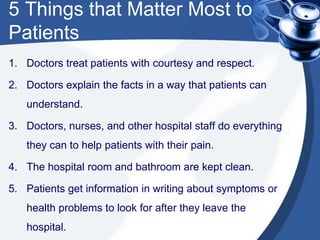
5 Things that Matter Most to
Patients
1. Doctors treat patients with courtesy and respect.

2. Doctors explain the facts in a way that patients can
understand.
3. Doctors, nurses, and other hospital staff do everything

they can to help patients with their pain.
4. The hospital room and bathroom are kept clean.
5. Patients get information in writing about symptoms or
health problems to look for after they leave the
hospital.
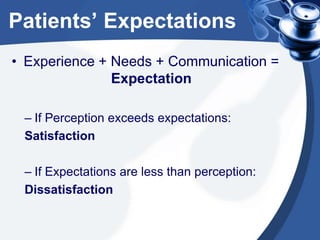
Patients’ Expectations
• Experience + Needs + Communication =
Expectation
– If Perception exceeds expectations:
Satisfaction
– If Expectations are less than perception:
Dissatisfaction
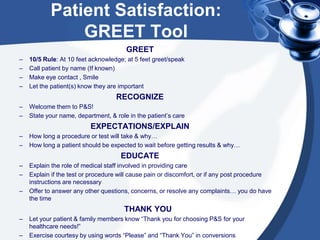
Patient Satisfaction:
GREET Tool
GREET
–
–
–
–

10/5 Rule: At 10 feet acknowledge; at 5 feet greet/speak
Call patient by name (If known)
Make eye contact , Smile
Let the patient(s) know they are important

RECOGNIZE
–
–

Welcome them to P&S!
State your name, department, & role in the patient’s care

EXPECTATIONS/EXPLAIN
–
–

How long a procedure or test will take & why…
How long a patient should be expected to wait before getting results & why…

EDUCATE
–
–

–

Explain the role of medical staff involved in providing care
Explain if the test or procedure will cause pain or discomfort, or if any post procedure
instructions are necessary
Offer to answer any other questions, concerns, or resolve any complaints… you do have
the time

THANK YOU
–
–

Let your patient & family members know “Thank you for choosing P&S for your
healthcare needs!”
Exercise courtesy by using words “Please” and “Thank You” in conversions
• End of presentation

Patient Satisfaction

  • 1.
  • 2.
  • 3.
    CAHPS Hospital Survey •Consumer Assessment of Healthcare Providers & Systems: • Also known as – Hospital CAHPS or – HCAHPS
  • 4.
    The Method ofHCAHPS • Ask Inpatients via (survey) • Collect in standardized, consistent manner • Analyze and adjust data • Publicly report hospital results • Use to improve hospital quality of care
  • 5.
    4 Objectives ofHCAHPS • Standardization permits meaningful comparisons across hospitals for public reporting • Increased hospital accountability and incentives for quality improvement • Pay-for-performance (VBP) Hospital Value Base Purchasing for (IPPS) Inpatient Prospective Payment System hospitals • Enhanced public accountability
  • 6.
    HCAHPS 101 • EligiblePatients: – Adults (18+) – Medical, surgical or maternity care – Overnight stay or longer – Alive at discharge – Excludes hospice discharge, prisoner, patients discharged to nursing homes, SNF swing bed within hospital, skilled nursing facilities
  • 7.
    HCAHPS and HospitalVBP • FY 2014: Hospital VBP links a portion of CMS payment to hospitals based on performance on a set of quality measures – Clinical Process of Care (13 measures) – Patient Experience of Care (HCAHPS) – Outcomes (Mortality)
  • 8.
    HCAHPS Content: 7 Composites 1. 2. 3. 4. 5. 6. 7. Communicationwith nurses Communication with doctors Responsiveness of hospital staff Pain management Communication about medicines Discharge information Care transition
  • 9.
    HCAHPS Content: Individual Items •What patients/consumers want to know: 1. Cleanliness of hospital environment 2. Quietness of hospital environment
  • 10.
    Patient Satisfaction Surveys •Ratings are similar to the Likert Scale – – – – – 1 Completely Disagree 2 Disagree 3 Neutral 4 Agree 5 Completely Agree • Raw Score and Percentile Ranking – Raw Score – Percentile Ranking • Where P&S is placed nationally among all other hospitals in the Press Ganey Database – (P&S uses the All PG Database)
  • 11.
    The New HealthcareConsumer • Today’s patient is more discerning and demanding. • Has more access to information and a wider array of choice. • In may ways, today’s patient shouldn’t be thought of as a patient, but as a consumer. • They want to know the quality of care provided by the doctor and hospital & how much procedures will cost.
  • 12.
    The New HealthcareConsumer • A savvy Internet user, the new consumer also expects health care to adopt the same functionalities as other industries: – that allow them to buy movie tickets – book a hotel room – pay a bill online • If the patient doesn’t like what is seen, they are more likely now than in the past to shop around with their health care dollars. • According to research by Press Ganey Associates Inc., People between the ages of 35 and 49– a major part of the new consumer cohort– have the lowest patient satisfaction scores compared with other age groups.
  • 13.
    What Do Patients/ClientsWant? • The new healthcare consumer wants: – Empathy – Positive outcomes – Relief from symptoms – Information – Is internet active – Is empowered – Insists on customer service – Insists on control
  • 14.
    5 Things thatMatter Most to Patients 1. Doctors treat patients with courtesy and respect. 2. Doctors explain the facts in a way that patients can understand. 3. Doctors, nurses, and other hospital staff do everything they can to help patients with their pain. 4. The hospital room and bathroom are kept clean. 5. Patients get information in writing about symptoms or health problems to look for after they leave the hospital.
  • 15.
    Patients’ Expectations • Experience+ Needs + Communication = Expectation – If Perception exceeds expectations: Satisfaction – If Expectations are less than perception: Dissatisfaction
  • 16.
    Patient Satisfaction: GREET Tool GREET – – – – 10/5Rule: At 10 feet acknowledge; at 5 feet greet/speak Call patient by name (If known) Make eye contact , Smile Let the patient(s) know they are important RECOGNIZE – – Welcome them to P&S! State your name, department, & role in the patient’s care EXPECTATIONS/EXPLAIN – – How long a procedure or test will take & why… How long a patient should be expected to wait before getting results & why… EDUCATE – – – Explain the role of medical staff involved in providing care Explain if the test or procedure will cause pain or discomfort, or if any post procedure instructions are necessary Offer to answer any other questions, concerns, or resolve any complaints… you do have the time THANK YOU – – Let your patient & family members know “Thank you for choosing P&S for your healthcare needs!” Exercise courtesy by using words “Please” and “Thank You” in conversions
  • 17.
    • End ofpresentation