UNIVERSITATEA DE STAT DE MEDICINĂ ŞI FARMACIE “NICOLAE
                     TESTEMIŢANU”


    Teeth and supporting tissues.
   Development and structure of the
               teeth.


CATEDRA HISTOLOGIE, CITOLOGIE ŞI EMBRIOLOGIE
TATIANA GLOBA
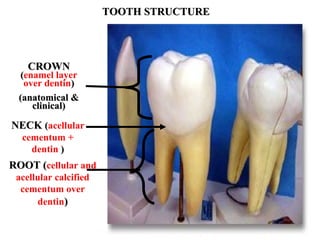
TOOTH STRUCTURE


    CROWN
   (enamel layer
    over dentin)
  (anatomical &
      clinical)

NECK (acellular
  cementum +
    dentin )
ROOT (cellular and
 acellular calcified
  cementum over
       dentin)
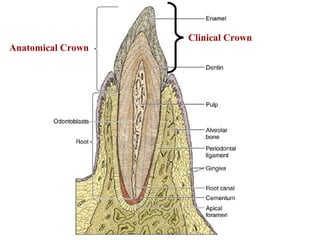
Clinical Crown
Anatomical Crown
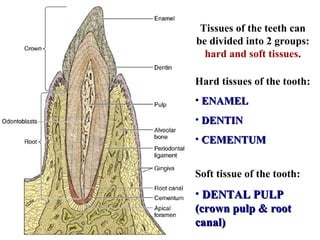
Tissues of the teeth can
be divided into 2 groups:
  hard and soft tissues.

Hard tissues of the tooth:
• ENAMEL
• DENTIN
• CEMENTUM


Soft tissue of the tooth:
• DENTAL PULP
(crown pulp & root
canal)
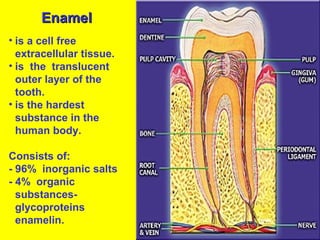
Enamel
• is a cell free
  extracellular tissue.
• is the translucent
  outer layer of the
  tooth.
• is the hardest
  substance in the
  human body.

Consists of:
- 96% inorganic salts
- 4% organic
  substances-
  glycoproteins
  enamelin.
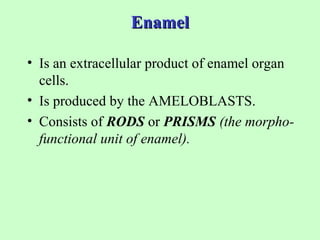
Enamel

• Is an extracellular product of enamel organ
  cells.
• Is produced by the AMELOBLASTS.
• Consists of RODS or PRISMS (the morpho-
  functional unit of enamel).
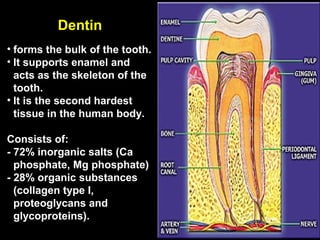
Dentin
• forms the bulk of the tooth.
• It supports enamel and
  acts as the skeleton of the
  tooth.
• It is the second hardest
  tissue in the human body.

Consists of:
- 72% inorganic salts (Ca
  phosphate, Mg phosphate)
- 28% organic substances
  (collagen type I,
  proteoglycans and
  glycoproteins).
Dentin
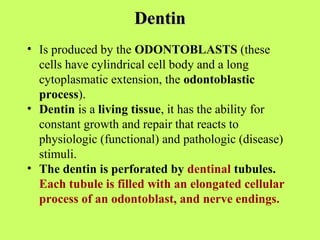
• Is produced by the ODONTOBLASTS (these
  cells have cylindrical cell body and a long
  cytoplasmatic extension, the odontoblastic
  process).
• Dentin is a living tissue, it has the ability for
  constant growth and repair that reacts to
  physiologic (functional) and pathologic (disease)
  stimuli.
• The dentin is perforated by dentinal tubules.
  Each tubule is filled with an elongated cellular
  process of an odontoblast, and nerve endings.
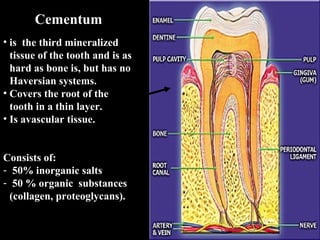
Cementum
• is the third mineralized
  tissue of the tooth and is as
  hard as bone is, but has no
  Haversian systems.
• Covers the root of the
  tooth in a thin layer.
• Is avascular tissue.


Consists of:
- 50% inorganic salts
- 50 % organic substances
  (collagen, proteoglycans).
Cementum
• Cells of the cementum are:
   – Cementocytes that are located in lacunae
   – Cementoblasts that are located on the outer surface of the cementum,
     adjacent to the periodontal ligament
• Cementum is capable of formation, destruction and repair and
  remodels continually throughout life. It is nourished from
  vessels within the periodontal ligament.
• Functions:
   – It protects the dentin (occludes the dentinal tubules)
   – It provides attachment of the periodontal fibers
   – It reverses tooth resorption
• There are 2 types of cementum:
   I. Cellular – contains cementocytes and cementoblasts
   II. Acelular – has no cells.
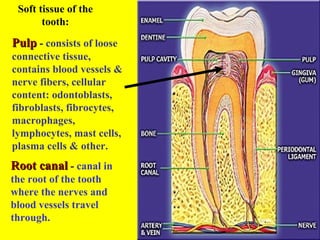
Soft tissue of the
       tooth:

Pulp - consists of loose
connective tissue,
contains blood vessels &
nerve fibers, cellular
content: odontoblasts,
fibroblasts, fibrocytes,
macrophages,
lymphocytes, mast cells,
plasma cells & other.
Root canal - canal in
the root of the tooth
where the nerves and
blood vessels travel
through.
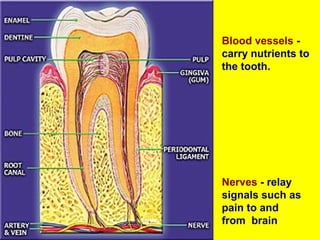
Blood vessels -
carry nutrients to
the tooth.


Nerves - relay
signals such as
pain to and
from brain
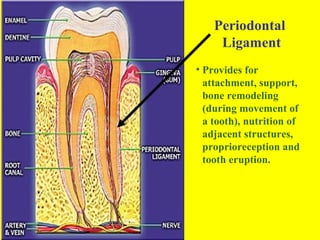
Periodontal
     Ligament
• Provides for
  attachment, support,
  bone remodeling
  (during movement of
  a tooth), nutrition of
  adjacent structures,
  proprioreception and
  tooth eruption.
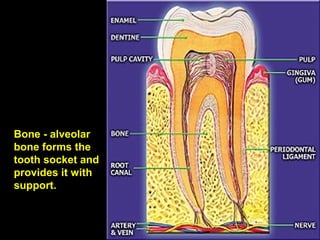
Bone - alveolar
bone forms the
tooth socket and
provides it with
support.
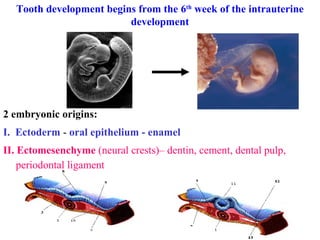
Tooth development begins from the 6th week of the intrauterine
                         development


2 embryonic origins:
I. Ectoderm - oral epithelium - enamel
II. Ectomesenchyme (neural crests)– dentin, cement, dental pulp,
    periodontal ligament
FUNCTIONAL STAGES OF
   TOOTH DEVELOPMENT
• Initiation
• Proliferation
• Morpho-differentiation and
  Histo-differentiation
• Apposition

• Root development
MORPHOLOGICAL STAGES
    OF TOOTH DEVELOPMENT
•   Bud stage
•   Cap stage
•   Bell stage (early & late)
•   Early & late crown

• Early root formation
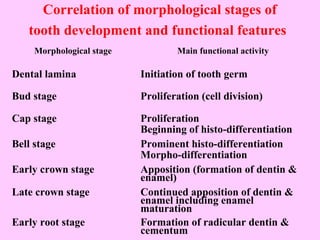
Correlation of morphological stages of
   tooth development and functional features
     Morphological stage           Main functional activity

Dental lamina              Initiation of tooth germ

Bud stage                  Proliferation (cell division)

Cap stage                  Proliferation
                           Beginning of histo-differentiation
Bell stage                 Prominent histo-differentiation
                           Morpho-differentiation
Early crown stage          Apposition (formation of dentin &
                           enamel)
Late crown stage           Continued apposition of dentin &
                           enamel including enamel
                           maturation
Early root stage           Formation of radicular dentin &
                           cementum
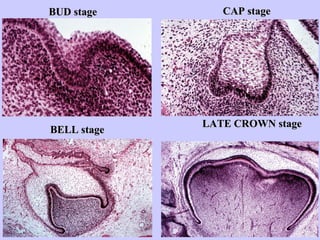
BUD stage       CAP stage


             LATE CROWN stage
BELL stage
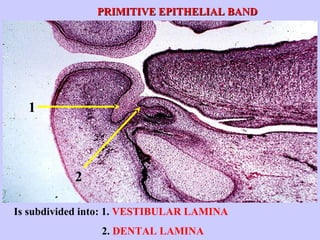
PRIMITIVE EPITHELIAL BAND


  1


           2

Is subdivided into: 1. VESTIBULAR LAMINA
                2. DENTAL LAMINA
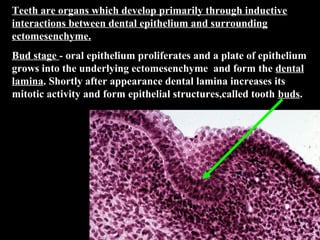
Teeth are organs which develop primarily through inductive
interactions between dental epithelium and surrounding
ectomesenchyme.
Bud stage - oral epithelium proliferates and a plate of epithelium
grows into the underlying ectomesenchyme and form the dental
lamina. Shortly after appearance dental lamina increases its
mitotic activity and form epithelial structures,called tooth buds.
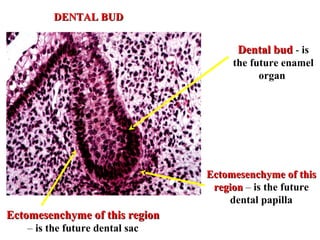
DENTAL BUD


                                      Dental bud - is
                                     the future enamel
                                           organ


                                Ectomesenchyme of this
                                 region – is the future
                                    dental papilla
Ectomesenchyme of this region
   – is the future dental sac
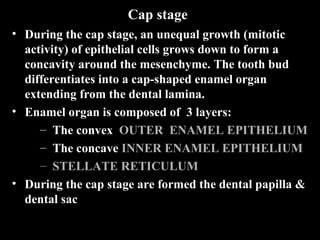
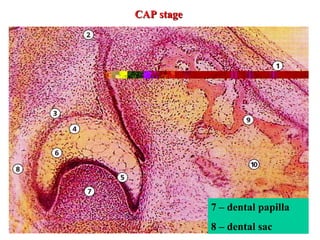
Cap stage
• During the cap stage, an unequal growth (mitotic
  activity) of epithelial cells grows down to form a
  concavity around the mesenchyme. The tooth bud
  differentiates into a cap-shaped enamel organ
  extending from the dental lamina.
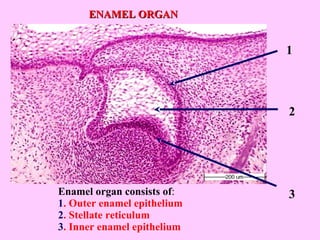
• Enamel organ is composed of 3 layers:
     – The convex OUTER ENAMEL EPITHELIUM
     – The concave INNER ENAMEL EPITHELIUM
     – STELLATE RETICULUM
• During the cap stage are formed the dental papilla &
  dental sac
ENAMEL ORGAN


                             1


                             2


Enamel organ consists of:    3
1. Outer enamel epithelium
2. Stellate reticulum
3. Inner enamel epithelium
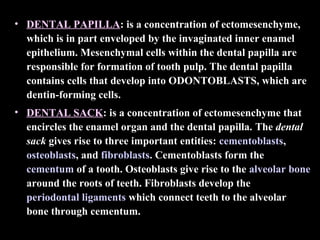
• DENTAL PAPILLA: is a concentration of ectomesenchyme,
  which is in part enveloped by the invaginated inner enamel
  epithelium. Mesenchymal cells within the dental papilla are
  responsible for formation of tooth pulp. The dental papilla
  contains cells that develop into ODONTOBLASTS, which are
  dentin-forming cells.
• DENTAL SACK: is a concentration of ectomesenchyme that
  encircles the enamel organ and the dental papilla. The dental
  sack gives rise to three important entities: cementoblasts,
  osteoblasts, and fibroblasts. Cementoblasts form the
  cementum of a tooth. Osteoblasts give rise to the alveolar bone
  around the roots of teeth. Fibroblasts develop the
  periodontal ligaments which connect teeth to the alveolar
  bone through cementum.
CAP stage


            7 – dental papilla
            8 – dental sac
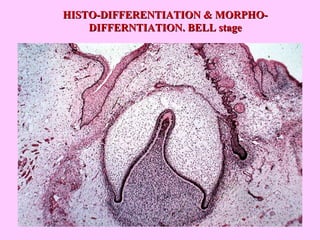
HISTO-DIFFERENTIATION & MORPHO-
    DIFFERNTIATION. BELL stage
Bell stage
• is known for the histodifferentiation and morphodifferentiation
  that takes place.
• The caracteristics of the stage:
   – Cellular differentiation
   – Morphological specialization, both with alternative,
      inductive and receptive role.
• We recognized two different processes during this stage:
   – Dentinogenesis (cells at the periphery of the dental papilla
      differentiate into odontoblasts and begin to elaborate
      predentin and dentin) – which precedes and follows what
      comes next, that is
   – Amelogenesis (cells of the inner enamel epithelium
      differentiate into ameloblasts which begin to elaborate
      enamel)
• The dentin and enamel adjoin each other and the junction
  between them is called the dentino-enamel junction.
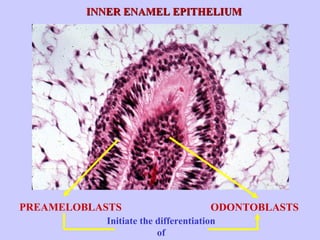
INNER ENAMEL EPITHELIUM


PREAMELOBLASTS                        ODONTOBLASTS
            Initiate the differentiation
                         of
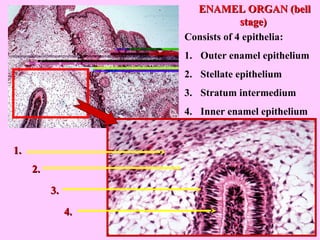
ENAMEL ORGAN (bell
                                 stage)
                    Consists of 4 epithelia:
                    1. Outer enamel epithelium
                    2. Stellate epithelium
                    3. Stratum intermedium
                    4. Inner enamel epithelium


1.
     2.

          3.

               4.
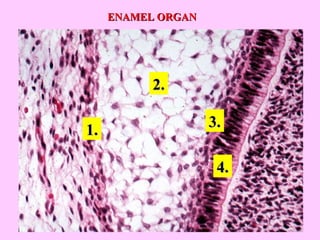
ENAMEL ORGAN


           2.

                    3.
1.

                     4.
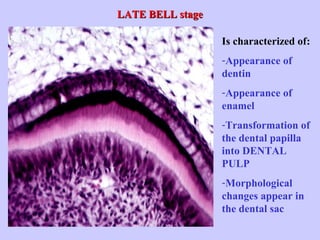
LATE BELL stage

                  Is characterized of:
                  -Appearance of
                  dentin
                  -Appearance of
                  enamel
                  -Transformation of
                  the dental papilla
                  into DENTAL
                  PULP
                  -Morphological
                  changes appear in
                  the dental sac
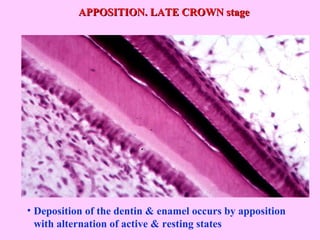
APPOSITION. LATE CROWN stage


• Deposition of the dentin & enamel occurs by apposition
  with alternation of active & resting states
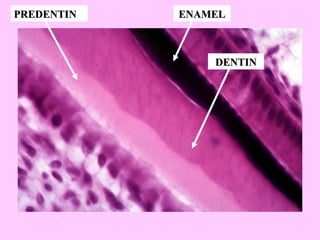
PREDENTIN   ENAMEL


                DENTIN
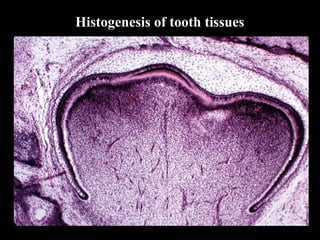
Histogenesis of tooth tissues
ROOT FORMATION
• Begins after complete formation of the
  tooth crown & continues after the eruption.
• Key elements, that take part in the root
  formation, are:

1. Cervical loop – that is transformed into
   EPITHELIAL ROOT SHEATH OF
   HERTWIG , that differentiates into
   EPITHELIAL DIAPHRAGM
2. Dental sac
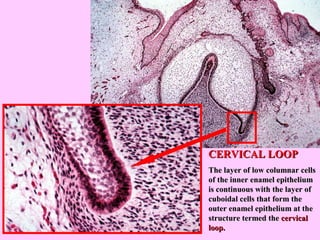
CERVICAL LOOP
The layer of low columnar cells
of the inner enamel epithelium
is continuous with the layer of
cuboidal cells that form the
outer enamel epithelium at the
structure termed the cervical
loop.
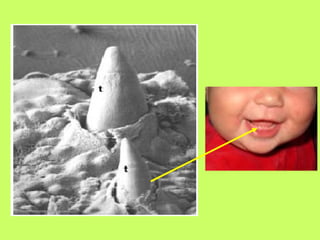
Tooth eruption is defined as:
“ The  movement of a tooth from its site
 of development within the alveolar
 process to its functional position in
 oral cavity,”

           Stage of tooth eruption
• Pre-eruptive
• Eruptive (intraosseous & extraosseous)
• Post-eruptive
Tooth development med.gen.engl

Tooth development med.gen.engl

  • 1.
    UNIVERSITATEA DE STATDE MEDICINĂ ŞI FARMACIE “NICOLAE TESTEMIŢANU” Teeth and supporting tissues. Development and structure of the teeth. CATEDRA HISTOLOGIE, CITOLOGIE ŞI EMBRIOLOGIE TATIANA GLOBA
  • 2.
    TOOTH STRUCTURE CROWN (enamel layer over dentin) (anatomical & clinical) NECK (acellular cementum + dentin ) ROOT (cellular and acellular calcified cementum over dentin)
  • 3.
  • 4.
    Tissues of theteeth can be divided into 2 groups: hard and soft tissues. Hard tissues of the tooth: • ENAMEL • DENTIN • CEMENTUM Soft tissue of the tooth: • DENTAL PULP (crown pulp & root canal)
  • 5.
    Enamel • is acell free extracellular tissue. • is the translucent outer layer of the tooth. • is the hardest substance in the human body. Consists of: - 96% inorganic salts - 4% organic substances- glycoproteins enamelin.
  • 6.
    Enamel • Is anextracellular product of enamel organ cells. • Is produced by the AMELOBLASTS. • Consists of RODS or PRISMS (the morpho- functional unit of enamel).
  • 7.
    Dentin • forms thebulk of the tooth. • It supports enamel and acts as the skeleton of the tooth. • It is the second hardest tissue in the human body. Consists of: - 72% inorganic salts (Ca phosphate, Mg phosphate) - 28% organic substances (collagen type I, proteoglycans and glycoproteins).
  • 8.
    Dentin • Is producedby the ODONTOBLASTS (these cells have cylindrical cell body and a long cytoplasmatic extension, the odontoblastic process). • Dentin is a living tissue, it has the ability for constant growth and repair that reacts to physiologic (functional) and pathologic (disease) stimuli. • The dentin is perforated by dentinal tubules. Each tubule is filled with an elongated cellular process of an odontoblast, and nerve endings.
  • 9.
    Cementum • is thethird mineralized tissue of the tooth and is as hard as bone is, but has no Haversian systems. • Covers the root of the tooth in a thin layer. • Is avascular tissue. Consists of: - 50% inorganic salts - 50 % organic substances (collagen, proteoglycans).
  • 10.
    Cementum • Cells ofthe cementum are: – Cementocytes that are located in lacunae – Cementoblasts that are located on the outer surface of the cementum, adjacent to the periodontal ligament • Cementum is capable of formation, destruction and repair and remodels continually throughout life. It is nourished from vessels within the periodontal ligament. • Functions: – It protects the dentin (occludes the dentinal tubules) – It provides attachment of the periodontal fibers – It reverses tooth resorption • There are 2 types of cementum: I. Cellular – contains cementocytes and cementoblasts II. Acelular – has no cells.
  • 11.
    Soft tissue ofthe tooth: Pulp - consists of loose connective tissue, contains blood vessels & nerve fibers, cellular content: odontoblasts, fibroblasts, fibrocytes, macrophages, lymphocytes, mast cells, plasma cells & other. Root canal - canal in the root of the tooth where the nerves and blood vessels travel through.
  • 12.
    Blood vessels - carrynutrients to the tooth. Nerves - relay signals such as pain to and from brain
  • 13.
    Periodontal Ligament • Provides for attachment, support, bone remodeling (during movement of a tooth), nutrition of adjacent structures, proprioreception and tooth eruption.
  • 14.
    Bone - alveolar boneforms the tooth socket and provides it with support.
  • 15.
    Tooth development beginsfrom the 6th week of the intrauterine development 2 embryonic origins: I. Ectoderm - oral epithelium - enamel II. Ectomesenchyme (neural crests)– dentin, cement, dental pulp, periodontal ligament
  • 16.
    FUNCTIONAL STAGES OF TOOTH DEVELOPMENT • Initiation • Proliferation • Morpho-differentiation and Histo-differentiation • Apposition • Root development
  • 17.
    MORPHOLOGICAL STAGES OF TOOTH DEVELOPMENT • Bud stage • Cap stage • Bell stage (early & late) • Early & late crown • Early root formation
  • 18.
    Correlation of morphologicalstages of tooth development and functional features Morphological stage Main functional activity Dental lamina Initiation of tooth germ Bud stage Proliferation (cell division) Cap stage Proliferation Beginning of histo-differentiation Bell stage Prominent histo-differentiation Morpho-differentiation Early crown stage Apposition (formation of dentin & enamel) Late crown stage Continued apposition of dentin & enamel including enamel maturation Early root stage Formation of radicular dentin & cementum
  • 19.
    BUD stage CAP stage LATE CROWN stage BELL stage
  • 20.
    PRIMITIVE EPITHELIAL BAND 1 2 Is subdivided into: 1. VESTIBULAR LAMINA 2. DENTAL LAMINA
  • 21.
    Teeth are organswhich develop primarily through inductive interactions between dental epithelium and surrounding ectomesenchyme. Bud stage - oral epithelium proliferates and a plate of epithelium grows into the underlying ectomesenchyme and form the dental lamina. Shortly after appearance dental lamina increases its mitotic activity and form epithelial structures,called tooth buds.
  • 22.
    DENTAL BUD Dental bud - is the future enamel organ Ectomesenchyme of this region – is the future dental papilla Ectomesenchyme of this region – is the future dental sac
  • 23.
    Cap stage • Duringthe cap stage, an unequal growth (mitotic activity) of epithelial cells grows down to form a concavity around the mesenchyme. The tooth bud differentiates into a cap-shaped enamel organ extending from the dental lamina. • Enamel organ is composed of 3 layers: – The convex OUTER ENAMEL EPITHELIUM – The concave INNER ENAMEL EPITHELIUM – STELLATE RETICULUM • During the cap stage are formed the dental papilla & dental sac
  • 24.
    ENAMEL ORGAN 1 2 Enamel organ consists of: 3 1. Outer enamel epithelium 2. Stellate reticulum 3. Inner enamel epithelium
  • 25.
    • DENTAL PAPILLA:is a concentration of ectomesenchyme, which is in part enveloped by the invaginated inner enamel epithelium. Mesenchymal cells within the dental papilla are responsible for formation of tooth pulp. The dental papilla contains cells that develop into ODONTOBLASTS, which are dentin-forming cells. • DENTAL SACK: is a concentration of ectomesenchyme that encircles the enamel organ and the dental papilla. The dental sack gives rise to three important entities: cementoblasts, osteoblasts, and fibroblasts. Cementoblasts form the cementum of a tooth. Osteoblasts give rise to the alveolar bone around the roots of teeth. Fibroblasts develop the periodontal ligaments which connect teeth to the alveolar bone through cementum.
  • 26.
    CAP stage 7 – dental papilla 8 – dental sac
  • 27.
    HISTO-DIFFERENTIATION & MORPHO- DIFFERNTIATION. BELL stage
  • 28.
    Bell stage • isknown for the histodifferentiation and morphodifferentiation that takes place. • The caracteristics of the stage: – Cellular differentiation – Morphological specialization, both with alternative, inductive and receptive role. • We recognized two different processes during this stage: – Dentinogenesis (cells at the periphery of the dental papilla differentiate into odontoblasts and begin to elaborate predentin and dentin) – which precedes and follows what comes next, that is – Amelogenesis (cells of the inner enamel epithelium differentiate into ameloblasts which begin to elaborate enamel) • The dentin and enamel adjoin each other and the junction between them is called the dentino-enamel junction.
  • 29.
    INNER ENAMEL EPITHELIUM PREAMELOBLASTS ODONTOBLASTS Initiate the differentiation of
  • 30.
    ENAMEL ORGAN (bell stage) Consists of 4 epithelia: 1. Outer enamel epithelium 2. Stellate epithelium 3. Stratum intermedium 4. Inner enamel epithelium 1. 2. 3. 4.
  • 31.
    ENAMEL ORGAN 2. 3. 1. 4.
  • 32.
    LATE BELL stage Is characterized of: -Appearance of dentin -Appearance of enamel -Transformation of the dental papilla into DENTAL PULP -Morphological changes appear in the dental sac
  • 33.
    APPOSITION. LATE CROWNstage • Deposition of the dentin & enamel occurs by apposition with alternation of active & resting states
  • 34.
    PREDENTIN ENAMEL DENTIN
  • 35.
  • 36.
    ROOT FORMATION • Beginsafter complete formation of the tooth crown & continues after the eruption. • Key elements, that take part in the root formation, are: 1. Cervical loop – that is transformed into EPITHELIAL ROOT SHEATH OF HERTWIG , that differentiates into EPITHELIAL DIAPHRAGM 2. Dental sac
  • 37.
    CERVICAL LOOP The layerof low columnar cells of the inner enamel epithelium is continuous with the layer of cuboidal cells that form the outer enamel epithelium at the structure termed the cervical loop.
  • 38.
    Tooth eruption isdefined as: “ The movement of a tooth from its site of development within the alveolar process to its functional position in oral cavity,” Stage of tooth eruption • Pre-eruptive • Eruptive (intraosseous & extraosseous) • Post-eruptive