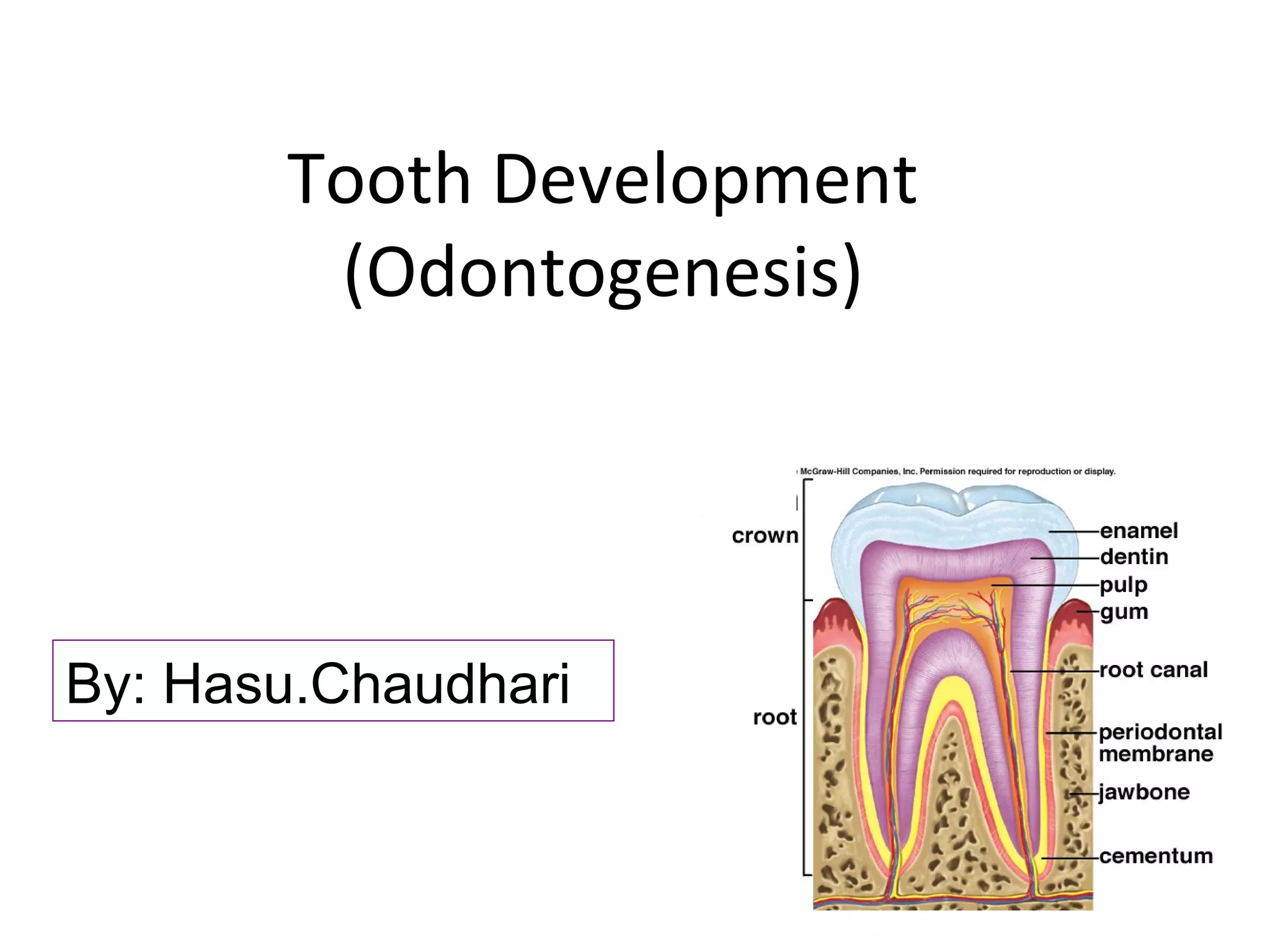
Tooth Development
(Odontogenesis)

By: Hasu.Chaudhari
Dentition
Primary dentition – develops during prenatal
period
•

20 teeth

–

Permanent dentition – develops as the jaw
grows and matures
•

32 teeth
period in between – during the preteen years
(mixed dentition period)
–
TOOTH DEVELOPMENT

Multiple stages:initiation stage – 6th to 7th week
bud stage – 8th week
cap stage – 9th to 10th weeks
bell stage – 11th to 12th weeks
apposition stage – varies per tooth
maturation stage – varies per tooth

•

•

•

•

•

•
BUD STAGE

Tooth formation

 Proliferation of ectoderm lining the Alveolar Process & Epithelium
become thick on convex side of this process form Dental lamina
Dental lamina where tooth formation will occur - on
the 1st branchial arch.
Dental lamina, even apparent before the alveolar
process itself is defined.
Alveolar process – Semicircular in outline
Similarly, Dental lamina – Curved.
•

•

•

•
 Dental lamina shows local thickening which results
to form 1 milk tooth.
 Deeper part of dental lamina enlarges to form
enamel organ.
 These thickening called enamel organs.
 10 in number – 5 on each side of alveolar process.
Stages in the formation of an enamel organ &
developing tooth
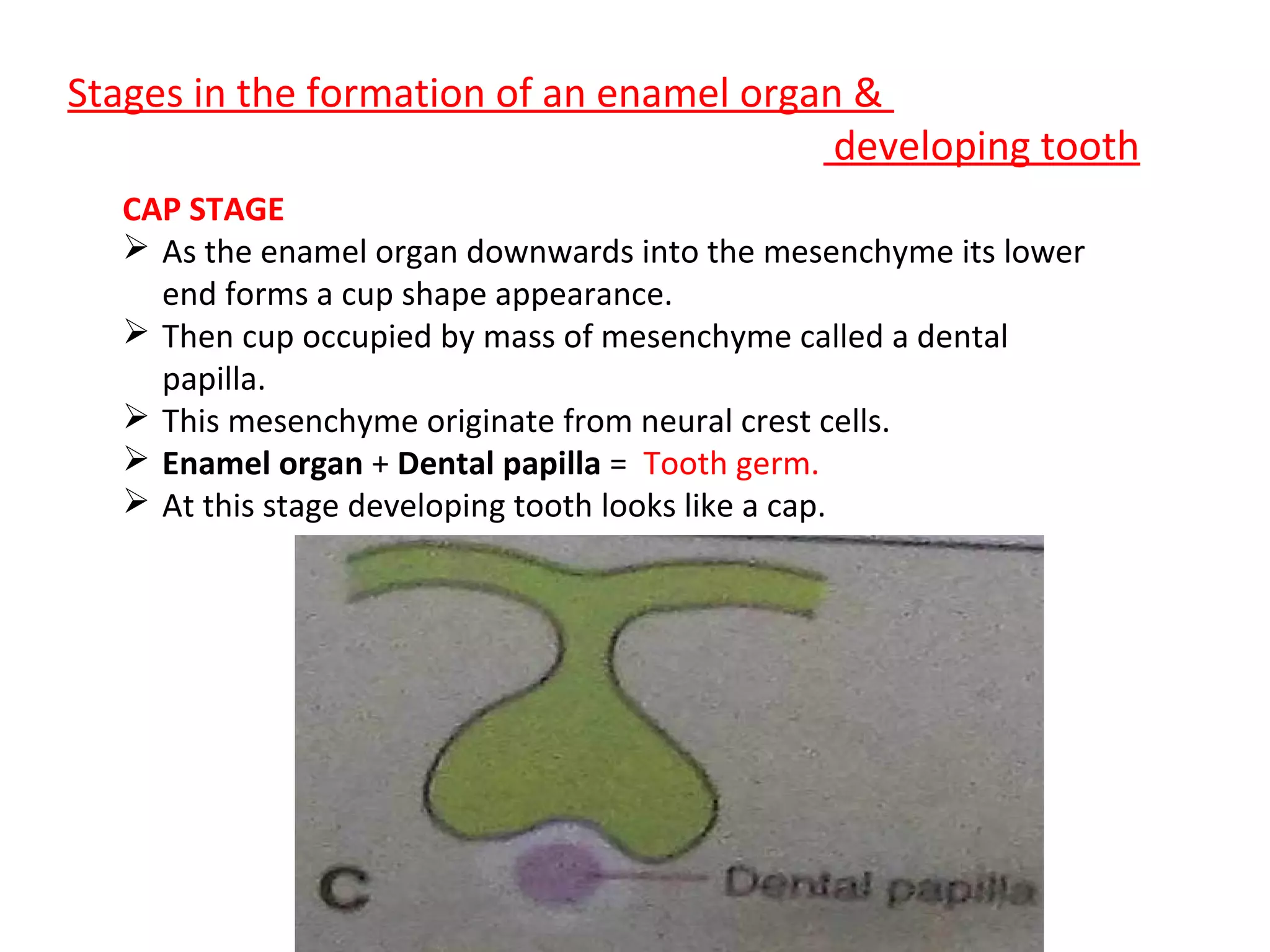
CAP STAGE
 As the enamel organ downwards into the mesenchyme its lower
end forms a cup shape appearance.
 Then cup occupied by mass of mesenchyme called a dental
papilla.
 This mesenchyme originate from neural crest cells.
 Enamel organ + Dental papilla = Tooth germ.
 At this stage developing tooth looks like a cap.
BELL STAGE
 The cells of the enamel organ that line the papilla become columnar these are
called ameloblasts.
 Mesodermal cells of the papilla that are adjacent to the ameloblast cells
arrange themselves as a continuous epithelium like layer. Cells of this layer are
called Odontoblasts.
 The ameloblasts & odontoblasts are separated by a basement membrane.
 The remaining cells of the papilla form the pulp of tooth.
 The developing tooth looks like a bell.
APPOSITIONAL STAGE
 Ameloblasts secrete enamel on the superficial surface of the basement
membrane.
 The odontoblasts secretes dentine on its deeper surface.
 The process of secretion of enamel & dentine is similar to that of formation of
bone by osteoblasts.
 Ameloblasts & odontoblasts move far away from each other by increasing layers
of enamel & dentine.
MATURATION STAGE

After the enamel is fully formed, the ameloblast
disappear leaving a thin membrane, the dental
cuticle, over the enamel.
The odontoblasts, continue to separate the
dentine from pulp throughout the life of the
tooth.
Alveolar part of the maxillae & the mandible are
formed by ossification.
As ossification progresses, roots of the teeth
become surrounded by bone.
The root of the tooth is established by continued
growth into underlying mesenchyme.
Odontoblasts in this region secrete dentine (no
ameloblasts cells).
As layers of dentine deposited, the pulp space
becomes narrower & converted into a canal through
which nerves & blood vessels pass into the tooth.
Dentine is covered by mesenchymal cells that
differentiate into cementoblasts.
These cells lay down a layer of dense bone called
Cementum.
Mesenchymal cells form a periodontal ligament which
connects the root with the socket in the jaw bone.
Formation of permanent tooth

 The dental lamina gives off a series of buds, one of which lies on the medial
side of each developing milk tooth.
 These buds form the enamel organs.
 They give rise to permanent incisors, canines & premolars.
The permanent molars are formed from buds that arise from the dental lamina
posterior to the region of last milk tooth.
Dental lamina is established in the 6th week of
intrauterine life.
The germ of 3rd molar is formed after birth & germ of
premolar & 2nd molar are not very developed & rest
of all show considerable development at birth.
The developing tooth germs undergo calcification
(accumulation of calcium salts in a body tissue).
All the temporary teeth & permanent lower 1st molar
begin to calcify before birth.
The permanent teeth begin to calcify at varying ages
after birth.
Anomalies of teeth
1. Anodentia :- one or more teeth may be absent or complete
absence.
Supernumerary teeth may be present
Gemination :- Two or more teeth may be fused to
each other.
Malocclusion :- Alignment of the upper & the lower
teeth may be incorrect.
The End :D

Tooth development for the embryology..

  • 1.
  • 2.
    Dentition Primary dentition –develops during prenatal period • 20 teeth – Permanent dentition – develops as the jaw grows and matures • 32 teeth period in between – during the preteen years (mixed dentition period) –
  • 3.
    TOOTH DEVELOPMENT Multiple stages:initiationstage – 6th to 7th week bud stage – 8th week cap stage – 9th to 10th weeks bell stage – 11th to 12th weeks apposition stage – varies per tooth maturation stage – varies per tooth • • • • • •
  • 4.
    BUD STAGE Tooth formation Proliferation of ectoderm lining the Alveolar Process & Epithelium become thick on convex side of this process form Dental lamina Dental lamina where tooth formation will occur - on the 1st branchial arch. Dental lamina, even apparent before the alveolar process itself is defined. Alveolar process – Semicircular in outline Similarly, Dental lamina – Curved. • • • •
  • 5.
     Dental laminashows local thickening which results to form 1 milk tooth.  Deeper part of dental lamina enlarges to form enamel organ.  These thickening called enamel organs.  10 in number – 5 on each side of alveolar process.
  • 6.
    Stages in theformation of an enamel organ & developing tooth CAP STAGE  As the enamel organ downwards into the mesenchyme its lower end forms a cup shape appearance.  Then cup occupied by mass of mesenchyme called a dental papilla.  This mesenchyme originate from neural crest cells.  Enamel organ + Dental papilla = Tooth germ.  At this stage developing tooth looks like a cap.
  • 7.
    BELL STAGE  Thecells of the enamel organ that line the papilla become columnar these are called ameloblasts.  Mesodermal cells of the papilla that are adjacent to the ameloblast cells arrange themselves as a continuous epithelium like layer. Cells of this layer are called Odontoblasts.  The ameloblasts & odontoblasts are separated by a basement membrane.  The remaining cells of the papilla form the pulp of tooth.  The developing tooth looks like a bell.
  • 8.
    APPOSITIONAL STAGE  Ameloblastssecrete enamel on the superficial surface of the basement membrane.  The odontoblasts secretes dentine on its deeper surface.  The process of secretion of enamel & dentine is similar to that of formation of bone by osteoblasts.  Ameloblasts & odontoblasts move far away from each other by increasing layers of enamel & dentine.
  • 9.
    MATURATION STAGE After theenamel is fully formed, the ameloblast disappear leaving a thin membrane, the dental cuticle, over the enamel. The odontoblasts, continue to separate the dentine from pulp throughout the life of the tooth. Alveolar part of the maxillae & the mandible are formed by ossification. As ossification progresses, roots of the teeth become surrounded by bone.
  • 10.
    The root ofthe tooth is established by continued growth into underlying mesenchyme. Odontoblasts in this region secrete dentine (no ameloblasts cells). As layers of dentine deposited, the pulp space becomes narrower & converted into a canal through which nerves & blood vessels pass into the tooth. Dentine is covered by mesenchymal cells that differentiate into cementoblasts. These cells lay down a layer of dense bone called Cementum. Mesenchymal cells form a periodontal ligament which connects the root with the socket in the jaw bone.
  • 11.
    Formation of permanenttooth  The dental lamina gives off a series of buds, one of which lies on the medial side of each developing milk tooth.  These buds form the enamel organs.  They give rise to permanent incisors, canines & premolars. The permanent molars are formed from buds that arise from the dental lamina posterior to the region of last milk tooth.
  • 12.
    Dental lamina isestablished in the 6th week of intrauterine life. The germ of 3rd molar is formed after birth & germ of premolar & 2nd molar are not very developed & rest of all show considerable development at birth. The developing tooth germs undergo calcification (accumulation of calcium salts in a body tissue). All the temporary teeth & permanent lower 1st molar begin to calcify before birth. The permanent teeth begin to calcify at varying ages after birth.
  • 13.
    Anomalies of teeth 1.Anodentia :- one or more teeth may be absent or complete absence.
  • 14.
  • 15.
    Gemination :- Twoor more teeth may be fused to each other.
  • 16.
    Malocclusion :- Alignmentof the upper & the lower teeth may be incorrect.
  • 17.