FIRST AID FOR
SHOCK
Presented by:
Harsh Rastogi,
M.Sc. Nursing 1st year,
King George’s Medical University,
Institute of Nursing,
Lucknow.
FIRST AID
• The Encyclopedia Britannica states First
Aid as "measures to be taken
immediately after an accident not with
an idea to cure but in order to prevent
further harm being done.”
FIRST AID (CONTINUED)
• It uses the available human and
material resources at the site of
accident to provide initial care to the
victim of injury or sudden illness until
more advance care is provided.
SHOCK
• Dangerous condition
– Not enough oxygen-rich blood reaching vital
organs such as brain and heart
• Caused by anything that significantly reduces
blood flow
• Life-threatening emergency
• May develop quickly or gradually
• Always call medical emergency number for
victim in shock
CAUSES OF SHOCK
• Severe bleeding
• Severe burns
• Heart failure
• Heart attack
• Head or spinal
injuries
• Severe allergic
reactions
• Dehydration
• Electrocution
• Serious infections
• Extreme emotional
reactions
(temporary/less
dangerous)
COMMON TYPES OF SHOCK
• Hypovolemic occurs when blood volume drops
• Cardiogenic occurs with diminished heart
function
• Neurogenic occurs with nervous system problems
• Anaphylactic extreme allergic reaction
DEVELOPMENT OF SHOCK
• Assume any victim with serious injury is at
risk for shock
• Often occurs in stages
• May progress gradually or quickly
• Victim ultimately becomes unresponsive
• Not all victims experience all signs and
symptoms of shock
SIGNS & SYMPTOMS OF
SHOCK
In compensatory shock (First stage):
– Anxiety, restlessness, fear
– Increased breathing and heart rate
In decompensatory shock (Second stage):
– Mental status continues to deteriorate
– Breathing becomes rapid and shallow, and
heartbeat rapid
– Skin becomes pale or ashen and cool
– Nausea and thirst occur
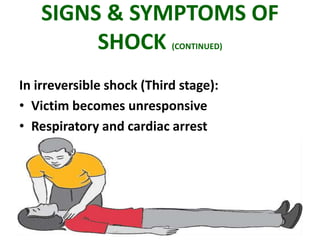
SIGNS & SYMPTOMS OF
SHOCK (CONTINUED)
In irreversible shock (Third stage):
• Victim becomes unresponsive
• Respiratory and cardiac arrest
URGENCY OF SHOCK
TREATMENT
• Shock continues to develop unless medical
treatment begins.
• Call medical emergency number immediately.
FIRST AID FOR SHOCK
1. Check for responsiveness, normal breathing
and severe bleeding, and care for life-
threatening injuries first.
2. Call medical emergency number immediately.
FIRST AID FOR SHOCK (CONTINUED)
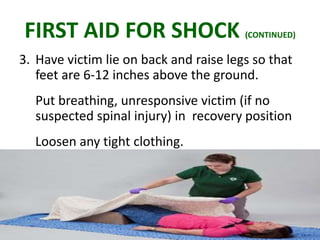
3. Have victim lie on back and raise legs so that
feet are 6-12 inches above the ground.
Put breathing, unresponsive victim (if no
suspected spinal injury) in recovery position
Loosen any tight clothing.
FIRST AID FOR SHOCK (CONTINUED)
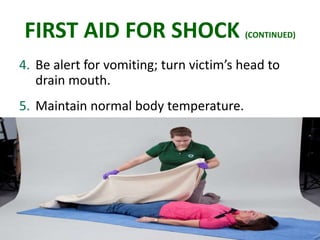
4. Be alert for vomiting; turn victim’s head to
drain mouth.
5. Maintain normal body temperature.
SHOCK IN CHILDREN
• Blood loss in infants/children may quickly lead
to shock
• Susceptible to shock from dehydration
• Early shock may be less obvious but child’s
condition rapidly declines
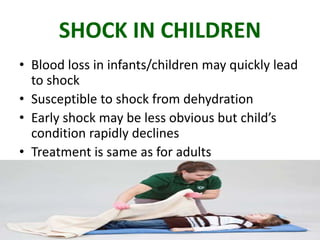
• Treatment is same as for adults
SUMMARY
• Introduction to the First Aid for Shock.
• Explain the definition of First Aid & Shock.
• Explain the causes of Shock.
• Explain the types of Shock.
• Explain the development steps of Shock.
• Explain the sign & symptoms of Shock?
• Explain the First Aid management for Shock.
• Explain the Shock management in children.
QUESTIONS
1. What is a First Aid?
2. What are the types of
Shocks?
Write a brief note on Types of Shocks &
their First Aid managements.
-Your friendly neighborhood Spiderman.
REFERENCES
• Crisp, J. and Potter, P. (2013). Potter
& Perry's fundamentals of nursing.
4th ed. Chatswood, N.S.W.: Mosby,
pp. Pages 163,164,239,544,799.
• Linton, Adrianne Dill.
(2012) Introduction to medical-
surgical nursing /St. Louis, Mo. :
Elsevier Saunders, Page number 443-
496.
• Sister Nancy, Fundamentals of
Nursing, Jaypee Brothers Medical
Publishers (P) Ltd., Edition 2015;
Page No. 57-72
First aid for shock

First aid for shock

  • 1.
    FIRST AID FOR SHOCK Presentedby: Harsh Rastogi, M.Sc. Nursing 1st year, King George’s Medical University, Institute of Nursing, Lucknow.
  • 2.
    FIRST AID • TheEncyclopedia Britannica states First Aid as "measures to be taken immediately after an accident not with an idea to cure but in order to prevent further harm being done.”
  • 3.
    FIRST AID (CONTINUED) •It uses the available human and material resources at the site of accident to provide initial care to the victim of injury or sudden illness until more advance care is provided.
  • 4.
    SHOCK • Dangerous condition –Not enough oxygen-rich blood reaching vital organs such as brain and heart • Caused by anything that significantly reduces blood flow • Life-threatening emergency • May develop quickly or gradually • Always call medical emergency number for victim in shock
  • 5.
    CAUSES OF SHOCK •Severe bleeding • Severe burns • Heart failure • Heart attack • Head or spinal injuries • Severe allergic reactions • Dehydration • Electrocution • Serious infections • Extreme emotional reactions (temporary/less dangerous)
  • 6.
    COMMON TYPES OFSHOCK • Hypovolemic occurs when blood volume drops • Cardiogenic occurs with diminished heart function • Neurogenic occurs with nervous system problems • Anaphylactic extreme allergic reaction
  • 7.
    DEVELOPMENT OF SHOCK •Assume any victim with serious injury is at risk for shock • Often occurs in stages • May progress gradually or quickly • Victim ultimately becomes unresponsive • Not all victims experience all signs and symptoms of shock
  • 8.
    SIGNS & SYMPTOMSOF SHOCK In compensatory shock (First stage): – Anxiety, restlessness, fear – Increased breathing and heart rate In decompensatory shock (Second stage): – Mental status continues to deteriorate – Breathing becomes rapid and shallow, and heartbeat rapid – Skin becomes pale or ashen and cool – Nausea and thirst occur
  • 9.
    SIGNS & SYMPTOMSOF SHOCK (CONTINUED) In irreversible shock (Third stage): • Victim becomes unresponsive • Respiratory and cardiac arrest
  • 10.
    URGENCY OF SHOCK TREATMENT •Shock continues to develop unless medical treatment begins. • Call medical emergency number immediately.
  • 11.
    FIRST AID FORSHOCK 1. Check for responsiveness, normal breathing and severe bleeding, and care for life- threatening injuries first. 2. Call medical emergency number immediately.
  • 12.
    FIRST AID FORSHOCK (CONTINUED) 3. Have victim lie on back and raise legs so that feet are 6-12 inches above the ground. Put breathing, unresponsive victim (if no suspected spinal injury) in recovery position Loosen any tight clothing.
  • 13.
    FIRST AID FORSHOCK (CONTINUED) 4. Be alert for vomiting; turn victim’s head to drain mouth. 5. Maintain normal body temperature.
  • 14.
    SHOCK IN CHILDREN •Blood loss in infants/children may quickly lead to shock • Susceptible to shock from dehydration • Early shock may be less obvious but child’s condition rapidly declines • Treatment is same as for adults
  • 15.
    SUMMARY • Introduction tothe First Aid for Shock. • Explain the definition of First Aid & Shock. • Explain the causes of Shock. • Explain the types of Shock. • Explain the development steps of Shock. • Explain the sign & symptoms of Shock? • Explain the First Aid management for Shock. • Explain the Shock management in children.
  • 18.
    QUESTIONS 1. What isa First Aid? 2. What are the types of Shocks?
  • 19.
    Write a briefnote on Types of Shocks & their First Aid managements. -Your friendly neighborhood Spiderman.
  • 20.
    REFERENCES • Crisp, J.and Potter, P. (2013). Potter & Perry's fundamentals of nursing. 4th ed. Chatswood, N.S.W.: Mosby, pp. Pages 163,164,239,544,799. • Linton, Adrianne Dill. (2012) Introduction to medical- surgical nursing /St. Louis, Mo. : Elsevier Saunders, Page number 443- 496. • Sister Nancy, Fundamentals of Nursing, Jaypee Brothers Medical Publishers (P) Ltd., Edition 2015; Page No. 57-72