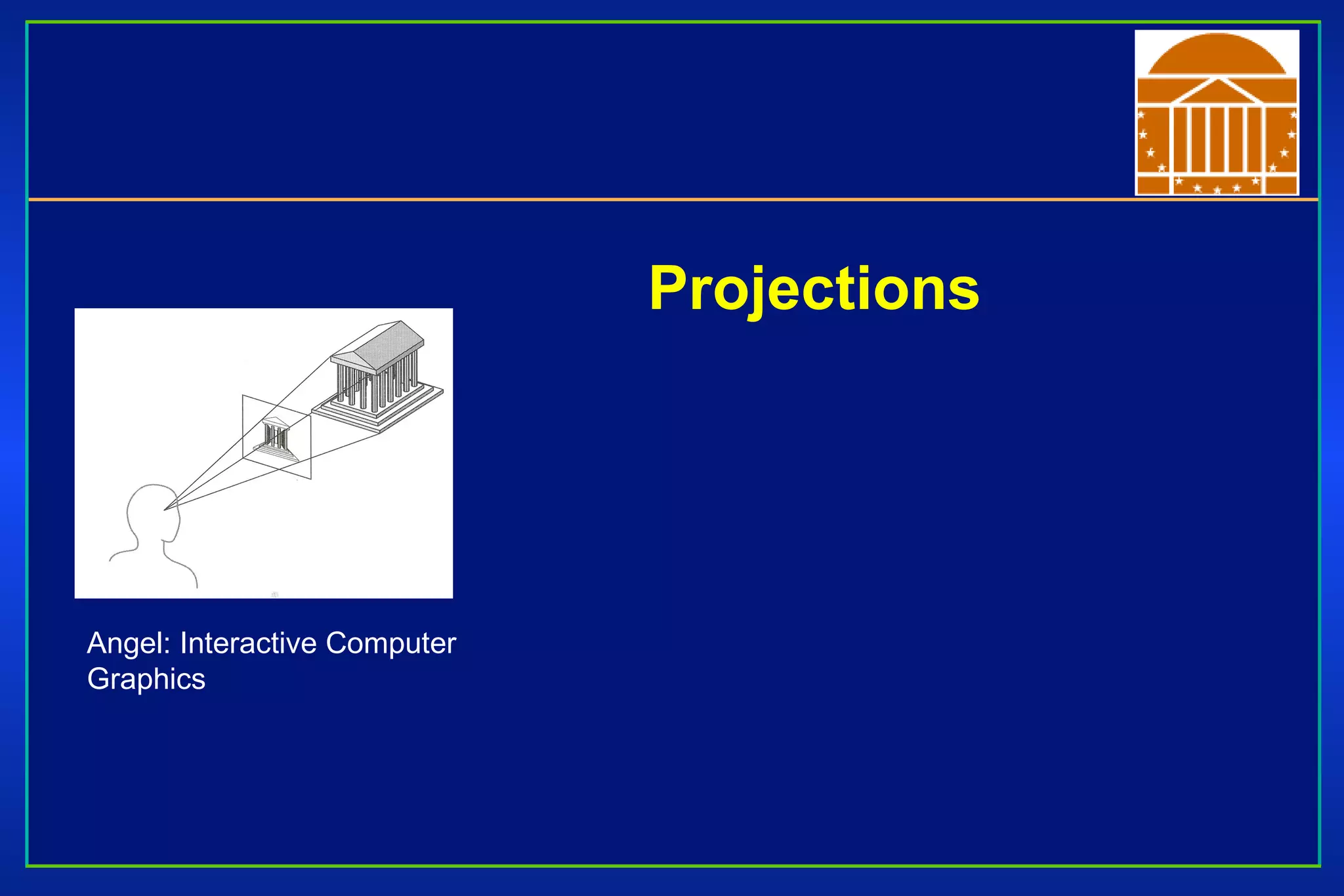
Projections  Angel: Interactive Computer Graphics
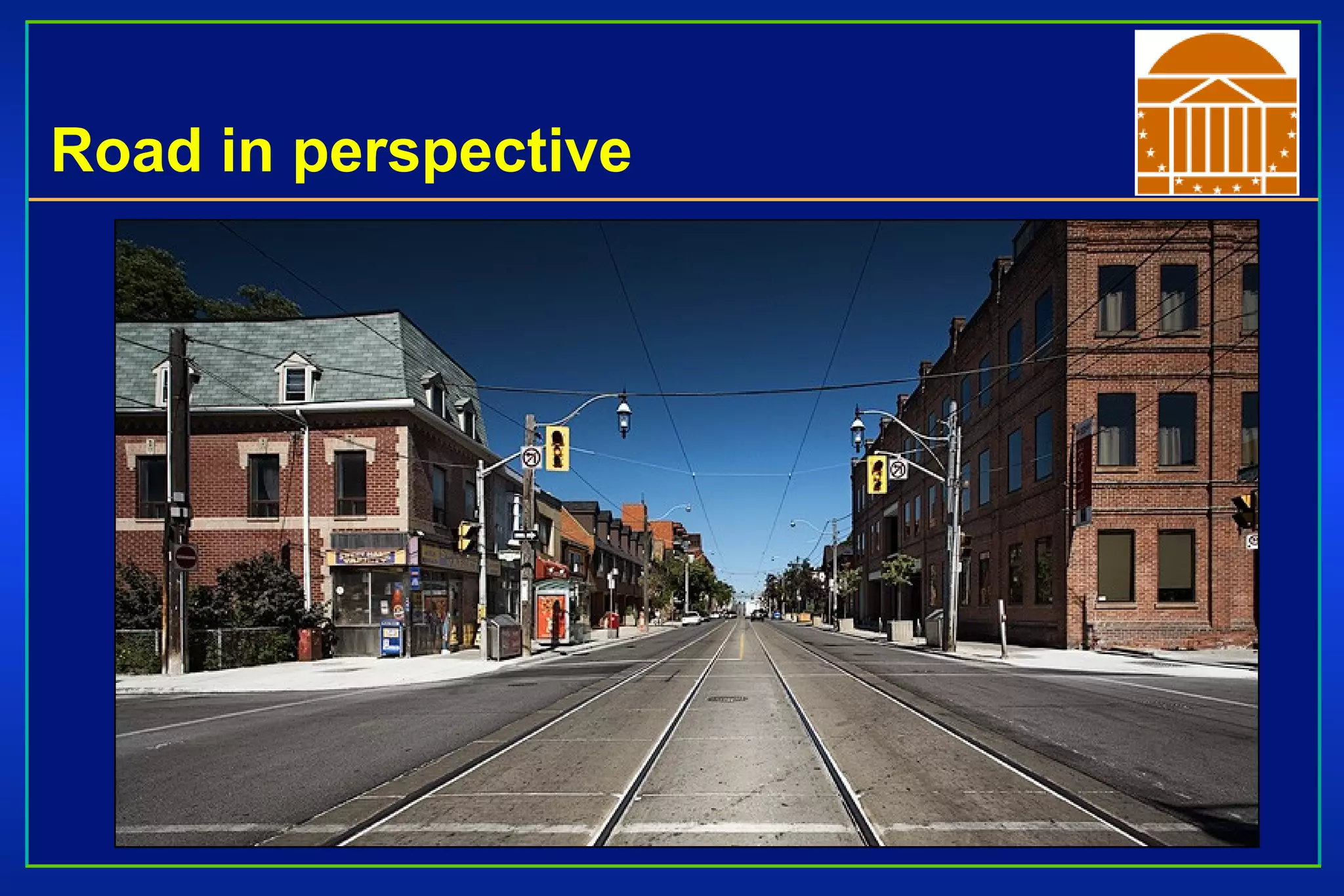
Road in perspective
Taxonomy of Projections FVFHP Figure 6.10
Taxonomy of Projections
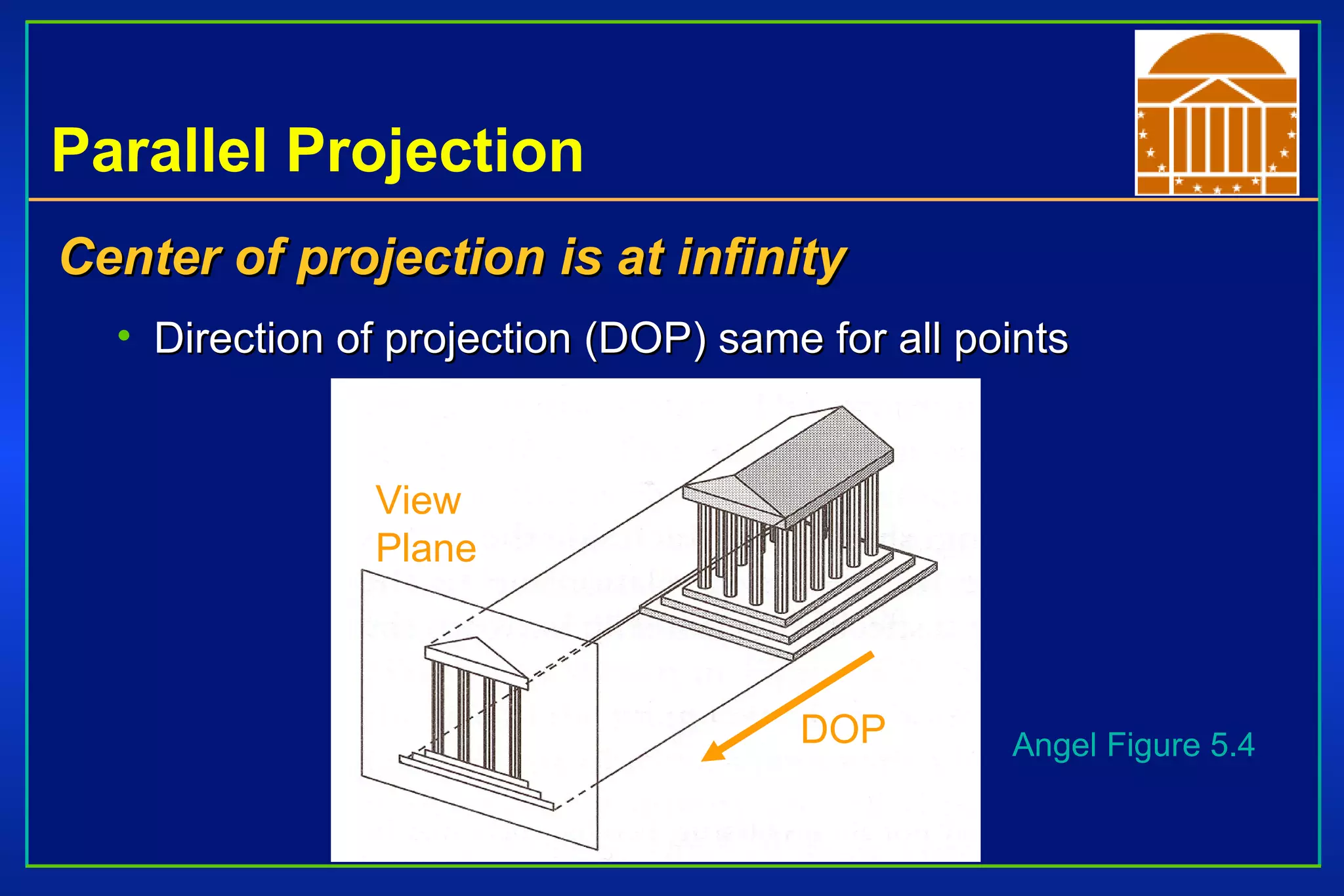
Parallel Projection Center of projection is at infinity Direction of projection (DOP) same for all points Angel Figure 5.4 DOP View Plane
Orthographic Projections DOP perpendicular to view plane Angel Figure 5.5 Top Side Front
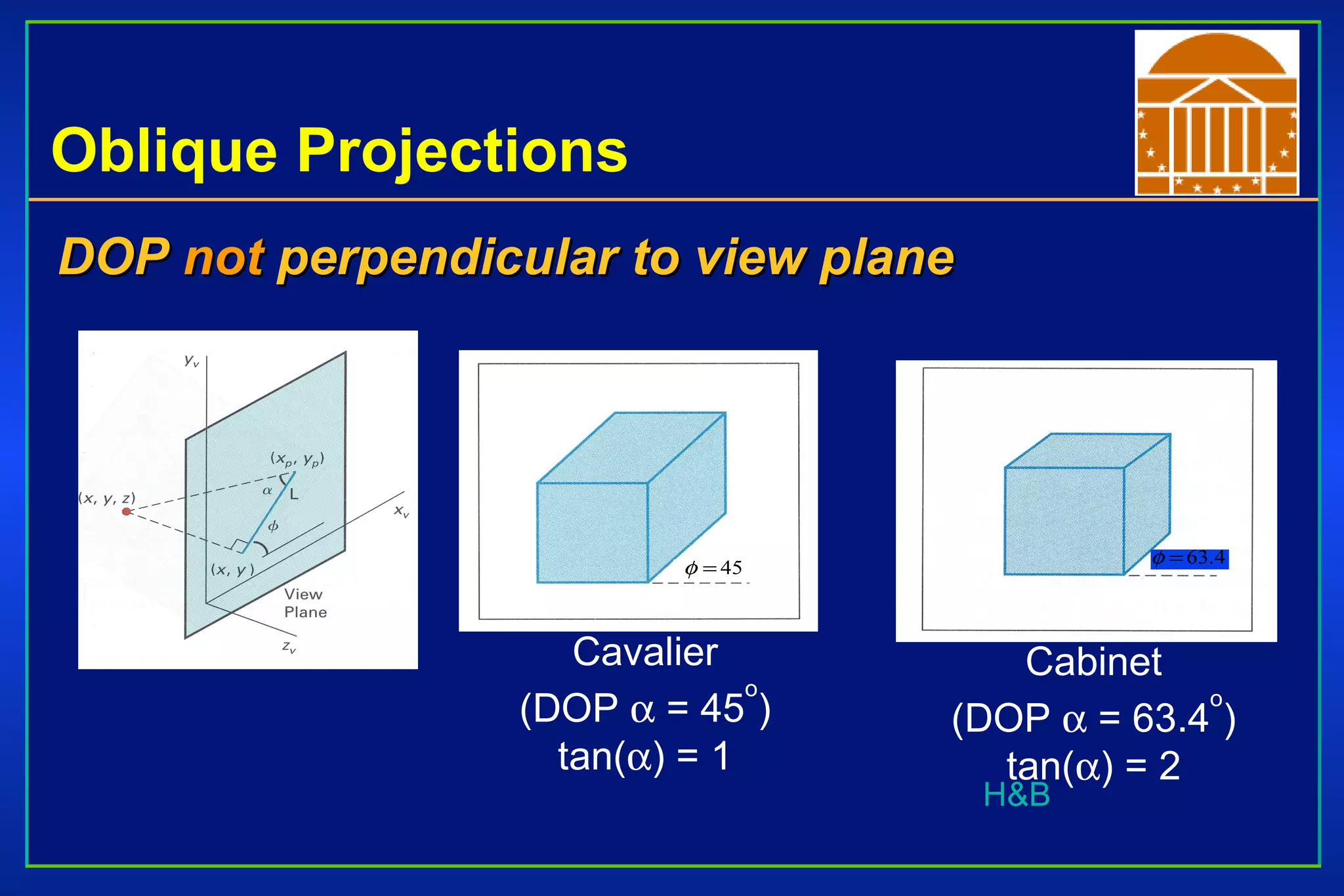
Oblique Projections DOP  not  perpendicular to view plane H&B Cavalier (DOP    = 45 o ) tan(  ) = 1 Cabinet (DOP    = 63.4 o ) tan(  ) = 2
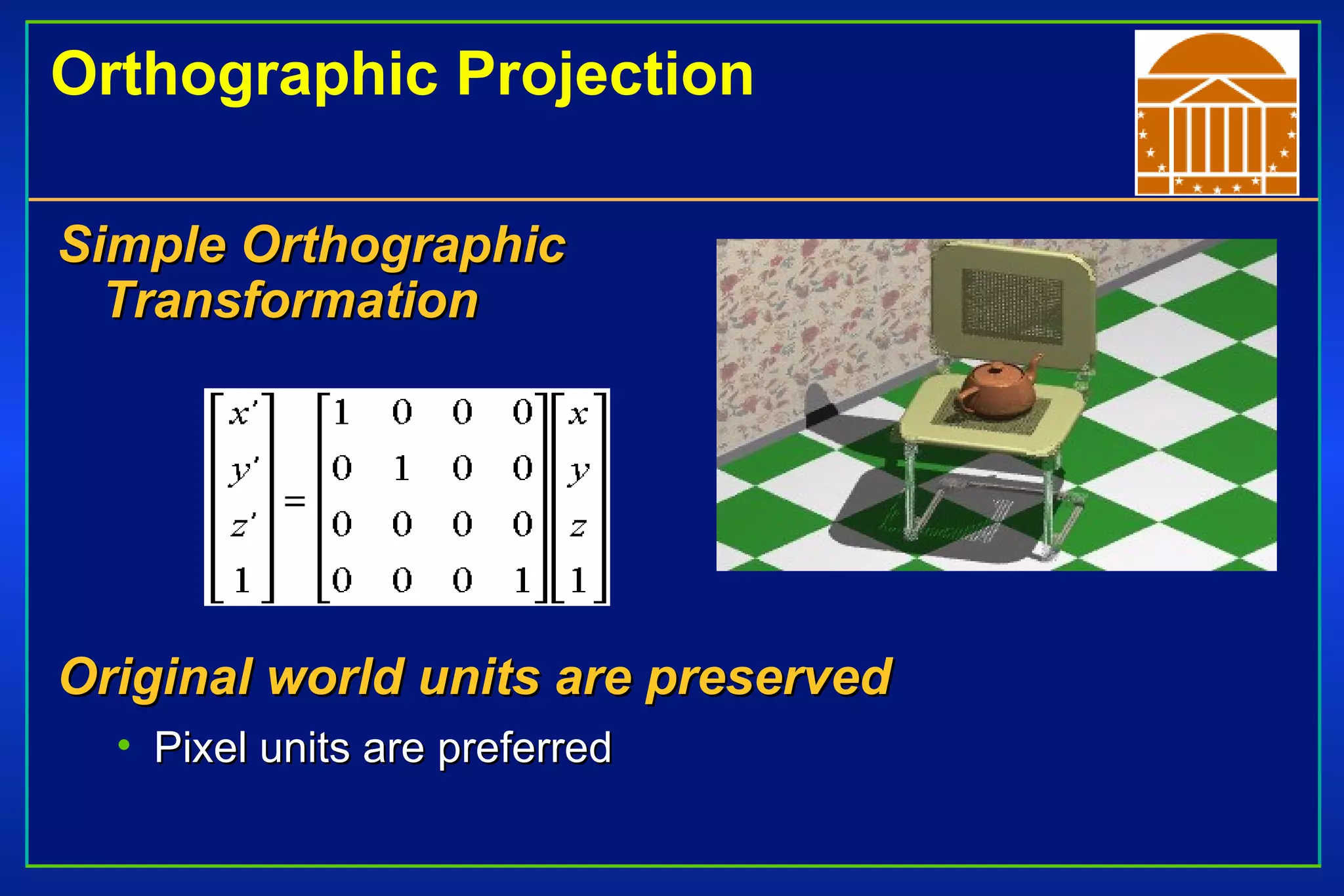
Orthographic Projection Simple Orthographic Transformation Original world units are preserved Pixel units are preferred
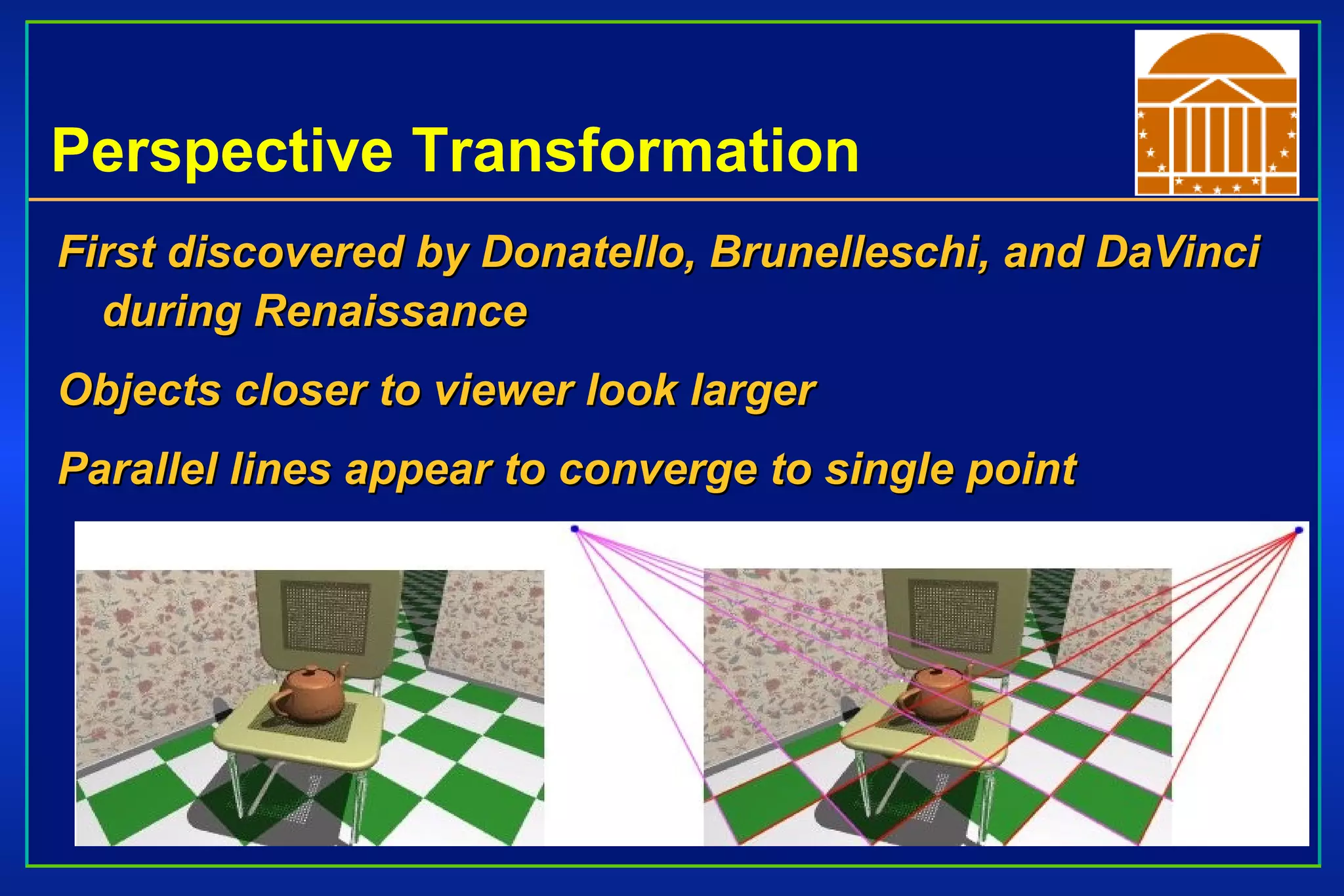
Perspective Transformation First discovered by Donatello, Brunelleschi, and DaVinci during Renaissance Objects closer to viewer look larger Parallel lines appear to converge to single point
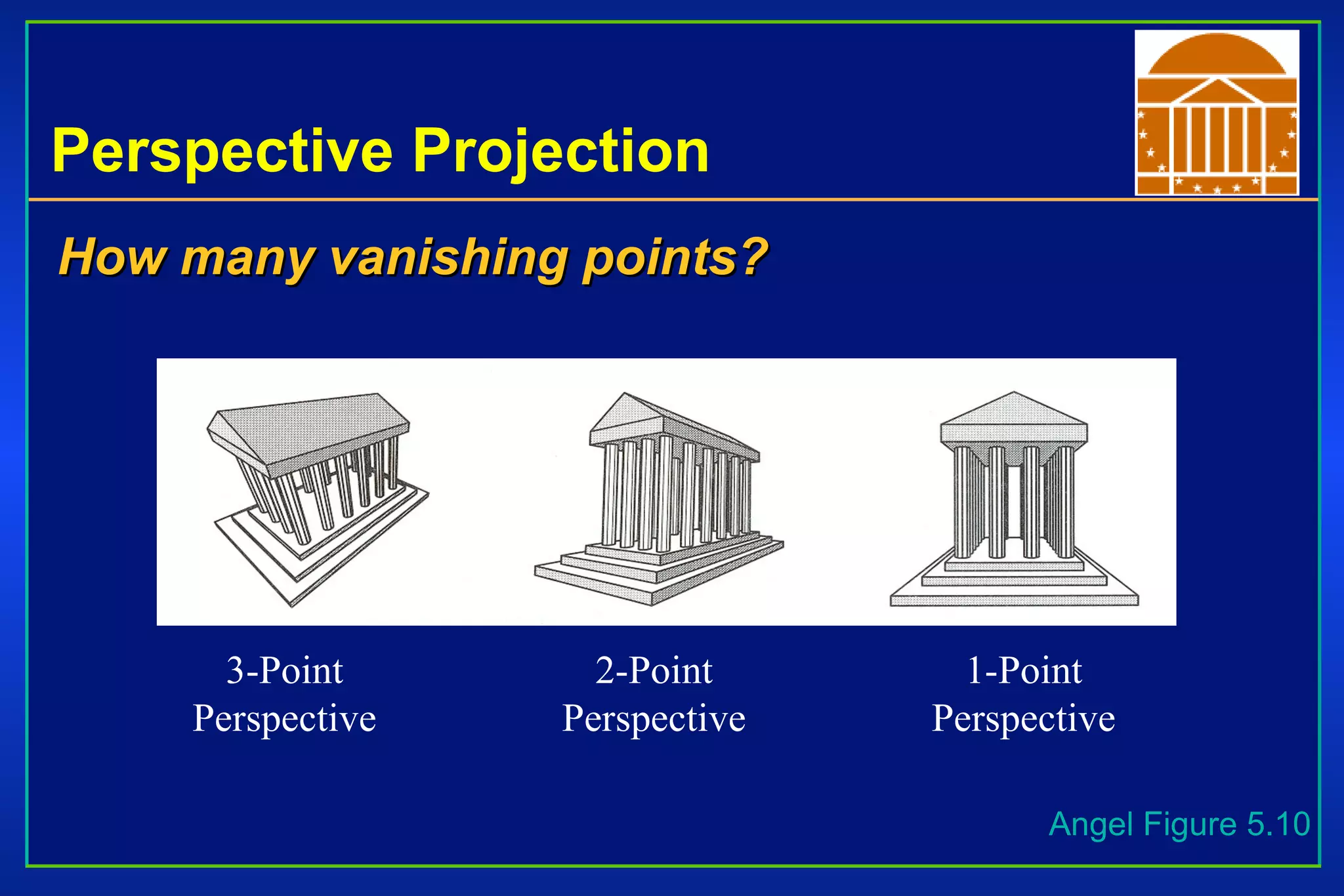
Perspective Projection How many vanishing points? Angel Figure 5.10 3-Point Perspective 2-Point Perspective 1-Point Perspective
Perspective Projection In the real world, objects exhibit  perspective foreshortening : distant objects appear smaller The basic situation:
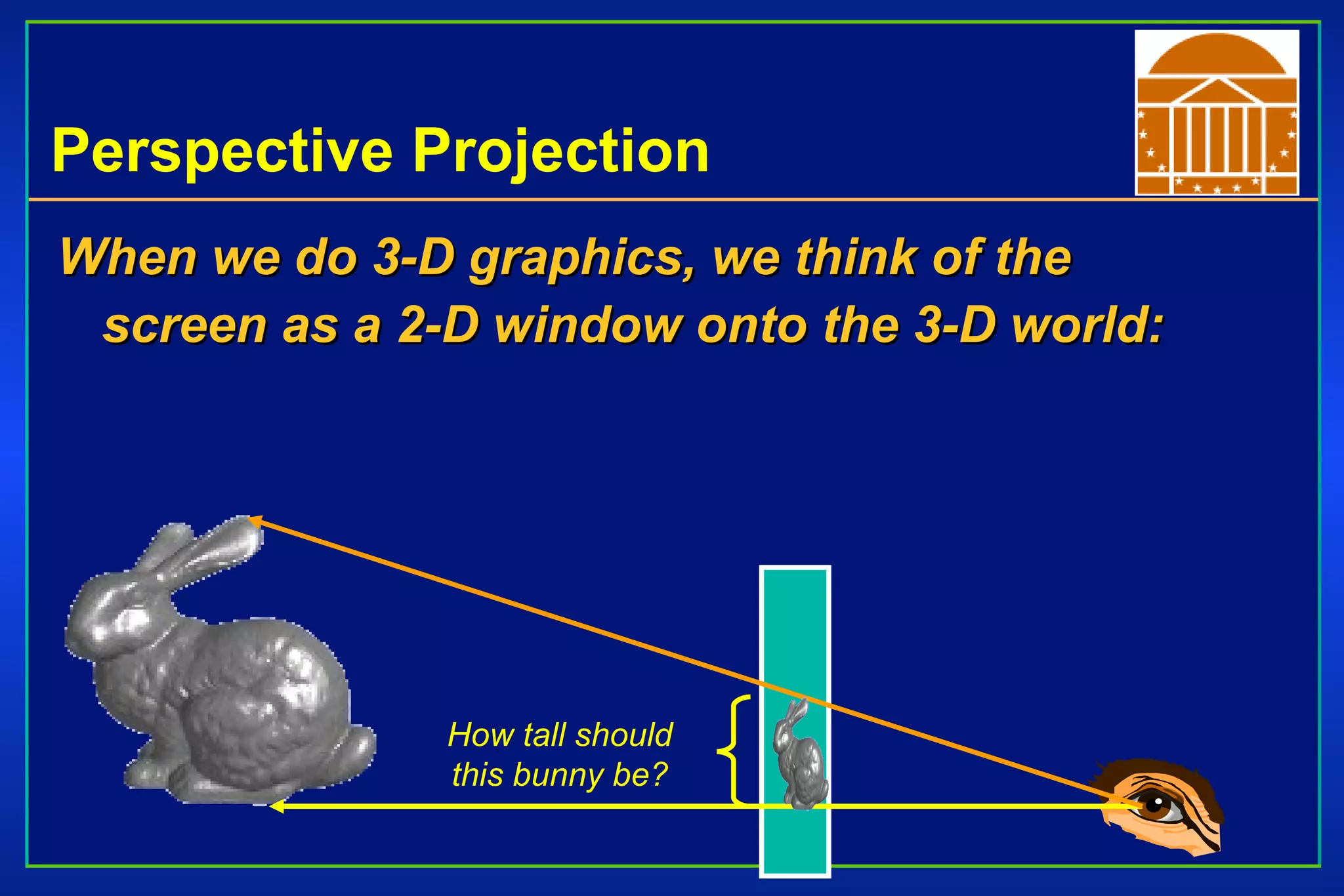
Perspective Projection When we do 3-D graphics, we think of the  screen as a 2-D window onto the 3-D world: How tall should this bunny be?
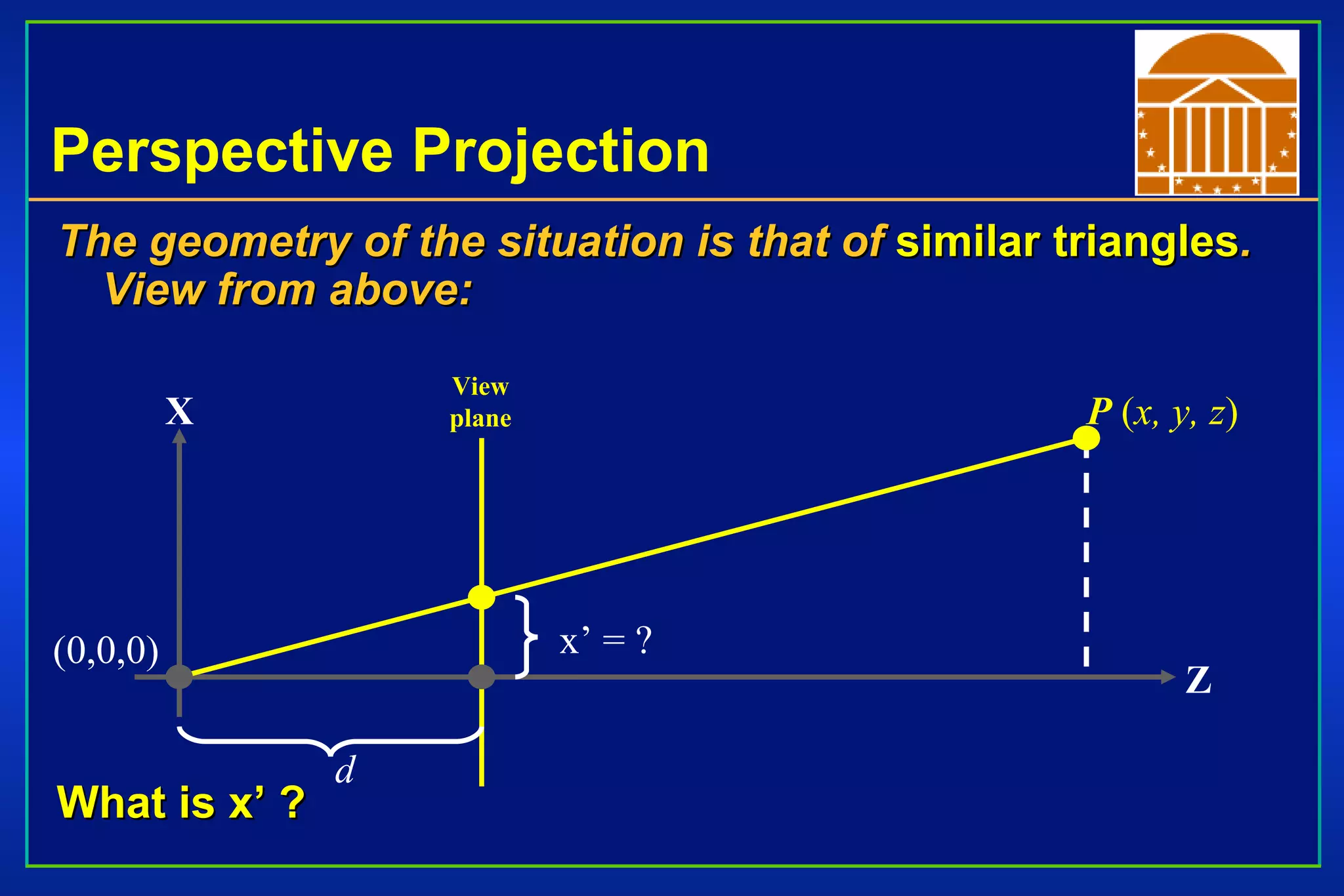
Perspective Projection The geometry of the situation is that of  similar triangles .  View from above: What is x’ ?   d P  ( x, y, z ) X Z View plane (0,0,0) x’ = ?
Perspective Projection Desired result for a point  [ x, y, z, 1 ] T  projected onto the view plane: What could a matrix look like to do this?
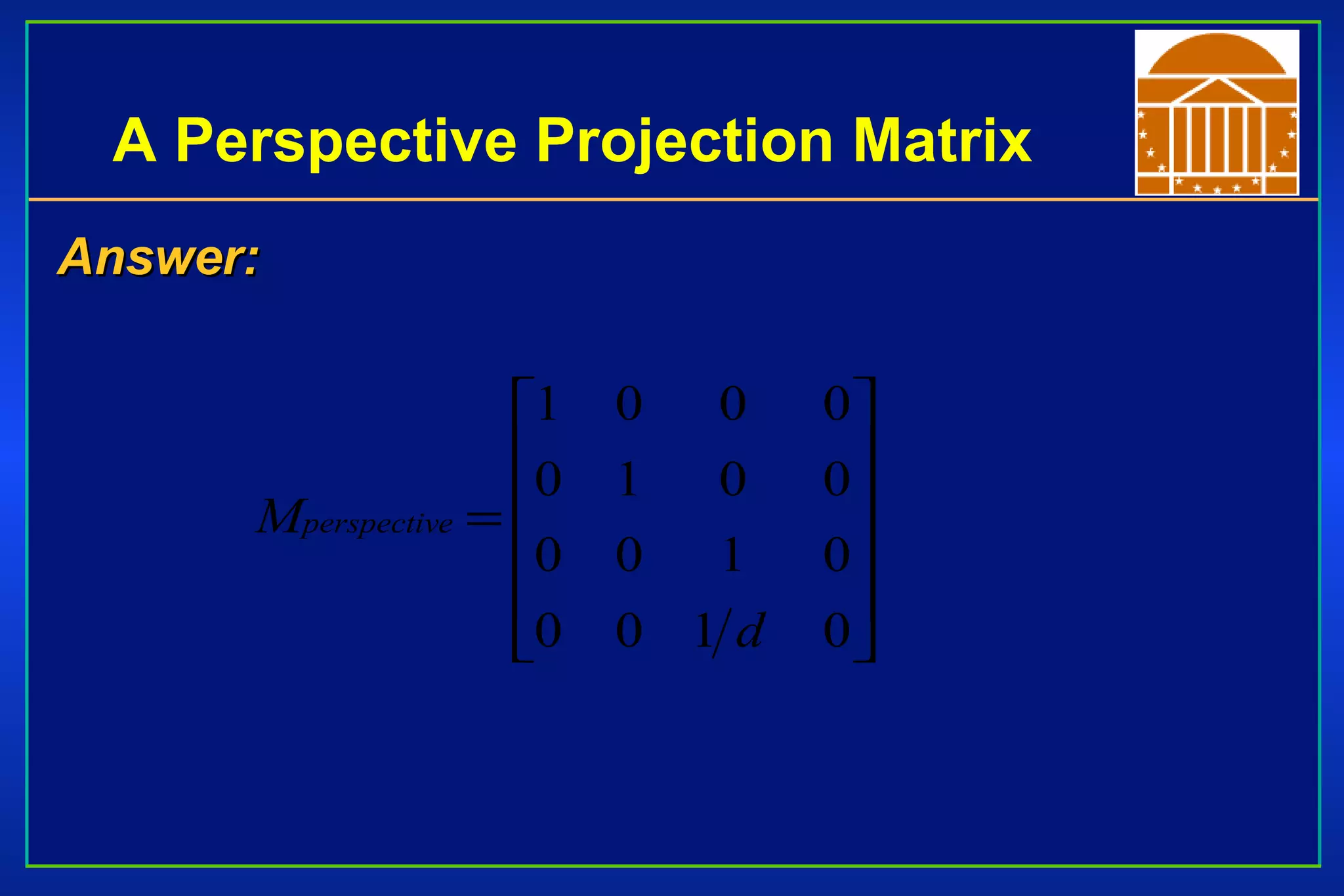
A Perspective Projection Matrix Answer:
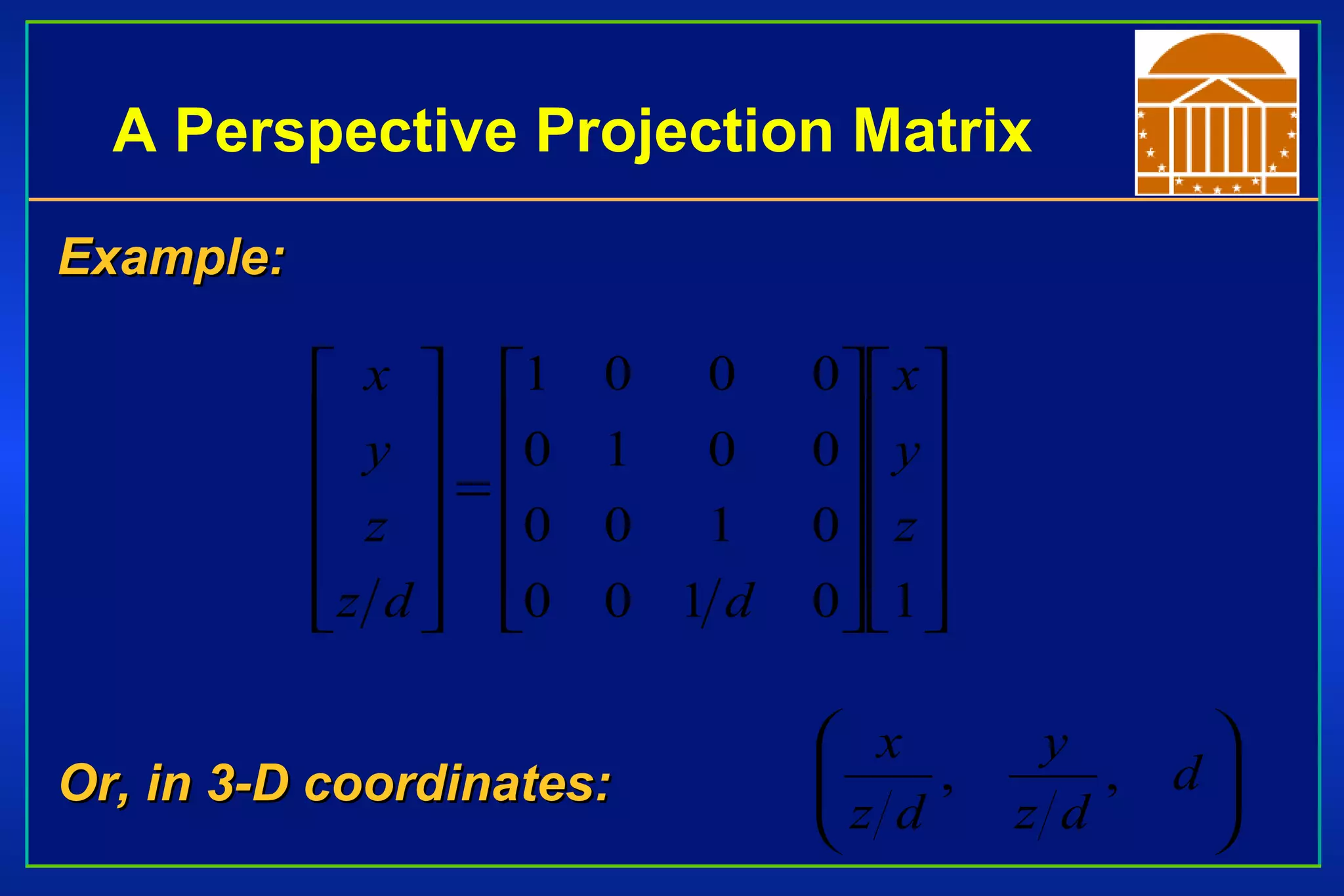
A Perspective Projection Matrix Example: Or, in 3-D coordinates:
Projection Matrices Now that we can express perspective foreshortening as a matrix, we can compose it onto our other matrices with the usual matrix multiplication End result: a single matrix encapsulating modeling, viewing, and projection transforms
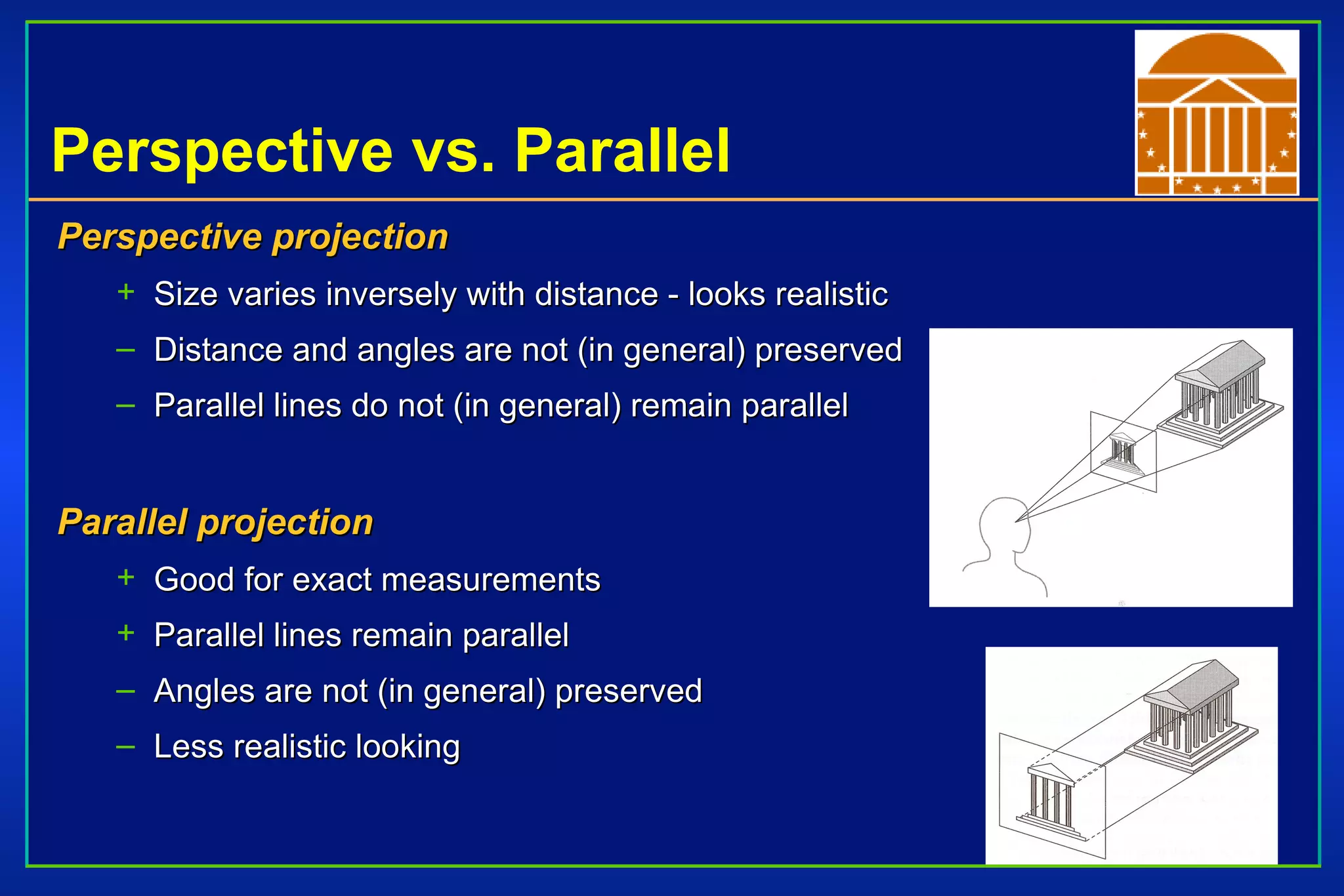
Perspective vs. Parallel Perspective projection Size varies inversely with distance - looks realistic Distance and angles are not (in general) preserved Parallel lines do not (in general) remain parallel Parallel projection Good for exact measurements Parallel lines remain parallel Angles are not (in general) preserved Less realistic looking
Classical Projections Angel Figure 5.3
A 3D Scene Notice the presence of the camera, the projection plane, and  the world coordinate axes Viewing transformations define how to acquire the image on the projection plane
Q1  Using the origin as the centre of projection, derive the perspective transformation onto the plane passing through the point R 0 (x 0 ,y 0 ,z 0 ) and having normal vector N=n 1 i+n 2 j+n 3 k
A1  P(x,y,z) is projected onto P’(x’,y’,z’) x’= α x, y’=  α y , z’=  α z n 1 x’+n 2 y’+n 3 z’=d (where d=n 1 x 0 +n 2 y 0 +n 3 z 0 ) α =d/( n 1 x+n 2 y+n 3 z) d  0  0  0 Per N,R0 =  0  d  0  0 0  0  d  0 n 1  n 2  n 3  0
Q2  Find the perspective projection onto the view plane z=d where the centre of projection is the origin(0,0,0)
Q3  Derive the general perspective transformation onto a plane with reference point R 0 (x 0 ,y 0 ,z 0 ), normal vector N=n 1 i+n 2 j+n 3 k, and using C(a,b,c) as the centre of projection
A3  Per N,R0’ =T C . Per N,R0  .T -C
Q4  Derive parallel projection onto xy plane in the direction of projection V=ai+bj+ck
A4  x’-x=ka , y’-y=kb , z’-z=kc K=-z/c (z=0 on xy plane) 1  0  -a/c Par V =  0  1  -b/c 0  0  0

Lecture 11 Perspective Projection

  • 1.
    Projections Angel:Interactive Computer Graphics
  • 2.
  • 3.
    Taxonomy of ProjectionsFVFHP Figure 6.10
  • 4.
  • 5.
    Parallel Projection Centerof projection is at infinity Direction of projection (DOP) same for all points Angel Figure 5.4 DOP View Plane
  • 6.
    Orthographic Projections DOPperpendicular to view plane Angel Figure 5.5 Top Side Front
  • 7.
    Oblique Projections DOP not perpendicular to view plane H&B Cavalier (DOP  = 45 o ) tan(  ) = 1 Cabinet (DOP  = 63.4 o ) tan(  ) = 2
  • 8.
    Orthographic Projection SimpleOrthographic Transformation Original world units are preserved Pixel units are preferred
  • 9.
    Perspective Transformation Firstdiscovered by Donatello, Brunelleschi, and DaVinci during Renaissance Objects closer to viewer look larger Parallel lines appear to converge to single point
  • 10.
    Perspective Projection Howmany vanishing points? Angel Figure 5.10 3-Point Perspective 2-Point Perspective 1-Point Perspective
  • 11.
    Perspective Projection Inthe real world, objects exhibit perspective foreshortening : distant objects appear smaller The basic situation:
  • 12.
    Perspective Projection Whenwe do 3-D graphics, we think of the screen as a 2-D window onto the 3-D world: How tall should this bunny be?
  • 13.
    Perspective Projection Thegeometry of the situation is that of similar triangles . View from above: What is x’ ? d P ( x, y, z ) X Z View plane (0,0,0) x’ = ?
  • 14.
    Perspective Projection Desiredresult for a point [ x, y, z, 1 ] T projected onto the view plane: What could a matrix look like to do this?
  • 15.
  • 16.
    A Perspective ProjectionMatrix Example: Or, in 3-D coordinates:
  • 17.
    Projection Matrices Nowthat we can express perspective foreshortening as a matrix, we can compose it onto our other matrices with the usual matrix multiplication End result: a single matrix encapsulating modeling, viewing, and projection transforms
  • 18.
    Perspective vs. ParallelPerspective projection Size varies inversely with distance - looks realistic Distance and angles are not (in general) preserved Parallel lines do not (in general) remain parallel Parallel projection Good for exact measurements Parallel lines remain parallel Angles are not (in general) preserved Less realistic looking
  • 19.
  • 20.
    A 3D SceneNotice the presence of the camera, the projection plane, and the world coordinate axes Viewing transformations define how to acquire the image on the projection plane
  • 21.
    Q1 Usingthe origin as the centre of projection, derive the perspective transformation onto the plane passing through the point R 0 (x 0 ,y 0 ,z 0 ) and having normal vector N=n 1 i+n 2 j+n 3 k
  • 22.
    A1 P(x,y,z)is projected onto P’(x’,y’,z’) x’= α x, y’= α y , z’= α z n 1 x’+n 2 y’+n 3 z’=d (where d=n 1 x 0 +n 2 y 0 +n 3 z 0 ) α =d/( n 1 x+n 2 y+n 3 z) d 0 0 0 Per N,R0 = 0 d 0 0 0 0 d 0 n 1 n 2 n 3 0
  • 23.
    Q2 Findthe perspective projection onto the view plane z=d where the centre of projection is the origin(0,0,0)
  • 24.
    Q3 Derivethe general perspective transformation onto a plane with reference point R 0 (x 0 ,y 0 ,z 0 ), normal vector N=n 1 i+n 2 j+n 3 k, and using C(a,b,c) as the centre of projection
  • 25.
    A3 PerN,R0’ =T C . Per N,R0 .T -C
  • 26.
    Q4 Deriveparallel projection onto xy plane in the direction of projection V=ai+bj+ck
  • 27.
    A4 x’-x=ka, y’-y=kb , z’-z=kc K=-z/c (z=0 on xy plane) 1 0 -a/c Par V = 0 1 -b/c 0 0 0