Dr.P.Karunanithi
Dr.Gayathri
SRM Medical college & Research centre
Potheri
kancheepuram
Breathing circuits
 Anesthetic gas exits the anaesthesia machine (via the
common gas outlet) and then enters a breathing
circuit. The function of the circuit is to deliver oxygen
and anaesthetic gases to the patient and to eliminate
CO2.
Classification
 This most basic classification of breathing systems
divides them into open, semi-open, semi-closed or
closed.
Ideal breathing circuit
 Simple and safe to use
 Delivers the right gas mixture
 Allows all methods of ventilation in all age groups
 Efficient
 Pressure relief
 Sturdy, small and light
 Allows easy removal of waste gases
 Easy to maintain with low running costs
Components
 Fresh Gas connection
 Patient connection
 Adjustable Pressure Limiting (APL) Valve
 Reservoir (Bag or Bellows)
 Tubing
 Waste gas connection
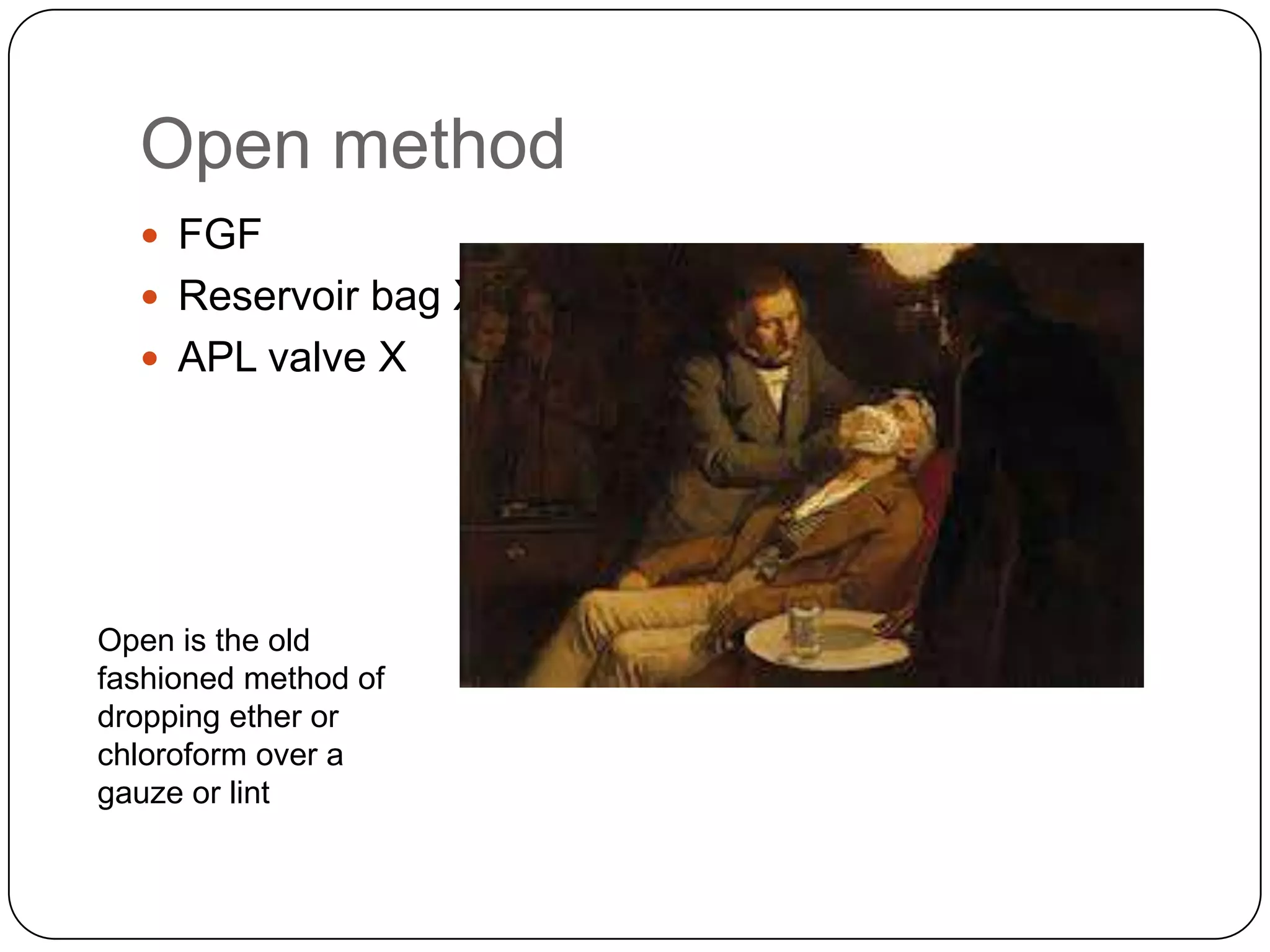
Open method
 FGF
 Reservoir bag X
 APL valve X
Open is the old
fashioned method of
dropping ether or
chloroform over a
gauze or lint
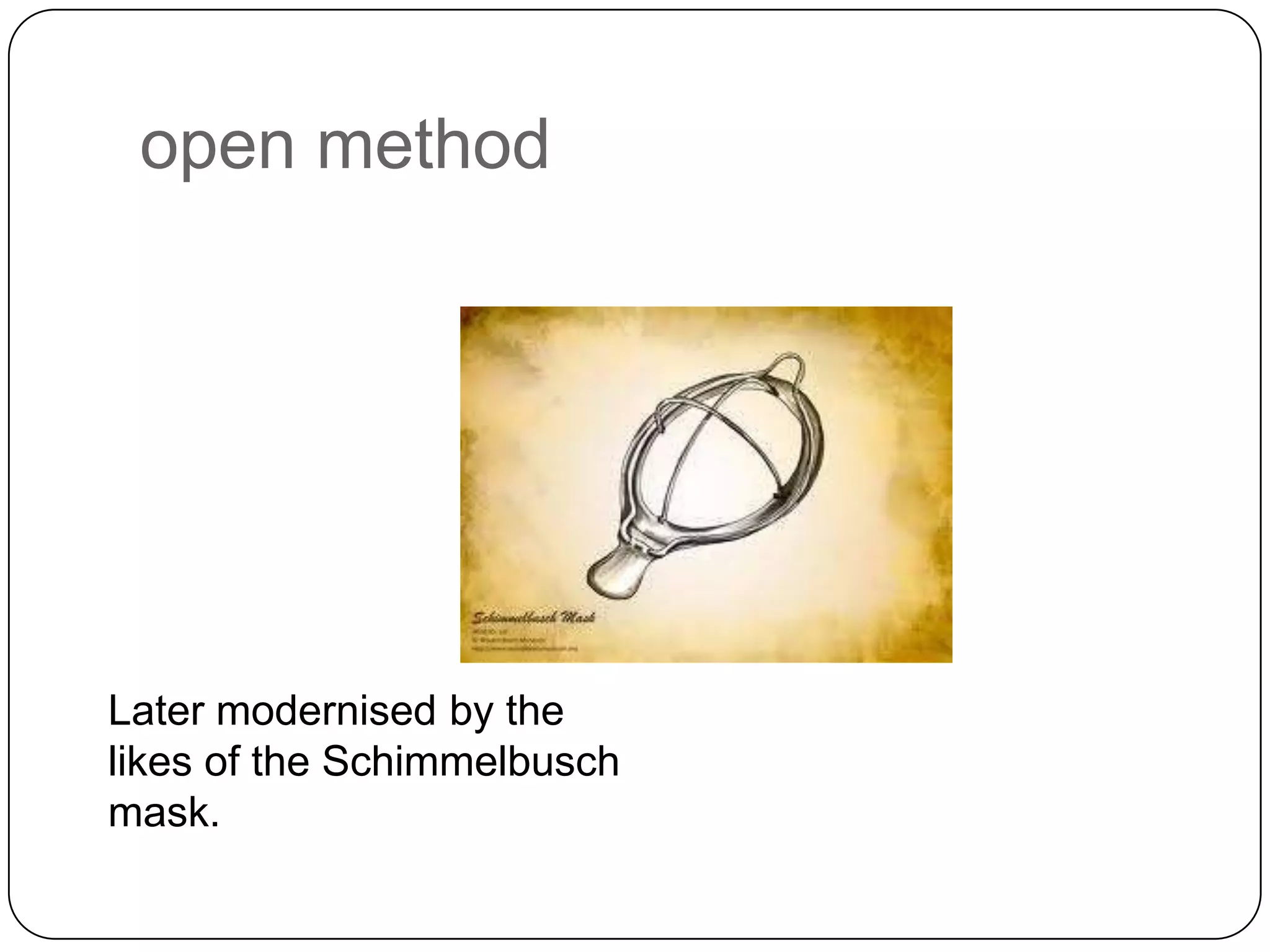
open method
Later modernised by the
likes of the Schimmelbusch
mask.
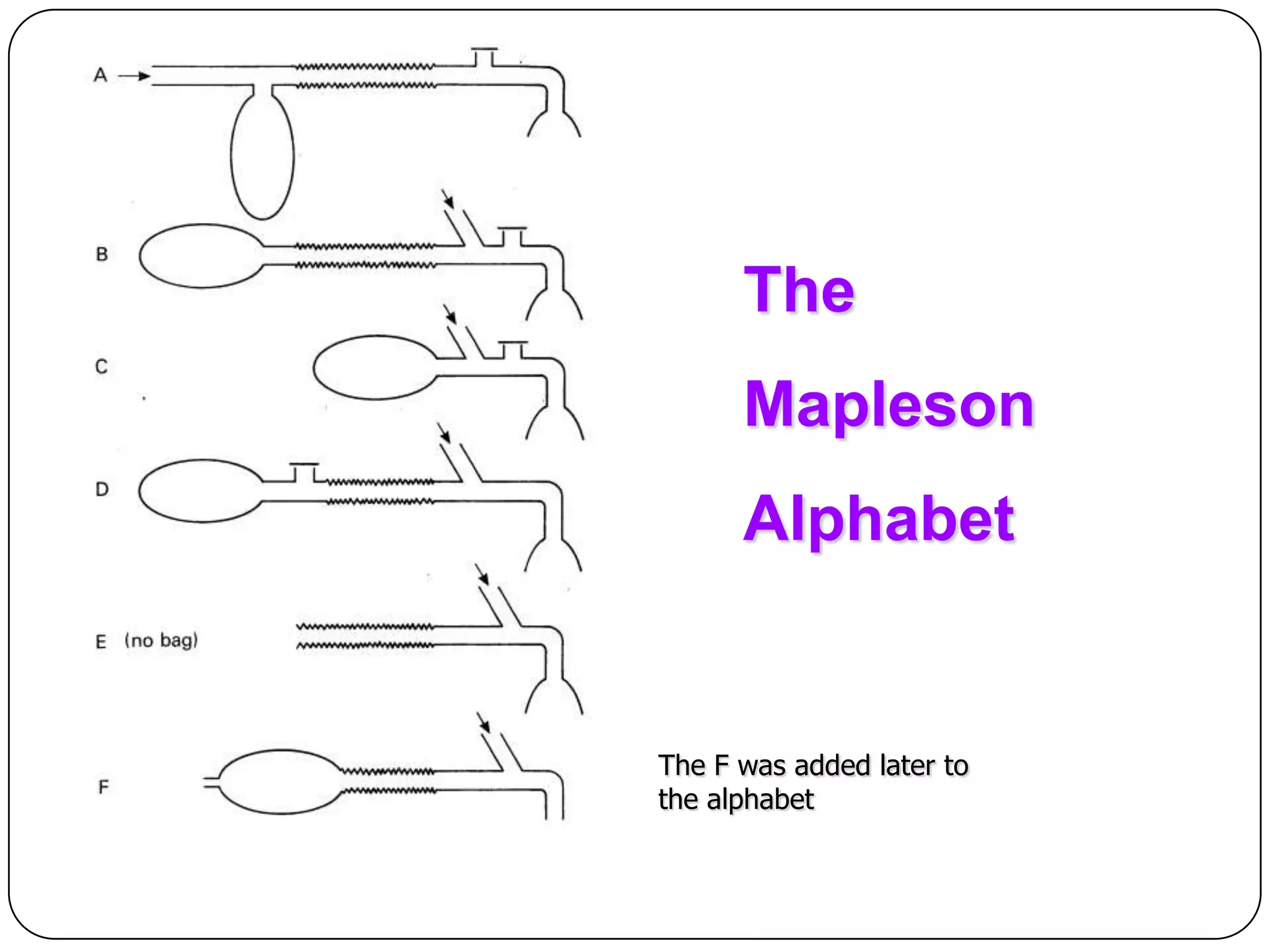
The
Mapleson
Alphabet
The F was added later to
the alphabet
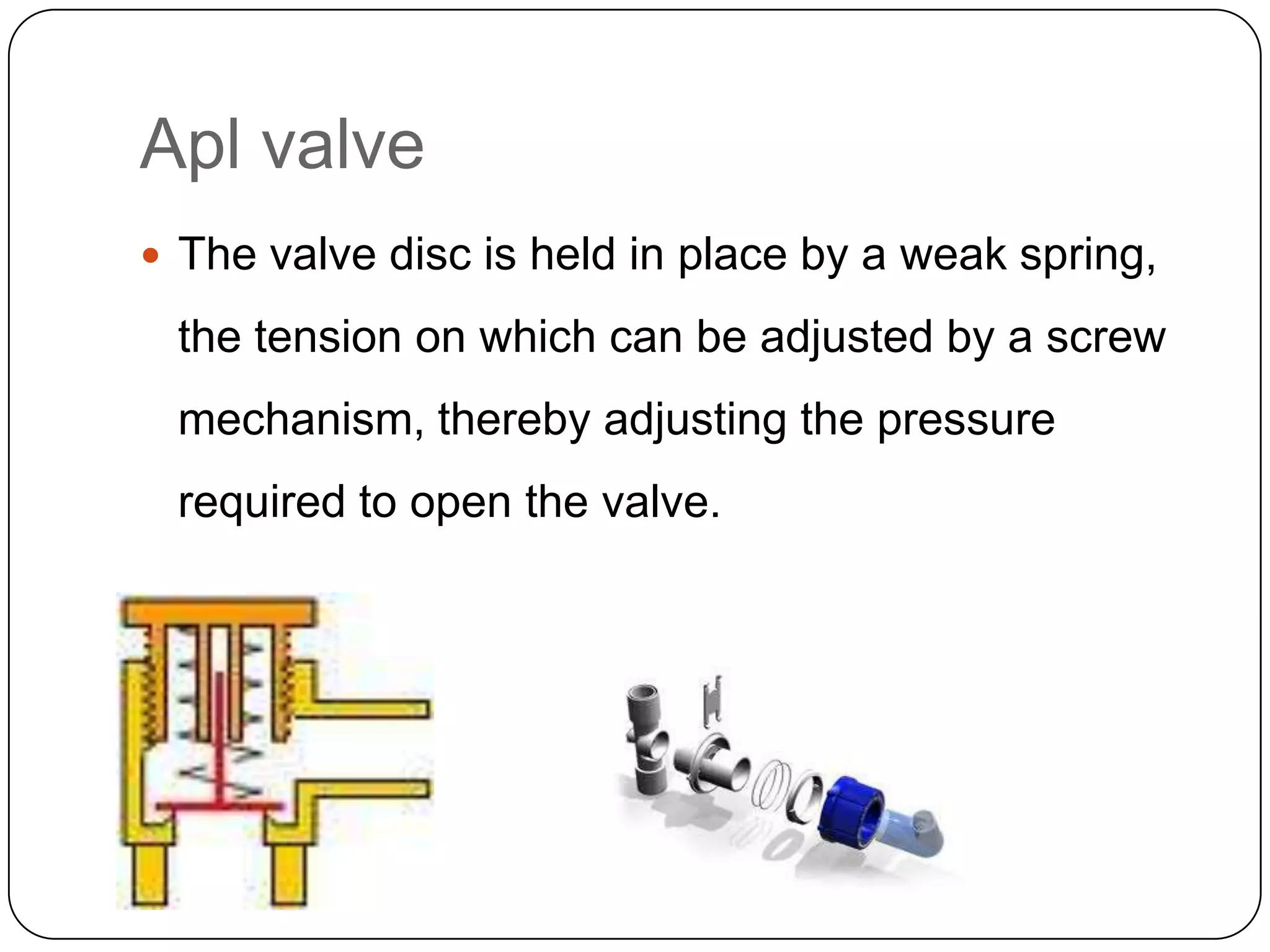
Apl valve
 The valve disc is held in place by a weak spring,
the tension on which can be adjusted by a screw
mechanism, thereby adjusting the pressure
required to open the valve.
Types of Semi- closed Circuit
Systems
 Mapleson A or Magill System
 Mapleson A or Lack System
 Mapleson D or Bain System
 Mapleson F or Ayres T Piece System
 Mapleson F with APL Valve
 Mapleson C Bagging System
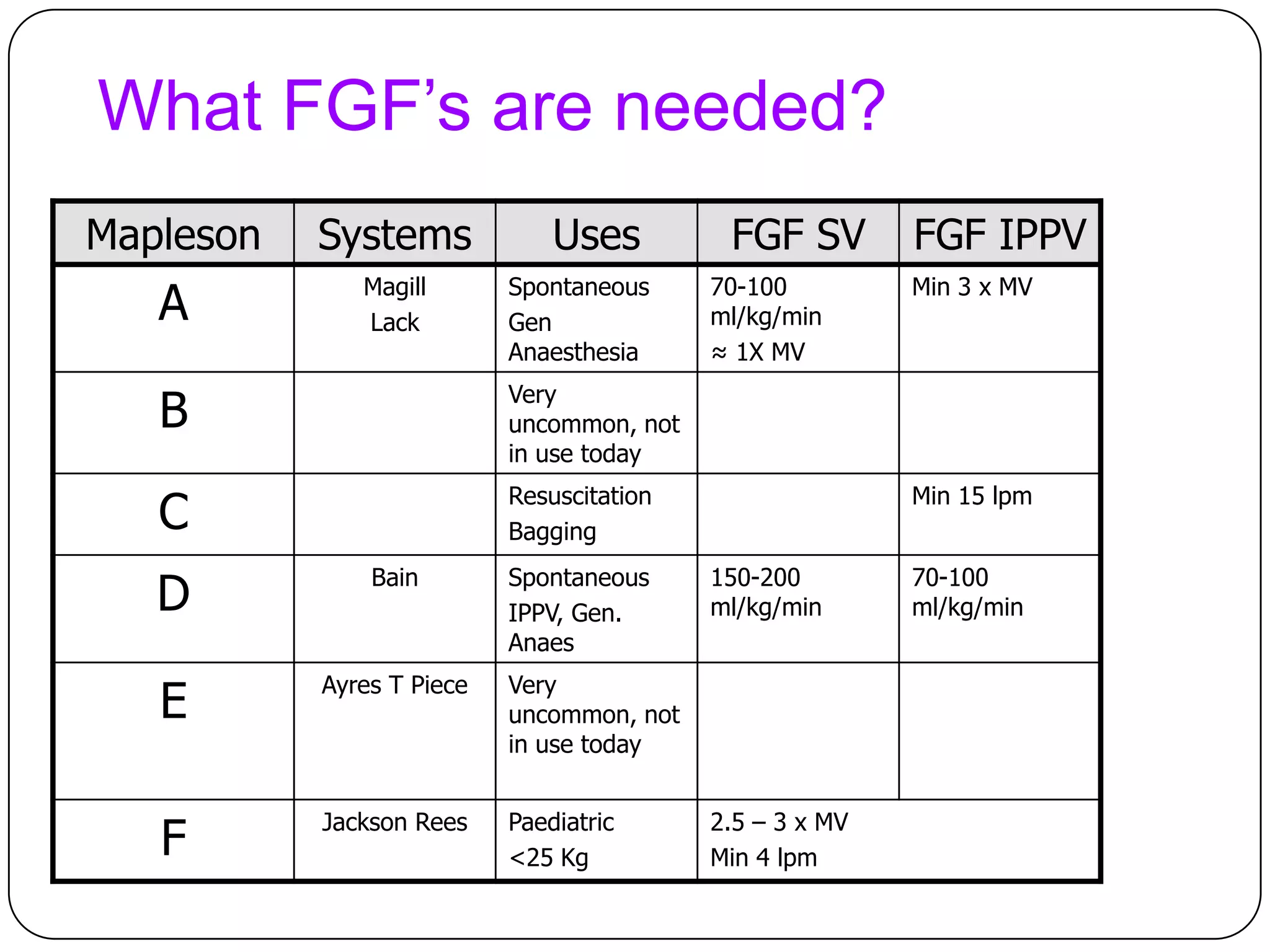
What FGF’s are needed?
Mapleson Systems Uses FGF SV FGF IPPV
A Magill
Lack
Spontaneous
Gen
Anaesthesia
70-100
ml/kg/min
≈ 1X MV
Min 3 x MV
B Very
uncommon, not
in use today
C Resuscitation
Bagging
Min 15 lpm
D Bain Spontaneous
IPPV, Gen.
Anaes
150-200
ml/kg/min
70-100
ml/kg/min
E Ayres T Piece Very
uncommon, not
in use today
F Jackson Rees Paediatric
<25 Kg
2.5 – 3 x MV
Min 4 lpm
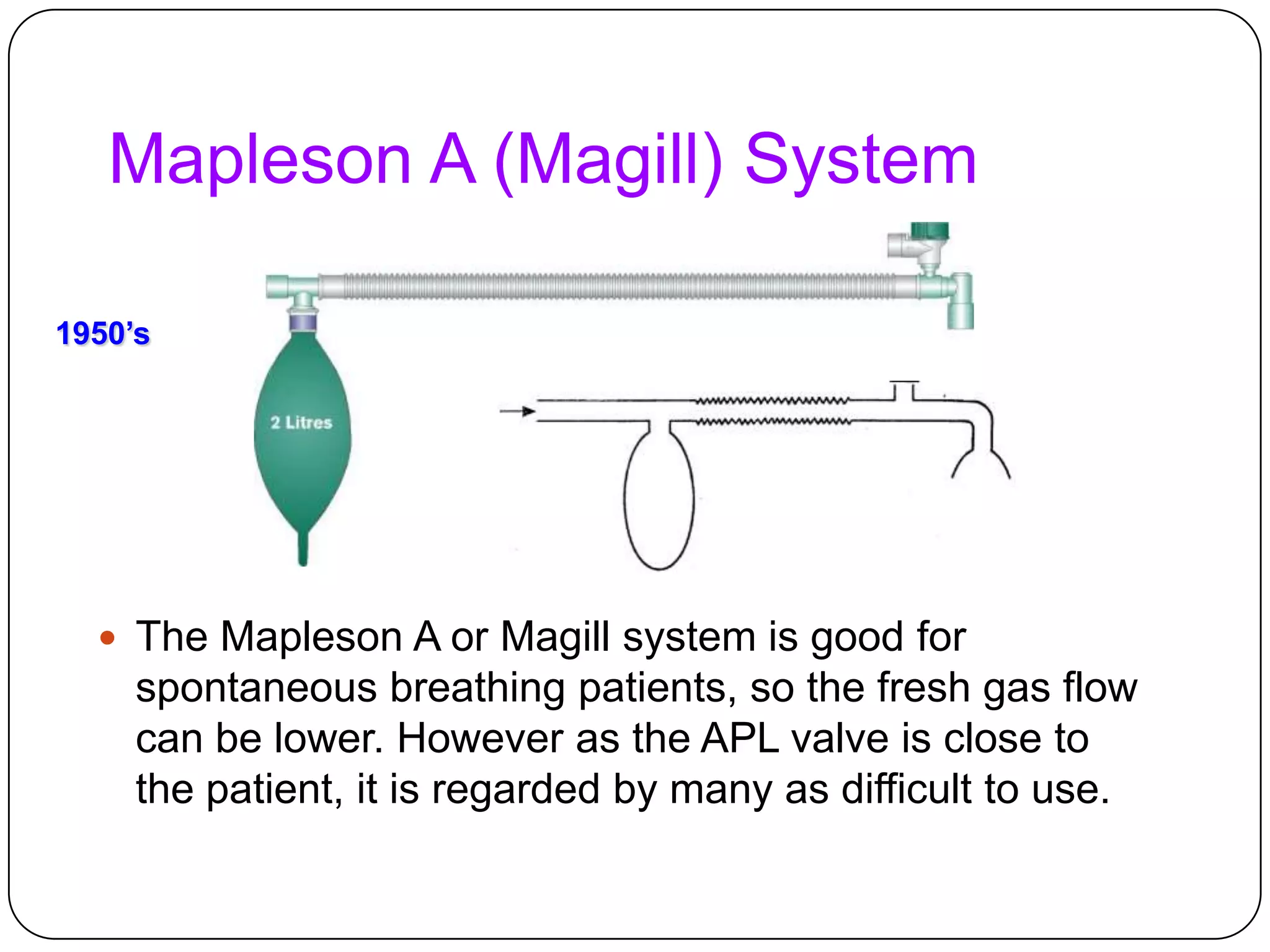
Mapleson A (Magill) System
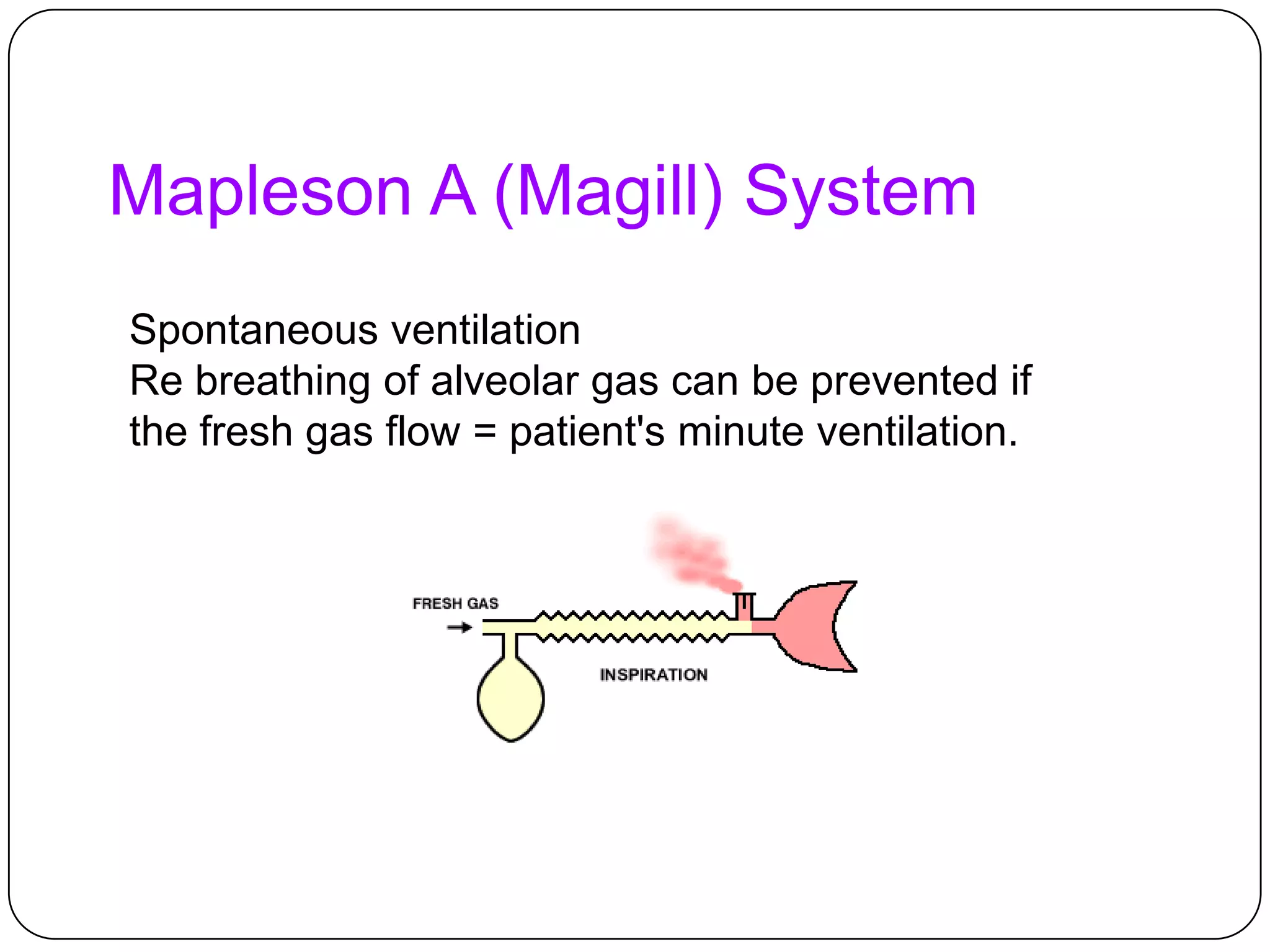
 The Mapleson A or Magill system is good for
spontaneous breathing patients, so the fresh gas flow
can be lower. However as the APL valve is close to
the patient, it is regarded by many as difficult to use.
1950’s
 Inspiration - The valve closes and the patient inspires fresh gas from the
reservoir tube. Fresh gas flushes the dead space gas toward the patient.
 Expiration - The patient expires into the reservoir tube. Towards the end
of expiration, the bag fills and positive pressure opens the valve,
allowing expired gas to escape. The patient end of the tubing is filled
with dead space gas followed by the alveolar gas. This stream travels up
the tubing and meets the fresh gas flowing into the circuit. The pressure
in the circuit increases and forces the expiratory valve to open, allowing
the alveolar gas to escape.
Expiratory pause - Fresh gas washes the expired gas out of the
reservoir tube, filling it with fresh gas for the next inspiration.
Mapleson A (Magill) System
Spontaneous ventilation
Re breathing of alveolar gas can be prevented if
the fresh gas flow = patient's minute ventilation.
Mapleson A (Magill) System
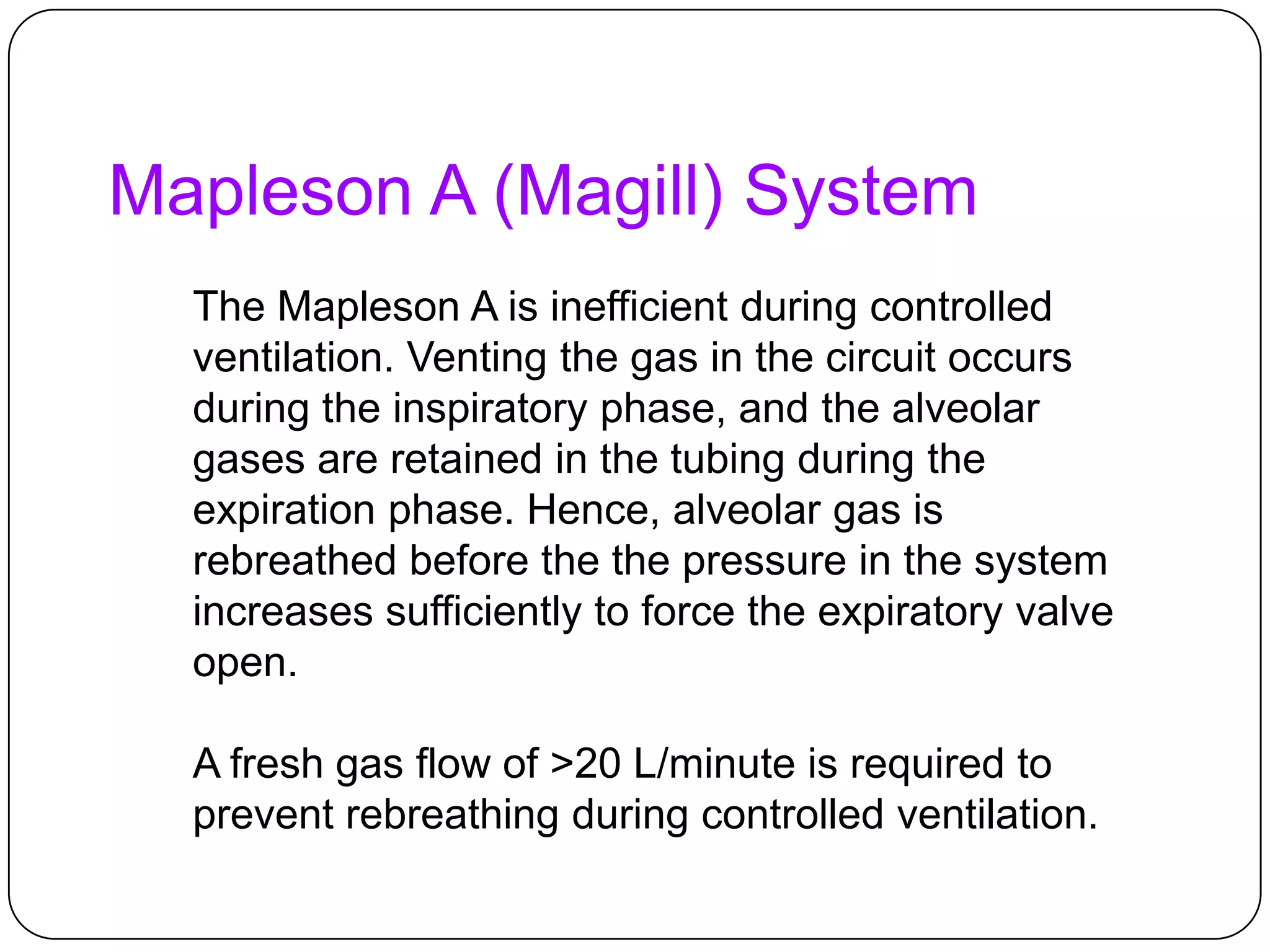
The Mapleson A is inefficient during controlled
ventilation. Venting the gas in the circuit occurs
during the inspiratory phase, and the alveolar
gases are retained in the tubing during the
expiration phase. Hence, alveolar gas is
rebreathed before the the pressure in the system
increases sufficiently to force the expiratory valve
open.
A fresh gas flow of >20 L/minute is required to
prevent rebreathing during controlled ventilation.
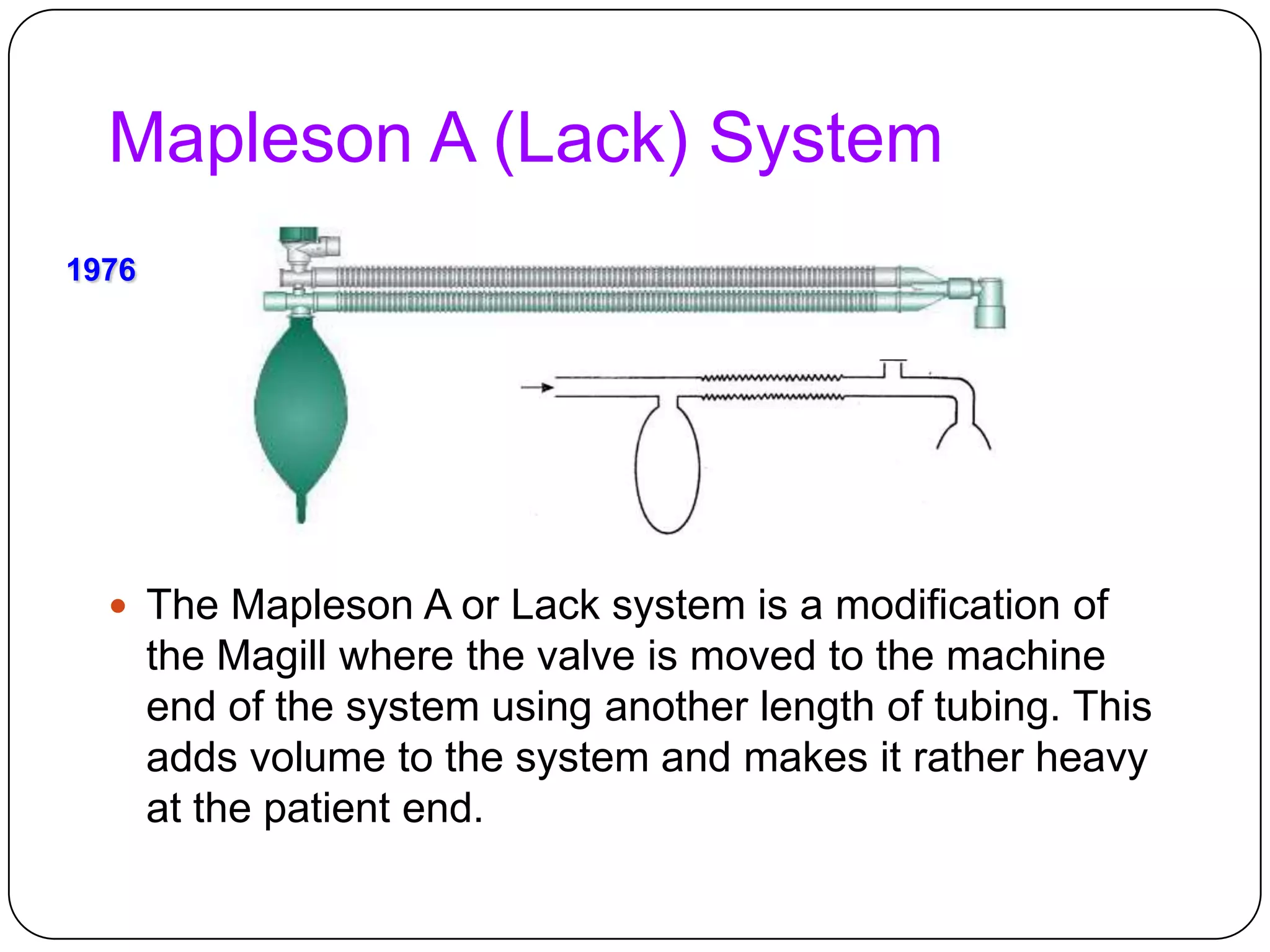
Mapleson A (Lack) System
 The Mapleson A or Lack system is a modification of
the Magill where the valve is moved to the machine
end of the system using another length of tubing. This
adds volume to the system and makes it rather heavy
at the patient end.
1976
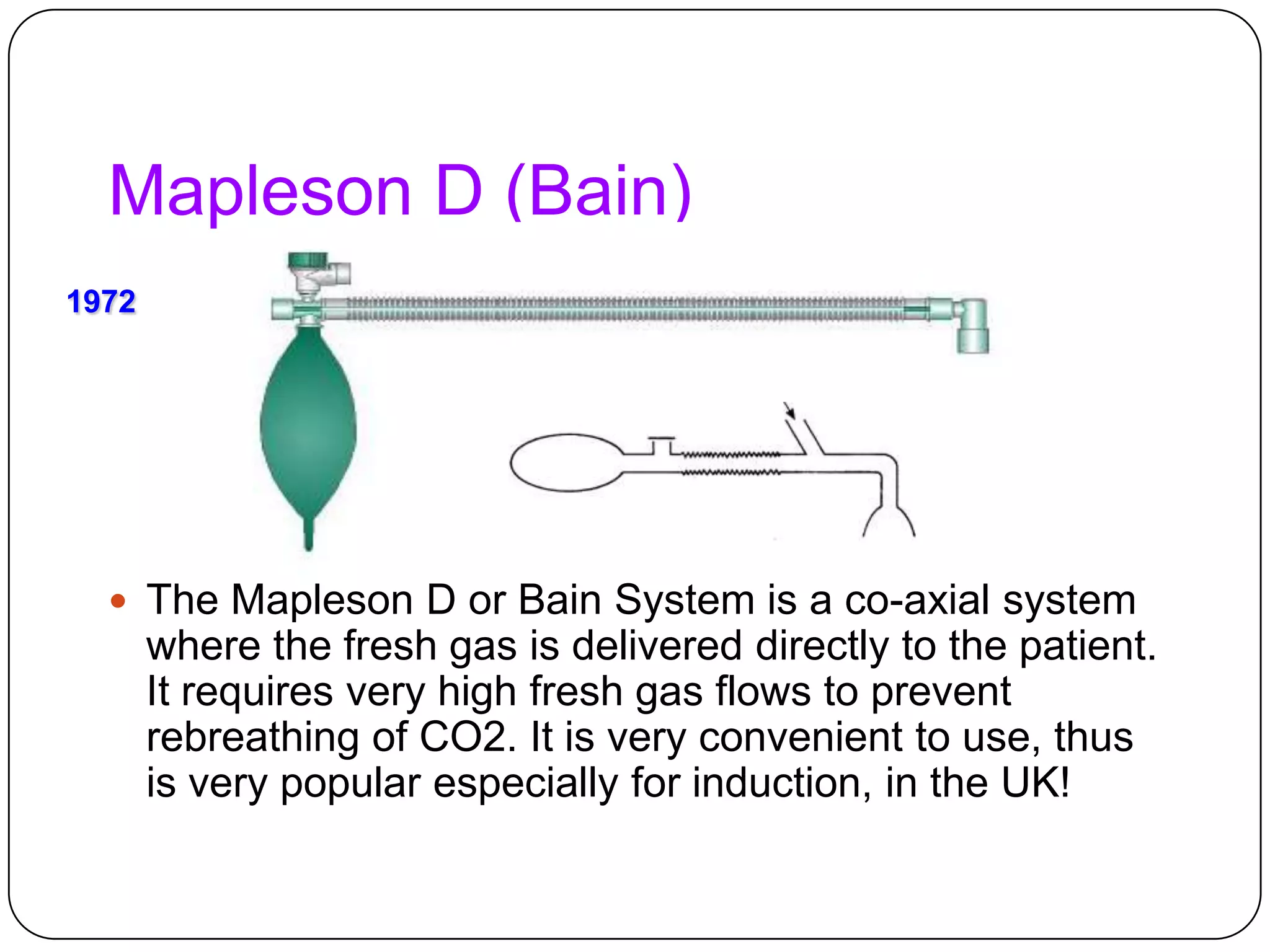
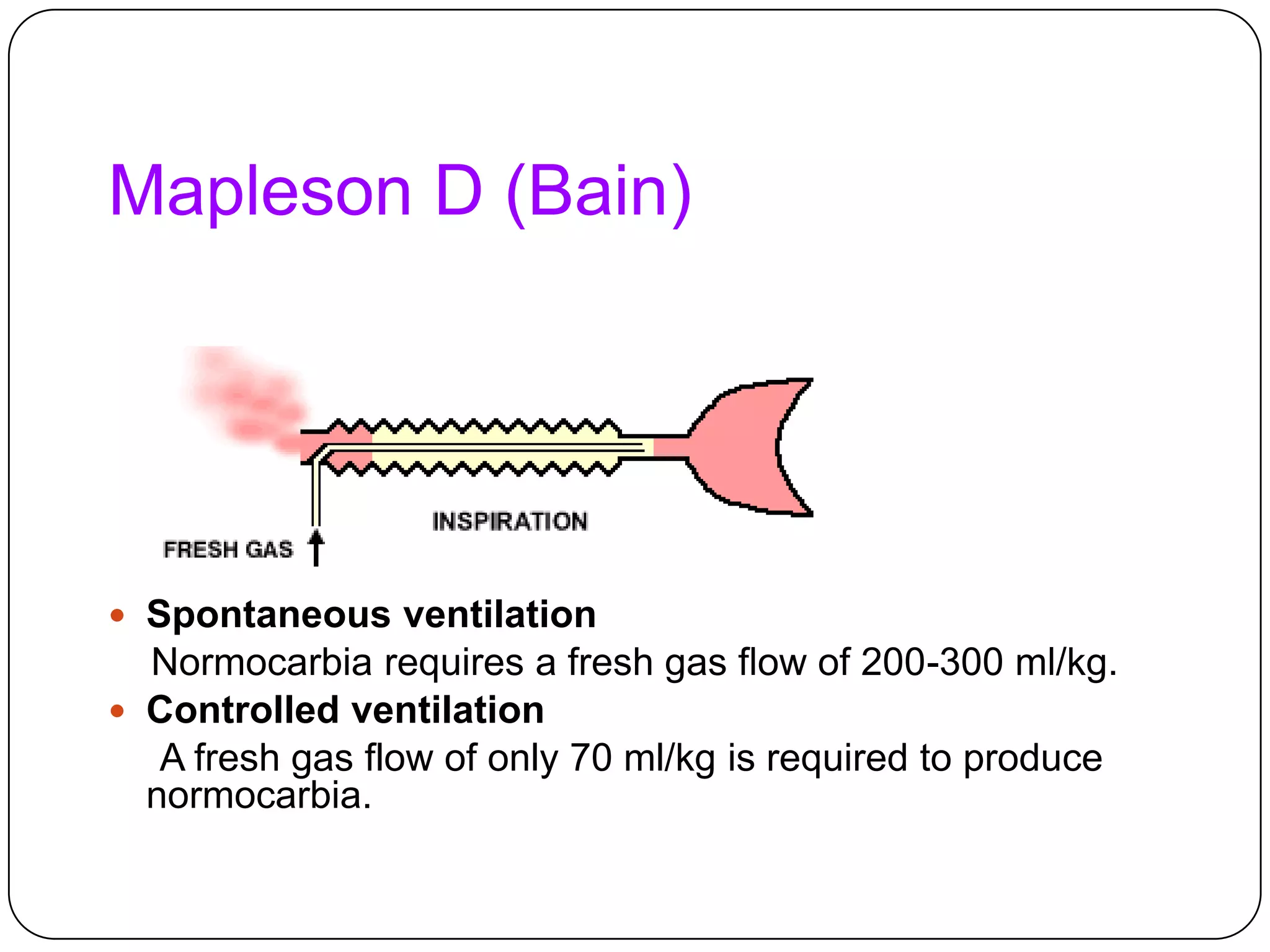
Mapleson D (Bain)
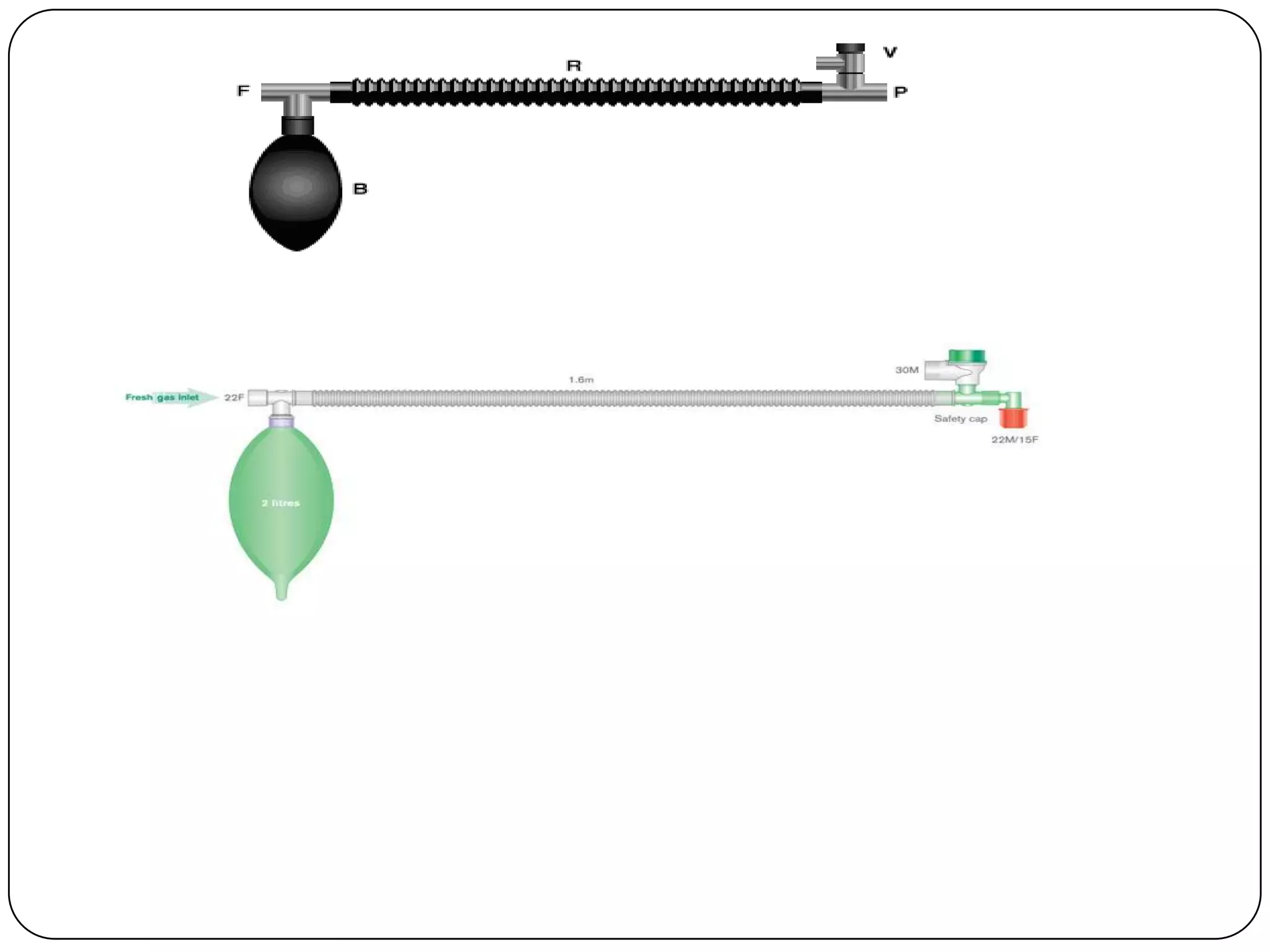
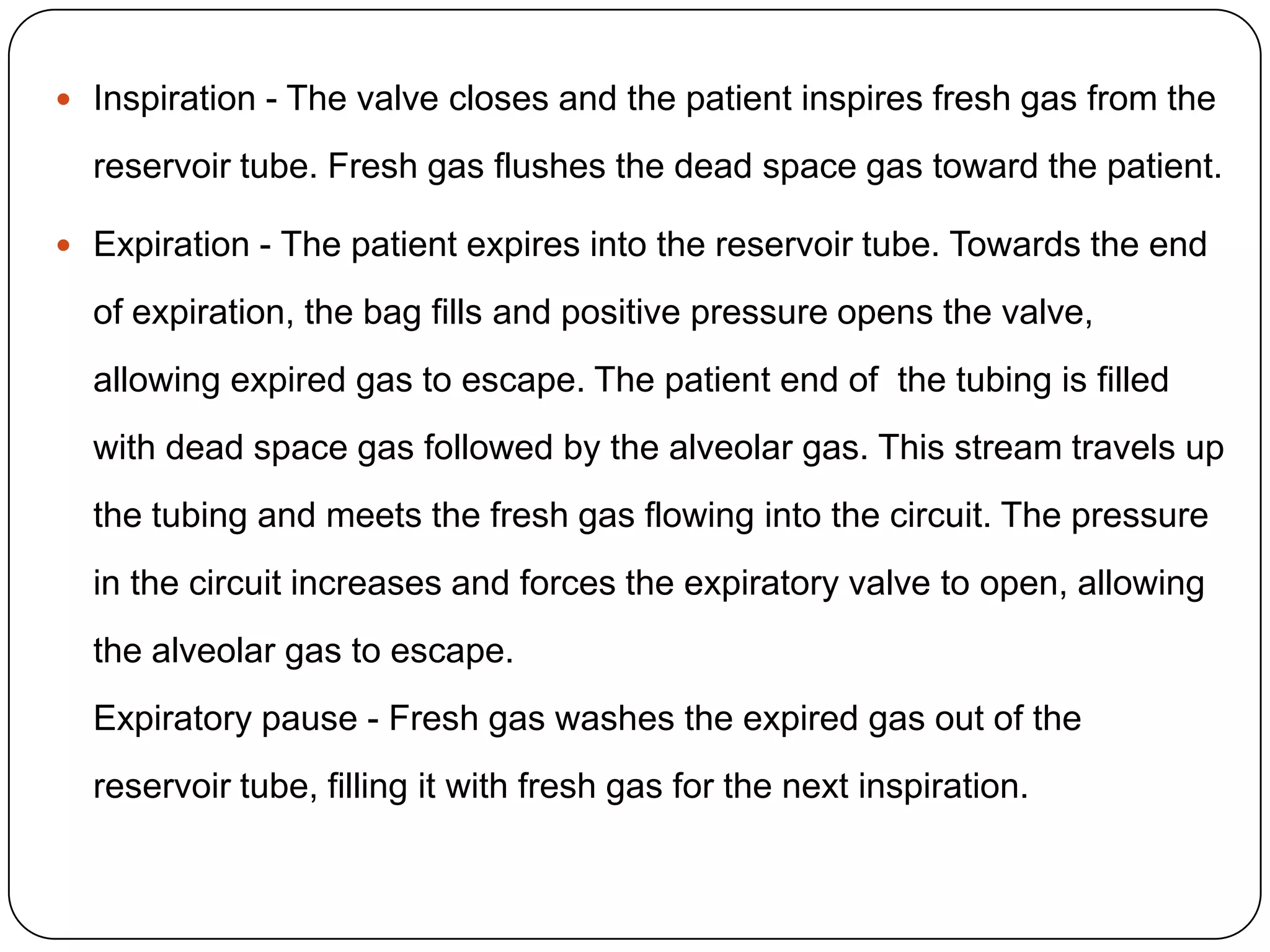
 The Mapleson D or Bain System is a co-axial system
where the fresh gas is delivered directly to the patient.
It requires very high fresh gas flows to prevent
rebreathing of CO2. It is very convenient to use, thus
is very popular especially for induction, in the UK!
1972
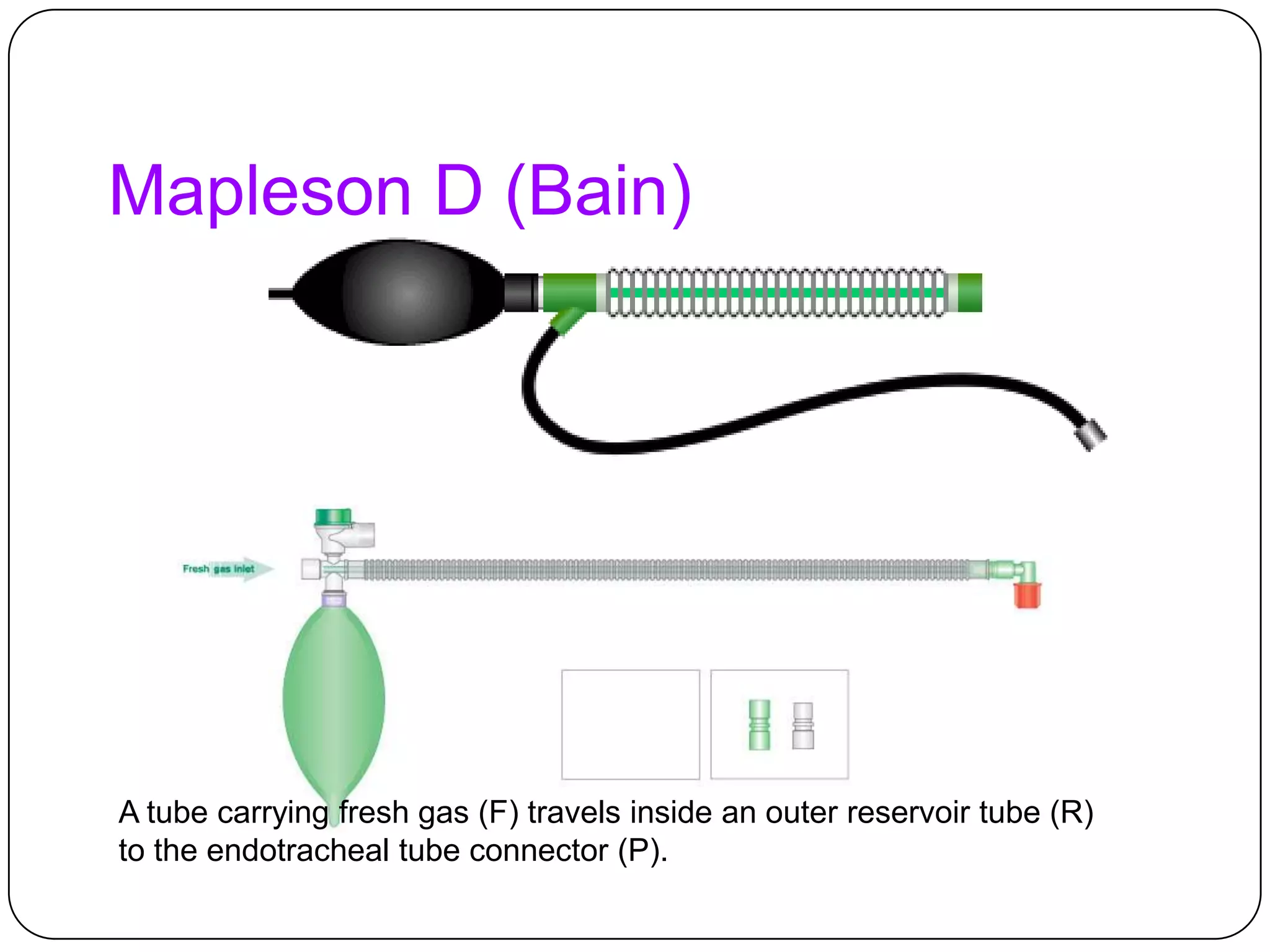
Mapleson D (Bain)
A tube carrying fresh gas (F) travels inside an outer reservoir tube (R)
to the endotracheal tube connector (P).
The Bain circuit is a modification of the Mapleson D system. It is a
co-axial system in which the fresh gas flows through a narrow
inner tube within the outer corrugated tubing.
Inspiration - The patient inspires fresh gas from the outer reservoir
tube.
Expiration - The patient expires into the reservoir tube. Although
fresh gas is still flowing into the system at this time, it is wasted,
as it is contaminated by expired gas.
Expiratory pause - Fresh gas from the inner tube washes the
expired gas out of the reservoir tube, filling it with fresh gas for the
next inspiration
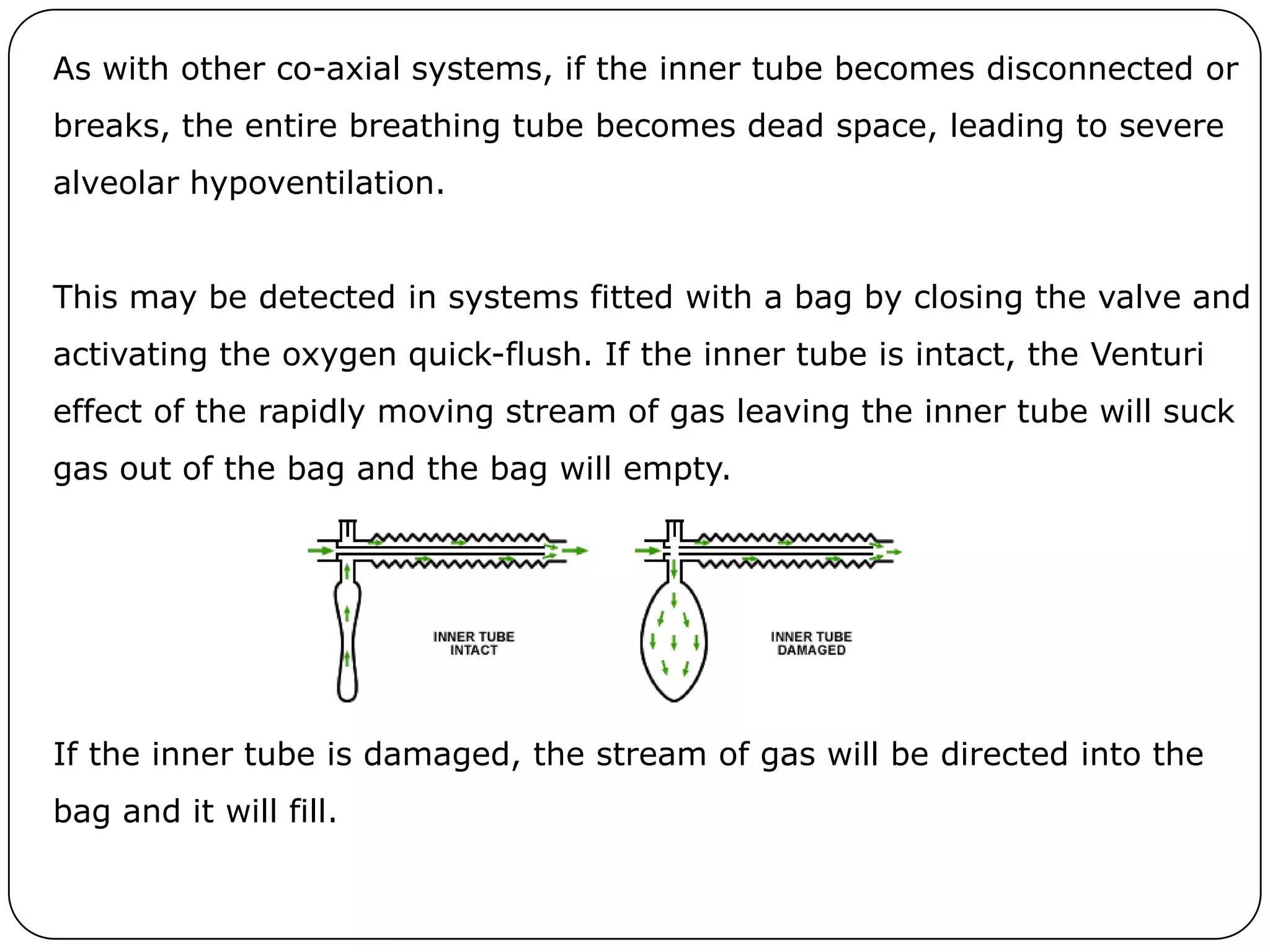
As with other co-axial systems, if the inner tube becomes disconnected or
breaks, the entire breathing tube becomes dead space, leading to severe
alveolar hypoventilation.
This may be detected in systems fitted with a bag by closing the valve and
activating the oxygen quick-flush. If the inner tube is intact, the Venturi
effect of the rapidly moving stream of gas leaving the inner tube will suck
gas out of the bag and the bag will empty.
If the inner tube is damaged, the stream of gas will be directed into the
bag and it will fill.
Mapleson D (Bain)
 Spontaneous ventilation
Normocarbia requires a fresh gas flow of 200-300 ml/kg.
 Controlled ventilation
A fresh gas flow of only 70 ml/kg is required to produce
normocarbia.
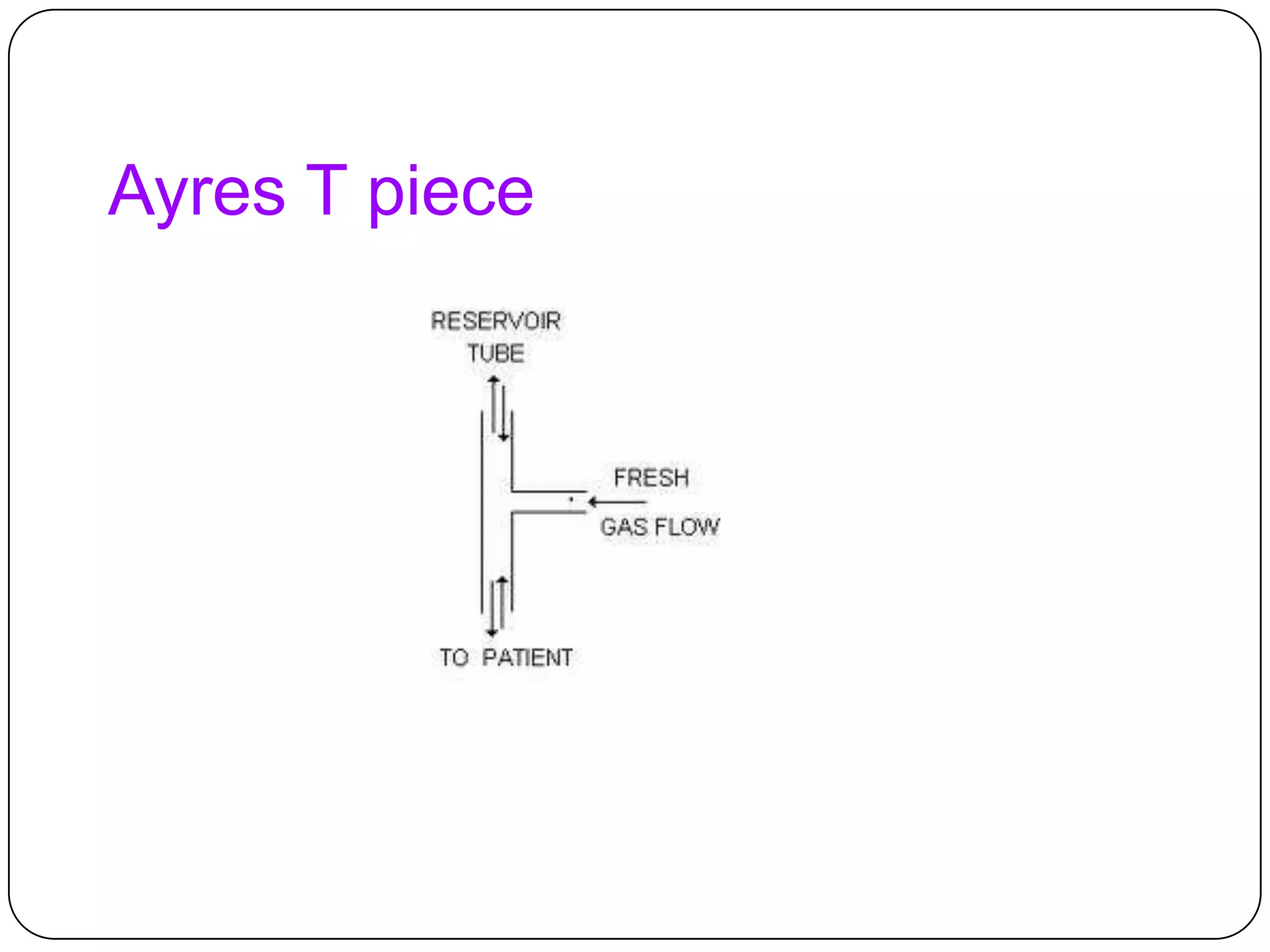
Ayres T piece
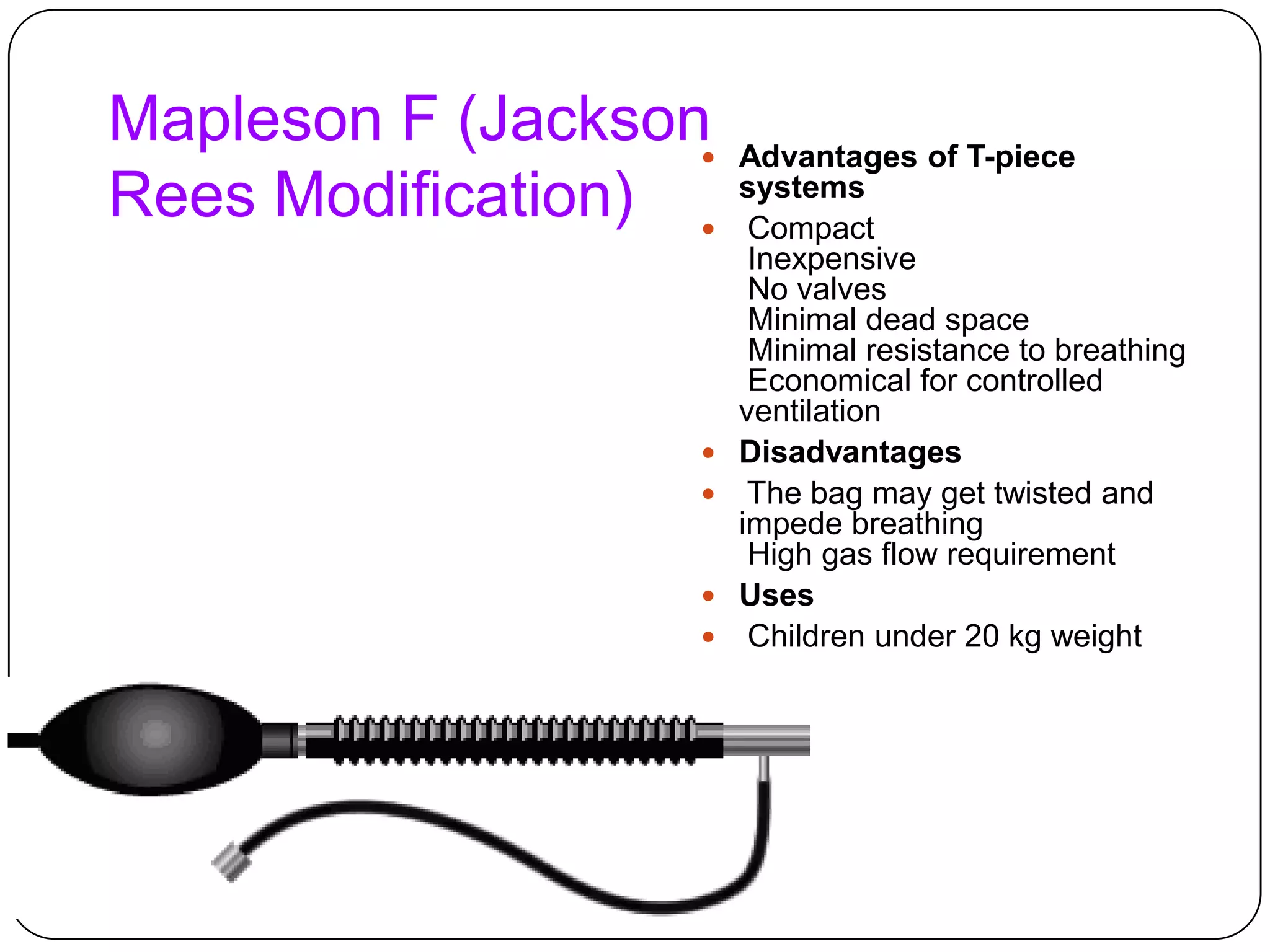
Mapleson F (Jackson Rees
Modification)
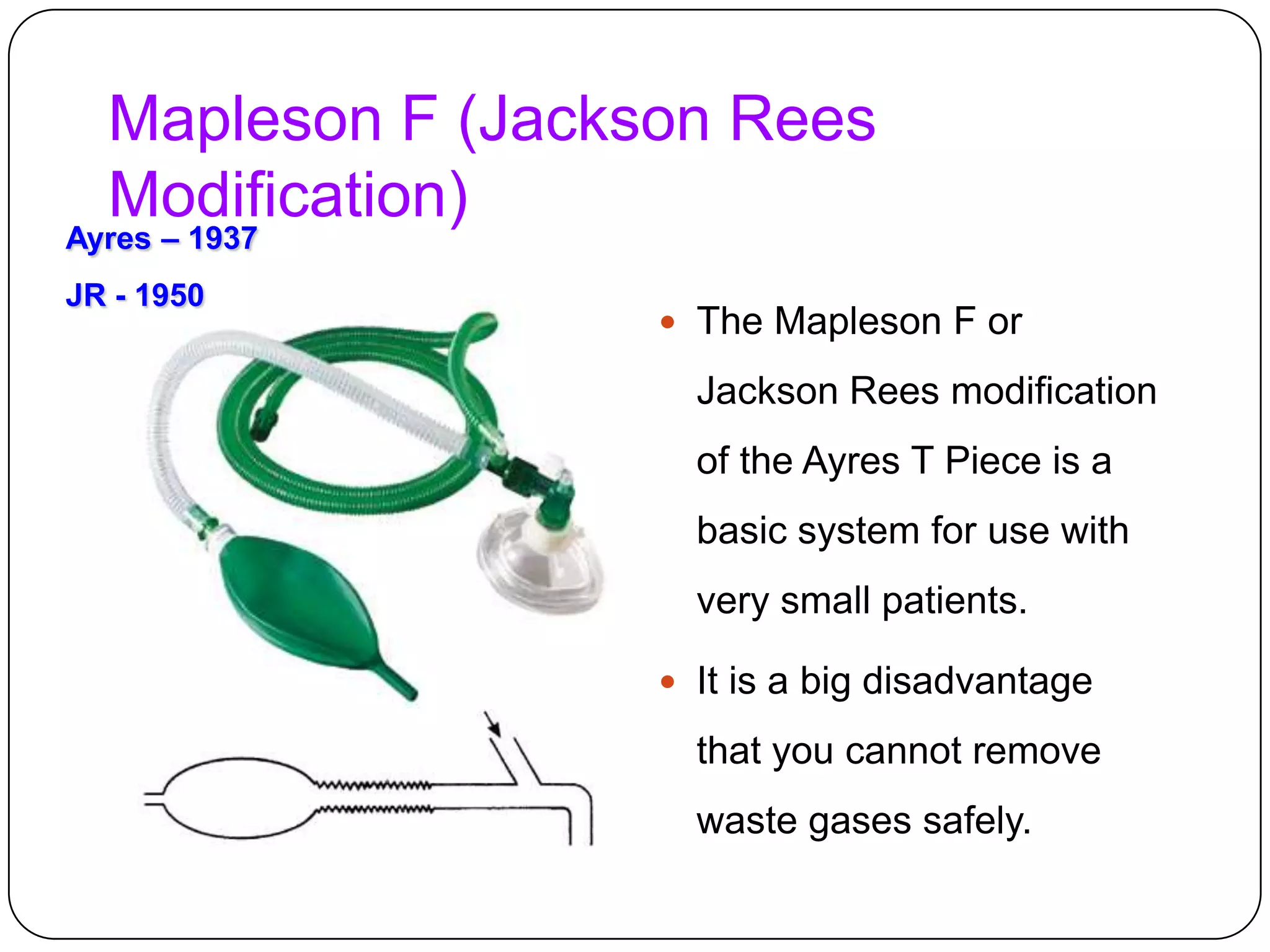
 The Mapleson F or
Jackson Rees modification
of the Ayres T Piece is a
basic system for use with
very small patients.
 It is a big disadvantage
that you cannot remove
waste gases safely.
Ayres – 1937
JR - 1950
Mapleson F (Jackson
Rees Modification)
 Advantages of T-piece
systems

 Compact
Inexpensive
No valves
Minimal dead space
Minimal resistance to breathing
Economical for controlled
ventilation
 Disadvantages
 The bag may get twisted and
impede breathing
High gas flow requirement
 Uses
 Children under 20 kg weight
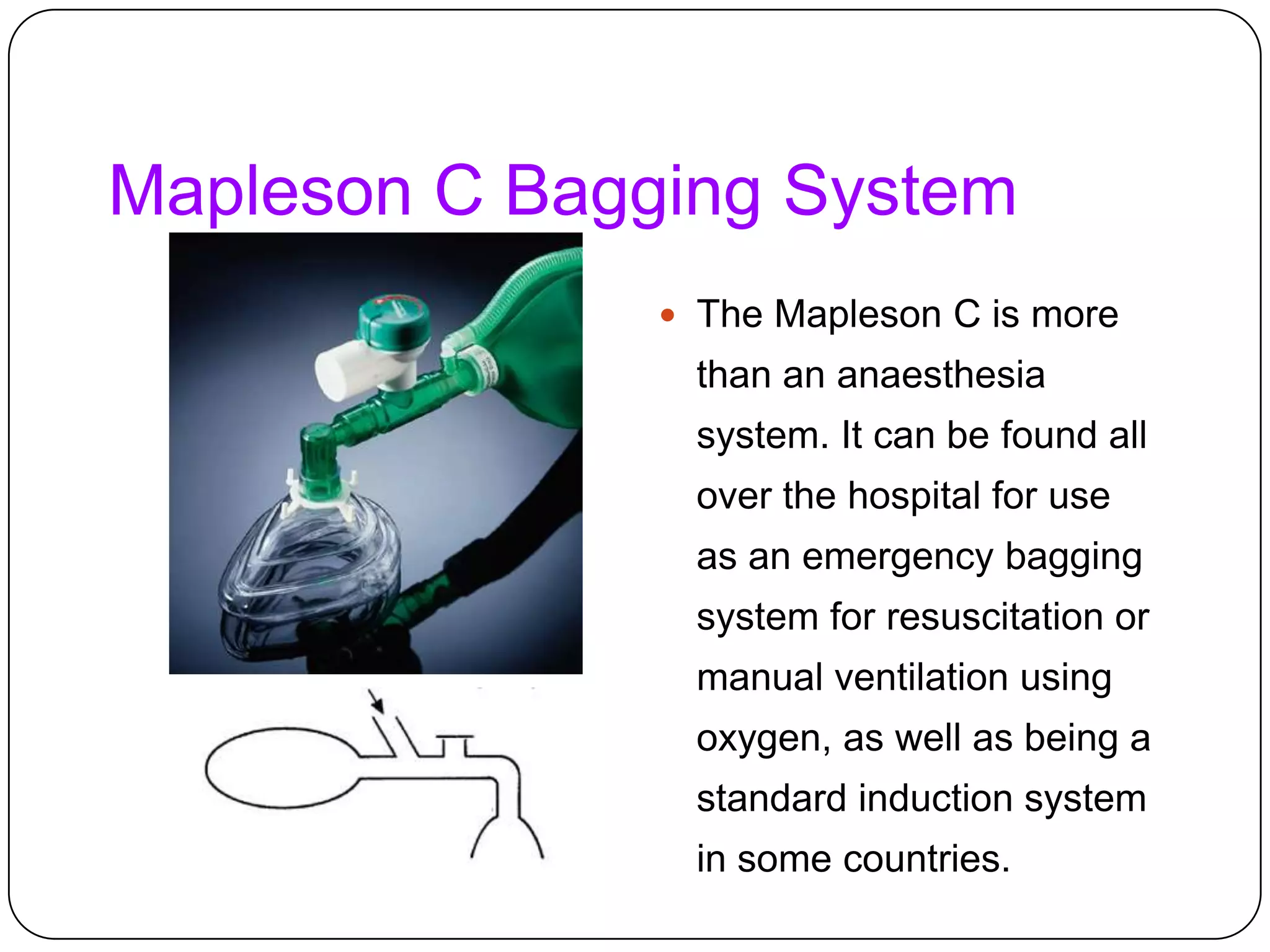
Mapleson C Bagging System
 The Mapleson C is more
than an anaesthesia
system. It can be found all
over the hospital for use
as an emergency bagging
system for resuscitation or
manual ventilation using
oxygen, as well as being a
standard induction system
in some countries.
Semi Closed Circuit Anaesthesia
 This type of General Anaesthesia is used mainly for
maintenance of anaesthesia following induction. It can
be used for induction of anaesthesia, but this is a
slower process.
 It requires an absorber system containing a CO2
Absorbent to remove CO2 from the expired patient
gases, and a high degree level of patient monitoring,
especially respiratory gas monitoring to measure
levels of inspired and expired CO2 and the volatile
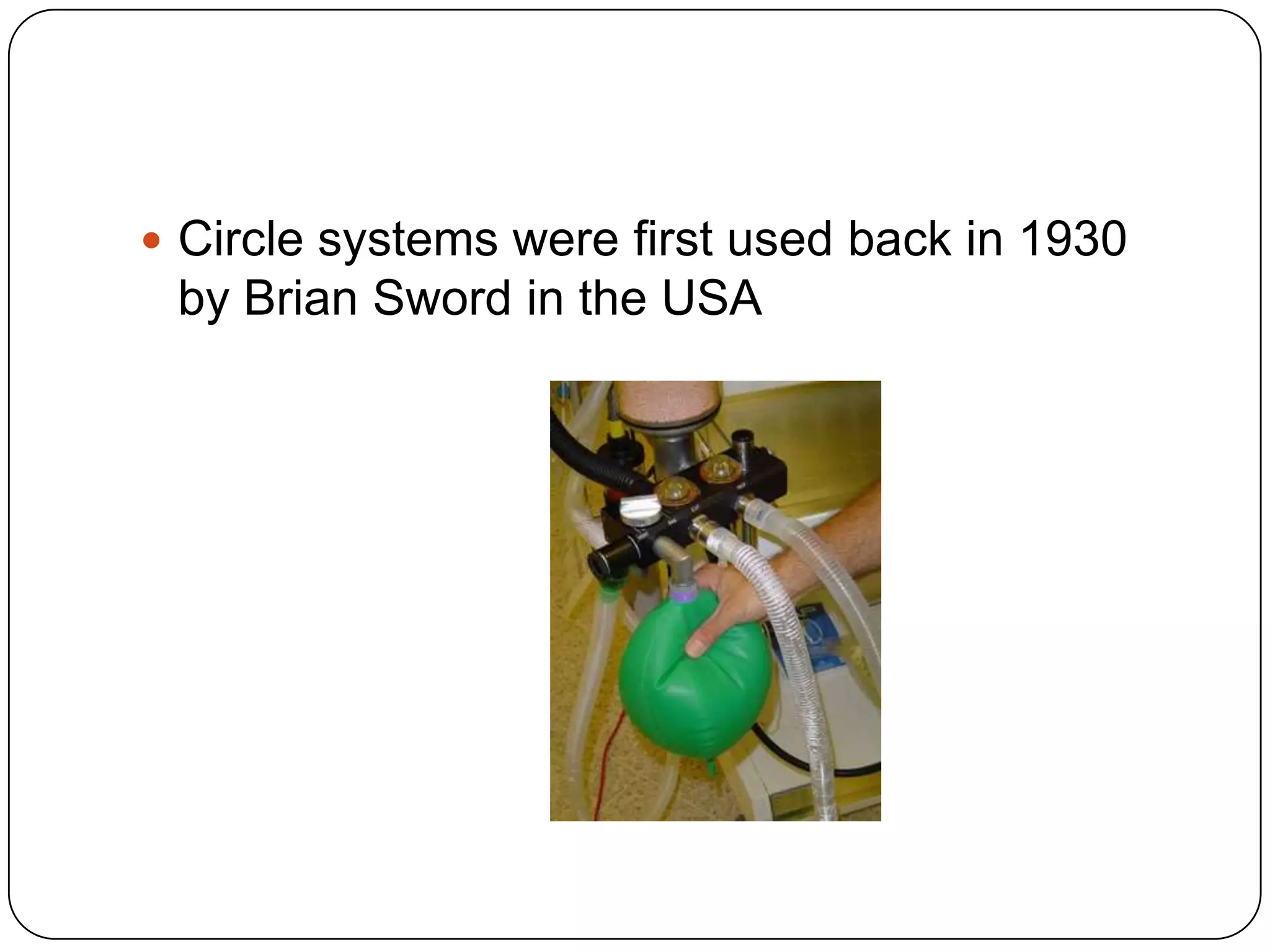
 Circle systems were first used back in 1930

by Brian Sword in the USA
Semi Closed Anaesthesia Explained
 Semi Closed Anaesthesia is where the
expired gases from the patient pass through a
canister in the breathing system which
contains a CO2 absorbent. This absorbent by
an exothermic chemical reaction removes the
CO2, so the patients expired gases can be
rebreathed. Because of this exothermic
chemical reaction, some warmth and humidity
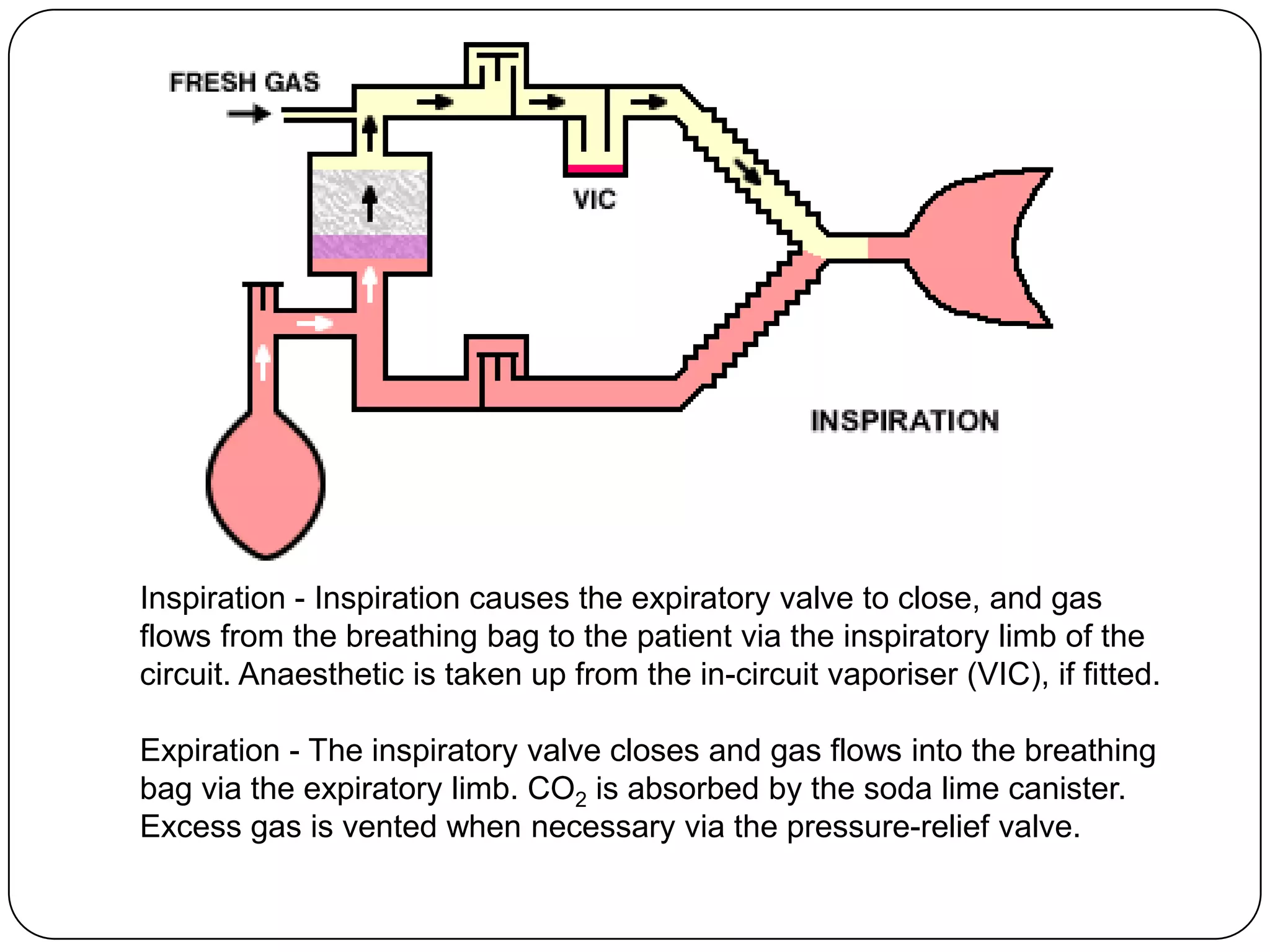
Inspiration - Inspiration causes the expiratory valve to close, and gas
flows from the breathing bag to the patient via the inspiratory limb of the
circuit. Anaesthetic is taken up from the in-circuit vaporiser (VIC), if fitted.
Expiration - The inspiratory valve closes and gas flows into the breathing
bag via the expiratory limb. CO2 is absorbed by the soda lime canister.
Excess gas is vented when necessary via the pressure-relief valve.
Semi Closed Anaesthesia Explained
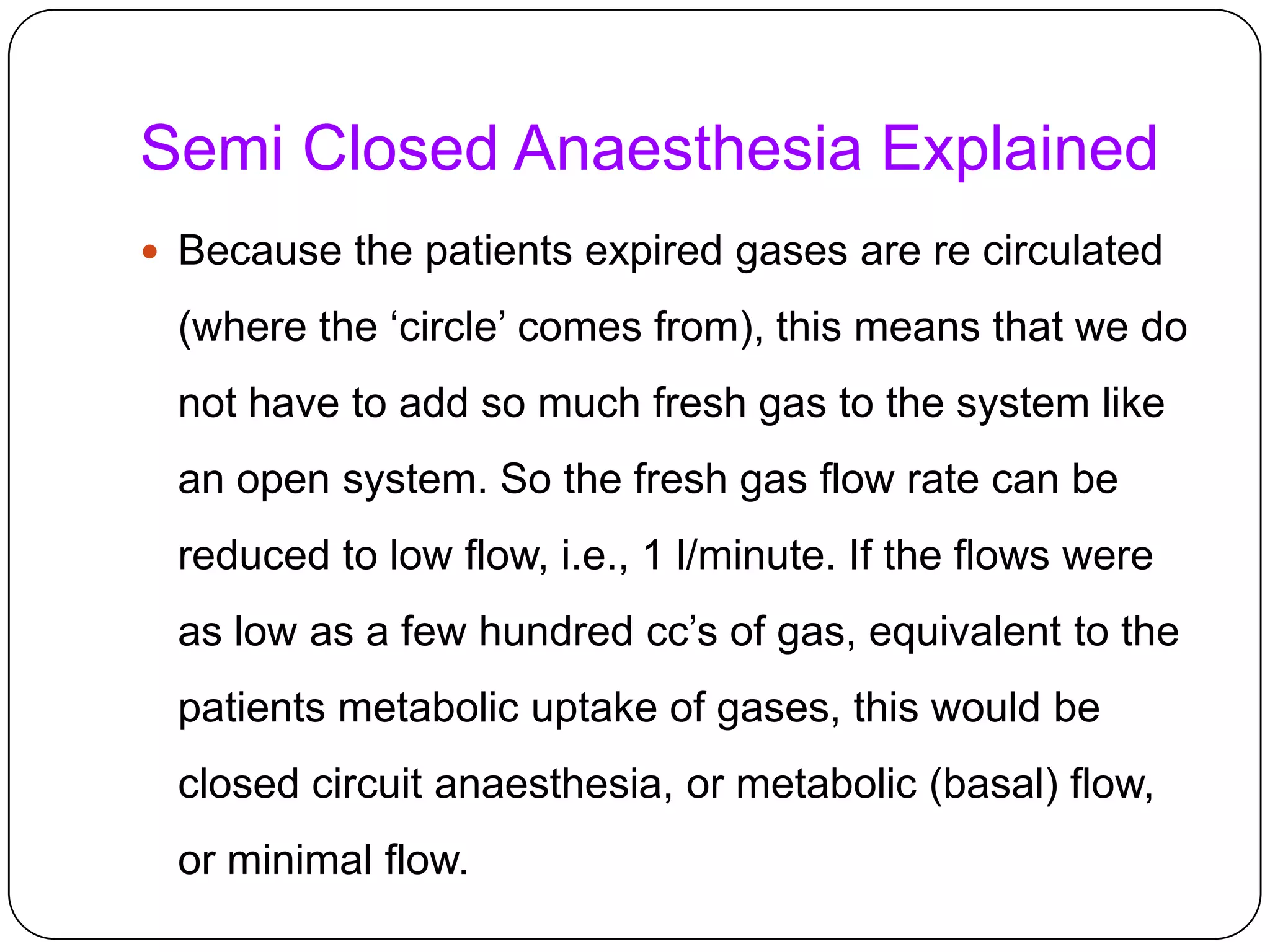
 Because the patients expired gases are re circulated
(where the ‘circle’ comes from), this means that we do
not have to add so much fresh gas to the system like
an open system. So the fresh gas flow rate can be
reduced to low flow, i.e., 1 l/minute. If the flows were
as low as a few hundred cc’s of gas, equivalent to the
patients metabolic uptake of gases, this would be
closed circuit anaesthesia, or metabolic (basal) flow,
or minimal flow.
THANKYOU
Breathing circuits
Breathing circuits
Breathing circuits
Breathing circuits

Breathing circuits

  • 1.
    Dr.P.Karunanithi Dr.Gayathri SRM Medical college& Research centre Potheri kancheepuram Breathing circuits
  • 2.
     Anesthetic gasexits the anaesthesia machine (via the common gas outlet) and then enters a breathing circuit. The function of the circuit is to deliver oxygen and anaesthetic gases to the patient and to eliminate CO2.
  • 3.
    Classification  This mostbasic classification of breathing systems divides them into open, semi-open, semi-closed or closed.

  • 4.
    Ideal breathing circuit Simple and safe to use  Delivers the right gas mixture  Allows all methods of ventilation in all age groups  Efficient  Pressure relief  Sturdy, small and light  Allows easy removal of waste gases  Easy to maintain with low running costs
  • 5.
    Components  Fresh Gasconnection  Patient connection  Adjustable Pressure Limiting (APL) Valve  Reservoir (Bag or Bellows)  Tubing  Waste gas connection
  • 6.
    Open method  FGF Reservoir bag X  APL valve X Open is the old fashioned method of dropping ether or chloroform over a gauze or lint
  • 7.
    open method Later modernisedby the likes of the Schimmelbusch mask.
  • 8.
    The Mapleson Alphabet The F wasadded later to the alphabet
  • 9.
    Apl valve  Thevalve disc is held in place by a weak spring, the tension on which can be adjusted by a screw mechanism, thereby adjusting the pressure required to open the valve.
  • 10.
    Types of Semi-closed Circuit Systems  Mapleson A or Magill System  Mapleson A or Lack System  Mapleson D or Bain System  Mapleson F or Ayres T Piece System  Mapleson F with APL Valve  Mapleson C Bagging System

  • 11.
    What FGF’s areneeded? Mapleson Systems Uses FGF SV FGF IPPV A Magill Lack Spontaneous Gen Anaesthesia 70-100 ml/kg/min ≈ 1X MV Min 3 x MV B Very uncommon, not in use today C Resuscitation Bagging Min 15 lpm D Bain Spontaneous IPPV, Gen. Anaes 150-200 ml/kg/min 70-100 ml/kg/min E Ayres T Piece Very uncommon, not in use today F Jackson Rees Paediatric <25 Kg 2.5 – 3 x MV Min 4 lpm

  • 12.
    Mapleson A (Magill)System  The Mapleson A or Magill system is good for spontaneous breathing patients, so the fresh gas flow can be lower. However as the APL valve is close to the patient, it is regarded by many as difficult to use. 1950’s
  • 14.
     Inspiration -The valve closes and the patient inspires fresh gas from the reservoir tube. Fresh gas flushes the dead space gas toward the patient.  Expiration - The patient expires into the reservoir tube. Towards the end of expiration, the bag fills and positive pressure opens the valve, allowing expired gas to escape. The patient end of the tubing is filled with dead space gas followed by the alveolar gas. This stream travels up the tubing and meets the fresh gas flowing into the circuit. The pressure in the circuit increases and forces the expiratory valve to open, allowing the alveolar gas to escape. Expiratory pause - Fresh gas washes the expired gas out of the reservoir tube, filling it with fresh gas for the next inspiration.
  • 15.
    Mapleson A (Magill)System Spontaneous ventilation Re breathing of alveolar gas can be prevented if the fresh gas flow = patient's minute ventilation.
  • 16.
    Mapleson A (Magill)System The Mapleson A is inefficient during controlled ventilation. Venting the gas in the circuit occurs during the inspiratory phase, and the alveolar gases are retained in the tubing during the expiration phase. Hence, alveolar gas is rebreathed before the the pressure in the system increases sufficiently to force the expiratory valve open. A fresh gas flow of >20 L/minute is required to prevent rebreathing during controlled ventilation.
  • 17.
    Mapleson A (Lack)System  The Mapleson A or Lack system is a modification of the Magill where the valve is moved to the machine end of the system using another length of tubing. This adds volume to the system and makes it rather heavy at the patient end. 1976
  • 18.
    Mapleson D (Bain) The Mapleson D or Bain System is a co-axial system where the fresh gas is delivered directly to the patient. It requires very high fresh gas flows to prevent rebreathing of CO2. It is very convenient to use, thus is very popular especially for induction, in the UK! 1972
  • 19.
    Mapleson D (Bain) Atube carrying fresh gas (F) travels inside an outer reservoir tube (R) to the endotracheal tube connector (P).
  • 20.
    The Bain circuitis a modification of the Mapleson D system. It is a co-axial system in which the fresh gas flows through a narrow inner tube within the outer corrugated tubing. Inspiration - The patient inspires fresh gas from the outer reservoir tube. Expiration - The patient expires into the reservoir tube. Although fresh gas is still flowing into the system at this time, it is wasted, as it is contaminated by expired gas. Expiratory pause - Fresh gas from the inner tube washes the expired gas out of the reservoir tube, filling it with fresh gas for the next inspiration
  • 21.
    As with otherco-axial systems, if the inner tube becomes disconnected or breaks, the entire breathing tube becomes dead space, leading to severe alveolar hypoventilation. This may be detected in systems fitted with a bag by closing the valve and activating the oxygen quick-flush. If the inner tube is intact, the Venturi effect of the rapidly moving stream of gas leaving the inner tube will suck gas out of the bag and the bag will empty. If the inner tube is damaged, the stream of gas will be directed into the bag and it will fill.
  • 22.
    Mapleson D (Bain) Spontaneous ventilation Normocarbia requires a fresh gas flow of 200-300 ml/kg.  Controlled ventilation A fresh gas flow of only 70 ml/kg is required to produce normocarbia.
  • 23.
  • 24.
    Mapleson F (JacksonRees Modification)  The Mapleson F or Jackson Rees modification of the Ayres T Piece is a basic system for use with very small patients.  It is a big disadvantage that you cannot remove waste gases safely. Ayres – 1937 JR - 1950
  • 25.
    Mapleson F (Jackson ReesModification)  Advantages of T-piece systems  Compact Inexpensive No valves Minimal dead space Minimal resistance to breathing Economical for controlled ventilation  Disadvantages  The bag may get twisted and impede breathing High gas flow requirement  Uses  Children under 20 kg weight
  • 26.
    Mapleson C BaggingSystem  The Mapleson C is more than an anaesthesia system. It can be found all over the hospital for use as an emergency bagging system for resuscitation or manual ventilation using oxygen, as well as being a standard induction system in some countries.
  • 27.
    Semi Closed CircuitAnaesthesia  This type of General Anaesthesia is used mainly for maintenance of anaesthesia following induction. It can be used for induction of anaesthesia, but this is a slower process.  It requires an absorber system containing a CO2 Absorbent to remove CO2 from the expired patient gases, and a high degree level of patient monitoring, especially respiratory gas monitoring to measure levels of inspired and expired CO2 and the volatile
  • 28.
     Circle systemswere first used back in 1930 by Brian Sword in the USA
  • 29.
    Semi Closed AnaesthesiaExplained  Semi Closed Anaesthesia is where the expired gases from the patient pass through a canister in the breathing system which contains a CO2 absorbent. This absorbent by an exothermic chemical reaction removes the CO2, so the patients expired gases can be rebreathed. Because of this exothermic chemical reaction, some warmth and humidity
  • 30.
    Inspiration - Inspirationcauses the expiratory valve to close, and gas flows from the breathing bag to the patient via the inspiratory limb of the circuit. Anaesthetic is taken up from the in-circuit vaporiser (VIC), if fitted. Expiration - The inspiratory valve closes and gas flows into the breathing bag via the expiratory limb. CO2 is absorbed by the soda lime canister. Excess gas is vented when necessary via the pressure-relief valve.
  • 31.
    Semi Closed AnaesthesiaExplained  Because the patients expired gases are re circulated (where the ‘circle’ comes from), this means that we do not have to add so much fresh gas to the system like an open system. So the fresh gas flow rate can be reduced to low flow, i.e., 1 l/minute. If the flows were as low as a few hundred cc’s of gas, equivalent to the patients metabolic uptake of gases, this would be closed circuit anaesthesia, or metabolic (basal) flow, or minimal flow.
  • 32.