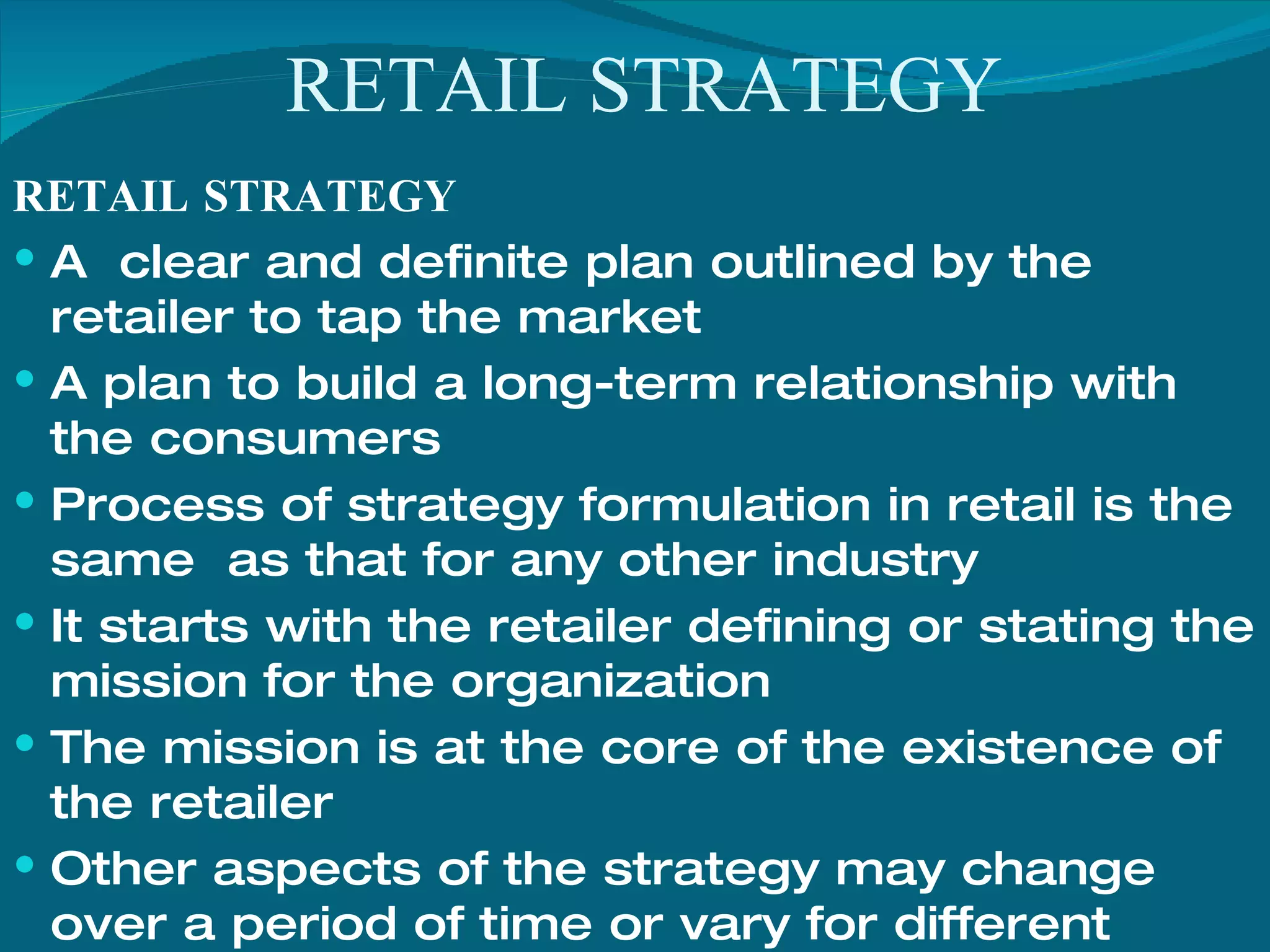
RETAIL STRATEGY RETAIL STRATEGY A  clear and definite plan outlined by the retailer to tap the market A plan to build a long-term relationship with the consumers Process of strategy formulation in retail is the same  as that for any other industry It starts with the retailer defining or stating the mission for the organization The mission is at the core of the existence of the retailer Other aspects of the strategy may change over a period of time or vary for different markets
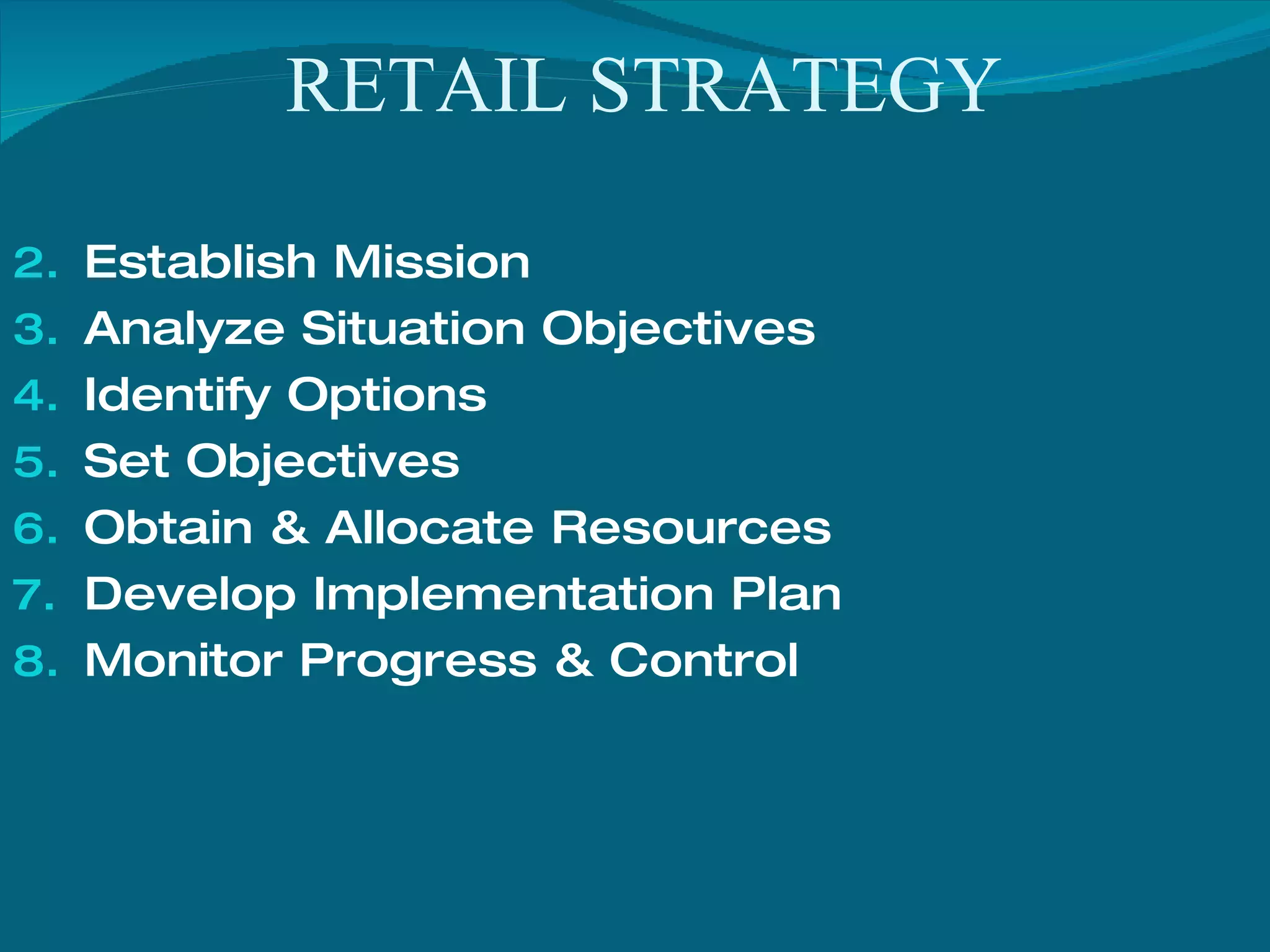
RETAIL STRATEGY Establish Mission Analyze Situation Objectives Identify Options Set Objectives Obtain & Allocate Resources Develop Implementation Plan Monitor Progress & Control
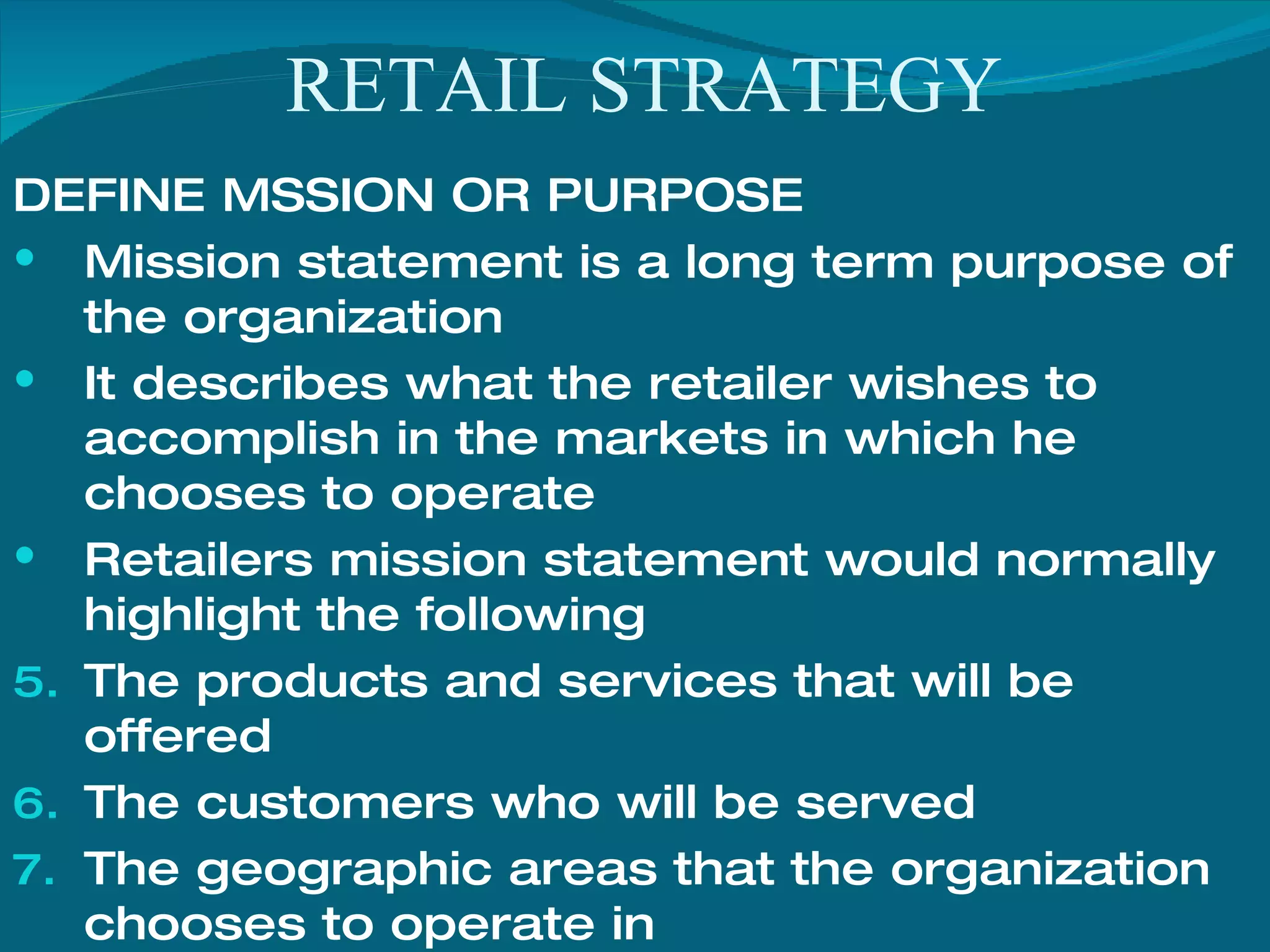
RETAIL STRATEGY DEFINE MSSION OR PURPOSE Mission statement is a long term purpose of the organization It describes what the retailer wishes to accomplish in the markets in which he chooses to operate Retailers mission statement would normally highlight the following The products and services that will be offered The customers who will be served The geographic areas that the organization chooses to operate in The manner in which he firm intends to compete
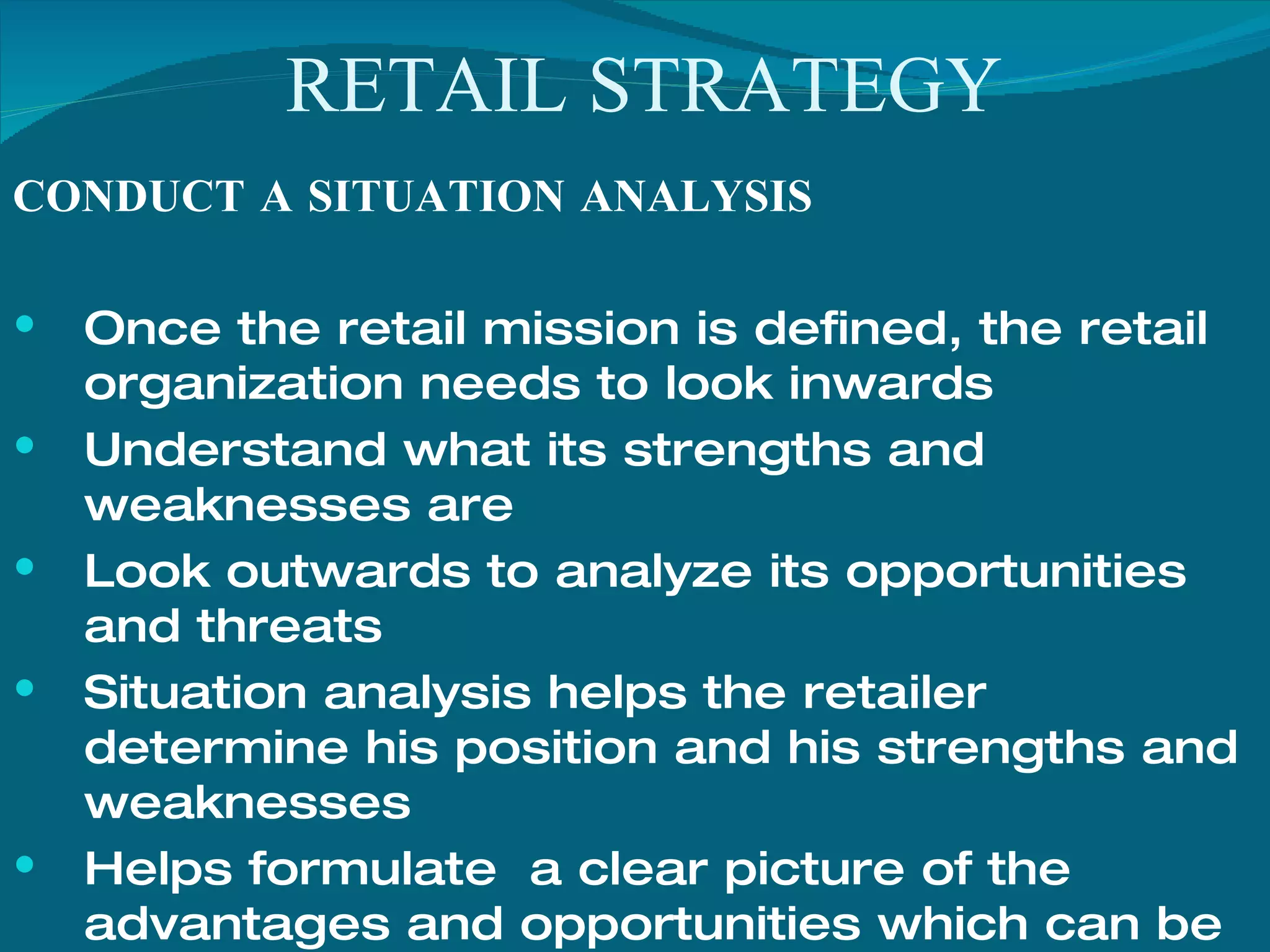
RETAIL STRATEGY CONDUCT A SITUATION ANALYSIS Once the retail mission is defined, the retail organization needs to look inwards Understand what its strengths and weaknesses are Look outwards to analyze its opportunities and threats  Situation analysis helps the retailer determine his position and his strengths and weaknesses Helps formulate  a clear picture of the advantages and opportunities which can be exploited  The weaknesses need to be worked upon This forms the basis or he core element of any strategy
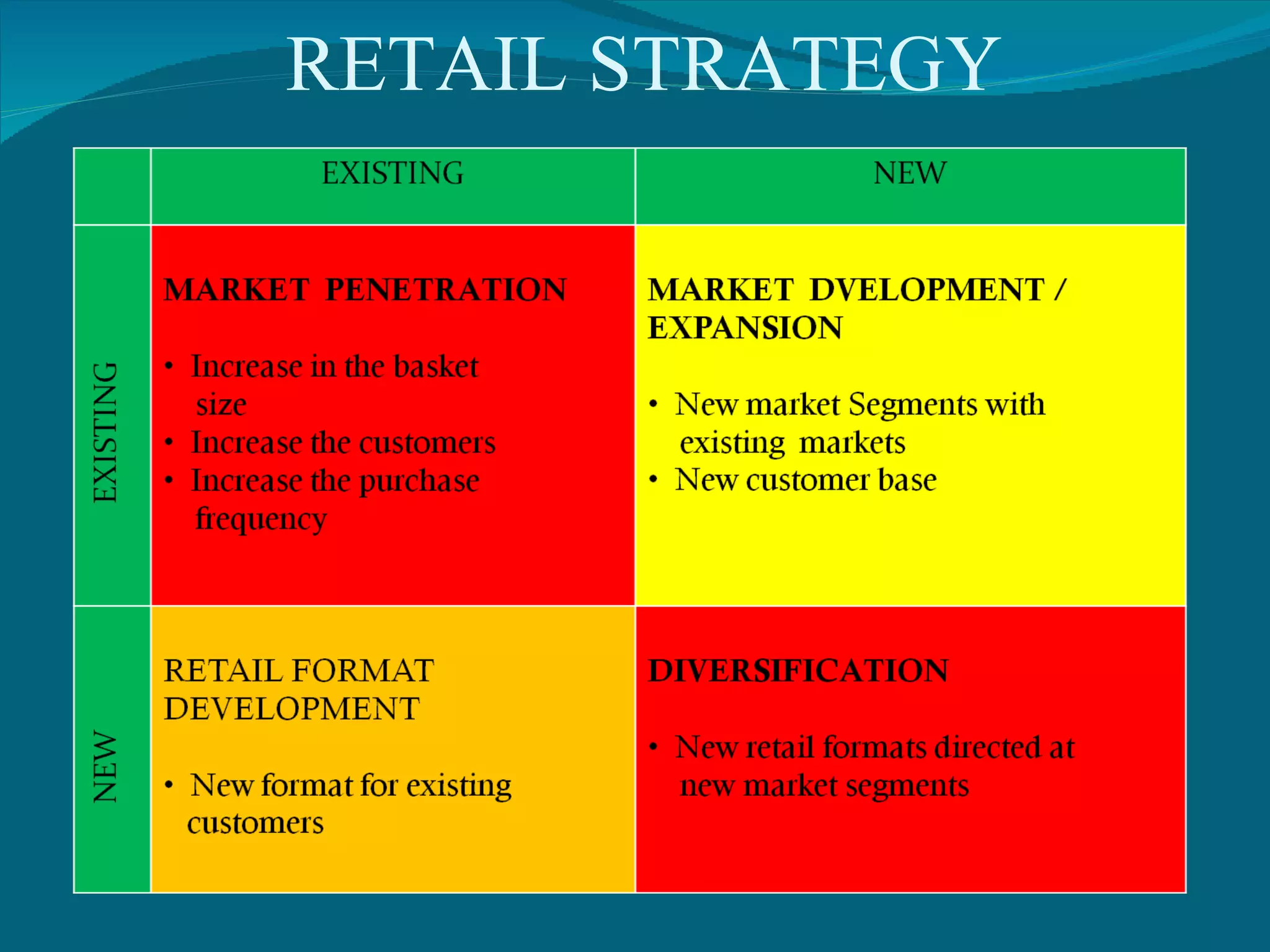
RETAIL STRATEGY IDENTIFY OPTIONS / STRATEGIC ALTERNATIVES After determining the strengths and weaknesses vis-à-vis he environment retailer needs to consider various alternatives available to tap a particular market Igor Ansoff presented a matrix which looked at growth opportunities  He focused on firm’s present and potential products in the existing and new markets Ansoff’s matrix also helps to understand the options available to a retailer
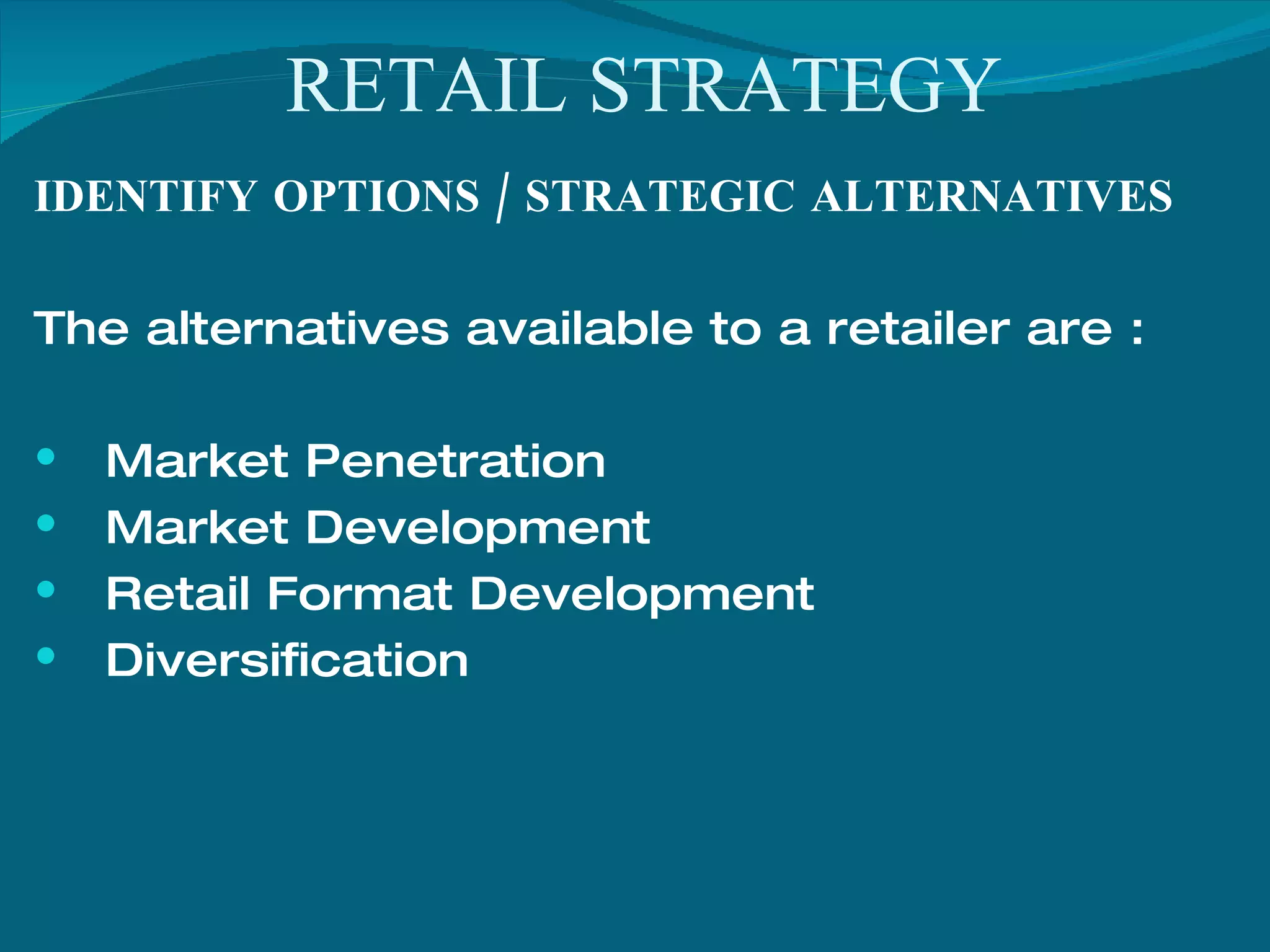
RETAIL STRATEGY IDENTIFY OPTIONS / STRATEGIC ALTERNATIVES The alternatives available to a retailer are : Market Penetration Market Development Retail Format Development Diversification
RETAIL STRATEGY
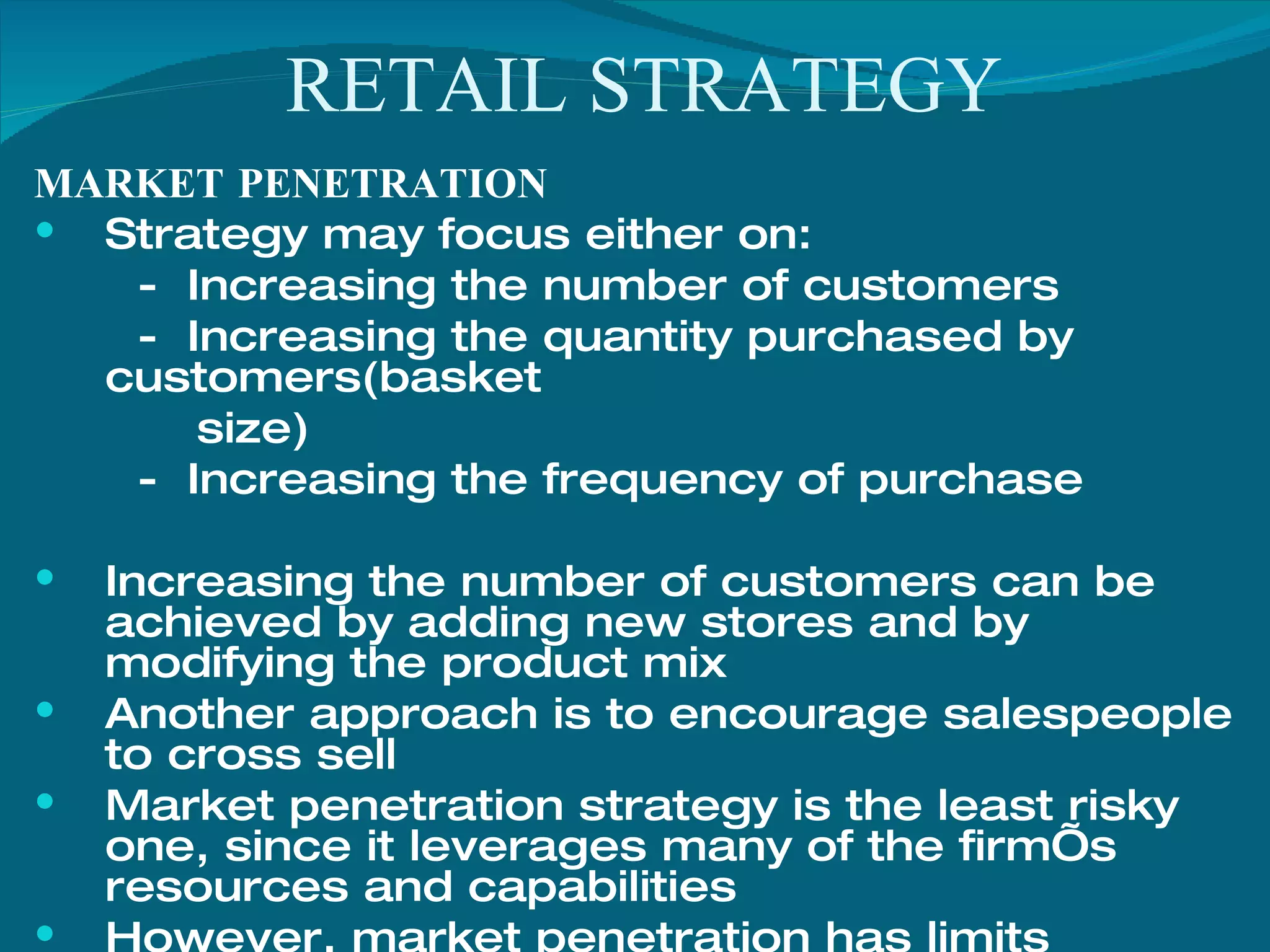
RETAIL STRATEGY MARKET PENETRATION Strategy may focus either on: -  Increasing the number of customers -  Increasing the quantity purchased by customers(basket  size) -  Increasing the frequency of purchase Increasing the number of customers can be achieved by adding new stores and by modifying the product mix Another approach is to encourage salespeople to cross sell Market penetration strategy is the least risky one, since it leverages many of the firm’s resources and capabilities However, market penetration has limits Once the market approaches saturation, a new strategy needs to be pursued if the firm is to continue growth
RETAIL STRATEGY MARKET  EXPANSION / DEVELOPMENT When a retailer is said to reach out to new market segments or completely changes his customer base This strategy involves : -  Tapping new geographical markets -  Introducing new products to the existing range that appeal to a  wider audience Expansion by adding new retail stores to existing  network is an example of geographical expansion Introducing a pharmacy in a supermarket  (eg. The medicine Shoppe at the Haiko Supermarket in Mumbai) is an example of  a retailer introducing new products, appealing o a different audience Another example is McDonald’s who introduced ice creams for Rs.7 This not only created add on sales, but also brought in customers who had the perception that McDonald’s is an expensive fast food restaurant
RETAIL STRATEGY RETAIL  FORMAT  DEVELOPMENT When a retailer is said to introduce new retail format to customers  Example fast food retailers like McDonald’s and Subway offer limited menus inside large department stores Another example is bookstore chain Crosswords, opening smaller format stores by the name Crossword Corner at Shopper’s Stop Strategy may be appropriate if the retailer’s strengths are related to specific customers, rather than to specific products In this situation retailer can leverage its strengths by developing a new product targeted to his existing customers
RETAIL STRATEGY SET OBJECTIVES Translation of mission statement into operational terms Indicate  Results to be achieved Give direction to and set standards for the measurement of performance Management sets both long term and short term objectives One or two year time frames for achieving specific targets are short term objectives Long term objectives are less specific and reflect the strategic dimension of the firm Two important focus areas of retailers  -  Market Performance -  Financial Performance Objectives are set keeping these focus areas in mind Sales volume targets Market hare targets Profitability targets Liquidity targets Returns on investment targets
RETAIL STRATEGY OBTAIN AND ALLOCATE RESOURCES NEEDED TO  COMPETE Resources needed by a retailer  -  Human Resources -  Financial Resources 1.  Human Resource HR plan must be consistent with overall strategy of the organization HR management focuses on issues such as recruiting, selecting, training,  compensating, and motivating personnel These activities must be managed effectively and efficiently 2.  Financial Resources Takes care of the monetary aspects of business Shop rent, salaries and payments for merchandise
RETAIL STRATEGY DEVELOP  THE  STRATEGIC  PLAN At this stage strategy is determined through which retailer will achieve objectives The retailer determines and defines his target market The retailer finalizes the retail mix that will serve the audience Target Market – that segment of consumer market that the retail orgn.decides to serve No definite process of deciding and selecting the target market Most retailers look at the entire market in terms of both size and consumer segments to which it might appeal From these segments he identifies smaller number of segments that appear promising These become possible targets Variables like growth potential, investment needed to compete, the strength of competition, etc are evaluated. This enables the retailer to arrive at the best alternative that is most compatible with the organizations resources and skills
RETAIL STRATEGY DEVELOP  THE  STRATEGIC  PLAN Considerations for successful market segmentation Measurable : The segment should be measurable and identifiable? Accessible : Focusing market marketing efforts on a particular market segment should have a positive impact towards eliciting the desired response Economically viable : The expense and efforts of focusing the marketing efforts in potential segments should be justified. Stable : The consumer characteristics are indicators of market potential. Hence stable indicators to be considered.
RETAIL STRATEGY DEVELOP  THE  STRATEGIC  PLAN After choosing the target market the retail mix needs to be developed This process involves the determination of the merchandise mix the pricing policy  types of location the retail stores would be located at  -  services to be offered  - communication platform that would be adopted by the retailer Next is the formulation of positioning strategy. This refers to  the image the retailer wants the customers to have in their minds about  the products and services
RETAIL STRATEGY IMPLEMENT THE STRATEGY, EVALUATE AND CONTROL Implementation is the key to success of any strategy Effective implementation of the retailers desired positioning requires Every aspect of stores to be focused on the target market Merchandising must be single-minded Displays must appeal to target market Advertising must talk to the target market Personnel must have empathy for the target market Customer service must be designed with the target customer in mind
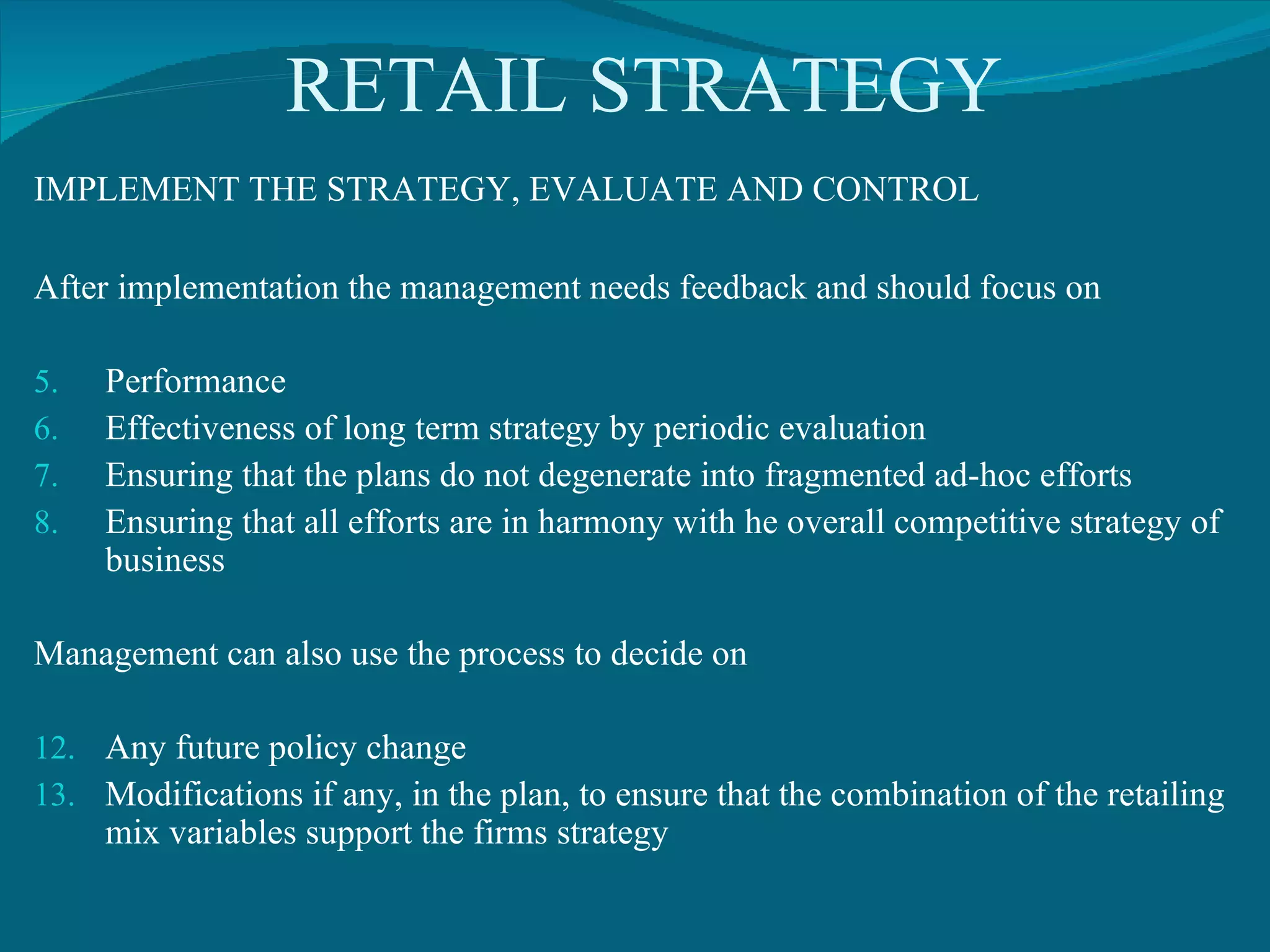
RETAIL STRATEGY IMPLEMENT THE STRATEGY, EVALUATE AND CONTROL After implementation the management needs feedback and should focus on  Performance  Effectiveness of long term strategy by periodic evaluation Ensuring that the plans do not degenerate into fragmented ad-hoc efforts Ensuring that all efforts are in harmony with he overall competitive strategy of business Management can also use the process to decide on Any future policy change Modifications if any, in the plan, to ensure that the combination of the retailing mix variables support the firms strategy
RETAIL STRATEGY INTERNATIONAL EXPANSION – A GROWTH STRATEGY Factors facilitating the rise of international retail trade Removal of trade barriers between countries The rise of consumerism
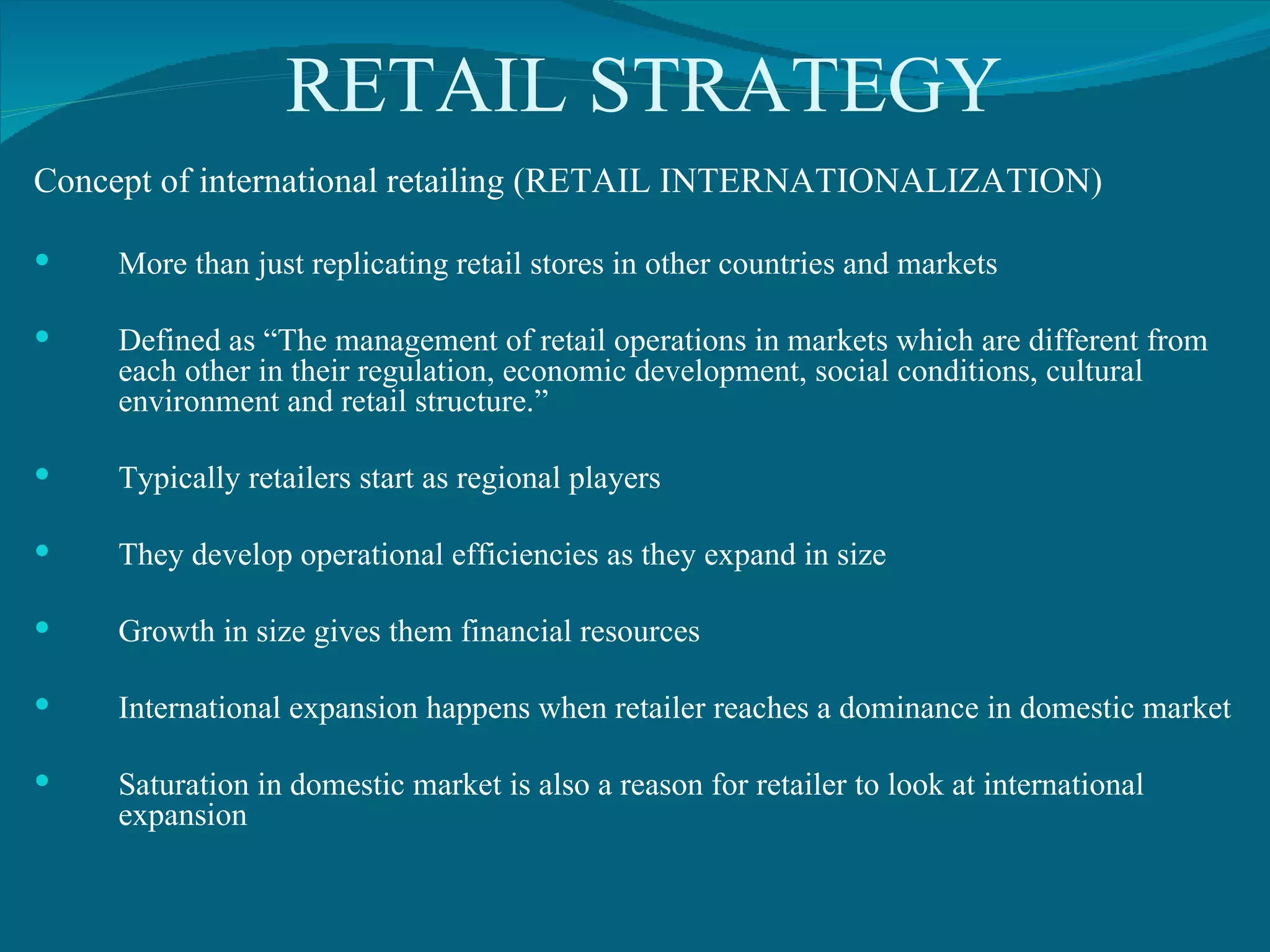
RETAIL STRATEGY Concept of international retailing (RETAIL INTERNATIONALIZATION) More than just replicating retail stores in other countries and markets Defined as “The management of retail operations in markets which are different from each other in their regulation, economic development, social conditions, cultural environment and retail structure.” Typically retailers start as regional players They develop operational efficiencies as they expand in size Growth in size gives them financial resources International expansion happens when retailer reaches a dominance in domestic market Saturation in domestic market is also a reason for retailer to look at international expansion
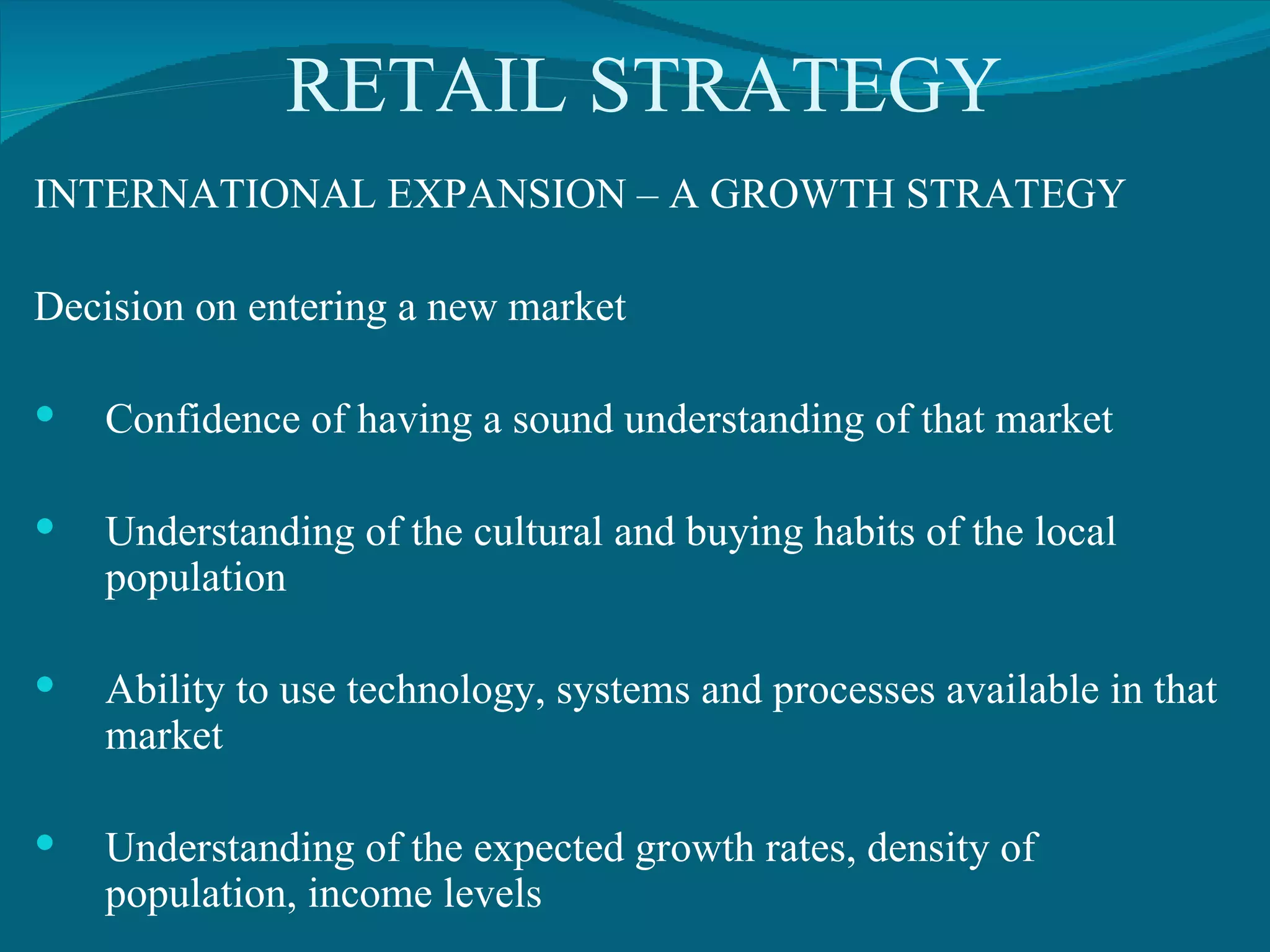
RETAIL STRATEGY INTERNATIONAL EXPANSION – A GROWTH STRATEGY Decision on entering a new market Confidence of having a sound understanding of that market Understanding of the cultural and buying habits of the local population Ability to use technology, systems and processes available in that market Understanding of the expected growth rates, density of population, income levels
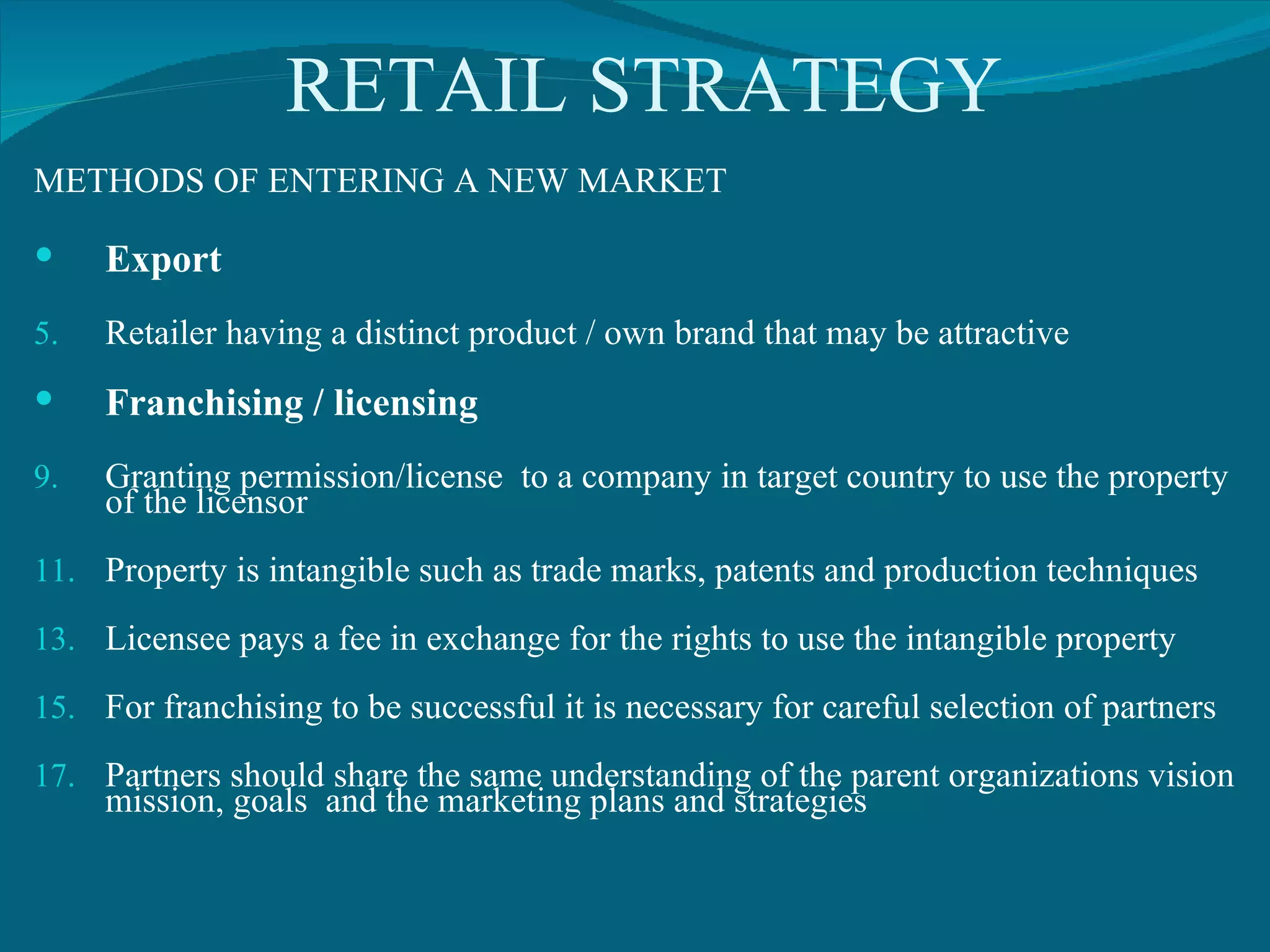
RETAIL STRATEGY METHODS OF ENTERING A NEW MARKET Export Retailer having a distinct product / own brand that may be attractive Franchising / licensing Granting permission/license  to a company in target country to use the property of the licensor Property is intangible such as trade marks, patents and production techniques Licensee pays a fee in exchange for the rights to use the intangible property For franchising to be successful it is necessary for careful selection of partners Partners should share the same understanding of the parent organizations vision mission, goals  and the marketing plans and strategies
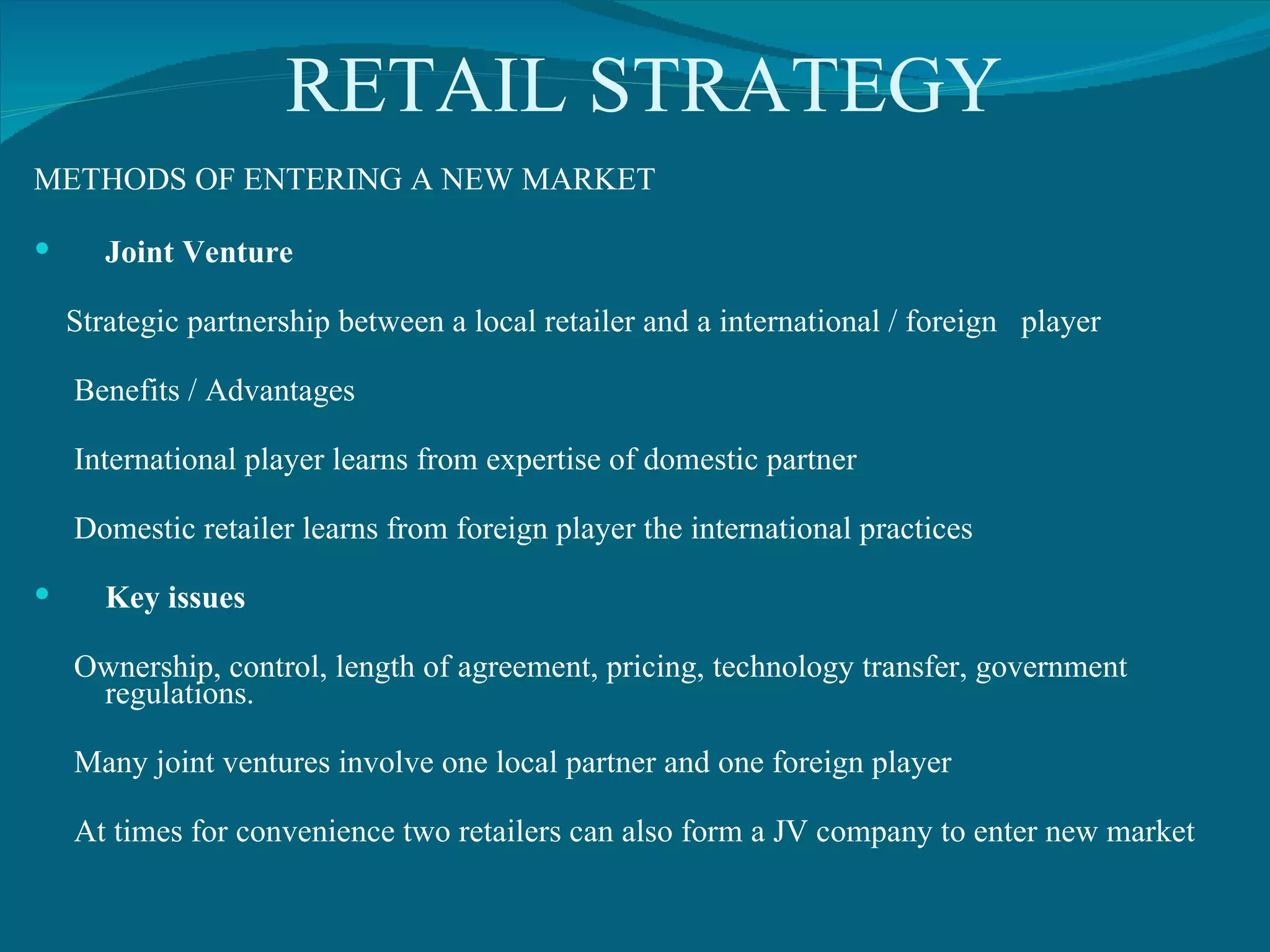
RETAIL STRATEGY METHODS OF ENTERING A NEW MARKET Joint Venture Strategic partnership between a local retailer and a international / foreign  player  Benefits / Advantages International player learns from expertise of domestic partner Domestic retailer learns from foreign player the international practices Key issues Ownership, control, length of agreement, pricing, technology transfer, government regulations. Many joint ventures involve one local partner and one foreign player At times for convenience two retailers can also form a JV company to enter new market
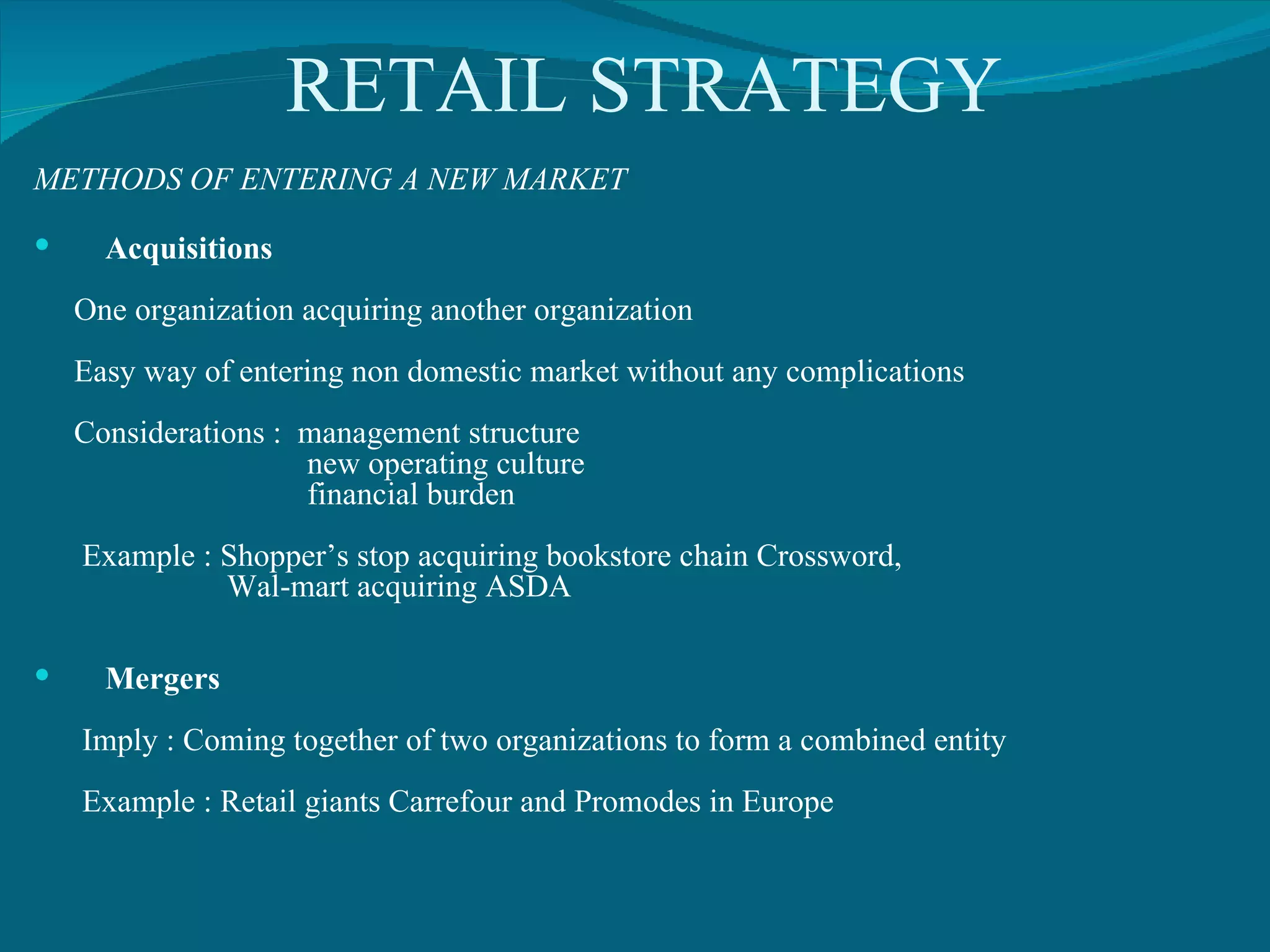
RETAIL STRATEGY METHODS OF ENTERING A NEW MARKET Acquisitions One organization acquiring another organization Easy way of entering non domestic market without any complications Considerations :  management structure new operating culture financial burden Example : Shopper’s stop acquiring bookstore chain Crossword, Wal-mart acquiring ASDA Mergers Imply : Coming together of two organizations to form a combined entity Example : Retail giants Carrefour and Promodes in Europe
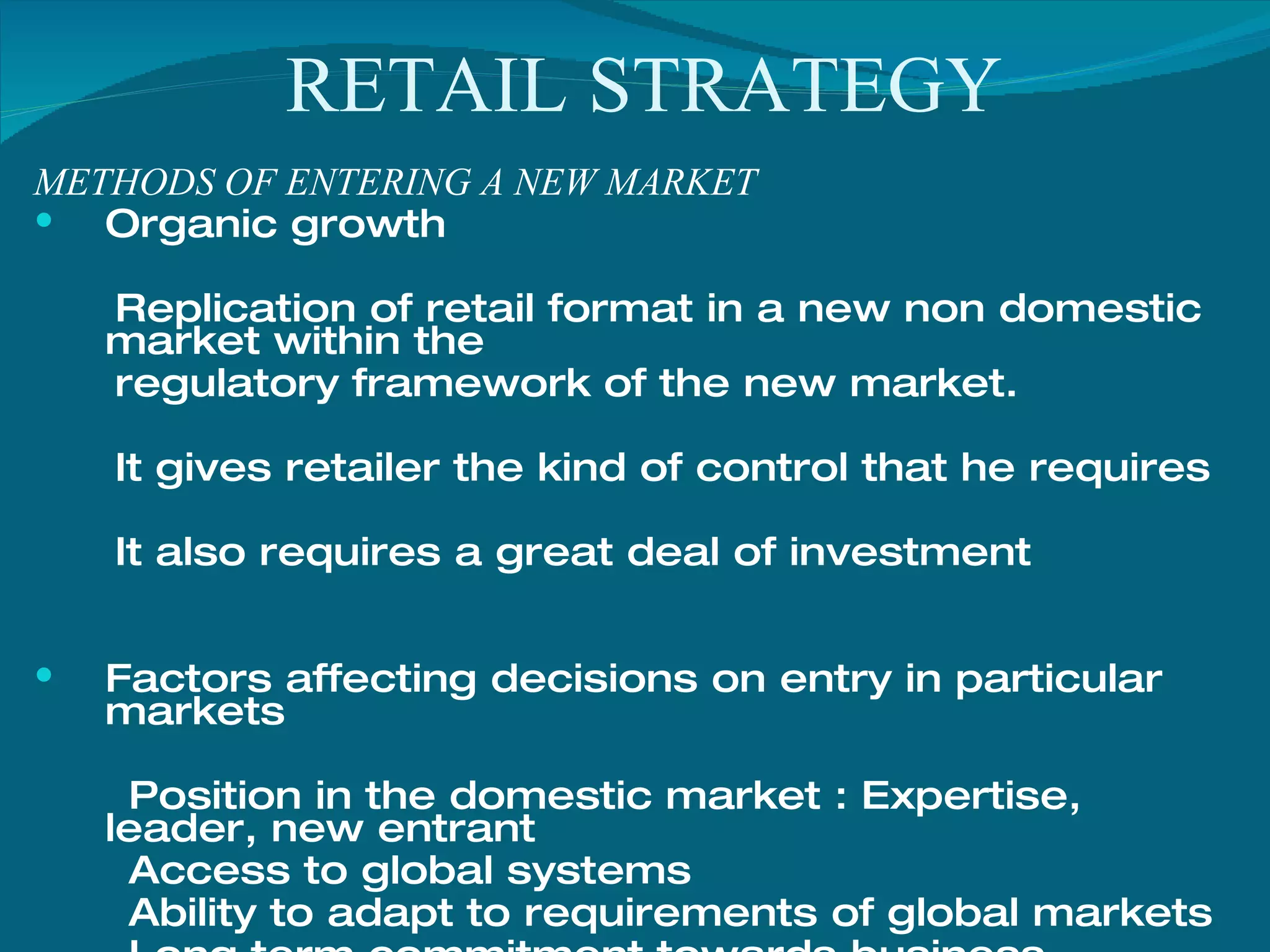
RETAIL STRATEGY METHODS OF ENTERING A NEW MARKET Organic growth Replication of retail format in a new non domestic market within the regulatory framework of the new market. It gives retailer the kind of control that he requires It also requires a great deal of investment Factors affecting decisions on entry in particular markets  Position in the domestic market : Expertise, leader, new entrant Access to global systems Ability to adapt to requirements of global markets Long term commitment towards business
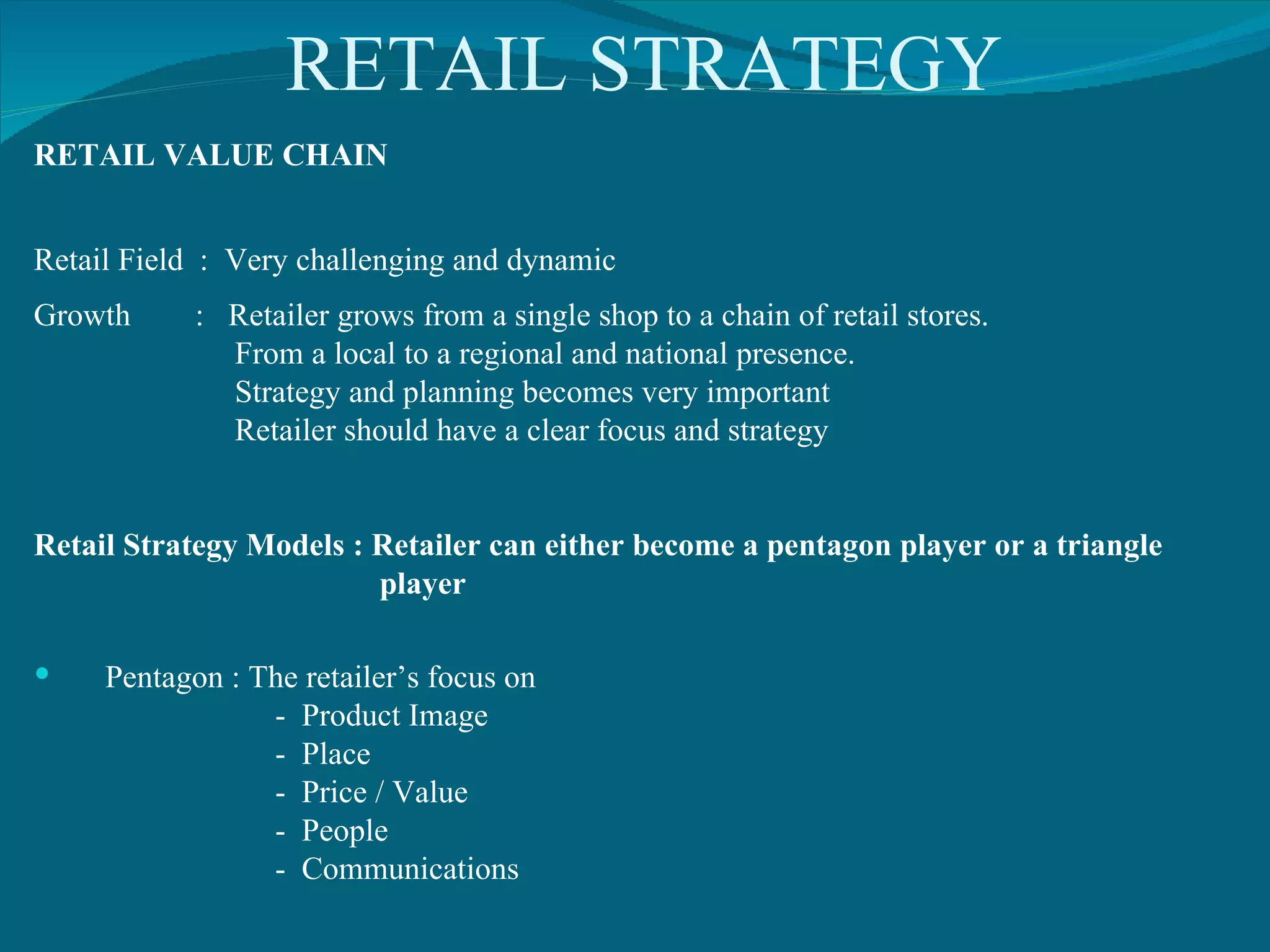
RETAIL STRATEGY RETAIL VALUE CHAIN Retail Field  :  Very challenging and dynamic Growth  :  Retailer grows from a single shop to a chain of retail stores. From a local to a regional and national presence. Strategy and planning becomes very important Retailer should have a clear focus and strategy Retail Strategy Models : Retailer can either become a pentagon player or a triangle  player Pentagon : The retailer’s focus on  -  Product Image -  Place -  Price / Value -  People -  Communications
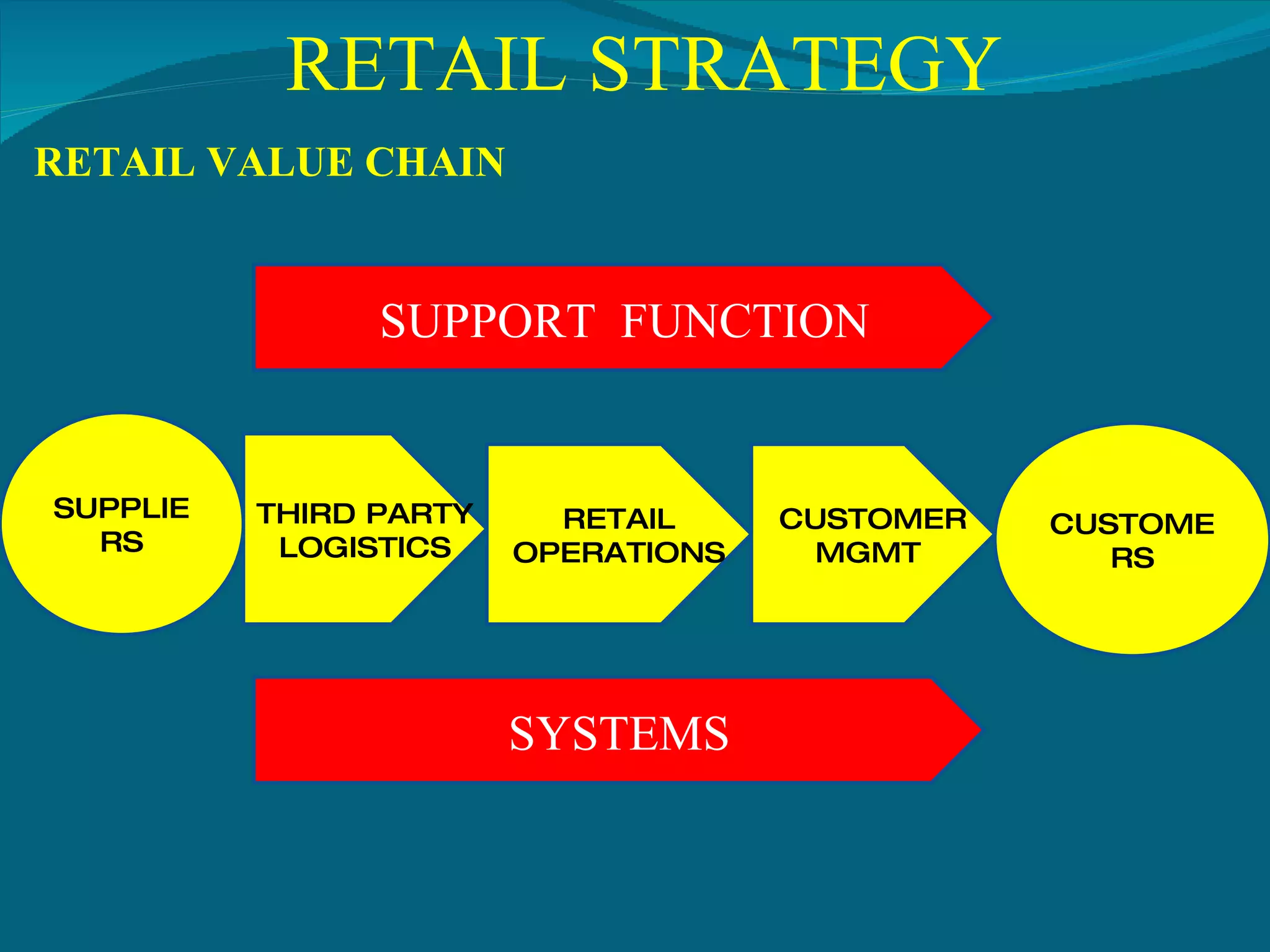
RETAIL STRATEGY RETAIL VALUE CHAIN Triangle  :  The retailer’s focus on - Systems - Logistics - Suppliers Above approaches to developing strategies are perhaps appropriate in mature marketplace At present , retail in India is oriented towards the mass market As such the retailer must consider all aspects of strategy development, such as product , price, place, communication and the supply chain There is an absence of a robust infrastructure and inadequate capabilities  of the service providers  in India Thus the retailer must necessarily invest in creating the appropriate support structure for its operations
RETAIL STRATEGY RETAIL VALUE CHAIN SUPPORT  FUNCTION SUPPLIERS THIRD   PARTY   LOGISTICS RETAIL   OPERATIONS CUSTOMER   MGMT   CUSTOMERS SYSTEMS

Retail Strategy

  • 1.
    RETAIL STRATEGY RETAILSTRATEGY A clear and definite plan outlined by the retailer to tap the market A plan to build a long-term relationship with the consumers Process of strategy formulation in retail is the same as that for any other industry It starts with the retailer defining or stating the mission for the organization The mission is at the core of the existence of the retailer Other aspects of the strategy may change over a period of time or vary for different markets
  • 2.
    RETAIL STRATEGY EstablishMission Analyze Situation Objectives Identify Options Set Objectives Obtain & Allocate Resources Develop Implementation Plan Monitor Progress & Control
  • 3.
    RETAIL STRATEGY DEFINEMSSION OR PURPOSE Mission statement is a long term purpose of the organization It describes what the retailer wishes to accomplish in the markets in which he chooses to operate Retailers mission statement would normally highlight the following The products and services that will be offered The customers who will be served The geographic areas that the organization chooses to operate in The manner in which he firm intends to compete
  • 4.
    RETAIL STRATEGY CONDUCTA SITUATION ANALYSIS Once the retail mission is defined, the retail organization needs to look inwards Understand what its strengths and weaknesses are Look outwards to analyze its opportunities and threats Situation analysis helps the retailer determine his position and his strengths and weaknesses Helps formulate a clear picture of the advantages and opportunities which can be exploited The weaknesses need to be worked upon This forms the basis or he core element of any strategy
  • 5.
    RETAIL STRATEGY IDENTIFYOPTIONS / STRATEGIC ALTERNATIVES After determining the strengths and weaknesses vis-à-vis he environment retailer needs to consider various alternatives available to tap a particular market Igor Ansoff presented a matrix which looked at growth opportunities He focused on firm’s present and potential products in the existing and new markets Ansoff’s matrix also helps to understand the options available to a retailer
  • 6.
    RETAIL STRATEGY IDENTIFYOPTIONS / STRATEGIC ALTERNATIVES The alternatives available to a retailer are : Market Penetration Market Development Retail Format Development Diversification
  • 7.
  • 8.
    RETAIL STRATEGY MARKETPENETRATION Strategy may focus either on: - Increasing the number of customers - Increasing the quantity purchased by customers(basket size) - Increasing the frequency of purchase Increasing the number of customers can be achieved by adding new stores and by modifying the product mix Another approach is to encourage salespeople to cross sell Market penetration strategy is the least risky one, since it leverages many of the firm’s resources and capabilities However, market penetration has limits Once the market approaches saturation, a new strategy needs to be pursued if the firm is to continue growth
  • 9.
    RETAIL STRATEGY MARKET EXPANSION / DEVELOPMENT When a retailer is said to reach out to new market segments or completely changes his customer base This strategy involves : - Tapping new geographical markets - Introducing new products to the existing range that appeal to a wider audience Expansion by adding new retail stores to existing network is an example of geographical expansion Introducing a pharmacy in a supermarket (eg. The medicine Shoppe at the Haiko Supermarket in Mumbai) is an example of a retailer introducing new products, appealing o a different audience Another example is McDonald’s who introduced ice creams for Rs.7 This not only created add on sales, but also brought in customers who had the perception that McDonald’s is an expensive fast food restaurant
  • 10.
    RETAIL STRATEGY RETAIL FORMAT DEVELOPMENT When a retailer is said to introduce new retail format to customers Example fast food retailers like McDonald’s and Subway offer limited menus inside large department stores Another example is bookstore chain Crosswords, opening smaller format stores by the name Crossword Corner at Shopper’s Stop Strategy may be appropriate if the retailer’s strengths are related to specific customers, rather than to specific products In this situation retailer can leverage its strengths by developing a new product targeted to his existing customers
  • 11.
    RETAIL STRATEGY SETOBJECTIVES Translation of mission statement into operational terms Indicate Results to be achieved Give direction to and set standards for the measurement of performance Management sets both long term and short term objectives One or two year time frames for achieving specific targets are short term objectives Long term objectives are less specific and reflect the strategic dimension of the firm Two important focus areas of retailers - Market Performance - Financial Performance Objectives are set keeping these focus areas in mind Sales volume targets Market hare targets Profitability targets Liquidity targets Returns on investment targets
  • 12.
    RETAIL STRATEGY OBTAINAND ALLOCATE RESOURCES NEEDED TO COMPETE Resources needed by a retailer - Human Resources - Financial Resources 1. Human Resource HR plan must be consistent with overall strategy of the organization HR management focuses on issues such as recruiting, selecting, training, compensating, and motivating personnel These activities must be managed effectively and efficiently 2. Financial Resources Takes care of the monetary aspects of business Shop rent, salaries and payments for merchandise
  • 13.
    RETAIL STRATEGY DEVELOP THE STRATEGIC PLAN At this stage strategy is determined through which retailer will achieve objectives The retailer determines and defines his target market The retailer finalizes the retail mix that will serve the audience Target Market – that segment of consumer market that the retail orgn.decides to serve No definite process of deciding and selecting the target market Most retailers look at the entire market in terms of both size and consumer segments to which it might appeal From these segments he identifies smaller number of segments that appear promising These become possible targets Variables like growth potential, investment needed to compete, the strength of competition, etc are evaluated. This enables the retailer to arrive at the best alternative that is most compatible with the organizations resources and skills
  • 14.
    RETAIL STRATEGY DEVELOP THE STRATEGIC PLAN Considerations for successful market segmentation Measurable : The segment should be measurable and identifiable? Accessible : Focusing market marketing efforts on a particular market segment should have a positive impact towards eliciting the desired response Economically viable : The expense and efforts of focusing the marketing efforts in potential segments should be justified. Stable : The consumer characteristics are indicators of market potential. Hence stable indicators to be considered.
  • 15.
    RETAIL STRATEGY DEVELOP THE STRATEGIC PLAN After choosing the target market the retail mix needs to be developed This process involves the determination of the merchandise mix the pricing policy types of location the retail stores would be located at - services to be offered - communication platform that would be adopted by the retailer Next is the formulation of positioning strategy. This refers to the image the retailer wants the customers to have in their minds about the products and services
  • 16.
    RETAIL STRATEGY IMPLEMENTTHE STRATEGY, EVALUATE AND CONTROL Implementation is the key to success of any strategy Effective implementation of the retailers desired positioning requires Every aspect of stores to be focused on the target market Merchandising must be single-minded Displays must appeal to target market Advertising must talk to the target market Personnel must have empathy for the target market Customer service must be designed with the target customer in mind
  • 17.
    RETAIL STRATEGY IMPLEMENTTHE STRATEGY, EVALUATE AND CONTROL After implementation the management needs feedback and should focus on Performance Effectiveness of long term strategy by periodic evaluation Ensuring that the plans do not degenerate into fragmented ad-hoc efforts Ensuring that all efforts are in harmony with he overall competitive strategy of business Management can also use the process to decide on Any future policy change Modifications if any, in the plan, to ensure that the combination of the retailing mix variables support the firms strategy
  • 18.
    RETAIL STRATEGY INTERNATIONALEXPANSION – A GROWTH STRATEGY Factors facilitating the rise of international retail trade Removal of trade barriers between countries The rise of consumerism
  • 19.
    RETAIL STRATEGY Conceptof international retailing (RETAIL INTERNATIONALIZATION) More than just replicating retail stores in other countries and markets Defined as “The management of retail operations in markets which are different from each other in their regulation, economic development, social conditions, cultural environment and retail structure.” Typically retailers start as regional players They develop operational efficiencies as they expand in size Growth in size gives them financial resources International expansion happens when retailer reaches a dominance in domestic market Saturation in domestic market is also a reason for retailer to look at international expansion
  • 20.
    RETAIL STRATEGY INTERNATIONALEXPANSION – A GROWTH STRATEGY Decision on entering a new market Confidence of having a sound understanding of that market Understanding of the cultural and buying habits of the local population Ability to use technology, systems and processes available in that market Understanding of the expected growth rates, density of population, income levels
  • 21.
    RETAIL STRATEGY METHODSOF ENTERING A NEW MARKET Export Retailer having a distinct product / own brand that may be attractive Franchising / licensing Granting permission/license to a company in target country to use the property of the licensor Property is intangible such as trade marks, patents and production techniques Licensee pays a fee in exchange for the rights to use the intangible property For franchising to be successful it is necessary for careful selection of partners Partners should share the same understanding of the parent organizations vision mission, goals and the marketing plans and strategies
  • 22.
    RETAIL STRATEGY METHODSOF ENTERING A NEW MARKET Joint Venture Strategic partnership between a local retailer and a international / foreign player Benefits / Advantages International player learns from expertise of domestic partner Domestic retailer learns from foreign player the international practices Key issues Ownership, control, length of agreement, pricing, technology transfer, government regulations. Many joint ventures involve one local partner and one foreign player At times for convenience two retailers can also form a JV company to enter new market
  • 23.
    RETAIL STRATEGY METHODSOF ENTERING A NEW MARKET Acquisitions One organization acquiring another organization Easy way of entering non domestic market without any complications Considerations : management structure new operating culture financial burden Example : Shopper’s stop acquiring bookstore chain Crossword, Wal-mart acquiring ASDA Mergers Imply : Coming together of two organizations to form a combined entity Example : Retail giants Carrefour and Promodes in Europe
  • 24.
    RETAIL STRATEGY METHODSOF ENTERING A NEW MARKET Organic growth Replication of retail format in a new non domestic market within the regulatory framework of the new market. It gives retailer the kind of control that he requires It also requires a great deal of investment Factors affecting decisions on entry in particular markets Position in the domestic market : Expertise, leader, new entrant Access to global systems Ability to adapt to requirements of global markets Long term commitment towards business
  • 25.
    RETAIL STRATEGY RETAILVALUE CHAIN Retail Field : Very challenging and dynamic Growth : Retailer grows from a single shop to a chain of retail stores. From a local to a regional and national presence. Strategy and planning becomes very important Retailer should have a clear focus and strategy Retail Strategy Models : Retailer can either become a pentagon player or a triangle player Pentagon : The retailer’s focus on - Product Image - Place - Price / Value - People - Communications
  • 26.
    RETAIL STRATEGY RETAILVALUE CHAIN Triangle : The retailer’s focus on - Systems - Logistics - Suppliers Above approaches to developing strategies are perhaps appropriate in mature marketplace At present , retail in India is oriented towards the mass market As such the retailer must consider all aspects of strategy development, such as product , price, place, communication and the supply chain There is an absence of a robust infrastructure and inadequate capabilities of the service providers in India Thus the retailer must necessarily invest in creating the appropriate support structure for its operations
  • 27.
    RETAIL STRATEGY RETAILVALUE CHAIN SUPPORT FUNCTION SUPPLIERS THIRD PARTY LOGISTICS RETAIL OPERATIONS CUSTOMER MGMT CUSTOMERS SYSTEMS