Chapter 5
Retail Market Strategy
Retail Strategy
Three important elements of Retail Strategy:
(1) the retailer’s target market,
(2) the format the retailer plans to use to satisfy
the target market’s needs, and
(3) the bases upon which the retailer plans to build
a sustainable competitive advantage.
Cont’d
• The target market is the market segment(s) toward
which the retailer plans to focus its resources and retail
mix.
• A retail format suggests the type of retail mix
(merchandise, services, pricing policy, advertising and
promotion program, store design, location etc) used by the
retailer to satisfy needs of target market.
• A sustainable competitive advantage is an advantage
over the competition that is not easily copied and thus can
be maintained over a long period of time.
5-5
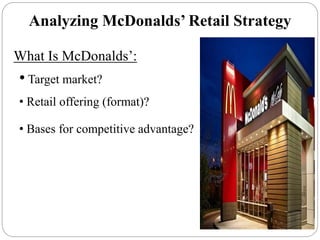
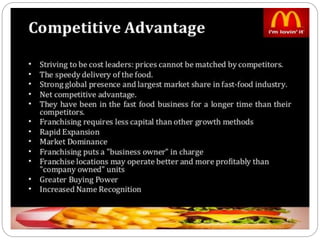
Analyzing McDonalds’ Retail Strategy
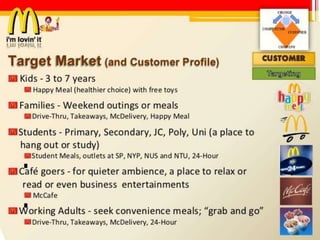
What Is McDonalds’:
• Target market?
• Retail offering (format)?
• Bases for competitive advantage?
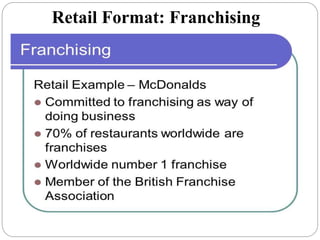
Retail Format: Franchising
5-9
Why Does a Retailer Need to
Focus on a
Specific Target Market?
Why Not Sell to Everyone?
Target Market and Retail Format
 The retailing concept focuses a retailer on
determining the needs of its target market and
satisfying those needs.
 The selection of target market concentrates
the retailer on a group of consumers whose
needs it will satisfy.
 The retail format outlines the retail mix to be
used to satisfy the needs of those customers.
 The retail market is a group of consumers with
5-11
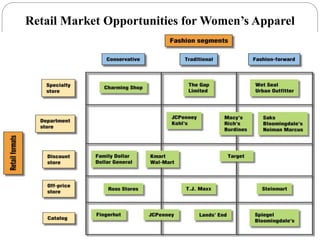
Retail Market Opportunities for Women’s Apparel
 Any business activity that a retailer engages
in can be the basis for a competitive
advantage.
 Some advantages can be sustainable over a
long period of time.
 E.g. Its hard for retailers to develop a long
term advantage by offering deeper
assortments.
 Establishing a competitive advantage means
that a retailer builds a wall around its position
in a retail market.
Building a Sustainable Competitive Advantage
1. Customer loyalty
2. Location
3. Human Resource Management
4. Distribution and Information systems
5. Unique merchandise
6. Vendor relations
7. Customer service
Building a Sustainable Competitive Advantage
 Customer loyalty means that customers
are committed to buying merchandise and
services from a particular retailer.
 Having dedicated employees, unique
merchandise and superior customer service
helps to build a loyal customer base.
 Loyalty means that the customer will be
reluctant to patronize competitive retailers.
1. Customer Loyalty
 Developing a strong brand for the store or
store brands.
 Developing a precise positioning
strategies.
 Creating an emotional attachment with
customers
through loyalty programs.
Ways of building customer loyalty
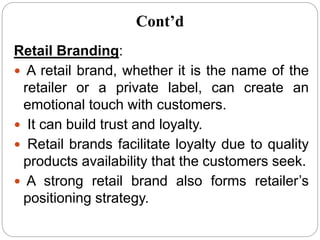
Retail Branding:
 A retail brand, whether it is the name of the
retailer or a private label, can create an
emotional touch with customers.
 It can build trust and loyalty.
 Retail brands facilitate loyalty due to quality
products availability that the customers seek.
 A strong retail brand also forms retailer’s
positioning strategy.
Cont’d
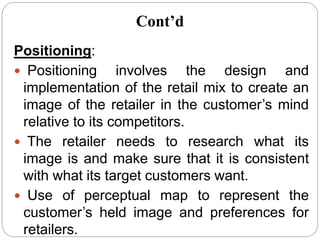
Positioning:
 Positioning involves the design and
implementation of the retail mix to create an
image of the retailer in the customer’s mind
relative to its competitors.
 The retailer needs to research what its
image is and make sure that it is consistent
with what its target customers want.
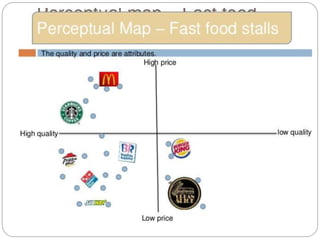
 Use of perceptual map to represent the
customer’s held image and preferences for
retailers.
Cont’d
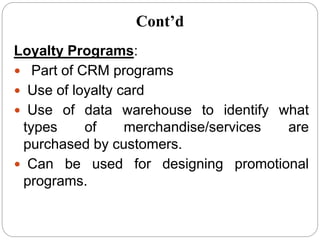
Loyalty Programs:
 Part of CRM programs
 Use of loyalty card
 Use of data warehouse to identify what
types of merchandise/services are
purchased by customers.
 Can be used for designing promotional
programs.
Cont’d
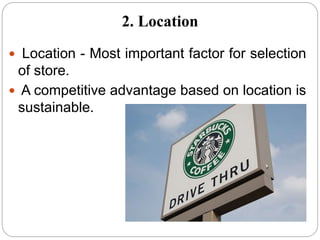
 Location - Most important factor for selection
of store.
 A competitive advantage based on location is
sustainable.
2. Location
 Employees play a major role in providing
services.
 Knowledgeable and skilled employees are
the assets.
 Sustainable competitive advantage can be
gained by:
 motivating employees
 fostering positive organizational culture
 providing appropriate incentives
 managing diversity.
3. Human Resource Management
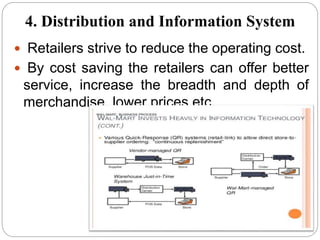
 Retailers strive to reduce the operating cost.
 By cost saving the retailers can offer better
service, increase the breadth and depth of
merchandise, lower prices etc.
4. Distribution and Information System
 Difficult to develop a competitive advantage
through merchandise.
 Private label brands (store brands.)
5. Unique Merchandise
6. Vendor Relations
 Obtain special terms of purchase due to
good relations.
 Receive popular merchandise in short
supply.
 By offering excellent customer services,
sustainable competitive advantage can be built.
 Consistent service is difficult.
 Quality of service can vary from person to
person and from day to day.
 Coaching and Training can help to offer good
service.
 Once a retailer has earned a service reputation,
it can sustain for long time.
7. Customer Service
Multiple Sources of Advantage
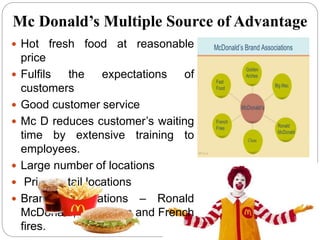
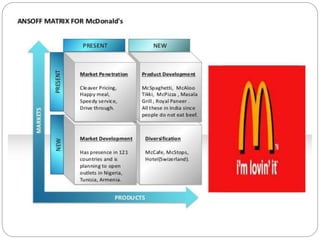
Mc Donald’s Multiple Source of Advantage
 Hot fresh food at reasonable
price
 Fulfils the expectations of
customers
 Good customer service
 Mc D reduces customer’s waiting
time by extensive training to
employees.
 Large number of locations
 Prime retail locations
 Brand Associations – Ronald
McDonald, fast, clean and French
fires.
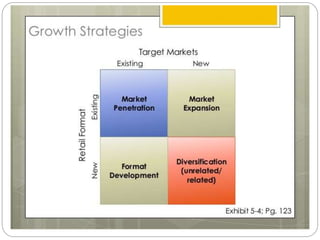
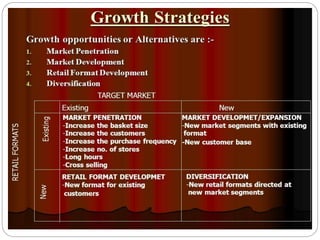
Market Penetration
• A market penetration growth opportunity involves
realizing growth by directing efforts towards existing
customers using the retailer’s present retailing format.
• Involves either attracting consumers from its current
target market who don’t patronize the retailer currently.
• Devise approaches that get current customers to visit the
retailer more often or buy more merchandise.
Market Penetration: Cont’d
Market Penetration approach includes:
• Opening more stores in the target market
• Keeping existing stores open for longer hours
• Displaying merchandise to increase impulse purchases
• Increase the quantity purchased by the customers
• Cross-selling
• Cross-selling means that sales associates in one department
attempt to sell complementary merchandise from other
departments.
• This strategy is the least risky as it leverages firms
resources and capabilities.
Market Expansion
• A market expansion growth opportunity involves using
the existing retail format in new market segments.
• Retail format remains same but merchandise may vary.
• This strategy involves:
- tapping new geographical markets.
- introducing new products to the existing range that
appeal to a wider audience.
• E.g. Mc D stores in various nations
• Carrefour stores in European and South American
countries.
Cont’d
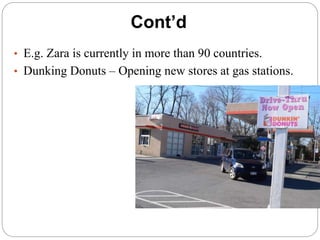
• E.g. Zara is currently in more than 90 countries.
• Dunking Donuts – Opening new stores at gas stations.
Retail Format Development
• It is a growth opportunity which a retailer develops a
new retail format – a format with a different retail mix –
for the same target market.
• For example, Amazon.com began selling electronic
items such as CDs, videos, pen drives and other
electronic items in addition to books and literature.
• In India, ‘Big Bazaar’, a leading retailer started
providing home services like plumber, electrician,
furniture, kitchen interiors besides general merchandise.
(Hometown)
• A store chain starting e-retailing is an example of new
retail format development.
Diversification
• A diversification growth opportunity is one in which a
retailer introduces a new retail format directed toward a
market segment that is not currently served by the
retailer.
• Diversification opportunities are either related or
unrelated.
• Related Diversification
• Unrelated Diversification
• Vertical Integration
Diversification: Cont’d
• In a related diversification, the retailer’s present target market or
retail format shares something in common with the new
opportunity.
• E.g. Purchasing from same vendors, operating in similar locations
using the same distribution system, or advertising in the same
newspapers to similar target markets.
• In unrelated diversification, there is no commonality between the
present business and the new business and it is risky.
• Subhiksha selling mobile phones which was selling grocery items.
Vertical Integration
• It is a diversification by retailers into wholesaling or
manufacturing.
• When retailers enter into manufacturing, they are making
risky investments.
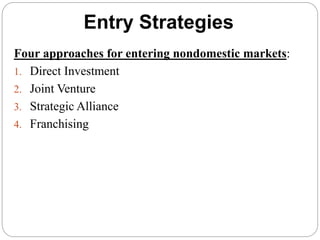
Entry Strategies
Four approaches for entering nondomestic markets:
1. Direct Investment
2. Joint Venture
3. Strategic Alliance
4. Franchising
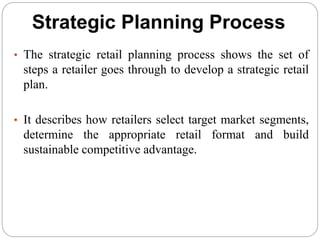
Strategic Planning Process
• The strategic retail planning process shows the set of
steps a retailer goes through to develop a strategic retail
plan.
• It describes how retailers select target market segments,
determine the appropriate retail format and build
sustainable competitive advantage.
5-41
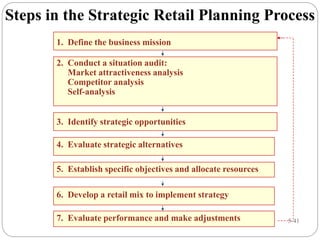
Steps in the Strategic Retail Planning Process
1. Define the business mission
2. Conduct a situation audit:
Market attractiveness analysis
Competitor analysis
Self-analysis
3. Identify strategic opportunities
5. Establish specific objectives and allocate resources
7. Evaluate performance and make adjustments
6. Develop a retail mix to implement strategy
4. Evaluate strategic alternatives
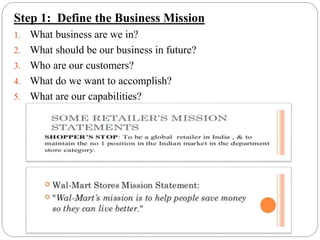
Step 1: Define the Business Mission
1. What business are we in?
2. What should be our business in future?
3. Who are our customers?
4. What do we want to accomplish?
5. What are our capabilities?
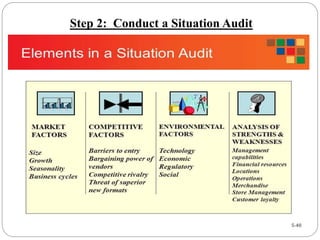
Step 2: Conduct a Situation Audit
 Market size, typically measures in retail
sales, indicates a retailer’s opportunity to
generate revenues to cover its investment.
 Large markets are attractive to large retail
firms but also to small entrepreneurs.
 Growing markets are attractive than mature
or declining markets.
 Markets with highly seasonal sales are
unattractive because a lot of resources are
needed during peak time.
 E.g. Resorts, food restaurants, Tours and
Market Factors
 Market dominated by large competitors with
scale economies are typically unattractive.
 Such firms have cost advantages as they
can buy merchandise cheaper and operate
more efficiently.
 Retail markets dominated by a well
established retailer that has developed a
loyal group of customers are also
unattractive.
 Availability of locations may impede
competitive entry.
Competitive Factors
 Competitive rivalry defines the frequency
and intensity of reactions to actions taken by
competitors.
 When rivalry is high, price wars erupt,
advertising and promotion expenses
increase and profit potential falls.
 Conditions leading to intense rivalry:
1. Large no. of competitors of same size
2. Slow growth
3. High cost
4. Lack of perceived differences between
Cont’d
 When a retail market is going through
significant changes in technology, existing
competitors can be attacked by new
entrants.
 Economic conditions also affect few retailers.
E.g. When unemployment is low, the
retailers cost may increase as salespeople’s
salary may rise due to difficulty of hiring
qualified people.
 Regulatory changes also affects the
retailers.
Environmental Factors
5-48
Strengths and Weaknesses Analysis: Elements
• Management Capability
• Financial Resources – Cash flow, ability to raise funds
• Operations (Distribution capabilities, MIS, Inventory
control system, Loss prevention systems)
• Merchandising Capabilities (Knowledge and skills of
buyers, Advertising and Promotion capabilities, Relations with
vendors, Capability to develop private label brands)
• Store Management Capabilities (Quality of sales associates,
commitment of sales associates)
• Locations
• Customers (Loyalty of customers)
5-49
Step 3: Identify Strategic Opportunities
• Market penetration
• Market Expansion
• Format development
• Diversification
5-50
Step 4: Evaluate Strategic Opportunities
• The evaluation determines the retailer’s potential to
establish a sustainable competitive advantage.
• Retailer must focus on opportunities that utilize its
strengths and its competitive advantages.
• The market attractiveness and competitive position must
be considered in evaluation of growth opportunity.
5-51
Step 5: Establish specific objectives
1. The performance sought, including a numerical index
against which progress may be measured.
2. A time frame within which the goal is to be achieved
3. Level of investment needed to achieve the objective.
THANK
YOU

Retail Ch.5.ppt

  • 1.
  • 2.
    Retail Strategy Three importantelements of Retail Strategy: (1) the retailer’s target market, (2) the format the retailer plans to use to satisfy the target market’s needs, and (3) the bases upon which the retailer plans to build a sustainable competitive advantage.
  • 3.
    Cont’d • The targetmarket is the market segment(s) toward which the retailer plans to focus its resources and retail mix. • A retail format suggests the type of retail mix (merchandise, services, pricing policy, advertising and promotion program, store design, location etc) used by the retailer to satisfy needs of target market. • A sustainable competitive advantage is an advantage over the competition that is not easily copied and thus can be maintained over a long period of time.
  • 5.
    5-5 Analyzing McDonalds’ RetailStrategy What Is McDonalds’: • Target market? • Retail offering (format)? • Bases for competitive advantage?
  • 7.
  • 9.
    5-9 Why Does aRetailer Need to Focus on a Specific Target Market? Why Not Sell to Everyone?
  • 10.
    Target Market andRetail Format  The retailing concept focuses a retailer on determining the needs of its target market and satisfying those needs.  The selection of target market concentrates the retailer on a group of consumers whose needs it will satisfy.  The retail format outlines the retail mix to be used to satisfy the needs of those customers.  The retail market is a group of consumers with
  • 11.
    5-11 Retail Market Opportunitiesfor Women’s Apparel
  • 12.
     Any businessactivity that a retailer engages in can be the basis for a competitive advantage.  Some advantages can be sustainable over a long period of time.  E.g. Its hard for retailers to develop a long term advantage by offering deeper assortments.  Establishing a competitive advantage means that a retailer builds a wall around its position in a retail market. Building a Sustainable Competitive Advantage
  • 13.
    1. Customer loyalty 2.Location 3. Human Resource Management 4. Distribution and Information systems 5. Unique merchandise 6. Vendor relations 7. Customer service Building a Sustainable Competitive Advantage
  • 14.
     Customer loyaltymeans that customers are committed to buying merchandise and services from a particular retailer.  Having dedicated employees, unique merchandise and superior customer service helps to build a loyal customer base.  Loyalty means that the customer will be reluctant to patronize competitive retailers. 1. Customer Loyalty
  • 15.
     Developing astrong brand for the store or store brands.  Developing a precise positioning strategies.  Creating an emotional attachment with customers through loyalty programs. Ways of building customer loyalty
  • 16.
    Retail Branding:  Aretail brand, whether it is the name of the retailer or a private label, can create an emotional touch with customers.  It can build trust and loyalty.  Retail brands facilitate loyalty due to quality products availability that the customers seek.  A strong retail brand also forms retailer’s positioning strategy. Cont’d
  • 17.
    Positioning:  Positioning involvesthe design and implementation of the retail mix to create an image of the retailer in the customer’s mind relative to its competitors.  The retailer needs to research what its image is and make sure that it is consistent with what its target customers want.  Use of perceptual map to represent the customer’s held image and preferences for retailers. Cont’d
  • 19.
    Loyalty Programs:  Partof CRM programs  Use of loyalty card  Use of data warehouse to identify what types of merchandise/services are purchased by customers.  Can be used for designing promotional programs. Cont’d
  • 20.
     Location -Most important factor for selection of store.  A competitive advantage based on location is sustainable. 2. Location
  • 21.
     Employees playa major role in providing services.  Knowledgeable and skilled employees are the assets.  Sustainable competitive advantage can be gained by:  motivating employees  fostering positive organizational culture  providing appropriate incentives  managing diversity. 3. Human Resource Management
  • 22.
     Retailers striveto reduce the operating cost.  By cost saving the retailers can offer better service, increase the breadth and depth of merchandise, lower prices etc. 4. Distribution and Information System
  • 23.
     Difficult todevelop a competitive advantage through merchandise.  Private label brands (store brands.) 5. Unique Merchandise 6. Vendor Relations  Obtain special terms of purchase due to good relations.  Receive popular merchandise in short supply.
  • 24.
     By offeringexcellent customer services, sustainable competitive advantage can be built.  Consistent service is difficult.  Quality of service can vary from person to person and from day to day.  Coaching and Training can help to offer good service.  Once a retailer has earned a service reputation, it can sustain for long time. 7. Customer Service Multiple Sources of Advantage
  • 26.
    Mc Donald’s MultipleSource of Advantage  Hot fresh food at reasonable price  Fulfils the expectations of customers  Good customer service  Mc D reduces customer’s waiting time by extensive training to employees.  Large number of locations  Prime retail locations  Brand Associations – Ronald McDonald, fast, clean and French fires.
  • 28.
    Market Penetration • Amarket penetration growth opportunity involves realizing growth by directing efforts towards existing customers using the retailer’s present retailing format. • Involves either attracting consumers from its current target market who don’t patronize the retailer currently. • Devise approaches that get current customers to visit the retailer more often or buy more merchandise.
  • 29.
    Market Penetration: Cont’d MarketPenetration approach includes: • Opening more stores in the target market • Keeping existing stores open for longer hours • Displaying merchandise to increase impulse purchases • Increase the quantity purchased by the customers • Cross-selling • Cross-selling means that sales associates in one department attempt to sell complementary merchandise from other departments. • This strategy is the least risky as it leverages firms resources and capabilities.
  • 30.
    Market Expansion • Amarket expansion growth opportunity involves using the existing retail format in new market segments. • Retail format remains same but merchandise may vary. • This strategy involves: - tapping new geographical markets. - introducing new products to the existing range that appeal to a wider audience. • E.g. Mc D stores in various nations • Carrefour stores in European and South American countries.
  • 31.
    Cont’d • E.g. Zarais currently in more than 90 countries. • Dunking Donuts – Opening new stores at gas stations.
  • 32.
    Retail Format Development •It is a growth opportunity which a retailer develops a new retail format – a format with a different retail mix – for the same target market. • For example, Amazon.com began selling electronic items such as CDs, videos, pen drives and other electronic items in addition to books and literature. • In India, ‘Big Bazaar’, a leading retailer started providing home services like plumber, electrician, furniture, kitchen interiors besides general merchandise. (Hometown) • A store chain starting e-retailing is an example of new retail format development.
  • 34.
    Diversification • A diversificationgrowth opportunity is one in which a retailer introduces a new retail format directed toward a market segment that is not currently served by the retailer. • Diversification opportunities are either related or unrelated. • Related Diversification • Unrelated Diversification • Vertical Integration
  • 35.
    Diversification: Cont’d • Ina related diversification, the retailer’s present target market or retail format shares something in common with the new opportunity. • E.g. Purchasing from same vendors, operating in similar locations using the same distribution system, or advertising in the same newspapers to similar target markets. • In unrelated diversification, there is no commonality between the present business and the new business and it is risky. • Subhiksha selling mobile phones which was selling grocery items.
  • 36.
    Vertical Integration • Itis a diversification by retailers into wholesaling or manufacturing. • When retailers enter into manufacturing, they are making risky investments.
  • 39.
    Entry Strategies Four approachesfor entering nondomestic markets: 1. Direct Investment 2. Joint Venture 3. Strategic Alliance 4. Franchising
  • 40.
    Strategic Planning Process •The strategic retail planning process shows the set of steps a retailer goes through to develop a strategic retail plan. • It describes how retailers select target market segments, determine the appropriate retail format and build sustainable competitive advantage.
  • 41.
    5-41 Steps in theStrategic Retail Planning Process 1. Define the business mission 2. Conduct a situation audit: Market attractiveness analysis Competitor analysis Self-analysis 3. Identify strategic opportunities 5. Establish specific objectives and allocate resources 7. Evaluate performance and make adjustments 6. Develop a retail mix to implement strategy 4. Evaluate strategic alternatives
  • 42.
    Step 1: Definethe Business Mission 1. What business are we in? 2. What should be our business in future? 3. Who are our customers? 4. What do we want to accomplish? 5. What are our capabilities?
  • 43.
    Step 2: Conducta Situation Audit
  • 44.
     Market size,typically measures in retail sales, indicates a retailer’s opportunity to generate revenues to cover its investment.  Large markets are attractive to large retail firms but also to small entrepreneurs.  Growing markets are attractive than mature or declining markets.  Markets with highly seasonal sales are unattractive because a lot of resources are needed during peak time.  E.g. Resorts, food restaurants, Tours and Market Factors
  • 45.
     Market dominatedby large competitors with scale economies are typically unattractive.  Such firms have cost advantages as they can buy merchandise cheaper and operate more efficiently.  Retail markets dominated by a well established retailer that has developed a loyal group of customers are also unattractive.  Availability of locations may impede competitive entry. Competitive Factors
  • 46.
     Competitive rivalrydefines the frequency and intensity of reactions to actions taken by competitors.  When rivalry is high, price wars erupt, advertising and promotion expenses increase and profit potential falls.  Conditions leading to intense rivalry: 1. Large no. of competitors of same size 2. Slow growth 3. High cost 4. Lack of perceived differences between Cont’d
  • 47.
     When aretail market is going through significant changes in technology, existing competitors can be attacked by new entrants.  Economic conditions also affect few retailers. E.g. When unemployment is low, the retailers cost may increase as salespeople’s salary may rise due to difficulty of hiring qualified people.  Regulatory changes also affects the retailers. Environmental Factors
  • 48.
    5-48 Strengths and WeaknessesAnalysis: Elements • Management Capability • Financial Resources – Cash flow, ability to raise funds • Operations (Distribution capabilities, MIS, Inventory control system, Loss prevention systems) • Merchandising Capabilities (Knowledge and skills of buyers, Advertising and Promotion capabilities, Relations with vendors, Capability to develop private label brands) • Store Management Capabilities (Quality of sales associates, commitment of sales associates) • Locations • Customers (Loyalty of customers)
  • 49.
    5-49 Step 3: IdentifyStrategic Opportunities • Market penetration • Market Expansion • Format development • Diversification
  • 50.
    5-50 Step 4: EvaluateStrategic Opportunities • The evaluation determines the retailer’s potential to establish a sustainable competitive advantage. • Retailer must focus on opportunities that utilize its strengths and its competitive advantages. • The market attractiveness and competitive position must be considered in evaluation of growth opportunity.
  • 51.
    5-51 Step 5: Establishspecific objectives 1. The performance sought, including a numerical index against which progress may be measured. 2. A time frame within which the goal is to be achieved 3. Level of investment needed to achieve the objective.
  • 52.