WHAT IS A RETAIL
STRATEGY?
Strategy
- is frequently use in
retailing.
- is used to commonly it
appears that all retailing
decisions are strategic
decisions.
Retail strategy
is a statement identifying the retailer’s
target market’s, the format the retailer plans to use
to satisfy the target market’s needs and the bases
upon which the retailer plans to build a
sustainable competitive advantage.
Target market
is the market segment toward which the
retailer plans to focus its resources and retail
mix.
Retail format
-suggests the type of retail mix (nature
of merchandise and service offered, pricing
policy, advertising and promotion program,
approach to store design and visual
merchandising, typical location.
Sustainable competitive
advantage
is an advantage over the
competition that is not
easily copied and thus can
be maintained over a long
period of time.
TARGET MARKET AND RETAIL
FORMAT
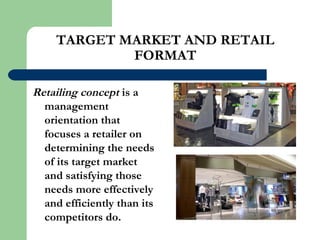
Retailing concept is a
management
orientation that
focuses a retailer on
determining the needs
of its target market
and satisfying those
needs more effectively
and efficiently than its
competitors do.
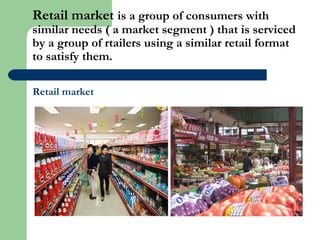
Retail market is a group of consumers with
similar needs ( a market segment ) that is serviced
by a group of rtailers using a similar retail format
to satisfy them.
Retail market
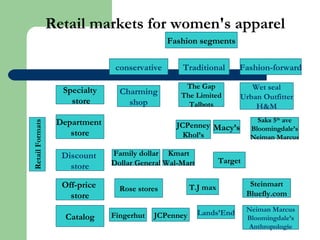
Retail markets for women's apparel
Fashion segments
conservative Traditional Fashion-forward
Specialty
store
Department
store
Discount
store
Off-price
store
Catalog
Charming
shop
The Gap
The Limited
Talbots
Wet seal
Urban Outfitter
H&M
JCPenney
Khol’s
Macy’s
Saks 5th
ave
Bloomingdale’s
Neiman Marcus
Family dollar
Dollar General
Kmart
Wal-Mart Target
Rose stores T.J max Steinmart
Bluefly.com
Fingerhut JCPenney Lands’End Neiman Marcus
Bloomingdale’s
Anthropologie
RetailFormats
BUILDING A SUSTAINABLE
COMPETITIVE ADVANTAGE
 The final element in a
retail strategy is the
retailer’s approach to
building a sustainable
competitive advantage.
Any business activity
that a retailer engages in
can be the basis for a
competitive advantage,
but some advantages are
sustainable over a long
period of time.
Seven important opportunities for retailers
to develop sustainable competitive
advantage
 Customer Loyalty
 Location
 Human resource management
 Distribution and information systems
 Unique merchandise
 Vendor relations
 Customer Service
Customer Loyalty
 Means that customers are committed to buying
merchandise and services from a particular
retailer.
 Other bases for sustainable competitive
advantage discussed in this section help attract
and maintain loyal customers.
 For instance, having dedicated employees,
unique merchandise, and superior customer
service all help solidify a loyal customer base.
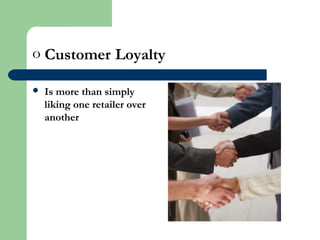
o Customer Loyalty
 Is more than simply
liking one retailer over
another
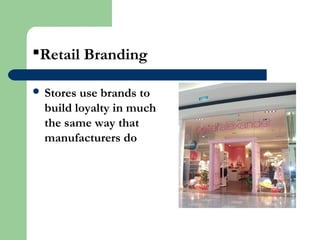
Retail Branding
 Stores use brands to
build loyalty in much
the same way that
manufacturers do
 Positioning
 A retailer builds customer loyalty by developing
a clear, distinctive image of its retail offering
and consistently reinforcing that image through
its merchandise and service.
 Involves the design and implementation of a
retail mix to create an image of the retailer in
the customer’s mind relative to its competitors.
 Loyalty Program
 Are part of an overall customer relationship
management program (CRM).
 Customer loyalty programs work hand-in-hand
with CRM. Members of loyalty programs are
identified when they buy because they use
some type of loyalty card.
 Their purchase information then is stored n a
huge database known as data warehouse.
Loyalty Program
 From this data
warehouse, analysts
determine what types
of merchandise and
services certain
groups of customers
are buying.
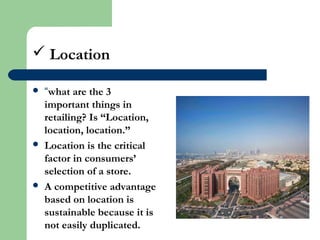
 Location
 “what are the 3
important things in
retailing? Is “Location,
location, location.”
 Location is the critical
factor in consumers’
selection of a store.
 A competitive advantage
based on location is
sustainable because it is
not easily duplicated.
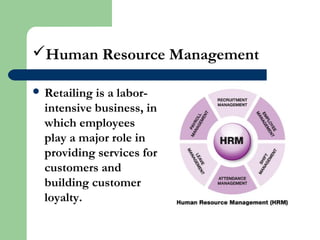
Human Resource Management
 Retailing is a labor-
intensive business, in
which employees
play a major role in
providing services for
customers and
building customer
loyalty.
Distribution and information systems
o All retailers strive to reduce operating costs-the
costs associated with running the business-and
make sure the merchandise that customers
want is available.
o Retailers achieve these efficiencies by
developing sophisticated distribution and
information systems and sharing information
with vendors.
Unique merchandise
 It is difficult for retailers to develop a
competitive advantage through merchandise
because most competitors can purchase and
sell the same popular national brands.
 Many retailers realize a sustainable competitive
advantage by developing Private Label Brands
(store brands), which are products developed
and marketed by a retailer and available only
from that retailer.
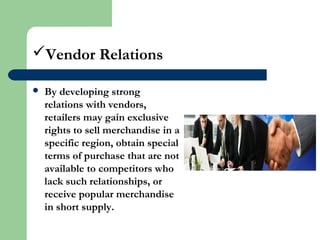
Vendor Relations
 By developing strong
relations with vendors,
retailers may gain exclusive
rights to sell merchandise in a
specific region, obtain special
terms of purchase that are not
available to competitors who
lack such relationships, or
receive popular merchandise
in short supply.
 Customer Service
 Retailers also can build a sustainable
competitive advantage by offering excellent
customer service. Offering good service
consistently is difficult because customer
service is provided by retail employees, and
humans are less consistent than machines.
 The quality of service can vary from person
to person and from day to day.
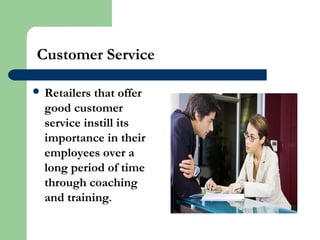
Customer Service
 Retailers that offer
good customer
service instill its
importance in their
employees over a
long period of time
through coaching
and training.
Multiple Sources of Advantage
To build a sustainable competitive
advantage, retailers typically don’t rely on
a single approach, such as low cost of
excellent service.
Instead, they need multiple approaches
to build as high a wall around their
position as possible.
Growth Strategies
Four types of growth opportunities that
retailers may pursue:
1. Market Penetration
2. Market Expansion
3. Retail Format Development
4. Diversification
1. Market Penetration
A market penetration growth opportunity
involves realizing growth by directing
efforts toward existing customers using
the retailer’s present retailing format.
Market penetration approaches include
opening more stores in the target market
keeping existing stores open for longer
hours.
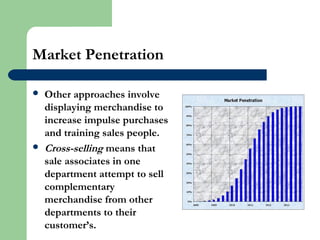
Market Penetration
 Other approaches involve
displaying merchandise to
increase impulse purchases
and training sales people.
 Cross-selling means that
sale associates in one
department attempt to sell
complementary
merchandise from other
departments to their
customer’s.
Market Penetration
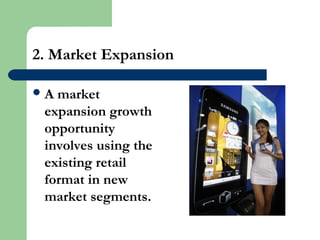
2. Market Expansion
A market
expansion growth
opportunity
involves using the
existing retail
format in new
market segments.
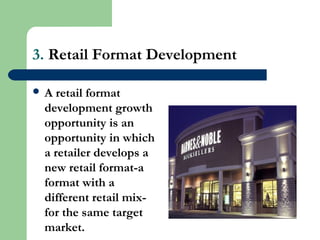
3. Retail Format Development
 A retail format
development growth
opportunity is an
opportunity in which
a retailer develops a
new retail format-a
format with a
different retail mix-
for the same target
market.
4. Diversification
 A diversification growth opportunity is one
in which a retailer introduces a new retail
format directed toward a market segment
that’s not currently served by the retailer.
 Diversification opportunities are either
related or unrelated
Related versus Unrelated
Diversification
 In a related diversification growth opportunity,
retailer’s present target market or retail format
shares something in common with the new
opportunity.
 Unrelated diversification lacks any
commonality between the present business and
the new business.
Vertical Integration
 Is diversification by retailers into wholesaling
or manufacturing.
 In addition, retailers and manufacturers have
different customers; the immediate customers
for a manufacturer’s merchandise are retailers,
whereas a retailer’s customers are consumers.
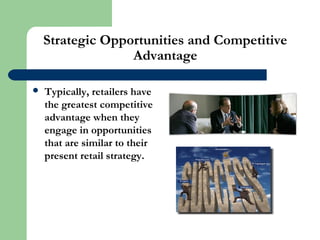
Strategic Opportunities and Competitive
Advantage
 Typically, retailers have
the greatest competitive
advantage when they
engage in opportunities
that are similar to their
present retail strategy.
Global Growth Opportunities
International expansion is a market
expansion growth opportunity that many
retailers find attractive. But international
expansion can be risky because retailers
must deal with different government
regulations, cultural traditions, supply
chain considerations, and languages.
Key to success
4 characteristics of retailers that have
successfully exploited international
growth opportunities:
a. A global sustainable competitive advantage
b. Adaptability
c. Global culture
d. Financial resources
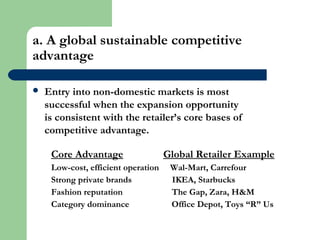
a. A global sustainable competitive
advantage
 Entry into non-domestic markets is most
successful when the expansion opportunity
is consistent with the retailer’s core bases of
competitive advantage.
Core Advantage Global Retailer Example
Low-cost, efficient operation Wal-Mart, Carrefour
Strong private brands IKEA, Starbucks
Fashion reputation The Gap, Zara, H&M
Category dominance Office Depot, Toys “R” Us
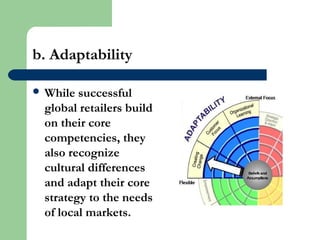
b. Adaptability
 While successful
global retailers build
on their core
competencies, they
also recognize
cultural differences
and adapt their core
strategy to the needs
of local markets.
C. Global culture
 To be global,
retailers must think
globally. It is not
sufficient to
transplant a home-
country culture and
infrastructure into
another country.
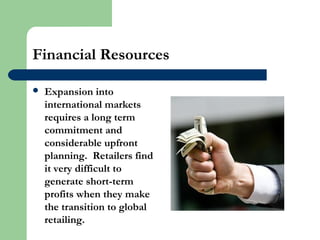
Financial Resources
 Expansion into
international markets
requires a long term
commitment and
considerable upfront
planning. Retailers find
it very difficult to
generate short-term
profits when they make
the transition to global
retailing.
Entry Strategies
 4 approaches that retailers can take when
entering nondomestic markets are:
1. Direct investment
2. Joint Venture
3. Strategic alliance
4. Franchising
1. Direct investment
 Involves a retail firm
investing in and owning
a division or subsidiary
that operates in a foreign
country. This entry
strategy requires the
highest level of
investment and exposes
the retailer to significant
risks, but is also has the
highest potential returns.
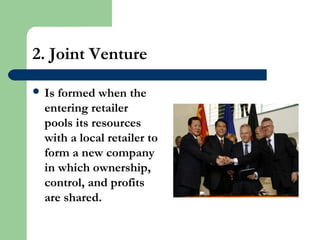
2. Joint Venture
 Is formed when the
entering retailer
pools its resources
with a local retailer to
form a new company
in which ownership,
control, and profits
are shared.
3. Strategic alliance
is a collaborate
relationship
between
independent
firms.
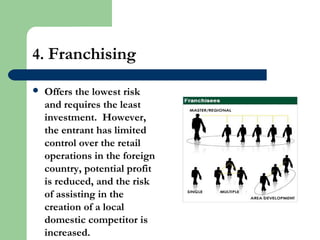
4. Franchising
 Offers the lowest risk
and requires the least
investment. However,
the entrant has limited
control over the retail
operations in the foreign
country, potential profit
is reduced, and the risk
of assisting in the
creation of a local
domestic competitor is
increased.
The Strategic Retail Planning Process
 Entails the set of steps a retailer goes through
to develop a strategic retail plan. It describes
how retailers select target market segments,
determine the appropriate retail format, and
build sustainable competitive advantages.
 The planning process can be used to formulate
strategic plans at different levels within a retail
corporation.
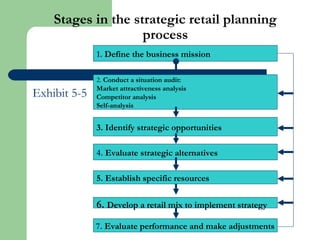
Stages in the strategic retail planning
process
Exhibit 5-5
1. Define the business mission
2. Conduct a situation audit:
Market attractiveness analysis
Competitor analysis
Self-analysis
3. Identify strategic opportunities
4. Evaluate strategic alternatives
5. Establish specific resources
6. Develop a retail mix to implement strategy
7. Evaluate performance and make adjustments
1. Define the business mission
 The first step in the strategic retail planning
process is to define the business mission.
 The mission statement is a broad description of
a retailers objectives and the scope of activities
it plans to undertake.
 The mission statement defines the general
nature of the target segments in retail formats
on which the firm will focus.
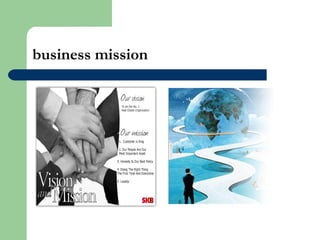
business mission
2. Conduct a situation audit
 After developing a mission statement and
setting objectives, the next step in the strategic
planning process is to conduct a situation
audit, an analysis of the opportunities and
threats in retail environment and the strengths
and weaknesses of the retail business relative to
its competitors.
Market Factors
 Some critical factors related to consumers and their
buying patterns and the target market size and growth,
sales cyclicity, and seasonality. Market size, typically
measured in retail sales dollars, is important because it
indicates a retailer’s opportunity to generate revenues
to cover its investment.
Competitive Factors
 The nature of the competition in retail
market is affective by barriers to entry, the
bargaining power or vendors, and
competitive rivalry.
 Barriers to entry institute condition in a
retail market that make it difficult for other
firms to enter the market, such as scale
economies, customer loyalty, and the
availability of great locations.
Competitive Factors
Scale economies are cost
advantages due to a retailer’s
size. Markets dominated by
large competitors with scale
economies are typically
unattractive.
Bargaining power of vendors
markets are less attractive
when only a few vendors
control the merchandise sold
in it.
Environmental Factors
 can affect market attractiveness span
technological, economic, regulatory, and social
changes.
 When a retail market is going through
significant changes in technology, existing
competitors are vulnerable to new entrants that
are skilled at using the new technology.
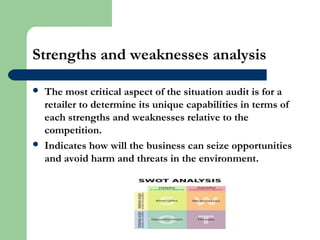
Strengths and weaknesses analysis
 The most critical aspect of the situation audit is for a
retailer to determine its unique capabilities in terms of
each strengths and weaknesses relative to the
competition.
 Indicates how will the business can seize opportunities
and avoid harm and threats in the environment.
3. Identify Strategic Opportunities
After completing the situation audit,
the next step is to identify
opportunities for increasing retail
sales. Kelly Bradford presently
competes in gift retailing using a
specialty store format.
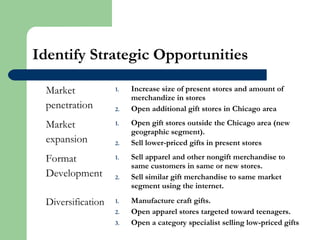
Identify Strategic Opportunities
Market
penetration
1. Increase size of present stores and amount of
merchandize in stores
2. Open additional gift stores in Chicago area
Market
expansion
1. Open gift stores outside the Chicago area (new
geographic segment).
2. Sell lower-priced gifts in present stores
Format
Development
1. Sell apparel and other nongift merchandise to
same customers in same or new stores.
2. Sell similar gift merchandise to same market
segment using the internet.
Diversification 1. Manufacture craft gifts.
2. Open apparel stores targeted toward teenagers.
3. Open a category specialist selling low-priced gifts
4. Evaluate Strategic Opportunities
 The 4th
step in the strategic planning progress is
to evaluate opportunities that have been
identified in the situation audit.
 The evaluation determines the retailer’s
potential to establish a sustainable competitive
advantage and reap long-term profits from the
opportunities being evaluated.
5. Establish specific objective and allocate
resources
 After evaluating the strategic investment
opportunities, the next step in the strategic
planning process is to establish a specific
objective for each opportunity.
 The retailer’s overall objective is included in
the mission statement; the specific objectives
are goals against which progress toward the
over all objective can be measured.
6. Develop a retail mix to implement
Strategy
 The 6th
step in the planning process is to
develop a retail mix for each opportunity in
which an investment will be made and control
and evaluate performance.
7. Evaluate Performance and Make
Adjustments
 The final step in the planning process is to
evaluate the results of the strategy and
implementation program.
 If the retailers is meeting or exceeding its
objectives, changes aren’t needed. But if the
retailer fails to meet its objectives, reanalysis is
required.
Thank you..

retail strategy

  • 1.
    WHAT IS ARETAIL STRATEGY? Strategy - is frequently use in retailing. - is used to commonly it appears that all retailing decisions are strategic decisions.
  • 2.
    Retail strategy is astatement identifying the retailer’s target market’s, the format the retailer plans to use to satisfy the target market’s needs and the bases upon which the retailer plans to build a sustainable competitive advantage. Target market is the market segment toward which the retailer plans to focus its resources and retail mix.
  • 3.
    Retail format -suggests thetype of retail mix (nature of merchandise and service offered, pricing policy, advertising and promotion program, approach to store design and visual merchandising, typical location. Sustainable competitive advantage is an advantage over the competition that is not easily copied and thus can be maintained over a long period of time.
  • 4.
    TARGET MARKET ANDRETAIL FORMAT Retailing concept is a management orientation that focuses a retailer on determining the needs of its target market and satisfying those needs more effectively and efficiently than its competitors do.
  • 5.
    Retail market isa group of consumers with similar needs ( a market segment ) that is serviced by a group of rtailers using a similar retail format to satisfy them. Retail market
  • 6.
    Retail markets forwomen's apparel Fashion segments conservative Traditional Fashion-forward Specialty store Department store Discount store Off-price store Catalog Charming shop The Gap The Limited Talbots Wet seal Urban Outfitter H&M JCPenney Khol’s Macy’s Saks 5th ave Bloomingdale’s Neiman Marcus Family dollar Dollar General Kmart Wal-Mart Target Rose stores T.J max Steinmart Bluefly.com Fingerhut JCPenney Lands’End Neiman Marcus Bloomingdale’s Anthropologie RetailFormats
  • 7.
    BUILDING A SUSTAINABLE COMPETITIVEADVANTAGE  The final element in a retail strategy is the retailer’s approach to building a sustainable competitive advantage. Any business activity that a retailer engages in can be the basis for a competitive advantage, but some advantages are sustainable over a long period of time.
  • 8.
    Seven important opportunitiesfor retailers to develop sustainable competitive advantage  Customer Loyalty  Location  Human resource management  Distribution and information systems  Unique merchandise  Vendor relations  Customer Service
  • 9.
    Customer Loyalty  Meansthat customers are committed to buying merchandise and services from a particular retailer.  Other bases for sustainable competitive advantage discussed in this section help attract and maintain loyal customers.  For instance, having dedicated employees, unique merchandise, and superior customer service all help solidify a loyal customer base.
  • 10.
    o Customer Loyalty Is more than simply liking one retailer over another
  • 11.
    Retail Branding  Storesuse brands to build loyalty in much the same way that manufacturers do
  • 12.
     Positioning  Aretailer builds customer loyalty by developing a clear, distinctive image of its retail offering and consistently reinforcing that image through its merchandise and service.  Involves the design and implementation of a retail mix to create an image of the retailer in the customer’s mind relative to its competitors.
  • 13.
     Loyalty Program Are part of an overall customer relationship management program (CRM).  Customer loyalty programs work hand-in-hand with CRM. Members of loyalty programs are identified when they buy because they use some type of loyalty card.  Their purchase information then is stored n a huge database known as data warehouse.
  • 14.
    Loyalty Program  Fromthis data warehouse, analysts determine what types of merchandise and services certain groups of customers are buying.
  • 15.
     Location  “whatare the 3 important things in retailing? Is “Location, location, location.”  Location is the critical factor in consumers’ selection of a store.  A competitive advantage based on location is sustainable because it is not easily duplicated.
  • 16.
    Human Resource Management Retailing is a labor- intensive business, in which employees play a major role in providing services for customers and building customer loyalty.
  • 17.
    Distribution and informationsystems o All retailers strive to reduce operating costs-the costs associated with running the business-and make sure the merchandise that customers want is available. o Retailers achieve these efficiencies by developing sophisticated distribution and information systems and sharing information with vendors.
  • 18.
    Unique merchandise  Itis difficult for retailers to develop a competitive advantage through merchandise because most competitors can purchase and sell the same popular national brands.  Many retailers realize a sustainable competitive advantage by developing Private Label Brands (store brands), which are products developed and marketed by a retailer and available only from that retailer.
  • 19.
    Vendor Relations  Bydeveloping strong relations with vendors, retailers may gain exclusive rights to sell merchandise in a specific region, obtain special terms of purchase that are not available to competitors who lack such relationships, or receive popular merchandise in short supply.
  • 20.
     Customer Service Retailers also can build a sustainable competitive advantage by offering excellent customer service. Offering good service consistently is difficult because customer service is provided by retail employees, and humans are less consistent than machines.  The quality of service can vary from person to person and from day to day.
  • 21.
    Customer Service  Retailersthat offer good customer service instill its importance in their employees over a long period of time through coaching and training.
  • 22.
    Multiple Sources ofAdvantage To build a sustainable competitive advantage, retailers typically don’t rely on a single approach, such as low cost of excellent service. Instead, they need multiple approaches to build as high a wall around their position as possible.
  • 23.
    Growth Strategies Four typesof growth opportunities that retailers may pursue: 1. Market Penetration 2. Market Expansion 3. Retail Format Development 4. Diversification
  • 24.
    1. Market Penetration Amarket penetration growth opportunity involves realizing growth by directing efforts toward existing customers using the retailer’s present retailing format. Market penetration approaches include opening more stores in the target market keeping existing stores open for longer hours.
  • 25.
    Market Penetration  Otherapproaches involve displaying merchandise to increase impulse purchases and training sales people.  Cross-selling means that sale associates in one department attempt to sell complementary merchandise from other departments to their customer’s. Market Penetration
  • 26.
    2. Market Expansion Amarket expansion growth opportunity involves using the existing retail format in new market segments.
  • 27.
    3. Retail FormatDevelopment  A retail format development growth opportunity is an opportunity in which a retailer develops a new retail format-a format with a different retail mix- for the same target market.
  • 28.
    4. Diversification  Adiversification growth opportunity is one in which a retailer introduces a new retail format directed toward a market segment that’s not currently served by the retailer.  Diversification opportunities are either related or unrelated
  • 29.
    Related versus Unrelated Diversification In a related diversification growth opportunity, retailer’s present target market or retail format shares something in common with the new opportunity.  Unrelated diversification lacks any commonality between the present business and the new business.
  • 30.
    Vertical Integration  Isdiversification by retailers into wholesaling or manufacturing.  In addition, retailers and manufacturers have different customers; the immediate customers for a manufacturer’s merchandise are retailers, whereas a retailer’s customers are consumers.
  • 31.
    Strategic Opportunities andCompetitive Advantage  Typically, retailers have the greatest competitive advantage when they engage in opportunities that are similar to their present retail strategy.
  • 32.
    Global Growth Opportunities Internationalexpansion is a market expansion growth opportunity that many retailers find attractive. But international expansion can be risky because retailers must deal with different government regulations, cultural traditions, supply chain considerations, and languages.
  • 33.
    Key to success 4characteristics of retailers that have successfully exploited international growth opportunities: a. A global sustainable competitive advantage b. Adaptability c. Global culture d. Financial resources
  • 34.
    a. A globalsustainable competitive advantage  Entry into non-domestic markets is most successful when the expansion opportunity is consistent with the retailer’s core bases of competitive advantage. Core Advantage Global Retailer Example Low-cost, efficient operation Wal-Mart, Carrefour Strong private brands IKEA, Starbucks Fashion reputation The Gap, Zara, H&M Category dominance Office Depot, Toys “R” Us
  • 35.
    b. Adaptability  Whilesuccessful global retailers build on their core competencies, they also recognize cultural differences and adapt their core strategy to the needs of local markets.
  • 36.
    C. Global culture To be global, retailers must think globally. It is not sufficient to transplant a home- country culture and infrastructure into another country.
  • 37.
    Financial Resources  Expansioninto international markets requires a long term commitment and considerable upfront planning. Retailers find it very difficult to generate short-term profits when they make the transition to global retailing.
  • 38.
    Entry Strategies  4approaches that retailers can take when entering nondomestic markets are: 1. Direct investment 2. Joint Venture 3. Strategic alliance 4. Franchising
  • 39.
    1. Direct investment Involves a retail firm investing in and owning a division or subsidiary that operates in a foreign country. This entry strategy requires the highest level of investment and exposes the retailer to significant risks, but is also has the highest potential returns.
  • 40.
    2. Joint Venture Is formed when the entering retailer pools its resources with a local retailer to form a new company in which ownership, control, and profits are shared.
  • 41.
    3. Strategic alliance isa collaborate relationship between independent firms.
  • 42.
    4. Franchising  Offersthe lowest risk and requires the least investment. However, the entrant has limited control over the retail operations in the foreign country, potential profit is reduced, and the risk of assisting in the creation of a local domestic competitor is increased.
  • 43.
    The Strategic RetailPlanning Process  Entails the set of steps a retailer goes through to develop a strategic retail plan. It describes how retailers select target market segments, determine the appropriate retail format, and build sustainable competitive advantages.  The planning process can be used to formulate strategic plans at different levels within a retail corporation.
  • 44.
    Stages in thestrategic retail planning process Exhibit 5-5 1. Define the business mission 2. Conduct a situation audit: Market attractiveness analysis Competitor analysis Self-analysis 3. Identify strategic opportunities 4. Evaluate strategic alternatives 5. Establish specific resources 6. Develop a retail mix to implement strategy 7. Evaluate performance and make adjustments
  • 45.
    1. Define thebusiness mission  The first step in the strategic retail planning process is to define the business mission.  The mission statement is a broad description of a retailers objectives and the scope of activities it plans to undertake.  The mission statement defines the general nature of the target segments in retail formats on which the firm will focus.
  • 46.
  • 47.
    2. Conduct asituation audit  After developing a mission statement and setting objectives, the next step in the strategic planning process is to conduct a situation audit, an analysis of the opportunities and threats in retail environment and the strengths and weaknesses of the retail business relative to its competitors.
  • 48.
    Market Factors  Somecritical factors related to consumers and their buying patterns and the target market size and growth, sales cyclicity, and seasonality. Market size, typically measured in retail sales dollars, is important because it indicates a retailer’s opportunity to generate revenues to cover its investment.
  • 49.
    Competitive Factors  Thenature of the competition in retail market is affective by barriers to entry, the bargaining power or vendors, and competitive rivalry.  Barriers to entry institute condition in a retail market that make it difficult for other firms to enter the market, such as scale economies, customer loyalty, and the availability of great locations.
  • 50.
    Competitive Factors Scale economiesare cost advantages due to a retailer’s size. Markets dominated by large competitors with scale economies are typically unattractive. Bargaining power of vendors markets are less attractive when only a few vendors control the merchandise sold in it.
  • 51.
    Environmental Factors  canaffect market attractiveness span technological, economic, regulatory, and social changes.  When a retail market is going through significant changes in technology, existing competitors are vulnerable to new entrants that are skilled at using the new technology.
  • 52.
    Strengths and weaknessesanalysis  The most critical aspect of the situation audit is for a retailer to determine its unique capabilities in terms of each strengths and weaknesses relative to the competition.  Indicates how will the business can seize opportunities and avoid harm and threats in the environment.
  • 53.
    3. Identify StrategicOpportunities After completing the situation audit, the next step is to identify opportunities for increasing retail sales. Kelly Bradford presently competes in gift retailing using a specialty store format.
  • 54.
    Identify Strategic Opportunities Market penetration 1.Increase size of present stores and amount of merchandize in stores 2. Open additional gift stores in Chicago area Market expansion 1. Open gift stores outside the Chicago area (new geographic segment). 2. Sell lower-priced gifts in present stores Format Development 1. Sell apparel and other nongift merchandise to same customers in same or new stores. 2. Sell similar gift merchandise to same market segment using the internet. Diversification 1. Manufacture craft gifts. 2. Open apparel stores targeted toward teenagers. 3. Open a category specialist selling low-priced gifts
  • 55.
    4. Evaluate StrategicOpportunities  The 4th step in the strategic planning progress is to evaluate opportunities that have been identified in the situation audit.  The evaluation determines the retailer’s potential to establish a sustainable competitive advantage and reap long-term profits from the opportunities being evaluated.
  • 56.
    5. Establish specificobjective and allocate resources  After evaluating the strategic investment opportunities, the next step in the strategic planning process is to establish a specific objective for each opportunity.  The retailer’s overall objective is included in the mission statement; the specific objectives are goals against which progress toward the over all objective can be measured.
  • 57.
    6. Develop aretail mix to implement Strategy  The 6th step in the planning process is to develop a retail mix for each opportunity in which an investment will be made and control and evaluate performance.
  • 58.
    7. Evaluate Performanceand Make Adjustments  The final step in the planning process is to evaluate the results of the strategy and implementation program.  If the retailers is meeting or exceeding its objectives, changes aren’t needed. But if the retailer fails to meet its objectives, reanalysis is required.
  • 59.