Global Retailing Scenario   &  Its Future By: Varun modi  ROLL NO. 4472
IN TRODUCTION TO RETAILING Retailing  consists of the  sale  of goods or merchandise for personal or household  consumption  either from a fixed location such as a shopping mall or store, or from a fixed location and related subordinated services.  In  commerce , a retailer buys goods or  products  in large quantities from  manufacturers  or  importers , either directly or through a  wholesaler , and then sells individual items or small quantities to the general public or end-user  customers , usually in a shop, also called a store.  Retailers are at the end of the  supply chain .  Marketers  see retailing as part of their overall  distribution  strategy.
Retail comes from the French word  retaillier  which refers to "cutting off, clip and divide" in terms of tailoring (1365). It first was recorded as a noun with the meaning of a "sale in small quantities" in 1433 (French).  Its literal meaning for  retail  was to "cut off, shred, paring".  In both Dutch and German also refer to sale of small quantities or items. Etymology
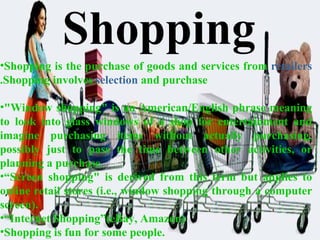
Shopping is the purchase of goods and services from  retailers .Shopping involves  selection  and purchase "Window shopping" is an American/English phrase meaning to look into glass windows of a shop for entertainment and imagine purchasing items without actually purchasing, possibly just to pass the time between other activities, or planning a purchase.  “ Screen shopping" is derived from this term but applies to online retail stores (i.e., window shopping through a computer screen). “ Internet Shopping”(eBay, Amazon) Shopping is fun for some people.  Shopping
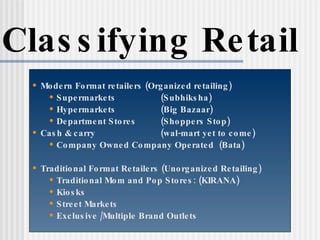
Modern Format retailers (Organized retailing) Supermarkets  (Subhiksha) Hypermarkets  (Big Bazaar) Department Stores (Shoppers Stop) Cash & carry   (wal-mart yet to come) Company Owned Company Operated  (Bata) Traditional Format Retailers (Unorganized Retailing) Traditional Mom and Pop Stores: (KIRANA) Kiosks Street Markets Exclusive /Multiple Brand Outlets Classifying Retail
In  France , the dominant chain is Carrefour  2nd largest chain of hypermarkets in the world after  Wal-Mart   Hypermarket  is a  superstore  which combines  a  supermarket  and a  department store .  Gigantic retail facility carries an enormous  range of products under one roof.  A consumer can ideally satisfy  all  of his or her routine  weekly shopping needs in one trip to the hypermarket. A typical  Wal-Mart  Supercenter covers 150,000 square feet, A typical  Carrefour  210,000 square feet Hypermarkets choose suburban or out-of-town  locations that are easily accessible by automobile. The concept was pioneered by  Carrefour  upon opening its first such store in  1962  at  Sainte-Geneviève-des-Bois ,  France   H ypermarket
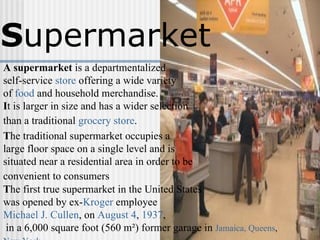
S upermarket A   supermarket  is a departmentalized  self-service  store  offering a wide variety  of  food  and household merchandise.  I t is larger in size and has a wider selection  than a traditional  grocery store .   T he traditional supermarket occupies a  large floor space on a single level and is situated near a residential area in order to be  convenient to consumers   T he first true supermarket in the United States  was opened by ex- Kroger  employee  Michael J. Cullen , on  August 4 ,  1937 , in a 6,000 square foot (560 m²) former garage in  Jamaica, Queens ,  New York
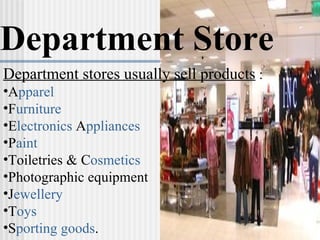
Department Store Department stores usually sell products  : A pparel   F urniture   E lectronics  A ppliances P aint Toiletries & C osmetics   Photographic equipment J ewellery   T oys S porting goods .
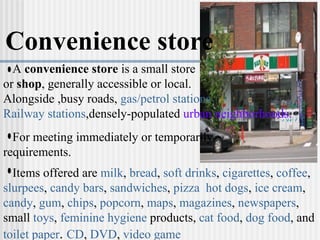
Convenience store A  convenience store  is a small store  or  shop , generally accessible or local. Alongside ,busy roads,  gas/petrol stations .  Railway stations ,densely-populated  urban neighborhoods. Items offered are  milk ,  bread ,  soft drinks ,  cigarettes ,  coffee ,  slurpees ,  candy bars ,  sandwiches ,  pizza   hot dogs ,  ice cream ,  candy ,  gum ,  chips ,  popcorn ,  maps ,  magazines ,  newspapers , small  toys ,  feminine hygiene  products,  cat food ,  dog food , and  toilet paper .  CD ,  DVD ,  video game   For meeting immediately or temporarily requirements.
Cash and Carry Goods are sold from a  wholesale  warehouse operated either on a self-service basis or on the basis of samples retailers Professional users, caterers, institutional buyers are customers Wholesalers buy from manufacturers and sell mostly to retailers Selling and promoting, buying and assortment building, warehousing, transporting, financing, risk-bearing, supplying market information, and providing management services  Cash and carry  wholesaler arrange the transport of the goods themselves and pay the goods in cash and not on credit  100% FDI is allowed in this format in INDIA. WAL-MART & BHARTI. Joint venture based on this strategy.  METRO(GERMANY), CARREFOUR(FRANCE),TESCO(U.K) planning to enter through the same format.
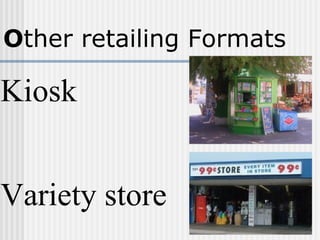
O ther retailing Formats Kiosk   Variety store
Berjaya Times Square  in  Kuala Lumpur, Malaysia , is 700,000 m². (approximately 7 million square feet).  Beijing's  Golden Resources Shopping Mall , opened in October 2004, is the world's largest, at 600,000 m² (approximately 6 million square feet).  SM Mall of Asia  in the  Philippines , opened in May 2006, is the world's third largest at 386,000 m² square meters of gross floor area with further expansions still ongoing.  The  Mall of Arabia  inside  Dubailand  in  Dubai ,  United Arab Emirates , which will open in  2008 , will become the largest mall in the world, at 929,000 square meters  (10 million sq. feet ).(22000 small shops of avg 50 sq.yds in india)  W orld`s largest Malls
G lobal Retailing Facts World’s largest private industry Above US $ 8 trillion sales worldwide annually Accounts for almost 10% of GDP in most  countries Major employer in most economies 16%  in US 15%  in Brazil 12%  in Poland 7%  in China Generates competition which results in  reduction of prices product and service innovation enhanced customer experience Major driver for real estate  and urban development
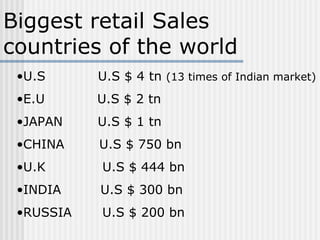
Biggest retail Sales countries of the world U.S  U.S $ 4 tn  (13 times of Indian market) E.U  U.S $ 2 tn JAPAN  U.S $ 1 tn  CHINA  U.S $ 750 bn U.K  U.S $ 444 bn INDIA  U.S $ 300 bn  RUSSIA  U.S $ 200 bn
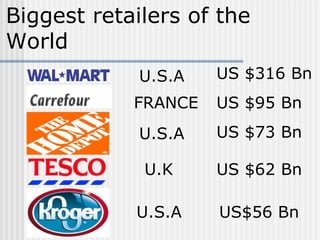
Biggest retailers of the World U.S.A FRANCE U.S.A U.S.A U.K US $316 Bn US $95 Bn US $73 Bn US $62 Bn US$56 Bn
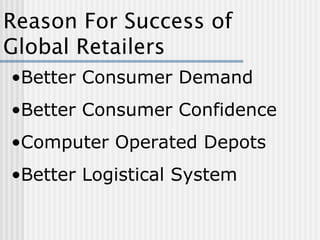
Reason For Success of Global Retailers Better Consumer Demand Better Consumer Confidence Computer Operated Depots Better Logistical System


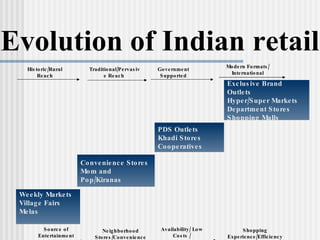
Weekly Markets Village Fairs Melas Convenience Stores Mom and Pop/Kiranas PDS Outlets Khadi Stores Cooperatives Exclusive Brand Outlets Hyper/Super Markets Department Stores Shopping Malls Traditional/Pervasive Reach  Government Supported Historic/Rural Reach Modern Formats/ International Evolution of Indian retail Source of Entertainment Neighborhood Stores/Convenience Availability/ Low Costs / Distribution Shopping Experience/Efficiency
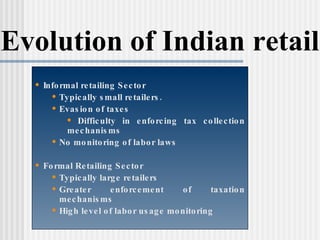
Evolution of Indian retail Informal retailing Sector Typically small retailers. Evasion of taxes Difficulty in enforcing tax collection mechanisms No monitoring of labor laws Formal Retailing Sector Typically large retailers Greater enforcement of taxation mechanisms High level of labor usage monitoring
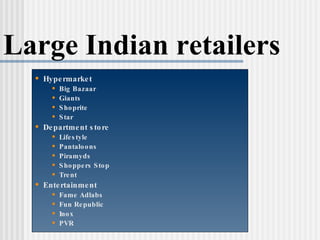
Large Indian retailers Hypermarket Big Bazaar Giants Shoprite Star Department store Lifestyle Pantaloons Piramyds Shoppers Stop Trent Entertainment Fame Adlabs Fun Republic Inox PVR
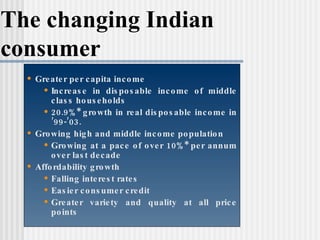
The changing Indian consumer Greater per capita income Increase in disposable income of middle class households 20.9%* growth in real disposable income in ’99-’03. Growing high and middle income population Growing at a pace of over 10%* per annum over last decade  Affordability growth Falling interest rates Easier consumer credit Greater variety and quality at all price points † From Euromonitor Retail Survey
The urban consumer Getting exposed to international lifestyles Inclined to acquiring asset More discerning and demanding than ever No longer need-based shopping Shopping is a family experience Changing Mindset Increasing tendency to spend Post Liberalization children coming of age 100 mn 17-21 year olds*. Tend to spend freely. Greater levels of education The changing Indian consumer
Anticipated growth Market size Current market size is roughly US$ 300 bn Only 3% is through organized retailing 96% of the 12 Million stores are less than 500 Sq. ft. Forecast Growth rate for the retailing industry is roughly 8.3% for 2003-2008  Sales from large format stores would  rise by 24-49% Formal and modern format retailing would enjoy rapid growth
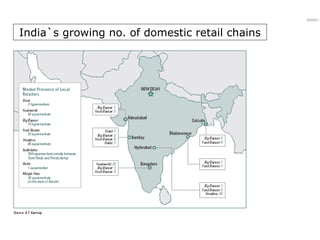
India`s growing no. of domestic retail chains
FDI in Indian retailing Current Indian FDI Regime  FDI not permitted in retail trade sector, except in:  Hi-Tech items / items requiring  specialized after sales service Medical and diagnostic items Items sourced from the Indian small sector (manufactured with technology provided by the foreign collaborator)
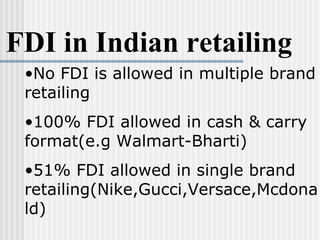
FDI in Indian retailing No FDI is allowed in multiple brand retailing 100% FDI allowed in cash & carry format(e.g Walmart-Bharti) 51% FDI allowed in single brand retailing(Nike,Gucci,Versace,Mcdonald)
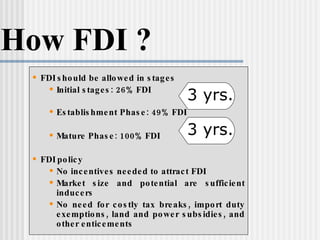
How FDI ? FDI should be allowed in stages Initial stages: 26% FDI Establishment Phase: 49% FDI Mature Phase: 100% FDI FDI policy No incentives needed to attract FDI Market size and potential are sufficient inducers No need for costly tax breaks, import duty exemptions, land and power subsidies, and other enticements 3 yrs. 3 yrs.
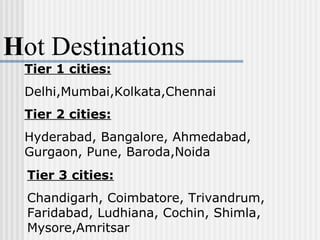
H ot Destinations Tier 1 cities: Delhi,Mumbai,Kolkata,Chennai Tier 2 cities: Hyderabad, Bangalore, Ahmedabad, Gurgaon, Pune, Baroda,Noida Tier 3 cities: Chandigarh, Coimbatore, Trivandrum, Faridabad, Ludhiana, Cochin, Shimla, Mysore,Amritsar
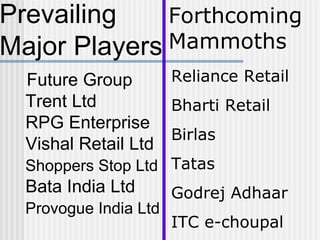
Prevailing Major Players Forthcoming Mammoths Reliance Retail Bharti Retail Birlas Tatas Godrej Adhaar ITC e-choupal                    Future Group                    Trent Ltd                    RPG Enterprise                    Vishal Retail Ltd                     Shoppers Stop Ltd                    Bata India Ltd                     Provogue India Ltd                    
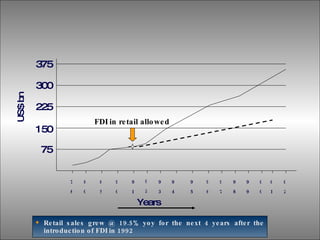
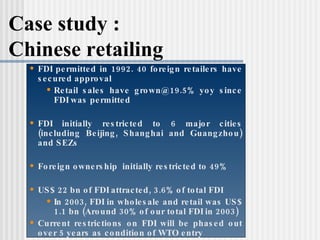
Case study :  Chinese retailing FDI permitted in 1992. 40 foreign retailers have secured approval  Retail sales have grown@19.5% yoy since FDI was permitted FDI initially restricted to 6 major cities (including Beijing, Shanghai and Guangzhou) and SEZs Foreign ownership  initially restricted to 49% US$ 22 bn of FDI attracted, 3.6% of total FDI In 2003, FDI in wholesale and retail was US$ 1.1 bn (Around 30% of our total FDI in 2003) Current restrictions on FDI will be phased out over 5 years as condition of WTO entry
7 8 8 0 8 5 9 0 9 1 9 2 9 3 9 4 9 5 9 6 9 7 9 8 9 9 0 0 0 1 0 2 75 150 225 300 375 FDI in retail allowed US$ bn Retail sales grew @ 19.5% yoy for the next 4 years after the introduction of FDI in 1992 Years
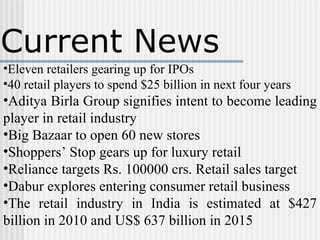
Current News Eleven retailers gearing up for IPOs 40 retail players to spend $25 billion in next four years Aditya Birla Group signifies intent to become leading player in retail industry  Big Bazaar to open 60 new stores Shoppers’ Stop gears up for luxury retail  Reliance targets Rs. 100000 crs. Retail sales target Dabur explores entering consumer retail business The retail industry in India is estimated at $427 billion in 2010 and US$ 637 billion in 2015
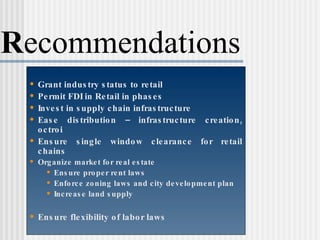
R ecommendations  Grant industry status to retail Permit FDI in Retail in phases Invest in supply chain infrastructure Ease distribution – infrastructure creation, octroi Ensure single window clearance for retail chains Organize market for real estate  Ensure proper rent laws  Enforce zoning laws and city development plan  Increase land supply  Ensure flexibility of labor laws
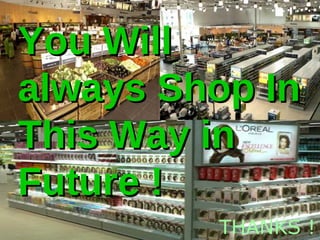
THANKS ! You Will always Shop In This Way in Future ! THANKS !

Global retail scenario and it's future

  • 1.
    Global Retailing Scenario & Its Future By: Varun modi ROLL NO. 4472
  • 2.
    IN TRODUCTION TORETAILING Retailing consists of the sale of goods or merchandise for personal or household consumption either from a fixed location such as a shopping mall or store, or from a fixed location and related subordinated services. In commerce , a retailer buys goods or products in large quantities from manufacturers or importers , either directly or through a wholesaler , and then sells individual items or small quantities to the general public or end-user customers , usually in a shop, also called a store. Retailers are at the end of the supply chain . Marketers see retailing as part of their overall distribution strategy.
  • 3.
    Retail comes fromthe French word retaillier which refers to "cutting off, clip and divide" in terms of tailoring (1365). It first was recorded as a noun with the meaning of a "sale in small quantities" in 1433 (French). Its literal meaning for retail was to "cut off, shred, paring". In both Dutch and German also refer to sale of small quantities or items. Etymology
  • 4.
    Shopping is thepurchase of goods and services from retailers .Shopping involves selection and purchase "Window shopping" is an American/English phrase meaning to look into glass windows of a shop for entertainment and imagine purchasing items without actually purchasing, possibly just to pass the time between other activities, or planning a purchase. “ Screen shopping" is derived from this term but applies to online retail stores (i.e., window shopping through a computer screen). “ Internet Shopping”(eBay, Amazon) Shopping is fun for some people. Shopping
  • 5.
    Modern Format retailers(Organized retailing) Supermarkets (Subhiksha) Hypermarkets (Big Bazaar) Department Stores (Shoppers Stop) Cash & carry (wal-mart yet to come) Company Owned Company Operated (Bata) Traditional Format Retailers (Unorganized Retailing) Traditional Mom and Pop Stores: (KIRANA) Kiosks Street Markets Exclusive /Multiple Brand Outlets Classifying Retail
  • 6.
    In France, the dominant chain is Carrefour 2nd largest chain of hypermarkets in the world after Wal-Mart Hypermarket is a superstore which combines a supermarket and a department store . Gigantic retail facility carries an enormous range of products under one roof. A consumer can ideally satisfy all of his or her routine weekly shopping needs in one trip to the hypermarket. A typical Wal-Mart Supercenter covers 150,000 square feet, A typical Carrefour 210,000 square feet Hypermarkets choose suburban or out-of-town locations that are easily accessible by automobile. The concept was pioneered by Carrefour upon opening its first such store in 1962 at Sainte-Geneviève-des-Bois , France H ypermarket
  • 7.
    S upermarket A supermarket is a departmentalized self-service store offering a wide variety of food and household merchandise. I t is larger in size and has a wider selection than a traditional grocery store . T he traditional supermarket occupies a large floor space on a single level and is situated near a residential area in order to be convenient to consumers T he first true supermarket in the United States was opened by ex- Kroger employee Michael J. Cullen , on August 4 , 1937 , in a 6,000 square foot (560 m²) former garage in Jamaica, Queens , New York
  • 8.
    Department Store Departmentstores usually sell products : A pparel F urniture E lectronics A ppliances P aint Toiletries & C osmetics Photographic equipment J ewellery T oys S porting goods .
  • 9.
    Convenience store A convenience store is a small store or shop , generally accessible or local. Alongside ,busy roads, gas/petrol stations . Railway stations ,densely-populated urban neighborhoods. Items offered are milk , bread , soft drinks , cigarettes , coffee , slurpees , candy bars , sandwiches , pizza hot dogs , ice cream , candy , gum , chips , popcorn , maps , magazines , newspapers , small toys , feminine hygiene products, cat food , dog food , and toilet paper . CD , DVD , video game For meeting immediately or temporarily requirements.
  • 10.
    Cash and CarryGoods are sold from a wholesale warehouse operated either on a self-service basis or on the basis of samples retailers Professional users, caterers, institutional buyers are customers Wholesalers buy from manufacturers and sell mostly to retailers Selling and promoting, buying and assortment building, warehousing, transporting, financing, risk-bearing, supplying market information, and providing management services Cash and carry wholesaler arrange the transport of the goods themselves and pay the goods in cash and not on credit 100% FDI is allowed in this format in INDIA. WAL-MART & BHARTI. Joint venture based on this strategy. METRO(GERMANY), CARREFOUR(FRANCE),TESCO(U.K) planning to enter through the same format.
  • 11.
    O ther retailingFormats Kiosk Variety store
  • 12.
    Berjaya Times Square in Kuala Lumpur, Malaysia , is 700,000 m². (approximately 7 million square feet). Beijing's Golden Resources Shopping Mall , opened in October 2004, is the world's largest, at 600,000 m² (approximately 6 million square feet). SM Mall of Asia in the Philippines , opened in May 2006, is the world's third largest at 386,000 m² square meters of gross floor area with further expansions still ongoing. The Mall of Arabia inside Dubailand in Dubai , United Arab Emirates , which will open in 2008 , will become the largest mall in the world, at 929,000 square meters (10 million sq. feet ).(22000 small shops of avg 50 sq.yds in india) W orld`s largest Malls
  • 13.
    G lobal RetailingFacts World’s largest private industry Above US $ 8 trillion sales worldwide annually Accounts for almost 10% of GDP in most countries Major employer in most economies 16% in US 15% in Brazil 12% in Poland 7% in China Generates competition which results in reduction of prices product and service innovation enhanced customer experience Major driver for real estate and urban development
  • 14.
    Biggest retail Salescountries of the world U.S U.S $ 4 tn (13 times of Indian market) E.U U.S $ 2 tn JAPAN U.S $ 1 tn CHINA U.S $ 750 bn U.K U.S $ 444 bn INDIA U.S $ 300 bn RUSSIA U.S $ 200 bn
  • 15.
    Biggest retailers ofthe World U.S.A FRANCE U.S.A U.S.A U.K US $316 Bn US $95 Bn US $73 Bn US $62 Bn US$56 Bn
  • 16.
    Reason For Successof Global Retailers Better Consumer Demand Better Consumer Confidence Computer Operated Depots Better Logistical System
  • 17.
  • 18.
  • 19.
  • 20.
  • 21.
  • 22.
    Weekly Markets VillageFairs Melas Convenience Stores Mom and Pop/Kiranas PDS Outlets Khadi Stores Cooperatives Exclusive Brand Outlets Hyper/Super Markets Department Stores Shopping Malls Traditional/Pervasive Reach Government Supported Historic/Rural Reach Modern Formats/ International Evolution of Indian retail Source of Entertainment Neighborhood Stores/Convenience Availability/ Low Costs / Distribution Shopping Experience/Efficiency
  • 23.
    Evolution of Indianretail Informal retailing Sector Typically small retailers. Evasion of taxes Difficulty in enforcing tax collection mechanisms No monitoring of labor laws Formal Retailing Sector Typically large retailers Greater enforcement of taxation mechanisms High level of labor usage monitoring
  • 24.
    Large Indian retailersHypermarket Big Bazaar Giants Shoprite Star Department store Lifestyle Pantaloons Piramyds Shoppers Stop Trent Entertainment Fame Adlabs Fun Republic Inox PVR
  • 25.
    The changing Indianconsumer Greater per capita income Increase in disposable income of middle class households 20.9%* growth in real disposable income in ’99-’03. Growing high and middle income population Growing at a pace of over 10%* per annum over last decade Affordability growth Falling interest rates Easier consumer credit Greater variety and quality at all price points † From Euromonitor Retail Survey
  • 26.
    The urban consumerGetting exposed to international lifestyles Inclined to acquiring asset More discerning and demanding than ever No longer need-based shopping Shopping is a family experience Changing Mindset Increasing tendency to spend Post Liberalization children coming of age 100 mn 17-21 year olds*. Tend to spend freely. Greater levels of education The changing Indian consumer
  • 27.
    Anticipated growth Marketsize Current market size is roughly US$ 300 bn Only 3% is through organized retailing 96% of the 12 Million stores are less than 500 Sq. ft. Forecast Growth rate for the retailing industry is roughly 8.3% for 2003-2008 Sales from large format stores would rise by 24-49% Formal and modern format retailing would enjoy rapid growth
  • 28.
    India`s growing no.of domestic retail chains
  • 29.
    FDI in Indianretailing Current Indian FDI Regime FDI not permitted in retail trade sector, except in: Hi-Tech items / items requiring specialized after sales service Medical and diagnostic items Items sourced from the Indian small sector (manufactured with technology provided by the foreign collaborator)
  • 30.
    FDI in Indianretailing No FDI is allowed in multiple brand retailing 100% FDI allowed in cash & carry format(e.g Walmart-Bharti) 51% FDI allowed in single brand retailing(Nike,Gucci,Versace,Mcdonald)
  • 31.
    How FDI ?FDI should be allowed in stages Initial stages: 26% FDI Establishment Phase: 49% FDI Mature Phase: 100% FDI FDI policy No incentives needed to attract FDI Market size and potential are sufficient inducers No need for costly tax breaks, import duty exemptions, land and power subsidies, and other enticements 3 yrs. 3 yrs.
  • 32.
    H ot DestinationsTier 1 cities: Delhi,Mumbai,Kolkata,Chennai Tier 2 cities: Hyderabad, Bangalore, Ahmedabad, Gurgaon, Pune, Baroda,Noida Tier 3 cities: Chandigarh, Coimbatore, Trivandrum, Faridabad, Ludhiana, Cochin, Shimla, Mysore,Amritsar
  • 33.
    Prevailing Major PlayersForthcoming Mammoths Reliance Retail Bharti Retail Birlas Tatas Godrej Adhaar ITC e-choupal                   Future Group                    Trent Ltd                    RPG Enterprise                    Vishal Retail Ltd                     Shoppers Stop Ltd                    Bata India Ltd                     Provogue India Ltd                    
  • 34.
    Case study : Chinese retailing FDI permitted in 1992. 40 foreign retailers have secured approval Retail sales have grown@19.5% yoy since FDI was permitted FDI initially restricted to 6 major cities (including Beijing, Shanghai and Guangzhou) and SEZs Foreign ownership initially restricted to 49% US$ 22 bn of FDI attracted, 3.6% of total FDI In 2003, FDI in wholesale and retail was US$ 1.1 bn (Around 30% of our total FDI in 2003) Current restrictions on FDI will be phased out over 5 years as condition of WTO entry
  • 35.
    7 8 80 8 5 9 0 9 1 9 2 9 3 9 4 9 5 9 6 9 7 9 8 9 9 0 0 0 1 0 2 75 150 225 300 375 FDI in retail allowed US$ bn Retail sales grew @ 19.5% yoy for the next 4 years after the introduction of FDI in 1992 Years
  • 36.
    Current News Elevenretailers gearing up for IPOs 40 retail players to spend $25 billion in next four years Aditya Birla Group signifies intent to become leading player in retail industry Big Bazaar to open 60 new stores Shoppers’ Stop gears up for luxury retail Reliance targets Rs. 100000 crs. Retail sales target Dabur explores entering consumer retail business The retail industry in India is estimated at $427 billion in 2010 and US$ 637 billion in 2015
  • 37.
    R ecommendations Grant industry status to retail Permit FDI in Retail in phases Invest in supply chain infrastructure Ease distribution – infrastructure creation, octroi Ensure single window clearance for retail chains Organize market for real estate Ensure proper rent laws Enforce zoning laws and city development plan Increase land supply Ensure flexibility of labor laws
  • 38.
    THANKS ! YouWill always Shop In This Way in Future ! THANKS !