Team Based Learning
Presented: October 17, 2014
http://www.teambasedlearning.org/
Funding was Provided by:
• The U. S. Department of Education's Title III,
Part A, Strengthening Institutions Program
– awarded to LSSU in 2013 to enhance faculty
teaching and strengthen student advising.
– Thank you to the following people:
• The Title III Project Coordinator, Carolyn Rajewski, the
Oversight Committee, the workgroup, and Krystle
Gertecich
Building the Bridge as You Walk on It
Robert .E. Quinn (2004).Building the Bridge As You Walk On It: A Guide for Leading Change. Wiley &
Sons.
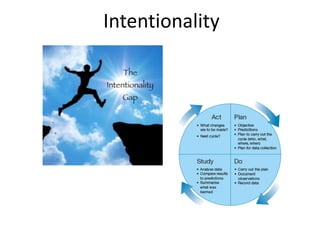
Intentionality
Will TeamBased Learning Fit Your
Class?
EBP Listed on TBL Website
• Medical School
• Nursing
• Law School
• Pharmacy
• Engineering, civil, mechanical
• Anatomy & Physiology
• Psychology
• Microbial physiology
• Ethics
Overview of Team Based Learning
http://www.teambasedlearning.org/
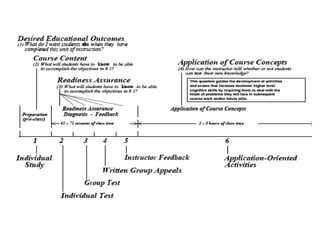
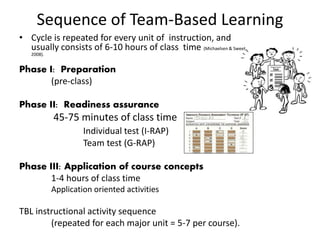
Sequence of Team-Based Learning
• Cycle is repeated for every unit of instruction, and
usually consists of 6-10 hours of class time (Michaelsen & Sweet,
2008).
Phase I: Preparation
(pre-class)
Phase II: Readiness assurance
45-75 minutes of class time
Individual test (I-RAP)
Team test (G-RAP)
Phase III: Application of course concepts
1-4 hours of class time
Application oriented activities
TBL instructional activity sequence
(repeated for each major unit = 5-7 per course).
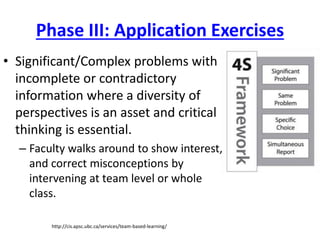
Phase III: Application Exercises
• Significant/Complex problems with
incomplete or contradictory
information where a diversity of
perspectives is an asset and critical
thinking is essential.
– Faculty walks around to show interest,
and correct misconceptions by
intervening at team level or whole
class.
http://cis.apsc.ubc.ca/services/team-based-learning/
Grading of TBL Courses
• The TBL grade component in a prototypical TBL
course
– ungraded application activities
– only iRAT and tRAT are grade
• can be as low as 25%.
• the other 75% of grades might come from traditional
components like individual essays, individual reports,
midterms, and finals.
• In some courses, the grades are 100% based on
TBL
– these courses most often have graded Application
Activities.
Faculty Commitment
• Initially, faculty must invest time to implement
team-based learning
– Faculty members are expected to be content experts
and provide clarification of material as necessary
• May be difficult when teaching a new class for the first
time
• Can be slowly implemented gradually by
converting a module each semester
Student Perspective
• See faculty as collegial and part of the team
• Opportunity to develop:
– interpersonal and teamwork skills
– professionalism
– communication skills
– collaboration skills
Limitations and Recommendations
• Initial time commitment from faculty members
• Must be willing and interested to try a new
teaching method (and tobe BRAVE)
• Some course content may not be appropriate
Web Sites
University of British Columbia
http://cis.apsc.ubc.ca/services/team-based-
learning/what-is-tbl/
• TBL Nurse Educators Interest Group web site
https://sites.google.com/site/tblfornurseeduc
ators/
– Use of Google + technology for online teaching
using TBL
References
• Britta M Thompson,Virginia F Schneider,Paul Haidet,Ruth E Levine,Kathryn K
McMahon,Linda C Perkowski,Boyd F Richards. Team-based learning at ten medical
schools: two years later Medical Education Volume 41, Issue 3, pages 250–257,
March 2007.
• Dinan, F.J. (2006) “Opening Day: Getting Started in the Cooperative Classroom’
Journal of College Science Teaching, v35 n4 p12-14
• Heidi A. Mennenga, Tish Smyer : A Model for Easily Incorporating Team-Based
Learning into Nursing Education. International Journal of Nursing Education
Scholarship Volume 7, Issue 1 2010 Article 4
• Harvard, Survival Team Exercise, pdf
• University of British Columbia (2014). Faculty of Applied Science. Center for
Instructional Support http://cis.apsc.ubc.ca/services/team-based-learning/
• Larry K. Michaelsena, Warren E. Watsonb, Albert Schwartzkopfa and Robert H.
Blackc Group Decision Making: How You Frame the Question Determines What You
Find Journal of Applied Psychology Volume 77, Issue 1, February 1992, Pages 106-
108

Team Based Learning

  • 1.
    Team Based Learning Presented:October 17, 2014 http://www.teambasedlearning.org/
  • 2.
    Funding was Providedby: • The U. S. Department of Education's Title III, Part A, Strengthening Institutions Program – awarded to LSSU in 2013 to enhance faculty teaching and strengthen student advising. – Thank you to the following people: • The Title III Project Coordinator, Carolyn Rajewski, the Oversight Committee, the workgroup, and Krystle Gertecich
  • 3.
    Building the Bridgeas You Walk on It Robert .E. Quinn (2004).Building the Bridge As You Walk On It: A Guide for Leading Change. Wiley & Sons.
  • 4.
  • 5.
    Will TeamBased LearningFit Your Class? EBP Listed on TBL Website • Medical School • Nursing • Law School • Pharmacy • Engineering, civil, mechanical • Anatomy & Physiology • Psychology • Microbial physiology • Ethics
  • 7.
    Overview of TeamBased Learning http://www.teambasedlearning.org/
  • 8.
    Sequence of Team-BasedLearning • Cycle is repeated for every unit of instruction, and usually consists of 6-10 hours of class time (Michaelsen & Sweet, 2008). Phase I: Preparation (pre-class) Phase II: Readiness assurance 45-75 minutes of class time Individual test (I-RAP) Team test (G-RAP) Phase III: Application of course concepts 1-4 hours of class time Application oriented activities TBL instructional activity sequence (repeated for each major unit = 5-7 per course).
  • 9.
    Phase III: ApplicationExercises • Significant/Complex problems with incomplete or contradictory information where a diversity of perspectives is an asset and critical thinking is essential. – Faculty walks around to show interest, and correct misconceptions by intervening at team level or whole class. http://cis.apsc.ubc.ca/services/team-based-learning/
  • 10.
    Grading of TBLCourses • The TBL grade component in a prototypical TBL course – ungraded application activities – only iRAT and tRAT are grade • can be as low as 25%. • the other 75% of grades might come from traditional components like individual essays, individual reports, midterms, and finals. • In some courses, the grades are 100% based on TBL – these courses most often have graded Application Activities.
  • 11.
    Faculty Commitment • Initially,faculty must invest time to implement team-based learning – Faculty members are expected to be content experts and provide clarification of material as necessary • May be difficult when teaching a new class for the first time • Can be slowly implemented gradually by converting a module each semester
  • 12.
    Student Perspective • Seefaculty as collegial and part of the team • Opportunity to develop: – interpersonal and teamwork skills – professionalism – communication skills – collaboration skills
  • 13.
    Limitations and Recommendations •Initial time commitment from faculty members • Must be willing and interested to try a new teaching method (and tobe BRAVE) • Some course content may not be appropriate
  • 14.
    Web Sites University ofBritish Columbia http://cis.apsc.ubc.ca/services/team-based- learning/what-is-tbl/ • TBL Nurse Educators Interest Group web site https://sites.google.com/site/tblfornurseeduc ators/ – Use of Google + technology for online teaching using TBL
  • 15.
    References • Britta MThompson,Virginia F Schneider,Paul Haidet,Ruth E Levine,Kathryn K McMahon,Linda C Perkowski,Boyd F Richards. Team-based learning at ten medical schools: two years later Medical Education Volume 41, Issue 3, pages 250–257, March 2007. • Dinan, F.J. (2006) “Opening Day: Getting Started in the Cooperative Classroom’ Journal of College Science Teaching, v35 n4 p12-14 • Heidi A. Mennenga, Tish Smyer : A Model for Easily Incorporating Team-Based Learning into Nursing Education. International Journal of Nursing Education Scholarship Volume 7, Issue 1 2010 Article 4 • Harvard, Survival Team Exercise, pdf • University of British Columbia (2014). Faculty of Applied Science. Center for Instructional Support http://cis.apsc.ubc.ca/services/team-based-learning/ • Larry K. Michaelsena, Warren E. Watsonb, Albert Schwartzkopfa and Robert H. Blackc Group Decision Making: How You Frame the Question Determines What You Find Journal of Applied Psychology Volume 77, Issue 1, February 1992, Pages 106- 108