The Frail Elderly


Marc Evans M. Abat, MD, FPCP, FPCGM
  Internal Medicine-Geriatric Medicine
What is Frailty?
Frailty
Refers to a loss of physiologic reserve that
makes a person susceptible to disability
from minor stresses.
An inherent vulnerability to challenge from
the environment.
Not dependent on age, diagnosis or
functional ability
Full forty years between age 60 to 100
Frailty
Functional status varies considerably
among older adults
– Portion remain independent in daily function
– Majority after 85 years need some assistance
  with instrumental activities
– Frail elderly are severely disabled
Common Features of Frailty
1. Weakness
2. Weight loss (unexplained)
3. Muscle wasting (sarcopenia)
4. Exercise intolerance
5. Frequent falls
6. Immobility
7. Incontinence
8. Instability of chronic diseases
Associated Features of Frailty
  Older Age
  Female
  Less Education
  Lower Income
  Poorer Health (Multiple co-morbid
  chronic disease)


                 (Fried et al [2001], Community-based study)
According to Buchner and Wagner

The goal of preventive strategies is to reduce or eliminate the factors
that threaten physiologic capacity
Frailty as a Clinical Syndrome
Clinical Syndrome of Frailty
Symptoms
                               Adverse Outcomes of
Weakness
                               Frailty
Fatigue
                               Falls
Anorexia
                               Injuries
Under nutrition
                               Acute Illnesses
Weight Loss
                               Hospitalizations
Signs                          Disability
Physiologic changes marking
                               Dependency
increased risk
                               Institutionalization
Decreased muscle mass
                               Death
Balance and gait
abnormalities
Severe deconditioning
Stages of Frailty
Speechly / Tinnetti:
– “There may be a transitional state between
  vigor and frailty.”
– “Earlier” stage of frailty – patient should be
  screened and interventions instituted
– “ If lack of full recovery after an illness Then:
  need for aggressive “Rehabilitation” after
  acute illness and “Prehabilitation” when
  surgery is anticipated.
Stages of Frailty
Late stage may not be reversible.


      “Failure to Thrive” Syndrome
Stages of Frailty
Characteristics of Hospitalized Individuals with
Failure to Thrive
(Berkman B. et al, Gerontologist, 1989)

       1. Mean age 79
       2. Average of 6 diagnoses
       3. Symptoms similar to clinical syndrome of frailty
       4. Malnourished, dehydrated, skin ulcers, falls, pain,
          cognitive disabilities
       5. Very limited effective intervention
       6. 16% die during hospitalization
Potential Causes of Frailty
1. Decline in function of multiple organ systems
   (due to aging) = enhance vulnerability to
   stressors
2. Hypothalamic – pituitary – adrenal axis (Central
   regulators of homeostasis)
  A. Older animals show decrease ability to terminate the
     adrenocortical response to stress ; decrease
     hippocampal glucocorticoid receptors
  B. Prolonged poststress corticosterone elevation
     contribute to catabolic state
Potential Causes of Frailty
3. Decline of growth hormone levels
    Contribute to decrease protein synthesis and muscle
     mass
    Decrease bone mass
    Diminish immunologic states


   (NEJM 1990 Rudman et al).

   Clinical Trial: 21 healthy GH deficient men ages 61-81
       receive rhGH
                                  Increase lean body mass 9%
                                  Decrease adipose tissue 14%
Potential Causes of Frailty
4. Changes in immune system may be due
  to T cell dysfunction
  – Increase lymphoproliferative disorder
  – Susceptibility to infection
  – Autoimmune disorders
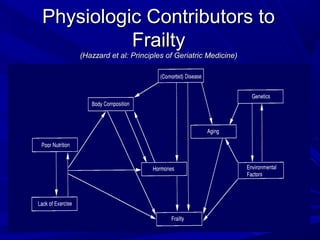
Physiologic Contributors to
          Frailty
    (Hazzard et al: Principles of Geriatric Medicine)
Challenges and Solutions in
    Care of the Frail Elderly
1. IMPORTANT to recognize the vulnerable and
   frail before adverse outcomes
   Recognize components that are reversible
   Recognize the syndrome early
2. Prevention of adverse outcomes (i.e. falls,
   medication side effects)
3. Increase physical activity level of FOA
   (improved strength, flexibility, exercise
   tolerance, nutrition)
4. Prehabilition and rehabilitation prevent decline
   associated with prolonged bedrest due to
   illness or surgery
Challenges and Solutions in
    Care of the Frail Elderly
5. Improve Quality of Acute Hospital Care
   A. Intensive case management – hospital-based
      Advanced Practice Nurses intervene early
       Identify newly admitted FOA early, aggressively
          monitor progress through discharge
         Coordinate efforts of health care team
         Educate staff, patient and families
         Bridge communication and clinical gaps between
          systems (i.e. hospital  NH )
         Facilitate access to programs and services
Challenges and Solutions in
 Care of the Frail Elderly
B. Be aware “BEWARE” of “cascade” of acute
   hospital care
Complication of Hospitalization

Hopitalization    Functional      Medical             Medical
                  Symptom       Intervention        Complication

                                Restraints         Thrombophlebitis
                 Confusion
                                Drugs              Pulmonary embolus

                 Not Eating     Nasogastric        Aspiration pneumonia
                                tube
                                Restraints         Thrombophlebitis
                 Falling
                                                   Fracture

                 Incontinence     Foley catheter     UTI / Septic shock
Challenges and Solutions in
 Care of the Frail Elderly
C. Early detection of acute illness
D. Delivery of medical treatment in least
   stressful site of care (i.e. home)
E. Comprehensive Geriatric Assessment
F. Palliative Care alternatives for respiratory/
   cardiac failure, weight loss, pain
   management.
Challenges and Solutions in
 Care of the Frail Elderly
 Advantages of CGA
  1) Creation of individual treatment plan
     with a multidisciplinary team
  2) Improve functional outcome
  3) Improve patient survival
  4) Reduction in hospital days
  5) Reduction in readmission rates
  6) No increase in mortality
Challenges and Solutions in
 Care of the Frail Elderly

Elderly with irreversible declines in
  functional capacity, QUALITY
  hospital care may shift from
  survival at all cost to improving
  patient’s functional outcome.
Advancing Health and Well Being
  Into Old Age in Filipino Society
              (Philippine [Inter-Agency] and DSWD Plan of Action CY 2007)


1. Advocacy on prevention of common diseases
2. Conduct regular medical check-up of senior
   citizens in rural health units (RHU).
3. Conduct care giving trainings to families of sick
   and frail senior citizens
4. Conduct seminars on gerontology, physical
   fitness program, nutrition education and dietary
   counseling
Advancing Health and Well Being
  Into Old Age in Filipino Society
             (Philippine [Inter-Agency] and DSWD Plan of Action CY 2007)


5. Establish geriatric wards in government
     and private hospitals.
6.   Implementation of neighborhood support
     services for older persons (NSSOP).
7.   Ensure the implementation of the
     Philippine Plan of Action for Nutrition
     (PPAN) as a blueprint and country’s
     guide for action to achieve nutritional
     adequacy for Filipinos
Have a good day!

Frailty

  • 1.
    The Frail Elderly MarcEvans M. Abat, MD, FPCP, FPCGM Internal Medicine-Geriatric Medicine
  • 2.
  • 3.
    Frailty Refers to aloss of physiologic reserve that makes a person susceptible to disability from minor stresses. An inherent vulnerability to challenge from the environment. Not dependent on age, diagnosis or functional ability
  • 4.
    Full forty yearsbetween age 60 to 100
  • 5.
    Frailty Functional status variesconsiderably among older adults – Portion remain independent in daily function – Majority after 85 years need some assistance with instrumental activities – Frail elderly are severely disabled
  • 6.
    Common Features ofFrailty 1. Weakness 2. Weight loss (unexplained) 3. Muscle wasting (sarcopenia) 4. Exercise intolerance 5. Frequent falls 6. Immobility 7. Incontinence 8. Instability of chronic diseases
  • 7.
    Associated Features ofFrailty Older Age Female Less Education Lower Income Poorer Health (Multiple co-morbid chronic disease) (Fried et al [2001], Community-based study)
  • 8.
    According to Buchnerand Wagner The goal of preventive strategies is to reduce or eliminate the factors that threaten physiologic capacity
  • 9.
    Frailty as aClinical Syndrome Clinical Syndrome of Frailty Symptoms Adverse Outcomes of Weakness Frailty Fatigue Falls Anorexia Injuries Under nutrition Acute Illnesses Weight Loss Hospitalizations Signs Disability Physiologic changes marking Dependency increased risk Institutionalization Decreased muscle mass Death Balance and gait abnormalities Severe deconditioning
  • 10.
    Stages of Frailty Speechly/ Tinnetti: – “There may be a transitional state between vigor and frailty.” – “Earlier” stage of frailty – patient should be screened and interventions instituted – “ If lack of full recovery after an illness Then: need for aggressive “Rehabilitation” after acute illness and “Prehabilitation” when surgery is anticipated.
  • 11.
    Stages of Frailty Latestage may not be reversible. “Failure to Thrive” Syndrome
  • 12.
    Stages of Frailty Characteristicsof Hospitalized Individuals with Failure to Thrive (Berkman B. et al, Gerontologist, 1989) 1. Mean age 79 2. Average of 6 diagnoses 3. Symptoms similar to clinical syndrome of frailty 4. Malnourished, dehydrated, skin ulcers, falls, pain, cognitive disabilities 5. Very limited effective intervention 6. 16% die during hospitalization
  • 13.
    Potential Causes ofFrailty 1. Decline in function of multiple organ systems (due to aging) = enhance vulnerability to stressors 2. Hypothalamic – pituitary – adrenal axis (Central regulators of homeostasis) A. Older animals show decrease ability to terminate the adrenocortical response to stress ; decrease hippocampal glucocorticoid receptors B. Prolonged poststress corticosterone elevation contribute to catabolic state
  • 14.
    Potential Causes ofFrailty 3. Decline of growth hormone levels  Contribute to decrease protein synthesis and muscle mass  Decrease bone mass  Diminish immunologic states (NEJM 1990 Rudman et al). Clinical Trial: 21 healthy GH deficient men ages 61-81 receive rhGH  Increase lean body mass 9%  Decrease adipose tissue 14%
  • 15.
    Potential Causes ofFrailty 4. Changes in immune system may be due to T cell dysfunction – Increase lymphoproliferative disorder – Susceptibility to infection – Autoimmune disorders
  • 16.
    Physiologic Contributors to Frailty (Hazzard et al: Principles of Geriatric Medicine)
  • 17.
    Challenges and Solutionsin Care of the Frail Elderly 1. IMPORTANT to recognize the vulnerable and frail before adverse outcomes  Recognize components that are reversible  Recognize the syndrome early 2. Prevention of adverse outcomes (i.e. falls, medication side effects) 3. Increase physical activity level of FOA (improved strength, flexibility, exercise tolerance, nutrition) 4. Prehabilition and rehabilitation prevent decline associated with prolonged bedrest due to illness or surgery
  • 18.
    Challenges and Solutionsin Care of the Frail Elderly 5. Improve Quality of Acute Hospital Care A. Intensive case management – hospital-based Advanced Practice Nurses intervene early  Identify newly admitted FOA early, aggressively monitor progress through discharge  Coordinate efforts of health care team  Educate staff, patient and families  Bridge communication and clinical gaps between systems (i.e. hospital  NH )  Facilitate access to programs and services
  • 19.
    Challenges and Solutionsin Care of the Frail Elderly B. Be aware “BEWARE” of “cascade” of acute hospital care
  • 20.
    Complication of Hospitalization Hopitalization Functional Medical Medical Symptom Intervention Complication Restraints Thrombophlebitis Confusion Drugs Pulmonary embolus Not Eating Nasogastric Aspiration pneumonia tube Restraints Thrombophlebitis Falling Fracture Incontinence Foley catheter UTI / Septic shock
  • 21.
    Challenges and Solutionsin Care of the Frail Elderly C. Early detection of acute illness D. Delivery of medical treatment in least stressful site of care (i.e. home) E. Comprehensive Geriatric Assessment F. Palliative Care alternatives for respiratory/ cardiac failure, weight loss, pain management.
  • 22.
    Challenges and Solutionsin Care of the Frail Elderly  Advantages of CGA 1) Creation of individual treatment plan with a multidisciplinary team 2) Improve functional outcome 3) Improve patient survival 4) Reduction in hospital days 5) Reduction in readmission rates 6) No increase in mortality
  • 23.
    Challenges and Solutionsin Care of the Frail Elderly Elderly with irreversible declines in functional capacity, QUALITY hospital care may shift from survival at all cost to improving patient’s functional outcome.
  • 24.
    Advancing Health andWell Being Into Old Age in Filipino Society (Philippine [Inter-Agency] and DSWD Plan of Action CY 2007) 1. Advocacy on prevention of common diseases 2. Conduct regular medical check-up of senior citizens in rural health units (RHU). 3. Conduct care giving trainings to families of sick and frail senior citizens 4. Conduct seminars on gerontology, physical fitness program, nutrition education and dietary counseling
  • 25.
    Advancing Health andWell Being Into Old Age in Filipino Society (Philippine [Inter-Agency] and DSWD Plan of Action CY 2007) 5. Establish geriatric wards in government and private hospitals. 6. Implementation of neighborhood support services for older persons (NSSOP). 7. Ensure the implementation of the Philippine Plan of Action for Nutrition (PPAN) as a blueprint and country’s guide for action to achieve nutritional adequacy for Filipinos
  • 26.