Colin M. Thomas MD, MPH
Clinical Professor of Medicine
Division of Geriatric Medicine
University of California, San Diego, School of Medicine
Associate Chief of Medicine, VA San Diego Healthcare
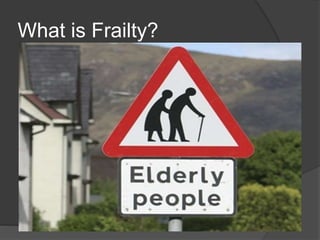
What is Frailty?
What is Frailty?
 Cumulative decline in many
physiological systems
 A state of vulnerability where minor
stressors may result in significant
decline in health status
 Associated with adverse outcomes like
falls, disability, nursing home placement
and mortality
Frailty is Vulnerability
Lancet 2013; 381: 752–62
 Decline in
multiple systems
 Decreased
Physical Activity
 Inadequate
Nutrition
 Intolerance of
stressor events
 Increasing
dependence
Lancet 2013; 381: 752–62
Models of Frailty
 Cumulative Deficit Model
 Musculoskeletal function
 Aerobic capacity
 Cognitive function
 Nutrition
 Phenotype model
 Weight loss
 Exhaustion
 Energy expenditure
 Gait speed
 Grip strength
Frailty is common
 Prevalence
 15% of non-institutionalized elders are frail
 45% are pre-frail
Journals of Geronology A Biol Sci Med Sci, 2015. 70(11), 1427-1434.
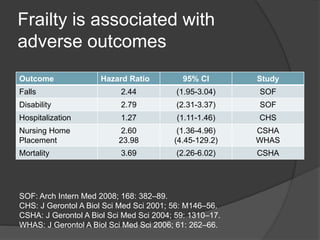
Frailty is associated with
adverse outcomes
Outcome Hazard Ratio 95% CI Study
Falls 2.44 (1.95-3.04) SOF
Disability 2.79 (2.31-3.37) SOF
Hospitalization 1.27 (1.11-1.46) CHS
Nursing Home
Placement
2.60
23.98
(1.36-4.96)
(4.45-129.2)
CSHA
WHAS
Mortality 3.69 (2.26-6.02) CSHA
SOF: Arch Intern Med 2008; 168: 382–89.
CHS: J Gerontol A Biol Sci Med Sci 2001; 56: M146–56.
CSHA: J Gerontol A Biol Sci Med Sci 2004; 59: 1310–17.
WHAS: J Gerontol A Biol Sci Med Sci 2006; 61: 262–66.
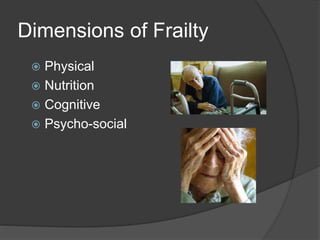
Dimensions of Frailty
 Physical
 Nutrition
 Cognitive
 Psycho-social
Physical Frailty
 Muscle mass
 Strength
 Balance
 Bone density
 Increased risk of falls and injury
Normal aging and muscular
function
 By the age of 70, the cross-sectional area of
skeletal muscle is reduced by up to 25–30%
and muscle strength is reduced by 30–40%
 Excretion of urinary creatinine, reflecting total
muscle mass, decreases by nearly 50%
between the ages of 20 and 90 yr
 Loss of strength continues to fall at a rate of 1–
2% per year
 Irreversible decrease in the total number of
individual muscle fibers and (reversible?)
atrophy of the remaining fibers
A. McArdle et al. Ageing Research Reviews 1 (2002) 79–93
Sarcopenia
A. McArdle et al. Ageing Research Reviews 1 (2002) 79–93
Nutritional frailty
 Appetite
 Taste and smell
 Oral health
 Digestion
 Economic factors
 Ability to acquire and prepare food
 Chronic illness
Annu. Rev. Nutr. 2002. 22:309–23
Cognitive Frailty
 Cognition not included in commonly
used frailty phenotype measures
 Non-frail older adults with impaired
cognition are more likely to become frail
 Frail adults with impaired cognition are
more likely to become disabled or die
JAGS 56:2292–2297, 2008
Psycho-social Frailty
 Mental health measures are not included in
common frailty phenotype measures
 Depression and frailty frequently co-occur
in the elderly population
 Social vulnerability is associated with
higher mortality, lower educational level and
lower income
J Am Geriatr Soc 62:500–505, 2014.
J Frailty Aging. 2013; 2(3): 121–124.
Gerontol B Psychol Sci Soc Sci 2009;64B:105-117.
But what can we do about
frailty?
 Can we prevent or
reverse frailty?
Evidence based interventions for
frailty
 Resistance exercise interventions for
physical frailty
 Strength training resulted in a 30% increase
in muscle fiber size
 Resistance training can slow or partially
reverse the process of aging atrophy of
skeletal muscles
 Strength training can improve VO2 max and
exercise treadmill time
Journal of Gerontology:BIOLOGICAL SCIENCES. 2000, 55A(7), B347–B354
Arch Intern Med. 2002 Mar 25;162(6):673-8
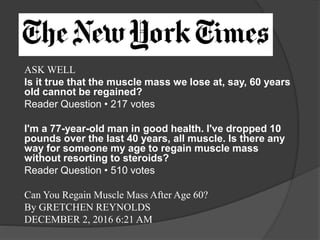
ASK WELL
Is it true that the muscle mass we lose at, say, 60 years
old cannot be regained?
Reader Question • 217 votes
I'm a 77-year-old man in good health. I've dropped 10
pounds over the last 40 years, all muscle. Is there any
way for someone my age to regain muscle mass
without resorting to steroids?
Reader Question • 510 votes
Can You Regain Muscle Mass After Age 60?
By GRETCHEN REYNOLDS
DECEMBER 2, 2016 6:21 AM
Evidence based interventions
for frailty
 Intensive training intervention for pre-frail
older adults compared to home exercise
program
 Structured program includes
 Flexibility, light resistance, balance
 Resistance
 Endurance
 Results
 Improve physical performance
 Increase in VO2 max
 Improve functional status score
J Am Geriatr Soc 50:1921–1928, 2002.
Evidence based interventions for
frailty
 Bone Mineral Density
 Demonstrated to increase with
weight bearing activity and high
intensity resistance exercise
 Effective in elderly men and
women
 Fracture risk may also be
improved by
○ Remodeling
○ Improved strength and balance
Scand J Med Sci Sports 2004: 14: 16–23
Evidence based interventions for
frailty
 Nutrition
 Demonstrated to increase body weight and lean
body mass
 Preponderance of trials show no effect on
functional status
 Cognitive
 Limited evidence of benefit of cognitive rehab
therapies
 Psychosocial
 Caregiver burden associated with increased risk
of nursing home admission
The Journal of Nutrition, Health & Aging 19, 3, 250-257.
Neuropsychol Rev (2013) 23: 63.
J Gerontol (1992) 47 (2): S73-S79.
Technology and potential frailty
interventions
 Physical
 Nutritional
 Cognitive
 Psycho-social
Technology interventions for physical
frailty
 Exercise games
 Require adaptation for balance, strength, vision
and mobility deficits
 Team games can capitalize on social interactions
Activities, Adaptation and Aging, 32(3-4), 238-239.
Technology interventions for physical
frailty
 Self monitoring tools
 Can define goals and provide positive feedback
and reminders
 Adapt interfaces to accommodate common
deficits
Journal of Behavioral Medicine, 26(4), 333.
Technology interventions for
nutritional frailty
 Smart scales
 Body weight
 Kitchen scales
 Integrate calorie intake and expenditure
The American Journal Of Clinical Nutrition, 41(4), 810-17.
Technology interventions for
cognitive impairment
 Exercise
 Cognitive training games
 Gains are specific and limited
to the area being trained
 Cognitive training does not
measurably improve
functional capacity
J Geriatr Psychiatry Neurol. 2007;20(4):239-249.
JAMA. 2002;288(18):2271-2281.
Technology interventions for
social isolation
 Telephone and video live
interaction
 E-mail
 Social networks
 Limitations
 Cost
 Adoption rates
 Accessibility
 Risks
The Gerontologist, 55(3), 412-421.
Summary
 Cumulative decline in multiple systems
 Increased vulnerability to stressors
 Increased rates of complications,
institutionalization and mortality
 Some effective interventions to mitigate
and reverse declines
 Promising technology that needs to be
assessed
Questions?

2016: Frailty-Thomas

  • 1.
    Colin M. ThomasMD, MPH Clinical Professor of Medicine Division of Geriatric Medicine University of California, San Diego, School of Medicine Associate Chief of Medicine, VA San Diego Healthcare
  • 2.
  • 3.
    What is Frailty? Cumulative decline in many physiological systems  A state of vulnerability where minor stressors may result in significant decline in health status  Associated with adverse outcomes like falls, disability, nursing home placement and mortality
  • 4.
  • 5.
     Decline in multiplesystems  Decreased Physical Activity  Inadequate Nutrition  Intolerance of stressor events  Increasing dependence Lancet 2013; 381: 752–62
  • 6.
    Models of Frailty Cumulative Deficit Model  Musculoskeletal function  Aerobic capacity  Cognitive function  Nutrition  Phenotype model  Weight loss  Exhaustion  Energy expenditure  Gait speed  Grip strength
  • 7.
    Frailty is common Prevalence  15% of non-institutionalized elders are frail  45% are pre-frail Journals of Geronology A Biol Sci Med Sci, 2015. 70(11), 1427-1434.
  • 8.
    Frailty is associatedwith adverse outcomes Outcome Hazard Ratio 95% CI Study Falls 2.44 (1.95-3.04) SOF Disability 2.79 (2.31-3.37) SOF Hospitalization 1.27 (1.11-1.46) CHS Nursing Home Placement 2.60 23.98 (1.36-4.96) (4.45-129.2) CSHA WHAS Mortality 3.69 (2.26-6.02) CSHA SOF: Arch Intern Med 2008; 168: 382–89. CHS: J Gerontol A Biol Sci Med Sci 2001; 56: M146–56. CSHA: J Gerontol A Biol Sci Med Sci 2004; 59: 1310–17. WHAS: J Gerontol A Biol Sci Med Sci 2006; 61: 262–66.
  • 9.
    Dimensions of Frailty Physical  Nutrition  Cognitive  Psycho-social
  • 10.
    Physical Frailty  Musclemass  Strength  Balance  Bone density  Increased risk of falls and injury
  • 11.
    Normal aging andmuscular function  By the age of 70, the cross-sectional area of skeletal muscle is reduced by up to 25–30% and muscle strength is reduced by 30–40%  Excretion of urinary creatinine, reflecting total muscle mass, decreases by nearly 50% between the ages of 20 and 90 yr  Loss of strength continues to fall at a rate of 1– 2% per year  Irreversible decrease in the total number of individual muscle fibers and (reversible?) atrophy of the remaining fibers A. McArdle et al. Ageing Research Reviews 1 (2002) 79–93
  • 12.
    Sarcopenia A. McArdle etal. Ageing Research Reviews 1 (2002) 79–93
  • 13.
    Nutritional frailty  Appetite Taste and smell  Oral health  Digestion  Economic factors  Ability to acquire and prepare food  Chronic illness Annu. Rev. Nutr. 2002. 22:309–23
  • 14.
    Cognitive Frailty  Cognitionnot included in commonly used frailty phenotype measures  Non-frail older adults with impaired cognition are more likely to become frail  Frail adults with impaired cognition are more likely to become disabled or die JAGS 56:2292–2297, 2008
  • 15.
    Psycho-social Frailty  Mentalhealth measures are not included in common frailty phenotype measures  Depression and frailty frequently co-occur in the elderly population  Social vulnerability is associated with higher mortality, lower educational level and lower income J Am Geriatr Soc 62:500–505, 2014. J Frailty Aging. 2013; 2(3): 121–124. Gerontol B Psychol Sci Soc Sci 2009;64B:105-117.
  • 16.
    But what canwe do about frailty?  Can we prevent or reverse frailty?
  • 17.
    Evidence based interventionsfor frailty  Resistance exercise interventions for physical frailty  Strength training resulted in a 30% increase in muscle fiber size  Resistance training can slow or partially reverse the process of aging atrophy of skeletal muscles  Strength training can improve VO2 max and exercise treadmill time Journal of Gerontology:BIOLOGICAL SCIENCES. 2000, 55A(7), B347–B354 Arch Intern Med. 2002 Mar 25;162(6):673-8
  • 18.
    ASK WELL Is ittrue that the muscle mass we lose at, say, 60 years old cannot be regained? Reader Question • 217 votes I'm a 77-year-old man in good health. I've dropped 10 pounds over the last 40 years, all muscle. Is there any way for someone my age to regain muscle mass without resorting to steroids? Reader Question • 510 votes Can You Regain Muscle Mass After Age 60? By GRETCHEN REYNOLDS DECEMBER 2, 2016 6:21 AM
  • 19.
    Evidence based interventions forfrailty  Intensive training intervention for pre-frail older adults compared to home exercise program  Structured program includes  Flexibility, light resistance, balance  Resistance  Endurance  Results  Improve physical performance  Increase in VO2 max  Improve functional status score J Am Geriatr Soc 50:1921–1928, 2002.
  • 20.
    Evidence based interventionsfor frailty  Bone Mineral Density  Demonstrated to increase with weight bearing activity and high intensity resistance exercise  Effective in elderly men and women  Fracture risk may also be improved by ○ Remodeling ○ Improved strength and balance Scand J Med Sci Sports 2004: 14: 16–23
  • 21.
    Evidence based interventionsfor frailty  Nutrition  Demonstrated to increase body weight and lean body mass  Preponderance of trials show no effect on functional status  Cognitive  Limited evidence of benefit of cognitive rehab therapies  Psychosocial  Caregiver burden associated with increased risk of nursing home admission The Journal of Nutrition, Health & Aging 19, 3, 250-257. Neuropsychol Rev (2013) 23: 63. J Gerontol (1992) 47 (2): S73-S79.
  • 22.
    Technology and potentialfrailty interventions  Physical  Nutritional  Cognitive  Psycho-social
  • 23.
    Technology interventions forphysical frailty  Exercise games  Require adaptation for balance, strength, vision and mobility deficits  Team games can capitalize on social interactions Activities, Adaptation and Aging, 32(3-4), 238-239.
  • 24.
    Technology interventions forphysical frailty  Self monitoring tools  Can define goals and provide positive feedback and reminders  Adapt interfaces to accommodate common deficits Journal of Behavioral Medicine, 26(4), 333.
  • 25.
    Technology interventions for nutritionalfrailty  Smart scales  Body weight  Kitchen scales  Integrate calorie intake and expenditure The American Journal Of Clinical Nutrition, 41(4), 810-17.
  • 26.
    Technology interventions for cognitiveimpairment  Exercise  Cognitive training games  Gains are specific and limited to the area being trained  Cognitive training does not measurably improve functional capacity J Geriatr Psychiatry Neurol. 2007;20(4):239-249. JAMA. 2002;288(18):2271-2281.
  • 27.
    Technology interventions for socialisolation  Telephone and video live interaction  E-mail  Social networks  Limitations  Cost  Adoption rates  Accessibility  Risks The Gerontologist, 55(3), 412-421.
  • 28.
    Summary  Cumulative declinein multiple systems  Increased vulnerability to stressors  Increased rates of complications, institutionalization and mortality  Some effective interventions to mitigate and reverse declines  Promising technology that needs to be assessed
  • 29.

Editor's Notes

  • #3 Frailty is a little like obscenity, hard to define, but you know it when you see it. (Justice Potter Stewart) What does this sign show? Stooped posture Poor balance Short steps Slow walking speed Need for assistive device Dependence for ADL’s Cognitive impairment Supportive group living environment
  • #7 Canadian Study on Health and Aging (CSHA) evaluated 92 dichotomous variables in 4 categories and calculated an index # impaired variables/total
  • #9 SOF: Study of Osteoporotic Fractures CHS: Cardiovascular Health Study CSHA: Canadian Study of Health and Aging WHAS: Women’s Health and Aging Study
  • #13 MRI of thigh. Similar thigh circumference. Fat is white. Muscle mass decreased. Fat increased. Bone is black. Marrow is white (fat).
  • #14 A complex set of factors contributes to nutritional frailty
  • #16 Elderly often become isolated due to retirement, low income, decreased mobility and shrinking peer group Incontinence, sensory deficits further limit their socialization 29% of community dwelling seniors live alone Data limited to associations between frailty and SES factors in cross sectional studies.
  • #17 Most evidence is for prevention rather than reversal of frailty.
  • #18 The most robust and consistent evidence demonstrates benefits of resistance training to reverse weakness and muscle atrophy associated with frailty.
  • #20 VO2 max is the overall ability of the heart and lungs to deliver oxygen during exercise A-V O2 difference is the ability of your muscles to extract oxygen from your blood The structured program consisted of three months each of listed elements.
  • #22 Nutrition is probably a necessary component of a multi-component intervention but ineffective as an isolated intervention Cognitive rehab therapies not studied specifically in frailty. Demonstrable improvements on psychometric testing but no evidence of functional improvement or long term benefits. Consistent evidence that caregiver support can delay placement in nursing homes.
  • #28 San Diego Deputy DA for elder abuse uses video chat daily with his elderly mother in the UK Cell phone use has grown faster than computer use in the elderly Mobile & Wireless technology like smartphones and tablets make technology more accessible to elders with limited mobility Impairments of Vision Hearing and Dexterity may be barriers Cost includes both broadband access and devices Accessibility includes ability to interact as well as troubleshoot/support On-line interactions can present new vulnerabilities to elders for financial abuse and scams