Buffalo, NY
steve@patientpattern.com
Photo by Al_HikesAZ - Creative Commons Attribution-NonCommercial License https://www.flickr.com/photos/7202153@N03 Created with Haiku Deck
Photo by jurvetson - Creative Commons Attribution License https://www.flickr.com/photos/44124348109@N01 Created with Haiku Deck
Photo by woodleywonderworks - Creative Commons Attribution License https://www.flickr.com/photos/73645804@N00 Created with Haiku Deck
FRAILTY
VITALITY
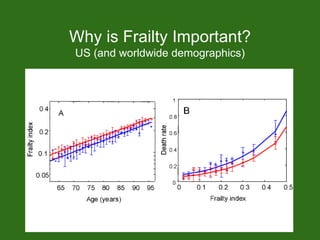
Why is Frailty Important?
US (and worldwide demographics)
Evans, Sayers, et. al.
Superior Predictor of Risk
Potential Causes of Frailty
• Multiple organ system decline
• Hypothalamic-pituitary-adrenal axis
• Immune dysfunction
– Increase interleukins, CRP
• Neuroendocrine
– Cortisol level increase
– Sex hormones decrease
– Growth hormones decrease
• Sarcopenia
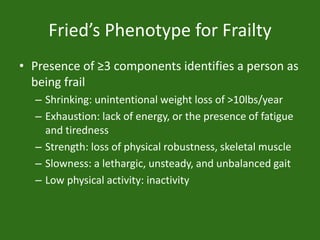
Fried’s Phenotype for Frailty
• Presence of ≥3 components identifies a person as
being frail
– Shrinking: unintentional weight loss of >10lbs/year
– Exhaustion: lack of energy, or the presence of fatigue
and tiredness
– Strength: loss of physical robustness, skeletal muscle
– Slowness: a lethargic, unsteady, and unbalanced gait
– Low physical activity: inactivity
Mayo Clin Proc. 2008 Oct; 83(10): 1146–1153.
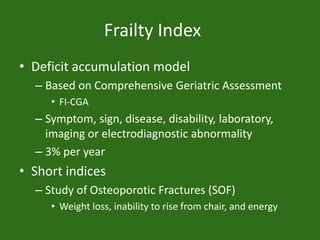
Frailty Index
• Deficit accumulation model
– Based on Comprehensive Geriatric Assessment
• FI-CGA
– Symptom, sign, disease, disability, laboratory,
imaging or electrodiagnostic abnormality
– 3% per year
• Short indices
– Study of Osteoporotic Fractures (SOF)
• Weight loss, inability to rise from chair, and energy
SUPERIORITY OF FRAILTY IN
PREDICTING OUTCOMES
• Geriatric trauma patients
• 2-year prospective cohort in Arizona
• 1° outcome: in-hospital complications
• 2° outcomes: adverse discharge disposition
• In-hospital complications (odds ratio, 2.5; 95% CI, 1.5-
6.0; P = .001)
• Adverse discharge disposition (odds ratio, 1.6; 95% CI,
1.1-2.4; P = .001)
• The mortality rate was 2.0% (n = 5), and all
patients who died had frailty. [JAMA Surg. 2014]
Photo by timtom.ch - Creative Commons Attribution-NonCommercial-ShareAlike License https://www.flickr.com/photos/19614198@N00 Created with Haiku Deck
Photo by colindunn - Creative Commons Attribution License https://www.flickr.com/photos/31192024@N05 Created with Haiku Deck
Drivers of Utilization
Expectations
Frailty
Severity
of
Illness
Photo by andrewmalone - Creative Commons Attribution License https://www.flickr.com/photos/41894170049@N01 Created with Haiku Deck
Does recognizing frailty
improve clinical care?
• Pre-operative evaluation
• Cardiovascular disease (Afilalo, et. al)
– OR of 2.7 to 4.1 for prevalent frailty
– OR of 1.5 for incident frailty not frail at baseline
– Frailty <--> CVD
• Contextualize risk and set expectations
Photo by Leo Reynolds - Creative Commons Attribution-NonCommercial-ShareAlike License https://www.flickr.com/photos/49968232@N00 Created with Haiku Deck
Operationalizing Frailty
• Emergency Room Screening
• Transitions of Care to PAC/SNF
• Palliative Care
• Medical Home
• Screening for Post-Operative Outcomes
• Telemedicine – Appropriate Patient Selection
• Reduce Re-Hospitalization
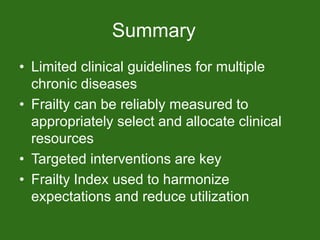
Summary
• Limited clinical guidelines for multiple
chronic diseases
• Frailty can be reliably measured to
appropriately select and allocate clinical
resources
• Targeted interventions are key
• Frailty Index used to harmonize
expectations and reduce utilization
Photo by Luminitsa - Creative Commons Attribution-NonCommercial-ShareAlike License https://www.flickr.com/photos/33393452@N00 Created with Haiku Deck
References
• Robinson TN, Finlayson E. How to Best Forecast Adverse Outcomes Following Geriatric Trauma: An
Ageless Question?. JAMA Surg. 2014;149(8):773.
• Clegg A, Young J, Iliffe S, Rikkert MO, Rockwood K. Frailty in elderly people. Lancet.
2013;381(9868):752–62.
• Joseph B, Pandit V, Zangbar B, et al. Superiority of Frailty Over Age in Predicting Outcomes Among
Geriatric Trauma Patients: A Prospective Analysis. JAMA Surg. 2014;149(8):766-772.
• Lacas A, Rockwood K. Frailty in primary care: a review of its conceptualization and implications for
practice. BMC Medicine. 2012;10:4. doi:10.1186/1741-7015-10-4.
• Afilalo, Jonathan et al. Role of Frailty in Patients With Cardiovascular Disease. American Journal of
Cardiology , Volume 103 , Issue 11 , 1616 – 1621
• Pulignano G, Del Sindaco D. Usefulness of frailty profile for targeting older heart failure patients in
disease management programs: a cost-effectiveness, pilot study. J Cardiovasc Med (Hagerstown).
2010 Oct; 11(10):739-47.
• Hastings SN, Purser JL, Johnson KS, Sloane RJ, Whitson HE. Frailty predicts some but not all adverse
outcomes in older adults discharged from the emergency department. J Am Geriatr Soc.
2008;56:1651–1657
• Evans SJ, Sayers M, Rockwood K. The risk of adverse outcomes in hospitalized older patients in
relation to a frailty index based on a comprehensive geriatric assessment. Age Ageing. 2014
Jan;43(1):127-32

Frailty applications in practice

  • 1.
  • 2.
    Photo by Al_HikesAZ- Creative Commons Attribution-NonCommercial License https://www.flickr.com/photos/7202153@N03 Created with Haiku Deck
  • 5.
    Photo by jurvetson- Creative Commons Attribution License https://www.flickr.com/photos/44124348109@N01 Created with Haiku Deck
  • 7.
    Photo by woodleywonderworks- Creative Commons Attribution License https://www.flickr.com/photos/73645804@N00 Created with Haiku Deck
  • 8.
  • 9.
    Why is FrailtyImportant? US (and worldwide demographics)
  • 10.
  • 11.
  • 12.
    Potential Causes ofFrailty • Multiple organ system decline • Hypothalamic-pituitary-adrenal axis • Immune dysfunction – Increase interleukins, CRP • Neuroendocrine – Cortisol level increase – Sex hormones decrease – Growth hormones decrease • Sarcopenia
  • 15.
    Fried’s Phenotype forFrailty • Presence of ≥3 components identifies a person as being frail – Shrinking: unintentional weight loss of >10lbs/year – Exhaustion: lack of energy, or the presence of fatigue and tiredness – Strength: loss of physical robustness, skeletal muscle – Slowness: a lethargic, unsteady, and unbalanced gait – Low physical activity: inactivity
  • 16.
    Mayo Clin Proc.2008 Oct; 83(10): 1146–1153.
  • 17.
    Frailty Index • Deficitaccumulation model – Based on Comprehensive Geriatric Assessment • FI-CGA – Symptom, sign, disease, disability, laboratory, imaging or electrodiagnostic abnormality – 3% per year • Short indices – Study of Osteoporotic Fractures (SOF) • Weight loss, inability to rise from chair, and energy
  • 19.
    SUPERIORITY OF FRAILTYIN PREDICTING OUTCOMES • Geriatric trauma patients • 2-year prospective cohort in Arizona • 1° outcome: in-hospital complications • 2° outcomes: adverse discharge disposition • In-hospital complications (odds ratio, 2.5; 95% CI, 1.5- 6.0; P = .001) • Adverse discharge disposition (odds ratio, 1.6; 95% CI, 1.1-2.4; P = .001) • The mortality rate was 2.0% (n = 5), and all patients who died had frailty. [JAMA Surg. 2014]
  • 20.
    Photo by timtom.ch- Creative Commons Attribution-NonCommercial-ShareAlike License https://www.flickr.com/photos/19614198@N00 Created with Haiku Deck
  • 21.
    Photo by colindunn- Creative Commons Attribution License https://www.flickr.com/photos/31192024@N05 Created with Haiku Deck
  • 22.
  • 23.
    Photo by andrewmalone- Creative Commons Attribution License https://www.flickr.com/photos/41894170049@N01 Created with Haiku Deck
  • 24.
    Does recognizing frailty improveclinical care? • Pre-operative evaluation • Cardiovascular disease (Afilalo, et. al) – OR of 2.7 to 4.1 for prevalent frailty – OR of 1.5 for incident frailty not frail at baseline – Frailty <--> CVD • Contextualize risk and set expectations
  • 25.
    Photo by LeoReynolds - Creative Commons Attribution-NonCommercial-ShareAlike License https://www.flickr.com/photos/49968232@N00 Created with Haiku Deck
  • 27.
    Operationalizing Frailty • EmergencyRoom Screening • Transitions of Care to PAC/SNF • Palliative Care • Medical Home • Screening for Post-Operative Outcomes • Telemedicine – Appropriate Patient Selection • Reduce Re-Hospitalization
  • 28.
    Summary • Limited clinicalguidelines for multiple chronic diseases • Frailty can be reliably measured to appropriately select and allocate clinical resources • Targeted interventions are key • Frailty Index used to harmonize expectations and reduce utilization
  • 29.
    Photo by Luminitsa- Creative Commons Attribution-NonCommercial-ShareAlike License https://www.flickr.com/photos/33393452@N00 Created with Haiku Deck
  • 30.
    References • Robinson TN,Finlayson E. How to Best Forecast Adverse Outcomes Following Geriatric Trauma: An Ageless Question?. JAMA Surg. 2014;149(8):773. • Clegg A, Young J, Iliffe S, Rikkert MO, Rockwood K. Frailty in elderly people. Lancet. 2013;381(9868):752–62. • Joseph B, Pandit V, Zangbar B, et al. Superiority of Frailty Over Age in Predicting Outcomes Among Geriatric Trauma Patients: A Prospective Analysis. JAMA Surg. 2014;149(8):766-772. • Lacas A, Rockwood K. Frailty in primary care: a review of its conceptualization and implications for practice. BMC Medicine. 2012;10:4. doi:10.1186/1741-7015-10-4. • Afilalo, Jonathan et al. Role of Frailty in Patients With Cardiovascular Disease. American Journal of Cardiology , Volume 103 , Issue 11 , 1616 – 1621 • Pulignano G, Del Sindaco D. Usefulness of frailty profile for targeting older heart failure patients in disease management programs: a cost-effectiveness, pilot study. J Cardiovasc Med (Hagerstown). 2010 Oct; 11(10):739-47. • Hastings SN, Purser JL, Johnson KS, Sloane RJ, Whitson HE. Frailty predicts some but not all adverse outcomes in older adults discharged from the emergency department. J Am Geriatr Soc. 2008;56:1651–1657 • Evans SJ, Sayers M, Rockwood K. The risk of adverse outcomes in hospitalized older patients in relation to a frailty index based on a comprehensive geriatric assessment. Age Ageing. 2014 Jan;43(1):127-32