Concentric Zone Model Theory
Presentedby
Gayathry Satheesan
Concentric Zone Model Theory
It was created by sociologist EW Burgess in 1925.
Based on a study of land use patterns and social group in
Chicago.
City grows outward beginning with the CBD.
Similar & functionally related activities will locate at the same
distance from CBD.
Formation of zones is based on accessibility in distance to the
city center.
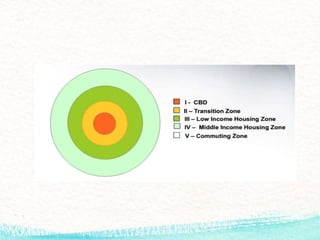
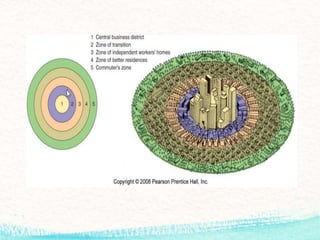
City is divided in to 5 concentric zones:
• Zone I Central Business District
• Zone II Zone of Transition
• Zone III Lower Income working People
• Zone IV High Income Residences
• Zone V Commuter Zone
Central Business District
• Social and civic life of city is found in this zone.
• It contains shopping areas, hotels, office buildings, banks,
theatres, wholesale centers, and other businesses.
• Public uses should be equidistant from the surrounding areas
• It also contains economic, political and cultural life of the city.
• City parks, marriage halls, higher order education facilities,
hospitals are also located in the center.
Zone of Transition
• Characterized by mixed pattern of industrial and residential
land use.
• This zone is identified by both area wise and population wise.
• This area may be slated for expansion if the business is good.
• The residential area also starts from this zone.
• Other identifying features of this zone are the old structures,
apartments ,residential slums and shabby homes.
Lower Income Working Zone
• Lower status residential area
• The "working men quarters"
• Solid blue-collar, located close to factories of zones 1 and 2
• More stable than the transition zone around the CBD
• Often characterized by ethnic neighborhoods
• Spreading outward because of pressure from transition zone
and because blue-collar workers demanded better housing
High Income Residences
• It contains large residential area of city.
• It is also called high class residential zone in the Concentric Zone
Model Theory
• Well decorated, undivided and costly constructed high class
residences are found in this zone.
• Buildings with high quality infrastructure and community facilities
are included in this zone.
• In most cases, this zone may be the most accessible area from all parts
of the city
Commuters' Zone
• In this zone, all the suburban communities found along
the arteries of transportation.
• As growth occurs, each inner zone of the generalized
diagram tends to invade the next outer zone.
Limitations
• Too simple and Static
• Limited in historical and cultural applications.
• It is a product of its time. (1950s)
• The model was developed for American cities and has
limited applicability elsewhere.
• Ignorance to the process of redevelopment
Thank you..

CONCENTRIC ZONE MODEL THEORY

  • 1.
    Concentric Zone ModelTheory Presentedby Gayathry Satheesan
  • 2.
    Concentric Zone ModelTheory It was created by sociologist EW Burgess in 1925. Based on a study of land use patterns and social group in Chicago. City grows outward beginning with the CBD. Similar & functionally related activities will locate at the same distance from CBD. Formation of zones is based on accessibility in distance to the city center.
  • 5.
    City is dividedin to 5 concentric zones: • Zone I Central Business District • Zone II Zone of Transition • Zone III Lower Income working People • Zone IV High Income Residences • Zone V Commuter Zone
  • 6.
    Central Business District •Social and civic life of city is found in this zone. • It contains shopping areas, hotels, office buildings, banks, theatres, wholesale centers, and other businesses. • Public uses should be equidistant from the surrounding areas • It also contains economic, political and cultural life of the city. • City parks, marriage halls, higher order education facilities, hospitals are also located in the center.
  • 7.
    Zone of Transition •Characterized by mixed pattern of industrial and residential land use. • This zone is identified by both area wise and population wise. • This area may be slated for expansion if the business is good. • The residential area also starts from this zone. • Other identifying features of this zone are the old structures, apartments ,residential slums and shabby homes.
  • 8.
    Lower Income WorkingZone • Lower status residential area • The "working men quarters" • Solid blue-collar, located close to factories of zones 1 and 2 • More stable than the transition zone around the CBD • Often characterized by ethnic neighborhoods • Spreading outward because of pressure from transition zone and because blue-collar workers demanded better housing
  • 9.
    High Income Residences •It contains large residential area of city. • It is also called high class residential zone in the Concentric Zone Model Theory • Well decorated, undivided and costly constructed high class residences are found in this zone. • Buildings with high quality infrastructure and community facilities are included in this zone. • In most cases, this zone may be the most accessible area from all parts of the city
  • 10.
    Commuters' Zone • Inthis zone, all the suburban communities found along the arteries of transportation. • As growth occurs, each inner zone of the generalized diagram tends to invade the next outer zone.
  • 11.
    Limitations • Too simpleand Static • Limited in historical and cultural applications. • It is a product of its time. (1950s) • The model was developed for American cities and has limited applicability elsewhere. • Ignorance to the process of redevelopment
  • 12.