INTERNAL COMBUSTION ENGINES-II Combustion 
University of Petroleum & Energy Studies 
Dehradun
I C ENGINES - II Air Motion & Combustion 
•Fuel - Air Mixing and Combustion : 
-The air motion so organized inside the combustion 
chamber and the turbulence of the air passes across the fuel jet tears it into fine particles. 
- A mixture of air and fuel forms at some location in the spray envelope and oxidation starts 
- The liquid fuel droplets initially evaporate and then get heated up , and A/F ratio ( local ) within combustible range , autoignite.
I C ENGINES - II Air Motion & Combustion 
•Combustion in CI Engines 
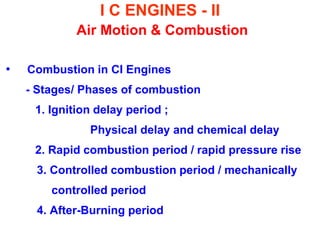
- Stages/ Phases of combustion 
1. Ignition delay period ; 
Physical delay and chemical delay 
2. Rapid combustion period / rapid pressure rise 
3. Controlled combustion period / mechanically 
controlled period 
4. After-Burning period
I C ENGINES - II Air Motion & Combustion 
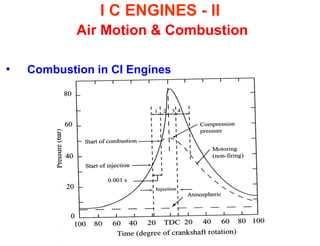
•Combustion in CI Engines
I C ENGINES - II Air Motion & Combustion 
Stages/ Phases of combustion 
1. Ignition delay period ; 
- Preparatory phase:some fuel admitted,not ignited 
- Period : start of injection to start of combustion 
(p-t curve separates from motoring curve) - Important : combustion, design, performance, 
emissions 
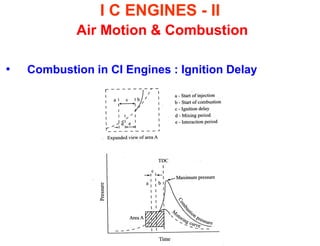
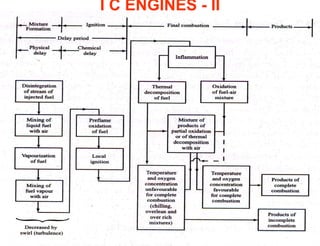
- Fuel does not ignite immediately and total delay period can be explained as; Physical delay and Chemical delay. Details are shown in the figure.
I C ENGINES - II Air Motion & Combustion 
•Combustion in CI Engines : Ignition Delay
I C ENGINES - II Air Motion & Combustion 
Stages/ Phases of combustion 
Physical delay : 
- period ; from beginning of injection to attainment 
of chemical reactions. 
- process; atomization, vaporization, mixing of fuel 
& air, raising to self-ignition temperature 
- depends on; fuel,air motion,combustion chamber
I C ENGINES - II Air Motion & Combustion 
Stages/ Phases of combustion 
Chemical delay : 
- Period ; from beginning of chemical reactions to 
auto-ignition 
- process ; pre-reactions in the mixture taking place 
up to auto-ignition that occurs at a local 
excess-air factor of 0.5 < λ < 0.7 
- depends ; chemical reactions are faster at higher temperature of the surroundings and accordingly the chemical delay becomes shorter.
I C ENGINES - II Air Motion & Combustion 
Stages/ Phases of combustion 
2. Rapid combustion period / rapid pressure rise 
- This is the phase of combustion when the rate of pressure rise is maximum and is also called uncontrolled combustion phase.The rate of heat release is maximum during this phase. 
- period ; from end of delay or beginning of 
combustion to the point of maximum pressure on 
indicator diagram 
- process ; most of the fuel would have formed combustible mixture with air and preflame reactions
I C ENGINES - II Air Motion & Combustion 
Stages/ Phases of combustion 
completed so that the layers of fuel vapours burn as fast as they can find fresh oxygen to continue the combustion process 
- depends ; It may be noted that the maximum pressure reached during this phase depends upon the delay period. Longer the delay the higher is the rate of pressure rise as more fuel gets accumulated 
during the delay period.
I C ENGINES - II Air Motion & Combustion 
- Stages/ Phases of combustion 
3. Controlled combustion period / mechanically 
controlled period 
- This is the phase of combustion when very steep rate of pressure rise has changed to much slower rate of pressure rise. 
- process ; This is the second phase of fuel injection when injected fuel finds more difficult to seek out and react with fresh oxygen in the remaining unburnt air mass. 
- period ; from the point of maximum pressure to the
I C ENGINES - II Air Motion & Combustion 
- Stages/ Phases of combustion 
point of maximum cycle temperature. 
- depends ; crank-angle duration of fuel injection as per load requirements (higher and full load power out-put ). Therefore, this is mechanically controlled by the injection pump out put characteristics. Prolongation of this variable period is determined by the amount of additional fuel supplied above that needed for no- load running.
I C ENGINES - II Air Motion & Combustion 
4. After-Burning period : fuel with the air 
- Combustion does not cease with completion of fuel 
injection.The unburnt and partially burnt fuel particles 
start burning as soon as they come in contact with 
oxygen. This continue for a certain duration called 
after- burning period. 
- period ; starts from the point of max.cycle temp. and 
continue over the part of expansion process. 
- depends ; rate of after burning depends upon velocity 
of diffusion and turbulent mixing of unburnt and 
partially burnt fuel with the air
I C ENGINES - II Air Motion & Combustion
I C ENGINES - II Air Motion & Combustion 
•Factors Affecting the Delay Period : 
Many design and Operating factors affect the delay period. Some of the significant factors are; 
- Compression ratio 
- Engine speed 
- Output 
- Atomization of fuel and duration of injection 
- Injection timing 
- Quality of fuel 
- Intake temperature and pressure
I C ENGINES - II Air Motion & Combustion 
•Factors Affecting the Delay Period : 
- Compression ratio (CR ) 
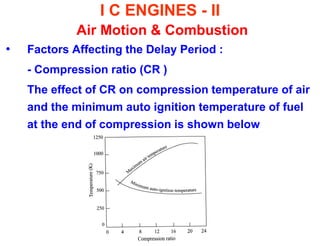
The effect of CR on compression temperature of air and the minimum auto ignition temperature of fuel at the end of compression is shown below
I C ENGINES - II Air Motion & Combustion 
•Factors Affecting the Delay Period : 
- It can be seen that the comp. temp. increases and the auto ignition temp.decreases due to increased density of air resulting in closer contact between molecules of air and fuel, thereby reducing the time of reaction and consequently the delay period. 
- The peak pressure is only marginally affected due to lower rate of pressure rise whereas mechanical efficiency decreases. 
- Optimum CR required considering cold starting & 
light loads at high speeds.
I C ENGINES - II Air Motion & Combustion 
•Factors Affecting the Delay Period : 
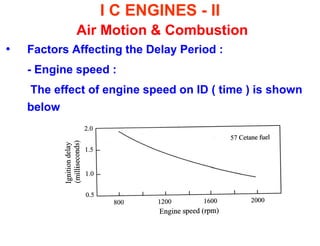
- Engine speed : 
The effect of engine speed on ID ( time ) is shown below
I C ENGINES - II Air Motion & Combustion 
•Factors Affecting the Delay Period : 
- It can be seen that delay period in milliseconds decreases with increase in speed. With increase in speed, the heat loss during compression decreases 
resulting in rise in temp. & press. and therefore reducing the delay period. 
- However, in ºCA the delay period increases as engine operate at higher rpm. The amount of fuel injected during delay period increases (as fuel pump is geared to engine) resulting in high rate of press. rise during second stage of combustion.
I C ENGINES - II Air Motion & Combustion 
•Factors Affecting the Delay Period : 
- Output : 
With increase load or output, the amount of fuel injected ( at constant rpm ) increases and therefore the air-fuel decreases and results in increase in temperature thereby reducing delay period. 
- The rate of pressure rise is unaffected but the peak 
pressure may be high.
I C ENGINES - II Air Motion & Combustion 
•Factors Affecting the Delay Period : 
- Atomization of fuel and duration of injection : 
Higher fuel-injection press. increases the degree (fineness) of atomization which reduces ignition delay due to higher surface to volume ratio. 
- Smaller droplets have low depth of penetration due to less momentum. Such droplets have less velocity relative to air and shorter fuel spray path, where it has to find oxygen after vaporization affecting air utilization factor. Also the aggregate area of inflammation after ignition will increase resulting in
I C ENGINES - II Air Motion & Combustion 
•Factors Affecting the Delay Period : 
higher pressure rise during second stage of combustion. 
- On the other hand, lower injection pressure giving larger droplets give lower pressure rise and soother 
running. 
- An optimum group mean diameter of the droplet should be attempted with appropriate fuel delivery characteristics.
I C ENGINES - II Air Motion & Combustion 
•Factors Affecting the Delay Period : 
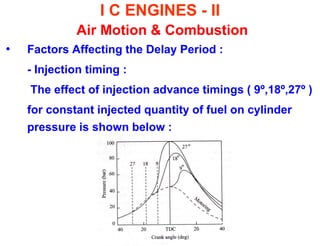
- Injection timing : 
The effect of injection advance timings ( 9º,18º,27º ) 
for constant injected quantity of fuel on cylinder pressure is shown below :
I C ENGINES - II Air Motion & Combustion 
•Factors Affecting the Delay Period : 
- As pressure and temperature at the begning of injection are lower for higher injection advance, the 
delay period increases with increase in injection advance. 
- The optimum angle of advance depends on many factors. Generally it is about 20º bTDC.
I C ENGINES - II Air Motion & Combustion 
•Factors Affecting the Delay Period : 
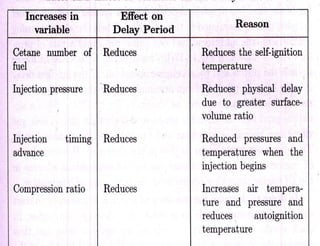
- Quality of fuel 
Self ignition temperature is the most important property of fuel which affects the delay period. A lower self-ignition temperature results in lower delay period. 
- Fuels with higher cetane number give lower delay. 
Other properties of fuel which affect delay period include volatility, latent heat, viscosity and surface tension.
I C ENGINES - II Air Motion & Combustion 
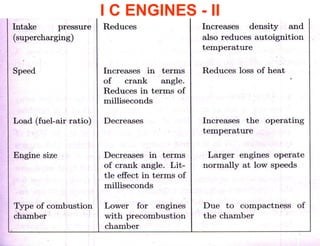
•Factors Affecting the Delay Period : 
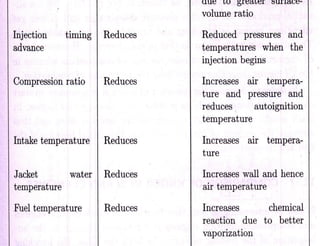
- Intake temperature and pressure : 
Increase in intake temp. increases compressed air temp. resulting in reduced delay period. Preheating 
may not be desirable as it reduces density of air affecting volumetric efficiency and power. 
- Increase in intake pressure reduces the auto - ignition temp. and hence the delay period. The peak pressure will be higher as compression pressure will be higher with higher intake pressure.
I C ENGINES - II Air Motion & Combustion
I C ENGINES - II Air Motion & Combustion 
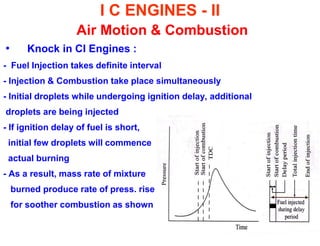
•Knock in CI Engines : 
- Fuel Injection takes definite interval 
- Injection & Combustion take place simultaneously 
- Initial droplets while undergoing ignition delay, additional 
droplets are being injected 
- If ignition delay of fuel is short, 
initial few droplets will commence 
actual burning 
- As a result, mass rate of mixture 
burned produce rate of press. rise 
for soother combustion as shown
I C ENGINES - II Air Motion & Combustion 
•Knock in CI Engines : 
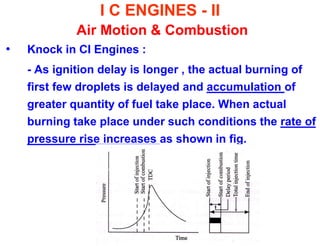
- As ignition delay is longer , the actual burning of first few droplets is delayed and accumulation of greater quantity of fuel take place. When actual burning take place under such conditions the rate of pressure rise increases as shown in fig.
I C ENGINES - II Air Motion & Combustion 
•Knock in CI Engines : 
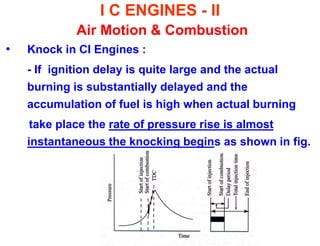
- If ignition delay is quite large and the actual burning is substantially delayed and the accumulation of fuel is high when actual burning 
take place the rate of pressure rise is almost instantaneous the knocking begins as shown in fig.
I C ENGINES - II Air Motion & Combustion 
•Knock in CI Engines : 
- Knocking is characterized by extreme pressure differentials and violent gas vibrations evidenced by audible knock. 
- In CI engines knocking occurs in the beginning of combustion. 
- In order to decrease knocking the actual burning should start as early as possible after the fuel injection begins. 
- It has been found that provided the rate of press. rise does not exceed 3 bar per ºCA combustion is
I C ENGINES - II Air Motion & Combustion 
•Knock in CI Engines : 
- smooth. Between 3 to 4 bar there is tendency to knock, above this rate of pressure rise the diesel knock will be prominent. 
- Normally audible knock is always present in CI engines, when it becomes sever and cause heavy vibrations in the engine , it is said to be knocking. It 
is, therefore, a matter of judgment. 
- Low ignition temp., ignition delay & speed reduce knock as also higher CR, Inlet Temp. & press., comb. wall temp. cylinder size
I C ENGINES - II Air Motion & Combustion 
Combustion Chambers for C.I. Engines 
CI combustion chamber : 
- provide proper mixing of fuel and air in short time 
- An organized air movement ; 
swirl, turbulence,squish 
- produce high relative velocity between fuel droplets and air 
- Shape of combustion chamber control air motion 
- CI engines classified as ; 
Direct- Injection (DI) & Indirect- Injection (IDI)
I C ENGINES - II Air Motion & Combustion 
Combustion Chambers for C.I. Engines 
CI combustion chamber : 
Direct- Injection (DI) 
- entire volume of combustion chamber located in 
main cylinder where fuel is injected. Also called 
open combustion chamber. 
Indirect- Injection (IDI) 
- Combustion space divided into two parts ; 
one part main cyl. & other part in cylinder head
I C ENGINES - II Air Motion & Combustion 
Combustion Chambers for C.I. Engines 
Indirect- Injection (IDI) 
- Classified as : 
1. Swirl chamber ; 
compression swirl generated 
2. Precombustion chamber ; 
combustion swirl induced 
3. Air cell chamber ; 
compression & combustion swirl induced
IC ENGINES-II Air Motion & Combustion 
Course Outlines ADEG-222 LTP-3 1 1 
I: BASIC THEORY 
II: FUEL INJECTION SYSTEM 
III: AIR MOTION, COBUSTION & COMBUSTION CHAMBERS 
IV: SUPERCHARGING and TUBOCHARGING 
V: DIESEL ENGINE TESTING & PERFORMAMCE 
VI: DIESEL ENGINE Emissions AND their Control Technology

CI Engine Knocking

  • 1.
    INTERNAL COMBUSTION ENGINES-IICombustion University of Petroleum & Energy Studies Dehradun
  • 2.
    I C ENGINES- II Air Motion & Combustion •Fuel - Air Mixing and Combustion : -The air motion so organized inside the combustion chamber and the turbulence of the air passes across the fuel jet tears it into fine particles. - A mixture of air and fuel forms at some location in the spray envelope and oxidation starts - The liquid fuel droplets initially evaporate and then get heated up , and A/F ratio ( local ) within combustible range , autoignite.
  • 3.
    I C ENGINES- II Air Motion & Combustion •Combustion in CI Engines - Stages/ Phases of combustion 1. Ignition delay period ; Physical delay and chemical delay 2. Rapid combustion period / rapid pressure rise 3. Controlled combustion period / mechanically controlled period 4. After-Burning period
  • 4.
    I C ENGINES- II Air Motion & Combustion •Combustion in CI Engines
  • 5.
    I C ENGINES- II Air Motion & Combustion Stages/ Phases of combustion 1. Ignition delay period ; - Preparatory phase:some fuel admitted,not ignited - Period : start of injection to start of combustion (p-t curve separates from motoring curve) - Important : combustion, design, performance, emissions - Fuel does not ignite immediately and total delay period can be explained as; Physical delay and Chemical delay. Details are shown in the figure.
  • 6.
    I C ENGINES- II Air Motion & Combustion •Combustion in CI Engines : Ignition Delay
  • 7.
    I C ENGINES- II Air Motion & Combustion Stages/ Phases of combustion Physical delay : - period ; from beginning of injection to attainment of chemical reactions. - process; atomization, vaporization, mixing of fuel & air, raising to self-ignition temperature - depends on; fuel,air motion,combustion chamber
  • 8.
    I C ENGINES- II Air Motion & Combustion Stages/ Phases of combustion Chemical delay : - Period ; from beginning of chemical reactions to auto-ignition - process ; pre-reactions in the mixture taking place up to auto-ignition that occurs at a local excess-air factor of 0.5 < λ < 0.7 - depends ; chemical reactions are faster at higher temperature of the surroundings and accordingly the chemical delay becomes shorter.
  • 9.
    I C ENGINES- II Air Motion & Combustion Stages/ Phases of combustion 2. Rapid combustion period / rapid pressure rise - This is the phase of combustion when the rate of pressure rise is maximum and is also called uncontrolled combustion phase.The rate of heat release is maximum during this phase. - period ; from end of delay or beginning of combustion to the point of maximum pressure on indicator diagram - process ; most of the fuel would have formed combustible mixture with air and preflame reactions
  • 10.
    I C ENGINES- II Air Motion & Combustion Stages/ Phases of combustion completed so that the layers of fuel vapours burn as fast as they can find fresh oxygen to continue the combustion process - depends ; It may be noted that the maximum pressure reached during this phase depends upon the delay period. Longer the delay the higher is the rate of pressure rise as more fuel gets accumulated during the delay period.
  • 11.
    I C ENGINES- II Air Motion & Combustion - Stages/ Phases of combustion 3. Controlled combustion period / mechanically controlled period - This is the phase of combustion when very steep rate of pressure rise has changed to much slower rate of pressure rise. - process ; This is the second phase of fuel injection when injected fuel finds more difficult to seek out and react with fresh oxygen in the remaining unburnt air mass. - period ; from the point of maximum pressure to the
  • 12.
    I C ENGINES- II Air Motion & Combustion - Stages/ Phases of combustion point of maximum cycle temperature. - depends ; crank-angle duration of fuel injection as per load requirements (higher and full load power out-put ). Therefore, this is mechanically controlled by the injection pump out put characteristics. Prolongation of this variable period is determined by the amount of additional fuel supplied above that needed for no- load running.
  • 13.
    I C ENGINES- II Air Motion & Combustion 4. After-Burning period : fuel with the air - Combustion does not cease with completion of fuel injection.The unburnt and partially burnt fuel particles start burning as soon as they come in contact with oxygen. This continue for a certain duration called after- burning period. - period ; starts from the point of max.cycle temp. and continue over the part of expansion process. - depends ; rate of after burning depends upon velocity of diffusion and turbulent mixing of unburnt and partially burnt fuel with the air
  • 14.
    I C ENGINES- II Air Motion & Combustion
  • 15.
    I C ENGINES- II Air Motion & Combustion •Factors Affecting the Delay Period : Many design and Operating factors affect the delay period. Some of the significant factors are; - Compression ratio - Engine speed - Output - Atomization of fuel and duration of injection - Injection timing - Quality of fuel - Intake temperature and pressure
  • 16.
    I C ENGINES- II Air Motion & Combustion •Factors Affecting the Delay Period : - Compression ratio (CR ) The effect of CR on compression temperature of air and the minimum auto ignition temperature of fuel at the end of compression is shown below
  • 17.
    I C ENGINES- II Air Motion & Combustion •Factors Affecting the Delay Period : - It can be seen that the comp. temp. increases and the auto ignition temp.decreases due to increased density of air resulting in closer contact between molecules of air and fuel, thereby reducing the time of reaction and consequently the delay period. - The peak pressure is only marginally affected due to lower rate of pressure rise whereas mechanical efficiency decreases. - Optimum CR required considering cold starting & light loads at high speeds.
  • 18.
    I C ENGINES- II Air Motion & Combustion •Factors Affecting the Delay Period : - Engine speed : The effect of engine speed on ID ( time ) is shown below
  • 19.
    I C ENGINES- II Air Motion & Combustion •Factors Affecting the Delay Period : - It can be seen that delay period in milliseconds decreases with increase in speed. With increase in speed, the heat loss during compression decreases resulting in rise in temp. & press. and therefore reducing the delay period. - However, in ºCA the delay period increases as engine operate at higher rpm. The amount of fuel injected during delay period increases (as fuel pump is geared to engine) resulting in high rate of press. rise during second stage of combustion.
  • 20.
    I C ENGINES- II Air Motion & Combustion •Factors Affecting the Delay Period : - Output : With increase load or output, the amount of fuel injected ( at constant rpm ) increases and therefore the air-fuel decreases and results in increase in temperature thereby reducing delay period. - The rate of pressure rise is unaffected but the peak pressure may be high.
  • 21.
    I C ENGINES- II Air Motion & Combustion •Factors Affecting the Delay Period : - Atomization of fuel and duration of injection : Higher fuel-injection press. increases the degree (fineness) of atomization which reduces ignition delay due to higher surface to volume ratio. - Smaller droplets have low depth of penetration due to less momentum. Such droplets have less velocity relative to air and shorter fuel spray path, where it has to find oxygen after vaporization affecting air utilization factor. Also the aggregate area of inflammation after ignition will increase resulting in
  • 22.
    I C ENGINES- II Air Motion & Combustion •Factors Affecting the Delay Period : higher pressure rise during second stage of combustion. - On the other hand, lower injection pressure giving larger droplets give lower pressure rise and soother running. - An optimum group mean diameter of the droplet should be attempted with appropriate fuel delivery characteristics.
  • 23.
    I C ENGINES- II Air Motion & Combustion •Factors Affecting the Delay Period : - Injection timing : The effect of injection advance timings ( 9º,18º,27º ) for constant injected quantity of fuel on cylinder pressure is shown below :
  • 24.
    I C ENGINES- II Air Motion & Combustion •Factors Affecting the Delay Period : - As pressure and temperature at the begning of injection are lower for higher injection advance, the delay period increases with increase in injection advance. - The optimum angle of advance depends on many factors. Generally it is about 20º bTDC.
  • 25.
    I C ENGINES- II Air Motion & Combustion •Factors Affecting the Delay Period : - Quality of fuel Self ignition temperature is the most important property of fuel which affects the delay period. A lower self-ignition temperature results in lower delay period. - Fuels with higher cetane number give lower delay. Other properties of fuel which affect delay period include volatility, latent heat, viscosity and surface tension.
  • 26.
    I C ENGINES- II Air Motion & Combustion •Factors Affecting the Delay Period : - Intake temperature and pressure : Increase in intake temp. increases compressed air temp. resulting in reduced delay period. Preheating may not be desirable as it reduces density of air affecting volumetric efficiency and power. - Increase in intake pressure reduces the auto - ignition temp. and hence the delay period. The peak pressure will be higher as compression pressure will be higher with higher intake pressure.
  • 27.
    I C ENGINES- II Air Motion & Combustion
  • 28.
    I C ENGINES- II Air Motion & Combustion
  • 29.
    I C ENGINES- II Air Motion & Combustion
  • 30.
    I C ENGINES- II Air Motion & Combustion •Knock in CI Engines : - Fuel Injection takes definite interval - Injection & Combustion take place simultaneously - Initial droplets while undergoing ignition delay, additional droplets are being injected - If ignition delay of fuel is short, initial few droplets will commence actual burning - As a result, mass rate of mixture burned produce rate of press. rise for soother combustion as shown
  • 31.
    I C ENGINES- II Air Motion & Combustion •Knock in CI Engines : - As ignition delay is longer , the actual burning of first few droplets is delayed and accumulation of greater quantity of fuel take place. When actual burning take place under such conditions the rate of pressure rise increases as shown in fig.
  • 32.
    I C ENGINES- II Air Motion & Combustion •Knock in CI Engines : - If ignition delay is quite large and the actual burning is substantially delayed and the accumulation of fuel is high when actual burning take place the rate of pressure rise is almost instantaneous the knocking begins as shown in fig.
  • 33.
    I C ENGINES- II Air Motion & Combustion •Knock in CI Engines : - Knocking is characterized by extreme pressure differentials and violent gas vibrations evidenced by audible knock. - In CI engines knocking occurs in the beginning of combustion. - In order to decrease knocking the actual burning should start as early as possible after the fuel injection begins. - It has been found that provided the rate of press. rise does not exceed 3 bar per ºCA combustion is
  • 34.
    I C ENGINES- II Air Motion & Combustion •Knock in CI Engines : - smooth. Between 3 to 4 bar there is tendency to knock, above this rate of pressure rise the diesel knock will be prominent. - Normally audible knock is always present in CI engines, when it becomes sever and cause heavy vibrations in the engine , it is said to be knocking. It is, therefore, a matter of judgment. - Low ignition temp., ignition delay & speed reduce knock as also higher CR, Inlet Temp. & press., comb. wall temp. cylinder size
  • 35.
    I C ENGINES- II Air Motion & Combustion Combustion Chambers for C.I. Engines CI combustion chamber : - provide proper mixing of fuel and air in short time - An organized air movement ; swirl, turbulence,squish - produce high relative velocity between fuel droplets and air - Shape of combustion chamber control air motion - CI engines classified as ; Direct- Injection (DI) & Indirect- Injection (IDI)
  • 36.
    I C ENGINES- II Air Motion & Combustion Combustion Chambers for C.I. Engines CI combustion chamber : Direct- Injection (DI) - entire volume of combustion chamber located in main cylinder where fuel is injected. Also called open combustion chamber. Indirect- Injection (IDI) - Combustion space divided into two parts ; one part main cyl. & other part in cylinder head
  • 37.
    I C ENGINES- II Air Motion & Combustion Combustion Chambers for C.I. Engines Indirect- Injection (IDI) - Classified as : 1. Swirl chamber ; compression swirl generated 2. Precombustion chamber ; combustion swirl induced 3. Air cell chamber ; compression & combustion swirl induced
  • 38.
    IC ENGINES-II AirMotion & Combustion Course Outlines ADEG-222 LTP-3 1 1 I: BASIC THEORY II: FUEL INJECTION SYSTEM III: AIR MOTION, COBUSTION & COMBUSTION CHAMBERS IV: SUPERCHARGING and TUBOCHARGING V: DIESEL ENGINE TESTING & PERFORMAMCE VI: DIESEL ENGINE Emissions AND their Control Technology