ABCDEF bundle
ICU Liberation Bundle*
Fakhir Raza
SIUT
Acknowledgement: No changes are made in any slide
*www.iculiberation.org
ICU PAD Guidelines
2
ABCDEF Bundle Checklist*
 A – Assess, Prevent and Manage Pain
 B – Both SATsand SBTs
 C – Choice of Sedation
 D – Delirium: Assess, Prevent and Manage
 E – Early Mobility and Exercise
 F – Family Engagement and Empowerment
*www.iculiberation.org
ABCDEF Bundle Objectives
3
 Optimize pain management.
 Break the cycle of deep sedation and prolonged
mechanical ventilation.
 Reduce the incidence, duration of ICU delirium.
 Improve short, long-term ICU patient outcomes.
 Reduce health care costs!
14
Why a Bundle?
Improve ICU
Team
Communication
Reduce
Practice
Variation
Every Patient,
Every Time
Standardize
Care
Processes
Resar R, Pronovost P,et al. JQPC. 2005;31(5):243-248
http://www.ihi.org/resources/Pages/ImprovementStories/WhatIsaBundle.aspx
Better
Outcomes!
Other ICU Bundles
Sepsis
VAP
CRBSI
CAUTI
5
ABCDE Bundle Implementation
Study Design:
• Hypothesis: Implementing the ABCDE bundle   incidence of ICU delirium,
ICU acquired weakness
• Prospective, observational cohort, before/after study design
• N = 296 adult pts ( MV), single center, 7 ICUs/SDUs (2010 – 2012)
Interventions:
• Awakening and Breathing Coordination
• Delirium Monitoring/Management
• Early exercise/mobility
Outcomes:
• Ventilator-free days
• Prevalence/duration of delirium, coma (RASS = -4 or -5)
• ICU mobilization frequency
• ICU/hospital mortality, LOS, discharge disposition
ABCDE Bundle
*Balas, et al, Crit Care Med 2014; 42:1024–1036
6
ABCDE Bundle Implementation (cont.)
Results:
• Pre- vs. post- groups similar except age (59 yr. vs. 56 yr., P =0.05)
•  ventilator free days by 3 days (P = 0.04)
• Odds of developing delirium  by = 45% (adjusted, P = 0.03)
• Odds of patients getting out of bed  x2 (P = 0.003)
• No differences in safety outcomes (i.e., unplanned extubation, re-
intubation, tracheostomies, restraints)
• No differences in LOS, mortality, or discharge disposition
•  frequency of SATs,SBTs
• No differences in sedative, opioid use!
• No change in deep sedation!
*Balas, et al, Crit Care Med 2014; 42:1024–1036
7
20
PAD Protocol + SATs+ SBTs
Study Design:
• Hypothesis: Implementing an integrated PAD management protocol bundled with
SATsand SBTs improves ICU patient outcomes.
• Prospective, observational cohort, before/after study design
• N = 1,483 MV ICU patients admitted to a single 24-bed Trauma/Surgical ICU
(2009 - 2011)
Interventions:
• Integrated PAD Protocol  analgosedation, TSS (light sedation)
• PAD management linked to daily SATs,SBTs (single bundle).
Outcomes:
• Pain (NRS), RASS, CAM-ICU assessments
• Benzodiazepine use
• Delirium incidence
• MV duration
• ICU/hospital mortality, LOS, VAP rate
Dale CR, et al. Ann Am Thorac Soc. 2014;11:367-374.
PAD Protocol + SATs+ SBTs (cont.)
Results:
•  # of RASS, CAM-ICU assessments performed per day (P = 0.01).
•  mean hourly benzodiazepine dose by 34.8% (P = 0.01).
•  mean RASS scores (i.e., patients were less sedated) (P = 0.01)
• Multivariate Analyses: (i.e., SAP score, age, gender, weight)
– ICU delirium risk  by 33% (OR, 0.67; 95% CI, 0.49–0.91; P = 0.01)
– MV duration  by 17.6% (95% CI, 0.6–31.7%; P = 0.04).
– ICU LOS  12.4% (95% CI, 0.5–22.8%; P = 0.04)
– Hospital LOS  14% (95% CI, 2.0–24.5%; P = 0.02)
– No significant changes in VAP rate, mortality, or discharge status
Dale CR, et al. Ann Am Thorac Soc. 2014;11:367-374.
9
10
  Duration of MV
  ICU, hospital LOS
  ICU patient throughput, bed availability
  Health care costs per patient
  Long-term cognitive function, mobility
  Number of patients discharged to home!
  Lives saved!
But by how much?????
ICU LIBERATION
11
Liberation from:
• The ventilator
• Deep sedation
• The bed/immobility
• Delirium
• PTSD
• Death
Implementation – Clinical Perspective
• A – Assess, Prevent and Manage Pain
• B – Both spontaneous Awakening trials (SAT)
& spontaneous Breathing trials (SBT)
• C – Choice of Analgesia and Sedation
• D – Delirium - Assess, Prevent and Manage
• E – Early Mobility and Exercise
• F – Family Engagement and Empowerment
The Entire Bundle Begins With Reduction of
sedation levels!
28
SCCM ICU Liberation 2015 ICULiberation.org
Implementation – Clinical Perspective
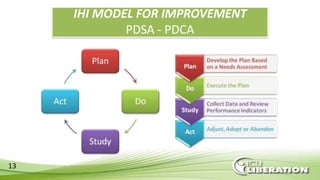
IHI MODEL FOR IMPROVEMENT
PDSA - PDCA
13
Build a New ‘Normal’
14
“You never change things by fighting
the existing reality. Tochange
something, build a new model that
makes the existing model obsolete.”
~R. Buckminster Fuller
ABCDEF
Assess, Prevent and Manage Pain
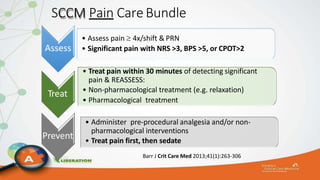
SCCM Pain CareBundle
Assess
• Assess pain  4x/shift & PRN
• Significant pain with NRS >3, BPS >5, or CPOT>2
Treat
• Treat pain within 30 minutes of detecting significant
pain & REASSESS:
• Non-pharmacological treatment (e.g. relaxation)
• Pharmacological treatment
Prevent
• Administer pre-procedural analgesia and/or non-
pharmacological interventions
• Treat pain first, then sedate
Barr J Crit Care Med 2013;41(1):263-306
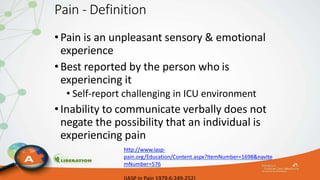
Pain - Definition
•Pain is an unpleasant sensory & emotional
experience
•Best reported by the person who is
experiencing it
• Self-report challenging in ICU environment
•Inability to communicate verbally does not
negate the possibility that an individual is
experiencing pain
http://www.iasp-
pain.org/Education/Content.aspx?ItemNumber=1698&navIte
mNumber=576
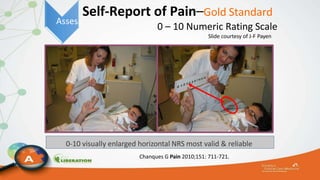
Self-Report of Pain–Gold Standard
0 – 10 Numeric Rating Scale
Slide courtesy of J-F Payen
0-10 visually enlarged horizontal NRS most valid & reliable
Chanques G Pain 2010;151: 711-721.
Assess
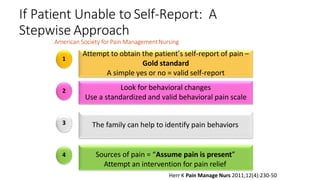
If Patient Unable to Self-Report: A
Stepwise Approach
American Society for Pain ManagementNursing
Attempt to obtain the patient’s self-report of pain –
Gold standard
A simple yes or no = valid self-report
Look for behavioral changes
Use a standardized and valid behavioral pain scale
The family can help to identify pain behaviors
Sources of pain = “Assume pain is present”
Attempt an intervention for pain relief
Herr K Pain Manage Nurs 2011;12(4):230-50
1
2
3
4
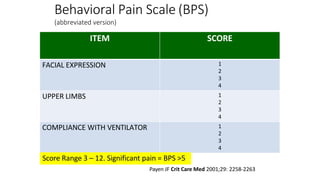
Behavioral Pain Scale (BPS)
(abbreviated version)
ITEM SCORE
FACIAL EXPRESSION 1
2
3
4
UPPER LIMBS 1
2
3
4
COMPLIANCE WITH VENTILATOR 1
2
3
4
Score Range 3 – 12. Significant pain = BPS >5
Payen JF Crit Care Med 2001;29: 2258-2263
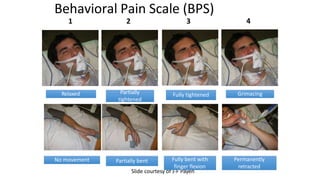
Behavioral Pain Scale (BPS)
1 2 3 4
Slide courtesy of J-F Payen
Relaxed Partially
tightened
Fully tightened Grimacing
No movement Partially bent Fully bent with
finger flexion
Permanently
retracted
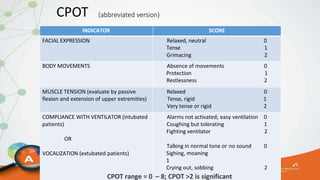
CPOT (abbreviated version)
INDICATOR SCORE
FACIAL EXPRESSION Relaxed, neutral 0
Tense 1
Grimacing 2
BODY MOVEMENTS Absence of movements 0
Protection 1
Restlessness 2
MUSCLE TENSION (evaluate by passive
flexion and extension of upper extremities)
Relaxed 0
Tense, rigid 1
Very tense or rigid 2
COMPLIANCE WITH VENTILATOR (intubated
patients)
OR
VOCALIZATION (extubated patients)
Alarms not activated; easy ventilation 0
Coughing but tolerating 1
Fighting ventilator 2
Talking in normal tone or no sound 0
Sighing, moaning
1
Crying out, sobbing 2
CPOT range = 0 – 8; CPOT >2 is significant
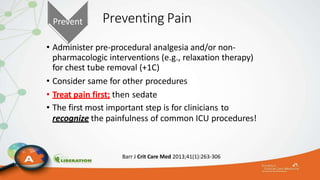
Preventing Pain
• Administer pre-procedural analgesia and/or non-
pharmacologic interventions (e.g., relaxation therapy)
for chest tube removal (+1C)
• Consider same for other procedures
• Treat pain first; then sedate
• The first most important step is for clinicians to
recognize the painfulness of common ICU procedures!
Barr J Crit Care Med 2013;41(1):263-306
Prevent
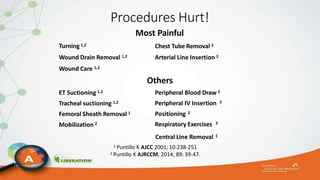
Procedures Hurt!
Turning 1,2
Most Painful
Chest Tube Removal 2
Wound Drain Removal 1,2 Arterial Line Insertion 2
Wound Care 1,2
Others
Peripheral Blood Draw 2
2Peripheral IV Insertion
Positioning 2
ET Suctioning 1,2
Tracheal suctioning 1,2
Femoral Sheath Removal 1
Mobilization 2 Respiratory Exercises 2
Central Line Removal 1
1 Puntillo K AJCC 2001; 10:238-251
2 Puntillo K AJRCCM, 2014; 89: 39-47.
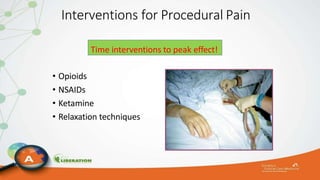
Interventions for Procedural Pain
• Opioids
• NSAIDs
• Ketamine
• Relaxation techniques
Time interventions to peak effect!
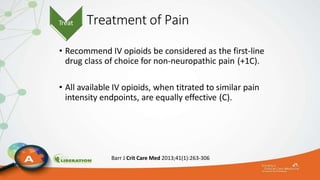
Treatment of Pain
• Recommend IV opioids be considered as the first-line
drug class of choice for non-neuropathic pain (+1C).
• All available IV opioids, when titrated to similar pain
intensity endpoints, are equally effective (C).
Barr J Crit Care Med 2013;41(1):263-306
Treat
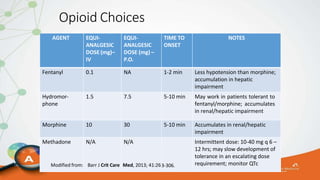
Opioid Choices
AGENT EQUI-
ANALGESIC
DOSE (mg)–
IV
EQUI-
ANALGESIC
DOSE (mg) –
P.O.
TIME TO
ONSET
NOTES
Fentanyl 0.1 NA 1-2 min Less hypotension than morphine;
accumulation in hepatic
impairment
Hydromor-
phone
1.5 7.5 5-10 min May work in patients tolerant to
fentanyl/morphine; accumulates
in renal/hepatic impairment
Morphine 10 30 5-10 min Accumulates in renal/hepatic
impairment
Methadone
Modified from:
N/A
Barr J Crit Care
N/A
Med, 2013; 41:263-306.
Intermittent dose: 10-40 mg q 6 –
12 hrs; may slow development of
tolerance in an escalating dose
requirement; monitor QTc
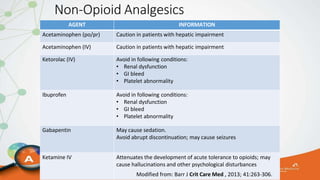
Non-Opioid Analgesics
AGENT INFORMATION
Acetaminophen (po/pr) Caution in patients with hepatic impairment
Acetaminophen (IV) Caution in patients with hepatic impairment
Ketorolac (IV) Avoid in following conditions:
• Renal dysfunction
• GI bleed
• Platelet abnormality
Ibuprofen Avoid in following conditions:
• Renal dysfunction
• GI bleed
• Platelet abnormality
Gabapentin May cause sedation.
Avoid abrupt discontinuation; may cause seizures
Ketamine IV Attenuates the development of acute tolerance to opioids; may
cause hallucinations and other psychological disturbances
Modified from: Barr J Crit Care Med , 2013; 41:263-306.
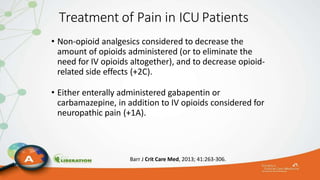
Treatment of Pain in ICUPatients
• Non-opioid analgesics considered to decrease the
amount of opioids administered (or to eliminate the
need for IV opioids altogether), and to decrease opioid-
related side effects (+2C).
• Either enterally administered gabapentin or
carbamazepine, in addition to IV opioids considered for
neuropathic pain (+1A).
Barr J Crit Care Med, 2013; 41:263-306.
What to remember – Pain Assessment
• Assessment of pain should not only be done
at rest, but also during care procedures as
well as before & after the administration of
an analgesic
• Always try to obtain the patient’s self-report
of pain
• When the patient’s self-report is impossible
to obtain, use a validated behavioral pain
scale such as the CPOT or BPS
What to remember – Pain Assessment
• Not all patient will need opioids, so
maximize non-opioids first when able
• Pain contributes to agitation & delirium,
so treat to pain first
• Validated tools in general ICU are the
best starting points for assessment in
difficult populations
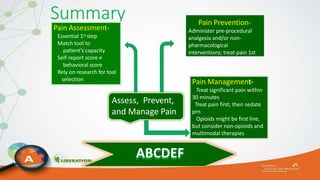
Summary
ABCDEF
Assess, Prevent,
and Manage Pain
Pain Assessment-
Essential 1st step
Match tool to
patient’s capacity
Self-report score ≠
behavioral score
Rely on research for tool
selection
Pain Management-
Treat significant pain within
30 minutes
Treat pain first; then sedate
prn
Opioids might be first line,
but consider non-opioids and
multimodal therapies
Pain Prevention-
Administer pre-procedural
analgesia and/or non-
pharmacological
interventions; treat pain 1st
ABCDEF
• B – Both spontaneous Awakening trials (SAT)
& spontaneous Breathing trials (SBT)
Negative Consequences of Prolonged, Deep
Sedation/Benefits of Light Sedation
• Deep sedation
• Reduced six-month survival
• Hospital mortality
• Longer duration of mechanical ventilation
• Longer ICU length of stay
• Increased physiologic stress in terms of elevated
catecholamine concentrations and/or increased oxygen
consumption at lighter sedation levels BUT no clear
relationship between elevation and clinical outcomes
Brook A. Crit Care Med. 1999;27:2609-15.
Girard T.Lancet. 2008;371:126-34.
Kress J. N Engl J Med. 2000;342:1471-7.
Treggiari M. Crit Care Med. 2009;37:2527-34.
Kollef M. Chest. 1998;114:541-8.
Shehabi Y.Am J Respir Crit Care Med. 2012;186:724-31.
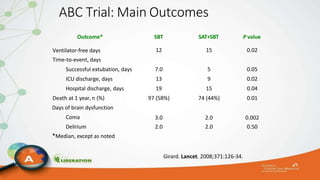
ABC Trial
Girard T.Lancet. 2008;371:126-34.
ABC Trial: Main Outcomes
Outcome* SBT SAT+SBT P value
Ventilator-free days 12 15 0.02
Time-to-event, days
Successful extubation, days 7.0 5 0.05
ICU discharge, days 13 9 0.02
Hospital discharge, days 19 15 0.04
Death at 1 year, n (%) 97 (58%) 74 (44%) 0.01
Days of brain dysfunction
Coma 3.0 2.0 0.002
Delirium 2.0 2.0 0.50
*Median, except as noted
Girard. Lancet. 2008;371:126-34.
PAD Agitation/Sedation Assessment Recommendations
• Depth and quality of sedation should be routinely assessed in
all ICU patients (1B)
• The RASS & SASS are the most valid and reliable scales for
assessing quality and depth of sedation in ICU patients (B)
• Suggest using objective measures of brain function to
adjunctively monitor sedation in patients receiving
neuromuscular blocking agents (2B)
• Use EEG monitoring either to monitor nonconvulsive seizure
activity in ICU patients at risk for seizures, or to titrate
electrosuppressive medication to achieve burst suppression in
ICU patients with elevated intracranial pressure (1A)
Barr J. Crit Care Med. 2013;41:263–306.
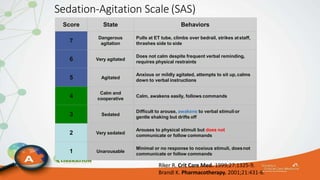
Sedation-Agitation Scale (SAS)
Riker R. Crit Care Med. 1999;27:1325-9.
Brandl K. Pharmacotherapy. 2001;21:431-6.
Score State Behaviors
7
Dangerous
agitation
Pulls at ET tube, climbs over bedrail, strikes atstaff,
thrashes side to side
6 Very agitated
Does not calm despite frequent verbal reminding,
requires physical restraints
5 Agitated
Anxious or mildly agitated, attempts to sit up,calms
down to verbal instructions
4
Calm and
cooperative
Calm, awakens easily, follows commands
3 Sedated
Difficult to arouse, awakens to verbal stimulior
gentle shaking but drifts off
2 Very sedated
Arouses to physical stimuli but does not
communicate or follow commands
1 Unarousable
Minimal or no response to noxious stimuli, doesnot
communicate or follow commands
Sessler C. Am J Respir Crit Care Med. 2002;166:1338-44.
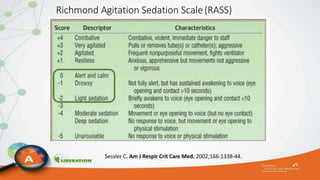
Richmond Agitation Sedation Scale(RASS)
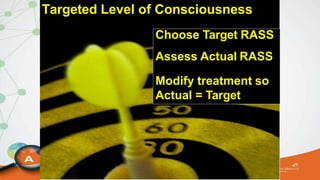
Targeted Level of Consciousness
Choose Target RASS
Assess Actual RASS
Modify treatment so
Actual = Target
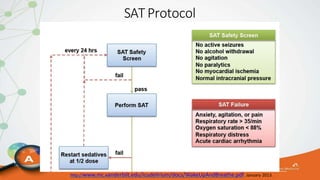
SAT Protocol
http://www.mc.vanderbilt.edu/icudelirium/docs/WakeUpAndBreathe.pdf. January 2013.
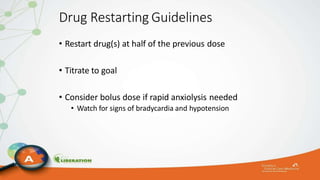
Drug Restarting Guidelines
• Restart drug(s) at half of the previous dose
• Titrate to goal
• Consider bolus dose if rapid anxiolysis needed
• Watch for signs of bradycardia and hypotension
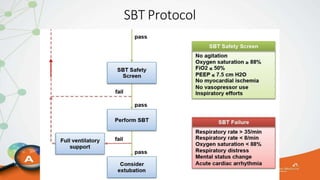
SBT Protocol
http://www.mc.vanderbilt.edu/icudelirium/docs/WakeUpAndBreathe.pdf . Accessed January 2013
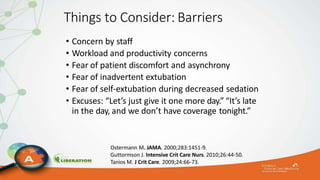
Things to Consider: Barriers
• Concern by staff
• Workload and productivity concerns
• Fear of patient discomfort and asynchrony
• Fear of inadvertent extubation
• Fear of self-extubation during decreased sedation
• Excuses: “Let’s just give it one more day.” “It’s late
in the day, and we don’t have coverage tonight.”
Ostermann M. JAMA. 2000;283:1451-9.
Guttormson J. Intensive Crit Care Nurs. 2010;26:44-50.
Tanios M. J Crit Care. 2009;24:66-73.
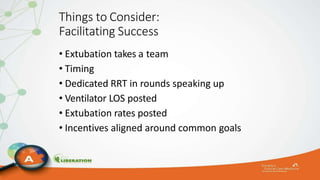
Things to Consider:
Facilitating Success
• Extubation takes a team
• Timing
• Dedicated RRT in rounds speaking up
• Ventilator LOS posted
• Extubation rates posted
• Incentives aligned around common goals
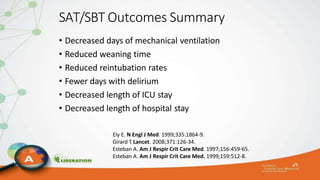
SAT/SBT Outcomes Summary
• Decreased days of mechanical ventilation
• Reduced weaning time
• Reduced reintubation rates
• Fewer days with delirium
• Decreased length of ICU stay
• Decreased length of hospital stay
Ely E. N Engl J Med. 1999;335:1864-9.
Girard T.Lancet. 2008;371:126-34.
Esteban A. Am J Respir Crit Care Med. 1997;156:459-65.
Esteban A. Am J Respir Crit Care Med. 1999;159:512-8.
ABCDEF
C – Choice of Analgesia and Sedation
Association of Benzodiazepines and delirium
The SEDCOM trial (Safety and Efficacy of Dexmedetomidine Compared with Midazolam)
A reduction in the prevalence of delirium and in the duration of mechanical ventilation in
patients sedated with dexmedetomidine compared with midazolam
Dexmedetomidine as sedative
This is coming up as a strong candidate for ICU sedation especially in septic patients
Main caution is Bradycardia
ABCDEF
D – Delirium: Assess, Prevent and Manage
Delirium: Key Features (DSM-V)
A. Disturbance in attention and awareness
B. Disturbance in cognition: e.g., memory, disorientation, language,
perception
C. Develops over a short period of time and tends to fluctuate during the
course of the day
D. Disturbances are NOT better explained by a preexisting, established or
evolving neurocognitive disorder and do NOT occur in the context of a
severely reduced level of arousal such as coma
E. There is evidence from the history and physical exam and/or labs that
the disturbance is caused by a medical condition, substance
intoxication or withdrawal, or medication/toxin side effect
American Psychiatric Association. DSM-V. Washington DC; 2013.
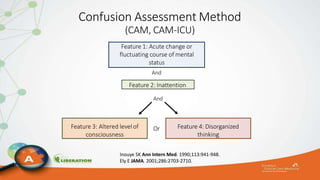
Confusion Assessment Method
(CAM, CAM-ICU)
Feature 1: Acute change or
fluctuating course of mental
status
And
Feature 2: Inattention
And
Feature 3: Altered levelof
consciousness
Feature 4: Disorganized
thinking
Or
Inouye SK Ann Intern Med. 1990;113:941-948.
Ely E JAMA. 2001;286:2703-2710.
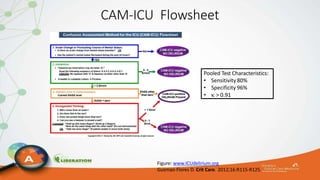
CAM-ICU Flowsheet
Figure: www.ICUdelirium.org
Gusmao-Flores D. Crit Care. 2012;16:R115-R125.
Pooled Test Characteristics:
• Sensitivity 80%
• Specificity 96%
•  > 0.91
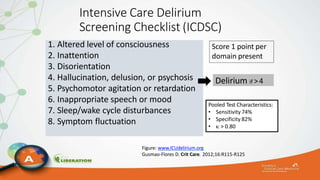
Intensive Care Delirium
Screening Checklist (ICDSC)
1. Altered level of consciousness
2. Inattention
3. Disorientation
4. Hallucination, delusion, or psychosis
5. Psychomotor agitation or retardation
6. Inappropriate speech or mood
7. Sleep/wake cycle disturbances
8. Symptom fluctuation
Delirium if >4
Score 1 point per
domain present
Pooled Test Characteristics:
• Sensitivity 74%
• Specificity 82%
•  > 0.80
Figure: www.ICUdelirium.org
Gusmao-Flores D. Crit Care. 2012;16:R115-R125
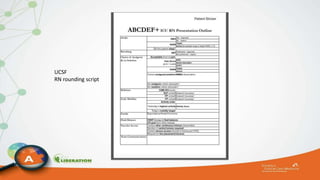
UCSF
RN rounding script
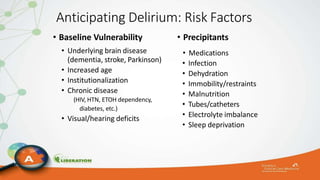
Anticipating Delirium: Risk Factors
• Baseline Vulnerability
• Underlying brain disease
(dementia, stroke, Parkinson)
• Increased age
• Institutionalization
• Chronic disease
(HIV, HTN, ETOH dependency,
diabetes, etc.)
• Visual/hearing deficits
• Precipitants
• Medications
• Infection
• Dehydration
• Immobility/restraints
• Malnutrition
• Tubes/catheters
• Electrolyte imbalance
• Sleep deprivation
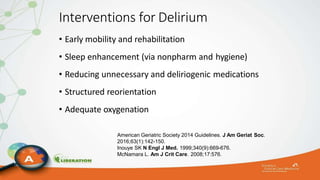
Interventions for Delirium
• Early mobility and rehabilitation
• Sleep enhancement (via nonpharm and hygiene)
• Reducing unnecessary and deliriogenic medications
• Structured reorientation
• Adequate oxygenation
American Geriatric Society 2014 Guidelines. J Am Geriat Soc.
2016;63(1):142-150.
Inouye SK N Engl J Med. 1999;340(9):669-676.
McNamara L. Am J Crit Care. 2008;17:576.
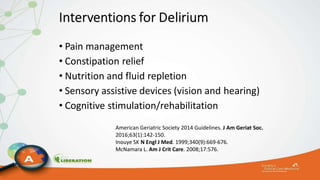
• Pain management
• Constipation relief
• Nutrition and fluid repletion
• Sensory assistive devices (vision and hearing)
• Cognitive stimulation/rehabilitation
American Geriatric Society 2014 Guidelines. J Am Geriat Soc.
2016;63(1):142-150.
Inouye SK N Engl J Med. 1999;340(9):669-676.
McNamara L. Am J Crit Care. 2008;17:576.
8
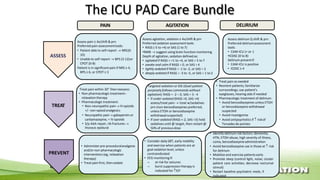
The ICU PAD Care Bundle
TREAT
PREVENT
ASSESS
PAIN AGITATION DELIRIUM
Treat pain within 30” thenreassess:
• Non-pharmacologic treatment–
relaxationtherapy
• Pharmacologic treatment:
• Non-neuropathic pain IV opioids
+/- non-opioidanalgesics
• Neuropathic pain gabapentin or
carbamazepine, + IV opioids
• S/p AAA repair, rib fractures
thoracic epidural
• Administer pre-proceduralanalgesia
and/or non-pharmacologic
interventions (eg, relaxation
therapy)
• Treat pain first, thensedate
Targeted sedation or DSI (Goal:patient
purposely follows commands without
agitation): RASS = -2 – 0, SAS = 3 - 4
• If under sedated (RASS >0, SAS >4)
assess/treat pain  treat w/sedatives
prn (non-benzodiazepines preferred,
unless ETOH or benzodiazepine
withdrawalsuspected)
• If over sedated (RASS <-2, SAS <3) hold
sedatives until @ target, then restart @
50% of previousdose
• Consider daily SBT, early mobility
and exercise when patients are at
goal sedation level, unless
contraindicated
• EEG monitoringif:
– at risk for seizures
– burst suppression therapy is
indicated for ICP
• Identify delirium risk factors: dementia,
HTN, ETOH abuse, high severity of illness,
coma, benzodiazepineadministration
• Avoid benzodiazepine use in those at  risk
for delirium
• Mobilize and exercise patientsearly
• Promote sleep (control light, noise; cluster
patient care activities; decrease nocturnal
stimuli)
• Restart baseline psychiatric meds, if
indicated
• Treat pain as needed
• Reorient patients; familiarize
surroundings; use patient’s
eyeglasses, hearing aids if needed
• Pharmacologic treatment of delirium:
• Avoid benzodiazepines unless ETOH
or benzodiazepine withdrawal
suspected
• Avoid rivastigmine
• Avoid antipsychotics if  riskof
Torsades de pointes
Assess pain ≥ 4x/shift & prn
Preferred pain assessmenttools:
• Patient able to self-report  NRS(0-
10)
• Unable to self-report  BPS (3-12)or
CPOT (0-8)
Patient is in significant pain if NRS ≥ 4,
BPS ≥ 6, or CPOT ≥ 3
Assess agitation, sedation ≥ 4x/shift & prn
Preferred sedation assessmenttools:
• RASS (-5 to +4) or SAS (1 to 7)
•NMB  suggest using brain function monitoring
Depth of agitation, sedation defined as:
• agitated if RASS = +1 to +4, or SAS = 5 to 7
• awake and calm if RASS = 0, or SAS = 4
• lightly sedated if RASS = -1 to -2, or SAS = 3
• deeply sedated if RASS = -3 to -5, or SAS = 1 to 2
Assess delirium Q shift & prn
Preferred deliriumassessment
tools:
• CAM-ICU (+ or-)
•ICDSC (0 to 8)
Delirium presentif:
• CAM-ICU is positive
• ICDSC ≥ 4
ABCDEF
E – Early Mobility and Exercise
Why Mobilize Patients in ICU?
Side Effects of Bed Rest
• Muscle strength in a healthy person can decrease
1.3% to 3% for every day spent on bedrest.1
• Effects are more profound in older people and in
those with critical illness.2
• A new study suggests that 3% to 11% strength loss
occurs for every day in bed in an ICU setting.3
• Age and days on bedrest are independent predictors of
worsening function.
Topp R. Am J Crit Care. Clin Issues 2002.
Yende S. Thorax. 2006.
Fan E. Am JRespir Crit Care Med. 2014;190:1437-46.
Evidence-Based Benefits of Early Progressive
Mobility
•Decrease ICU and hospital LOS
•Improve overall physical functioning
•Decrease duration of mechanical
ventilation
•Decrease incidence of delirium
Bailey P. Crit Care Med. 2007;35:139-45.
Morris P.Crit Care Med. 2008 Aug;36:2238-43.
Schweickert W.Lancet. 2009;373:1874-82.
When Is It Time to Stop and Rest?
Patient remains unresponsive
Fatigued, pale appearance
Respiratory rate consistently > 10 bpm above baseline
Decreasing muscle recruitment
Loss of balance
Decreasing weight bearing ability
Diaphoresis
Early Progressive Mobility in ICU
In-bed mobility
• Passive range-of-
motion exercises
• Turning side to side
• Sitting on the side
of the bed
• Active
strengthening
exercises
Out-of-bed mobility
• Standing at bedside
• Sitting on a regular
chair
• Sitting on a cardiac
chair
• Walking
MOBILITY IS EVERYONE’S JOB IN
THE INTENSIVE CARE UNIT!
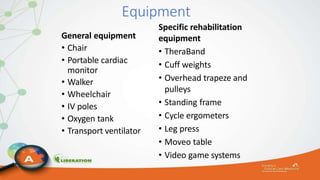
Equipment
General equipment
• Chair
• Portable cardiac
monitor
• Walker
• Wheelchair
• IV poles
• Oxygen tank
• Transport ventilator
Specific rehabilitation
equipment
• TheraBand
• Cuff weights
• Overhead trapeze and
pulleys
• Standing frame
• Cycle ergometers
• Leg press
• Moveo table
• Video game systems
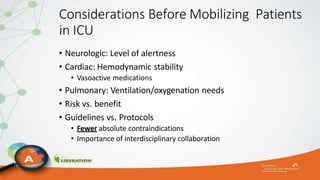
Considerations Before Mobilizing Patients
in ICU
• Neurologic: Level of alertness
• Cardiac: Hemodynamic stability
• Vasoactive medications
• Pulmonary: Ventilation/oxygenation needs
• Risk vs. benefit
• Guidelines vs. Protocols
• Fewer absolute contraindications
• Importance of interdisciplinary collaboration
ABCDEF
F: Family Engagement and
Empowerment
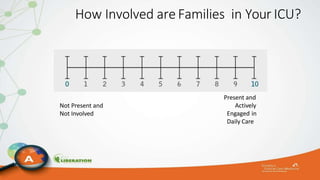
How Involved are Families in Your ICU?
Not Present and
Not Involved
Present and
Actively
Engaged in
Daily Care
Myths and Misconceptions
• Family presence interferes with care.
• Family presence exhausts the patient.
• Family presence is a burden to families.
• Family presence spreads infection.
Institute for Patient and Family Centered Care
http://www.ipfcc.org
Current Realities
• Social isolation separates patients from families.
• Families know the patient’s cognitive function.
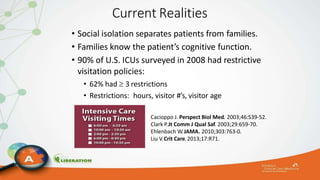
• 90% of U.S. ICUs surveyed in 2008 had restrictive
visitation policies:
• 62% had  3 restrictions
• Restrictions: hours, visitor #’s, visitor age
Cacioppo J. Perspect Biol Med. 2003;46:S39-52.
Clark P.Jt Comm J Qual Saf.2003;29:659-70.
Ehlenbach W.JAMA. 2010;303:763-0.
Liu V.Crit Care.2013;17:R71.
Creating the Right Environment
• Family presence
• Family and patient engagement
• Family and patient empowerment
Family Presence: Flexible Visitation
• Concept of an open ICU.
• Daily meetings with the family.
• Healthcare providers learn to work while being
observed by family members.
• Unit redesign efforts should consider impact of
family presence:
• Comfort
• Sleeping
Davidson J. Crit Care Med. 2007;35:605-22.
Cypress B. Dimens Crit Care Nurs. 2012;31:53-64.
Let’s Open the Door
• Today: Resistance is from
healthcare workers!
• Why? Fear of consequences
and failure to understand the
importance of families.
• Family presence at the beside
is seen as a privilege, not as a
necessary component of the
patient’s care.
Burchardi, H. Intensive Care Med. 2002:28;1371-2.
Riccioni L. Trends Anesth and CC. 2014: 4; 182-185.
ICU Flexible Visitation:
Patient Benefits
Decreases:
• anxiety, confusion, agitation
• CV complications
• ICU length of stay
Increases:
• feelings of security
• patient satisfaction
• quality and safety
Bell L. AACN practice alert. Nov 2011.
Davidson J. Crit Care Med. 2007;35:605-22
ICU Flexible Visitation:
Family Benefits
•  family satisfaction.
•  family anxiety.
• Promotes communication.
• Contributes to a better understanding of the patient.
• Allows more opportunities for teaching.
•  family involvement in care.
Bell L. AACN practice alert. Nov 2011.
Davidson J. Crit Care Med. 2007;35:605-22.
Creating the Right Environment
• Family presence
• Family and patient engagement
• Family and patient empowerment
Inviting Families and Patients to Engage
in Care
• Focus on activities that actively involve families in
the patient’s care.
• Be sensitive - address questions and concerns.
• Facilitate communication -  understanding of
cultural/spiritual needs.
• Develop strategies for family engagement;
provide education and role modeling.
How to Engage FamilyMembers
Provide brochures  suggest ways that family
members can help the patient:
• Speak softly to patients and use simple words.
• Re-orient the patient (5 W’s + 1H).
• Talk about family and friends.
• Bring patient’s sensory aides (eyeglasses, hearing aids).
• Decorate the room with reminders of home.
• Participate in mobilizing the patient.
• Document the patient’s stay in an ICU diary.
Creating the Right Environment
• Family presence
• Family and patient engagement
• Family and patient empowerment
Empowering Family Members
• Family members = patients’ primary advocates.
• Provide them the tools and permission to speak up!
• Create a safe environment to speak openly.
• Create a culture where it is acceptable for our
actions to be questioned.
• Three key areas:
• Shared decision-making
• Safety
• Future care expectations
Shared Decision-Making
• Shared planning /decision-making:
• Doing things with patients’ families, not for or to them
• Partnership = Patient+ Family + ICU Team.
• Necessitates full disclosure of patient’s status.
• Necessitates regular meetings within 24-48 hours.
• Staff training needed in these areas:
• Good communication skills
• Meeting facilitation skills
• Conflict management skills
Davidson J. Crit Care Med. 2007;35:605-22.
Safety
• Safety is personal!
“Patients and families can play a critical role in
preventing medical errors and reducing harm.”
• NPSF recommendations for patients:
Don’t go to the hospital alone.
Be sure you understand your plan of care.
Patients/families should be invited to participate on
quality/safety committees.
National Patient Safety Foundation. 2014.
If You See Something Unsafe,
Say Something!
• Give families permission to speak up.
• Teach them what should be happening.
• Ask them to hold the team accountable.
• Examples include:
• Allergies
• Hand washing
• Untreated pain
• Delirium symptoms
Future Care Needs
• Families have little appreciation for critical illness as a
traumatic stressor.
• Provide education to adjust expectations:
• Brochures on what to expect after ICU discharge.
• Websites with patient/family-centered information.
• Signs of depression, anxiety, and PTSD.
• Introduce post-intensive care syndrome (PICS).
• Create educational materials for discharge packets.
Davidson J. American Nurse Today. 2013;8:32-7.

ABCDEF bundle: ICU Liberation Bundle

  • 1.
    ABCDEF bundle ICU LiberationBundle* Fakhir Raza SIUT Acknowledgement: No changes are made in any slide *www.iculiberation.org
  • 2.
    ICU PAD Guidelines 2 ABCDEFBundle Checklist*  A – Assess, Prevent and Manage Pain  B – Both SATsand SBTs  C – Choice of Sedation  D – Delirium: Assess, Prevent and Manage  E – Early Mobility and Exercise  F – Family Engagement and Empowerment *www.iculiberation.org
  • 3.
    ABCDEF Bundle Objectives 3 Optimize pain management.  Break the cycle of deep sedation and prolonged mechanical ventilation.  Reduce the incidence, duration of ICU delirium.  Improve short, long-term ICU patient outcomes.  Reduce health care costs!
  • 4.
    14 Why a Bundle? ImproveICU Team Communication Reduce Practice Variation Every Patient, Every Time Standardize Care Processes Resar R, Pronovost P,et al. JQPC. 2005;31(5):243-248 http://www.ihi.org/resources/Pages/ImprovementStories/WhatIsaBundle.aspx Better Outcomes!
  • 5.
  • 6.
    ABCDE Bundle Implementation StudyDesign: • Hypothesis: Implementing the ABCDE bundle   incidence of ICU delirium, ICU acquired weakness • Prospective, observational cohort, before/after study design • N = 296 adult pts ( MV), single center, 7 ICUs/SDUs (2010 – 2012) Interventions: • Awakening and Breathing Coordination • Delirium Monitoring/Management • Early exercise/mobility Outcomes: • Ventilator-free days • Prevalence/duration of delirium, coma (RASS = -4 or -5) • ICU mobilization frequency • ICU/hospital mortality, LOS, discharge disposition ABCDE Bundle *Balas, et al, Crit Care Med 2014; 42:1024–1036 6
  • 7.
    ABCDE Bundle Implementation(cont.) Results: • Pre- vs. post- groups similar except age (59 yr. vs. 56 yr., P =0.05) •  ventilator free days by 3 days (P = 0.04) • Odds of developing delirium  by = 45% (adjusted, P = 0.03) • Odds of patients getting out of bed  x2 (P = 0.003) • No differences in safety outcomes (i.e., unplanned extubation, re- intubation, tracheostomies, restraints) • No differences in LOS, mortality, or discharge disposition •  frequency of SATs,SBTs • No differences in sedative, opioid use! • No change in deep sedation! *Balas, et al, Crit Care Med 2014; 42:1024–1036 7
  • 8.
    20 PAD Protocol +SATs+ SBTs Study Design: • Hypothesis: Implementing an integrated PAD management protocol bundled with SATsand SBTs improves ICU patient outcomes. • Prospective, observational cohort, before/after study design • N = 1,483 MV ICU patients admitted to a single 24-bed Trauma/Surgical ICU (2009 - 2011) Interventions: • Integrated PAD Protocol  analgosedation, TSS (light sedation) • PAD management linked to daily SATs,SBTs (single bundle). Outcomes: • Pain (NRS), RASS, CAM-ICU assessments • Benzodiazepine use • Delirium incidence • MV duration • ICU/hospital mortality, LOS, VAP rate Dale CR, et al. Ann Am Thorac Soc. 2014;11:367-374.
  • 9.
    PAD Protocol +SATs+ SBTs (cont.) Results: •  # of RASS, CAM-ICU assessments performed per day (P = 0.01). •  mean hourly benzodiazepine dose by 34.8% (P = 0.01). •  mean RASS scores (i.e., patients were less sedated) (P = 0.01) • Multivariate Analyses: (i.e., SAP score, age, gender, weight) – ICU delirium risk  by 33% (OR, 0.67; 95% CI, 0.49–0.91; P = 0.01) – MV duration  by 17.6% (95% CI, 0.6–31.7%; P = 0.04). – ICU LOS  12.4% (95% CI, 0.5–22.8%; P = 0.04) – Hospital LOS  14% (95% CI, 2.0–24.5%; P = 0.02) – No significant changes in VAP rate, mortality, or discharge status Dale CR, et al. Ann Am Thorac Soc. 2014;11:367-374. 9
  • 10.
    10   Durationof MV   ICU, hospital LOS   ICU patient throughput, bed availability   Health care costs per patient   Long-term cognitive function, mobility   Number of patients discharged to home!   Lives saved! But by how much?????
  • 11.
    ICU LIBERATION 11 Liberation from: •The ventilator • Deep sedation • The bed/immobility • Delirium • PTSD • Death Implementation – Clinical Perspective
  • 12.
    • A –Assess, Prevent and Manage Pain • B – Both spontaneous Awakening trials (SAT) & spontaneous Breathing trials (SBT) • C – Choice of Analgesia and Sedation • D – Delirium - Assess, Prevent and Manage • E – Early Mobility and Exercise • F – Family Engagement and Empowerment The Entire Bundle Begins With Reduction of sedation levels! 28 SCCM ICU Liberation 2015 ICULiberation.org Implementation – Clinical Perspective
  • 13.
    IHI MODEL FORIMPROVEMENT PDSA - PDCA 13
  • 14.
    Build a New‘Normal’ 14 “You never change things by fighting the existing reality. Tochange something, build a new model that makes the existing model obsolete.” ~R. Buckminster Fuller
  • 15.
  • 16.
    SCCM Pain CareBundle Assess •Assess pain  4x/shift & PRN • Significant pain with NRS >3, BPS >5, or CPOT>2 Treat • Treat pain within 30 minutes of detecting significant pain & REASSESS: • Non-pharmacological treatment (e.g. relaxation) • Pharmacological treatment Prevent • Administer pre-procedural analgesia and/or non- pharmacological interventions • Treat pain first, then sedate Barr J Crit Care Med 2013;41(1):263-306
  • 17.
    Pain - Definition •Painis an unpleasant sensory & emotional experience •Best reported by the person who is experiencing it • Self-report challenging in ICU environment •Inability to communicate verbally does not negate the possibility that an individual is experiencing pain http://www.iasp- pain.org/Education/Content.aspx?ItemNumber=1698&navIte mNumber=576
  • 18.
    Self-Report of Pain–GoldStandard 0 – 10 Numeric Rating Scale Slide courtesy of J-F Payen 0-10 visually enlarged horizontal NRS most valid & reliable Chanques G Pain 2010;151: 711-721. Assess
  • 19.
    If Patient Unableto Self-Report: A Stepwise Approach American Society for Pain ManagementNursing Attempt to obtain the patient’s self-report of pain – Gold standard A simple yes or no = valid self-report Look for behavioral changes Use a standardized and valid behavioral pain scale The family can help to identify pain behaviors Sources of pain = “Assume pain is present” Attempt an intervention for pain relief Herr K Pain Manage Nurs 2011;12(4):230-50 1 2 3 4
  • 20.
    Behavioral Pain Scale(BPS) (abbreviated version) ITEM SCORE FACIAL EXPRESSION 1 2 3 4 UPPER LIMBS 1 2 3 4 COMPLIANCE WITH VENTILATOR 1 2 3 4 Score Range 3 – 12. Significant pain = BPS >5 Payen JF Crit Care Med 2001;29: 2258-2263
  • 21.
    Behavioral Pain Scale(BPS) 1 2 3 4 Slide courtesy of J-F Payen Relaxed Partially tightened Fully tightened Grimacing No movement Partially bent Fully bent with finger flexion Permanently retracted
  • 22.
    CPOT (abbreviated version) INDICATORSCORE FACIAL EXPRESSION Relaxed, neutral 0 Tense 1 Grimacing 2 BODY MOVEMENTS Absence of movements 0 Protection 1 Restlessness 2 MUSCLE TENSION (evaluate by passive flexion and extension of upper extremities) Relaxed 0 Tense, rigid 1 Very tense or rigid 2 COMPLIANCE WITH VENTILATOR (intubated patients) OR VOCALIZATION (extubated patients) Alarms not activated; easy ventilation 0 Coughing but tolerating 1 Fighting ventilator 2 Talking in normal tone or no sound 0 Sighing, moaning 1 Crying out, sobbing 2 CPOT range = 0 – 8; CPOT >2 is significant
  • 23.
    Preventing Pain • Administerpre-procedural analgesia and/or non- pharmacologic interventions (e.g., relaxation therapy) for chest tube removal (+1C) • Consider same for other procedures • Treat pain first; then sedate • The first most important step is for clinicians to recognize the painfulness of common ICU procedures! Barr J Crit Care Med 2013;41(1):263-306 Prevent
  • 24.
    Procedures Hurt! Turning 1,2 MostPainful Chest Tube Removal 2 Wound Drain Removal 1,2 Arterial Line Insertion 2 Wound Care 1,2 Others Peripheral Blood Draw 2 2Peripheral IV Insertion Positioning 2 ET Suctioning 1,2 Tracheal suctioning 1,2 Femoral Sheath Removal 1 Mobilization 2 Respiratory Exercises 2 Central Line Removal 1 1 Puntillo K AJCC 2001; 10:238-251 2 Puntillo K AJRCCM, 2014; 89: 39-47.
  • 25.
    Interventions for ProceduralPain • Opioids • NSAIDs • Ketamine • Relaxation techniques Time interventions to peak effect!
  • 26.
    Treatment of Pain •Recommend IV opioids be considered as the first-line drug class of choice for non-neuropathic pain (+1C). • All available IV opioids, when titrated to similar pain intensity endpoints, are equally effective (C). Barr J Crit Care Med 2013;41(1):263-306 Treat
  • 27.
    Opioid Choices AGENT EQUI- ANALGESIC DOSE(mg)– IV EQUI- ANALGESIC DOSE (mg) – P.O. TIME TO ONSET NOTES Fentanyl 0.1 NA 1-2 min Less hypotension than morphine; accumulation in hepatic impairment Hydromor- phone 1.5 7.5 5-10 min May work in patients tolerant to fentanyl/morphine; accumulates in renal/hepatic impairment Morphine 10 30 5-10 min Accumulates in renal/hepatic impairment Methadone Modified from: N/A Barr J Crit Care N/A Med, 2013; 41:263-306. Intermittent dose: 10-40 mg q 6 – 12 hrs; may slow development of tolerance in an escalating dose requirement; monitor QTc
  • 28.
    Non-Opioid Analgesics AGENT INFORMATION Acetaminophen(po/pr) Caution in patients with hepatic impairment Acetaminophen (IV) Caution in patients with hepatic impairment Ketorolac (IV) Avoid in following conditions: • Renal dysfunction • GI bleed • Platelet abnormality Ibuprofen Avoid in following conditions: • Renal dysfunction • GI bleed • Platelet abnormality Gabapentin May cause sedation. Avoid abrupt discontinuation; may cause seizures Ketamine IV Attenuates the development of acute tolerance to opioids; may cause hallucinations and other psychological disturbances Modified from: Barr J Crit Care Med , 2013; 41:263-306.
  • 29.
    Treatment of Painin ICUPatients • Non-opioid analgesics considered to decrease the amount of opioids administered (or to eliminate the need for IV opioids altogether), and to decrease opioid- related side effects (+2C). • Either enterally administered gabapentin or carbamazepine, in addition to IV opioids considered for neuropathic pain (+1A). Barr J Crit Care Med, 2013; 41:263-306.
  • 30.
    What to remember– Pain Assessment • Assessment of pain should not only be done at rest, but also during care procedures as well as before & after the administration of an analgesic • Always try to obtain the patient’s self-report of pain • When the patient’s self-report is impossible to obtain, use a validated behavioral pain scale such as the CPOT or BPS
  • 31.
    What to remember– Pain Assessment • Not all patient will need opioids, so maximize non-opioids first when able • Pain contributes to agitation & delirium, so treat to pain first • Validated tools in general ICU are the best starting points for assessment in difficult populations
  • 32.
    Summary ABCDEF Assess, Prevent, and ManagePain Pain Assessment- Essential 1st step Match tool to patient’s capacity Self-report score ≠ behavioral score Rely on research for tool selection Pain Management- Treat significant pain within 30 minutes Treat pain first; then sedate prn Opioids might be first line, but consider non-opioids and multimodal therapies Pain Prevention- Administer pre-procedural analgesia and/or non- pharmacological interventions; treat pain 1st
  • 33.
    ABCDEF • B –Both spontaneous Awakening trials (SAT) & spontaneous Breathing trials (SBT)
  • 34.
    Negative Consequences ofProlonged, Deep Sedation/Benefits of Light Sedation • Deep sedation • Reduced six-month survival • Hospital mortality • Longer duration of mechanical ventilation • Longer ICU length of stay • Increased physiologic stress in terms of elevated catecholamine concentrations and/or increased oxygen consumption at lighter sedation levels BUT no clear relationship between elevation and clinical outcomes Brook A. Crit Care Med. 1999;27:2609-15. Girard T.Lancet. 2008;371:126-34. Kress J. N Engl J Med. 2000;342:1471-7. Treggiari M. Crit Care Med. 2009;37:2527-34. Kollef M. Chest. 1998;114:541-8. Shehabi Y.Am J Respir Crit Care Med. 2012;186:724-31.
  • 35.
  • 36.
    ABC Trial: MainOutcomes Outcome* SBT SAT+SBT P value Ventilator-free days 12 15 0.02 Time-to-event, days Successful extubation, days 7.0 5 0.05 ICU discharge, days 13 9 0.02 Hospital discharge, days 19 15 0.04 Death at 1 year, n (%) 97 (58%) 74 (44%) 0.01 Days of brain dysfunction Coma 3.0 2.0 0.002 Delirium 2.0 2.0 0.50 *Median, except as noted Girard. Lancet. 2008;371:126-34.
  • 37.
    PAD Agitation/Sedation AssessmentRecommendations • Depth and quality of sedation should be routinely assessed in all ICU patients (1B) • The RASS & SASS are the most valid and reliable scales for assessing quality and depth of sedation in ICU patients (B) • Suggest using objective measures of brain function to adjunctively monitor sedation in patients receiving neuromuscular blocking agents (2B) • Use EEG monitoring either to monitor nonconvulsive seizure activity in ICU patients at risk for seizures, or to titrate electrosuppressive medication to achieve burst suppression in ICU patients with elevated intracranial pressure (1A) Barr J. Crit Care Med. 2013;41:263–306.
  • 38.
    Sedation-Agitation Scale (SAS) RikerR. Crit Care Med. 1999;27:1325-9. Brandl K. Pharmacotherapy. 2001;21:431-6. Score State Behaviors 7 Dangerous agitation Pulls at ET tube, climbs over bedrail, strikes atstaff, thrashes side to side 6 Very agitated Does not calm despite frequent verbal reminding, requires physical restraints 5 Agitated Anxious or mildly agitated, attempts to sit up,calms down to verbal instructions 4 Calm and cooperative Calm, awakens easily, follows commands 3 Sedated Difficult to arouse, awakens to verbal stimulior gentle shaking but drifts off 2 Very sedated Arouses to physical stimuli but does not communicate or follow commands 1 Unarousable Minimal or no response to noxious stimuli, doesnot communicate or follow commands
  • 39.
    Sessler C. AmJ Respir Crit Care Med. 2002;166:1338-44. Richmond Agitation Sedation Scale(RASS)
  • 40.
    Targeted Level ofConsciousness Choose Target RASS Assess Actual RASS Modify treatment so Actual = Target
  • 41.
  • 42.
    Drug Restarting Guidelines •Restart drug(s) at half of the previous dose • Titrate to goal • Consider bolus dose if rapid anxiolysis needed • Watch for signs of bradycardia and hypotension
  • 43.
  • 44.
    Things to Consider:Barriers • Concern by staff • Workload and productivity concerns • Fear of patient discomfort and asynchrony • Fear of inadvertent extubation • Fear of self-extubation during decreased sedation • Excuses: “Let’s just give it one more day.” “It’s late in the day, and we don’t have coverage tonight.” Ostermann M. JAMA. 2000;283:1451-9. Guttormson J. Intensive Crit Care Nurs. 2010;26:44-50. Tanios M. J Crit Care. 2009;24:66-73.
  • 45.
    Things to Consider: FacilitatingSuccess • Extubation takes a team • Timing • Dedicated RRT in rounds speaking up • Ventilator LOS posted • Extubation rates posted • Incentives aligned around common goals
  • 46.
    SAT/SBT Outcomes Summary •Decreased days of mechanical ventilation • Reduced weaning time • Reduced reintubation rates • Fewer days with delirium • Decreased length of ICU stay • Decreased length of hospital stay Ely E. N Engl J Med. 1999;335:1864-9. Girard T.Lancet. 2008;371:126-34. Esteban A. Am J Respir Crit Care Med. 1997;156:459-65. Esteban A. Am J Respir Crit Care Med. 1999;159:512-8.
  • 47.
    ABCDEF C – Choiceof Analgesia and Sedation
  • 48.
    Association of Benzodiazepinesand delirium The SEDCOM trial (Safety and Efficacy of Dexmedetomidine Compared with Midazolam) A reduction in the prevalence of delirium and in the duration of mechanical ventilation in patients sedated with dexmedetomidine compared with midazolam
  • 49.
    Dexmedetomidine as sedative Thisis coming up as a strong candidate for ICU sedation especially in septic patients Main caution is Bradycardia
  • 50.
    ABCDEF D – Delirium:Assess, Prevent and Manage
  • 51.
    Delirium: Key Features(DSM-V) A. Disturbance in attention and awareness B. Disturbance in cognition: e.g., memory, disorientation, language, perception C. Develops over a short period of time and tends to fluctuate during the course of the day D. Disturbances are NOT better explained by a preexisting, established or evolving neurocognitive disorder and do NOT occur in the context of a severely reduced level of arousal such as coma E. There is evidence from the history and physical exam and/or labs that the disturbance is caused by a medical condition, substance intoxication or withdrawal, or medication/toxin side effect American Psychiatric Association. DSM-V. Washington DC; 2013.
  • 52.
    Confusion Assessment Method (CAM,CAM-ICU) Feature 1: Acute change or fluctuating course of mental status And Feature 2: Inattention And Feature 3: Altered levelof consciousness Feature 4: Disorganized thinking Or Inouye SK Ann Intern Med. 1990;113:941-948. Ely E JAMA. 2001;286:2703-2710.
  • 53.
    CAM-ICU Flowsheet Figure: www.ICUdelirium.org Gusmao-FloresD. Crit Care. 2012;16:R115-R125. Pooled Test Characteristics: • Sensitivity 80% • Specificity 96% •  > 0.91
  • 54.
    Intensive Care Delirium ScreeningChecklist (ICDSC) 1. Altered level of consciousness 2. Inattention 3. Disorientation 4. Hallucination, delusion, or psychosis 5. Psychomotor agitation or retardation 6. Inappropriate speech or mood 7. Sleep/wake cycle disturbances 8. Symptom fluctuation Delirium if >4 Score 1 point per domain present Pooled Test Characteristics: • Sensitivity 74% • Specificity 82% •  > 0.80 Figure: www.ICUdelirium.org Gusmao-Flores D. Crit Care. 2012;16:R115-R125
  • 55.
  • 56.
    Anticipating Delirium: RiskFactors • Baseline Vulnerability • Underlying brain disease (dementia, stroke, Parkinson) • Increased age • Institutionalization • Chronic disease (HIV, HTN, ETOH dependency, diabetes, etc.) • Visual/hearing deficits • Precipitants • Medications • Infection • Dehydration • Immobility/restraints • Malnutrition • Tubes/catheters • Electrolyte imbalance • Sleep deprivation
  • 57.
    Interventions for Delirium •Early mobility and rehabilitation • Sleep enhancement (via nonpharm and hygiene) • Reducing unnecessary and deliriogenic medications • Structured reorientation • Adequate oxygenation American Geriatric Society 2014 Guidelines. J Am Geriat Soc. 2016;63(1):142-150. Inouye SK N Engl J Med. 1999;340(9):669-676. McNamara L. Am J Crit Care. 2008;17:576.
  • 58.
    • Pain management •Constipation relief • Nutrition and fluid repletion • Sensory assistive devices (vision and hearing) • Cognitive stimulation/rehabilitation American Geriatric Society 2014 Guidelines. J Am Geriat Soc. 2016;63(1):142-150. Inouye SK N Engl J Med. 1999;340(9):669-676. McNamara L. Am J Crit Care. 2008;17:576.
  • 59.
    8 The ICU PADCare Bundle TREAT PREVENT ASSESS PAIN AGITATION DELIRIUM Treat pain within 30” thenreassess: • Non-pharmacologic treatment– relaxationtherapy • Pharmacologic treatment: • Non-neuropathic pain IV opioids +/- non-opioidanalgesics • Neuropathic pain gabapentin or carbamazepine, + IV opioids • S/p AAA repair, rib fractures thoracic epidural • Administer pre-proceduralanalgesia and/or non-pharmacologic interventions (eg, relaxation therapy) • Treat pain first, thensedate Targeted sedation or DSI (Goal:patient purposely follows commands without agitation): RASS = -2 – 0, SAS = 3 - 4 • If under sedated (RASS >0, SAS >4) assess/treat pain  treat w/sedatives prn (non-benzodiazepines preferred, unless ETOH or benzodiazepine withdrawalsuspected) • If over sedated (RASS <-2, SAS <3) hold sedatives until @ target, then restart @ 50% of previousdose • Consider daily SBT, early mobility and exercise when patients are at goal sedation level, unless contraindicated • EEG monitoringif: – at risk for seizures – burst suppression therapy is indicated for ICP • Identify delirium risk factors: dementia, HTN, ETOH abuse, high severity of illness, coma, benzodiazepineadministration • Avoid benzodiazepine use in those at  risk for delirium • Mobilize and exercise patientsearly • Promote sleep (control light, noise; cluster patient care activities; decrease nocturnal stimuli) • Restart baseline psychiatric meds, if indicated • Treat pain as needed • Reorient patients; familiarize surroundings; use patient’s eyeglasses, hearing aids if needed • Pharmacologic treatment of delirium: • Avoid benzodiazepines unless ETOH or benzodiazepine withdrawal suspected • Avoid rivastigmine • Avoid antipsychotics if  riskof Torsades de pointes Assess pain ≥ 4x/shift & prn Preferred pain assessmenttools: • Patient able to self-report  NRS(0- 10) • Unable to self-report  BPS (3-12)or CPOT (0-8) Patient is in significant pain if NRS ≥ 4, BPS ≥ 6, or CPOT ≥ 3 Assess agitation, sedation ≥ 4x/shift & prn Preferred sedation assessmenttools: • RASS (-5 to +4) or SAS (1 to 7) •NMB  suggest using brain function monitoring Depth of agitation, sedation defined as: • agitated if RASS = +1 to +4, or SAS = 5 to 7 • awake and calm if RASS = 0, or SAS = 4 • lightly sedated if RASS = -1 to -2, or SAS = 3 • deeply sedated if RASS = -3 to -5, or SAS = 1 to 2 Assess delirium Q shift & prn Preferred deliriumassessment tools: • CAM-ICU (+ or-) •ICDSC (0 to 8) Delirium presentif: • CAM-ICU is positive • ICDSC ≥ 4
  • 60.
    ABCDEF E – EarlyMobility and Exercise
  • 61.
  • 62.
    Side Effects ofBed Rest • Muscle strength in a healthy person can decrease 1.3% to 3% for every day spent on bedrest.1 • Effects are more profound in older people and in those with critical illness.2 • A new study suggests that 3% to 11% strength loss occurs for every day in bed in an ICU setting.3 • Age and days on bedrest are independent predictors of worsening function. Topp R. Am J Crit Care. Clin Issues 2002. Yende S. Thorax. 2006. Fan E. Am JRespir Crit Care Med. 2014;190:1437-46.
  • 63.
    Evidence-Based Benefits ofEarly Progressive Mobility •Decrease ICU and hospital LOS •Improve overall physical functioning •Decrease duration of mechanical ventilation •Decrease incidence of delirium Bailey P. Crit Care Med. 2007;35:139-45. Morris P.Crit Care Med. 2008 Aug;36:2238-43. Schweickert W.Lancet. 2009;373:1874-82.
  • 64.
    When Is ItTime to Stop and Rest? Patient remains unresponsive Fatigued, pale appearance Respiratory rate consistently > 10 bpm above baseline Decreasing muscle recruitment Loss of balance Decreasing weight bearing ability Diaphoresis
  • 65.
    Early Progressive Mobilityin ICU In-bed mobility • Passive range-of- motion exercises • Turning side to side • Sitting on the side of the bed • Active strengthening exercises Out-of-bed mobility • Standing at bedside • Sitting on a regular chair • Sitting on a cardiac chair • Walking MOBILITY IS EVERYONE’S JOB IN THE INTENSIVE CARE UNIT!
  • 66.
    Equipment General equipment • Chair •Portable cardiac monitor • Walker • Wheelchair • IV poles • Oxygen tank • Transport ventilator Specific rehabilitation equipment • TheraBand • Cuff weights • Overhead trapeze and pulleys • Standing frame • Cycle ergometers • Leg press • Moveo table • Video game systems
  • 67.
    Considerations Before MobilizingPatients in ICU • Neurologic: Level of alertness • Cardiac: Hemodynamic stability • Vasoactive medications • Pulmonary: Ventilation/oxygenation needs • Risk vs. benefit • Guidelines vs. Protocols • Fewer absolute contraindications • Importance of interdisciplinary collaboration
  • 68.
  • 69.
    How Involved areFamilies in Your ICU? Not Present and Not Involved Present and Actively Engaged in Daily Care
  • 70.
    Myths and Misconceptions •Family presence interferes with care. • Family presence exhausts the patient. • Family presence is a burden to families. • Family presence spreads infection. Institute for Patient and Family Centered Care http://www.ipfcc.org
  • 71.
    Current Realities • Socialisolation separates patients from families. • Families know the patient’s cognitive function. • 90% of U.S. ICUs surveyed in 2008 had restrictive visitation policies: • 62% had  3 restrictions • Restrictions: hours, visitor #’s, visitor age Cacioppo J. Perspect Biol Med. 2003;46:S39-52. Clark P.Jt Comm J Qual Saf.2003;29:659-70. Ehlenbach W.JAMA. 2010;303:763-0. Liu V.Crit Care.2013;17:R71.
  • 72.
    Creating the RightEnvironment • Family presence • Family and patient engagement • Family and patient empowerment
  • 73.
    Family Presence: FlexibleVisitation • Concept of an open ICU. • Daily meetings with the family. • Healthcare providers learn to work while being observed by family members. • Unit redesign efforts should consider impact of family presence: • Comfort • Sleeping Davidson J. Crit Care Med. 2007;35:605-22. Cypress B. Dimens Crit Care Nurs. 2012;31:53-64.
  • 74.
    Let’s Open theDoor • Today: Resistance is from healthcare workers! • Why? Fear of consequences and failure to understand the importance of families. • Family presence at the beside is seen as a privilege, not as a necessary component of the patient’s care. Burchardi, H. Intensive Care Med. 2002:28;1371-2. Riccioni L. Trends Anesth and CC. 2014: 4; 182-185.
  • 75.
    ICU Flexible Visitation: PatientBenefits Decreases: • anxiety, confusion, agitation • CV complications • ICU length of stay Increases: • feelings of security • patient satisfaction • quality and safety Bell L. AACN practice alert. Nov 2011. Davidson J. Crit Care Med. 2007;35:605-22
  • 76.
    ICU Flexible Visitation: FamilyBenefits •  family satisfaction. •  family anxiety. • Promotes communication. • Contributes to a better understanding of the patient. • Allows more opportunities for teaching. •  family involvement in care. Bell L. AACN practice alert. Nov 2011. Davidson J. Crit Care Med. 2007;35:605-22.
  • 77.
    Creating the RightEnvironment • Family presence • Family and patient engagement • Family and patient empowerment
  • 78.
    Inviting Families andPatients to Engage in Care • Focus on activities that actively involve families in the patient’s care. • Be sensitive - address questions and concerns. • Facilitate communication -  understanding of cultural/spiritual needs. • Develop strategies for family engagement; provide education and role modeling.
  • 79.
    How to EngageFamilyMembers Provide brochures  suggest ways that family members can help the patient: • Speak softly to patients and use simple words. • Re-orient the patient (5 W’s + 1H). • Talk about family and friends. • Bring patient’s sensory aides (eyeglasses, hearing aids). • Decorate the room with reminders of home. • Participate in mobilizing the patient. • Document the patient’s stay in an ICU diary.
  • 80.
    Creating the RightEnvironment • Family presence • Family and patient engagement • Family and patient empowerment
  • 81.
    Empowering Family Members •Family members = patients’ primary advocates. • Provide them the tools and permission to speak up! • Create a safe environment to speak openly. • Create a culture where it is acceptable for our actions to be questioned. • Three key areas: • Shared decision-making • Safety • Future care expectations
  • 82.
    Shared Decision-Making • Sharedplanning /decision-making: • Doing things with patients’ families, not for or to them • Partnership = Patient+ Family + ICU Team. • Necessitates full disclosure of patient’s status. • Necessitates regular meetings within 24-48 hours. • Staff training needed in these areas: • Good communication skills • Meeting facilitation skills • Conflict management skills Davidson J. Crit Care Med. 2007;35:605-22.
  • 83.
    Safety • Safety ispersonal! “Patients and families can play a critical role in preventing medical errors and reducing harm.” • NPSF recommendations for patients: Don’t go to the hospital alone. Be sure you understand your plan of care. Patients/families should be invited to participate on quality/safety committees. National Patient Safety Foundation. 2014.
  • 84.
    If You SeeSomething Unsafe, Say Something! • Give families permission to speak up. • Teach them what should be happening. • Ask them to hold the team accountable. • Examples include: • Allergies • Hand washing • Untreated pain • Delirium symptoms
  • 85.
    Future Care Needs •Families have little appreciation for critical illness as a traumatic stressor. • Provide education to adjust expectations: • Brochures on what to expect after ICU discharge. • Websites with patient/family-centered information. • Signs of depression, anxiety, and PTSD. • Introduce post-intensive care syndrome (PICS). • Create educational materials for discharge packets. Davidson J. American Nurse Today. 2013;8:32-7.