Pulmonary Function Testing
Flow volume loop
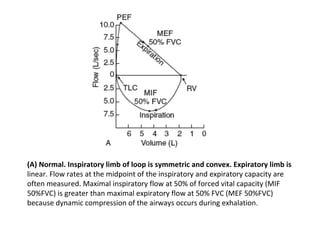
(A) Normal. Inspiratory limb of loop is symmetric and convex. Expiratory limb is linear. Flow rates at the midpoint of the inspiratory and expiratory capacity are often measured. Maximal inspiratory flow at 50% of forced vital capacity (MIF 50%FVC) is greater than maximal expiratory flow at 50% FVC (MEF 50%FVC) because dynamic compression of the airways occurs during exhalation.
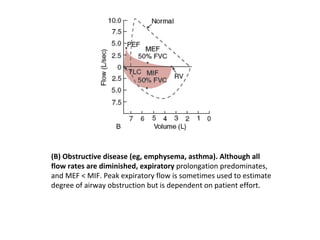
(B) Obstructive disease (eg, emphysema, asthma). Although all flow rates are diminished, expiratory  prolongation predominates, and MEF < MIF. Peak expiratory flow is sometimes used to estimate degree of airway obstruction but is dependent on patient effort.
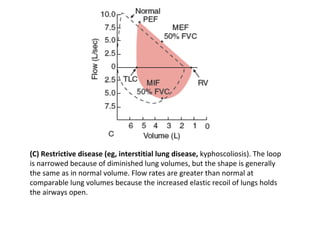
(C) Restrictive disease (eg, interstitial lung disease,  kyphoscoliosis). The loop is narrowed because of diminished lung volumes, but the shape is generally the same as in normal volume. Flow rates are greater than normal at comparable lung volumes because the increased elastic recoil of lungs holds the airways open.
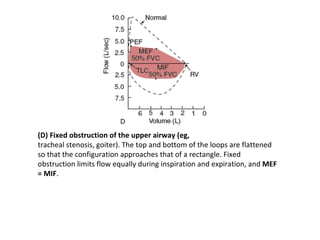
(D) Fixed obstruction of the upper airway (eg, tracheal stenosis, goiter). The top and bottom of the loops are flattened so that the configuration approaches that of a rectangle. Fixed obstruction limits flow equally during inspiration and expiration, and  MEF = MIF .
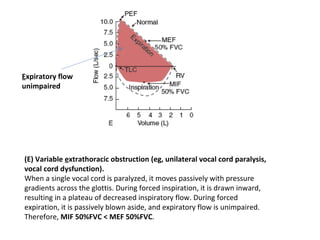
(E) Variable  e xtrathoracic obstruction (eg, unilateral vocal cord paralysis, vocal cord dysfunction). When a single vocal cord is paralyzed, it moves passively with pressure gradients across the glottis. During forced inspiration, it is drawn inward, resulting in a plateau of decreased inspiratory flow. During forced expiration, it is passively blown aside, and expiratory flow is unimpaired. Therefore,  MIF 50%FVC < MEF 50%FVC . E xpiratory flow  unimpaired
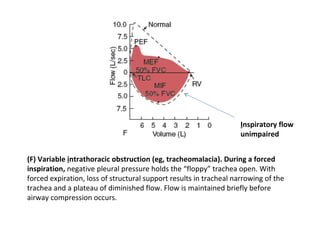
(F) Variable  i ntrathoracic obstruction (eg, tracheomalacia). During a forced inspiration,  negative pleural pressure holds the “floppy” trachea open. With forced expiration, loss of structural support results in tracheal narrowing of the trachea and a plateau of diminished flow. Flow is maintained briefly before airway compression occurs. I nspiratory flow  unimpaired
How to interpret lung function test?
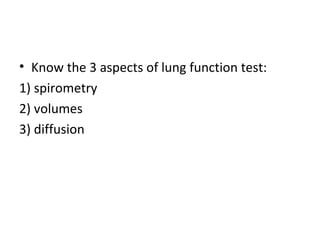
Know the 3 aspects of lung function test: 1) spirometry 2) volumes 3) diffusion
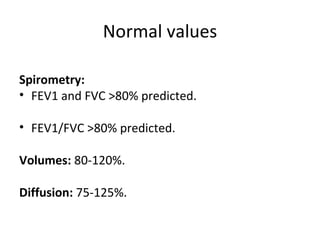
Normal values Spirometry: FEV1 and FVC >80% predicted. FEV1/FVC >80% predicted. Volumes:  80-120%. Diffusion:  75-125%.
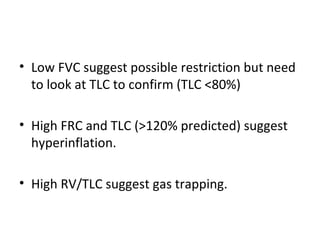
Low FVC suggest possible restriction but need to look at TLC to confirm (TLC <80%) High FRC and TLC (>120% predicted) suggest hyperinflation. High RV/TLC suggest gas trapping.
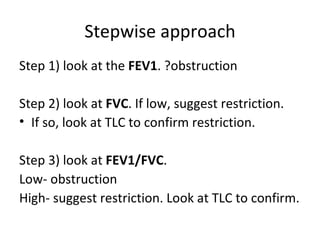
Stepwise approach Step 1) look at the  FEV1 . ?obstruction  Step 2) look at  FVC . If low, suggest restriction. If so, look at TLC to confirm restriction. Step 3) look at  FEV1/FVC . Low- obstruction High- suggest restriction. Look at TLC to confirm.
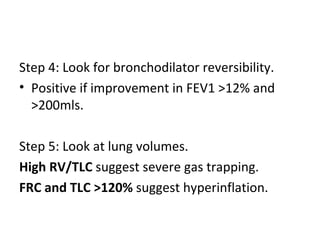
Step 4: Look for bronchodilator reversibility. Positive if improvement in FEV1 >12% and >200mls. Step 5: Look at lung volumes. High RV/TLC  suggest severe gas trapping. FRC and TLC >120%  suggest hyperinflation.
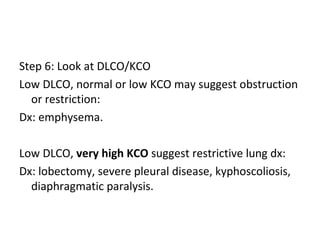
Step 6: Look at DLCO/KCO Low DLCO, normal or low KCO may suggest obstruction or restriction: Dx: emphysema. Low DLCO,  very high KCO  suggest restrictive lung dx: Dx: lobectomy, severe pleural disease, kyphoscoliosis, diaphragmatic paralysis.
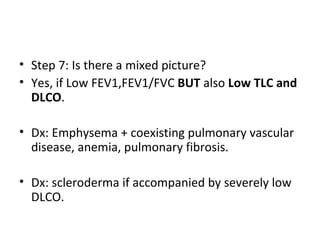
Step 7: Is there a mixed picture? Yes, if Low FEV1,FEV1/FVC  BUT  also  Low TLC and DLCO . Dx: Emphysema + coexisting pulmonary vascular disease, anemia, pulmonary fibrosis. Dx: scleroderma if accompanied by severely low DLCO.
Features suggestive of pulmonary vascular disease (ie: Pulmonary embolism): Restrictive pattern (Normal FEV/FVC, low TLC) No bronchodilator response. Very low DLCO in a setting of a normal CXR.
Features suggestive of obesity hypoventilation syndrome: Restrictive pattern Obesity Hypercapnemia on ABG.(Type 2 respiratory failure)

Flow volume loop

  • 1.
  • 2.
  • 3.
    (A) Normal. Inspiratorylimb of loop is symmetric and convex. Expiratory limb is linear. Flow rates at the midpoint of the inspiratory and expiratory capacity are often measured. Maximal inspiratory flow at 50% of forced vital capacity (MIF 50%FVC) is greater than maximal expiratory flow at 50% FVC (MEF 50%FVC) because dynamic compression of the airways occurs during exhalation.
  • 4.
    (B) Obstructive disease(eg, emphysema, asthma). Although all flow rates are diminished, expiratory prolongation predominates, and MEF < MIF. Peak expiratory flow is sometimes used to estimate degree of airway obstruction but is dependent on patient effort.
  • 5.
    (C) Restrictive disease(eg, interstitial lung disease, kyphoscoliosis). The loop is narrowed because of diminished lung volumes, but the shape is generally the same as in normal volume. Flow rates are greater than normal at comparable lung volumes because the increased elastic recoil of lungs holds the airways open.
  • 6.
    (D) Fixed obstructionof the upper airway (eg, tracheal stenosis, goiter). The top and bottom of the loops are flattened so that the configuration approaches that of a rectangle. Fixed obstruction limits flow equally during inspiration and expiration, and MEF = MIF .
  • 7.
    (E) Variable e xtrathoracic obstruction (eg, unilateral vocal cord paralysis, vocal cord dysfunction). When a single vocal cord is paralyzed, it moves passively with pressure gradients across the glottis. During forced inspiration, it is drawn inward, resulting in a plateau of decreased inspiratory flow. During forced expiration, it is passively blown aside, and expiratory flow is unimpaired. Therefore, MIF 50%FVC < MEF 50%FVC . E xpiratory flow unimpaired
  • 8.
    (F) Variable i ntrathoracic obstruction (eg, tracheomalacia). During a forced inspiration, negative pleural pressure holds the “floppy” trachea open. With forced expiration, loss of structural support results in tracheal narrowing of the trachea and a plateau of diminished flow. Flow is maintained briefly before airway compression occurs. I nspiratory flow unimpaired
  • 9.
    How to interpretlung function test?
  • 10.
    Know the 3aspects of lung function test: 1) spirometry 2) volumes 3) diffusion
  • 11.
    Normal values Spirometry:FEV1 and FVC >80% predicted. FEV1/FVC >80% predicted. Volumes: 80-120%. Diffusion: 75-125%.
  • 12.
    Low FVC suggestpossible restriction but need to look at TLC to confirm (TLC <80%) High FRC and TLC (>120% predicted) suggest hyperinflation. High RV/TLC suggest gas trapping.
  • 13.
    Stepwise approach Step1) look at the FEV1 . ?obstruction Step 2) look at FVC . If low, suggest restriction. If so, look at TLC to confirm restriction. Step 3) look at FEV1/FVC . Low- obstruction High- suggest restriction. Look at TLC to confirm.
  • 14.
    Step 4: Lookfor bronchodilator reversibility. Positive if improvement in FEV1 >12% and >200mls. Step 5: Look at lung volumes. High RV/TLC suggest severe gas trapping. FRC and TLC >120% suggest hyperinflation.
  • 15.
    Step 6: Lookat DLCO/KCO Low DLCO, normal or low KCO may suggest obstruction or restriction: Dx: emphysema. Low DLCO, very high KCO suggest restrictive lung dx: Dx: lobectomy, severe pleural disease, kyphoscoliosis, diaphragmatic paralysis.
  • 16.
    Step 7: Isthere a mixed picture? Yes, if Low FEV1,FEV1/FVC BUT also Low TLC and DLCO . Dx: Emphysema + coexisting pulmonary vascular disease, anemia, pulmonary fibrosis. Dx: scleroderma if accompanied by severely low DLCO.
  • 17.
    Features suggestive ofpulmonary vascular disease (ie: Pulmonary embolism): Restrictive pattern (Normal FEV/FVC, low TLC) No bronchodilator response. Very low DLCO in a setting of a normal CXR.
  • 18.
    Features suggestive ofobesity hypoventilation syndrome: Restrictive pattern Obesity Hypercapnemia on ABG.(Type 2 respiratory failure)