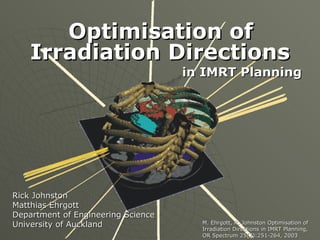
Optimisation of Irradiation Directions   in IMRT Planning Rick Johnston Matthias Ehrgott Department of Engineering Science University of Auckland M. Ehrgott, R. Johnston Optimisation of Irradiation Directions in IMRT Planning, OR Spectrum 25(2):251-264, 2003
What is Radiotherapy?
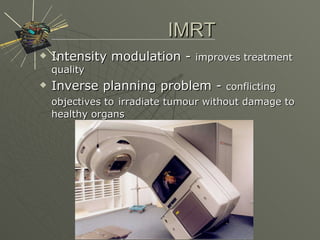
Intensity modulation -  improves treatment quality  Inverse planning problem -  conflicting objectives to   irradiate tumour without damage to healthy organs IMRT
Model Formulation Discretisation of Body and Beam Voxels Bixels gantry
Angle Discretisation Linearises the problem A number of LPs to be solved  Replicates physical setup
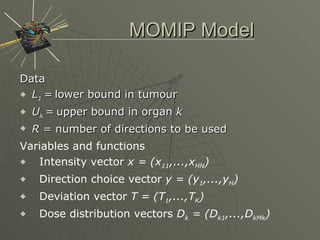
MOMIP Model Data L 1   =   lower bound in tumour U k   =   upper bound in organ  k R  = number of directions to be used  Variables and functions Intensity vector  x = (x 11 ,...,x HN ) Direction choice vector  y = (y 1 ,...,y H ) Deviation vector  T = (T 1 ,...,T K ) Dose distribution vectors  D k  = (D k1 ,...,D kMk )
min (T 1 ,...,T K ) D 1  = P 1 x    (L 1  - T 1 ) 1   D k  = P k x    (U k  + T k ) 1 , k=2,...,K   x hi     My h , h=1,…,H, i=1,…,N y 1 + ...+y H     R y h    {0,1} h=1,...,H  T, x     0 To study effect of direction optimisation consider weighted sum min   1 T 1 +   2 T 2  + ... +   K T K Extension of multicriteria model by Hamacher/Küfer
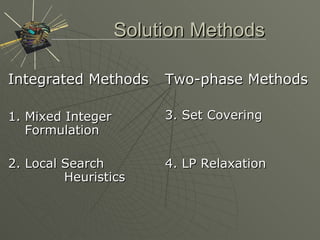
Solution Methods   Two-phase Methods 3. Set Covering 4. LP Relaxation Integrated Methods 1. Mixed Integer Formulation 2. Local Search  Heuristics
Integrated Methods CPLEX 7.0 If  R  increases problem becomes easier, objective value improves For small  R  and small angle discretisation often no feasible solution found MIP SOLVER 1
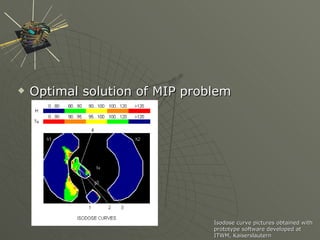
Optimal solution of MIP problem Isodose curve pictures obtained with prototype software developed at ITWM, Kaiserslautern
Integrated Methods Alter each gantry position in turn to find better angles Steepest descent with randomised starting angles Solve LP for each selection of angles LOCAL SEARCH 2
Local Search Movie
Two-phase Methods Intuitive Considers all angles Relatively quick Fully irradiate every voxel in the tumour Avoid damage to healthy organs Benefits: SET COVERING 3
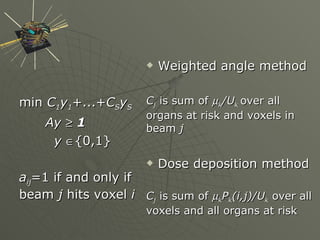
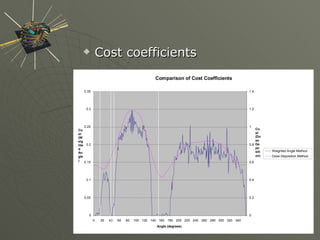
min  C 1 y 1 +...+ C S y S Ay      1 y    {0,1} a ij =1 if and only if beam  j  hits voxel  i Weighted angle method C j  is sum of   k /U k   over all organs at risk and voxels in beam  j Dose deposition method C j   is sum of   k P k (i,j)/U k  over all voxels and all organs at risk
Cost coefficients
Set Covering Solution MIP Solution
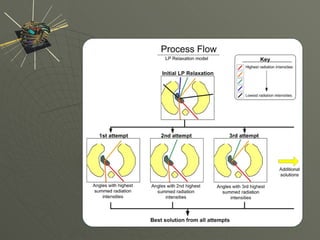
Two-Phase Methods LP RELAXATION 4 Optimal solution of LP relaxation 10-40 beams used
 
Results All methods were successful in generating good treatment plans in a reasonable timeframe (10 min) Optimal beams were  often counterintuitive Angle optimisation is  important if few beams  to be used
Solution with equidistant beams Solution with optimised beams
Comparison Objective 0 0.02 0.04 0.06 0.08 0.1 0.12 0.14 0.16 Problem 1 3 heads Problem 1 4 heads Problem 2 3 heads Problem 2 4 heads Problem 3 3 heads Set Covering LP relaxation Local Search Mixed Integer
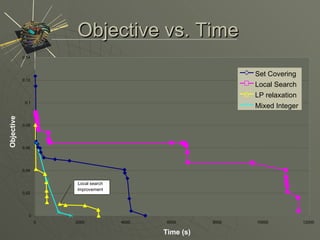
Objective vs. Time Objective 0 0.02 0.04 0.06 0.08 0.1 0.12 0.14 0 2000 4000 6000 8000 10000 12000 Time (s) Local search  improvement Set Covering Local Search LP relaxation Mixed Integer

Imrt

  • 1.
    Optimisation of IrradiationDirections in IMRT Planning Rick Johnston Matthias Ehrgott Department of Engineering Science University of Auckland M. Ehrgott, R. Johnston Optimisation of Irradiation Directions in IMRT Planning, OR Spectrum 25(2):251-264, 2003
  • 2.
  • 3.
    Intensity modulation - improves treatment quality Inverse planning problem - conflicting objectives to irradiate tumour without damage to healthy organs IMRT
  • 4.
    Model Formulation Discretisationof Body and Beam Voxels Bixels gantry
  • 5.
    Angle Discretisation Linearisesthe problem A number of LPs to be solved Replicates physical setup
  • 6.
    MOMIP Model DataL 1 = lower bound in tumour U k = upper bound in organ k R = number of directions to be used Variables and functions Intensity vector x = (x 11 ,...,x HN ) Direction choice vector y = (y 1 ,...,y H ) Deviation vector T = (T 1 ,...,T K ) Dose distribution vectors D k = (D k1 ,...,D kMk )
  • 7.
    min (T 1,...,T K ) D 1 = P 1 x  (L 1 - T 1 ) 1 D k = P k x  (U k + T k ) 1 , k=2,...,K x hi  My h , h=1,…,H, i=1,…,N y 1 + ...+y H  R y h  {0,1} h=1,...,H T, x  0 To study effect of direction optimisation consider weighted sum min  1 T 1 +  2 T 2 + ... +  K T K Extension of multicriteria model by Hamacher/Küfer
  • 8.
    Solution Methods Two-phase Methods 3. Set Covering 4. LP Relaxation Integrated Methods 1. Mixed Integer Formulation 2. Local Search Heuristics
  • 9.
    Integrated Methods CPLEX7.0 If R increases problem becomes easier, objective value improves For small R and small angle discretisation often no feasible solution found MIP SOLVER 1
  • 10.
    Optimal solution ofMIP problem Isodose curve pictures obtained with prototype software developed at ITWM, Kaiserslautern
  • 11.
    Integrated Methods Altereach gantry position in turn to find better angles Steepest descent with randomised starting angles Solve LP for each selection of angles LOCAL SEARCH 2
  • 12.
  • 13.
    Two-phase Methods IntuitiveConsiders all angles Relatively quick Fully irradiate every voxel in the tumour Avoid damage to healthy organs Benefits: SET COVERING 3
  • 14.
    min C1 y 1 +...+ C S y S Ay  1 y  {0,1} a ij =1 if and only if beam j hits voxel i Weighted angle method C j is sum of  k /U k over all organs at risk and voxels in beam j Dose deposition method C j is sum of  k P k (i,j)/U k over all voxels and all organs at risk
  • 15.
  • 16.
  • 17.
    Two-Phase Methods LPRELAXATION 4 Optimal solution of LP relaxation 10-40 beams used
  • 18.
  • 19.
    Results All methodswere successful in generating good treatment plans in a reasonable timeframe (10 min) Optimal beams were often counterintuitive Angle optimisation is important if few beams to be used
  • 20.
    Solution with equidistantbeams Solution with optimised beams
  • 21.
    Comparison Objective 00.02 0.04 0.06 0.08 0.1 0.12 0.14 0.16 Problem 1 3 heads Problem 1 4 heads Problem 2 3 heads Problem 2 4 heads Problem 3 3 heads Set Covering LP relaxation Local Search Mixed Integer
  • 22.
    Objective vs. TimeObjective 0 0.02 0.04 0.06 0.08 0.1 0.12 0.14 0 2000 4000 6000 8000 10000 12000 Time (s) Local search improvement Set Covering Local Search LP relaxation Mixed Integer

Editor's Notes

  • #2 Welcome. Name, supervisor, conjunction with Auckland Hospital.
  • #3 Contrary public opinion, radiotherapy nothing do with radios. Three Treatments for cancer, local to area. Successful 60%, non-metastastised localised cancers. What going talk about today
  • #4 Starship Enterprise. Machine, bed interaction. Gantry turns. Number of Irradiation Directions. Auckland Hospital; welcome! Long setup times.
  • #5 Represents 2-d version what just saw. Bixels – intensity across the beam. Voxels, break up body into homogeneous segments. LP formulation, specify maximum dose to healthy organs, min dose tumour
  • #6 Creates linear problem from high-dimensional multi-extremal non-linear optimisation. (CLICK) Number of positions used picked by planners (say three). Large no. of LPs. Better approach than other papers in field.
  • #9 Two main approaches.
  • #10 MIP: each possible angle has a boo var associated. Allow only fixed number of boo variables be ‘on’ then solve. Problems. Very slow improve on initial solution. Failed find feasible integer solution in difficult problems. Priority list, improved search techniques (no time)
  • #14 Set is the volume of the tumour, aim to cover tumour with radiation. Aim: replicate planner decision strategies. Aim for gaps. Results: good for low number of insertion points. Generalised SC and Distribution methods.
  • #18 Phase 1: allow irradiation from any number of directions Phase 2: use heuristics to consider only a few of these directions. Includes Local Search