Simplifying Expressions

By Zain Bin Masood
Senior Maths Teacher
At The Intellect School
Objective
This presentation is designed to give a brief
review of simplifying algebraic
expressions and evaluating algebraic
expressions.
Algebraic Expressions
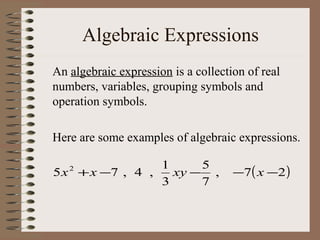
An algebraic expression is a collection of real
numbers, variables, grouping symbols and
operation symbols.
Here are some examples of algebraic expressions.
1
5
5 x + x −7 , 4 ,
xy − ,
3
7
2

−7( x −2 )
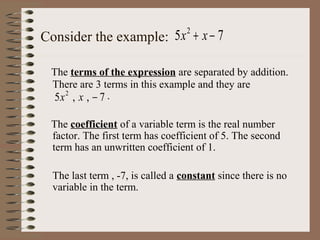
Consider the example: 5 x + x − 7
2

The terms of the expression are separated by addition.
There are 3 terms in this example and they are
5x 2 , x , − 7 .
The coefficient of a variable term is the real number
factor. The first term has coefficient of 5. The second
term has an unwritten coefficient of 1.
The last term , -7, is called a constant since there is no
variable in the term.
Let’s begin with a review of two important
skills for simplifying expression, using the
Distributive Property and combining like
terms. Then we will use both skills in the
same simplifying problem.
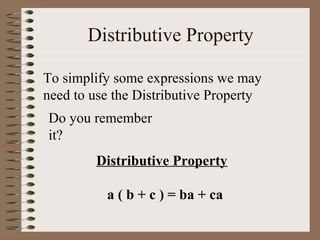
Distributive Property
To simplify some expressions we may
need to use the Distributive Property
Do you remember
it?
Distributive Property
a ( b + c ) = ba + ca
Examples
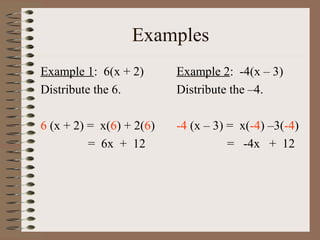
Example 1: 6(x + 2)
Distribute the 6.

Example 2: -4(x – 3)
Distribute the –4.

6 (x + 2) = x(6) + 2(6)
= 6x + 12

-4 (x – 3) = x(-4) –3(-4)
= -4x + 12
Practice Problem
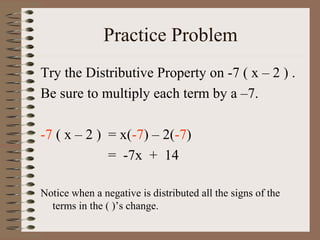
Try the Distributive Property on -7 ( x – 2 ) .
Be sure to multiply each term by a –7.
-7 ( x – 2 ) = x(-7) – 2(-7)
= -7x + 14
Notice when a negative is distributed all the signs of the
terms in the ( )’s change.
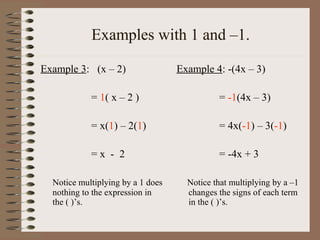
Examples with 1 and –1.
Example 3: (x – 2)

Example 4: -(4x – 3)

= 1( x – 2 )

= -1(4x – 3)

= x(1) – 2(1)

= 4x(-1) – 3(-1)

=x - 2

= -4x + 3

Notice multiplying by a 1 does
nothing to the expression in
the ( )’s.

Notice that multiplying by a –1
changes the signs of each term
in the ( )’s.
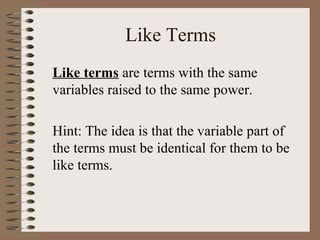
Like Terms
Like terms are terms with the same
variables raised to the same power.
Hint: The idea is that the variable part of
the terms must be identical for them to be
like terms.
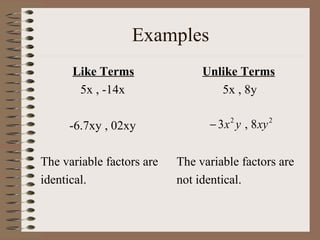
Examples
Like Terms
5x , -14x

Unlike Terms
5x , 8y

-6.7xy , 02xy

− 3 x y , 8 xy

The variable factors are
identical.

The variable factors are
not identical.

2

2
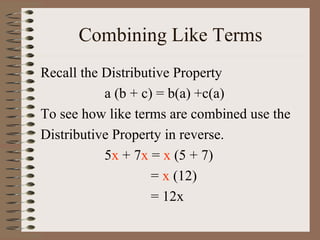
Combining Like Terms
Recall the Distributive Property
a (b + c) = b(a) +c(a)
To see how like terms are combined use the
Distributive Property in reverse.
5x + 7x = x (5 + 7)
= x (12)
= 12x
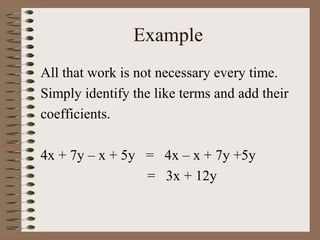
Example
All that work is not necessary every time.
Simply identify the like terms and add their
coefficients.
4x + 7y – x + 5y = 4x – x + 7y +5y
= 3x + 12y
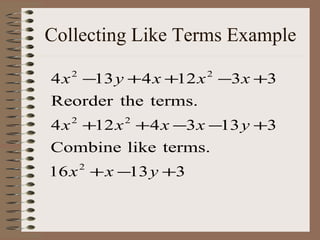
Collecting Like Terms Example
4 x 2 −13 y +4 x +12 x 2 −3 x +3
Reorder the terms.
4 x +12 x +4 x −3 x −13 y +3
Combine like terms.
2

2

16 x + x −13 y +3
2
Both Skills
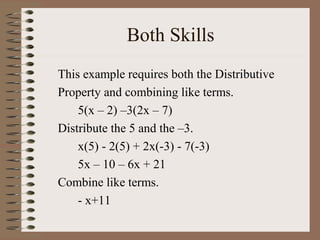
This example requires both the Distributive
Property and combining like terms.
5(x – 2) –3(2x – 7)
Distribute the 5 and the –3.
x(5) - 2(5) + 2x(-3) - 7(-3)
5x – 10 – 6x + 21
Combine like terms.
- x+11
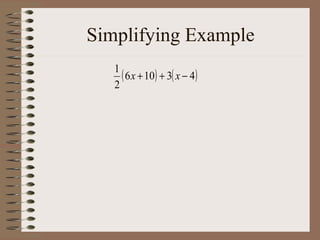
Simplifying Example
1
( 6 x + 10) + 3( x − 4)
2
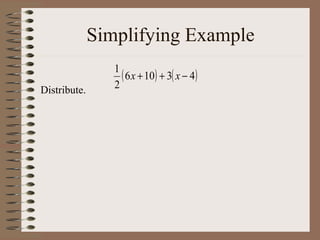
Simplifying Example
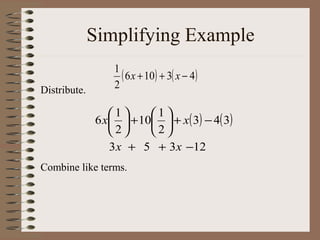
Distribute.

1
( 6 x + 10) + 3( x − 4)
2
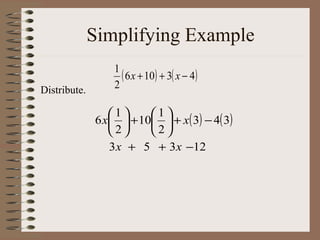
Simplifying Example
Distribute.

1
( 6 x + 10) + 3( x − 4)
2

1
1
6 x  + 10  + x( 3) − 4( 3)
2
2
3 x + 5 + 3 x −12
Simplifying Example
Distribute.

1
( 6 x + 10) + 3( x − 4)
2

1
1
6 x  + 10  + x( 3) − 4( 3)
2
2
3 x + 5 + 3 x −12
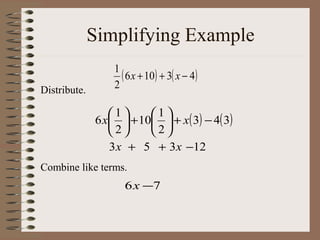
Combine like terms.
Simplifying Example
Distribute.

1
( 6 x + 10) + 3( x − 4)
2

1
1
6 x  + 10  + x( 3) − 4( 3)
2
2
3 x + 5 + 3 x −12
Combine like terms.

6 x −7
Evaluating Expressions
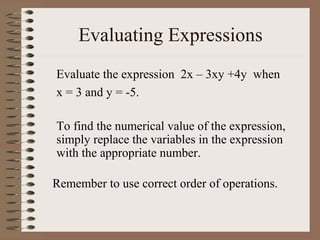
Evaluate the expression 2x – 3xy +4y when
x = 3 and y = -5.
To find the numerical value of the expression,
simply replace the variables in the expression
with the appropriate number.
Remember to use correct order of operations.
Example
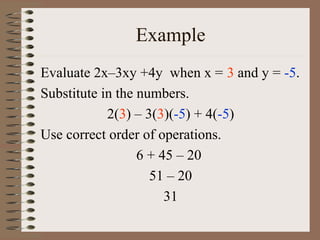
Evaluate 2x–3xy +4y when x = 3 and y = -5.
Substitute in the numbers.
2(3) – 3(3)(-5) + 4(-5)
Use correct order of operations.
6 + 45 – 20
51 – 20
31
Evaluating Example
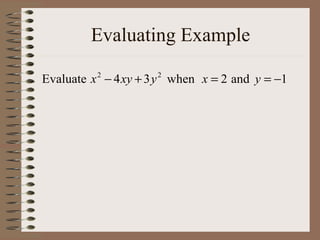
Evaluate x 2 − 4 xy + 3 y 2 when x = 2 and y = −1
Evaluating Example
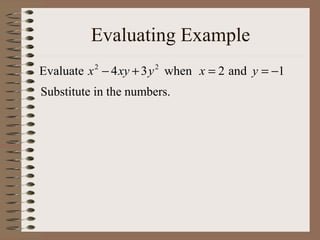
Evaluate x − 4 xy + 3 y when x = 2 and y = −1
2

2

Substitute in the numbers.
Evaluating Example
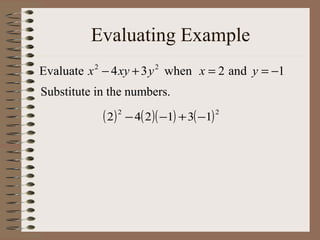
Evaluate x − 4 xy + 3 y when x = 2 and y = −1
2

2

Substitute in the numbers.

( 2) 2 − 4( 2)( −1) + 3( −1) 2
Evaluating Example
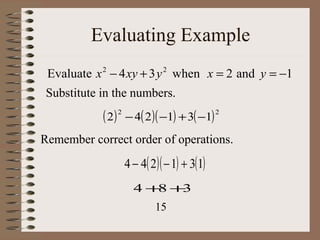
Evaluate x 2 − 4 xy + 3 y 2 when x = 2 and y = −1
Substitute in the numbers.

( 2) 2 − 4( 2)( −1) + 3( −1) 2
Remember correct order of operations.

4 − 4( 2)( − 1) + 3(1)
4+ +
8 3
15
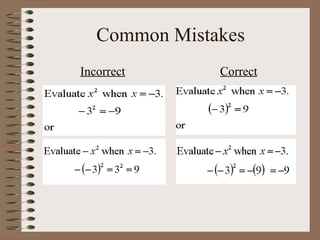
Common Mistakes
Incorrect

Correct
Simplifying expressions

Simplifying expressions

  • 1.
    Simplifying Expressions By ZainBin Masood Senior Maths Teacher At The Intellect School
  • 2.
    Objective This presentation isdesigned to give a brief review of simplifying algebraic expressions and evaluating algebraic expressions.
  • 3.
    Algebraic Expressions An algebraicexpression is a collection of real numbers, variables, grouping symbols and operation symbols. Here are some examples of algebraic expressions. 1 5 5 x + x −7 , 4 , xy − , 3 7 2 −7( x −2 )
  • 4.
    Consider the example:5 x + x − 7 2 The terms of the expression are separated by addition. There are 3 terms in this example and they are 5x 2 , x , − 7 . The coefficient of a variable term is the real number factor. The first term has coefficient of 5. The second term has an unwritten coefficient of 1. The last term , -7, is called a constant since there is no variable in the term.
  • 5.
    Let’s begin witha review of two important skills for simplifying expression, using the Distributive Property and combining like terms. Then we will use both skills in the same simplifying problem.
  • 6.
    Distributive Property To simplifysome expressions we may need to use the Distributive Property Do you remember it? Distributive Property a ( b + c ) = ba + ca
  • 7.
    Examples Example 1: 6(x+ 2) Distribute the 6. Example 2: -4(x – 3) Distribute the –4. 6 (x + 2) = x(6) + 2(6) = 6x + 12 -4 (x – 3) = x(-4) –3(-4) = -4x + 12
  • 8.
    Practice Problem Try theDistributive Property on -7 ( x – 2 ) . Be sure to multiply each term by a –7. -7 ( x – 2 ) = x(-7) – 2(-7) = -7x + 14 Notice when a negative is distributed all the signs of the terms in the ( )’s change.
  • 9.
    Examples with 1and –1. Example 3: (x – 2) Example 4: -(4x – 3) = 1( x – 2 ) = -1(4x – 3) = x(1) – 2(1) = 4x(-1) – 3(-1) =x - 2 = -4x + 3 Notice multiplying by a 1 does nothing to the expression in the ( )’s. Notice that multiplying by a –1 changes the signs of each term in the ( )’s.
  • 10.
    Like Terms Like termsare terms with the same variables raised to the same power. Hint: The idea is that the variable part of the terms must be identical for them to be like terms.
  • 11.
    Examples Like Terms 5x ,-14x Unlike Terms 5x , 8y -6.7xy , 02xy − 3 x y , 8 xy The variable factors are identical. The variable factors are not identical. 2 2
  • 12.
    Combining Like Terms Recallthe Distributive Property a (b + c) = b(a) +c(a) To see how like terms are combined use the Distributive Property in reverse. 5x + 7x = x (5 + 7) = x (12) = 12x
  • 13.
    Example All that workis not necessary every time. Simply identify the like terms and add their coefficients. 4x + 7y – x + 5y = 4x – x + 7y +5y = 3x + 12y
  • 14.
    Collecting Like TermsExample 4 x 2 −13 y +4 x +12 x 2 −3 x +3 Reorder the terms. 4 x +12 x +4 x −3 x −13 y +3 Combine like terms. 2 2 16 x + x −13 y +3 2
  • 15.
    Both Skills This examplerequires both the Distributive Property and combining like terms. 5(x – 2) –3(2x – 7) Distribute the 5 and the –3. x(5) - 2(5) + 2x(-3) - 7(-3) 5x – 10 – 6x + 21 Combine like terms. - x+11
  • 16.
    Simplifying Example 1 ( 6x + 10) + 3( x − 4) 2
  • 17.
  • 18.
    Simplifying Example Distribute. 1 ( 6x + 10) + 3( x − 4) 2 1 1 6 x  + 10  + x( 3) − 4( 3) 2 2 3 x + 5 + 3 x −12
  • 19.
    Simplifying Example Distribute. 1 ( 6x + 10) + 3( x − 4) 2 1 1 6 x  + 10  + x( 3) − 4( 3) 2 2 3 x + 5 + 3 x −12 Combine like terms.
  • 20.
    Simplifying Example Distribute. 1 ( 6x + 10) + 3( x − 4) 2 1 1 6 x  + 10  + x( 3) − 4( 3) 2 2 3 x + 5 + 3 x −12 Combine like terms. 6 x −7
  • 21.
    Evaluating Expressions Evaluate theexpression 2x – 3xy +4y when x = 3 and y = -5. To find the numerical value of the expression, simply replace the variables in the expression with the appropriate number. Remember to use correct order of operations.
  • 22.
    Example Evaluate 2x–3xy +4ywhen x = 3 and y = -5. Substitute in the numbers. 2(3) – 3(3)(-5) + 4(-5) Use correct order of operations. 6 + 45 – 20 51 – 20 31
  • 23.
    Evaluating Example Evaluate x2 − 4 xy + 3 y 2 when x = 2 and y = −1
  • 24.
    Evaluating Example Evaluate x− 4 xy + 3 y when x = 2 and y = −1 2 2 Substitute in the numbers.
  • 25.
    Evaluating Example Evaluate x− 4 xy + 3 y when x = 2 and y = −1 2 2 Substitute in the numbers. ( 2) 2 − 4( 2)( −1) + 3( −1) 2
  • 26.
    Evaluating Example Evaluate x2 − 4 xy + 3 y 2 when x = 2 and y = −1 Substitute in the numbers. ( 2) 2 − 4( 2)( −1) + 3( −1) 2 Remember correct order of operations. 4 − 4( 2)( − 1) + 3(1) 4+ + 8 3 15
  • 27.