LINEAR EQUATIONS IN ONE VARIABLE 15
2.1 Introduction
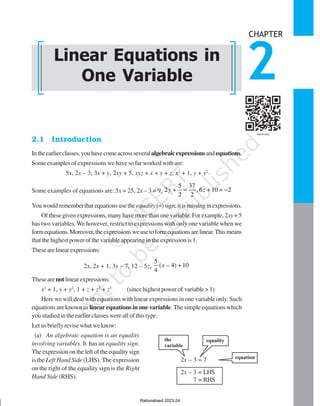
Intheearlierclasses,youhavecomeacrossseveralalgebraicexpressionsandequations.
Some examples of expressions we have so far worked with are:
5x, 2x – 3, 3x + y, 2xy + 5, xyz + x + y + z, x2
+ 1, y + y2
Some examples of equations are: 5x = 25, 2x – 3 = 9,
5 37
2 , 6 10 2
2 2
y z
+ = + = −
Youwouldrememberthatequationsusetheequality(=)sign;itismissinginexpressions.
Ofthesegivenexpressions,manyhavemorethanonevariable.Forexample,2xy+5
has two variables.We however, restrict to expressions with only one variable when we
formequations.Moreover,theexpressionsweusetoformequationsarelinear.Thismeans
that the highest power of the variable appearing in the expression is 1.
Thesearelinearexpressions:
2x, 2x + 1, 3y – 7, 12 – 5z,
5
( – 4) 10
4
x +
Thesearenotlinearexpressions:
x2
+ 1, y + y2
, 1 + z + z2
+ z3
(since highest power of variable > 1)
Here we will deal with equations with linear expressions in one variable only. Such
equations are known as linear equations in one variable. The simple equations which
you studied in the earlier classes were all of this type.
Letusbrieflyrevisewhatweknow:
(a) An algebraic equation is an equality
involving variables. It has an equality sign.
Theexpressionontheleftoftheequalitysign
is the Left Hand Side (LHS). The expression
on the right of the equality sign is the Right
Hand Side (RHS).
CHAPTER
2
Linear Equations in
One Variable
2x – 3 = 7
2x – 3 = LHS
7 = RHS
Rationalised 2023-24
16 MATHEMATICS
(b) In an equation the values of
the expressions on the LHS
and RHS are equal. This
happens to be true only for
certainvaluesofthevariable.
These values are the
solutions of the equation.
(c) How to find the solution of an equation?
Weassumethatthetwosidesoftheequationarebalanced.
We perform the same mathematical operations on both
sidesoftheequation,sothatthebalanceisnotdisturbed.
Afewsuchstepsgivethesolution.
2.2 Solving Equations having the Variable on
both Sides
An equation is the equality of the values of two expressions. In the equation 2x – 3 = 7,
the two expressions are 2x – 3 and 7. In most examples that we have come across so
far, the RHS is just a number. But this need not always be so; both sides could have
expressions with variables. For example, the equation 2x – 3 = x + 2 has expressions
with a variable on both sides; the expression on the LHS is (2x – 3) and the expression
on the RHS is (x + 2).
• Wenowdiscusshowtosolvesuchequationswhichhaveexpressionswiththevariable
on both sides.
Example 1: Solve 2x – 3 = x + 2
Solution: We have
2x = x + 2 + 3
or 2x = x + 5
or 2x – x = x + 5 – x (subtracting x from both sides)
or x = 5 (solution)
Here we subtracted from both sides of the equation, not a number (constant), but a
term involving the variable.We can do this as variables are also numbers.Also, note that
subtracting x from both sides amounts to transposing x to LHS.
Example 2: Solve 5x +
7 3
14
2 2
x
= −
Solution: Multiply both sides of the equation by 2.We get
2 5
7
2
× +






x = 2
3
2
14
× −






x
x = 5 is the solution of the equation
2x – 3 = 7. For x = 5,
LHS = 2 × 5 – 3 = 7 = RHS
On the other hand x = 10 is not a solution of the
equation. For x = 10, LHS = 2 × 10 –3 = 17.
This is not equal to the RHS
Rationalised 2023-24
LINEAR EQUATIONS IN ONE VARIABLE 17
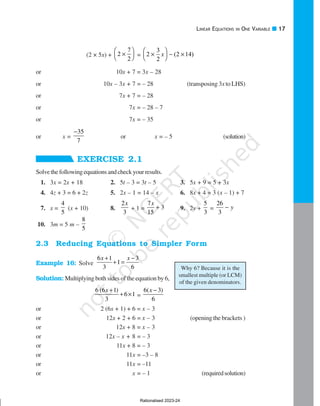
Why 6? Because it is the
smallest multiple (or LCM)
of the given denominators.
(2 × 5x) + 2
7
2
×





 = 2
3
2
2 14
×





 − ×
x ( )
or 10x + 7 = 3x – 28
or 10x – 3x + 7 = – 28 (transposing 3xto LHS)
or 7x + 7 = – 28
or 7x = – 28 – 7
or 7x = – 35
or x =
35
7
−
or x = – 5 (solution)
EXERCISE 2.1
Solvethefollowingequationsandcheckyourresults.
1. 3x = 2x + 18 2. 5t – 3 = 3t – 5 3. 5x + 9 = 5 + 3x
4. 4z + 3 = 6 + 2z 5. 2x – 1 = 14 – x 6. 8x + 4 = 3 (x – 1) + 7
7. x =
4
5
(x + 10) 8.
2
3
x
+ 1 =
7
3
15
x
+ 9. 2y +
5
3
=
26
3
y
−
10. 3m = 5 m –
8
5
2.3 Reducing Equations to Simpler Form
Example 16: Solve
6 1 3
1
3 6
x x
+ −
+ =
Solution: Multiplying both sides of the equation by 6,
6 (6 1)
6 1
3
x +
+ × =
6( 3)
6
x −
or 2 (6x + 1) + 6 = x – 3
or 12x + 2 + 6 = x – 3 (opening the brackets )
or 12x + 8 = x – 3
or 12x – x + 8 = – 3
or 11x + 8 = – 3
or 11x = –3 – 8
or 11x = –11
or x = – 1 (requiredsolution)
Rationalised 2023-24
18 MATHEMATICS
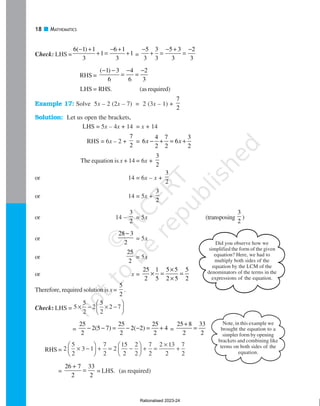
Check: LHS =
6( 1) 1 6 1
1 1
3 3
− + − +
+ = + =
5 3 5 3 2
3 3 3 3
− − + −
+ = =
RHS =
( 1) 3 4 2
6 6 3
− − − −
= =
LHS = RHS. (as required)
Example 17: Solve 5x – 2 (2x – 7) = 2 (3x – 1) +
7
2
Solution: Let us open the brackets,
LHS = 5x – 4x + 14 = x + 14
RHS = 6x – 2 +
7
2
=
4 7 3
6 6
2 2 2
x x
− + = +
The equation is x + 14 = 6x +
3
2
or 14 = 6x – x +
3
2
or 14 = 5x +
3
2
or 14 –
3
2
= 5x (transposing
3
2
)
or
28 3
2
−
= 5x
or
25
2
= 5x
or x =
25 1 5 5 5
2 5 2 5 2
×
× = =
×
Therefore, required solution is x =
5
2
.
Check: LHS =
=
25 25 25
2(5 7) 2( 2) 4
2 2 2
− − = − − = + =
25 8 33
2 2
+
=
RHS =
=
26 7 33
2 2
+
= = LHS. (as required)
Did you observe how we
simplified the form of the given
equation? Here, we had to
multiply both sides of the
equation by the LCM of the
denominators of the terms in the
expressions of the equation.
Note, in this example we
brought the equation to a
simpler form by opening
brackets and combining like
terms on both sides of the
equation.
Rationalised 2023-24
LINEAR EQUATIONS IN ONE VARIABLE 19
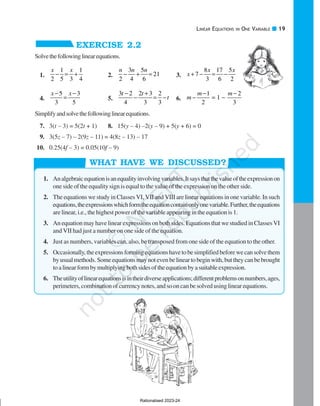
WHAT HAVE WE DISCUSSED?
1. Analgebraicequationisanequalityinvolvingvariables.Itsaysthatthevalueoftheexpressionon
one side of the equality sign is equal to the value of the expression on the other side.
2. The equations we study in Classes VI, VII and VIII are linear equations in one variable. In such
equations,theexpressionswhichformtheequationcontainonlyonevariable.Further,theequations
are linear, i.e., the highest power of the variable appearing in the equation is 1.
3. An equation may have linear expressions on both sides. Equations that we studied in Classes VI
and VII had just a number on one side of the equation.
4. Just as numbers, variables can, also, be transposed from one side of the equation to the other.
5. Occasionally,theexpressionsformingequationshavetobesimplifiedbeforewecansolvethem
byusualmethods.Someequationsmaynotevenbelineartobeginwith,buttheycanbebrought
toalinearformbymultiplyingbothsidesoftheequationbyasuitableexpression.
6. Theutilityoflinearequationsisintheirdiverseapplications;differentproblemsonnumbers,ages,
perimeters, combination of currency notes, and so on can be solved using linear equations.
EXERCISE 2.2
Solvethefollowinglinearequations.
1.
1 1
2 5 3 4
x x
− = + 2.
3 5
21
2 4 6
n n n
− + = 3.
8 17 5
7
3 6 2
x x
x + − = −
4.
5 3
3 5
x x
− −
= 5.
3 2 2 3 2
4 3 3
t t
t
− +
− = − 6.
1 2
1
2 3
m m
m
− −
− = −
Simplifyandsolvethefollowinglinearequations.
7. 3(t – 3) = 5(2t + 1) 8. 15(y – 4) –2(y – 9) + 5(y + 6) = 0
9. 3(5z – 7) – 2(9z – 11) = 4(8z – 13) – 17
10. 0.25(4f – 3) = 0.05(10f – 9)
Rationalised 2023-24
20 MATHEMATICS
NOTES
Rationalised 2023-24

Linear Equationsdfgva in One Variable.pdf

  • 1.
    LINEAR EQUATIONS INONE VARIABLE 15 2.1 Introduction Intheearlierclasses,youhavecomeacrossseveralalgebraicexpressionsandequations. Some examples of expressions we have so far worked with are: 5x, 2x – 3, 3x + y, 2xy + 5, xyz + x + y + z, x2 + 1, y + y2 Some examples of equations are: 5x = 25, 2x – 3 = 9, 5 37 2 , 6 10 2 2 2 y z + = + = − Youwouldrememberthatequationsusetheequality(=)sign;itismissinginexpressions. Ofthesegivenexpressions,manyhavemorethanonevariable.Forexample,2xy+5 has two variables.We however, restrict to expressions with only one variable when we formequations.Moreover,theexpressionsweusetoformequationsarelinear.Thismeans that the highest power of the variable appearing in the expression is 1. Thesearelinearexpressions: 2x, 2x + 1, 3y – 7, 12 – 5z, 5 ( – 4) 10 4 x + Thesearenotlinearexpressions: x2 + 1, y + y2 , 1 + z + z2 + z3 (since highest power of variable > 1) Here we will deal with equations with linear expressions in one variable only. Such equations are known as linear equations in one variable. The simple equations which you studied in the earlier classes were all of this type. Letusbrieflyrevisewhatweknow: (a) An algebraic equation is an equality involving variables. It has an equality sign. Theexpressionontheleftoftheequalitysign is the Left Hand Side (LHS). The expression on the right of the equality sign is the Right Hand Side (RHS). CHAPTER 2 Linear Equations in One Variable 2x – 3 = 7 2x – 3 = LHS 7 = RHS Rationalised 2023-24
  • 2.
    16 MATHEMATICS (b) Inan equation the values of the expressions on the LHS and RHS are equal. This happens to be true only for certainvaluesofthevariable. These values are the solutions of the equation. (c) How to find the solution of an equation? Weassumethatthetwosidesoftheequationarebalanced. We perform the same mathematical operations on both sidesoftheequation,sothatthebalanceisnotdisturbed. Afewsuchstepsgivethesolution. 2.2 Solving Equations having the Variable on both Sides An equation is the equality of the values of two expressions. In the equation 2x – 3 = 7, the two expressions are 2x – 3 and 7. In most examples that we have come across so far, the RHS is just a number. But this need not always be so; both sides could have expressions with variables. For example, the equation 2x – 3 = x + 2 has expressions with a variable on both sides; the expression on the LHS is (2x – 3) and the expression on the RHS is (x + 2). • Wenowdiscusshowtosolvesuchequationswhichhaveexpressionswiththevariable on both sides. Example 1: Solve 2x – 3 = x + 2 Solution: We have 2x = x + 2 + 3 or 2x = x + 5 or 2x – x = x + 5 – x (subtracting x from both sides) or x = 5 (solution) Here we subtracted from both sides of the equation, not a number (constant), but a term involving the variable.We can do this as variables are also numbers.Also, note that subtracting x from both sides amounts to transposing x to LHS. Example 2: Solve 5x + 7 3 14 2 2 x = − Solution: Multiply both sides of the equation by 2.We get 2 5 7 2 × +       x = 2 3 2 14 × −       x x = 5 is the solution of the equation 2x – 3 = 7. For x = 5, LHS = 2 × 5 – 3 = 7 = RHS On the other hand x = 10 is not a solution of the equation. For x = 10, LHS = 2 × 10 –3 = 17. This is not equal to the RHS Rationalised 2023-24
  • 3.
    LINEAR EQUATIONS INONE VARIABLE 17 Why 6? Because it is the smallest multiple (or LCM) of the given denominators. (2 × 5x) + 2 7 2 ×       = 2 3 2 2 14 ×       − × x ( ) or 10x + 7 = 3x – 28 or 10x – 3x + 7 = – 28 (transposing 3xto LHS) or 7x + 7 = – 28 or 7x = – 28 – 7 or 7x = – 35 or x = 35 7 − or x = – 5 (solution) EXERCISE 2.1 Solvethefollowingequationsandcheckyourresults. 1. 3x = 2x + 18 2. 5t – 3 = 3t – 5 3. 5x + 9 = 5 + 3x 4. 4z + 3 = 6 + 2z 5. 2x – 1 = 14 – x 6. 8x + 4 = 3 (x – 1) + 7 7. x = 4 5 (x + 10) 8. 2 3 x + 1 = 7 3 15 x + 9. 2y + 5 3 = 26 3 y − 10. 3m = 5 m – 8 5 2.3 Reducing Equations to Simpler Form Example 16: Solve 6 1 3 1 3 6 x x + − + = Solution: Multiplying both sides of the equation by 6, 6 (6 1) 6 1 3 x + + × = 6( 3) 6 x − or 2 (6x + 1) + 6 = x – 3 or 12x + 2 + 6 = x – 3 (opening the brackets ) or 12x + 8 = x – 3 or 12x – x + 8 = – 3 or 11x + 8 = – 3 or 11x = –3 – 8 or 11x = –11 or x = – 1 (requiredsolution) Rationalised 2023-24
  • 4.
    18 MATHEMATICS Check: LHS= 6( 1) 1 6 1 1 1 3 3 − + − + + = + = 5 3 5 3 2 3 3 3 3 − − + − + = = RHS = ( 1) 3 4 2 6 6 3 − − − − = = LHS = RHS. (as required) Example 17: Solve 5x – 2 (2x – 7) = 2 (3x – 1) + 7 2 Solution: Let us open the brackets, LHS = 5x – 4x + 14 = x + 14 RHS = 6x – 2 + 7 2 = 4 7 3 6 6 2 2 2 x x − + = + The equation is x + 14 = 6x + 3 2 or 14 = 6x – x + 3 2 or 14 = 5x + 3 2 or 14 – 3 2 = 5x (transposing 3 2 ) or 28 3 2 − = 5x or 25 2 = 5x or x = 25 1 5 5 5 2 5 2 5 2 × × = = × Therefore, required solution is x = 5 2 . Check: LHS = = 25 25 25 2(5 7) 2( 2) 4 2 2 2 − − = − − = + = 25 8 33 2 2 + = RHS = = 26 7 33 2 2 + = = LHS. (as required) Did you observe how we simplified the form of the given equation? Here, we had to multiply both sides of the equation by the LCM of the denominators of the terms in the expressions of the equation. Note, in this example we brought the equation to a simpler form by opening brackets and combining like terms on both sides of the equation. Rationalised 2023-24
  • 5.
    LINEAR EQUATIONS INONE VARIABLE 19 WHAT HAVE WE DISCUSSED? 1. Analgebraicequationisanequalityinvolvingvariables.Itsaysthatthevalueoftheexpressionon one side of the equality sign is equal to the value of the expression on the other side. 2. The equations we study in Classes VI, VII and VIII are linear equations in one variable. In such equations,theexpressionswhichformtheequationcontainonlyonevariable.Further,theequations are linear, i.e., the highest power of the variable appearing in the equation is 1. 3. An equation may have linear expressions on both sides. Equations that we studied in Classes VI and VII had just a number on one side of the equation. 4. Just as numbers, variables can, also, be transposed from one side of the equation to the other. 5. Occasionally,theexpressionsformingequationshavetobesimplifiedbeforewecansolvethem byusualmethods.Someequationsmaynotevenbelineartobeginwith,buttheycanbebrought toalinearformbymultiplyingbothsidesoftheequationbyasuitableexpression. 6. Theutilityoflinearequationsisintheirdiverseapplications;differentproblemsonnumbers,ages, perimeters, combination of currency notes, and so on can be solved using linear equations. EXERCISE 2.2 Solvethefollowinglinearequations. 1. 1 1 2 5 3 4 x x − = + 2. 3 5 21 2 4 6 n n n − + = 3. 8 17 5 7 3 6 2 x x x + − = − 4. 5 3 3 5 x x − − = 5. 3 2 2 3 2 4 3 3 t t t − + − = − 6. 1 2 1 2 3 m m m − − − = − Simplifyandsolvethefollowinglinearequations. 7. 3(t – 3) = 5(2t + 1) 8. 15(y – 4) –2(y – 9) + 5(y + 6) = 0 9. 3(5z – 7) – 2(9z – 11) = 4(8z – 13) – 17 10. 0.25(4f – 3) = 0.05(10f – 9) Rationalised 2023-24
  • 6.