IPA
Transcription
Practice
Resource Person: Faiza Liaqat
MS. Applied Linguistics
University of Sargodha, Gujranwala Campus
Charts
English vowels:
The labels “Front”, “Central”, and “Back” refer to the
part of the tongue. The terms “High”, “Mid”, and “Low”
describe the position the tongue assumes for a given
vowel. For example, the vowels in hip, heap and hippy
are highfront vowels: /hɪp/ /hiːp/ /hɪpi/.
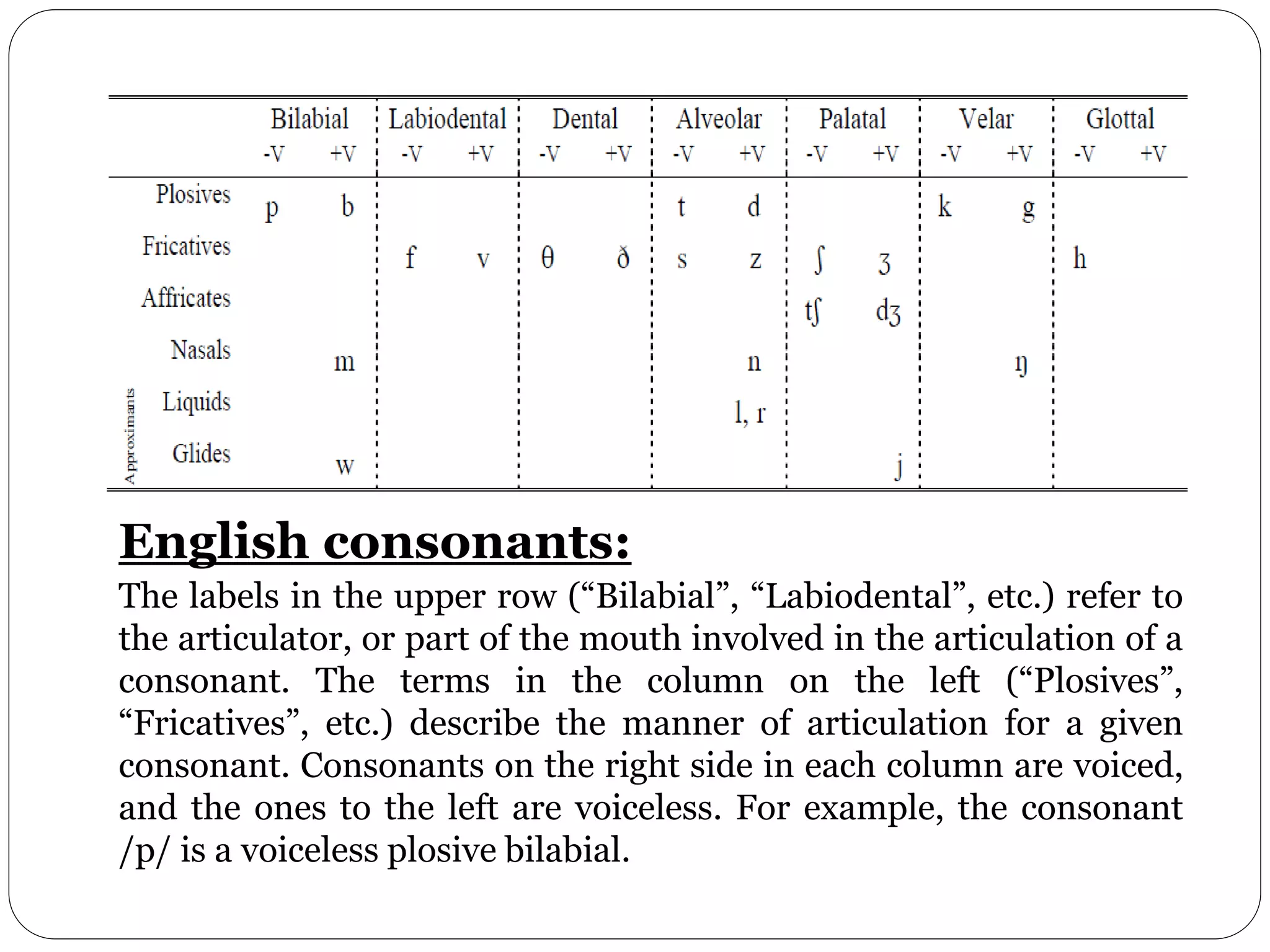
English consonants:
The labels in the upper row (“Bilabial”, “Labiodental”, etc.) refer to
the articulator, or part of the mouth involved in the articulation of a
consonant. The terms in the column on the left (“Plosives”,
“Fricatives”, etc.) describe the manner of articulation for a given
consonant. Consonants on the right side in each column are voiced,
and the ones to the left are voiceless. For example, the consonant
/p/ is a voiceless plosive bilabial.
trænˈskrɪpʃən ˈpræktɪs
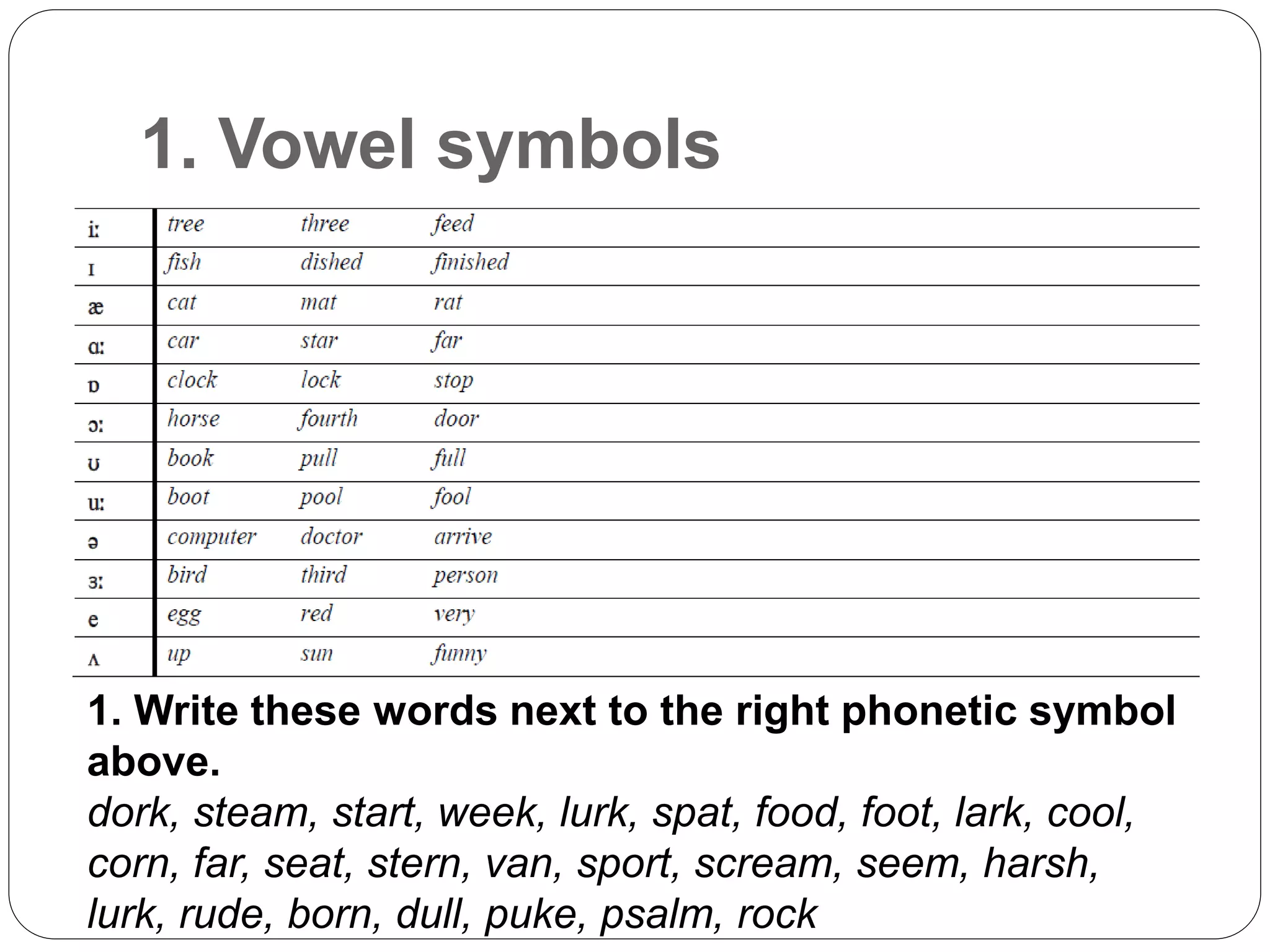
1. Vowel symbols
1. Write these words next to the right phonetic symbol
above.
dork, steam, start, week, lurk, spat, food, foot, lark, cool,
corn, far, seat, stern, van, sport, scream, seem, harsh,
lurk, rude, born, dull, puke, psalm, rock
Odd man out
2. Eliminate the word whose vowel is different from those in
the other three. In words with more syllables, the vowel in
question is in bold type.
 (F) stick, myth, feet, fit (A) lard, father, parent, jar
 (G) blood, muck, tar, pub (B) done, gun, fall ,stub
 (H) roll, rot, dot, gosh (C) sat, Nazi, clap, plaid
 (I) son, run, fun, butcher (D) set ,dead, heat, bet
 (J) lock, bottle, shore, stop (E) sieve ,leave,
meat, Steve
3. Transcribe the vowels in the following sentences.
 Love thy neighbor as yourself, but choose your
neighborhood.
/l_v ðaɪ neɪb_r əz jəs_lf bət tʃ_z jə neɪb_h_d/
 If you are not criticized, you may not be doing much.
/_f ju ɑː n_t kr_təsaɪzd jə meɪ n_t bi duɪŋ m_tʃ/
 Opportunity is missed by most people because it’s
dressed in overalls and looks like work.
/ɒpət_n_ti ɪz m_st baɪ məʊst p_pəl bikɒz ɪts dr_st ɪn
əʊvər_lz ən ɪt l_ks laɪk w_k/
 I don't think anyone should write their autobiography until
after they're dead.
aɪ dəʊnt θ_ŋk _nibʌdi ʃəd raɪt ðər əʊn baɪɒgr_fi ʌnt_l ðə
d_d
Vowels /ʊ/ and /uː/
 spelled ‘u’ /ʊ/
When the letter ‘u’ is pronounced as a high-back vowel, it is usually the
short /ʊ/: bull, butcher, full, pull, push, sugar, wuss
 u-e /uː/
But when a syllable containing the /u/ sound is followed by the letter ‘e’
in the spelling, the sound will be /uː/: absolute, cute, crude, dude,
exude, immune, include, mute, nuke, rude, use, etc.
 spelled ‘ew’ /uː/ brew, chew, jewel, Jewish, lewd, Lewis, newt,
shrewd, etc.
 spelled ‘oo’ /uː/ bloom, boom, boost, boot, booth, booze, cool,
doom, food, fool, gloom, goof, goose, hoot, loop, loot, loose, mood,
moon, moot, noose, ooze, pool, proof, school, shoot, smooth, snoop,
soon, spook, spoon, stool, swoon, swoop, tool, tooth, troop, zoom
 spelled ‘oo’ /ʊ/ book, good, foot, hood, hook, look,
nook, shook, stood, took, wood, wool
 Final /uː/ Words usually end in the long /uː/: argue,
avenue, bamboo, boo, coo, loo, peekaboo, shoo,
taboo, tattoo, too, voodoo, Yahoo, zoo, etc.
 both /ʊ/&/uː/ broom, groom, roof, room; in AmE also
root, soot, whoop
 idiosyncratic /ʊ/ woman, wolf
 /uː/ womb, tomb, fruit, group, soup, suit
Exercises
 Minimal pairs. The words below differ only in
one sound (the /uː/-/ʊ/contrast). Complete the
table.
wood /wʊd/- wooed /wuːd/ ____ /pʊl/ - ____ /puːl/
____ /fʊl/- fool /fuːl/ ____ /lʊk/- ____ /luːk/
 Transcribe the following phrases.
true blue, loose woman, A Few Good Men,
footloose groupie, cool looking dude, spoonful of
sugar, hooked on books, Fruit of the Loom,
shooting some bull, food and booze, cute Susan
crude tool, new tattoo, useful fool wolf on the
loose, astute conclusion, groovy music
Vowels /ɪ/ and /iː/
Patterns
 /ɪ/ is usually spelled as the letter “i”: bit, spin, zit,
glib, etc.
 /iː/ is often pronounced when spelled as:
‘ee’ bee, greet, meet, leek, reek, see, etc.; employee,
refugee, divorcee, etc.
‘ea’ bean, beat, heat, league, peace, sea, weave etc.
‘ie’ / ‘ei’ achieve, believe, field, piece, ceiling, receive,
conceive, etc.
e-CONSONANT-e athlete, complete, concrete,decent,
Irene, obese, Pete, Portuguese, Steve,
But there are exceptions:
 Looks like /iː/ but is really pronounced as /ɪ/:
sieve, mischief, counterfeit, foreign
 Looks like /ɪ/ but is really pronounced as /iː/: liter,
kilo, and -ique words antique, physique, pique,
technique
 Plus, there are some tricky examples of Irish
names: Sean /ʃɑːn/, Sinead /ʃɪˈneɪd/
Exercise
 Transcribe the following
King and Queen
kith and kin
speed limit
feeling of bliss
 Decipher these minimal pairs
/fiːl/ /fɪl/ /stiːl/ /stɪl/ /biːn/ /bɪn/
/riːm/ /rɪm/ /diːm/ /dɪm/ /liːk/ /lɪk/
Vowels /ə/, /ʌ/ and /æ/
 /ə/ (the “schwa”) is the most frequent vowel in
English.
 It usually appears in unstressed syllables, but
never in stressed syllables: about, afraid,
confuse, etc.
 It is not associated with any specific letter in the
spelling (in fact, it can be spelled with any vowel
letter: ability, seven, dinosaur, suppose)
 The indefinite article a/an is pronounced with
the schwa: /ə bed/, /ən æpəl/.
 /æ/ is usually spelled as the letter “a”: ban,
cat, dab, hag, stack, tab, etc.
 /ʌ/ is usually spelled as the letter “u”: bun,
cut, dub, hug, stuck, tub, etc.
Exceptions:
 Some exceptional cases of /ʌ/ words to
memorize:
 ton, son, won, front;
 one, done, none, come, love, glove, brother,
mother, some, something, other, nothing, money,
monkey, cover, govern, color, does;
 blood, flood;
 enough, rough, tough;
 touch, country, cousin, young, couple, double,
trouble.
which sound comes
before
Past /d/, /t/, or /ɪd/
 After unvoiced sounds such as p, k, f, s, sh,
and ch the final -ed is pronounced like t as in the
word cat. Note that the -e remains silent.
e.g. p help helped f stuff stuffed, laugh laughed s
miss missed dice diced , fix fixed
 After voiced sounds such as b, , g, v, z, , , m, n,
ŋ, l, and r the final -ed sound is pronounced like d
as in good. Note that the -e remains silent.
e.g. b grab grabbed g hug hugged v save
saved z ooze oozed, please pleased
 The final -ed is also pronounced like the d in
good after all vowel sounds. Note that the -e
remains silent.
e.g. stay stayed, free freed, lie lied
 For verbs ending in d and t the final -ed is
pronounced Id as in the final two letters of the
word did. Note that here the -e is not silent and
this final -ed sound adds another syllable to the
end of the verb.
E.g. add added, grade graded, decide decided
which sound comes
before
plural /z/, /s/, or /ɪz/
 If the noun ends in an unvoiced consonant
sound: /f/, /k/, /p/, /t/, /th/-(thin), pronounce "s" as
/s/.
 When it ends in a voiced consonant sound,
/b/, /d/, /g/, /l/, /m/, /n/, /ng/, /r/ or with a vowel
sound, /a/, /e/, /i/, /o/, /u/, pronounce "s" as /z/.
 If it ends with /s/, /z/, /sh/, /ch/-chair, /zh/-the
second "g" in garage, /dz/-(j), pronounce "s" or
"-es" as /iz/.
DIACRITICS
Diacritics Used with
Consonants
Changes in Place of Articulation for
Consonants.
These symbols describe deviations from normal
tongue placement for consonants.
Dentalization.
 Dentalization refers to an articulatory variation in
which the tongue approaches the upper incisors.
 It is marked by [ ] placed under the IPA symbol.
 For example,
the symbol [d] stands for a coronal alveolar voiced
stop.
widow and width.
FORMULA
Dentalization rule
 [-dental] → [+dental] ∕ ___________ [+
dental]
Palatalization
 Another modification of consonant articulation is
palatalization. Only sounds for which the palate is
not the place of articulation can be palatalized.
 The diacritical mark for palatalization is a
superscript j added
to the right of the basic IPA symbol.
Ch, dz, 3, sh
S sound in question
FORMULA:
[-palatal] → [+palatal] ∕ ___________ [+ palatal]
Velarization.
 Velarization refers to the posterior movement of
the tongue placement (in the direction of the
velum) for palatal sounds.
 The diacritical mark for velarization is a
superscript γ placed to the right of the IPA
symbol.
 FORMULA:
[-velar] → [velar] ∕ ___________ [+ velar]
 since [sins] silk [silk]
 mince [mins] milk [milk]
 Voice Symbols
 Aspiration and Nonaspiration
 Syllabic Consonants.
Unstressed syllables easily become reduced
syllables. This means that their vowel nucleus
practically disappears.
If the vowel nucleus is reduced, the following
consonant becomes a syllabic; that is, it becomes
the peak of that syllable.
 “little” [l tl ]
 “scratching” [skr tʃn ]
Nesalization
 leap [li:p] lean [li:n]
 tap [tap] tan [tæn]
 Nasalization rule
[- nasal] → [+nasal] ∕ ___________ [+ nasal]
 five past
[faivpa:st] [faifpa:st]
 love to
[lΛvte] [lΛfte]
 as can be shown [ezkenbifoun]
[eskenbifoun]
 that boy → /dap bɔɪ/ that girl → /dak gɜːl/
(Cruttenden, 2001: 285)
 good pen → /gʊb pen/ good concert → /gʊg
kɒnsət/ (Cruttenden, 2001: 285)
 ten players → /tem pleɪəz/ ten cups →/teŋ kʌps/
(Cruttenden, 2001: 285)
 that thing → /dat̪ θɪŋ/ get those → /gɛt̪ dəʊz/
(Roach, 2000: 139)
Connected speech processes interact
with one another in complex ways.

Ipa transcription practice 5th lecture

  • 1.
    IPA Transcription Practice Resource Person: FaizaLiaqat MS. Applied Linguistics University of Sargodha, Gujranwala Campus
  • 2.
    Charts English vowels: The labels“Front”, “Central”, and “Back” refer to the part of the tongue. The terms “High”, “Mid”, and “Low” describe the position the tongue assumes for a given vowel. For example, the vowels in hip, heap and hippy are highfront vowels: /hɪp/ /hiːp/ /hɪpi/.
  • 3.
    English consonants: The labelsin the upper row (“Bilabial”, “Labiodental”, etc.) refer to the articulator, or part of the mouth involved in the articulation of a consonant. The terms in the column on the left (“Plosives”, “Fricatives”, etc.) describe the manner of articulation for a given consonant. Consonants on the right side in each column are voiced, and the ones to the left are voiceless. For example, the consonant /p/ is a voiceless plosive bilabial.
  • 4.
  • 5.
    1. Vowel symbols 1.Write these words next to the right phonetic symbol above. dork, steam, start, week, lurk, spat, food, foot, lark, cool, corn, far, seat, stern, van, sport, scream, seem, harsh, lurk, rude, born, dull, puke, psalm, rock
  • 6.
    Odd man out 2.Eliminate the word whose vowel is different from those in the other three. In words with more syllables, the vowel in question is in bold type.  (F) stick, myth, feet, fit (A) lard, father, parent, jar  (G) blood, muck, tar, pub (B) done, gun, fall ,stub  (H) roll, rot, dot, gosh (C) sat, Nazi, clap, plaid  (I) son, run, fun, butcher (D) set ,dead, heat, bet  (J) lock, bottle, shore, stop (E) sieve ,leave, meat, Steve
  • 7.
    3. Transcribe thevowels in the following sentences.  Love thy neighbor as yourself, but choose your neighborhood. /l_v ðaɪ neɪb_r əz jəs_lf bət tʃ_z jə neɪb_h_d/  If you are not criticized, you may not be doing much. /_f ju ɑː n_t kr_təsaɪzd jə meɪ n_t bi duɪŋ m_tʃ/  Opportunity is missed by most people because it’s dressed in overalls and looks like work. /ɒpət_n_ti ɪz m_st baɪ məʊst p_pəl bikɒz ɪts dr_st ɪn əʊvər_lz ən ɪt l_ks laɪk w_k/  I don't think anyone should write their autobiography until after they're dead. aɪ dəʊnt θ_ŋk _nibʌdi ʃəd raɪt ðər əʊn baɪɒgr_fi ʌnt_l ðə d_d
  • 8.
    Vowels /ʊ/ and/uː/  spelled ‘u’ /ʊ/ When the letter ‘u’ is pronounced as a high-back vowel, it is usually the short /ʊ/: bull, butcher, full, pull, push, sugar, wuss  u-e /uː/ But when a syllable containing the /u/ sound is followed by the letter ‘e’ in the spelling, the sound will be /uː/: absolute, cute, crude, dude, exude, immune, include, mute, nuke, rude, use, etc.  spelled ‘ew’ /uː/ brew, chew, jewel, Jewish, lewd, Lewis, newt, shrewd, etc.  spelled ‘oo’ /uː/ bloom, boom, boost, boot, booth, booze, cool, doom, food, fool, gloom, goof, goose, hoot, loop, loot, loose, mood, moon, moot, noose, ooze, pool, proof, school, shoot, smooth, snoop, soon, spook, spoon, stool, swoon, swoop, tool, tooth, troop, zoom
  • 9.
     spelled ‘oo’/ʊ/ book, good, foot, hood, hook, look, nook, shook, stood, took, wood, wool  Final /uː/ Words usually end in the long /uː/: argue, avenue, bamboo, boo, coo, loo, peekaboo, shoo, taboo, tattoo, too, voodoo, Yahoo, zoo, etc.  both /ʊ/&/uː/ broom, groom, roof, room; in AmE also root, soot, whoop  idiosyncratic /ʊ/ woman, wolf  /uː/ womb, tomb, fruit, group, soup, suit
  • 10.
    Exercises  Minimal pairs.The words below differ only in one sound (the /uː/-/ʊ/contrast). Complete the table. wood /wʊd/- wooed /wuːd/ ____ /pʊl/ - ____ /puːl/ ____ /fʊl/- fool /fuːl/ ____ /lʊk/- ____ /luːk/  Transcribe the following phrases. true blue, loose woman, A Few Good Men, footloose groupie, cool looking dude, spoonful of sugar, hooked on books, Fruit of the Loom, shooting some bull, food and booze, cute Susan crude tool, new tattoo, useful fool wolf on the loose, astute conclusion, groovy music
  • 11.
    Vowels /ɪ/ and/iː/ Patterns  /ɪ/ is usually spelled as the letter “i”: bit, spin, zit, glib, etc.  /iː/ is often pronounced when spelled as: ‘ee’ bee, greet, meet, leek, reek, see, etc.; employee, refugee, divorcee, etc. ‘ea’ bean, beat, heat, league, peace, sea, weave etc. ‘ie’ / ‘ei’ achieve, believe, field, piece, ceiling, receive, conceive, etc. e-CONSONANT-e athlete, complete, concrete,decent, Irene, obese, Pete, Portuguese, Steve,
  • 12.
    But there areexceptions:  Looks like /iː/ but is really pronounced as /ɪ/: sieve, mischief, counterfeit, foreign  Looks like /ɪ/ but is really pronounced as /iː/: liter, kilo, and -ique words antique, physique, pique, technique  Plus, there are some tricky examples of Irish names: Sean /ʃɑːn/, Sinead /ʃɪˈneɪd/
  • 13.
    Exercise  Transcribe thefollowing King and Queen kith and kin speed limit feeling of bliss  Decipher these minimal pairs /fiːl/ /fɪl/ /stiːl/ /stɪl/ /biːn/ /bɪn/ /riːm/ /rɪm/ /diːm/ /dɪm/ /liːk/ /lɪk/
  • 14.
    Vowels /ə/, /ʌ/and /æ/  /ə/ (the “schwa”) is the most frequent vowel in English.  It usually appears in unstressed syllables, but never in stressed syllables: about, afraid, confuse, etc.  It is not associated with any specific letter in the spelling (in fact, it can be spelled with any vowel letter: ability, seven, dinosaur, suppose)  The indefinite article a/an is pronounced with the schwa: /ə bed/, /ən æpəl/.
  • 15.
     /æ/ isusually spelled as the letter “a”: ban, cat, dab, hag, stack, tab, etc.  /ʌ/ is usually spelled as the letter “u”: bun, cut, dub, hug, stuck, tub, etc.
  • 16.
    Exceptions:  Some exceptionalcases of /ʌ/ words to memorize:  ton, son, won, front;  one, done, none, come, love, glove, brother, mother, some, something, other, nothing, money, monkey, cover, govern, color, does;  blood, flood;  enough, rough, tough;  touch, country, cousin, young, couple, double, trouble.
  • 17.
  • 18.
    Past /d/, /t/,or /ɪd/  After unvoiced sounds such as p, k, f, s, sh, and ch the final -ed is pronounced like t as in the word cat. Note that the -e remains silent. e.g. p help helped f stuff stuffed, laugh laughed s miss missed dice diced , fix fixed  After voiced sounds such as b, , g, v, z, , , m, n, ŋ, l, and r the final -ed sound is pronounced like d as in good. Note that the -e remains silent. e.g. b grab grabbed g hug hugged v save saved z ooze oozed, please pleased
  • 19.
     The final-ed is also pronounced like the d in good after all vowel sounds. Note that the -e remains silent. e.g. stay stayed, free freed, lie lied  For verbs ending in d and t the final -ed is pronounced Id as in the final two letters of the word did. Note that here the -e is not silent and this final -ed sound adds another syllable to the end of the verb. E.g. add added, grade graded, decide decided
  • 20.
  • 21.
    plural /z/, /s/,or /ɪz/  If the noun ends in an unvoiced consonant sound: /f/, /k/, /p/, /t/, /th/-(thin), pronounce "s" as /s/.  When it ends in a voiced consonant sound, /b/, /d/, /g/, /l/, /m/, /n/, /ng/, /r/ or with a vowel sound, /a/, /e/, /i/, /o/, /u/, pronounce "s" as /z/.  If it ends with /s/, /z/, /sh/, /ch/-chair, /zh/-the second "g" in garage, /dz/-(j), pronounce "s" or "-es" as /iz/.
  • 22.
  • 23.
    Diacritics Used with Consonants Changesin Place of Articulation for Consonants. These symbols describe deviations from normal tongue placement for consonants.
  • 24.
    Dentalization.  Dentalization refersto an articulatory variation in which the tongue approaches the upper incisors.  It is marked by [ ] placed under the IPA symbol.  For example, the symbol [d] stands for a coronal alveolar voiced stop. widow and width. FORMULA Dentalization rule  [-dental] → [+dental] ∕ ___________ [+ dental]
  • 26.
    Palatalization  Another modificationof consonant articulation is palatalization. Only sounds for which the palate is not the place of articulation can be palatalized.  The diacritical mark for palatalization is a superscript j added to the right of the basic IPA symbol. Ch, dz, 3, sh S sound in question FORMULA: [-palatal] → [+palatal] ∕ ___________ [+ palatal]
  • 27.
    Velarization.  Velarization refersto the posterior movement of the tongue placement (in the direction of the velum) for palatal sounds.  The diacritical mark for velarization is a superscript γ placed to the right of the IPA symbol.  FORMULA: [-velar] → [velar] ∕ ___________ [+ velar]  since [sins] silk [silk]  mince [mins] milk [milk]
  • 28.
     Voice Symbols Aspiration and Nonaspiration  Syllabic Consonants. Unstressed syllables easily become reduced syllables. This means that their vowel nucleus practically disappears. If the vowel nucleus is reduced, the following consonant becomes a syllabic; that is, it becomes the peak of that syllable.  “little” [l tl ]  “scratching” [skr tʃn ]
  • 29.
    Nesalization  leap [li:p]lean [li:n]  tap [tap] tan [tæn]  Nasalization rule [- nasal] → [+nasal] ∕ ___________ [+ nasal]
  • 30.
     five past [faivpa:st][faifpa:st]  love to [lΛvte] [lΛfte]  as can be shown [ezkenbifoun] [eskenbifoun]
  • 31.
     that boy→ /dap bɔɪ/ that girl → /dak gɜːl/ (Cruttenden, 2001: 285)  good pen → /gʊb pen/ good concert → /gʊg kɒnsət/ (Cruttenden, 2001: 285)  ten players → /tem pleɪəz/ ten cups →/teŋ kʌps/ (Cruttenden, 2001: 285)  that thing → /dat̪ θɪŋ/ get those → /gɛt̪ dəʊz/ (Roach, 2000: 139)
  • 32.
    Connected speech processesinteract with one another in complex ways.