Allophonic
Variation
NUR ARDIAN RAHMAWATI (004)
SALSABILA (014)
AFIFAH KHOIROTUL ISTI’ANA (015)
ANIS CHILYATUNNISA (019)
ADITYA ADI KATON AJI (027)
FARIDA AZZAHRO (031)
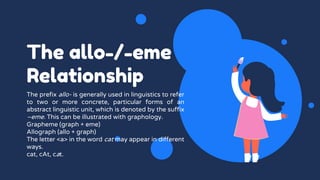
The allo-/-eme
Relationship
The prefix allo- is generally used in linguistics to refer
to two or more concrete, particular forms of an
abstract linguistic unit, which is denoted by the suffix
–eme. This can be illustrated with graphology.
Grapheme (graph + eme)
Allograph (allo + graph)
The letter <a> in the word cat may appear in different
ways.
cat, cAt, cat.
Phoneme
vs
Allophone
What is an
Phoneme?
An phoneme is the smallest
distinctive or contrastive linguistic
unit in the sound system of a
language which may bring about a
change of meaning.
Example:
Ban /bæn/ → /b/
Pan /pæn/ → /p/
What is an
Allophone?
In phonology, an allophone (/ˈæləfoʊn/; from
the Greek ἄλλος, állos, 'other' and φωνή,
phōnē, 'voice, sound') is a set of multiple
possible spoken sounds or signs used to
pronounce a single phoneme in a particular
language.
Example: allophones in the phoneme /p/
[pʰ] pin
[p] spin
[p˺] nip
Allophone in Free
Variation &
Complementary
Distribution
Allophones in
Free Variation
If two or more allophones can replace
one another.
Example:
economics /ˌiː.kəˈnɒm.ɪks/ / ɛ
k.əˈnɒm.ɪks/
which may pronounced with /iː/ or /ɛ/
Allophones in
Complementary
Distribution
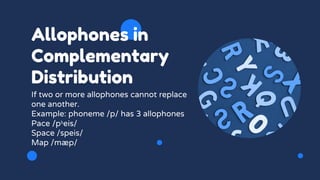
If two or more allophones cannot replace
one another.
Example: phoneme /p/ has 3 allophones
Pace /pʰeis/
Space /speis/
Map /mæp/
Devoicing,
Fronting and
Retraction
Devoicing
If voice is essentially voiced, the voice is
articulated with less sound than usual or
no sound at all, meaning that there is no
vibration of the vocal cords, the voice is
said to be partially or completely cut off.
Because devoicing is usually
conditioned by the phonetic
environment.
There are three main processes by which the consonant lenis
completely, or almost completely:
(1) /b, d, g, dʒ, v, ð, z, ʒ/. The vibration of the vocal folds
generally diminishes at the end of speaking. As in Cab [kæb],
Lid [lɪd], Bag [bæg], Judge [ˈʤʌʤ], Leave [liːv], Breathe [briːð],
Freeze [friːz], and Rouge [ruːʒ]
(2) /l, r,°w/. The lenis lateral and these two lenis approximants
can be fully devoiced when they follow any one of the fortis
plosives, /p, t, k/, in stressed syllables, as in please [pliːz] , try
[traɪ], and quick [kwɪk].
(3) /j/. This lenis approximant can be fully devoiced when it
follows any one of the fortis plosives, /p, t, k/, or the fortis
glottal fricative, /h/, in stressed syllables. As in [pçu:] for pew,
[tçu:n] for tune, [kçu:b] for cube, and [hçu:] for hue. Since the
symbol [ç] already indicates voicelessness.
Fronting and Retraction
- Fronting is a sound is articulated further forward in the
mouth than the underlying phoneme, usually under the
influence of the surrounding sounds.
- Retraction is a sound is articulated further back in the
mouth than the underlying phoneme, again usually under
the influence of the surrounding sounds.
- Fronting and retraction are usually conditioned by the
phonetic environment.
- Dental articulation can be indicated in the IPA by the
diacritic [¬] under the relevant symbol, as in the
transcription [tɛnθ] for the word tenth; fronting processes
can be indicated by a small cross [x] as in [ki:] for key;
retraction can be indicated by an underbar [_], as in
[ko:d] for cord.
Two (or three)
types of Phonetic
Transcription
A phonetic transcription in the concrete
utterances of an individual speaker on a
particular occasion . It does so with a high
degree of accuracy , showing a lot of
articulatory details .
Examples of phonetic transcriptions of words
with a considerable degree of accuracy are
[kçu : b] for cube and [ ko : d ] for cord
Phonetic transcription
proper
This type of transcription is also called broad
transcription [weite Umschrift]. It is best referred to
as a phonological transcription [phonologische
Umschrift) or phonemic transcription
[phonematische Umschrift] because it represents
spoken language at the level of phonology, through
phonetic symbols that are taken to represent
phonemes, and are thus better regarded as
phonemic symbols. The transcribed text is usually
enclosed in slashes, //. The difference between a
narrow (phonetic transcription) and a broad
(phonemic transcription) for example: ‘cube’ in the
phonetic transcription proper [keu:p] while in
phonemic symbols use /kju:b/.
PHONEMIC
TRANSCRIPTION
BROAD PHONETIC
TRANSCRIPTION : An
intermediate type
For the learning and teaching of English
pronunciation, the phonetic transcription
proper certainly shows too many fine details
whereas a phonemic transcription often does
not seem detailed enough. This type of
transcription is best regarded as a broad
phonetic transcription, although it is largely
phonemic. The transcribed text must be
enclosed in square brackets, [ ]. A broad
phonetic transcription is used in most
university courses in phonetics and
phonology, and in the transcription course
integrated with this manual.
Unstressed i- and u- sounds
We said that the distinction between the long and the short i- and u- sounds is not so clear in "some" unstressed
syllables. The intermediate [i] usually occurs in unstressed syllables in the following phonetic environments:
-In word-final position (if the final i- sound is not the second element of one of the three closing diphthongs
moving towards /ɪ/), as in easy [i:zi] or hurry [hʌri] even when followed by suffixes beginning with a vowel, as in
easiest [i:ziəst].
- In prefixes like re- , pre- , and de- when followed by a vowel, as in react [riækt] or preoccupied [priɒkjupaɪd];
- In suffixes like -tal , -iate , and -ious when they are pronounced as two syllables, as in appreciate [əˈpriːʃieɪt] or
hilarious [hɪˈleəriəs];
- In the words he, she, we, me, be, and the when followed by a vowel, as in the enemy [ði enəmi]. The intermediate
[u] is much less common, but if it occurs, it usually occurs in unstressed syllables in these phonetic environments:
- In the words you, to, into, and do when followed by a vowel or pause, as in particle-infinitive sequences like to eat
[tu i:t];
- In the words through and who in all positions;
- Before a vowel within a word, as in evaluate [ɪvæljueɪt] or actual [æktʃuəl].
A Brief Excursion
Into
Morphophonology
The regular plural, the
possessive case, and the third-
person singular morphemes
The regular plural, the possessive case, and the third-
person singular morphemes has some morpheme which is
symbolized by [S].We can speak of the "plural -s ", the
"possessive 's ", and the "third-person singular -s ".
The allomorph rules and examples:
- /s/ after fortis (voiceless) consonants, except after the
fortis sibilants, /s, ʃ, tʃ/ in example : cats /kæts/, dentist's
/dentɪsts/, writes /raɪts/;
- /z/ after vowels and lenis (voiced) consonants, except
after the lenis sibilants, /z, ʒ, dʒ/ in example: dogs /dɒɡz/,
children's /tʃɪldrənz/, goes /ɡəʊz/;
- /ɪz/ after the sibilants, /s, z, ʃ, ʒ, tʃ, dʒ/ in example: foxes
/fɒksɪz/, waitress's /ˈweɪtrəsɪz/ reaches /riːtʃɪz/
The Regular Past Tense and
Past Participle Morphemes
The morpheme for the regular past tense and the
morpheme for the regular past participle are
conventionally symbolised by -d or –ed. These
morphemes, too, are realised by three allomorphs,
transcribed as /t/, /d/, /Id/.
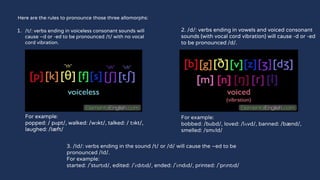
Here are the rules to pronounce those three allomorphs:
1. /t/: verbs ending in voiceless consonant sounds will
cause –d or -ed to be pronounced /t/ with no vocal
cord vibration.
For example:
popped: / pɑpt/, walked: /wɔkt/, talked: / tɔkt/,
laughed: /læft/
2. /d/: verbs ending in vowels and voiced consonant
sounds (with vocal cord vibration) will cause -d or -ed
to be pronounced /d/.
For example:
bobbed: /bɑbd/, loved: /lʌvd/, banned: /bænd/,
smelled: /smɛld/
3. /Id/: verbs ending in the sound /t/ or /d/ will cause the –ed to be
pronounced /Id/.
For example:
started: /ˈstɑrtɪd/, edited: /ˈɛdɪtɪd/, ended: /ˈɛndɪd/, printed: /ˈprɪntɪd/
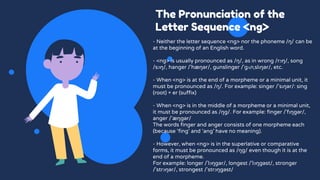
- Neither the letter sequence <ng> nor the phoneme /ŋ/ can be
at the beginning of an English word.
- <ng> is usually pronounced as /ŋ/, as in wrong /rɔŋ/, song
/sɔŋ/, hanger /ˈhæŋər/, gunslinger /ˈgʌnˌslɪŋər/, etc.
- When <ng> is at the end of a morpheme or a minimal unit, it
must be pronounced as /ŋ/. For example: singer /ˈsɪŋər/: sing
(root) + er (suffix)
- When <ng> is in the middle of a morpheme or a minimal unit,
it must be pronounced as /ŋg/. For example: finger /ˈfɪŋgər/,
anger /ˈæŋgər/
The words finger and anger consists of one morpheme each
(because ‘fing’ and ‘ang’ have no meaning).
- However, when <ng> is in the superlative or comparative
forms, it must be pronounced as /ŋg/ even though it is at the
end of a morpheme.
For example: longer /ˈlɔŋgər/, longest /ˈlɔŋgəst/, stronger
/ˈstrɔŋər/, strongest /ˈstrɔŋgəst/
The Pronunciation of the
Letter Sequence <ng>
Do you have any question?
Thanks!

Allophonic Variation.pdf

  • 1.
    Allophonic Variation NUR ARDIAN RAHMAWATI(004) SALSABILA (014) AFIFAH KHOIROTUL ISTI’ANA (015) ANIS CHILYATUNNISA (019) ADITYA ADI KATON AJI (027) FARIDA AZZAHRO (031)
  • 2.
    The allo-/-eme Relationship The prefixallo- is generally used in linguistics to refer to two or more concrete, particular forms of an abstract linguistic unit, which is denoted by the suffix –eme. This can be illustrated with graphology. Grapheme (graph + eme) Allograph (allo + graph) The letter <a> in the word cat may appear in different ways. cat, cAt, cat.
  • 3.
  • 4.
    What is an Phoneme? Anphoneme is the smallest distinctive or contrastive linguistic unit in the sound system of a language which may bring about a change of meaning. Example: Ban /bæn/ → /b/ Pan /pæn/ → /p/
  • 5.
    What is an Allophone? Inphonology, an allophone (/ˈæləfoʊn/; from the Greek ἄλλος, állos, 'other' and φωνή, phōnē, 'voice, sound') is a set of multiple possible spoken sounds or signs used to pronounce a single phoneme in a particular language. Example: allophones in the phoneme /p/ [pʰ] pin [p] spin [p˺] nip
  • 6.
    Allophone in Free Variation& Complementary Distribution
  • 7.
    Allophones in Free Variation Iftwo or more allophones can replace one another. Example: economics /ˌiː.kəˈnɒm.ɪks/ / ɛ k.əˈnɒm.ɪks/ which may pronounced with /iː/ or /ɛ/
  • 8.
    Allophones in Complementary Distribution If twoor more allophones cannot replace one another. Example: phoneme /p/ has 3 allophones Pace /pʰeis/ Space /speis/ Map /mæp/
  • 9.
  • 10.
    Devoicing If voice isessentially voiced, the voice is articulated with less sound than usual or no sound at all, meaning that there is no vibration of the vocal cords, the voice is said to be partially or completely cut off. Because devoicing is usually conditioned by the phonetic environment.
  • 11.
    There are threemain processes by which the consonant lenis completely, or almost completely: (1) /b, d, g, dʒ, v, ð, z, ʒ/. The vibration of the vocal folds generally diminishes at the end of speaking. As in Cab [kæb], Lid [lɪd], Bag [bæg], Judge [ˈʤʌʤ], Leave [liːv], Breathe [briːð], Freeze [friːz], and Rouge [ruːʒ] (2) /l, r,°w/. The lenis lateral and these two lenis approximants can be fully devoiced when they follow any one of the fortis plosives, /p, t, k/, in stressed syllables, as in please [pliːz] , try [traɪ], and quick [kwɪk]. (3) /j/. This lenis approximant can be fully devoiced when it follows any one of the fortis plosives, /p, t, k/, or the fortis glottal fricative, /h/, in stressed syllables. As in [pçu:] for pew, [tçu:n] for tune, [kçu:b] for cube, and [hçu:] for hue. Since the symbol [ç] already indicates voicelessness.
  • 12.
    Fronting and Retraction -Fronting is a sound is articulated further forward in the mouth than the underlying phoneme, usually under the influence of the surrounding sounds. - Retraction is a sound is articulated further back in the mouth than the underlying phoneme, again usually under the influence of the surrounding sounds. - Fronting and retraction are usually conditioned by the phonetic environment. - Dental articulation can be indicated in the IPA by the diacritic [¬] under the relevant symbol, as in the transcription [tɛnθ] for the word tenth; fronting processes can be indicated by a small cross [x] as in [ki:] for key; retraction can be indicated by an underbar [_], as in [ko:d] for cord.
  • 13.
    Two (or three) typesof Phonetic Transcription
  • 14.
    A phonetic transcriptionin the concrete utterances of an individual speaker on a particular occasion . It does so with a high degree of accuracy , showing a lot of articulatory details . Examples of phonetic transcriptions of words with a considerable degree of accuracy are [kçu : b] for cube and [ ko : d ] for cord Phonetic transcription proper
  • 15.
    This type oftranscription is also called broad transcription [weite Umschrift]. It is best referred to as a phonological transcription [phonologische Umschrift) or phonemic transcription [phonematische Umschrift] because it represents spoken language at the level of phonology, through phonetic symbols that are taken to represent phonemes, and are thus better regarded as phonemic symbols. The transcribed text is usually enclosed in slashes, //. The difference between a narrow (phonetic transcription) and a broad (phonemic transcription) for example: ‘cube’ in the phonetic transcription proper [keu:p] while in phonemic symbols use /kju:b/. PHONEMIC TRANSCRIPTION
  • 16.
    BROAD PHONETIC TRANSCRIPTION :An intermediate type For the learning and teaching of English pronunciation, the phonetic transcription proper certainly shows too many fine details whereas a phonemic transcription often does not seem detailed enough. This type of transcription is best regarded as a broad phonetic transcription, although it is largely phonemic. The transcribed text must be enclosed in square brackets, [ ]. A broad phonetic transcription is used in most university courses in phonetics and phonology, and in the transcription course integrated with this manual.
  • 17.
    Unstressed i- andu- sounds We said that the distinction between the long and the short i- and u- sounds is not so clear in "some" unstressed syllables. The intermediate [i] usually occurs in unstressed syllables in the following phonetic environments: -In word-final position (if the final i- sound is not the second element of one of the three closing diphthongs moving towards /ɪ/), as in easy [i:zi] or hurry [hʌri] even when followed by suffixes beginning with a vowel, as in easiest [i:ziəst]. - In prefixes like re- , pre- , and de- when followed by a vowel, as in react [riækt] or preoccupied [priɒkjupaɪd]; - In suffixes like -tal , -iate , and -ious when they are pronounced as two syllables, as in appreciate [əˈpriːʃieɪt] or hilarious [hɪˈleəriəs]; - In the words he, she, we, me, be, and the when followed by a vowel, as in the enemy [ði enəmi]. The intermediate [u] is much less common, but if it occurs, it usually occurs in unstressed syllables in these phonetic environments: - In the words you, to, into, and do when followed by a vowel or pause, as in particle-infinitive sequences like to eat [tu i:t]; - In the words through and who in all positions; - Before a vowel within a word, as in evaluate [ɪvæljueɪt] or actual [æktʃuəl].
  • 18.
  • 19.
    The regular plural,the possessive case, and the third- person singular morphemes The regular plural, the possessive case, and the third- person singular morphemes has some morpheme which is symbolized by [S].We can speak of the "plural -s ", the "possessive 's ", and the "third-person singular -s ". The allomorph rules and examples: - /s/ after fortis (voiceless) consonants, except after the fortis sibilants, /s, ʃ, tʃ/ in example : cats /kæts/, dentist's /dentɪsts/, writes /raɪts/; - /z/ after vowels and lenis (voiced) consonants, except after the lenis sibilants, /z, ʒ, dʒ/ in example: dogs /dɒɡz/, children's /tʃɪldrənz/, goes /ɡəʊz/; - /ɪz/ after the sibilants, /s, z, ʃ, ʒ, tʃ, dʒ/ in example: foxes /fɒksɪz/, waitress's /ˈweɪtrəsɪz/ reaches /riːtʃɪz/
  • 20.
    The Regular PastTense and Past Participle Morphemes The morpheme for the regular past tense and the morpheme for the regular past participle are conventionally symbolised by -d or –ed. These morphemes, too, are realised by three allomorphs, transcribed as /t/, /d/, /Id/.
  • 21.
    Here are therules to pronounce those three allomorphs: 1. /t/: verbs ending in voiceless consonant sounds will cause –d or -ed to be pronounced /t/ with no vocal cord vibration. For example: popped: / pɑpt/, walked: /wɔkt/, talked: / tɔkt/, laughed: /læft/ 2. /d/: verbs ending in vowels and voiced consonant sounds (with vocal cord vibration) will cause -d or -ed to be pronounced /d/. For example: bobbed: /bɑbd/, loved: /lʌvd/, banned: /bænd/, smelled: /smɛld/ 3. /Id/: verbs ending in the sound /t/ or /d/ will cause the –ed to be pronounced /Id/. For example: started: /ˈstɑrtɪd/, edited: /ˈɛdɪtɪd/, ended: /ˈɛndɪd/, printed: /ˈprɪntɪd/
  • 22.
    - Neither theletter sequence <ng> nor the phoneme /ŋ/ can be at the beginning of an English word. - <ng> is usually pronounced as /ŋ/, as in wrong /rɔŋ/, song /sɔŋ/, hanger /ˈhæŋər/, gunslinger /ˈgʌnˌslɪŋər/, etc. - When <ng> is at the end of a morpheme or a minimal unit, it must be pronounced as /ŋ/. For example: singer /ˈsɪŋər/: sing (root) + er (suffix) - When <ng> is in the middle of a morpheme or a minimal unit, it must be pronounced as /ŋg/. For example: finger /ˈfɪŋgər/, anger /ˈæŋgər/ The words finger and anger consists of one morpheme each (because ‘fing’ and ‘ang’ have no meaning). - However, when <ng> is in the superlative or comparative forms, it must be pronounced as /ŋg/ even though it is at the end of a morpheme. For example: longer /ˈlɔŋgər/, longest /ˈlɔŋgəst/, stronger /ˈstrɔŋər/, strongest /ˈstrɔŋgəst/ The Pronunciation of the Letter Sequence <ng>
  • 23.
    Do you haveany question? Thanks!