






Theoretical &
practical
considerations for
serious games
development &
implementation in
medical education
AMEE 2019.08.26 Wien, AT
WORKSHOP FACILITATORS
•Todd P Chang, MD MAcM
•Martin V Pusic, MD PhD
•Eric B Bauman, PhD FSSH
•Chaoyan Dong, PhD
•Gerald R Stapleton, MS
•Elizabeth K Kachur, PhD
NO CONFLICTS & DISCLOSURES
•Elizabeth K Kachur, PhD
•Martin V Pusic, MD, PhD
•Chaoyan Dong, PhD
•Eric B Bauman, PhD, FSSH
•Gerald R Stapleton, MS
•Todd P Chang, MD, MAcM
OBJECTIVES
1. List types of games and game elements
used in medical education, with examples
2. Select types of games to fit curricular
needs
3. Discuss an implementation plan for
applying games to their own setting
BRIEF TERMINOLOGY
And definitions
WHAT IS A ‘GAME’?
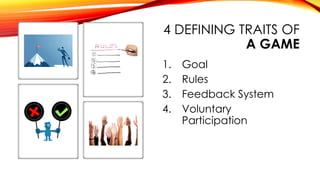
4 DEFINING TRAITS OF
A GAME
1. Goal
2. Rules
3. Feedback System
4. Voluntary
Participation
“WINNING” IS NOT A
NECESSARY GAME TRAIT
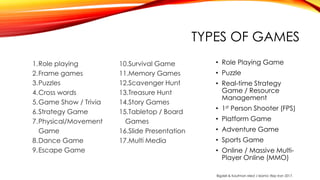
TYPES OF GAMES
1.Role playing
2.Frame games
3.Puzzles
4.Cross words
5.Game Show / Trivia
6.Strategy Game
7.Physical/Movement
Game
8.Dance Game
9.Escape Game
10.Survival Game
11.Memory Games
12.Scavenger Hunt
13.Treasure Hunt
14.Story Games
15.Tabletop / Board
Games
16.Slide Presentation
17.Multi Media
• Role Playing Game
• Puzzle
• Real-time Strategy
Game / Resource
Management
• 1st Person Shooter (FPS)
• Platform Game
• Adventure Game
• Sports Game
• Online / Massive Multi-
Player Online (MMO)
Bigdeli & Kaufman Med J Islamic Rep Iran 2017.
WHAT GAMES DO YOU PLAY?
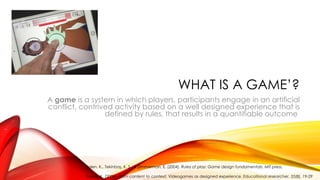
WHAT IS A GAME’?
A game is a system in which players, participants engage in an artificial
conflict, contrived activity based on a well designed experience that is
defined by rules, that results in a quantifiable outcome
Salen, K., Tekinbaş, K. S., & Zimmerman, E. (2004). Rules of play: Game design fundamentals. MIT press.
Squire, K. (2006). From content to context: Videogames as designed experience. Educational researcher, 35(8), 19-29
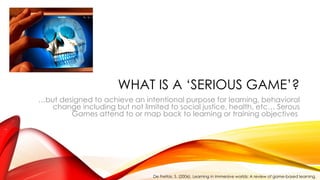
WHAT IS A ‘SERIOUS GAME’?
…but designed to achieve an intentional purpose for learning, behavioral
change including but not limited to social justice, health, etc… Serous
Games attend to or map back to learning or training objectives
De Freitas, S. (2006). Learning in immersive worlds: A review of game-based learning.
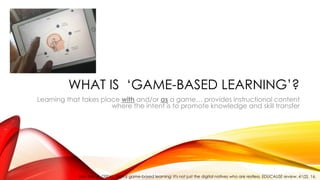
WHAT IS ‘GAME-BASED LEARNING’?
Learning that takes place with and/or as a game… provides instructional content
where the intent is to promote knowledge and skill transfer
Van Eck, R. (2006). Digital game-based learning: It's not just the digital natives who are restless. EDUCAUSE review, 41(2), 16.
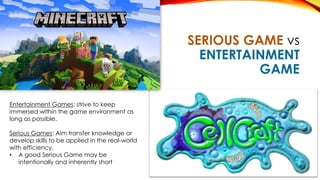
SERIOUS GAME vs
ENTERTAINMENT
GAME
Entertainment Games: strive to keep
immersed within the game environment as
long as possible.
Serious Games: Aim transfer knowledge or
develop skills to be applied in the real-world
with efficiency.
• A good Serious Game may be
intentionally and inherently short
SUMMARY TERMINOLOGY
•Game
•Serious Game
•Entertainment Game
•Game-based Learning
ANY QUESTIONS SO FAR?
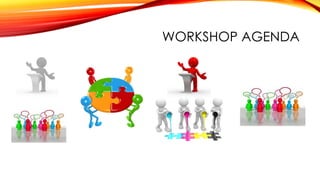
WORKSHOP AGENDA
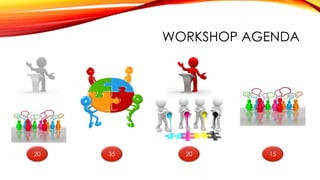
WORKSHOP AGENDA
20 35 20 15
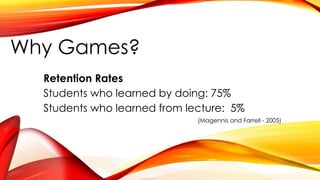
Why Games?
Retention Rates
Students who learned by doing: 75%
Students who learned from lecture: 5%
(Magennis and Farrell - 2005)
Why Games?
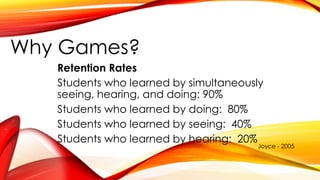
Retention Rates
Students who learned by simultaneously
seeing, hearing, and doing: 90%
Students who learned by doing: 80%
Students who learned by seeing: 40%
Students who learned by hearing: 20%
Joyce - 2005
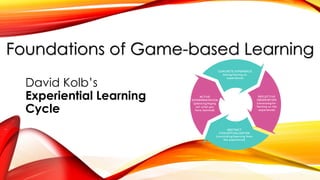
Foundations of Game-based Learning
David Kolb’s
Experiential Learning
Cycle
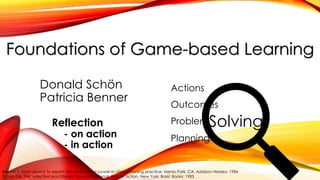
Foundations of Game-based Learning
Donald Schön
Patricia Benner
Reflection
- on action
- in action
Actions
Outcomes
Problem
Planning
Solving
Benner P. From novice to expert: Excellence and power in clinical nursing practice. Menlo Park, CA: Addison-Wesley; 1984
Schön DA. The reflective practitioner: How professionals think in action. New York: Basic Books; 1983
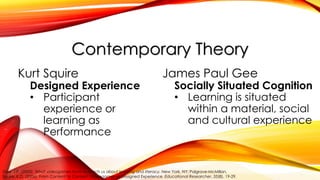
Contemporary Theory
Kurt Squire
Designed Experience
• Participant
experience or
learning as
Performance
James Paul Gee
Socially Situated Cognition
• Learning is situated
within a material, social
and cultural experience
Gee, J.P. (2003). What videogames have to teach us about learning and literacy. New York, NY: Palgrave-McMillan.
Squire, K.D. (2006). From Content to Context: Videogames as Designed Experience. Educational Researcher, 35(8), 19-29.
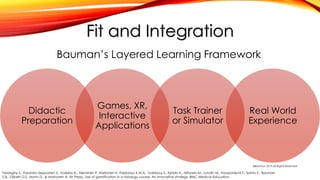
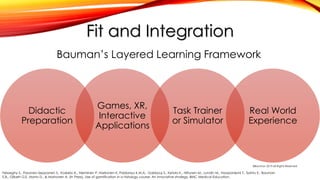
Fit and Integration
Didactic
Preparation
Games, XR,
Interactive
Applications
Task Trainer
or Simulator
Real World
Experience
Bauman’s Layered Learning Framework
©Bauman 2019 all Rights Reserved
Felszeghy S., Pasonen-Seppanen S., Koskela A., Nieminen P, Harkonen K, Paldanius K.M.A., Gabbouj S., Ketola K., Hiltunen M., Lundin M., Haapaniemi T., Sointu E., Bauman
E.B., Gilbert G.E, Morto D., & Mahonen A. (In Press). Use of gamification in a histology course: An innovative strategy. BMC Medical Education.
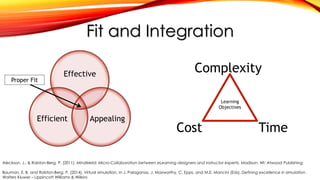
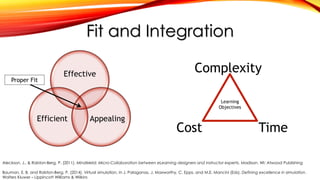
Fit and Integration
Effective
AppealingEfficient
Proper Fit
Learning
Objectives
Complexity
Cost Time
Aleckson, J., & Ralston-Berg, P. (2011). MindMeld: Micro-Collaboration between eLearning designers and instructor experts. Madison, WI: Atwood Publishing
Bauman, E. B. and Ralston-Berg, P. (2014). Virtual simulation. In J. Palaganas, J. Maxworthy, C. Epps, and M.E. Mancini (Eds). Defining excellence in simulation.
Wolters Kluwer – Lippincott Williams & Wilkins
SMALL GROUP ACTIVITY
Application of Game Types to potential Educational Objectives
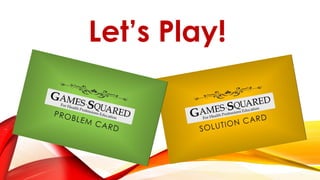
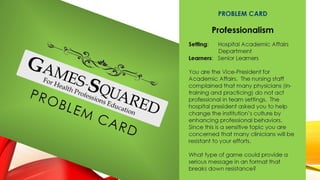
GAMES - SQUARED
Let’s Play!
Problem Card: Description of a learning challenge
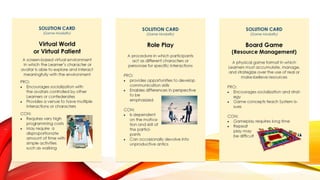
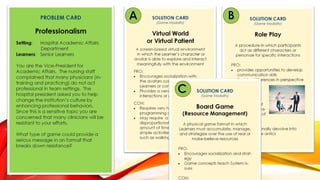
Solution Cards
• Game Type
• Pros (Advantages)
• Cons (Limitations)
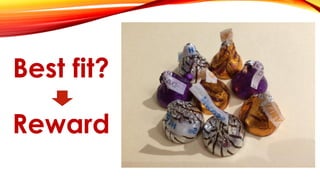
Best fit?
Reward
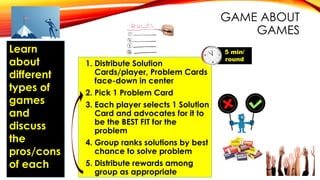
GAME ABOUT
GAMES
Learn
about
different
types of
games
and
discuss
the
pros/cons
of each
1. Distribute Solution
Cards/player, Problem Cards
face-down in center
2. Pick 1 Problem Card
3. Each player selects 1 Solution
Card and advocates for it to
be the BEST FIT for the
problem
4. Group ranks solutions by best
chance to solve problem
5. Distribute rewards among
group as appropriate
5 min/
round
!
!
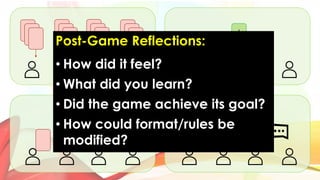
Post-Game Reflections:
• How did it feel?
• What did you learn?
• Did the game achieve its goal?
• How could format/rules be
modified?
Next up…
What are some of the key characteristics,
elements and features of effective games
and game strategies?
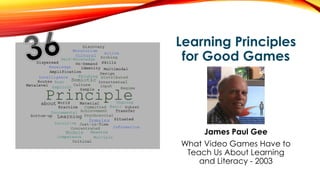
Learning Principles
for Good Games
James Paul Gee
What Video Games Have to
Teach Us About Learning
and Literacy - 2003
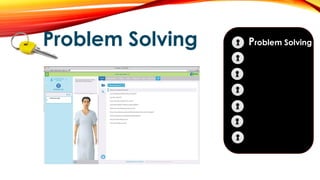
Problem Solving Problem Solving
Empowerment
Risk
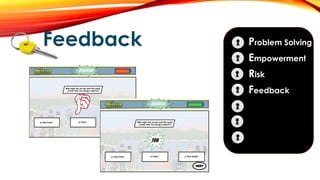
Feedback
Edge
Context
Transfer
Empowerment Problem Solving
Empowerment
Risk
Feedback
Edge
Context
Transfer
Risk Problem Solving
Empowerment
Risk
Feedback
Edge
Context
Transfer
Feedback Problem Solving
Empowerment
Risk
Feedback
Edge
Context
Transfer
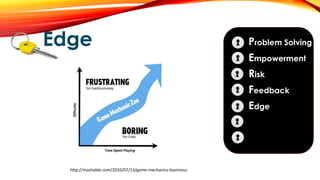
Edge Problem Solving
Empowerment
Risk
Feedback
Edge
Context
Transfer
http://mashable.com/2010/07/13/game-mechanics-business/
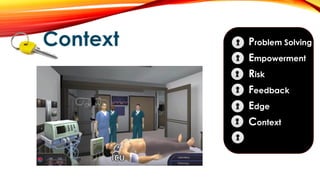
Context Problem Solving
Empowerment
Risk
Feedback
Edge
Context
Transfer
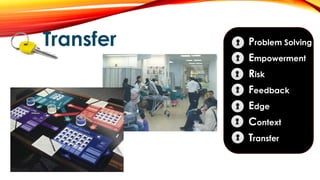
Transfer Problem Solving
Empowerment
Risk
Feedback
Edge
Context
Transfer
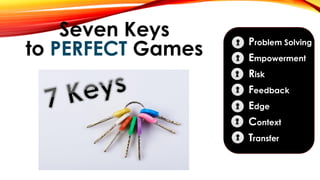
Seven Keys
to PERFECT Games
Problem Solving
Empowerment
Risk
Feedback
Edge
Context
Transfer
IMPLEMENTATION
Now how will you make it fit?
Fit and Integration
Didactic
Preparation
Games, XR,
Interactive
Applications
Task Trainer
or Simulator
Real World
Experience
Bauman’s Layered Learning Framework
©Bauman 2019 all Rights Reserved
Felszeghy S., Pasonen-Seppanen S., Koskela A., Nieminen P, Harkonen K, Paldanius K.M.A., Gabbouj S., Ketola K., Hiltunen M., Lundin M., Haapaniemi T., Sointu E., Bauman
E.B., Gilbert G.E, Morto D., & Mahonen A. (In Press). Use of gamification in a histology course: An innovative strategy. BMC Medical Education.
Fit and Integration
Effective
AppealingEfficient
Proper Fit
Learning
Objectives
Complexity
Cost Time
Aleckson, J., & Ralston-Berg, P. (2011). MindMeld: Micro-Collaboration between eLearning designers and instructor experts. Madison, WI: Atwood Publishing
Bauman, E. B. and Ralston-Berg, P. (2014). Virtual simulation. In J. Palaganas, J. Maxworthy, C. Epps, and M.E. Mancini (Eds). Defining excellence in simulation.
Wolters Kluwer – Lippincott Williams & Wilkins
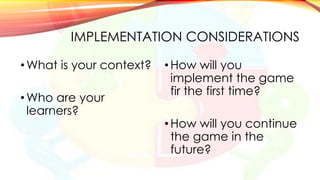
IMPLEMENTATION CONSIDERATIONS
•What is your context?
•Who are your
learners?
• How will you
implement the game
fir the first time?
• How will you continue
the game in the
future?
THANK YOU
dr.toddchang@gmail.com
• Todd P Chang, MD MAcM
• Martin V Pusic, MD PhD
• Eric B Bauman, PhD FSSH
• Chaoyan Dong, PhD
• Gerald R Stapleton, MS
• Elizabeth K Kachur, PhD
GAMIFICATION vs SERIOUS GAMES
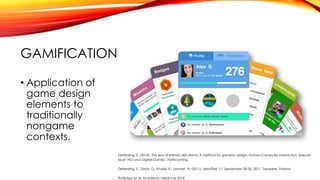
GAMIFICATION
• Application of
game design
elements to
traditionally
nongame
contexts.
Deterding, S. (2014). The lens of intrinsic skill atoms: A method for gameful design. Human-Computer Interaction, Special
Issue" HCI and Digital Games," Forthcoming.
Deterding, S., Dixon, D., Khalid, R., Lennart, N. (2011). MindTrek’11, September 28-30, 2011, Tampere, Finland.
Rutledge et al. Academic Medicine 2018

Theoretical and Practical Considerations for Serious Games Development

  • 1.
    Theoretical & practical considerations for seriousgames development & implementation in medical education AMEE 2019.08.26 Wien, AT
  • 2.
    WORKSHOP FACILITATORS •Todd PChang, MD MAcM •Martin V Pusic, MD PhD •Eric B Bauman, PhD FSSH •Chaoyan Dong, PhD •Gerald R Stapleton, MS •Elizabeth K Kachur, PhD
  • 3.
    NO CONFLICTS &DISCLOSURES •Elizabeth K Kachur, PhD •Martin V Pusic, MD, PhD •Chaoyan Dong, PhD •Eric B Bauman, PhD, FSSH •Gerald R Stapleton, MS •Todd P Chang, MD, MAcM
  • 4.
    OBJECTIVES 1. List typesof games and game elements used in medical education, with examples 2. Select types of games to fit curricular needs 3. Discuss an implementation plan for applying games to their own setting
  • 5.
  • 6.
    WHAT IS A‘GAME’?
  • 7.
    4 DEFINING TRAITSOF A GAME 1. Goal 2. Rules 3. Feedback System 4. Voluntary Participation
  • 8.
    “WINNING” IS NOTA NECESSARY GAME TRAIT
  • 9.
    TYPES OF GAMES 1.Roleplaying 2.Frame games 3.Puzzles 4.Cross words 5.Game Show / Trivia 6.Strategy Game 7.Physical/Movement Game 8.Dance Game 9.Escape Game 10.Survival Game 11.Memory Games 12.Scavenger Hunt 13.Treasure Hunt 14.Story Games 15.Tabletop / Board Games 16.Slide Presentation 17.Multi Media • Role Playing Game • Puzzle • Real-time Strategy Game / Resource Management • 1st Person Shooter (FPS) • Platform Game • Adventure Game • Sports Game • Online / Massive Multi- Player Online (MMO) Bigdeli & Kaufman Med J Islamic Rep Iran 2017.
  • 10.
    WHAT GAMES DOYOU PLAY?
  • 11.
    WHAT IS AGAME’? A game is a system in which players, participants engage in an artificial conflict, contrived activity based on a well designed experience that is defined by rules, that results in a quantifiable outcome Salen, K., Tekinbaş, K. S., & Zimmerman, E. (2004). Rules of play: Game design fundamentals. MIT press. Squire, K. (2006). From content to context: Videogames as designed experience. Educational researcher, 35(8), 19-29
  • 12.
    WHAT IS A‘SERIOUS GAME’? …but designed to achieve an intentional purpose for learning, behavioral change including but not limited to social justice, health, etc… Serous Games attend to or map back to learning or training objectives De Freitas, S. (2006). Learning in immersive worlds: A review of game-based learning.
  • 13.
    WHAT IS ‘GAME-BASEDLEARNING’? Learning that takes place with and/or as a game… provides instructional content where the intent is to promote knowledge and skill transfer Van Eck, R. (2006). Digital game-based learning: It's not just the digital natives who are restless. EDUCAUSE review, 41(2), 16.
  • 14.
    SERIOUS GAME vs ENTERTAINMENT GAME EntertainmentGames: strive to keep immersed within the game environment as long as possible. Serious Games: Aim transfer knowledge or develop skills to be applied in the real-world with efficiency. • A good Serious Game may be intentionally and inherently short
  • 17.
  • 18.
  • 19.
  • 20.
  • 21.
    Why Games? Retention Rates Studentswho learned by doing: 75% Students who learned from lecture: 5% (Magennis and Farrell - 2005)
  • 22.
    Why Games? Retention Rates Studentswho learned by simultaneously seeing, hearing, and doing: 90% Students who learned by doing: 80% Students who learned by seeing: 40% Students who learned by hearing: 20% Joyce - 2005
  • 24.
    Foundations of Game-basedLearning David Kolb’s Experiential Learning Cycle
  • 25.
    Foundations of Game-basedLearning Donald Schön Patricia Benner Reflection - on action - in action Actions Outcomes Problem Planning Solving Benner P. From novice to expert: Excellence and power in clinical nursing practice. Menlo Park, CA: Addison-Wesley; 1984 Schön DA. The reflective practitioner: How professionals think in action. New York: Basic Books; 1983
  • 26.
    Contemporary Theory Kurt Squire DesignedExperience • Participant experience or learning as Performance James Paul Gee Socially Situated Cognition • Learning is situated within a material, social and cultural experience Gee, J.P. (2003). What videogames have to teach us about learning and literacy. New York, NY: Palgrave-McMillan. Squire, K.D. (2006). From Content to Context: Videogames as Designed Experience. Educational Researcher, 35(8), 19-29.
  • 27.
    Fit and Integration Didactic Preparation Games,XR, Interactive Applications Task Trainer or Simulator Real World Experience Bauman’s Layered Learning Framework ©Bauman 2019 all Rights Reserved Felszeghy S., Pasonen-Seppanen S., Koskela A., Nieminen P, Harkonen K, Paldanius K.M.A., Gabbouj S., Ketola K., Hiltunen M., Lundin M., Haapaniemi T., Sointu E., Bauman E.B., Gilbert G.E, Morto D., & Mahonen A. (In Press). Use of gamification in a histology course: An innovative strategy. BMC Medical Education.
  • 28.
    Fit and Integration Effective AppealingEfficient ProperFit Learning Objectives Complexity Cost Time Aleckson, J., & Ralston-Berg, P. (2011). MindMeld: Micro-Collaboration between eLearning designers and instructor experts. Madison, WI: Atwood Publishing Bauman, E. B. and Ralston-Berg, P. (2014). Virtual simulation. In J. Palaganas, J. Maxworthy, C. Epps, and M.E. Mancini (Eds). Defining excellence in simulation. Wolters Kluwer – Lippincott Williams & Wilkins
  • 29.
    SMALL GROUP ACTIVITY Applicationof Game Types to potential Educational Objectives GAMES - SQUARED
  • 30.
  • 31.
    Problem Card: Descriptionof a learning challenge
  • 32.
    Solution Cards • GameType • Pros (Advantages) • Cons (Limitations)
  • 33.
  • 37.
    GAME ABOUT GAMES Learn about different types of games and discuss the pros/cons ofeach 1. Distribute Solution Cards/player, Problem Cards face-down in center 2. Pick 1 Problem Card 3. Each player selects 1 Solution Card and advocates for it to be the BEST FIT for the problem 4. Group ranks solutions by best chance to solve problem 5. Distribute rewards among group as appropriate 5 min/ round
  • 38.
    ! ! Post-Game Reflections: • Howdid it feel? • What did you learn? • Did the game achieve its goal? • How could format/rules be modified?
  • 39.
    Next up… What aresome of the key characteristics, elements and features of effective games and game strategies?
  • 40.
    Learning Principles for GoodGames James Paul Gee What Video Games Have to Teach Us About Learning and Literacy - 2003
  • 42.
    Problem Solving ProblemSolving Empowerment Risk Feedback Edge Context Transfer
  • 43.
  • 44.
  • 45.
  • 46.
  • 47.
  • 48.
  • 49.
    Seven Keys to PERFECTGames Problem Solving Empowerment Risk Feedback Edge Context Transfer
  • 50.
  • 51.
    Fit and Integration Didactic Preparation Games,XR, Interactive Applications Task Trainer or Simulator Real World Experience Bauman’s Layered Learning Framework ©Bauman 2019 all Rights Reserved Felszeghy S., Pasonen-Seppanen S., Koskela A., Nieminen P, Harkonen K, Paldanius K.M.A., Gabbouj S., Ketola K., Hiltunen M., Lundin M., Haapaniemi T., Sointu E., Bauman E.B., Gilbert G.E, Morto D., & Mahonen A. (In Press). Use of gamification in a histology course: An innovative strategy. BMC Medical Education.
  • 52.
    Fit and Integration Effective AppealingEfficient ProperFit Learning Objectives Complexity Cost Time Aleckson, J., & Ralston-Berg, P. (2011). MindMeld: Micro-Collaboration between eLearning designers and instructor experts. Madison, WI: Atwood Publishing Bauman, E. B. and Ralston-Berg, P. (2014). Virtual simulation. In J. Palaganas, J. Maxworthy, C. Epps, and M.E. Mancini (Eds). Defining excellence in simulation. Wolters Kluwer – Lippincott Williams & Wilkins
  • 53.
    IMPLEMENTATION CONSIDERATIONS •What isyour context? •Who are your learners? • How will you implement the game fir the first time? • How will you continue the game in the future?
  • 55.
    THANK YOU dr.toddchang@gmail.com • ToddP Chang, MD MAcM • Martin V Pusic, MD PhD • Eric B Bauman, PhD FSSH • Chaoyan Dong, PhD • Gerald R Stapleton, MS • Elizabeth K Kachur, PhD
  • 56.
  • 57.
    GAMIFICATION • Application of gamedesign elements to traditionally nongame contexts. Deterding, S. (2014). The lens of intrinsic skill atoms: A method for gameful design. Human-Computer Interaction, Special Issue" HCI and Digital Games," Forthcoming. Deterding, S., Dixon, D., Khalid, R., Lennart, N. (2011). MindTrek’11, September 28-30, 2011, Tampere, Finland. Rutledge et al. Academic Medicine 2018