“ Coil Coating”
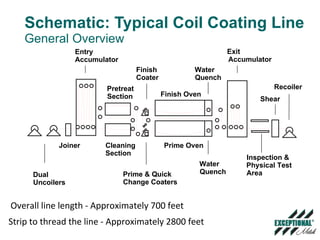
Schematic: Typical Coil Coating Line General Overview   (Not to Scale) Dual Uncoilers Joiner Entry Accumulator Exit  Accumulator Finish Oven Prime Oven Cleaning Section Pretreat Section Inspection & Physical Test Area Water Quench Recoiler Shear Prime & Quick Change Coaters Water Quench Finish Coater Overall line length - Approximately 700 feet Strip to thread the line - Approximately 2800 feet
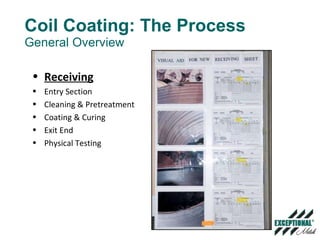
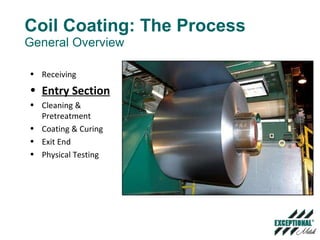
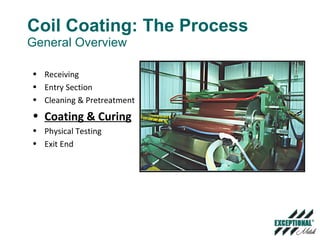
Coil Coating: The Process General Overview   Receiving Entry Section Cleaning & Pretreatment Coating & Curing Exit End Physical Testing
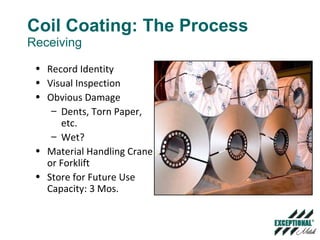
Coil Coating: The Process Receiving Record Identity Visual Inspection Obvious Damage Dents, Torn Paper, etc. Wet? Material Handling Crane or Forklift Store for Future Use  Capacity: 3 Mos.
Coil Coating: The Process General Overview   Receiving Entry Section Cleaning & Pretreatment Coating & Curing Exit End Physical Testing
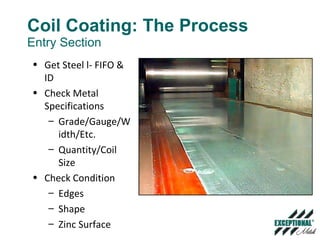
Coil Coating: The Process Entry Section Get Steel l- FIFO & ID Check Metal Specifications Grade/Gauge/Width/Etc. Quantity/Coil Size Check Condition Edges Shape Zinc Surface
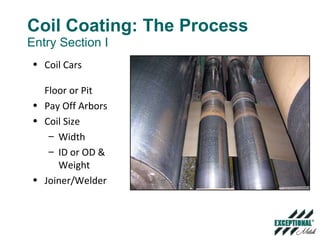
Coil Coating: The Process Entry Section I Coil Cars  Floor or Pit Pay Off Arbors Coil Size Width  ID or OD & Weight  Joiner/Welder
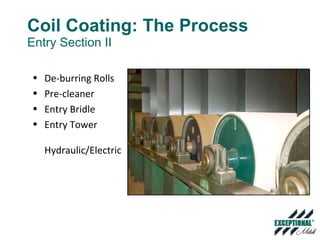
Coil Coating: The Process Entry Section II De-burring Rolls Pre-cleaner Entry Bridle Entry Tower  Hydraulic/Electric
Coil Coating: The Process General Overview Receiving Entry Section Cleaning & Pretreatment Coating & Curing Physical Testing Exit End
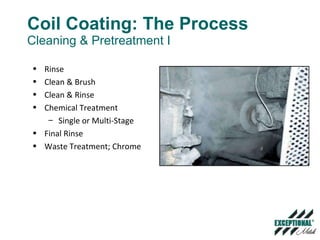
Coil Coating: The Process Cleaning & Pretreatment I Rinse Clean & Brush Clean & Rinse Chemical Treatment  Single or Multi-Stage Final Rinse Waste Treatment; Chrome
Coil Coating: The Process Cleaning & Pretreatment II The key to quality is preparing the metal to accept the paint. Pretreatments enhance the corrosion resistance of the system. The type of pretreatments used depends on the base metal. Galvanized - Zinc Phosphate 37S Galvalume - Chromate Oxide 1310 Final Rinse - Parcolene 62 Chromic Acid Dried-in-Place Coatings: 1402W (some Cr. free) Duplex Complex Oxide or Zinc Phos. & 1402W
Coil Coating: The Process Cleaning & Pretreatment III A liquid used to produce a corrosion-resistant, organically bonded coating on Aluminum, Galvalume and Galvanized. Incorporating a chromate rinse which is the major agent that allows the primer to bond to the substrate and helps prevent corrosion.  Benefits of Pretreatments: Provides superior long term corrosion. Effective on Aluminum, Galvalume and Galvanized. Coating quality is consistent.
Coil Coating: The Process General Overview Receiving Entry Section Cleaning & Pretreatment Coating & Curing Physical Testing Exit End
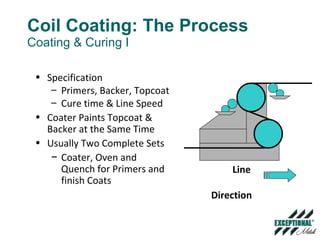
Coil Coating: The Process Coating & Curing I Specification Primers, Backer, Topcoat Cure time & Line Speed Coater Paints Topcoat & Backer at the Same Time Usually Two Complete Sets Coater, Oven and Quench for Primers and finish Coats Line   Direction
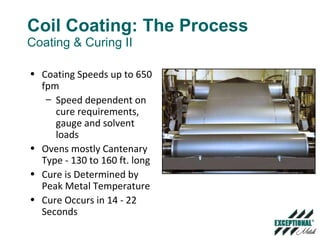
Coil Coating: The Process Coating & Curing II Coating Speeds up to 650 fpm Speed dependent on cure requirements, gauge and solvent loads Ovens mostly Cantenary Type - 130 to 160 ft. long Cure is Determined by Peak Metal Temperature Cure Occurs in 14 - 22 Seconds
Coil Coating: The Process Coating & Curing III - PRIMER The base layer of the paint applied by the coater to the pretreated substrate.  It is formulated to provide corrosion protection to the base metal and to enhance adhesion between the top coat (paint) and the base metal. Standard Primers:  Water Based Urethane Based
Coil Coating: The Process General Overview Receiving Entry Section Cleaning & Pretreatment Coating & Curing Physical Testing Exit End
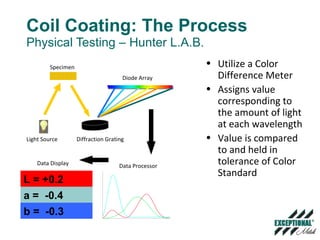
Coil Coating: The Process Physical Testing – Hunter L.A.B. Utilize a Color Difference Meter Assigns value corresponding to the amount of light at each wavelength Value is compared to and held in tolerance of Color Standard L = +0.2 a =  -0.4 b =  -0.3 Specimen Light Source Diffraction Grating Diode Array Data Processor Data Display
5/8” diameter steel ball is dropped from a prescribed height onto the panel. Effect leaves a deformation that is subject to cross hatch and tape test. Tape (Scotch #610) is aggressively adhered and pulled (not peeled) away from the sample. Coil Coating: The Process Physical Testing – Reverse Impact Adhesion
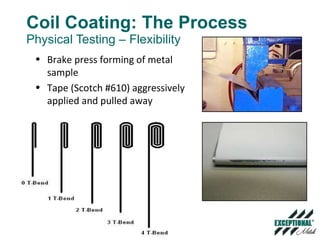
Coil Coating: The Process Physical Testing – Flexibility Brake press forming of metal sample Tape (Scotch #610) aggressively applied and pulled away
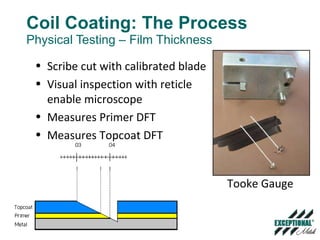
Coil Coating: The Process Physical Testing – Film Thickness Scribe cut with calibrated blade Visual inspection with reticle enable microscope Measures Primer DFT Measures Topcoat DFT Tooke Gauge
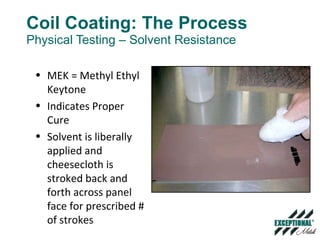
Coil Coating: The Process Physical Testing – Solvent Resistance MEK = Methyl Ethyl Keytone Indicates Proper Cure Solvent is liberally applied and cheesecloth is stroked back and forth across panel face for prescribed # of strokes
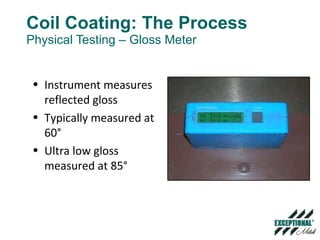
Coil Coating: The Process Physical Testing – Gloss Meter Instrument measures reflected gloss Typically measured at 60 ° Ultra low gloss measured at 85°
Coil Coating: The Process General Overview Receiving Entry Section Cleaning & Pretreatment Coating & Curing Physical Testing Exit End
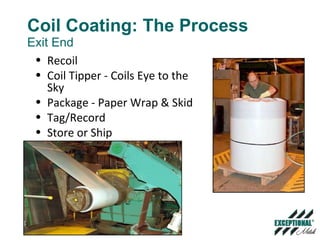
Coil Coating: The Process Exit End Recoil Coil Tipper - Coils Eye to the Sky Package - Paper Wrap & Skid Tag/Record Store or Ship

Coil Coating

  • 1.
  • 2.
    Schematic: Typical CoilCoating Line General Overview (Not to Scale) Dual Uncoilers Joiner Entry Accumulator Exit Accumulator Finish Oven Prime Oven Cleaning Section Pretreat Section Inspection & Physical Test Area Water Quench Recoiler Shear Prime & Quick Change Coaters Water Quench Finish Coater Overall line length - Approximately 700 feet Strip to thread the line - Approximately 2800 feet
  • 3.
    Coil Coating: TheProcess General Overview Receiving Entry Section Cleaning & Pretreatment Coating & Curing Exit End Physical Testing
  • 4.
    Coil Coating: TheProcess Receiving Record Identity Visual Inspection Obvious Damage Dents, Torn Paper, etc. Wet? Material Handling Crane or Forklift Store for Future Use Capacity: 3 Mos.
  • 5.
    Coil Coating: TheProcess General Overview Receiving Entry Section Cleaning & Pretreatment Coating & Curing Exit End Physical Testing
  • 6.
    Coil Coating: TheProcess Entry Section Get Steel l- FIFO & ID Check Metal Specifications Grade/Gauge/Width/Etc. Quantity/Coil Size Check Condition Edges Shape Zinc Surface
  • 7.
    Coil Coating: TheProcess Entry Section I Coil Cars Floor or Pit Pay Off Arbors Coil Size Width ID or OD & Weight Joiner/Welder
  • 8.
    Coil Coating: TheProcess Entry Section II De-burring Rolls Pre-cleaner Entry Bridle Entry Tower Hydraulic/Electric
  • 9.
    Coil Coating: TheProcess General Overview Receiving Entry Section Cleaning & Pretreatment Coating & Curing Physical Testing Exit End
  • 10.
    Coil Coating: TheProcess Cleaning & Pretreatment I Rinse Clean & Brush Clean & Rinse Chemical Treatment Single or Multi-Stage Final Rinse Waste Treatment; Chrome
  • 11.
    Coil Coating: TheProcess Cleaning & Pretreatment II The key to quality is preparing the metal to accept the paint. Pretreatments enhance the corrosion resistance of the system. The type of pretreatments used depends on the base metal. Galvanized - Zinc Phosphate 37S Galvalume - Chromate Oxide 1310 Final Rinse - Parcolene 62 Chromic Acid Dried-in-Place Coatings: 1402W (some Cr. free) Duplex Complex Oxide or Zinc Phos. & 1402W
  • 12.
    Coil Coating: TheProcess Cleaning & Pretreatment III A liquid used to produce a corrosion-resistant, organically bonded coating on Aluminum, Galvalume and Galvanized. Incorporating a chromate rinse which is the major agent that allows the primer to bond to the substrate and helps prevent corrosion. Benefits of Pretreatments: Provides superior long term corrosion. Effective on Aluminum, Galvalume and Galvanized. Coating quality is consistent.
  • 13.
    Coil Coating: TheProcess General Overview Receiving Entry Section Cleaning & Pretreatment Coating & Curing Physical Testing Exit End
  • 14.
    Coil Coating: TheProcess Coating & Curing I Specification Primers, Backer, Topcoat Cure time & Line Speed Coater Paints Topcoat & Backer at the Same Time Usually Two Complete Sets Coater, Oven and Quench for Primers and finish Coats Line Direction
  • 15.
    Coil Coating: TheProcess Coating & Curing II Coating Speeds up to 650 fpm Speed dependent on cure requirements, gauge and solvent loads Ovens mostly Cantenary Type - 130 to 160 ft. long Cure is Determined by Peak Metal Temperature Cure Occurs in 14 - 22 Seconds
  • 16.
    Coil Coating: TheProcess Coating & Curing III - PRIMER The base layer of the paint applied by the coater to the pretreated substrate. It is formulated to provide corrosion protection to the base metal and to enhance adhesion between the top coat (paint) and the base metal. Standard Primers: Water Based Urethane Based
  • 17.
    Coil Coating: TheProcess General Overview Receiving Entry Section Cleaning & Pretreatment Coating & Curing Physical Testing Exit End
  • 18.
    Coil Coating: TheProcess Physical Testing – Hunter L.A.B. Utilize a Color Difference Meter Assigns value corresponding to the amount of light at each wavelength Value is compared to and held in tolerance of Color Standard L = +0.2 a = -0.4 b = -0.3 Specimen Light Source Diffraction Grating Diode Array Data Processor Data Display
  • 19.
    5/8” diameter steelball is dropped from a prescribed height onto the panel. Effect leaves a deformation that is subject to cross hatch and tape test. Tape (Scotch #610) is aggressively adhered and pulled (not peeled) away from the sample. Coil Coating: The Process Physical Testing – Reverse Impact Adhesion
  • 20.
    Coil Coating: TheProcess Physical Testing – Flexibility Brake press forming of metal sample Tape (Scotch #610) aggressively applied and pulled away
  • 21.
    Coil Coating: TheProcess Physical Testing – Film Thickness Scribe cut with calibrated blade Visual inspection with reticle enable microscope Measures Primer DFT Measures Topcoat DFT Tooke Gauge
  • 22.
    Coil Coating: TheProcess Physical Testing – Solvent Resistance MEK = Methyl Ethyl Keytone Indicates Proper Cure Solvent is liberally applied and cheesecloth is stroked back and forth across panel face for prescribed # of strokes
  • 23.
    Coil Coating: TheProcess Physical Testing – Gloss Meter Instrument measures reflected gloss Typically measured at 60 ° Ultra low gloss measured at 85°
  • 24.
    Coil Coating: TheProcess General Overview Receiving Entry Section Cleaning & Pretreatment Coating & Curing Physical Testing Exit End
  • 25.
    Coil Coating: TheProcess Exit End Recoil Coil Tipper - Coils Eye to the Sky Package - Paper Wrap & Skid Tag/Record Store or Ship

Editor's Notes

  • #25 Mar rate – Kynar is more flexible and softer Polyester – SMP Harder resin