The Basic of Airless Spraying
Coating Material 
4 Basic Components 
 Binder, Resin, or Polymer 
 Pigment 
 Solvent 
 Additives
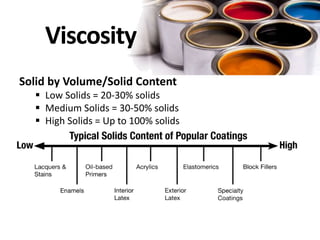
Viscosity 
Solid by Volume/Solid Content 
 Low Solids = 20-30% solids 
 Medium Solids = 30-50% solids 
 High Solids = Up to 100% solids
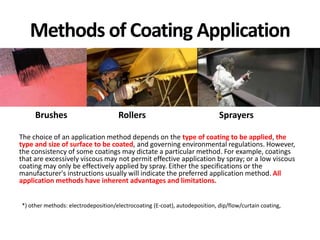
Methods of Coating Application 
Brushes Rollers Sprayers 
The choice of an application method depends on the type of coating to be applied, the 
type and size of surface to be coated, and governing environmental regulations. However, 
the consistency of some coatings may dictate a particular method. For example, coatings 
that are excessively viscous may not permit effective application by spray; or a low viscous 
coating may only be effectively applied by spray. Either the specifications or the 
manufacturer's instructions usually will indicate the preferred application method. All 
application methods have inherent advantages and limitations. 
*) other methods: electrodeposition/electrocoating (E-coat), autodeposition, dip/flow/curtain coating,
Brush 
Methods Advantages Limitation 
Brush • the ability to stripe coat 
• best for oil-based and waterborne 
coatings, or slow-drying coating 
• most common, particularly around 
irregular surfaces such as rivets, bolt 
heads, piping, railing, and similar areas 
• low investment, low technology 
• independent of power 
• it aids in thorough wetting of the 
substrate, particularly on surfaces that 
are porous 
• can be used in restricted spaces, be 
useful for small areas, with less wastage 
and contamination of surroundings. 
• no loss through overspray 
• short set-up time 
• slow, low productivity, 
• labor intensive 
• may not produce a uniform coating 
thickness 
• not practical for large surfaces 
• may leave unsightly brush marks 
• not recommended for fast-drying & 
high solid coating (i.e. vinyl zinc-rich 
and epoxy zinc-rich coatings that need 
agitator to be kept in suspension 
during application)
Roller 
Methods Advantages Limitation 
Roller • excellent for large, flat areas (e.g., tank 
sidewalls and tops, decks, ship hulls, 
walls, and ceilings) or whenever 
application does not require the skill 
needed for brush or spray application 
• recommended for use in windy 
conditions to eliminate excessive 
material loss and overspray 
• may be used for indoor application 
when overspray cannot be tolerated. 
• Twice faster than brush application 
• Roller application characteristics for 
high solids coatings and inorganic zinc 
rich coatings are considered poor. 
High performance coatings/linings for 
immersion are seldom applied by 
roller because of non-uniform 
thickness and wicking caused by roller 
nap residue. 
• demands suitable rheological 
properties of the paint.
Sprayer 
Methods Advantages Limitation 
Spray • speed of application 
• control of film thickness 
• allows the use of fast drying coatings 
• uniform finish 
• can be installed as an automatic process 
• more cost effective in the long run 
• overspray & solvent emission = health 
hazard 
• does not properly fill cracks or seal 
most rough surfaces 
• requires more skilled operator 
• requires more maintenance 
• medium/high investment cost 
• considerably more waste, need 
serious handling
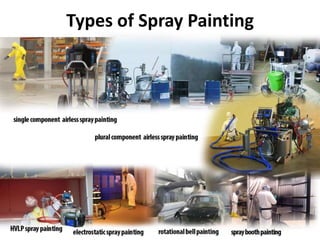
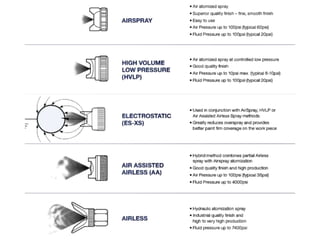
Types of Spray Painting
Type Pressure Advantages Disadvantages 
Air spray / 
Conventional 
Max 7 bar • Very good finish achieved 
• Good control ability 
• You can use small amounts of material 
• Poor transfer efficiency: 60% waste 
(overspray) 
• Slow application rate 
• Can only spray low viscosity paints 
HVLP 
(High Volume Low 
Pressure) 
Max 0.7 bar • Approximately 80% efficient vs. air spray 
• Good paint saving 
• Environmentally friendly 
• Far cleaner application, & less 
maintenance 
• Slow application rate 
• Low viscosity materials only can be 
sprayed 
Airless Max 500 bar • Fast application - 200 to 250 M²/hour 
• Good transfer efficiency 
• Application of high build coatings 
• High film build 
• Poor control 
• Reduced quality of finish 
 Incapable of partial triggering 
 Susceptible to “tails” 
 Fluid injection hazard 
 Spray gun tip wear 
Air Assisted 
Airless /Airmix / 
Aircoat 
Max 400 bar •More control, high production rates 
•Better transfer efficiency 
•Better quality finish 
• reduced wear on fluid nozzle and pumps 
 No partial triggering 
 Requires extra air hose 
 Fluid injection hazard 
 Susceptible to lower transfer efficiency 
than airless due to improper setup of air 
and fluid pressure 
Electrostatic • Greatly reduced overspray 
• Paint saving 
• Low booth maintenance 
• Labor saving 
• Less spraying ability required 
 Spray equipment more expensive 
 Can produce minor shocks 
 Electrostatics can be easily deactivated 
and thereby become more inefficient 
 Ungrounded areas will repel coatings 
 Requires good ground, <1 meg ohm
X70 Light Cart 
X50 X40 
X70 Heavy-duty Chart
Why Plural Component Airless Sprayer? 
• Almost 90% of today’s coating materials are plural components, but 
applied with single component sprayer. 
• Today’s “solventless” coatings are high in viscosity. When 100% solids 
components are mixed, then cross-link to form a solid. There is no 
solvent to act as a “heat sink” and slow down the reaction. Reaction 
is subject to heat generation (exothermic reaction) that shortens an 
already short pot life. Larger quantities generate greater heat, 
leading to shorter pot life. Plural Component system are usually 
equipped with heaters to reduce viscosity. 
• 100% SBV or solvent-free coating material: 
– Epoxy: A two-component material that mixes a base (resin or epoxy) with 
an activator (catalyst, hardener, or converter). 
– Polyurethane: A two-component, fastset coating formed by reacting (or 
mixing) an isocyanate with a polyol resin. 
– Polyurea: A two-component fast-set coating that is formed by reacting an 
isocyanate with an amine resin.
Plural Component Airless Sprayer 
The base and activator are pumped to a mixer 
manifold or plural component spray gun separately. 
They are then mixed and applied immediately to 
the work piece via the spray nozzle. 
Advantages 
– Labour saving 
– Material saving 
– Guarantee of correct mixing 
– Allows short pot life materials to be applied 
Disadvantages 
– Can be difficult to use
Plural Component Airless Sprayer 
XP35 XP50 
XP70 
XM70 
XMPFP 
XM50
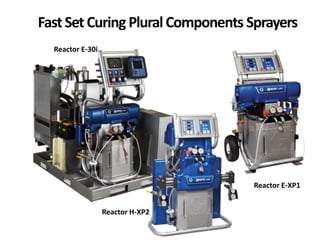
Fast Set Curing Plural Components Sprayers 
Reactor E-30i 
Reactor H-XP2 
Reactor E-XP1
Plural Components Sprayers Accessories 
Standard heater 
(Viscosity Control) 
Gun Splitter 
Electric heated hose 
Externally controlled Viscon 
Water-jacketed Heat Hose 
Complete Viscon HF Heater 
with Manual Thermostat Control 
Remote manifold 
Mix manifold 
Hopper 
Heated Hose Controller 
XTR 5 
XTR 7 
Fusion gun 
Probler gun
Spraying is simple but you must have the right equipment 
What types of materials will you spray? Now and in the future? 
The types of materials you spray will determine the size of the tips you use. If you plan 
to spray a variety of materials you have to consider buying a sprayer with more 
versatility. 
How many gallons per week will you spray? 
Purchasing a part-time sprayer to do a full-time job has disappointed many 
contractors. In the long run, saving money on a sprayer that is inadequate for the job, 
or not durable enough, will cost a lot in lost labor. 
What power sources are available? Will most jobs be indoors or outdoors? 
Your answers will help choose a unit family (gas, electric, or compressed air) 
based on power sources alone. 
What types of surfaces will you be spraying? 
Will you be spraying on drywall, exterior siding, or concrete? You have to 
consider the tip sizes needed as well as the quality of finish required in order to 
choose the best sprayer for the job. 
.
Spraying is simple but you must have the right equipment 
How many spray guns will you use at one time, now and in the future? 
If you plan to use more than one gun at a time, then you have to purchase a unit that 
has the ability to handle multiple guns. 
What types of jobs will you bid? 
Each job has its own requirements. New construction, maintenance work, and 
commercial jobs all vary in terms of: coatings used, crew size needed, and power 
sources available. 
What hose lengths will you use? 
Hose length depends on the job site, material being sprayed, tip size, and hose 
diameter. Your sprayer must be able to support the length of hose. 
How much do you want to spend on a sprayer? 
Buying a sprayer is an investment. You do not want to over-buy or under-buy. Keep in 
mind the cliché, “You can pay now or pay later”. Downtime resulting from an 
undersized, overworked sprayer or poor quality equipment can quickly wipe out any 
savings from the initial low purchase cost of the sprayer.
Airless Spraying Techniques 
Adjusting the Pressure 
It is best to spray at the lowest pressure that completely atomizes the coating. The pressure 
control should be set at a low-pressure setting and slowly increased until the paint is completely 
atomized. If the spray pattern has fingers or tails, then the pressure should be increased. 
If the maximum pressure of the sprayer is not enough to achieve a good spray pattern, a spray tip 
with a smaller orifice should be used.
Airless Spraying Techniques 
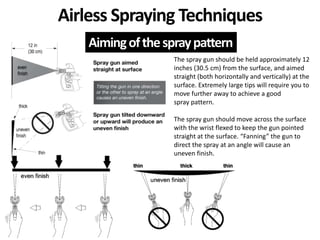
Aiming of the spray pattern 
The spray gun should be held approximately 12 
inches (30.5 cm) from the surface, and aimed 
straight (both horizontally and vertically) at the 
surface. Extremely large tips will require you to 
move further away to achieve a good 
spray pattern. 
The spray gun should move across the surface 
with the wrist flexed to keep the gun pointed 
straight at the surface. “Fanning” the gun to 
direct the spray at an angle will cause an 
uneven finish.
Airless Spraying Techniques 
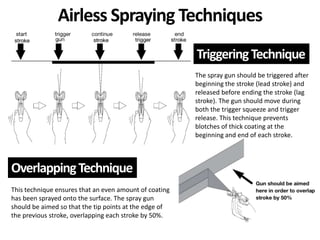
Triggering Technique 
The spray gun should be triggered after 
beginning the stroke (lead stroke) and 
released before ending the stroke (lag 
stroke). The gun should move during 
both the trigger squeeze and trigger 
release. This technique prevents 
blotches of thick coating at the 
beginning and end of each stroke. 
Overlapping Technique 
This technique ensures that an even amount of coating 
has been sprayed onto the surface. The spray gun 
should be aimed so that the tip points at the edge of 
the previous stroke, overlapping each stroke by 50%.
Common Spray Technique Errors 
Pressure Set to High 
It is easy to just crank up the pressure control to the maximum and slap on the 
material. For professional results, turn down the pressure as low as you can 
without getting tails. You will: 
– Reduce wear on your pump 
– Reduce wear on your spray tip 
– Spray a more consistent even finish 
– Reduce the amount of overspray (wasted paint) 
Holding Down the Trigger too Long 
It is easy to just pull the trigger and keep moving up and down or side to side, 
overlapping and moving down the wall spraying constantly. If you are not triggering 
the gun every time you change directions you will have at least double the mil 
thickness in every spot you change directions. In the right light or over time, your 
customer may be able to see these heavy areas. As explained earlier, you should 
trigger the gun on each stroke and be moving into and out of each trigger pull.

The Basic of Airless Spraying

  • 1.
    The Basic ofAirless Spraying
  • 2.
    Coating Material 4Basic Components  Binder, Resin, or Polymer  Pigment  Solvent  Additives
  • 3.
    Viscosity Solid byVolume/Solid Content  Low Solids = 20-30% solids  Medium Solids = 30-50% solids  High Solids = Up to 100% solids
  • 4.
    Methods of CoatingApplication Brushes Rollers Sprayers The choice of an application method depends on the type of coating to be applied, the type and size of surface to be coated, and governing environmental regulations. However, the consistency of some coatings may dictate a particular method. For example, coatings that are excessively viscous may not permit effective application by spray; or a low viscous coating may only be effectively applied by spray. Either the specifications or the manufacturer's instructions usually will indicate the preferred application method. All application methods have inherent advantages and limitations. *) other methods: electrodeposition/electrocoating (E-coat), autodeposition, dip/flow/curtain coating,
  • 5.
    Brush Methods AdvantagesLimitation Brush • the ability to stripe coat • best for oil-based and waterborne coatings, or slow-drying coating • most common, particularly around irregular surfaces such as rivets, bolt heads, piping, railing, and similar areas • low investment, low technology • independent of power • it aids in thorough wetting of the substrate, particularly on surfaces that are porous • can be used in restricted spaces, be useful for small areas, with less wastage and contamination of surroundings. • no loss through overspray • short set-up time • slow, low productivity, • labor intensive • may not produce a uniform coating thickness • not practical for large surfaces • may leave unsightly brush marks • not recommended for fast-drying & high solid coating (i.e. vinyl zinc-rich and epoxy zinc-rich coatings that need agitator to be kept in suspension during application)
  • 6.
    Roller Methods AdvantagesLimitation Roller • excellent for large, flat areas (e.g., tank sidewalls and tops, decks, ship hulls, walls, and ceilings) or whenever application does not require the skill needed for brush or spray application • recommended for use in windy conditions to eliminate excessive material loss and overspray • may be used for indoor application when overspray cannot be tolerated. • Twice faster than brush application • Roller application characteristics for high solids coatings and inorganic zinc rich coatings are considered poor. High performance coatings/linings for immersion are seldom applied by roller because of non-uniform thickness and wicking caused by roller nap residue. • demands suitable rheological properties of the paint.
  • 7.
    Sprayer Methods AdvantagesLimitation Spray • speed of application • control of film thickness • allows the use of fast drying coatings • uniform finish • can be installed as an automatic process • more cost effective in the long run • overspray & solvent emission = health hazard • does not properly fill cracks or seal most rough surfaces • requires more skilled operator • requires more maintenance • medium/high investment cost • considerably more waste, need serious handling
  • 8.
  • 9.
    Type Pressure AdvantagesDisadvantages Air spray / Conventional Max 7 bar • Very good finish achieved • Good control ability • You can use small amounts of material • Poor transfer efficiency: 60% waste (overspray) • Slow application rate • Can only spray low viscosity paints HVLP (High Volume Low Pressure) Max 0.7 bar • Approximately 80% efficient vs. air spray • Good paint saving • Environmentally friendly • Far cleaner application, & less maintenance • Slow application rate • Low viscosity materials only can be sprayed Airless Max 500 bar • Fast application - 200 to 250 M²/hour • Good transfer efficiency • Application of high build coatings • High film build • Poor control • Reduced quality of finish  Incapable of partial triggering  Susceptible to “tails”  Fluid injection hazard  Spray gun tip wear Air Assisted Airless /Airmix / Aircoat Max 400 bar •More control, high production rates •Better transfer efficiency •Better quality finish • reduced wear on fluid nozzle and pumps  No partial triggering  Requires extra air hose  Fluid injection hazard  Susceptible to lower transfer efficiency than airless due to improper setup of air and fluid pressure Electrostatic • Greatly reduced overspray • Paint saving • Low booth maintenance • Labor saving • Less spraying ability required  Spray equipment more expensive  Can produce minor shocks  Electrostatics can be easily deactivated and thereby become more inefficient  Ungrounded areas will repel coatings  Requires good ground, <1 meg ohm
  • 11.
    X70 Light Cart X50 X40 X70 Heavy-duty Chart
  • 12.
    Why Plural ComponentAirless Sprayer? • Almost 90% of today’s coating materials are plural components, but applied with single component sprayer. • Today’s “solventless” coatings are high in viscosity. When 100% solids components are mixed, then cross-link to form a solid. There is no solvent to act as a “heat sink” and slow down the reaction. Reaction is subject to heat generation (exothermic reaction) that shortens an already short pot life. Larger quantities generate greater heat, leading to shorter pot life. Plural Component system are usually equipped with heaters to reduce viscosity. • 100% SBV or solvent-free coating material: – Epoxy: A two-component material that mixes a base (resin or epoxy) with an activator (catalyst, hardener, or converter). – Polyurethane: A two-component, fastset coating formed by reacting (or mixing) an isocyanate with a polyol resin. – Polyurea: A two-component fast-set coating that is formed by reacting an isocyanate with an amine resin.
  • 13.
    Plural Component AirlessSprayer The base and activator are pumped to a mixer manifold or plural component spray gun separately. They are then mixed and applied immediately to the work piece via the spray nozzle. Advantages – Labour saving – Material saving – Guarantee of correct mixing – Allows short pot life materials to be applied Disadvantages – Can be difficult to use
  • 14.
    Plural Component AirlessSprayer XP35 XP50 XP70 XM70 XMPFP XM50
  • 15.
    Fast Set CuringPlural Components Sprayers Reactor E-30i Reactor H-XP2 Reactor E-XP1
  • 16.
    Plural Components SprayersAccessories Standard heater (Viscosity Control) Gun Splitter Electric heated hose Externally controlled Viscon Water-jacketed Heat Hose Complete Viscon HF Heater with Manual Thermostat Control Remote manifold Mix manifold Hopper Heated Hose Controller XTR 5 XTR 7 Fusion gun Probler gun
  • 17.
    Spraying is simplebut you must have the right equipment What types of materials will you spray? Now and in the future? The types of materials you spray will determine the size of the tips you use. If you plan to spray a variety of materials you have to consider buying a sprayer with more versatility. How many gallons per week will you spray? Purchasing a part-time sprayer to do a full-time job has disappointed many contractors. In the long run, saving money on a sprayer that is inadequate for the job, or not durable enough, will cost a lot in lost labor. What power sources are available? Will most jobs be indoors or outdoors? Your answers will help choose a unit family (gas, electric, or compressed air) based on power sources alone. What types of surfaces will you be spraying? Will you be spraying on drywall, exterior siding, or concrete? You have to consider the tip sizes needed as well as the quality of finish required in order to choose the best sprayer for the job. .
  • 18.
    Spraying is simplebut you must have the right equipment How many spray guns will you use at one time, now and in the future? If you plan to use more than one gun at a time, then you have to purchase a unit that has the ability to handle multiple guns. What types of jobs will you bid? Each job has its own requirements. New construction, maintenance work, and commercial jobs all vary in terms of: coatings used, crew size needed, and power sources available. What hose lengths will you use? Hose length depends on the job site, material being sprayed, tip size, and hose diameter. Your sprayer must be able to support the length of hose. How much do you want to spend on a sprayer? Buying a sprayer is an investment. You do not want to over-buy or under-buy. Keep in mind the cliché, “You can pay now or pay later”. Downtime resulting from an undersized, overworked sprayer or poor quality equipment can quickly wipe out any savings from the initial low purchase cost of the sprayer.
  • 19.
    Airless Spraying Techniques Adjusting the Pressure It is best to spray at the lowest pressure that completely atomizes the coating. The pressure control should be set at a low-pressure setting and slowly increased until the paint is completely atomized. If the spray pattern has fingers or tails, then the pressure should be increased. If the maximum pressure of the sprayer is not enough to achieve a good spray pattern, a spray tip with a smaller orifice should be used.
  • 20.
    Airless Spraying Techniques Aiming of the spray pattern The spray gun should be held approximately 12 inches (30.5 cm) from the surface, and aimed straight (both horizontally and vertically) at the surface. Extremely large tips will require you to move further away to achieve a good spray pattern. The spray gun should move across the surface with the wrist flexed to keep the gun pointed straight at the surface. “Fanning” the gun to direct the spray at an angle will cause an uneven finish.
  • 21.
    Airless Spraying Techniques Triggering Technique The spray gun should be triggered after beginning the stroke (lead stroke) and released before ending the stroke (lag stroke). The gun should move during both the trigger squeeze and trigger release. This technique prevents blotches of thick coating at the beginning and end of each stroke. Overlapping Technique This technique ensures that an even amount of coating has been sprayed onto the surface. The spray gun should be aimed so that the tip points at the edge of the previous stroke, overlapping each stroke by 50%.
  • 22.
    Common Spray TechniqueErrors Pressure Set to High It is easy to just crank up the pressure control to the maximum and slap on the material. For professional results, turn down the pressure as low as you can without getting tails. You will: – Reduce wear on your pump – Reduce wear on your spray tip – Spray a more consistent even finish – Reduce the amount of overspray (wasted paint) Holding Down the Trigger too Long It is easy to just pull the trigger and keep moving up and down or side to side, overlapping and moving down the wall spraying constantly. If you are not triggering the gun every time you change directions you will have at least double the mil thickness in every spot you change directions. In the right light or over time, your customer may be able to see these heavy areas. As explained earlier, you should trigger the gun on each stroke and be moving into and out of each trigger pull.