• Compression molding process is one of the low cost molding methods as
compared to injection molding and transfer molding.
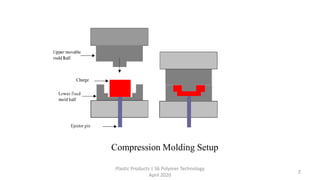
• It is a high pressure forming process in which the molten plastic material is
squeezed directly into a mould cavity, by the application of heat and
pressure to conform to the shape of the mold.
Compression Molding
1
Plastic Products | S6 Polymer Technology
April 2020
Compression Molding Setup
2
Plastic Products | S6 Polymer Technology
April 2020
• In compression molding of thermosets the mold remains hot throughout the
entire cycle; as soon as a molded part is ejected, a new charge of molding
powder can be introduced.
• On the other hand, unlike thermosets, thermoplastics must be cooled to harden.
So before a molded part is ejected, the entire mold must be cooled, and as a
result, the process of compression molding is quite slow with thermoplastics.
Compression Molding
Cont..
3
Plastic Products | S6 Polymer Technology
April 2020
• Compression molding is thus commonly used for thermosetting plastics such as
phenolics, urea, melamine, an alkyds; it is not ordinarily used for thermoplastics.
• However, in special cases, such as when extreme accuracy is needed,
thermoplastics are also compression molded.
Compression Molding Cont..
4
Plastic Products | S6 Polymer Technology
April 2020
The three common types of mold designs are:
• Open flash
• Fully positive
• Semi-positive
Mold Design
5
Plastic Products | S6 Polymer Technology
April 2020
• In an open flash mold a slight excess of molding powder is
loaded into the mold cavity.
• On closing the top and bottom platens, the excess material is
forced out and flash is formed.
• The flash blocks the plastic remaining in the cavity and causes
the mold plunger to exert pressure on it.
Open Flash
6
Plastic Products | S6 Polymer Technology
April 2020
• In the fully positive molds no allowance is made for placing excess powder in
the cavity.
• If excess powder is loaded, the mold will not close; an insufficient charge will
result in reduced thickness of the molded article.
• A correctly measured charge must therefore be used with this mold, it is a
disadvantage of the positive mold.
• Another disadvantage is that the gases liberated during the chemical curing
reaction are trapped inside and may show as blisters on the molded surface.
Fully Positive
7
Plastic Products | S6 Polymer Technology
April 2020
• The semi-positive mold combines certain features of the open flash and fully
positive molds and makes allowance for excess powder and flash. It is also
possible to get both horizontal and vertical flash.
• Semi-positive molds are more expensive to manufacture and maintain than
the other types, but they are much better from an applications point ofview.
Semi-Positive
8
Plastic Products | S6 Polymer Technology
April 2020
Compression MoldingAnimation
Source: https://www.youtube.com/watch?v=-
FxiWMnY4aQ
9
Plastic Products | S6 Polymer Technology
April 2020
Important factors to be considered before compression molding process are:
• Amount of plastic material (charge).
• Heating time
• Melting temperature of plastic material.
• Pressure required to squeeze the material in to the mold cavity.
• Cooling time.
Process Parameters
10
Plastic Products | S6 Polymer Technology
April 2020
Materials Used
• Different types of thermosets and thermoplastics
materials can be used for
• compression molding process.
• For example: Epoxy, Urea formaldehyde (UF),
Polyester, Polyamide (PI),
• Polyethylene (PE), Polypropylene (PP).
11
Plastic Products | S6 Polymer Technology
April 2020
Compression molding is used for manufacturing:
Electrical and electronic equipments, brush and mirror handles, trays,
cookware knobs, cooking utensils, dinnerware, appliance housings,
aircraft main power terminal housing, pot handles, dinnerware plates,
automotive parts, flatware, buttons, and large container.
Applications
12
Plastic Products | S6 Polymer Technology
April 2020
Applications
Carbon Fiber Reinforced Composites Plastic Trays Plastic Caps
13
Plastic Products | S6 Polymer Technology
April 2020
• Low initial setup cost and fast setup time.
• Heavy plastic parts can be molded.
• Good surface finish of the molded parts.
• Wastes relatively little material as compared with other methods.
• Thermoplastic composites with unidirectional tapes, woven fabrics, randomly
orientated fiber mat or chopped strand can be manufactured.
Advantages
14
Plastic Products | S6 Polymer Technology
April 2020
The limitations of the compression molding process:
• Low production rate.
• Limited largely to flat or moderately curved parts with no
undercuts.
Limitatio
ns
15
Plastic Products | S6 Polymer Technology
April 2020

compression moulding.pdf

  • 1.
    • Compression moldingprocess is one of the low cost molding methods as compared to injection molding and transfer molding. • It is a high pressure forming process in which the molten plastic material is squeezed directly into a mould cavity, by the application of heat and pressure to conform to the shape of the mold. Compression Molding 1 Plastic Products | S6 Polymer Technology April 2020
  • 2.
    Compression Molding Setup 2 PlasticProducts | S6 Polymer Technology April 2020
  • 3.
    • In compressionmolding of thermosets the mold remains hot throughout the entire cycle; as soon as a molded part is ejected, a new charge of molding powder can be introduced. • On the other hand, unlike thermosets, thermoplastics must be cooled to harden. So before a molded part is ejected, the entire mold must be cooled, and as a result, the process of compression molding is quite slow with thermoplastics. Compression Molding Cont.. 3 Plastic Products | S6 Polymer Technology April 2020
  • 4.
    • Compression moldingis thus commonly used for thermosetting plastics such as phenolics, urea, melamine, an alkyds; it is not ordinarily used for thermoplastics. • However, in special cases, such as when extreme accuracy is needed, thermoplastics are also compression molded. Compression Molding Cont.. 4 Plastic Products | S6 Polymer Technology April 2020
  • 5.
    The three commontypes of mold designs are: • Open flash • Fully positive • Semi-positive Mold Design 5 Plastic Products | S6 Polymer Technology April 2020
  • 6.
    • In anopen flash mold a slight excess of molding powder is loaded into the mold cavity. • On closing the top and bottom platens, the excess material is forced out and flash is formed. • The flash blocks the plastic remaining in the cavity and causes the mold plunger to exert pressure on it. Open Flash 6 Plastic Products | S6 Polymer Technology April 2020
  • 7.
    • In thefully positive molds no allowance is made for placing excess powder in the cavity. • If excess powder is loaded, the mold will not close; an insufficient charge will result in reduced thickness of the molded article. • A correctly measured charge must therefore be used with this mold, it is a disadvantage of the positive mold. • Another disadvantage is that the gases liberated during the chemical curing reaction are trapped inside and may show as blisters on the molded surface. Fully Positive 7 Plastic Products | S6 Polymer Technology April 2020
  • 8.
    • The semi-positivemold combines certain features of the open flash and fully positive molds and makes allowance for excess powder and flash. It is also possible to get both horizontal and vertical flash. • Semi-positive molds are more expensive to manufacture and maintain than the other types, but they are much better from an applications point ofview. Semi-Positive 8 Plastic Products | S6 Polymer Technology April 2020
  • 9.
  • 10.
    Important factors tobe considered before compression molding process are: • Amount of plastic material (charge). • Heating time • Melting temperature of plastic material. • Pressure required to squeeze the material in to the mold cavity. • Cooling time. Process Parameters 10 Plastic Products | S6 Polymer Technology April 2020
  • 11.
    Materials Used • Differenttypes of thermosets and thermoplastics materials can be used for • compression molding process. • For example: Epoxy, Urea formaldehyde (UF), Polyester, Polyamide (PI), • Polyethylene (PE), Polypropylene (PP). 11 Plastic Products | S6 Polymer Technology April 2020
  • 12.
    Compression molding isused for manufacturing: Electrical and electronic equipments, brush and mirror handles, trays, cookware knobs, cooking utensils, dinnerware, appliance housings, aircraft main power terminal housing, pot handles, dinnerware plates, automotive parts, flatware, buttons, and large container. Applications 12 Plastic Products | S6 Polymer Technology April 2020
  • 13.
    Applications Carbon Fiber ReinforcedComposites Plastic Trays Plastic Caps 13 Plastic Products | S6 Polymer Technology April 2020
  • 14.
    • Low initialsetup cost and fast setup time. • Heavy plastic parts can be molded. • Good surface finish of the molded parts. • Wastes relatively little material as compared with other methods. • Thermoplastic composites with unidirectional tapes, woven fabrics, randomly orientated fiber mat or chopped strand can be manufactured. Advantages 14 Plastic Products | S6 Polymer Technology April 2020
  • 15.
    The limitations ofthe compression molding process: • Low production rate. • Limited largely to flat or moderately curved parts with no undercuts. Limitatio ns 15 Plastic Products | S6 Polymer Technology April 2020