Presented By:
Jennifer
Erle
Amberlee
French
Sarah
Bennett
Josh
Hamilton
John
Schmitt
Powder coating is a dry finishing process,
using fine particles of paint, which are
electrostatically charged and sprayed onto a
workpiece.
Once the powder is applied, the part is
cured, causing the powder to adhere to the
surface.
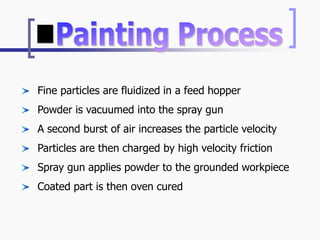
Fine particles are fluidized in a feed hopper
Powder is vacuumed into the spray gun
A second burst of air increases the particle velocity
Particles are then charged by high velocity friction
Spray gun applies powder to the grounded workpiece
Coated part is then oven cured
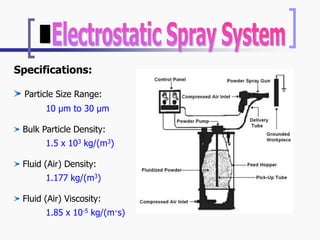
Specifications:
Particle Size Range:
10 μm to 30 μm
Bulk Particle Density:
1.5 x 10³ kg/(m3)
Fluid (Air) Density:
1.177 kg/(m3)
Fluid (Air) Viscosity:
1.85 x 10⁻⁵ kg/(m·s)
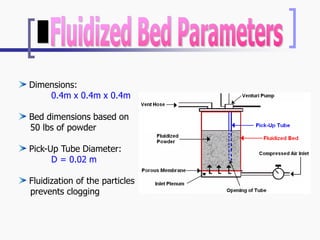
Dimensions:
0.4m x 0.4m x 0.4m
Bed dimensions based on
50 lbs of powder
Pick-Up Tube Diameter:
D = 0.02 m
Fluidization of the particles
prevents clogging
1) Terminal velocity for the
smallest particle size :
vt = 4.41×10⁻³ m/s
2) Reynold’s number :
Re = 2.81×10⁻³
3) Volume fraction of the
powder particles for
minimum fluidization :
w = 0.41
4) Velocity in the pick-up
tube :
vtube = 48.52 m/s
The volume flow rate at the
tip of the gun was tabulated:
vpowder = 250 m/s
Aguntip = 3.142×10⁻⁴ m2
Vguntip = 0.079 m3/s
The second burst of
compressed air volume flow
rate was calculated:
V2ndburst = 0.063 m3/s
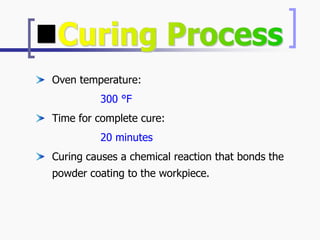
Oven temperature:
300 °F
Time for complete cure:
20 minutes
Curing causes a chemical reaction that bonds the
powder coating to the workpiece.
Higher Quality
Extremely Durable
Environmentally Friendly
Cost Efficient
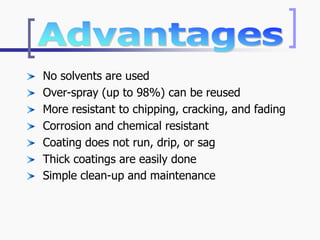
No solvents are used
Over-spray (up to 98%) can be reused
More resistant to chipping, cracking, and fading
Corrosion and chemical resistant
Coating does not run, drip, or sag
Thick coatings are easily done
Simple clean-up and maintenance
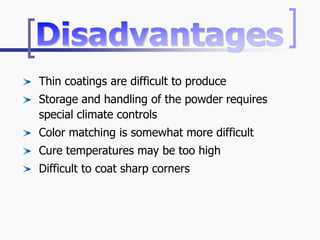
Thin coatings are difficult to produce
Storage and handling of the powder requires
special climate controls
Color matching is somewhat more difficult
Cure temperatures may be too high
Difficult to coat sharp corners
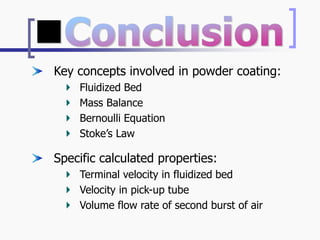
Key concepts involved in powder coating:
Fluidized Bed
Mass Balance
Bernoulli Equation
Stoke’s Law
Specific calculated properties:
Terminal velocity in fluidized bed
Velocity in pick-up tube
Volume flow rate of second burst of air
Presented By:
Jennifer
Erle
Amberlee
French
Sarah
Bennett
Josh
Hamilton
John
Schmitt
Questions ?

powder coating (final).ppt

  • 1.
  • 2.
    Powder coating isa dry finishing process, using fine particles of paint, which are electrostatically charged and sprayed onto a workpiece. Once the powder is applied, the part is cured, causing the powder to adhere to the surface.
  • 3.
    Fine particles arefluidized in a feed hopper Powder is vacuumed into the spray gun A second burst of air increases the particle velocity Particles are then charged by high velocity friction Spray gun applies powder to the grounded workpiece Coated part is then oven cured
  • 4.
    Specifications: Particle Size Range: 10μm to 30 μm Bulk Particle Density: 1.5 x 10³ kg/(m3) Fluid (Air) Density: 1.177 kg/(m3) Fluid (Air) Viscosity: 1.85 x 10⁻⁵ kg/(m·s)
  • 5.
    Dimensions: 0.4m x 0.4mx 0.4m Bed dimensions based on 50 lbs of powder Pick-Up Tube Diameter: D = 0.02 m Fluidization of the particles prevents clogging
  • 6.
    1) Terminal velocityfor the smallest particle size : vt = 4.41×10⁻³ m/s 2) Reynold’s number : Re = 2.81×10⁻³ 3) Volume fraction of the powder particles for minimum fluidization : w = 0.41 4) Velocity in the pick-up tube : vtube = 48.52 m/s
  • 7.
    The volume flowrate at the tip of the gun was tabulated: vpowder = 250 m/s Aguntip = 3.142×10⁻⁴ m2 Vguntip = 0.079 m3/s The second burst of compressed air volume flow rate was calculated: V2ndburst = 0.063 m3/s
  • 9.
    Oven temperature: 300 °F Timefor complete cure: 20 minutes Curing causes a chemical reaction that bonds the powder coating to the workpiece.
  • 10.
  • 11.
    No solvents areused Over-spray (up to 98%) can be reused More resistant to chipping, cracking, and fading Corrosion and chemical resistant Coating does not run, drip, or sag Thick coatings are easily done Simple clean-up and maintenance
  • 12.
    Thin coatings aredifficult to produce Storage and handling of the powder requires special climate controls Color matching is somewhat more difficult Cure temperatures may be too high Difficult to coat sharp corners
  • 13.
    Key concepts involvedin powder coating: Fluidized Bed Mass Balance Bernoulli Equation Stoke’s Law Specific calculated properties: Terminal velocity in fluidized bed Velocity in pick-up tube Volume flow rate of second burst of air
  • 14.