PHYSCIAN MEET D. SUBBURAJ MD PGM3 UNIT
16/ male       c/o head ache,  neck pain -4 yrs      abnormal mobility  of  left shoulder jt  &loss of pain sensation in left UL  for 2 yrs
HISTORY OF PRESENTING ILLNESSHead  ache-4yrs lasting for 1-2 hrs daily;mostly in morning; not progressiveOccipitalRelieved by drugs ↑ by coughing ,sneezing, playingNot associated with  diminished visual acuity no vomiting,aura
H/O  neck pain -4yrs  More in left side Insidious , not progressiveDull aching, continuous, not radiating↑ by playing, not associated with shock like sensationNot ↑ by neck movementsH/O  abnormal  excessive mobility of lt shoulder-2 yrsNo traumaMild dull aching pain,  no swellingWhile abducting left shoulder –he can dislocate & reduces him self voluntarily
H/O  loss of  pain & temperature  in lt UL & nape of neck -2 yrsAble to feel clothingNo h/o tingling, numbness no H/O weaknessNo H/O unsteadiness while walkingNo  H/O incoordination in the darkNo H/O involuntary movements
No history suggestive of cranial nerve involvement,No h/o sweating disturbanceNo h/o bladder , bowel involvementNo h/o seizure
summary16/m Occipital headacheNeck painLoss of pain & temperature in left upper limbLaxity of left shoulder jt
Conscious , oriented ,AfebrileNo pallor ,jaundice ,lymph adenopathyHeight : neck ratio =11Upper lower segment ratio-1height: arm span ratio -normalNo neurocutaneous markersNo trophic changes  in  left ULNO nerve thickening,No digital ulcer
vitalsBP  LYING POSITION-110/80 mmhg       STANDING- 108/80 mmhgRR- 12/MINPR -78/ MIN
CVS,RS – NADCNSHMF –normalCranial nerves –normalSpino motor systemBulk , power , tone – normal Superficial reflex -normal
DTR
SENSORY SYSTEMPAIN ,TEMPERATURE  ABSENT INLEFT ULNAPE OF NECK LEFT SIDE ANGLE OF MANDIBLE PECTORAL  REGION  UP TO   T2
CO ORDINATION TEST – NORMAL IN BOTH UL&LLNO NYSTAGMUSCEREBELLAR SIGNS -ABSENTNO INVOLUNTARY MOVEMENTGAIT – NORMALNO MENINGEAL SIGNSSPINE & CRANIUM -NORMAL
Summary of the findingsLoss of pain & temperature from  C3 to T2 in left sideAbsent biceps,supinator reflex left sideChonic head ache & neck pain increased by coughing, sneezing
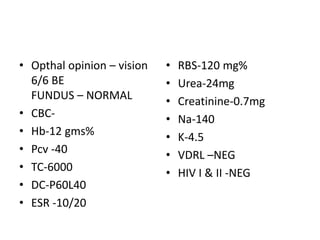
Opthal opinion – vision 6/6 BE                              FUNDUS – NORMALCBC-Hb-12 gms%Pcv -40TC-6000DC-P60L40ESR -10/20RBS-120 mg%Urea-24mgCreatinine-0.7mgNa-140 K-4.5VDRL –NEGHIV I & II -NEG
NERVE CONDUCTION STUDY  -NORMAL
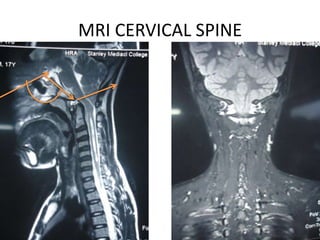
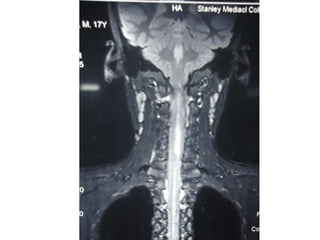
MRI CERVICAL SPINE
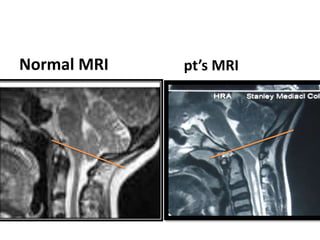
Normal MRI     pt’s MRI
Charcot shoulderRare rapid destruction of the proximal humerus and glenoid related to neuropathic disease  Clinical EvaluationPresents with swelling ,pain and stiffness.May present with dislocated shoulder.Generally decreased active and passive ROM.Charcot Shoulder XrayMost common finding is resorption of the humeral head. May have glenoidresorption or shoulder dislocation. Look for pathologic fracture.
Abnormal , excessive movements only in lt shoulder- hyperlaxityNo swelling , rednessNo joint destruction in x rayPreserved proprioceptionMulti dimensional instabiltity of shoulder
FINAL DIAGNOSISSYRINGOMYELIA INVOLVING CERVICAL, THORACIC CORD REGION  WITH  ARNOLD –CHIARI MALFORMATOIN TYPE I
Arnold–Chiari malformationsChiari malformations, types I-IV, refer to a spectrum of congenital hindbrain abnormalities affecting the structural relationships between the cerebellum, brainstem, the upper cervical cord, and the bony cranial base.
CM TYPE IA congenital malformation. Most commonHerniation of cerebellartonsilsSyndrome of occipitoatlantoaxialhypermobilityAn acquired Chiari I Malformation in patients with hereditary disorders of connective tissue.Patients who exhibit extreme joint hypermobility and connective tissue weakness as a result of Ehlers-Danlossyndromeor Marfan Syndrome are susceptible to instabilities of the craniocervical junction and thus acquiring a Chiari Malformation. This type is difficult to diagnose and treat.
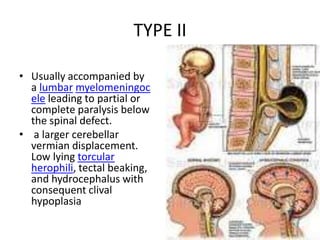
TYPE IIUsually accompanied by a lumbar myelomeningocele leading to partial or complete paralysis below the spinal defect.   a larger cerebellarvermian displacement. Low lying torcularherophili, tectalbeaking, and hydrocephalus with consequent clivalhypoplasia
TYPE III    Causes severe neurological defects. It is associated with an occipital encephalocele.TYPE IV                   Characterized by a lack of cerebellar development.
Causes ? Genetic –chromosome 9&15? Vitamin deficencies
Type ITrue incidence –not knownm: f ratio-2:3Common in adult & paediatric age groupIncidence syrinx- 25—70% syringohydromyelia - secondary to pathologic CSF dynamics
SYMPTOMSDisruption of CSF flow through foramen magnu MC symptom-head acheheadache and neck pain in Chiari I are often exacerbated by cough and Valsalva  manoeuvresyringomyelia and central cord symptoms such as hand weakness and dissociated sensory loss
symptomsCompression of medulla and upper spinal cord,myelopathylower cranial nerve  palsiesnuclear dysfunction.Compression of cerebellum ataxia, dysmetria, nystagmus, dysequilibrium.
William's theoryherniated tonsil at foramen magnum – valve like action.Pressure differrence   increases. The increase in subarachnoid fluid pressure from increased venous pressure during coughing or Valsalvamaneuvers is localized to the intracranial compartment.increase cisterna magna pressure occurs simultaneously with a decrease in spinal subarachnoid pressure.This craniospinal pressure gradient draws CSF   caudally into the syrinx.
New conceptIn chiari , pressure in veins & capillary  around central canal very highCoughing , sneezing , even heart beat put more stress on blood vessels,Leakage of plasma – form  syrinx
syringomyeliaFrequently  associated developmental abnormalities  vertebral column (thoracic scoliosis, fusion of vertebrae,  or Klippel-Feil anomaly),  base of the skull (platybasia,  basilar invagination),   cerebellum and brain  (type I Chiari malformation) 90 percent of cases of syringomyelia have type I Chiari malformation
TYPESCONGENITAL- associated with chiari malformationsACQUIRED -Spinal cord tumors (usually intramedullary, especially hemangioblastoma) Traumatic myelopathySpinal arachnoiditis and pachymeningitisSecondary myelomalacia from cord compression (tumor, spondylosis), infarction, hematomyeliaIDIOPATHIC
Depending on the connection with  fourth ventricle     A-Communicating   B- Non communicating   C-Extra canalicular
Symptoms begins unilaterally  Syrinx gradually destroys:  1- decussating S/T tracts  2- ant. horn cells  3- lateral C/S tracts  4- sympathetic tracts  5- trigeminal, 1X, X, X1 & X11 cranial N nuclei      and vestibular system as syrinx extends to     the medulla.
SENSORYDissociated sensory loss
 in either or both arms, or in a shawl like distribution ,
Dysesthetic pain, a common complaint in syringomyelia, usually involves the neck and shoulders, but may follow a radicular distribution in the arms or trunk.
When the cavity enlarges to involve the posterior columns, position and vibration senses in the feet are lost; astereognosis may be noted in the hands.MOTORSyrinx extension into the anterior horns of the spinal cord damages motor neurons (lower motor neuron) and causes diffuse muscle atrophy that begins in the hands and progresses proximally to include the forearms and shoulder girdles. Clawhand may develop.
Respiratory insufficiency, which usually is related to changes in position, may occur.AUTONOMICImpaired bowel and bladder functions usually occur as a late manifestation.
Sexual dysfunction may develop in long-standing cases.
Horner syndrome may appear, reflecting damage to the sympathetic neurons in the intermediolateral cell column.Extension of the syrinxsyringobulbia.[4, 5] T dysphagia, nystagmus, pharyngeal and palatal weakness, asymmetric weakness and atrophy of the tongue, and loss of pain ,temperature   in the distribution of the trigeminal nerve.Syringocephalus -rarely, the syrinx cavity can extend beyond the medulla in the brain stem into the centrumsemiovale .Lumbar syringomyelia -atrophy of the proximal and distal leg muscles with dissociated sensory loss in the lumbar and sacral dermatomes. Lower limb reflexes are reduced or absent. Impairment of sphincter function is common.
Other manifestationsArm reflex diminshed or absent
Painless ulcers of the hands are frequent. Edema and hyperhidrosis can be due to interruption of central autonomic pathways.
Neurogenicarthropathies (Charcot joint) –MC-shoulder [6] Scoliosis is seen sometimes.[7, 8]
Charcot shoulder –so far only 60 cases reported imagingX ray cervical spine3D CTMRICine MRI ( Movie of brain !!)
X ray cervical spine     Osseous anomalies of the skull base and skeletal system are observed in 25-50% of ptsPlatybasia, basilar invagination (25-50%)Atlantooccipital assimilation (1-5%)Klippel-Feil syndrome (5-10%)Incomplete ossification of C1 ring (5%)Proatlantal remnant spina bifida at the C1 levelRetroflexed odontoid process (26%)Scoliosis (42%)KyphosisIncreased cervical lordosisCervical ribsFused thoracic ribs
CT SCANCT scanning is reliable in detecting osseous abnormalities.Obliterated cisterna magnaHydrocephalusFlattened spinal cordTonsillarectopia.Peglikecerebellar tonsilsNormally positioned fourth ventricleRarely, spinal CT scans may show syringomyelia. In the past, CT cisternography and/or myelography, supplemented by image reconstruction in nonaxial planes, was used to assess tonsillar position and configuration. CT myelograms do not demonstrate the lower brainstem and bulbomedullary junction in sufficient detail. Associated syringomyelia is often missed.
MRIDisplacement of cerebellar tonsils below the level of the foramen magnumPointed and/or peglike tonsilsNarrow posterior cranial fossaElongation of the fourth ventricle, which remains in the normal positionHindbrain abnormalitiesObstructive hydrocephalusAssociated abnormalities such as syringomyelia and skeletal abnormalities
TonsillarectopiaTonsillar tips that extend less than 3 mm below the landmark are normal. Tonsillarherniation should be primary and not secondary to an intracranial mass lesion to meet the criteria for congenital Chiari I malformation. The most reliable criterion is herniation of at least 1 cerebellar tonsil that is 5 mm or more below the plane of the foramen magnum, Tonsillarectopia of 5 mm is 100% specific and 92% sensitive for Chiari I malformation.
Tonsillarherniation of less than 5 mm does not exclude the diagnosis.Herniation of both tonsils that are 3-5 mm below the foramen magnum, accompanied by certain other features, may suggest Chiari I malformation.
Cerebellar tonsils ascend with age. Some authorities suggest the following criteria for tonsillarectopia:  (1) herniation of 6 mm in those aged 0-10 years, (2) herniation of 5 mm in those aged 10-30 years, (3) herniation of 4 mm in those aged 30-80 years, and (4) herniation of 3 mm in those aged 80-90 years
OTHER FINDINGS IN MRINarrowing or obliteration of the retrocerebellar CSF spaces - lower pole of the cerebellar tonsils. The height of supraocciput is reduced, The slope of tentorium is increased. The posterior cranial fossa volume, expressed as a ratio of supratentorial volume (posterior fossa ratio), is significantly smaller; however, mean brain volumes did not differ in patients and control subjects.
The cervical subarachnoid space below the level of the C2-3 disks is markedly narrowed in patients with syringomyelia as a result of spinal cord expansion. The posterior subarachnoid space below the tip of the cerebellar tonsils may be completely obliterated.
Cine MRICSF flow study with phase-contrast cine MRI. Brain pulsations results in caudad and cephalad flow of CSF across foramen magnum during systole and diastole. The reversal in the direction of flow is picked up by alternating light and dark appearance of CSF in front and behind the medulla and upper spinal cord on phase-contrast cine MRI.
Cine MRI – CSF flow analysis
the complete absence of CSF flow behind (arrowheads) and focal constriction of CSF flow (arrows) in front of cervicomedullary junction.
CSF flow analysis through foramen magnum with phase-contrast cine MRI helps distinguish symptomatic Chiari I from asymptomatic cerebellarectopia and helps predict response to surgical decompression
Treatment Analgesics  - for head ache & neck painSurgery – decompressivesxSuboccipital and cervical decompression.Laminectomy and syringotomy (dorsolateralmyelotomy)

Syringomyelia

  • 1.
    PHYSCIAN MEET D.SUBBURAJ MD PGM3 UNIT
  • 2.
    16/ male c/o head ache, neck pain -4 yrs abnormal mobility of left shoulder jt &loss of pain sensation in left UL for 2 yrs
  • 3.
    HISTORY OF PRESENTINGILLNESSHead ache-4yrs lasting for 1-2 hrs daily;mostly in morning; not progressiveOccipitalRelieved by drugs ↑ by coughing ,sneezing, playingNot associated with diminished visual acuity no vomiting,aura
  • 4.
    H/O neckpain -4yrs More in left side Insidious , not progressiveDull aching, continuous, not radiating↑ by playing, not associated with shock like sensationNot ↑ by neck movementsH/O abnormal excessive mobility of lt shoulder-2 yrsNo traumaMild dull aching pain, no swellingWhile abducting left shoulder –he can dislocate & reduces him self voluntarily
  • 6.
    H/O lossof pain & temperature in lt UL & nape of neck -2 yrsAble to feel clothingNo h/o tingling, numbness no H/O weaknessNo H/O unsteadiness while walkingNo H/O incoordination in the darkNo H/O involuntary movements
  • 7.
    No history suggestiveof cranial nerve involvement,No h/o sweating disturbanceNo h/o bladder , bowel involvementNo h/o seizure
  • 8.
    summary16/m Occipital headacheNeckpainLoss of pain & temperature in left upper limbLaxity of left shoulder jt
  • 9.
    Conscious , oriented,AfebrileNo pallor ,jaundice ,lymph adenopathyHeight : neck ratio =11Upper lower segment ratio-1height: arm span ratio -normalNo neurocutaneous markersNo trophic changes in left ULNO nerve thickening,No digital ulcer
  • 10.
    vitalsBP LYINGPOSITION-110/80 mmhg STANDING- 108/80 mmhgRR- 12/MINPR -78/ MIN
  • 11.
    CVS,RS – NADCNSHMF–normalCranial nerves –normalSpino motor systemBulk , power , tone – normal Superficial reflex -normal
  • 12.
  • 13.
    SENSORY SYSTEMPAIN ,TEMPERATURE ABSENT INLEFT ULNAPE OF NECK LEFT SIDE ANGLE OF MANDIBLE PECTORAL REGION UP TO T2
  • 14.
    CO ORDINATION TEST– NORMAL IN BOTH UL&LLNO NYSTAGMUSCEREBELLAR SIGNS -ABSENTNO INVOLUNTARY MOVEMENTGAIT – NORMALNO MENINGEAL SIGNSSPINE & CRANIUM -NORMAL
  • 15.
    Summary of thefindingsLoss of pain & temperature from C3 to T2 in left sideAbsent biceps,supinator reflex left sideChonic head ache & neck pain increased by coughing, sneezing
  • 16.
    Opthal opinion –vision 6/6 BE FUNDUS – NORMALCBC-Hb-12 gms%Pcv -40TC-6000DC-P60L40ESR -10/20RBS-120 mg%Urea-24mgCreatinine-0.7mgNa-140 K-4.5VDRL –NEGHIV I & II -NEG
  • 17.
  • 18.
  • 19.
    Normal MRI pt’s MRI
  • 23.
    Charcot shoulderRare rapiddestruction of the proximal humerus and glenoid related to neuropathic disease Clinical EvaluationPresents with swelling ,pain and stiffness.May present with dislocated shoulder.Generally decreased active and passive ROM.Charcot Shoulder XrayMost common finding is resorption of the humeral head. May have glenoidresorption or shoulder dislocation. Look for pathologic fracture.
  • 24.
    Abnormal , excessivemovements only in lt shoulder- hyperlaxityNo swelling , rednessNo joint destruction in x rayPreserved proprioceptionMulti dimensional instabiltity of shoulder
  • 25.
    FINAL DIAGNOSISSYRINGOMYELIA INVOLVINGCERVICAL, THORACIC CORD REGION WITH ARNOLD –CHIARI MALFORMATOIN TYPE I
  • 26.
    Arnold–Chiari malformationsChiari malformations,types I-IV, refer to a spectrum of congenital hindbrain abnormalities affecting the structural relationships between the cerebellum, brainstem, the upper cervical cord, and the bony cranial base.
  • 27.
    CM TYPE IAcongenital malformation. Most commonHerniation of cerebellartonsilsSyndrome of occipitoatlantoaxialhypermobilityAn acquired Chiari I Malformation in patients with hereditary disorders of connective tissue.Patients who exhibit extreme joint hypermobility and connective tissue weakness as a result of Ehlers-Danlossyndromeor Marfan Syndrome are susceptible to instabilities of the craniocervical junction and thus acquiring a Chiari Malformation. This type is difficult to diagnose and treat.
  • 28.
    TYPE IIUsually accompaniedby a lumbar myelomeningocele leading to partial or complete paralysis below the spinal defect. a larger cerebellarvermian displacement. Low lying torcularherophili, tectalbeaking, and hydrocephalus with consequent clivalhypoplasia
  • 29.
    TYPE III Causes severe neurological defects. It is associated with an occipital encephalocele.TYPE IV Characterized by a lack of cerebellar development.
  • 30.
    Causes ? Genetic–chromosome 9&15? Vitamin deficencies
  • 31.
    Type ITrue incidence–not knownm: f ratio-2:3Common in adult & paediatric age groupIncidence syrinx- 25—70% syringohydromyelia - secondary to pathologic CSF dynamics
  • 32.
    SYMPTOMSDisruption of CSFflow through foramen magnu MC symptom-head acheheadache and neck pain in Chiari I are often exacerbated by cough and Valsalva manoeuvresyringomyelia and central cord symptoms such as hand weakness and dissociated sensory loss
  • 33.
    symptomsCompression of medullaand upper spinal cord,myelopathylower cranial nerve palsiesnuclear dysfunction.Compression of cerebellum ataxia, dysmetria, nystagmus, dysequilibrium.
  • 34.
    William's theoryherniated tonsilat foramen magnum – valve like action.Pressure differrence increases. The increase in subarachnoid fluid pressure from increased venous pressure during coughing or Valsalvamaneuvers is localized to the intracranial compartment.increase cisterna magna pressure occurs simultaneously with a decrease in spinal subarachnoid pressure.This craniospinal pressure gradient draws CSF caudally into the syrinx.
  • 35.
    New conceptIn chiari, pressure in veins & capillary around central canal very highCoughing , sneezing , even heart beat put more stress on blood vessels,Leakage of plasma – form syrinx
  • 36.
    syringomyeliaFrequently associateddevelopmental abnormalities vertebral column (thoracic scoliosis, fusion of vertebrae, or Klippel-Feil anomaly), base of the skull (platybasia, basilar invagination), cerebellum and brain (type I Chiari malformation) 90 percent of cases of syringomyelia have type I Chiari malformation
  • 37.
    TYPESCONGENITAL- associated withchiari malformationsACQUIRED -Spinal cord tumors (usually intramedullary, especially hemangioblastoma) Traumatic myelopathySpinal arachnoiditis and pachymeningitisSecondary myelomalacia from cord compression (tumor, spondylosis), infarction, hematomyeliaIDIOPATHIC
  • 38.
    Depending on theconnection with fourth ventricle A-Communicating B- Non communicating C-Extra canalicular
  • 39.
    Symptoms begins unilaterally Syrinx gradually destroys: 1- decussating S/T tracts 2- ant. horn cells 3- lateral C/S tracts 4- sympathetic tracts 5- trigeminal, 1X, X, X1 & X11 cranial N nuclei and vestibular system as syrinx extends to the medulla.
  • 40.
  • 41.
    in eitheror both arms, or in a shawl like distribution ,
  • 42.
    Dysesthetic pain, acommon complaint in syringomyelia, usually involves the neck and shoulders, but may follow a radicular distribution in the arms or trunk.
  • 43.
    When the cavityenlarges to involve the posterior columns, position and vibration senses in the feet are lost; astereognosis may be noted in the hands.MOTORSyrinx extension into the anterior horns of the spinal cord damages motor neurons (lower motor neuron) and causes diffuse muscle atrophy that begins in the hands and progresses proximally to include the forearms and shoulder girdles. Clawhand may develop.
  • 44.
    Respiratory insufficiency, whichusually is related to changes in position, may occur.AUTONOMICImpaired bowel and bladder functions usually occur as a late manifestation.
  • 45.
    Sexual dysfunction maydevelop in long-standing cases.
  • 46.
    Horner syndrome mayappear, reflecting damage to the sympathetic neurons in the intermediolateral cell column.Extension of the syrinxsyringobulbia.[4, 5] T dysphagia, nystagmus, pharyngeal and palatal weakness, asymmetric weakness and atrophy of the tongue, and loss of pain ,temperature in the distribution of the trigeminal nerve.Syringocephalus -rarely, the syrinx cavity can extend beyond the medulla in the brain stem into the centrumsemiovale .Lumbar syringomyelia -atrophy of the proximal and distal leg muscles with dissociated sensory loss in the lumbar and sacral dermatomes. Lower limb reflexes are reduced or absent. Impairment of sphincter function is common.
  • 47.
  • 48.
    Painless ulcers ofthe hands are frequent. Edema and hyperhidrosis can be due to interruption of central autonomic pathways.
  • 49.
    Neurogenicarthropathies (Charcot joint)–MC-shoulder [6] Scoliosis is seen sometimes.[7, 8]
  • 50.
    Charcot shoulder –sofar only 60 cases reported imagingX ray cervical spine3D CTMRICine MRI ( Movie of brain !!)
  • 51.
    X ray cervicalspine Osseous anomalies of the skull base and skeletal system are observed in 25-50% of ptsPlatybasia, basilar invagination (25-50%)Atlantooccipital assimilation (1-5%)Klippel-Feil syndrome (5-10%)Incomplete ossification of C1 ring (5%)Proatlantal remnant spina bifida at the C1 levelRetroflexed odontoid process (26%)Scoliosis (42%)KyphosisIncreased cervical lordosisCervical ribsFused thoracic ribs
  • 52.
    CT SCANCT scanningis reliable in detecting osseous abnormalities.Obliterated cisterna magnaHydrocephalusFlattened spinal cordTonsillarectopia.Peglikecerebellar tonsilsNormally positioned fourth ventricleRarely, spinal CT scans may show syringomyelia. In the past, CT cisternography and/or myelography, supplemented by image reconstruction in nonaxial planes, was used to assess tonsillar position and configuration. CT myelograms do not demonstrate the lower brainstem and bulbomedullary junction in sufficient detail. Associated syringomyelia is often missed.
  • 53.
    MRIDisplacement of cerebellartonsils below the level of the foramen magnumPointed and/or peglike tonsilsNarrow posterior cranial fossaElongation of the fourth ventricle, which remains in the normal positionHindbrain abnormalitiesObstructive hydrocephalusAssociated abnormalities such as syringomyelia and skeletal abnormalities
  • 54.
    TonsillarectopiaTonsillar tips thatextend less than 3 mm below the landmark are normal. Tonsillarherniation should be primary and not secondary to an intracranial mass lesion to meet the criteria for congenital Chiari I malformation. The most reliable criterion is herniation of at least 1 cerebellar tonsil that is 5 mm or more below the plane of the foramen magnum, Tonsillarectopia of 5 mm is 100% specific and 92% sensitive for Chiari I malformation.
  • 55.
    Tonsillarherniation of lessthan 5 mm does not exclude the diagnosis.Herniation of both tonsils that are 3-5 mm below the foramen magnum, accompanied by certain other features, may suggest Chiari I malformation.
  • 56.
    Cerebellar tonsils ascendwith age. Some authorities suggest the following criteria for tonsillarectopia: (1) herniation of 6 mm in those aged 0-10 years, (2) herniation of 5 mm in those aged 10-30 years, (3) herniation of 4 mm in those aged 30-80 years, and (4) herniation of 3 mm in those aged 80-90 years
  • 57.
    OTHER FINDINGS INMRINarrowing or obliteration of the retrocerebellar CSF spaces - lower pole of the cerebellar tonsils. The height of supraocciput is reduced, The slope of tentorium is increased. The posterior cranial fossa volume, expressed as a ratio of supratentorial volume (posterior fossa ratio), is significantly smaller; however, mean brain volumes did not differ in patients and control subjects.
  • 58.
    The cervical subarachnoidspace below the level of the C2-3 disks is markedly narrowed in patients with syringomyelia as a result of spinal cord expansion. The posterior subarachnoid space below the tip of the cerebellar tonsils may be completely obliterated.
  • 59.
    Cine MRICSF flowstudy with phase-contrast cine MRI. Brain pulsations results in caudad and cephalad flow of CSF across foramen magnum during systole and diastole. The reversal in the direction of flow is picked up by alternating light and dark appearance of CSF in front and behind the medulla and upper spinal cord on phase-contrast cine MRI.
  • 60.
    Cine MRI –CSF flow analysis
  • 61.
    the complete absenceof CSF flow behind (arrowheads) and focal constriction of CSF flow (arrows) in front of cervicomedullary junction.
  • 62.
    CSF flow analysisthrough foramen magnum with phase-contrast cine MRI helps distinguish symptomatic Chiari I from asymptomatic cerebellarectopia and helps predict response to surgical decompression
  • 63.
    Treatment Analgesics - for head ache & neck painSurgery – decompressivesxSuboccipital and cervical decompression.Laminectomy and syringotomy (dorsolateralmyelotomy)