

ARTERIAL BLOOD GAS ANALYSIS
Dr Unnikrishnan P MD,DA,PDCC,MBA
www.thelaymedicalman.blogspot.in
TOUGH QUESTIONS
Was demonetization a good step?
Where Virat stands as a captain compared to
Dhoni?
What will be Kim Jong Un’s next plan?
When will you be able to see Evs dominating
Indian roads?
Are you an expert in interpreting ABG?
Really difficult to contain!
ABG HAS THE RIGHT TO INFORMATION ABOUT
OXYGENATION
VENTILATION
ACID BASE IMBALANCE
At the end of the day…
Know Copenhagen
See PaO2 ,with A-a gradient & PaO2/FiO2
No more strained relations with the Alveolar Gas equation
See PaCO2 with a search for CO2 production ,Abnormal
Alveolar ventilation and Dead space ventilation
Look for AG in Acidosis
Chloride: I am here
In wide AG acidosis, calculate the Bicarbonate gap
REVIEW OF RESPIRATORY
PHYSIOLOGY
Lets focus on the
Oxygenation &
Ventilation
part of ABG
V/Q Mismatch is the commonest cause of hypoxia*
V/Q: Ideal -1, Real life: 0.3-2.1
What will be the V/Q in these alveoli?
This dead space adds to apparatus dead space and can
pCO2 [dead space causes less hypoxia than shunt]
Facebook page: Anesthesia Info from The
Normal ratio of Dead space
ventilation to Vt is 0.3; When >0.5
CO2 will increase
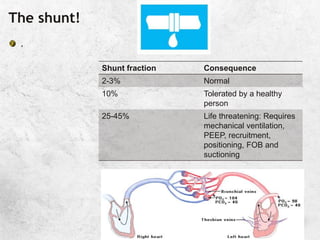
The shunt!
.
Shunt fraction Consequence
2-3% Normal
10% Tolerated by a healthy
person
25-45% Life threatening: Requires
mechanical ventilation,
PEEP, recruitment,
positioning, FOB and
suctioning
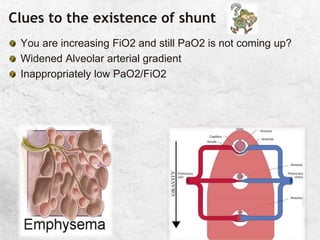
Clues to the existence of shunt
You are increasing FiO2 and still PaO2 is not coming up?
Widened Alveolar arterial gradient
Inappropriately low PaO2/FiO2
The concept of ‘Mixed Venous Sample’
Venous effluents from different organs have different oxygen
content
How a single sample can represent the whole body?
Pulmonary Artery Catheter (PAC)
Mixed Venous PO2 [PvO2]  40 mm of Hg
Mixed Venous saturation [SvO2]  75%
In low CO states with continuing O2 extraction, PvO2 will be
low
Sample from a CVC [if no PAC] can serve as an alternative
Facebook page: Anesthesia Info from The
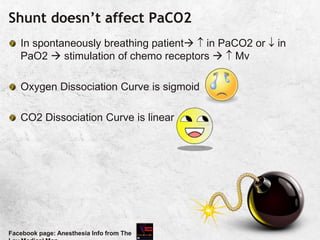
Shunt doesn’t affect PaCO2
In spontaneously breathing patient  in PaCO2 or  in
PaO2  stimulation of chemo receptors   Mv
Oxygen Dissociation Curve is sigmoid
CO2 Dissociation Curve is linear
Facebook page: Anesthesia Info from The
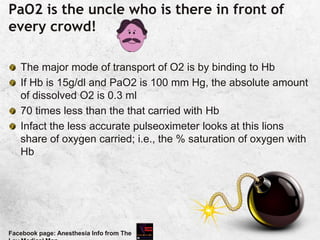
PaO2 is the uncle who is there in front of
every crowd!
The major mode of transport of O2 is by binding to Hb
If Hb is 15g/dl and PaO2 is 100 mm Hg, the absolute amount
of dissolved O2 is 0.3 ml
70 times less than the that carried with Hb
Infact the less accurate pulseoximeter looks at this lions
share of oxygen carried; i.e., the % saturation of oxygen with
Hb
Facebook page: Anesthesia Info from The
Travel [of O2] and Living [of humans]
When air is inhaled, it gets saturated with water
vapour. So to find out the alveolar partial
pressure of O2, water vapour pressure has to
be substracted..also the mean airway pressure!
Travel [of O2] and Living [of humans]
Alveolar partial pressure of O2
713 x FiO2 – 1.25 x PaCO2
PAO2 =[(PB – PH2O) FiO2 ] – (PaCO2 / RQ)
Atmospheric pressure is 760 mm Hg at sea level
PH2O is vapor pressure of water at 37°C and is equal to 47 mmHg
The respiratory quotient or respiratory coefficient (RQ) is the ratio of CO2
produced divided by the O2 consumed, and its value is typically 0.8 (RQ
= CO2 eliminated / O2 consumed). R is taken as ! @FiO2> 0.6
PB – PH2O is known as PiO2 713
Simplified as
Facebook page: Anesthesia Info from The
PAO2 = 713 x FiO2 – 1.25 x
PaCO2
ESTIMATING SHUNT FRACTION
mm
The Alveolar –Arterial Oxygen Gradient
As O2 reaches blood by diffusion, the expected PaO2 will be
less than PAO2 [ suspect air bubble, in ABG sample, if > 100 in patient
breathing room air]
Known as Alveolar –Arterial Oxygen Gradient
10-15 mm in young to middle aged
PaO2= 109- 0.43 [age in years]
It increases with increase in FiO2 [@FiO2 of 1,110!)
If higher than expected for age, shunt fraction is high
Patient should receive 100% O2 for 15 minsIdeally PaO2 should be  550; every 20 mm
Hg difference is equal to 1% shunt
Facebook page: Anesthesia Info from The
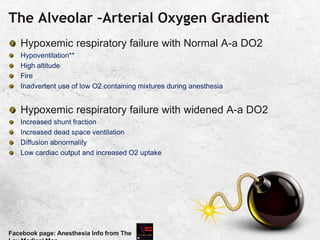
The Alveolar –Arterial Oxygen Gradient
Hypoxemic respiratory failure with Normal A-a DO2
Hypoventilation**
High altitude
Fire
Inadvertent use of low O2 containing mixtures during anesthesia
Hypoxemic respiratory failure with widened A-a DO2
Increased shunt fraction
Increased dead space ventilation
Diffusion abnormality
Low cardiac output and increased O2 uptake
Facebook page: Anesthesia Info from The
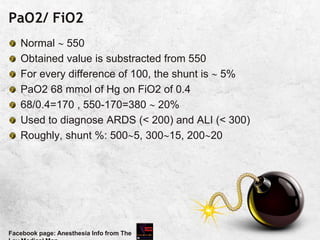
PaO2/ FiO2
Normal  550
Obtained value is substracted from 550
For every difference of 100, the shunt is  5%
PaO2 68 mmol of Hg on FiO2 of 0.4
68/0.4=170 , 550-170=380  20%
Used to diagnose ARDS (< 200) and ALI (< 300)
Roughly, shunt %: 5005, 30015, 20020
Facebook page: Anesthesia Info from The
Real life situation*
Patient breathing room air, has PaO2 90 mm of Hg, SpO2
96%, and PaCO2 110 mm of Hg
Apply Alveolar Gas Equation
[713x0.2]-[1.2x110]= PAO2 is 18!, but SpO2 is 96. So one
among the value is wrong.
Facebook page: Anesthesia Info from The
CaO2- Oxygen Content
Oxygen carried as oxyhemoglobin + dissolved O2
CaO2= [1.39 X Hb (gm/dl) X Saturation] + 0.003 X PaO2
1.39 is the amount of O2 in ml, that will bind to 1 gm of Hb
0.003 is the solubility coefficient of O2
If Hd=15 g/dl, SaO2 99%, 20.4 ml as oxy Hb + 0.3 ml in
plasma20.7
Facebook page: Anesthesia Info from The
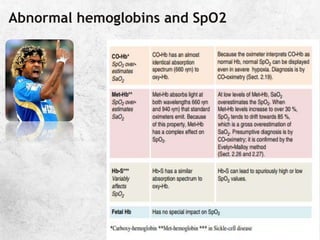
Abnormal hemoglobins and SpO2
.
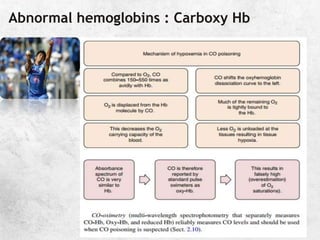
Abnormal hemoglobins : Carboxy Hb
.
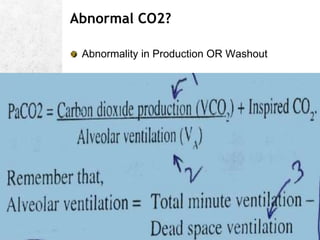
Abnormal CO2?
Abnormality in Production OR Washout
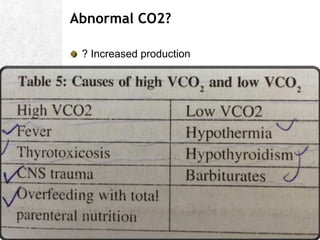
Abnormal CO2?
? Increased production
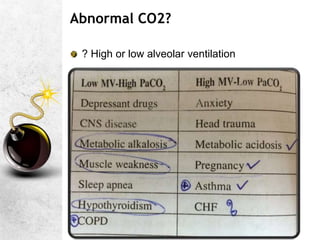
Abnormal CO2?
? High or low alveolar ventilation
Abnormal CO2?
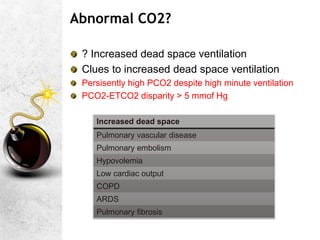
? Increased dead space ventilation
Clues to increased dead space ventilation
Persisently high PCO2 despite high minute ventilation
PCO2-ETCO2 disparity > 5 mmof Hg
Increased dead space
Pulmonary vascular disease
Pulmonary embolism
Hypovolemia
Low cardiac output
COPD
ARDS
Pulmonary fibrosis
REVIEW OF ACID-BASE PHYSIOLOGY
Lets focus on the
acid-base part of ABG
A great quote!
O
pKa is the negative logarithm of the dissociation constant
pKa' s value is dependent on the temperature,[H+] and the
ionic concentration of the solution. It has a value of 6.1 @
37C and pH of 7.4
Facebook page: Anesthesia Info from The
A few confusing very good approaches!
Only measured variable in ABG is pH and PaCO2
All methods rely on PaCO2 to measure respiratory acid base
imbalance
For measuring metabolic acid base balance, Copenhagen
school rely on pH and SBE while Boston school rely on
calculated bicarbonate
We are following the Copenhagen school here
Acids are either Respiratory acids or Metabolic acids
Facebook page: Anesthesia Info from The
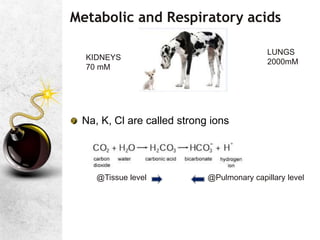
Metabolic and Respiratory acids
Na, K, Cl are called strong ions
LUNGS
2000mM
KIDNEYS
70 mM
@Tissue level @Pulmonary capillary level
Unity in Diversity; concept of SBE
HCO3 may be the primary mover in metabolic imbalance
But there are other Non carbonic buffer systems
The concept of SBE makes this multi-buffer system into a
hypothetical system, where the entire body behaves like a
bicarbonate solution
BE[actual] = BE of whole blood
SBE = BE of ECF
Facebook page: Anesthesia Info from The
This is how I did it! Hmm tasty
Nullify respiratory effects: make PaCO2: 40 and Temp 370 C
Assume pH of sample as alkaline titrate HCl till pH becomes
7.4 the amount of HCl required is the amount of excess
acids[=BE]. [Similarly excess acids titrated by NaOH -BE or
Base deficit
Titratable hydrogen ion concentration is a better term than Base
excess or Deficit. Ok.. One question from ECF “ Oh. Why you
are neglecting me??? You want that silly blood alone?? “
Facebook page: Anesthesia Info from The
ECF is the fluid through which acid base changes are mediated.
Create a hypothetical ECF compartment by diluting the arterial
Blood 3 fold by its own plasma. Now report BE of this compartment:
Your delicious dish is ready: SBE is the best measure of
assessing metabolic acid base changes; Reported in
mM/L Normal: ± 2 mM/L
Scribble pad
pCO2 12 mm Hg = 0.1 pH = BE 6 mEq/L
Rosenthal correction factor: Change in pH = 0.015 pH units
per degree C change in temperature
CO2 crosses cell membranes easily so changes in pCO2
affect intracellular pH rapidly and in a predictable direction
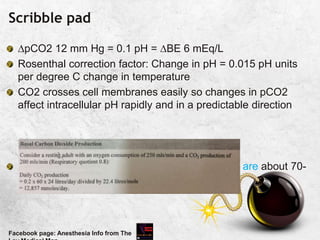
Net production of the non volatile or fixed acids are about 70-
100 mmoles of H+ per day in an adult
Facebook page: Anesthesia Info from The
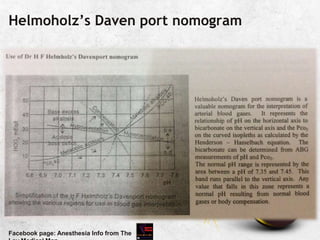
Helmoholz’s Daven port nomogram
.
Facebook page: Anesthesia Info from The
pH and [H+]

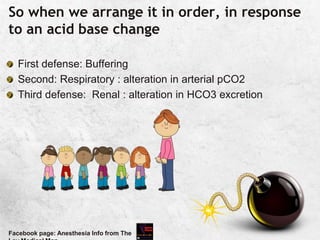
So when we arrange it in order, in response
to an acid base change
First defense: Buffering
Second: Respiratory : alteration in arterial pCO2
Third defense: Renal : alteration in HCO3 excretion
Facebook page: Anesthesia Info from The
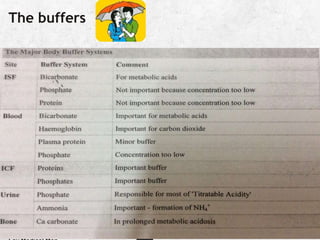
The buffers
.
Facebook page: Anesthesia Info from The
Salute our buffers!
In the ICF proteins (mainly imidazole group of Histidine and
phosphates) is responsible for 97-99% of body's total
buffering of respiratory acid base disorders, 60% for
metabolic acidosis and 30% for metabolic alkalosis
Protein buffers in blood: hb-150 g/L plasma proteins 70g/l
Hb contains about 3 times the number of histidine residues
per molecule, and present in twice the conc, so quantitatively
its 6 times more important than plasma proteins
Facebook page: Anesthesia Info from The
Salute our buffers!
Deoxy hemoglobin is a better buffer than oxyhemoglobin
Respiratory disorders are predominantly buffered in the
intracellular compartment
Conversely ecf buffers 40% for a metabolic acidosis and 70%
for a metabolic alkalosis
In ECF bicarbonate system is the most important
In blood, Hb is the most important for CO2
Facebook page: Anesthesia Info from The
Salute our buffers!
Bicarbonate buffer system is the major buffer system in the
ECF.
Responsible for about 80% of extracellular buffering.
It can't buffer respiratory acid base disorders [Bicarbonate
system cannot buffer changes in H+ produced by the
reaction between CO2 and H2O]
Facebook page: Anesthesia Info from The
Where is the dustbin?
Standard pH
Standard bicarbonate
Buffer base
Total CO2
Facebook page: Anesthesia Info from The
THESE GAPS ARE REALLY
HURTING
.
ANION GAP
When all the commonly measured anions are substracted
from the cations, the result is a positive value of 12±4 mEq/L
Due to unmeasured anions
Corrected AG = Calculated AG + 2.5 [4.5-measured albumin
in g/dl]
Facebook page: Anesthesia Info from The
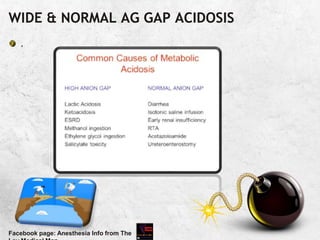
WIDE & NORMAL AG GAP ACIDOSIS
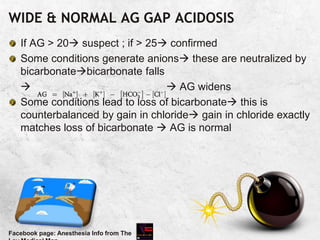
If AG > 20 suspect ; if > 25 confirmed
Some conditions generate anions these are neutralized by
bicarbonatebicarbonate falls
  AG widens
Some conditions lead to loss of bicarbonate this is
counterbalanced by gain in chloride gain in chloride exactly
matches loss of bicarbonate  AG is normal
Facebook page: Anesthesia Info from The
WIDE & NORMAL AG GAP ACIDOSIS
.
Facebook page: Anesthesia Info from The
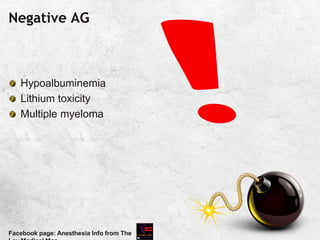
Negative AG
Hypoalbuminemia
Lithium toxicity
Multiple myeloma
Facebook page: Anesthesia Info from The
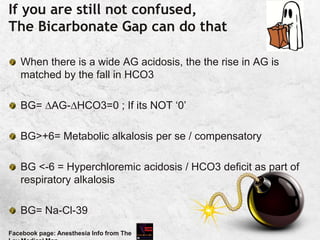
If you are still not confused,
The Bicarbonate Gap can do that
When there is a wide AG acidosis, the the rise in AG is
matched by the fall in HCO3
BG= AG-HCO3=0 ; If its NOT ‘0’
BG>+6= Metabolic alkalosis per se / compensatory
BG <-6 = Hyperchloremic acidosis / HCO3 deficit as part of
respiratory alkalosis
BG= Na-Cl-39
Facebook page: Anesthesia Info from The
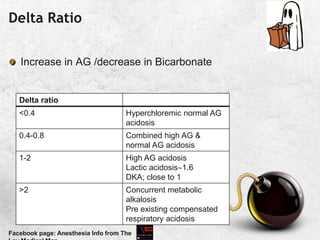
Delta Ratio
Increase in AG /decrease in Bicarbonate
Facebook page: Anesthesia Info from The
Delta ratio
<0.4 Hyperchloremic normal AG
acidosis
0.4-0.8 Combined high AG &
normal AG acidosis
1-2 High AG acidosis
Lactic acidosis1.6
DKA; close to 1
>2 Concurrent metabolic
alkalosis
Pre existing compensated
respiratory acidosis
The concept of normality; who is normal?
.
“Do not fear to be eccentric in opinion, for every opinion now
accepted was once eccentric.”
― Bertrand Russell
Facebook page: Anesthesia Info from The
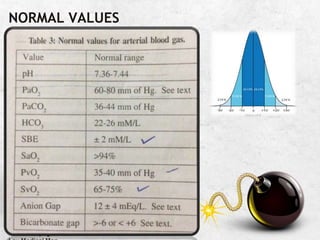
NORMAL VALUES
.
Facebook page: Anesthesia Info from The
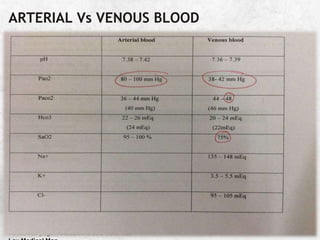
ARTERIAL Vs VENOUS BLOOD
.
Facebook page: Anesthesia Info from The
INDIVIDUAL ACID BASE
ABNORMALITIES AND
‘COMPENSATION’
mm
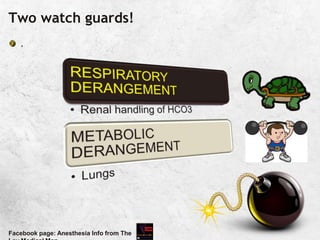
Two watch guards!
.
Facebook page: Anesthesia Info from The
ACUTE RESPIRATORY ACID BASE CHANGES
PaCO2  pH SBE=0
• ACUTE RESPIRATORY ACIDOSIS[
buffering only; 99% in ICF]
PaCO2  pH
• ACUTE RESPIRATORY ALKALOSIS
Facebook page: Anesthesia Info from The
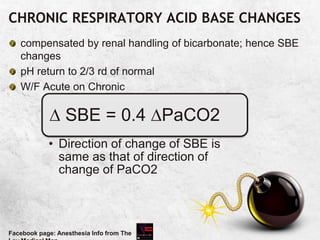
CHRONIC RESPIRATORY ACID BASE CHANGES
compensated by renal handling of bicarbonate; hence SBE
changes
pH return to 2/3 rd of normal
W/F Acute on Chronic
Facebook page: Anesthesia Info from The
 SBE = 0.4 PaCO2
• Direction of change of SBE is
same as that of direction of
change of PaCO2
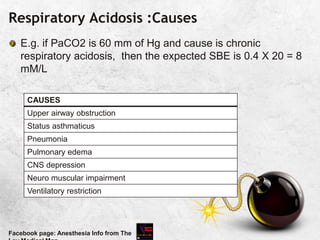
Respiratory Acidosis :Causes
E.g. if PaCO2 is 60 mm of Hg and cause is chronic
respiratory acidosis, then the expected SBE is 0.4 X 20 = 8
mM/L
Facebook page: Anesthesia Info from The
CAUSES
Upper airway obstruction
Status asthmaticus
Pneumonia
Pulmonary edema
CNS depression
Neuro muscular impairment
Ventilatory restriction
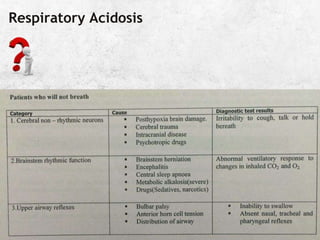
Respiratory Acidosis
.
Facebook page: Anesthesia Info from The
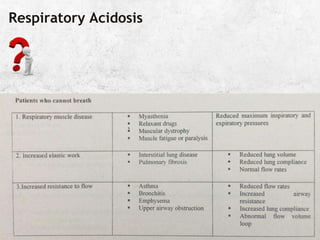
Respiratory Acidosis
.
Facebook page: Anesthesia Info from The
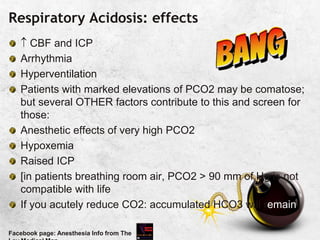
Respiratory Acidosis: effects
 CBF and ICP
Arrhythmia
Hyperventilation
Patients with marked elevations of PCO2 may be comatose;
but several OTHER factors contribute to this and screen for
those:
Anesthetic effects of very high PCO2
Hypoxemia
Raised ICP
[in patients breathing room air, PCO2 > 90 mm of Hg is not
compatible with life
If you acutely reduce CO2: accumulated HCO3 will remain
Facebook page: Anesthesia Info from The
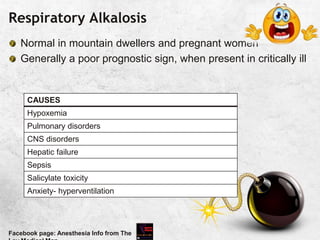
Respiratory Alkalosis
Normal in mountain dwellers and pregnant women
Generally a poor prognostic sign, when present in critically ill
Facebook page: Anesthesia Info from The
CAUSES
Hypoxemia
Pulmonary disorders
CNS disorders
Hepatic failure
Sepsis
Salicylate toxicity
Anxiety- hyperventilation
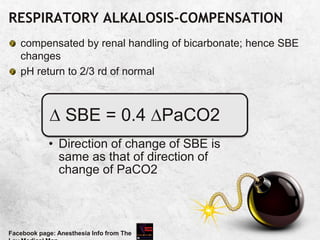
RESPIRATORY ALKALOSIS-COMPENSATION
compensated by renal handling of bicarbonate; hence SBE
changes
pH return to 2/3 rd of normal
Facebook page: Anesthesia Info from The
 SBE = 0.4 PaCO2
• Direction of change of SBE is
same as that of direction of
change of PaCO2
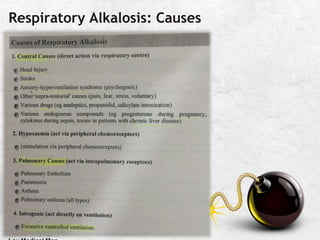
Respiratory Alkalosis: Causes
.
Facebook page: Anesthesia Info from The
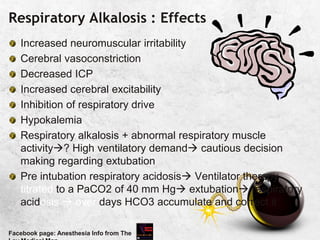
Respiratory Alkalosis : Effects
Increased neuromuscular irritability
Cerebral vasoconstriction
Decreased ICP
Increased cerebral excitability
Inhibition of respiratory drive
Hypokalemia
Respiratory alkalosis + abnormal respiratory muscle
activity? High ventilatory demand cautious decision
making regarding extubation
Pre intubation respiratory acidosis Ventilator therapy
titrated to a PaCO2 of 40 mm Hg extubation respiratory
acidosis  over days HCO3 accumulate and correct it
Facebook page: Anesthesia Info from The
Metabolic Acidosis
Produced by increase in titratable hydrogen ion concentration
Respiratory compensation return pH to one third to half way
normal
Facebook page: Anesthesia Info from The
PaCO2 = SBE
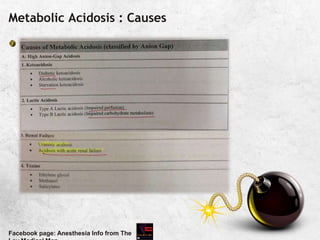
Metabolic Acidosis : Causes
Respiratory
Facebook page: Anesthesia Info from The
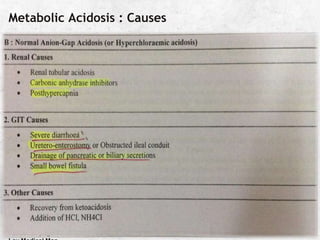
Metabolic Acidosis : Causes
.
Facebook page: Anesthesia Info from The
Metabolic Acidosis : effects
Decreased strength of respiratory muscles
Hyperventilation
Myocardial depression
Sympathetic over activity
Decreased arrhythmia threshold
Resistance to catecholamines
Hyperkalemia
Increased metabolic demand [N:5%of VO2; in distress 25%]
Insulin resistance
Facebook page: Anesthesia Info from The
Urinary Anion Gap [UAG]
=UA-UC=[Na]+[K]-[Cl]
If acidosis is due to loss of base via bowel, kidneys will try to
increase [H+] losswith NH4+ & Cl- in urineUAG
So in a patient with hyperchloremic metabolic acidosis:
Negative UAG GIT loss of [HCO3-]
Positive UAG Loss of base via kidney (problem is with
kidney and it cant increase ammonium excretion)
“neGUTive”
Facebook page: Anesthesia Info from The
Metabolic Acidosis and Mechanical ventilation
Respiratory effect is hyper ventilation may not be tolerated
by patients with compromised cardiac or respiratory
reserve mechanical ventilation may be required in such
patients , till underlying metabolic acidosis is addressed
When on ventilator, try to mimic the natural compensation;
but don’t go < 30 mmof Hg of PaCO2
Facebook page: Anesthesia Info from The
Metabolic Alkalosis
Produced by decrease in titratable hydrogen ion
concentration
Depress ventilation
Facebook page: Anesthesia Info from The
PaCO2 = 0.6 SBE
weaning
Metabolic Alkalosis
Generally pCO2 wont go > 55; if > 55, indicates severe
alkalosis OR combined metabolic alkalosis + respiratory
acidosis
Usually [HCO3-] prompt [HCO3-] excretion by kidney;
persistence requires additional process to impair [HCO3-]
excretion
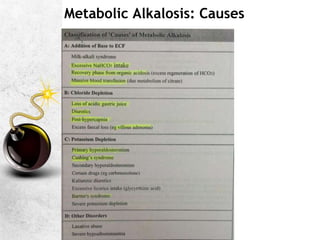
Metabolic Alkalosis: Causes
.
Additional points- Metabolic alkalosis
Depresses respiration hypoxemia & hypercarbia
Effects on PaCO2 are seen only when HCO3> 35 Mm/L
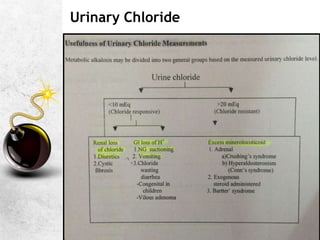
Chloride responsive [Urinary Cl- < 15 mEq/L]: Rx is chloride-
volume-potassium repletion [ If severe infusion of 0.1N HCl
Chloride resistant [Urinary Cl- >25 mEq/L]: Rx is correction of
the cause of mineralocorticoid excess and potassium
depletion
Selective HCO3 excreting diuretic Acetazolamide
Facebook page: Anesthesia Info from The
Curious facts
Hepatic metabolism of citrate, lactate, acetate--. Brief
alkalosis
Chloride and bicarbonate are the only anions present in
appreciable amounts in ECF: so a defiency in one must lead
to an increase in the other to maintain electroneutrality
Vomiting and diuretics cause chloride depletion
Mineralocorticoid excess [in Cushings, the excess
corticosteroids have some mineralocorticoid effects]K+ &
H+ loss matched by [HCO3-]
Facebook page: Anesthesia Info from The
You cant exist alone man; who is behind you?
Reduced GFR
Chloride depletion
Potassium depletion
ECF volume depletion
Because kidney has a large capacity to excrete bicarbonate
and return the plasma level to normal
Facebook page: Anesthesia Info from The
Urinary Chloride
,
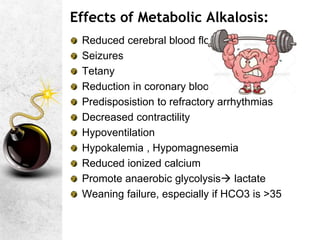
Effects of Metabolic Alkalosis:
Reduced cerebral blood flow
Seizures
Tetany
Reduction in coronary blood flow
Predisposistion to refractory arrhythmias
Decreased contractility
Hypoventilation
Hypokalemia , Hypomagnesemia
Reduced ionized calcium
Promote anaerobic glycolysis lactate
Weaning failure, especially if HCO3 is >35
Impaired arterial oxygen content
Hypoventilation
Micro atelectasis
V-P mismatch
So assess for the requirement of supplemental
oxygen in metabolic alkalosis
Give Cl, K and volume!
Chloride deficit = 0.3 X weight X (100- Plasma
chloride)
Volume of isotonic saline in L = Chloride deficit /
154
Rarely ancillary measures used: One or two
dose of Acetazolamide
Problems: renal loss of Na and water, raise K,
slower and difficult to titrate
THE APPROACH
.
Don’t satisfy the criteria for OCD
Even stable patients on ventilator can show variability in
PaO2 in the range of 2-37 mm of Hg and in PCO2 in the
range of 1-12 mm of Hg…should be considered as normal
Unnecessary repeating of ABGs will create confusion
Facebook page: Anesthesia Info from The
Find…
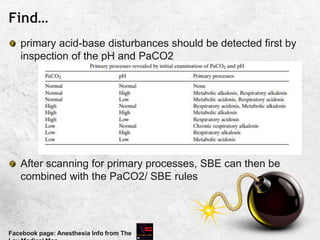
primary acid-base disturbances should be detected first by
inspection of the pH and PaCO2
After scanning for primary processes, SBE can then be
combined with the PaCO2/ SBE rules
Facebook page: Anesthesia Info from The
Scan….
Check :
1. The in vivo metabolic component of any acid-base
disturbance.
2. The appropriateness of the metabolic response to any
respiratory acid-base derangement.
3. The appropriateness of the respiratory response to any
metabolic acid-base derangement.
For example, if the pH, PaCO2 and SBE are all elevated, the
primary process is a metabolic alkalosis
Facebook page: Anesthesia Info from The
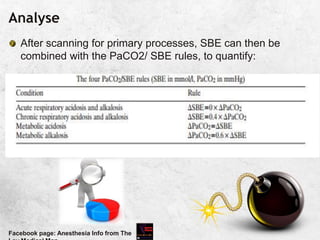
Analyse
After scanning for primary processes, SBE can then be
combined with the PaCO2/ SBE rules, to quantify:
Facebook page: Anesthesia Info from The
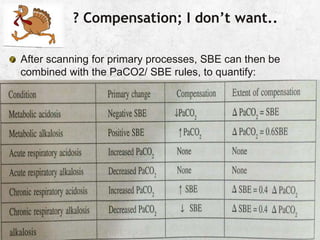
? Compensation; I don’t want..
After scanning for primary processes, SBE can then be
combined with the PaCO2/ SBE rules, to quantify:
Facebook page: Anesthesia Info from The
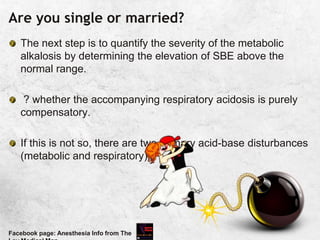
Are you single or married?
The next step is to quantify the severity of the metabolic
alkalosis by determining the elevation of SBE above the
normal range.
? whether the accompanying respiratory acidosis is purely
compensatory.
If this is not so, there are two primary acid-base disturbances
(metabolic and respiratory).
Facebook page: Anesthesia Info from The
Example:1,2
pH = 7.35, PCO2 = 60 mmHg, SBE = 7 mM/L
acidosis
Respiratory
SBE =0.4 X PaCO2= 0.4x 20= 8mM/L- therefore
compensatory.
Partially compensated respiratory acidosis
pH = 7.15, PCO2 = 60 mmHg, SBE = - 6 mEq/L
acidosis
?Respiratory acidosis.
?Metabolic acidosis.
The components are pulling in same direction - neither can
be compensating for the other
combined respiratory +Metabolic acidosis
Facebook page: Anesthesia Info from The
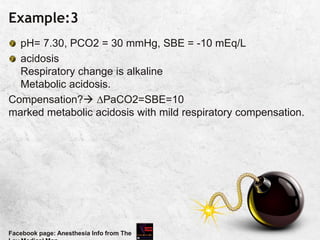
Example:3
pH= 7.30, PCO2 = 30 mmHg, SBE = -10 mEq/L
acidosis
Respiratory change is alkaline
Metabolic acidosis.
Compensation? PaCO2=SBE=10
marked metabolic acidosis with mild respiratory compensation.
Facebook page: Anesthesia Info from The
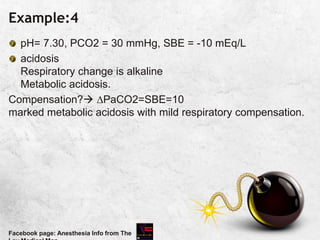
Example:4
pH= 7.30, PCO2 = 30 mmHg, SBE = -10 mEq/L
acidosis
Respiratory change is alkaline
Metabolic acidosis.
Compensation? PaCO2=SBE=10
marked metabolic acidosis with mild respiratory compensation.
Facebook page: Anesthesia Info from The
Example:5
.
?alkalosis, ?respiratory, expected= 0.4x 16[40-24]=6
Compensated respiratory alkalosis
Facebook page: Anesthesia Info from The
pH:
PaCO2:
HCO3:
BE:
7.44
24
16
-6
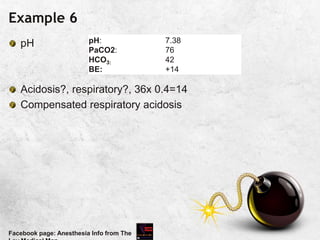
Example 6
pH
Acidosis?, respiratory?, 36x 0.4=14
Compensated respiratory acidosis
Facebook page: Anesthesia Info from The
pH:
PaCO2:
HCO3:
BE:
7.38
76
42
+14
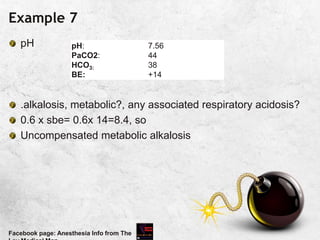
Example 7
pH
.alkalosis, metabolic?, any associated respiratory acidosis?
0.6 x sbe= 0.6x 14=8.4, so
Uncompensated metabolic alkalosis
Facebook page: Anesthesia Info from The
pH:
PaCO2:
HCO3:
BE:
7.56
44
38
+14
Example 8
Alkalosis, respiratory?, ?metabolic compensation 0.4x 14=
5.6 [ direction: same as CO2]
Facebook page: Anesthesia Info from The
pH:
PaCO2:
HCO3:
BE:
7.44
26
18
-4
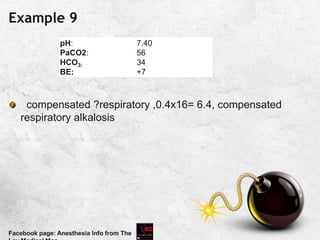
Example 9
compensated ?respiratory ,0.4x16= 6.4, compensated
respiratory alkalosis
Facebook page: Anesthesia Info from The
pH:
PaCO2:
HCO3:
BE:
7.40
56
34
+7
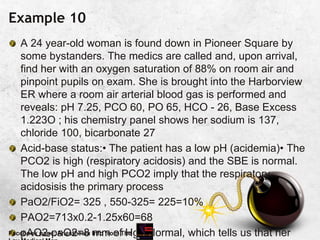
Example 10
A 24 year-old woman is found down in Pioneer Square by
some bystanders. The medics are called and, upon arrival,
find her with an oxygen saturation of 88% on room air and
pinpoint pupils on exam. She is brought into the Harborview
ER where a room air arterial blood gas is performed and
reveals: pH 7.25, PCO 60, PO 65, HCO - 26, Base Excess
1.223O ; his chemistry panel shows her sodium is 137,
chloride 100, bicarbonate 27
Acid-base status:• The patient has a low pH (acidemia)• The
PCO2 is high (respiratory acidosis) and the SBE is normal.
The low pH and high PCO2 imply that the respiratory
acidosisis the primary process
PaO2/FiO2= 325 , 550-325= 225=10%
PAO2=713x0.2-1.25x60=68
pAO2-paO2=8 mm of Hg.. Normal, which tells us that her
Facebook page: Anesthesia Info from The
Sorry.. Foreign ABG
There is no compensation happening
The anion gap is 10 and is, therefore, normal.
The respiratory acidosis implies that the patient is
hypoventilating. This fact, in combination with the pinpoint
pupils suggests the patient is suffering from an acute narcotic
overdose. In this case, the narcotic is most likely heroin.
Facebook page: Anesthesia Info from The
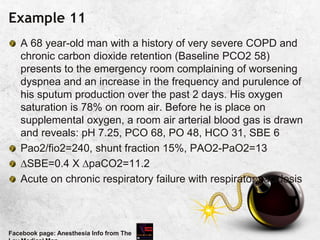
Example 11
A 68 year-old man with a history of very severe COPD and
chronic carbon dioxide retention (Baseline PCO2 58)
presents to the emergency room complaining of worsening
dyspnea and an increase in the frequency and purulence of
his sputum production over the past 2 days. His oxygen
saturation is 78% on room air. Before he is place on
supplemental oxygen, a room air arterial blood gas is drawn
and reveals: pH 7.25, PCO 68, PO 48, HCO 31, SBE 6
Pao2/fio2=240, shunt fraction 15%, PAO2-PaO2=13
SBE=0.4 X paCO2=11.2
Acute on chronic respiratory failure with respiratory acidosis
Facebook page: Anesthesia Info from The
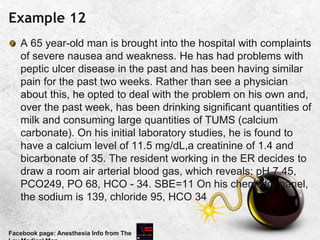
Example 12
A 65 year-old man is brought into the hospital with complaints
of severe nausea and weakness. He has had problems with
peptic ulcer disease in the past and has been having similar
pain for the past two weeks. Rather than see a physician
about this, he opted to deal with the problem on his own and,
over the past week, has been drinking significant quantities of
milk and consuming large quantities of TUMS (calcium
carbonate). On his initial laboratory studies, he is found to
have a calcium level of 11.5 mg/dL,a creatinine of 1.4 and
bicarbonate of 35. The resident working in the ER decides to
draw a room air arterial blood gas, which reveals: pH 7.45,
PCO249, PO 68, HCO - 34. SBE=11 On his chemistry panel,
the sodium is 139, chloride 95, HCO 34
Facebook page: Anesthesia Info from The
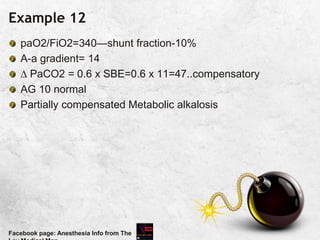
Example 12
paO2/FiO2=340—shunt fraction-10%
A-a gradient= 14
 PaCO2 = 0.6 x SBE=0.6 x 11=47..compensatory
AG 10 normal
Partially compensated Metabolic alkalosis
Facebook page: Anesthesia Info from The
References :
Dr Suneel P.R., SCTIMST, Arterial blood gas
before, during and after mechanical ventilation,
Respiratory Care Update 2007
Arterial blood gases made easy, Ian A M
Hennessey, Alan G Japp
Lawrence Martin, All you really need to know to
interpret arterial blood gases, 2 nd edition
Simple as ABG, Ted &Larry’s
A. Hasan, Handbook of Blood Gas/Acid-Base
Interpretation, 2013
Standard Base Excess, T. J. MORGAN,
Australasian anesthesia 2003
THANK YOU
Facebook page: Anesthesia Info from The Lay Medical
Man
Blog : The Lay Medical Man

ARTERIAL BLOOD GAS ANALYSIS FINAL.pptx

  • 1.
    ARTERIAL BLOOD GASANALYSIS Dr Unnikrishnan P MD,DA,PDCC,MBA www.thelaymedicalman.blogspot.in
  • 2.
    TOUGH QUESTIONS Was demonetizationa good step? Where Virat stands as a captain compared to Dhoni? What will be Kim Jong Un’s next plan? When will you be able to see Evs dominating Indian roads? Are you an expert in interpreting ABG?
  • 3.
  • 4.
    ABG HAS THERIGHT TO INFORMATION ABOUT OXYGENATION VENTILATION ACID BASE IMBALANCE
  • 5.
    At the endof the day… Know Copenhagen See PaO2 ,with A-a gradient & PaO2/FiO2 No more strained relations with the Alveolar Gas equation See PaCO2 with a search for CO2 production ,Abnormal Alveolar ventilation and Dead space ventilation Look for AG in Acidosis Chloride: I am here In wide AG acidosis, calculate the Bicarbonate gap
  • 6.
    REVIEW OF RESPIRATORY PHYSIOLOGY Letsfocus on the Oxygenation & Ventilation part of ABG
  • 7.
    V/Q Mismatch isthe commonest cause of hypoxia* V/Q: Ideal -1, Real life: 0.3-2.1 What will be the V/Q in these alveoli? This dead space adds to apparatus dead space and can pCO2 [dead space causes less hypoxia than shunt] Facebook page: Anesthesia Info from The Normal ratio of Dead space ventilation to Vt is 0.3; When >0.5 CO2 will increase
  • 8.
    The shunt! . Shunt fractionConsequence 2-3% Normal 10% Tolerated by a healthy person 25-45% Life threatening: Requires mechanical ventilation, PEEP, recruitment, positioning, FOB and suctioning
  • 9.
    Clues to theexistence of shunt You are increasing FiO2 and still PaO2 is not coming up? Widened Alveolar arterial gradient Inappropriately low PaO2/FiO2
  • 10.
    The concept of‘Mixed Venous Sample’ Venous effluents from different organs have different oxygen content How a single sample can represent the whole body? Pulmonary Artery Catheter (PAC) Mixed Venous PO2 [PvO2]  40 mm of Hg Mixed Venous saturation [SvO2]  75% In low CO states with continuing O2 extraction, PvO2 will be low Sample from a CVC [if no PAC] can serve as an alternative Facebook page: Anesthesia Info from The
  • 11.
    Shunt doesn’t affectPaCO2 In spontaneously breathing patient  in PaCO2 or  in PaO2  stimulation of chemo receptors   Mv Oxygen Dissociation Curve is sigmoid CO2 Dissociation Curve is linear Facebook page: Anesthesia Info from The
  • 12.
    PaO2 is theuncle who is there in front of every crowd! The major mode of transport of O2 is by binding to Hb If Hb is 15g/dl and PaO2 is 100 mm Hg, the absolute amount of dissolved O2 is 0.3 ml 70 times less than the that carried with Hb Infact the less accurate pulseoximeter looks at this lions share of oxygen carried; i.e., the % saturation of oxygen with Hb Facebook page: Anesthesia Info from The
  • 13.
    Travel [of O2]and Living [of humans] When air is inhaled, it gets saturated with water vapour. So to find out the alveolar partial pressure of O2, water vapour pressure has to be substracted..also the mean airway pressure!
  • 14.
    Travel [of O2]and Living [of humans] Alveolar partial pressure of O2 713 x FiO2 – 1.25 x PaCO2 PAO2 =[(PB – PH2O) FiO2 ] – (PaCO2 / RQ) Atmospheric pressure is 760 mm Hg at sea level PH2O is vapor pressure of water at 37°C and is equal to 47 mmHg The respiratory quotient or respiratory coefficient (RQ) is the ratio of CO2 produced divided by the O2 consumed, and its value is typically 0.8 (RQ = CO2 eliminated / O2 consumed). R is taken as ! @FiO2> 0.6 PB – PH2O is known as PiO2 713 Simplified as Facebook page: Anesthesia Info from The PAO2 = 713 x FiO2 – 1.25 x PaCO2
  • 15.
  • 16.
    The Alveolar –ArterialOxygen Gradient As O2 reaches blood by diffusion, the expected PaO2 will be less than PAO2 [ suspect air bubble, in ABG sample, if > 100 in patient breathing room air] Known as Alveolar –Arterial Oxygen Gradient 10-15 mm in young to middle aged PaO2= 109- 0.43 [age in years] It increases with increase in FiO2 [@FiO2 of 1,110!) If higher than expected for age, shunt fraction is high Patient should receive 100% O2 for 15 minsIdeally PaO2 should be  550; every 20 mm Hg difference is equal to 1% shunt Facebook page: Anesthesia Info from The
  • 17.
    The Alveolar –ArterialOxygen Gradient Hypoxemic respiratory failure with Normal A-a DO2 Hypoventilation** High altitude Fire Inadvertent use of low O2 containing mixtures during anesthesia Hypoxemic respiratory failure with widened A-a DO2 Increased shunt fraction Increased dead space ventilation Diffusion abnormality Low cardiac output and increased O2 uptake Facebook page: Anesthesia Info from The
  • 18.
    PaO2/ FiO2 Normal 550 Obtained value is substracted from 550 For every difference of 100, the shunt is  5% PaO2 68 mmol of Hg on FiO2 of 0.4 68/0.4=170 , 550-170=380  20% Used to diagnose ARDS (< 200) and ALI (< 300) Roughly, shunt %: 5005, 30015, 20020 Facebook page: Anesthesia Info from The
  • 19.
    Real life situation* Patientbreathing room air, has PaO2 90 mm of Hg, SpO2 96%, and PaCO2 110 mm of Hg Apply Alveolar Gas Equation [713x0.2]-[1.2x110]= PAO2 is 18!, but SpO2 is 96. So one among the value is wrong. Facebook page: Anesthesia Info from The
  • 20.
    CaO2- Oxygen Content Oxygencarried as oxyhemoglobin + dissolved O2 CaO2= [1.39 X Hb (gm/dl) X Saturation] + 0.003 X PaO2 1.39 is the amount of O2 in ml, that will bind to 1 gm of Hb 0.003 is the solubility coefficient of O2 If Hd=15 g/dl, SaO2 99%, 20.4 ml as oxy Hb + 0.3 ml in plasma20.7 Facebook page: Anesthesia Info from The
  • 21.
  • 22.
  • 23.
    Abnormal CO2? Abnormality inProduction OR Washout
  • 24.
  • 25.
    Abnormal CO2? ? Highor low alveolar ventilation
  • 26.
    Abnormal CO2? ? Increaseddead space ventilation Clues to increased dead space ventilation Persisently high PCO2 despite high minute ventilation PCO2-ETCO2 disparity > 5 mmof Hg Increased dead space Pulmonary vascular disease Pulmonary embolism Hypovolemia Low cardiac output COPD ARDS Pulmonary fibrosis
  • 27.
    REVIEW OF ACID-BASEPHYSIOLOGY Lets focus on the acid-base part of ABG
  • 28.
    A great quote! O pKais the negative logarithm of the dissociation constant pKa' s value is dependent on the temperature,[H+] and the ionic concentration of the solution. It has a value of 6.1 @ 37C and pH of 7.4 Facebook page: Anesthesia Info from The
  • 29.
    A few confusingvery good approaches! Only measured variable in ABG is pH and PaCO2 All methods rely on PaCO2 to measure respiratory acid base imbalance For measuring metabolic acid base balance, Copenhagen school rely on pH and SBE while Boston school rely on calculated bicarbonate We are following the Copenhagen school here Acids are either Respiratory acids or Metabolic acids Facebook page: Anesthesia Info from The
  • 30.
    Metabolic and Respiratoryacids Na, K, Cl are called strong ions LUNGS 2000mM KIDNEYS 70 mM @Tissue level @Pulmonary capillary level
  • 31.
    Unity in Diversity;concept of SBE HCO3 may be the primary mover in metabolic imbalance But there are other Non carbonic buffer systems The concept of SBE makes this multi-buffer system into a hypothetical system, where the entire body behaves like a bicarbonate solution BE[actual] = BE of whole blood SBE = BE of ECF Facebook page: Anesthesia Info from The
  • 32.
    This is howI did it! Hmm tasty Nullify respiratory effects: make PaCO2: 40 and Temp 370 C Assume pH of sample as alkaline titrate HCl till pH becomes 7.4 the amount of HCl required is the amount of excess acids[=BE]. [Similarly excess acids titrated by NaOH -BE or Base deficit Titratable hydrogen ion concentration is a better term than Base excess or Deficit. Ok.. One question from ECF “ Oh. Why you are neglecting me??? You want that silly blood alone?? “ Facebook page: Anesthesia Info from The ECF is the fluid through which acid base changes are mediated. Create a hypothetical ECF compartment by diluting the arterial Blood 3 fold by its own plasma. Now report BE of this compartment: Your delicious dish is ready: SBE is the best measure of assessing metabolic acid base changes; Reported in mM/L Normal: ± 2 mM/L
  • 33.
    Scribble pad pCO2 12mm Hg = 0.1 pH = BE 6 mEq/L Rosenthal correction factor: Change in pH = 0.015 pH units per degree C change in temperature CO2 crosses cell membranes easily so changes in pCO2 affect intracellular pH rapidly and in a predictable direction Net production of the non volatile or fixed acids are about 70- 100 mmoles of H+ per day in an adult Facebook page: Anesthesia Info from The
  • 34.
    Helmoholz’s Daven portnomogram . Facebook page: Anesthesia Info from The
  • 35.
  • 36.
    So when wearrange it in order, in response to an acid base change First defense: Buffering Second: Respiratory : alteration in arterial pCO2 Third defense: Renal : alteration in HCO3 excretion Facebook page: Anesthesia Info from The
  • 37.
    The buffers . Facebook page:Anesthesia Info from The
  • 38.
    Salute our buffers! Inthe ICF proteins (mainly imidazole group of Histidine and phosphates) is responsible for 97-99% of body's total buffering of respiratory acid base disorders, 60% for metabolic acidosis and 30% for metabolic alkalosis Protein buffers in blood: hb-150 g/L plasma proteins 70g/l Hb contains about 3 times the number of histidine residues per molecule, and present in twice the conc, so quantitatively its 6 times more important than plasma proteins Facebook page: Anesthesia Info from The
  • 39.
    Salute our buffers! Deoxyhemoglobin is a better buffer than oxyhemoglobin Respiratory disorders are predominantly buffered in the intracellular compartment Conversely ecf buffers 40% for a metabolic acidosis and 70% for a metabolic alkalosis In ECF bicarbonate system is the most important In blood, Hb is the most important for CO2 Facebook page: Anesthesia Info from The
  • 40.
    Salute our buffers! Bicarbonatebuffer system is the major buffer system in the ECF. Responsible for about 80% of extracellular buffering. It can't buffer respiratory acid base disorders [Bicarbonate system cannot buffer changes in H+ produced by the reaction between CO2 and H2O] Facebook page: Anesthesia Info from The
  • 41.
    Where is thedustbin? Standard pH Standard bicarbonate Buffer base Total CO2 Facebook page: Anesthesia Info from The
  • 42.
    THESE GAPS AREREALLY HURTING .
  • 43.
    ANION GAP When allthe commonly measured anions are substracted from the cations, the result is a positive value of 12±4 mEq/L Due to unmeasured anions Corrected AG = Calculated AG + 2.5 [4.5-measured albumin in g/dl] Facebook page: Anesthesia Info from The
  • 44.
    WIDE & NORMALAG GAP ACIDOSIS If AG > 20 suspect ; if > 25 confirmed Some conditions generate anions these are neutralized by bicarbonatebicarbonate falls   AG widens Some conditions lead to loss of bicarbonate this is counterbalanced by gain in chloride gain in chloride exactly matches loss of bicarbonate  AG is normal Facebook page: Anesthesia Info from The
  • 45.
    WIDE & NORMALAG GAP ACIDOSIS . Facebook page: Anesthesia Info from The
  • 46.
    Negative AG Hypoalbuminemia Lithium toxicity Multiplemyeloma Facebook page: Anesthesia Info from The
  • 47.
    If you arestill not confused, The Bicarbonate Gap can do that When there is a wide AG acidosis, the the rise in AG is matched by the fall in HCO3 BG= AG-HCO3=0 ; If its NOT ‘0’ BG>+6= Metabolic alkalosis per se / compensatory BG <-6 = Hyperchloremic acidosis / HCO3 deficit as part of respiratory alkalosis BG= Na-Cl-39 Facebook page: Anesthesia Info from The
  • 48.
    Delta Ratio Increase inAG /decrease in Bicarbonate Facebook page: Anesthesia Info from The Delta ratio <0.4 Hyperchloremic normal AG acidosis 0.4-0.8 Combined high AG & normal AG acidosis 1-2 High AG acidosis Lactic acidosis1.6 DKA; close to 1 >2 Concurrent metabolic alkalosis Pre existing compensated respiratory acidosis
  • 49.
    The concept ofnormality; who is normal? . “Do not fear to be eccentric in opinion, for every opinion now accepted was once eccentric.” ― Bertrand Russell Facebook page: Anesthesia Info from The
  • 50.
    NORMAL VALUES . Facebook page:Anesthesia Info from The
  • 51.
    ARTERIAL Vs VENOUSBLOOD . Facebook page: Anesthesia Info from The
  • 52.
    INDIVIDUAL ACID BASE ABNORMALITIESAND ‘COMPENSATION’ mm
  • 53.
    Two watch guards! . Facebookpage: Anesthesia Info from The
  • 54.
    ACUTE RESPIRATORY ACIDBASE CHANGES PaCO2  pH SBE=0 • ACUTE RESPIRATORY ACIDOSIS[ buffering only; 99% in ICF] PaCO2  pH • ACUTE RESPIRATORY ALKALOSIS Facebook page: Anesthesia Info from The
  • 55.
    CHRONIC RESPIRATORY ACIDBASE CHANGES compensated by renal handling of bicarbonate; hence SBE changes pH return to 2/3 rd of normal W/F Acute on Chronic Facebook page: Anesthesia Info from The  SBE = 0.4 PaCO2 • Direction of change of SBE is same as that of direction of change of PaCO2
  • 56.
    Respiratory Acidosis :Causes E.g.if PaCO2 is 60 mm of Hg and cause is chronic respiratory acidosis, then the expected SBE is 0.4 X 20 = 8 mM/L Facebook page: Anesthesia Info from The CAUSES Upper airway obstruction Status asthmaticus Pneumonia Pulmonary edema CNS depression Neuro muscular impairment Ventilatory restriction
  • 57.
    Respiratory Acidosis . Facebook page:Anesthesia Info from The
  • 58.
    Respiratory Acidosis . Facebook page:Anesthesia Info from The
  • 59.
    Respiratory Acidosis: effects CBF and ICP Arrhythmia Hyperventilation Patients with marked elevations of PCO2 may be comatose; but several OTHER factors contribute to this and screen for those: Anesthetic effects of very high PCO2 Hypoxemia Raised ICP [in patients breathing room air, PCO2 > 90 mm of Hg is not compatible with life If you acutely reduce CO2: accumulated HCO3 will remain Facebook page: Anesthesia Info from The
  • 60.
    Respiratory Alkalosis Normal inmountain dwellers and pregnant women Generally a poor prognostic sign, when present in critically ill Facebook page: Anesthesia Info from The CAUSES Hypoxemia Pulmonary disorders CNS disorders Hepatic failure Sepsis Salicylate toxicity Anxiety- hyperventilation
  • 61.
    RESPIRATORY ALKALOSIS-COMPENSATION compensated byrenal handling of bicarbonate; hence SBE changes pH return to 2/3 rd of normal Facebook page: Anesthesia Info from The  SBE = 0.4 PaCO2 • Direction of change of SBE is same as that of direction of change of PaCO2
  • 62.
    Respiratory Alkalosis: Causes . Facebookpage: Anesthesia Info from The
  • 63.
    Respiratory Alkalosis :Effects Increased neuromuscular irritability Cerebral vasoconstriction Decreased ICP Increased cerebral excitability Inhibition of respiratory drive Hypokalemia Respiratory alkalosis + abnormal respiratory muscle activity? High ventilatory demand cautious decision making regarding extubation Pre intubation respiratory acidosis Ventilator therapy titrated to a PaCO2 of 40 mm Hg extubation respiratory acidosis  over days HCO3 accumulate and correct it Facebook page: Anesthesia Info from The
  • 64.
    Metabolic Acidosis Produced byincrease in titratable hydrogen ion concentration Respiratory compensation return pH to one third to half way normal Facebook page: Anesthesia Info from The PaCO2 = SBE
  • 65.
    Metabolic Acidosis :Causes Respiratory Facebook page: Anesthesia Info from The
  • 66.
    Metabolic Acidosis :Causes . Facebook page: Anesthesia Info from The
  • 67.
    Metabolic Acidosis :effects Decreased strength of respiratory muscles Hyperventilation Myocardial depression Sympathetic over activity Decreased arrhythmia threshold Resistance to catecholamines Hyperkalemia Increased metabolic demand [N:5%of VO2; in distress 25%] Insulin resistance Facebook page: Anesthesia Info from The
  • 68.
    Urinary Anion Gap[UAG] =UA-UC=[Na]+[K]-[Cl] If acidosis is due to loss of base via bowel, kidneys will try to increase [H+] losswith NH4+ & Cl- in urineUAG So in a patient with hyperchloremic metabolic acidosis: Negative UAG GIT loss of [HCO3-] Positive UAG Loss of base via kidney (problem is with kidney and it cant increase ammonium excretion) “neGUTive” Facebook page: Anesthesia Info from The
  • 69.
    Metabolic Acidosis andMechanical ventilation Respiratory effect is hyper ventilation may not be tolerated by patients with compromised cardiac or respiratory reserve mechanical ventilation may be required in such patients , till underlying metabolic acidosis is addressed When on ventilator, try to mimic the natural compensation; but don’t go < 30 mmof Hg of PaCO2 Facebook page: Anesthesia Info from The
  • 70.
    Metabolic Alkalosis Produced bydecrease in titratable hydrogen ion concentration Depress ventilation Facebook page: Anesthesia Info from The PaCO2 = 0.6 SBE weaning
  • 71.
    Metabolic Alkalosis Generally pCO2wont go > 55; if > 55, indicates severe alkalosis OR combined metabolic alkalosis + respiratory acidosis Usually [HCO3-] prompt [HCO3-] excretion by kidney; persistence requires additional process to impair [HCO3-] excretion
  • 72.
  • 73.
    Additional points- Metabolicalkalosis Depresses respiration hypoxemia & hypercarbia Effects on PaCO2 are seen only when HCO3> 35 Mm/L Chloride responsive [Urinary Cl- < 15 mEq/L]: Rx is chloride- volume-potassium repletion [ If severe infusion of 0.1N HCl Chloride resistant [Urinary Cl- >25 mEq/L]: Rx is correction of the cause of mineralocorticoid excess and potassium depletion Selective HCO3 excreting diuretic Acetazolamide Facebook page: Anesthesia Info from The
  • 74.
    Curious facts Hepatic metabolismof citrate, lactate, acetate--. Brief alkalosis Chloride and bicarbonate are the only anions present in appreciable amounts in ECF: so a defiency in one must lead to an increase in the other to maintain electroneutrality Vomiting and diuretics cause chloride depletion Mineralocorticoid excess [in Cushings, the excess corticosteroids have some mineralocorticoid effects]K+ & H+ loss matched by [HCO3-] Facebook page: Anesthesia Info from The
  • 75.
    You cant existalone man; who is behind you? Reduced GFR Chloride depletion Potassium depletion ECF volume depletion Because kidney has a large capacity to excrete bicarbonate and return the plasma level to normal Facebook page: Anesthesia Info from The
  • 76.
  • 77.
    Effects of MetabolicAlkalosis: Reduced cerebral blood flow Seizures Tetany Reduction in coronary blood flow Predisposistion to refractory arrhythmias Decreased contractility Hypoventilation Hypokalemia , Hypomagnesemia Reduced ionized calcium Promote anaerobic glycolysis lactate Weaning failure, especially if HCO3 is >35
  • 78.
    Impaired arterial oxygencontent Hypoventilation Micro atelectasis V-P mismatch So assess for the requirement of supplemental oxygen in metabolic alkalosis
  • 79.
    Give Cl, Kand volume! Chloride deficit = 0.3 X weight X (100- Plasma chloride) Volume of isotonic saline in L = Chloride deficit / 154 Rarely ancillary measures used: One or two dose of Acetazolamide Problems: renal loss of Na and water, raise K, slower and difficult to titrate
  • 80.
  • 81.
    Don’t satisfy thecriteria for OCD Even stable patients on ventilator can show variability in PaO2 in the range of 2-37 mm of Hg and in PCO2 in the range of 1-12 mm of Hg…should be considered as normal Unnecessary repeating of ABGs will create confusion Facebook page: Anesthesia Info from The
  • 82.
    Find… primary acid-base disturbancesshould be detected first by inspection of the pH and PaCO2 After scanning for primary processes, SBE can then be combined with the PaCO2/ SBE rules Facebook page: Anesthesia Info from The
  • 83.
    Scan…. Check : 1. Thein vivo metabolic component of any acid-base disturbance. 2. The appropriateness of the metabolic response to any respiratory acid-base derangement. 3. The appropriateness of the respiratory response to any metabolic acid-base derangement. For example, if the pH, PaCO2 and SBE are all elevated, the primary process is a metabolic alkalosis Facebook page: Anesthesia Info from The
  • 84.
    Analyse After scanning forprimary processes, SBE can then be combined with the PaCO2/ SBE rules, to quantify: Facebook page: Anesthesia Info from The
  • 85.
    ? Compensation; Idon’t want.. After scanning for primary processes, SBE can then be combined with the PaCO2/ SBE rules, to quantify: Facebook page: Anesthesia Info from The
  • 86.
    Are you singleor married? The next step is to quantify the severity of the metabolic alkalosis by determining the elevation of SBE above the normal range. ? whether the accompanying respiratory acidosis is purely compensatory. If this is not so, there are two primary acid-base disturbances (metabolic and respiratory). Facebook page: Anesthesia Info from The
  • 87.
    Example:1,2 pH = 7.35,PCO2 = 60 mmHg, SBE = 7 mM/L acidosis Respiratory SBE =0.4 X PaCO2= 0.4x 20= 8mM/L- therefore compensatory. Partially compensated respiratory acidosis pH = 7.15, PCO2 = 60 mmHg, SBE = - 6 mEq/L acidosis ?Respiratory acidosis. ?Metabolic acidosis. The components are pulling in same direction - neither can be compensating for the other combined respiratory +Metabolic acidosis Facebook page: Anesthesia Info from The
  • 88.
    Example:3 pH= 7.30, PCO2= 30 mmHg, SBE = -10 mEq/L acidosis Respiratory change is alkaline Metabolic acidosis. Compensation? PaCO2=SBE=10 marked metabolic acidosis with mild respiratory compensation. Facebook page: Anesthesia Info from The
  • 89.
    Example:4 pH= 7.30, PCO2= 30 mmHg, SBE = -10 mEq/L acidosis Respiratory change is alkaline Metabolic acidosis. Compensation? PaCO2=SBE=10 marked metabolic acidosis with mild respiratory compensation. Facebook page: Anesthesia Info from The
  • 90.
    Example:5 . ?alkalosis, ?respiratory, expected=0.4x 16[40-24]=6 Compensated respiratory alkalosis Facebook page: Anesthesia Info from The pH: PaCO2: HCO3: BE: 7.44 24 16 -6
  • 91.
    Example 6 pH Acidosis?, respiratory?,36x 0.4=14 Compensated respiratory acidosis Facebook page: Anesthesia Info from The pH: PaCO2: HCO3: BE: 7.38 76 42 +14
  • 92.
    Example 7 pH .alkalosis, metabolic?,any associated respiratory acidosis? 0.6 x sbe= 0.6x 14=8.4, so Uncompensated metabolic alkalosis Facebook page: Anesthesia Info from The pH: PaCO2: HCO3: BE: 7.56 44 38 +14
  • 93.
    Example 8 Alkalosis, respiratory?,?metabolic compensation 0.4x 14= 5.6 [ direction: same as CO2] Facebook page: Anesthesia Info from The pH: PaCO2: HCO3: BE: 7.44 26 18 -4
  • 94.
    Example 9 compensated ?respiratory,0.4x16= 6.4, compensated respiratory alkalosis Facebook page: Anesthesia Info from The pH: PaCO2: HCO3: BE: 7.40 56 34 +7
  • 95.
    Example 10 A 24year-old woman is found down in Pioneer Square by some bystanders. The medics are called and, upon arrival, find her with an oxygen saturation of 88% on room air and pinpoint pupils on exam. She is brought into the Harborview ER where a room air arterial blood gas is performed and reveals: pH 7.25, PCO 60, PO 65, HCO - 26, Base Excess 1.223O ; his chemistry panel shows her sodium is 137, chloride 100, bicarbonate 27 Acid-base status:• The patient has a low pH (acidemia)• The PCO2 is high (respiratory acidosis) and the SBE is normal. The low pH and high PCO2 imply that the respiratory acidosisis the primary process PaO2/FiO2= 325 , 550-325= 225=10% PAO2=713x0.2-1.25x60=68 pAO2-paO2=8 mm of Hg.. Normal, which tells us that her Facebook page: Anesthesia Info from The
  • 96.
    Sorry.. Foreign ABG Thereis no compensation happening The anion gap is 10 and is, therefore, normal. The respiratory acidosis implies that the patient is hypoventilating. This fact, in combination with the pinpoint pupils suggests the patient is suffering from an acute narcotic overdose. In this case, the narcotic is most likely heroin. Facebook page: Anesthesia Info from The
  • 97.
    Example 11 A 68year-old man with a history of very severe COPD and chronic carbon dioxide retention (Baseline PCO2 58) presents to the emergency room complaining of worsening dyspnea and an increase in the frequency and purulence of his sputum production over the past 2 days. His oxygen saturation is 78% on room air. Before he is place on supplemental oxygen, a room air arterial blood gas is drawn and reveals: pH 7.25, PCO 68, PO 48, HCO 31, SBE 6 Pao2/fio2=240, shunt fraction 15%, PAO2-PaO2=13 SBE=0.4 X paCO2=11.2 Acute on chronic respiratory failure with respiratory acidosis Facebook page: Anesthesia Info from The
  • 98.
    Example 12 A 65year-old man is brought into the hospital with complaints of severe nausea and weakness. He has had problems with peptic ulcer disease in the past and has been having similar pain for the past two weeks. Rather than see a physician about this, he opted to deal with the problem on his own and, over the past week, has been drinking significant quantities of milk and consuming large quantities of TUMS (calcium carbonate). On his initial laboratory studies, he is found to have a calcium level of 11.5 mg/dL,a creatinine of 1.4 and bicarbonate of 35. The resident working in the ER decides to draw a room air arterial blood gas, which reveals: pH 7.45, PCO249, PO 68, HCO - 34. SBE=11 On his chemistry panel, the sodium is 139, chloride 95, HCO 34 Facebook page: Anesthesia Info from The
  • 99.
    Example 12 paO2/FiO2=340—shunt fraction-10% A-agradient= 14  PaCO2 = 0.6 x SBE=0.6 x 11=47..compensatory AG 10 normal Partially compensated Metabolic alkalosis Facebook page: Anesthesia Info from The
  • 100.
    References : Dr SuneelP.R., SCTIMST, Arterial blood gas before, during and after mechanical ventilation, Respiratory Care Update 2007 Arterial blood gases made easy, Ian A M Hennessey, Alan G Japp Lawrence Martin, All you really need to know to interpret arterial blood gases, 2 nd edition Simple as ABG, Ted &Larry’s A. Hasan, Handbook of Blood Gas/Acid-Base Interpretation, 2013 Standard Base Excess, T. J. MORGAN, Australasian anesthesia 2003
  • 101.
    THANK YOU Facebook page:Anesthesia Info from The Lay Medical Man Blog : The Lay Medical Man