

Dr.S.Marimuthu, M.S., D.N.B., M.Ch
Consultant Surgical Oncologist
Vishnu Cancer Centre & Research Institute
THANJAVUR, INDIA
PIGTAIL CATHETER
Pigtail catheter
• A drainage catheter with side holes in the tip
side.
• Used for draining clear non-viscid or non-
coagulable collections of bile, urine or
pancreatic fluids and even air in cases of
spontaneous pneumothorax
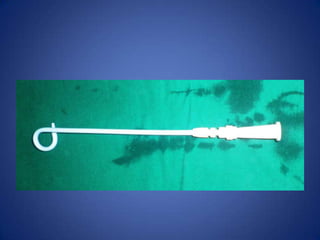
• Ending in a tightly curled tip that resembles the
tail of a pig.
• The pigtail catheter fits over the trocar needle
which allows for single-stick placement of the
catheter.
• The coiled end acts to hold the catheter in place
• It can also be used to slow the flow of fluids
injected through the catheter so that they do not
burst out in a jet and cause injuries or obscure a
medical imaging study.
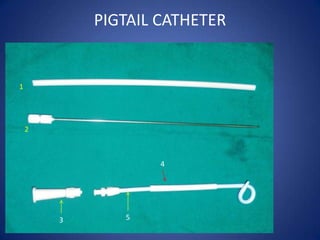
PIGTAIL CATHETER
1
2
3
4
5
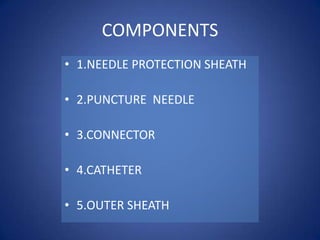
COMPONENTS
• 1.NEEDLE PROTECTION SHEATH
• 2.PUNCTURE NEEDLE
• 3.CONNECTOR
• 4.CATHETER
• 5.OUTER SHEATH
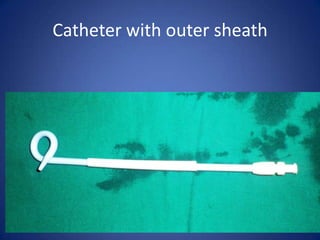
Catheter with outer sheath
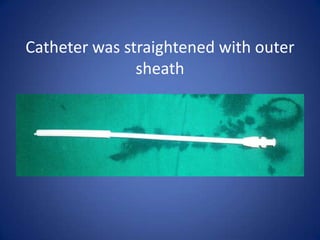
Catheter was straightened with outer
sheath
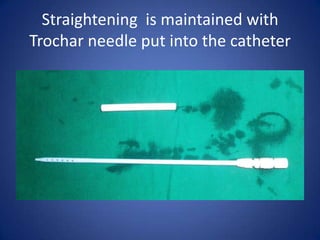
Straightening is maintained with
Trochar needle put into the catheter
Procedure
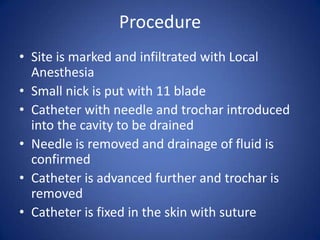
• Site is marked and infiltrated with Local
Anesthesia
• Small nick is put with 11 blade
• Catheter with needle and trochar introduced
into the cavity to be drained
• Needle is removed and drainage of fluid is
confirmed
• Catheter is advanced further and trochar is
removed
• Catheter is fixed in the skin with suture
Procedure
• Catheter is connected to connector and
drainage bag
• In case of pleural drainage, catheter is
connected to under water drainage
Uses
• Nephrostomy
• Intra-peritoneal fluid drainage(abcess, bile,
pancreatic fluid, ascites, urine)
• Pleural fluid drainage
• Pleurodesis with instillation of sclerosant into
pleural cavity
• Imaging studies that use tracer dyes
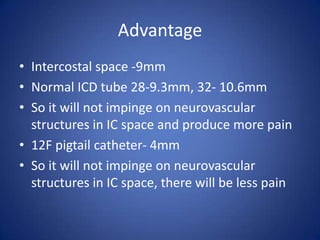
Advantage
• Intercostal space -9mm
• Normal ICD tube 28-9.3mm, 32- 10.6mm
• So it will not impinge on neurovascular
structures in IC space and produce more pain
• 12F pigtail catheter- 4mm
• So it will not impinge on neurovascular
structures in IC space, there will be less pain
Pros and cons
• They are easier to insert, disrupt less
tissue, are less painful, and usually placed
more quickly.
• On the other hand, they are more likely to
obstruct, can easily kink, allow significantly
less flow out of the chest and may not work
for thick fluid drainage.
Our Team-Tumor board Members
• Dept of Surgical Oncology
 Dr.S.Marimuthu, MS., DNB.,MCh
• Dept of Medical Oncology
 Dr.S.Suresh., MD(RT),DM(Med.Onco)
• Dept of Radiation Oncology
 Prof.G.L.Murugavel
 Dr.K.Shanti
 Dr.R.Vijayakumar
• Dept. of OncoPathology
 Dr.K.G.padmanaban
 Dr.Shanthi
Videos on Web
• www.youtube.com/ search as saravanamuthu
Marimuthu
• More than 30 videos
• More than 30,000 viewers
THANK YOU

Pigtail catheter

  • 1.
    Dr.S.Marimuthu, M.S., D.N.B.,M.Ch Consultant Surgical Oncologist Vishnu Cancer Centre & Research Institute THANJAVUR, INDIA PIGTAIL CATHETER
  • 2.
    Pigtail catheter • Adrainage catheter with side holes in the tip side. • Used for draining clear non-viscid or non- coagulable collections of bile, urine or pancreatic fluids and even air in cases of spontaneous pneumothorax
  • 3.
    • Ending ina tightly curled tip that resembles the tail of a pig. • The pigtail catheter fits over the trocar needle which allows for single-stick placement of the catheter. • The coiled end acts to hold the catheter in place • It can also be used to slow the flow of fluids injected through the catheter so that they do not burst out in a jet and cause injuries or obscure a medical imaging study.
  • 4.
  • 5.
    COMPONENTS • 1.NEEDLE PROTECTIONSHEATH • 2.PUNCTURE NEEDLE • 3.CONNECTOR • 4.CATHETER • 5.OUTER SHEATH
  • 6.
  • 7.
    Catheter was straightenedwith outer sheath
  • 8.
    Straightening is maintainedwith Trochar needle put into the catheter
  • 9.
    Procedure • Site ismarked and infiltrated with Local Anesthesia • Small nick is put with 11 blade • Catheter with needle and trochar introduced into the cavity to be drained • Needle is removed and drainage of fluid is confirmed • Catheter is advanced further and trochar is removed • Catheter is fixed in the skin with suture
  • 10.
    Procedure • Catheter isconnected to connector and drainage bag • In case of pleural drainage, catheter is connected to under water drainage
  • 12.
    Uses • Nephrostomy • Intra-peritonealfluid drainage(abcess, bile, pancreatic fluid, ascites, urine) • Pleural fluid drainage • Pleurodesis with instillation of sclerosant into pleural cavity • Imaging studies that use tracer dyes
  • 13.
    Advantage • Intercostal space-9mm • Normal ICD tube 28-9.3mm, 32- 10.6mm • So it will not impinge on neurovascular structures in IC space and produce more pain • 12F pigtail catheter- 4mm • So it will not impinge on neurovascular structures in IC space, there will be less pain
  • 14.
    Pros and cons •They are easier to insert, disrupt less tissue, are less painful, and usually placed more quickly. • On the other hand, they are more likely to obstruct, can easily kink, allow significantly less flow out of the chest and may not work for thick fluid drainage.
  • 15.
    Our Team-Tumor boardMembers • Dept of Surgical Oncology  Dr.S.Marimuthu, MS., DNB.,MCh • Dept of Medical Oncology  Dr.S.Suresh., MD(RT),DM(Med.Onco) • Dept of Radiation Oncology  Prof.G.L.Murugavel  Dr.K.Shanti  Dr.R.Vijayakumar • Dept. of OncoPathology  Dr.K.G.padmanaban  Dr.Shanthi
  • 16.
    Videos on Web •www.youtube.com/ search as saravanamuthu Marimuthu • More than 30 videos • More than 30,000 viewers
  • 17.